Thursday, April 8, 2021
FRED HAMPTON WAS RIGHT
By Lauren Araiza, Truthout.
April 5, 2021
https://popularresistance.org/fred-hampton-was-right/
We Must Fight Racism With Cross-Racial Solidarity.
On March 15, the Academy of Motion Picture Arts & Sciences announced that the film Judas and the Black Messiah, about the assassination of Chicago Black Panther Party leader Fred Hampton, received six Oscar nominations, including one for best picture. Hampton was assassinated because the FBI and Chicago Police Department viewed the 21-year-old as a threat to be eliminated not just because of his leadership of the Black community, but because of his skill in forming bonds across race with other oppressed people, forming what has been referred to as the first Rainbow Coalition. Oscars are a deserved recognition for this important film, but if we really want to honor Hampton, we need to try to emulate him. The day after the Oscar nominations were announced, eight people — six of whom were Asian and Asian American women — were shot and killed by a white man on a murderous rampage through Atlanta. This horrendous crime is proof that we need solidarity among marginalized people — a new Rainbow Coalition.
Hampton and the rest of the Black Panther Party exemplify the possibility and power of cross-racial solidarity. From its founding in 1966 in Oakland, California, the party sought racial and economic justice on behalf of all oppressed peoples and advocated multiracial solidarity, forming alliances with organizations as varied as the radical Chinese American organization the Red Guard Party; the predominantly Mexican American union the United Farm Workers (UFW); and in Chicago, the Puerto Rican nationalist Young Lords and the white Appalachian Young Patriots Organization. The Panthers recognized that despite their racial or ethnic differences, these groups could come together in a shared struggle against white supremacy and capitalist exploitation.
The Black Panthers and their allies demonstrated their solidarity in numerous, concrete ways. For example, in Chicago, the Panthers, Young Lords and Young Patriots Organization worked together to address poverty, urban renewal and unsafe housing in their communities. In California, Panthers and UFW organizers combined their boycotts of Safeway grocery stores and walked picket lines together, and Japanese American activists demonstrated outside the trial of party co-founder Huey Newton. These groups wrote about each other’s causes in their newspapers, attended each other’s rallies and demonstrations, and worked to convince their communities of the importance of cross-racial solidarity. In my book, To March for Others: The Black Freedom Struggle and the United Farm Workers, I demonstrate that these alliances were successful because these activists intentionally sought to find common cause with each other.
The Black Panther Party’s cross-racial coalitions are part of a long history of solidarity movements between people of color. For example, in the 19th century, abolitionist Frederick Douglass spoke against the impending Chinese Exclusion Act and called for unfettered immigration. Responding to white North American economic exploitation and racial discrimination in the Southwest, in 1915 Mexican and Tejano rebels wrote the Plan de San Diego, which called for the creation of a “Liberating Army for Races and Peoples” consisting of Mexican American, African American, and Japanese soldiers; Black liberation and the creation of an independent Black republic in southern Texas; and the restoration of lands to Native American nations. Following the 1943 “Zoot Suit Riots” in Los Angeles, the local NAACP banded together with the Mexican American Community Service Organization to demand accountability from the U.S. Navy. In 1968, Asian American, Black, Chicana/o, and Native American students of San Francisco State University joined together and organized a massive strike that led to the creation of the first Black Studies department and School of Ethnic Studies in the country.
At other times, however, possibilities for cross-racial solidarity were diminished by inter-group tensions, hostility and bigotry, as well as failures to grasp the interconnections between the various forms of racism and exploitation experienced by different groups.
It is this sort of dynamic that Black Panther Party co-founder Bobby Seale sought to warn against, writing: “Racism and ethnic differences allow the power structure to exploit the masses of workers in this country, because that’s the key by which they maintain their control.”
Within the last decade, a new generation of coalitional activism has emerged. In 2012 Arab American, Black, and Latinx youth formed the Dream Defenders, whose organizing focuses on criminal justice reform, immigrant rights and economic justice. The Asian American Organizing Project shared resources in Cantonese and Mandarin that explain George Floyd’s murder and call for Asians and Asian Americans to support the Black Lives Matter movement. In North Carolina, the Carolina Federation, Mijente and Poder NC collaborated to register Black and Latinx voters and get them to the polls for the 2020 presidential election.
In the wake of the Atlanta shootings and Derek Chauvin’s trial for the murder of George Floyd, powerful new expressions of cross-racial solidarity between Asian Americans and African Americans have emerged, such as the Black & Asian Solidarity protest and march in New York City on March 21. Many African Americans are among the volunteers of Compassion in Oakland, which was founded in February to provide free escorts for seniors in Oakland, California’s Chinatown. In Chicago, InterAction — founded in 2015 to organize young people of color — recently established the Young Black and Asian Solidarity Working Group to promote coalition-building between the two communities.
As a historian, I look at these expanding spaces of cross-racial solidarity with optimism, knowing that the Rainbow Coalition in Chicago was so successful because its participants refused to allow themselves to be divided. In a 1969 speech Fred Hampton declared, “We say you don’t fight racism with racism — we’re gonna fight racism with solidarity.” He and his allies knew that the forces against them were so powerful that only by working together would they even begin to achieve equality and justice.
We must acknowledge that the massacres in Atlanta, Charleston and El Paso — all perpetrated by 21-year-old white men (ironically, the same age as Hampton when he was assassinated) — are all connected by the common thread of white masculine supremacy. And law enforcement’s attempts to humanize and defend the murderers are just echoes of those who orchestrated Hampton’s assassination. As Hampton warned us, marginalized people must work together if we hope to survive, much less achieve equality and justice.

FAIRY CREEK BLOCKADE DEMONSTRATORS CALL IN MORE PROTESTERS
By Julian Kolsut, Chek News.
April 5, 2021
https://popularresistance.org/fairy-creek-blockade-demonstrators-call-in-more-protesters/
Demonstrators at the Fairy Creek logging blockade say they are digging in and calling in more help after an injunction was granted against them this week.
On Saturday there was a steady stream of supporters arriving at their headquarters.
Shambu, an organizer with the blockade, said they are moving forward because it is “rightful.”
“We have the B.C. Union of Hereditary Chiefs on board, because we have every chamber of commerce on board with us,” said Shambu. “People are coming out, people are wanting this. It’s everyone’s block aid. There are countless examples of immoral laws, laws that serve a few, that were law and became illegal, and it was through this kind of civil disobedience.”
The blockade has been in place since August 2020, organized in part by members of the Rainforest Flying Squad, to stop the logging company Teal-Jones from building a road into the Fairy Creek area and prevent old-growth logging.
Demonstrators say they are extremely disappointed with the decision, and that now is the last chance to save the area.
“This is the last stand, literally last stand of old-growth. Ninety-seven per cent of the forests of British Columbia are tree farms,” said Shambu.
“The last time trees were saved, it took how many arrests to make that happen [in the Clayoquot protests]?”
Protesters say due to the Easter weekend, they expect a big boost in numbers of around 150 people showing up by early next week.
After the B.C. Supreme Court granted an injunction on Thursday, the RCMP have not made contact with the protestors.
'Follow the Money': Corporations Gave $50 Million to GOP Lawmakers Behind Voter Suppression Onslaught
"No matter how many PR statements Big Business puts out, its complicity with the antidemocratic forces that want to make voting harder is clear."
by
Jake Johnson, staff writer
https://www.commondreams.org/news/2021/04/05/follow-money-corporations-gave-50-million-gop-lawmakers-behind-voter-suppression
Since 2015, AT&T, Comcast, UnitedHealth Group, Walmart, and other big businesses have donated a combined $50 million to state Republican lawmakers who are currently supporting voter suppression bills across the United States—generous political spending at odds with recent corporate efforts to rebrand as defenders of voting rights.
A new report (pdf) released Monday morning by consumer advocacy group Public Citizen found that during the 2020 election cycle alone, U.S. corporations donated $22 million to Republican architects of voter suppression bills that are advancing through state legislatures nationwide.
"This is why you follow the money, not the good PR," Public Citizen tweeted."AT&T [since 2015] has given the most, $811,000," Public Citizen found, citing data from The National Institute on Money in Politics. "AT&T is followed by Altria/Philip Morris, Comcast, UnitedHealth Group, Walmart, State Farm, and Pfizer. Household names that fell just out of the top 25 list... include Nationwide ($182,000), Merck ($180,000), CVS ($174,000), John Deere ($159,000), and Caterpillar ($157,000)."
The group's findings came after a number of prominent corporations—including AT&T, Comcast, and Georgia-based companies Coca-Cola and Delta—issued statements denouncing a sweeping Georgia voter suppression measure only after Republican Gov. Brian Kemp signed it into law last month.
Despite vocal demands for them to speak out and use their influence to fight the bill, those companies were largely quiet as the measure made its way through Georgia's Republican-dominated legislature.
Between 2015 and 2020, according to Public Citizen, corporations donated more than $10.8 million to Georgia Republicans who are supporting the 26 voter suppression bills that have been introduced in the state's legislature this year. Corporations have also donated big to voter suppression advocates in Texas, Arizona, Virginia, Iowa, Pennsylvania, and Arkansas.
"From coast to coast, politicians that Corporate America helped elect are pushing racist voter suppression laws," Rick Claypool, research director for Public Citizen's president's office and one of the authors of the new report, told Common Dreams.
"No matter how many PR statements Big Business puts out, its complicity with the anti-democratic forces that want to make voting harder is clear," Claypool added. "Corporations should keep their money out of our democracy—and Congress must put the people back in charge by swiftly passing the For The People Act."
According to the latest tally by the Brennan Center for Justice, legislators have introduced 361 bills with vote-restricting provisions in 47 states this year, and five have become law.
In the wake of the January 6 Capitol insurrection by a mob of Trump supporters, many large corporations vowed to temporarily suspend all political giving as they faced backlash for financially supporting Republican members of Congress who helped provoke the attack with brazen lies about the 2020 presidential election.
But Public Citizen argued Monday that such face-saving efforts—as well as belated disavowals of voter suppression measures—"will amount to a meaningless gesture if corporations continue to bankroll the bills' supporters with future campaign contributions."
"The days in which corporate America can fund politicians and then claim no responsibly for their actions may be coming to an end," the group said. "Corporations seeking to demonstrate their reverence for our democracy could best do so by ending their attempts to influence the outcomes of elections at the federal and state levels."
Lenin Moreno Deepens Ecuador’s Political Crisis Ahead of Presidential Elections
By Alejandra Garcia on April 4, 2021
https://www.resumen-english.org/2021/04/lenin-moreno-deepens-ecuadors-political-crisis-ahead-of-presidential-elections/
Ecuador will go to the polls on Sunday, April 11, amid new restrictive measures imposed by outgoing President Lenin Moreno to contain the pandemic. Although the country has been mired in a health crisis for months due to the government’s mishandling of COVID-19, the ultra-right-wing leader has decreed a 30-day state of emergency in the country’s eight main provinces one week before elections.
“Ecuador’s democracy is once again in danger,” warned leftist Union for Hope Alliance (UNES) candidate Andres Arauz, who is the favorite to win the second round of presidential elections, according to national polls.
In a dialogue with Pagina 12, Arauz assured that “Moreno’s decision generates a clear conflict. The state of exception prohibits the realization of mass events and implies the deployment of the National Police and the Armed Forces in the streets to ‘guarantee citizens’ calmness’. How is it possible for us to hold elections without the measures affecting the electoral process?”
The state of emergency also restricts freedom of transit and mobility in the eight main provinces, including the capital Quito. This measure applies to the entire population, except for health workers, waste collectors, food providers, and members of the emergency services sector.
Arauz, who could receive up to 37 percent of voting intentions ahead of his rival, banker Guillermo Lasso, alerted the world about this new attempt by Lenin Moreno to hinder Ecuador’s democratic path. “We believe the electoral process and the result can be manipulated.”
The candidate supported by former progressive president Rafael Correa (2007-2017) fears that the state of emergency will significantly reduce voter turnout at polling stations or prevent citizen mobilization in defense of their democratic rights given an electoral fraud.
“My concern is well-founded: the electoral process has been full of threats and lawfare against our candidacy. The Moreno administration has hindered the process since our candidacy registration as it decreed the non-existence of our party and we were forced to ally with another political movement.”
Arauz recalled that, at the beginning of the race in June 2020, the National Electoral Council (CNE) also prevented Correa from formalizing his pre-candidacy for the vice-presidency. The political persecution against the former President, who is accused of alleged corruption crimes, “also forced us to change our electoral proposal. One year later, Moreno’s hostilities against the Arauz-Carlos Rabascall ticket continues to intensify,” he said.
When Arauz’s triumph seemed imminent according to national polls before February 7, Moreno bragged about postponing the date of that first round of elections. “He could repeat the threat now amid the state of exception. I hope the CNE will act rationally and respect democracy. The Ecuadorian people will not tolerate a prolongation of Lenin Moreno’s presidential term.”
In the last weeks, the leftist candidate has taken his electoral campaign to the most remote places of the Ecuadorian geography: the coast, the highlands, and the Amazon. “I have seen with my very own eyes the desperation, anguish, and pain of the Ecuadorians. There is a generalized feeling of abandonment and indignation at the government’s negligence in dealing with the pandemic and the economic crisis.”
Ecuador kicked off its vaccination campaign on January 21. On that day Moreno promised to place at least 4.5 million doses before the end of his administration on May 24. However, only about 140,000 doses have been administered nationwide so far. Meanwhile, the country has registered over 300,000 COVID-19 cases.
Moreno could not contain the health crisis even in the first months of the pandemic. In August, images of dead bodies in the streets of Guayaquil, the country’s second-largest city, portrayed how his administration was being overwhelmed by COVID-19. Health authorities were only reporting about 80,000 cases.
“Knowing firsthand the people’s anguish has made me even more committed to giving everything to restore Ecuadorian families’ dignity,” Arauz said and added that if he wins the presidency, his government will attend to the crisis, boost the vaccination process, restore the public health system, and reactivate the local economy.
“We will rebuild national unity by putting Ecuador, truth, justice, and reparation first,” he concluded.
Restaurant Chains Debunk Their Lobbyists’ Arguments Against A $15 Minimum Wage
While restaurant lobbyists tell lawmakers it’s the “wrong time” for a wage hike, companies they represent are telling investors they can afford to pay higher wages.
Julia Rock and Andrew Perez
Apr 5

Big restaurant chains are telling investors that a national minimum wage hike wouldn't be a big deal—even as their corporate lobbying groups in Washington fight plans for a $15 minimum wage.
"We share your view that a national discussion on wage issues for working Americans is needed—but the Raise the Wage Act is the wrong bill at the wrong time for our nation's restaurants," the National Restaurant Association wrote in a letter to congressional leaders in February. "The restaurant industry and our workforce will suffer from a fast-tracked wage increase and elimination of the tip credit."
The following day, a top executive at Denny's, one of the association's members, told investors that gradual increases in the minimum wage haven't been a problem for the company at all. In fact, California's law raising the minimum wage to $15 by 2023 has actually been good for the diner chain's business, according to Denny's chief financial officer, Robert Verostek.
"As they've increased their minimum wage kind of in a tempered pace over that time frame, if you look at that time frame from us, California has outperformed the system," Verostek said on an earnings call. "Over that time frame, they had six consecutive years of positive guest traffic—not just positive sales, but positive guest traffic—as the minimum wage was going up."
NEWSWEEK NEWSLETTER SIGN-UP >
Denny's is one of several publicly-traded restaurant chains whose executives have told investors in recent months that Democrats' proposed minimum wage hike is not a real threat to their business and may even be a net positive, according to a Daily Poster review of corporate earnings calls. All of the companies have historically belonged to the restaurant association, which has led the fight against the Raise the Wage Act, legislation from Democrats that would gradually increase the minimum wage to $15 by 2025.
The National Restaurant Association declined The Daily Poster's request for comment.
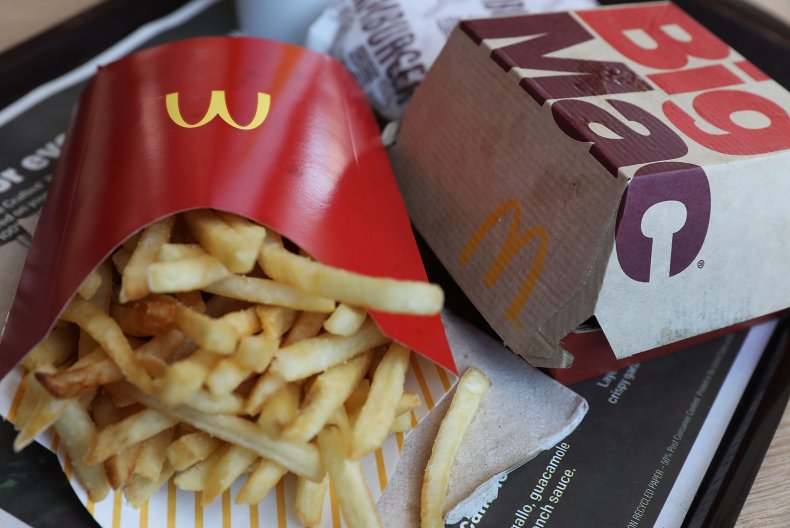
Restaurants like McDonald's tell investors that a minimum-wage hike to $15 won't be a problem. So why is their industry lobbying group fighting it?JOE RAEDLE/GETTY IMAGES
"McDonald's will do just fine"
The National Restaurant Association, which represents restaurants around the country, has been a staunch opponent of federal efforts to raise the minimum wage to $15 an hour. Last year, the group spent $2.6 million on federal lobbying, including on lobbying against the Raise the Wage Act.
Other trade associations that have lobbied against a wage hike include the U.S. Chamber of Commerce, the nation's top business lobby, and the National Small Business Association, according to federal lobbying data.
Fast food giant McDonald's told the National Restaurant Association in 2019 that it would no longer participate in the group's lobbying efforts to oppose increases to the minimum wage at the federal, state, or local level, according to Politico.
In January, McDonald's CEO Chris Kempczinski told investors the company "developed quite a bit of experience" with minimum wage hikes at the state level, and they haven't been a problem.
"Our view is the minimum wage is most likely going to be increasing whether that's federally or at the state level as I referenced, and so long as it's done... in a staged way and in a way that is equitable for everybody, McDonald's will do just fine through that," Kempczinski said.
This Fast Food Giant Bragged About Killing $15 Minimum Wage
Companies debunk industry's talking points
The National Restaurant Association has been saying that restaurants—because they operate on tight margins, rely on tips, and have been hit hard by the pandemic—can't handle a $15 minimum wage and the elimination of the tipped minimum wage.
However, on recent earnings calls, executives at restaurant chains that belong to the association have explicitly debunked these talking points when answering questions about how a higher minimum wage would impact business.
"Our industry runs on a 3- to 5-percent pre-tax profit margin in a good year—during a pandemic is not the time to impose a triple-digit increase in labor costs. Far too many restaurants will respond by laying off even more workers or closing their doors for good," the National Restaurant Association said in a January statement on the Raise the Wage Act.
While the group does not currently disclose its members, two companies it previously listed among its national corporate members have recently disputed the idea that $15 an hour is an unaffordable labor cost.
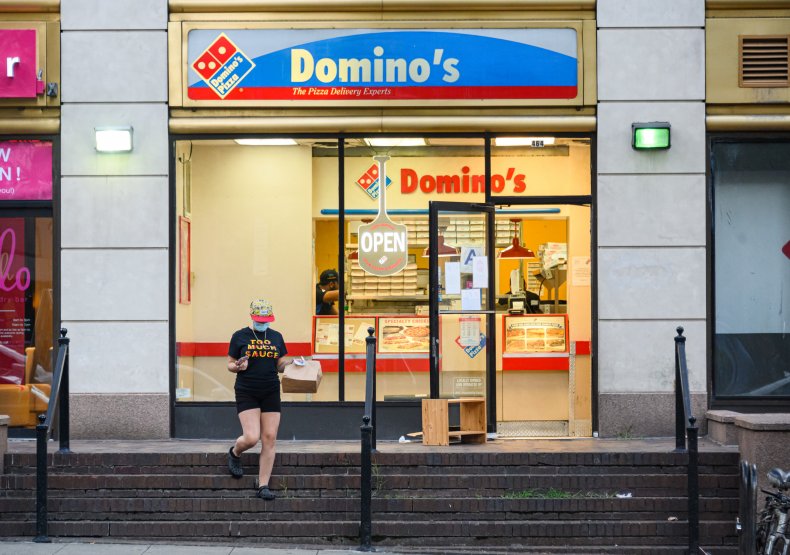
Domino's Pizza CEO Allison told investors, "We've been able to manage our way through a lot of minimum wage increases across the country."NOAM GALAI/GETTY IMAGES
Domino's Pizza CEO Ritch Allison told investors in a February earnings call, "We've been able to manage our way through a lot of minimum wage increases across the country. And I'll tell you, quite honestly, in our corporate store business, we're not paying the federal minimum wage anyway. You can't go out there and hire people at that rate anyway. We're above the minimum wage, both for our folks that work inside the stores and our tip drivers on the road. And then in our supply chain business, we're in excess of $15 an hour everywhere we operate."
The company's response to investor inquiries about a $15 minimum wage is especially notable, given that its employees lean Republican: Domino's Pizza employees gave more than $654,000 to GOP candidates in the 2020 election cycle.
The Cheesecake Factory is now partially owned by private equity firm Roark Capital Group, whose fast food chain recently bragged that it helped convince Congress not to include a $15 minimum wage measure in the American Rescue Plan.
Roark Capital has warned its investors that its portfolio companies could be "adversely affected by changes in governmental policies," including the minimum wage. The firm's managing director serves on the National Restaurant Association's board, according to his firm bio.
But a top executive at the Cheesecake Factory told investors in February that raising the minimum wage would not cause problems for the company.
"Labor input is just a cost input," said Matt Clark, Cheesecake Factory's chief financial officer. "And you can try to put some technology around it to improve efficiency and such. But at the end of the day, most competition prices for it. And I think that's the necessity to maintain margin structures that are competitive and attractive for continued investment."
Clark added that a wage hike could affect some of the company's competitors, and "ultimately the stronger survive and take market share."
The comments were hardly anomalous: over the last two months of earnings seasons, top executives from DiamondRock Hospitality, Kroger, HCA Healthcare, Hilton and Six Flags all downplayed the negative effects of a prospective minimum wage increase, and some have argued it would boost consumer spending. The statements from leaders across various service industry sectors undercut corporate lobbying groups in Washington that have pretended such a wage increase would destroy the economy.
"Many including me are supportive over time that the minimum wage needs to move up," said Hilton CEO Chris Nassetta in a February earnings call. "I think we should all assume that the minimum wage is going to be going up over time. In fact, because it needs to."
"To the extent that there is minimum wage increases in certain of our demographics where we operate, that has got a halo effect on the revenue side," said Six Flags chief financial officer Sandeep Reddy during a February earnings call, in response to a question about whether a higher wage helps boost spending at its parks.
Six Flags' CEO Michael Spanos added: 'We're roughly half teens and young adults and roughly half families and children and to Sandeep's point, we think it absolutely helps in that regard [to] put more money in their pockets."
"We don't really see an impact to tips"
The federal minimum wage for jobs that rely on tips, such as restaurant servers, is currently $2.13, although most states require companies to pay more than that. The Raise the Wage Act would phase out this subminimum wage by 2025, and then companies will have to pay tipped workers the federal minimum wage.
A recent study from the Center for American Progress found that workers who are paid the $2.13 federal tipped minimum wage are more likely to live in poverty than tipped workers in states that have eliminated the subminimum wage for such workers.
Last summer, the advocacy group One Fair Wage wrote that the subminimum wage was becoming an even bigger problem during the COVID-19 pandemic. "In numerous states around the country, restaurant workers are reporting that tips are down 50-70 percent," they wrote.
Nevertheless, the restaurant industry has often tried to argue that ending the tipped wage will be bad for workers and ultimately reduce the amount of money they make. The argument is that customers won't tip as generously if restaurants are forced to raise their prices, or because customers won't feel like restaurant workers need their money as desperately as they do now.
The National Restaurant Association, for example, wrote in a press release in January: "The elimination of the tip credit will cut the take-home wages of thousands of tipped employees who make far above the proposed minimum hourly wage."
There is no evidence that workers are tipped less in states that have eliminated the minimum wage. In February, a top executive at the steakhouse chain Texas Roadhouse said on an earnings call that the company's employees haven't been losing out on tip money in states like California and Minnesota, where there's no subminimum wage for tipped workers, or in Colorado and Arizona where tipped workers must be paid more than $9 an hour.
"We don't really see an impact to tips for those servers in those higher wage states," said Tonya Robinson, Texas Roadhouse's chief financial officer. "They continue to get tipped well, and their overall average wage is pretty high."
Potentially harmful chemicals found in plastic toys
https://www.sciencedaily.com/releases/2021/02/210222124552.htm
It has long been known that several chemicals used in plastic toys in different parts of the world can be harmful to human health. However, it is difficult for parents to figure out how to avoid plastic toys containing chemicals that may cause possible health risks to their children.
Regulations and labelling schemes are different across regions and countries, and there is no international agreement on which substances should be banned from use in toy materials. For the most part, regulations and international lists of 'chemicals of concern' in toys focus on certain substance groups with known harmful properties, such as phthalates, but do not cover the wider range of chemicals found in plastic toys.
Researchers from DTU and the University of Michigan together with UN Environment have looked into this important issue, analyzed data on chemical functions and amounts found in plastic toys, and quantified related children exposure and potential health risks. They ranked the chemicals according to their health risk and compared these results with existing priority substances lists from around the world. The study has been published with open access in the journal Environment International.
"Out of 419 chemicals found in hard, soft and foam plastic materials used in children toys, we identified 126 substances that can potentially harm children's health either via cancer or non-cancer effects, including 31 plasticizers, 18 flame retardants, and 8 fragrances. Being harmful in our study means that for these chemicals, estimated exposure doses exceed regulatory Reference Doses (RfD) or cancer risks exceed regulatory risk thresholds. These substances should be prioritized for phase-out in toy materials and replaced with safer and more sustainable alternatives," says Peter Fantke, Professor at DTU Management and the study's principle investigator.
Nicolò Aurisano, the study's first author and Peter's PhD student, explains that toy manufacturers usually do not provide any information on the chemical content in the toys, and toy composition databases are missing. Hence, the researchers had to collect and scrutinize information on chemicals contents in toy materials based on chemical test data for specific toys reported in 25 different peer-reviewed studies.
Nicolò further states: "We have combined the reported chemical content in toy materials with material characteristics and toy use patterns, such as how long a child typically plays with a toy, whether it puts it into the mouth, and how many toys are found in a household per child. We used this information to estimate exposure using high-throughput mass-balance models, and compared exposure doses with doses below which there is no unacceptable risk to the children."
The researchers find that children in Western countries have on average about 18 kilograms of plastic toys, which underlines the large amounts of plastic that children are surrounded by on a daily basis.
Chemicals that the researchers identified to be of possible concern for children's health include, for example, widely known phthalates and brominated flame retardants but also the two plasticizers butyrate TXIB and citrate ATBC, which are used as alternatives to some regulated phthalates.
"These alternatives showed indications for high non-cancer risk potentials in exposed children and should be further assessed to avoid 'regrettable substitutions', where one harmful chemical is replaced with a similarly harmful alternative. Overall, soft plastics cause higher exposure to certain harmful chemicals, and inhalation exposure dominates overall children exposure, because children potentially inhale chemicals diffusing out of all toys in the room, while usually only touching one toy at the time," Peter Fantke explains.
A way toward safe use of chemicals in plastic toys
Many lists exist that inform about 'chemicals of concern' across product and material applications. However, what is currently missing is any information about the levels at which the use of chemicals in the different applications would be safe and sustainable. Here, the researchers introduce a new metric to benchmark chemical contents in toy materials based on exposure and risk.
Peter Fantke explains: "Since the same chemicals can be found in different concentrations across toy materials, we have estimated the 'maximum acceptable chemical content (MACC)' for all the substances reported to be found in plastic toys. Such information will enable decision-makers to develop benchmarks for various chemicals in different applications, but will also help toy companies to evaluate the amount of chemicals used for a specific function against such benchmarks."
For parents, it will continue to be difficult to avoid using plastic toys that can contain harmful chemicals, until regulators include all substances, and address exposure to toys that are produced outside Europe and imported to the European market. A good piece of advice from the researchers is hence to reduce the consumption of plastic materials in general, avoid the use of soft plastic toys, and remember to ventilate your children's rooms well every day.
Story Source:
Materials provided by Technical University of Denmark. Original written by Tine Naja Berg. Note: Content may be edited for style and length.
Journal Reference:
Nicolò Aurisano, Lei Huang, Llorenç Milà i Canals, Olivier Jolliet, Peter Fantke. Chemicals of concern in plastic toys. Environment International, 2021; 146: 106194 DOI: 10.1016/j.envint.2020.106194
Wednesday, April 7, 2021
‘Tankie’ & Other Popular Terms of Narrative Control
April 6, 2021
Caitlin Johnstone presents some of the most common pejoratives deployed by imperial-narrative managers to smear critical thinkers as untrustworthy.
https://consortiumnews.com/2021/04/06/tankie-other-popular-terms-of-narrative-control/
Bloomberg pundit Noah Smith had a revealing interaction on Twitter the other day.
It began with Smith sharing a screenshot of an article by journalist Yasha Levine which condemns U.S. imperialist escalations against China and ties them to the sudden spike in anti-Asian hate crimes we’ve been seeing. Smith shared his screenshot with the caption, “I hold by my prediction that the American Left is going to split into A) social democrats and B) foreign-policy-obsessed pseudo-tankies.”
“How do we stop the B group from driving the narrative?” one of Smith’s followers asked him.
“Well, first we teach everyone the word ‘tankie’!” Smith replied, with a Substack article he authored explaining that any leftist who opposes Western imperialist agendas against China should be branded with that label and dismissed.
Which is just so refreshing in its honesty, really. It’s been obvious for ages that such pejoratives are being used by imperialists to control the narrative in a way that benefits ruling power structures, but it’s not often you’ll have a mainstream narrative manager come right out and say that this is exactly what they are trying to do.
Smith’s admission that he is training his audience to bleat the word “tankie” at any leftist who is “obsessed” with a tiny trivial matter like U.S. foreign policy in order to control the dominant foreign policy narrative is borne out by the rest of his Twitter activity, which sees him repeating that word constantly and weaponizing it against anyone who expresses skepticism of the empire’s official foreign policy narratives.
“Tankie” used to be a term for British communists who supported the Soviet Union, but under the facilitation of narrative managers like Smith it’s enjoying a mainstream resurrection in which it is commonly weaponized against anyone to the left of Sen. Bernie Sanders who opposes U.S. imperialist agendas.
I wrote against anti-imperialism for years without anyone ever applying that pejorative to me, but now it comes up on a near-daily basis. I haven’t changed the basics of my beliefs or my approach to anti-imperialism, but the widespread use of “tankie” as a pejorative against people like me most certainly has changed.
Joining the Upper Ranks
It joins the ranks of famous weaponized pejoratives like “Russian bot,” “CCP propagandist,” “Assadist” and the one-size-fits-all perennial favorite “conspiracy theorist” in labels used to dismiss anyone who voices skepticism of narratives that are being promoted by known liars to facilitate the agendas of murderous psychopaths.
Another new crowd favorite is “genocide denier,” a label applied to anyone who points out the glaring plot holes in the imperial Uyghur narrative which narrative managers are overjoyed about being able to use because it lets them equate skepticism of a geostrategically significant U.S. narrative with Nazism.
What these pejoratives accomplish, as Noah Smith is well aware, is the ability to inoculate the mainstream herd from the wrong think of anyone to whom that label has been applied. That way they never have to engage the argument or the evidence that gets laid out contradicting the official imperial line; as long as they can convince enough people to accept their pejorative as legitimate, they have a magical phrase they can utter to dispel any anti-imperialist argument which appears anywhere in the information ecosystem.
This is a major part of an imperial narrative manager’s job these days: smearing anti-imperialists and critical thinkers as untrustworthy. The debate is never to be engaged and counter-arguments are never to be made; why engage in a debate you will probably lose when you can simply explain to everyone why nobody should listen to the other side?
A perfect example of this would be the recent smear piece the Australian Strategic Policy Institute (ASPI) put out on The Grayzone with the title “Strange bedfellows on Xinjiang: The CCP, fringe media and U.S. social media platforms.“
As explained in a thread by The Grayzone‘s Aaron Maté, the government-funded and arms industry-funded think tank ASPI makes no effort in its report to dispute or debunk any of the reporting that The Grayzone has been putting out on China or on anything else. Rather, they simply work to associate the outlet with the Chinese government by citing incidents in which Chinese officials shared Grayzone articles on social media. By fallaciously associating The Grayzone with the Chinese government, narrative managers now have a weapon which enables them to dismiss the outlet as “CCP propaganda.”
Common Tactic
As anyone who has been active in anti-imperialist online discourse knows, this is an extremely common tactic, which narrative managers and their indoctrinated herd use to dismiss questions, criticisms and evidence that is inconvenient to the U.S.-centralized imperial war machine. Try countering their claims with a well-sourced article full of robust argumentation and solid evidence, and they’ll dismiss you with a “Ha ha, THAT outlet? That outlet is propaganda!” Because it came from an anti-imperialist outlet like The Grayzone or Consortium News instead of an outlet which never fails to support U.S. military agendas like The New York Times.
But it’s a completely ridiculous tactic if you think about it. All they’re really saying is “You can’t use that anti-imperialist outlet to substantiate your anti-imperialist position! You can only use the pro-U.S. outlets, which have helped deceive westerners into backing every U.S. war!” It’s also logically fallacious; attacking the source instead of the argument is what people do when they can’t attack the argument.
Citing an empire-targeted government sharing an anti-imperialist article as evidence that that government is tied to that outlet in some way is an equally absurd argument; obviously governments are going to cite evidence and arguments which favor them, and the imperialist Western media isn’t going to be publishing such evidence or arguments.
The fact that Western anti-imperialists and nations like Russia and China both oppose Western imperialism doesn’t mean Western anti-imperialists work for Russia or China. It means those groups all oppose western imperialism for their own reasons. Since Western imperialism is the most murderous and oppressive force on this planet, it’s to be expected that multiple different groups will oppose it.
Pay attention to the way imperial narrative managers try to use smears and pejoratives to file away anti-imperialists into a “don’t listen to the things this person says” box, and help others pay attention to it too. This is no more legitimate an argument than the Wizard of Oz yelling “Pay no attention to that man behind the curtain,” and it should be treated with no more respect than that.
Subscribe to:
Comments (Atom)