https://thenextrecession.wordpress.com/2021/03/28/the-rise-of-capitalism-and-the-productivity-of-labour/
In my view, there are two great scientific discoveries made by Marx and Engels: the materialist conception of history and the law of value under capitalism; in particular, the existence of surplus value in capitalist accumulation. The materialist conception of history asserts that the material conditions of a society’s mode of production and the social classes that emerge in that mode of production ultimately determine a society’s relations and ideology. As Marx said in the preface to his 1859 book A Contribution to the Critique of Political Economy: “The mode of production of material life conditions the general process of social, political and intellectual life. It is not the consciousness of men that determines their existence, but their social existence that determines their consciousness.”
That general view has been vindicated many times in studies of the economic and political history of human organisation. That is particularly the case in explaining the rise of capitalism to become the dominant mode of production. Now there is new study that adds yet more support for the materialist conception of history. Three scholars at Berkeley and Columbia Universities have published a paper, When Did Growth Begin? New Estimates of Productivity Growth in England from 1250 to 1870.
https://eml.berkeley.edu/~jsteinsson/papers/malthus.pdf
They attempt to measure when productivity growth (output per worker or worker hours) really took off in England, one of the first countries where the capitalist mode production became dominant. They find that there was hardly any growth in productivity before 1600. But productivity started to take off well before the so-called ‘Glorious Revolution’ of 1688 when England became a ‘constitutional monarchy’ and the political rule of the merchants and capitalist landowners was established. These scholars find that, from about 1600 to 1810, there was a modest rise of the productivity of the labour force in England of about 4% in each decade (so 0.4% a year), but after 1810 with the industrialisation of Britain, there was a rapid acceleration of productivity growth to about 18% every decade (or 1.8% a year). The move from agricultural capitalism of the 17th century to industrial capitalism transformed the productivity of labour.
They attempt to measure when productivity growth (output per worker or worker hours) really took off in England, one of the first countries where the capitalist mode production became dominant. They find that there was hardly any growth in productivity before 1600. But productivity started to take off well before the so-called ‘Glorious Revolution’ of 1688 when England became a ‘constitutional monarchy’ and the political rule of the merchants and capitalist landowners was established. These scholars find that, from about 1600 to 1810, there was a modest rise of the productivity of the labour force in England of about 4% in each decade (so 0.4% a year), but after 1810 with the industrialisation of Britain, there was a rapid acceleration of productivity growth to about 18% every decade (or 1.8% a year). The move from agricultural capitalism of the 17th century to industrial capitalism transformed the productivity of labour.
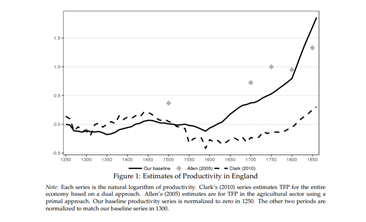
The authors comment: “our evidence helps distinguish between theories of why growth began. In particular, our findings support the idea that broad-based economic change preceded the bourgeois institutional reforms of 17th century England and may have contributed to causing them.” In other words, it was the change in the mode of production and the social classes that came first; the political changes came later.
As the authors go on to say, “an important debate regarding the onset of growth is whether economic change drove political and institutional change as Marx famously argued or whether political and institutional change kick-started economic growth”. The authors don’t want to accept Marx’s conception outright and seek to argue that “reality is likely more complex than either polar view.” But they cannot escape their own results: that productivity growth began almost a century before the Glorious Revolution and well before the English Civil War. And “this supports the Marxist view that economic change contributed importantly to 17th century institutional change in England.”
The other interesting aspect of the paper is that the authors try to measure the impact of population growth on productivity and wages. In the early 19th century, Thomas Malthus argued that it was impossible for productivity growth to rise sufficiently to enable workers to increase their real incomes, because higher incomes would lead to increased births and eventually over-population, scarcity of food and famines etc, then reducing the population and incomes again.
The authors note that before 1600, there is evidence to support the Malthusian case. The period from 1300 to 1450 was a period of frequent plagues — the most famous being the Black Death of 1348. Over this period, the population of England fell by a factor of two resulting in a sharp drop in labour supply. Over this same period, real wages rose substantially. Then from 1450 to 1600, the population (and labour supply) recovered and real wages fell. In 1630, the English economy was back to almost exactly the same point it was at in 1300.
The reason that the Malthusian argument has validity before 1600 is that there was little or no productivity growth; so livelihoods were determined by labour supply and wages alone. Pre-capitalist England was a stagnant, stationary economy in terms of the productivity of labour. But so was the impact of the Malthusian over-population theory. The authors found that Malthusian population dynamics were very slow: a doubling of real incomes led to a 6 percentage point per decade (0.6% a year) increase in population growth. That implied that it took 150 years for a rise in real incomes to drive up population sufficiently to cause a reversal in income growth.
But once capitalism appears on the scene, the drive for profit by capitalist landowners and trading merchants encourages the use of new agricultural techniques and technology and the expansion of trade. Then productivity growth takes off at a rate increasingly fast enough to overcome the slow impact of Malthusian ‘overpopulation’. Indeed, with industrial capitalism after 1800, the growth in productivity is 28 times higher than the very slow negative impact of rising population on real incomes.

Thomas Malthus
This confirms the view of Engels when he wrote: “For us the matter is easy to explain. The productive power at mankind’s disposal is immeasurable. The productivity of the soil can be increased ad infinitum by the application of capital, labour and science.” Umrisse 1842
Before capitalism, feudal societies stumbled along with their economies ravaged by plagues and climate. For example, the Black Death of 1348 engulfed English society for more than a year, claiming about 25% of the population. For three centuries after the Black Death, the plague would reappear every few decades and wipe out a significant share of the population each time. So real wages in England were mainly affected by these population changes and the consequent size of the labour force (if, as argued above, at a very slow rate).

But under capitalism, productivity rose sharply and the level of real wages was no longer determined by the weather or pandemics but by the class struggle over the production and distribution of the value and surplus value created in capitalist production in agriculture and industry. One of the features of the rise of capitalism from 1600 that the authors point out is the increase in the working day and working year – another confirmation of Marx’s analysis of exploitation under capitalism.

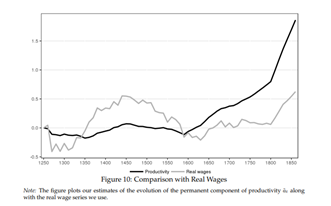
The authors note that as capitalism started to move from agricultural production to industry, in the latter half of the 18th century, real wages in England fell slightly despite substantial productivity growth. They cite one potential explanation, namely “Engel’s Pause,” i.e., the idea that the lion’s share of the gains from early industrialization went to capitalists as opposed to labourers.
The authors are reluctant to accept that Engels was right, preferring a Malthusian explanation in the late 18th century (having just rejected it). Moreover, they think real wages started to grow as early as 1810, before the period of the 1820-1840 cited by Engels as a ‘pause’. But anyway, we can see that the gap between productivity and real wages widened sharply from the beginning of industrial capitalism to now. Surplus value (the value of unpaid labour) rocketed through the early 19th century.
Most important, the study refutes the ‘Whig interpretation of history’, namely human ‘civilisation’ is one of gradual progress with changes coming from wiser ideas and political forms constructed by clever people. Instead, the evidence of productivity growth in England shows “sharp and sizable shifts in average growth” supporting the notion that “something changed.” i.e., that the transition from stagnation to growth was more than a steady process of very gradually increased growth.” On the gradual Whig interpretation, the authors conclude that “the results do not support this view of history.”
https://www.researchgate.net/publication/334831075_The_Whig_interpretation_of_history
Also, the study shows that, as sustained productivity growth began in England substantially before the Glorious Revolution of 1688, it was not the change in political institutions that led to economic growth. On the contrary, it was the change in economic relations that led to productivity growth and then political change. “While the institutional changes associated with the Glorious Revolution may well have been important for growth, our results contradict the view that these events preceded the onset of growth in England.”
As Engels put it succinctly: “The materialist conception of history starts from the proposition that the production of the means to support human life and, next to production, the exchange of things produced, is the basis of all social structure; that in every society that has appeared in history, the manner in which wealth is distributed and society divided into classes or orders is dependent upon what is produced, how it is produced, and how the products are exchanged. From this point of view, the final causes of all social changes and political revolutions are to be sought, not in men’s brains, not in men’s better insights into eternal truth and justice, but in changes in the modes of production and exchange.”
The authors cannot avoid reaching a similar conclusion. As they say: “Marx stressed the transition from feudalism to capitalism. He argued that after the disappearance of serfdom in the 14th century, English peasants were expelled from their land through the enclosure movement. That spoliation inaugurated a new mode of production: one where workers did not own the means of production, and could only subsist on wage labour. This proletariat was ripe for exploitation by a new class of capitalist farmers and industrialists. In that process, political revolutions were a decisive step in securing the rise of the bourgeoisie. To triumph, capitalism needed to break the remaining shackles of feudalism…. Our findings lend some support to the Marxist view in that we estimate that the onset of growth preceded both the Glorious Revolution and the English Civil War (1642-1651). This timing of the onset of growth supports the view that economic change propelled history forward and drove political and ideological change.”
The development of capitalism in agriculture and in trade laid the basis for the introduction of industrial technology that led to the so-called industrial revolution and industrial capitalism. The Industrial Revolution occurred in Britain around 1800 because “innovation was uniquely profitable then and there”. As real wages rose, there was an incentive to exploit the raw materials necessary for labour saving technologies in textiles such as the spinning jenny, water frame, and mule, as well as coal burning technologies such as the steam engine and coke smelting furnace. Labour productivity exploded upwards. There was staggering rise in investment in means of production relative to labour. According to the authors, from 1600 to 1860, the capital stock in England grew by a factor of five, or 8% per decade.

Industrial capitalism had arrived, and along with rising productivity came increased exploitation of labour and the ideology of ‘political economy’ and bourgeois institutions of rule.