Members of the Congressional Progressive Caucus—led by Rep. Pramila Jayapal—used a private meeting with White House Chief of Staff Ron Klain on Wednesday to pressure the Biden administration to support whatever procedural maneuvers are necessary to pass a $15 federal minimum wage, a proposal Senate Democratic leaders stripped from the recently approved Covid-19 relief package.
The path forward for the popular $15 minimum wage measure has been uncertain since the unelected Senate parliamentarian advised lawmakers late last month that the pay increase would run afoul of the arcane rules of budget reconciliation, the filibuster-proof process congressional Democrats used to pass the American Rescue Plan without any Republican support.
During Wednesday's meeting, according to Politico, progressive attendees offered two potential alternative ways to push through the long-overdue pay raise for 32 million workers: Eliminating the Senate's archaic legislative filibuster, or attaching the minimum wage proposal to must-pass government funding legislation later this year.Rejecting vocal demands from progressive lawmakers and grassroots activists, Vice President Kamala Harris and Senate Democrats refused to overrule the parliamentarian on the $15 minimum wage, despite the official's complete lack of constitutional authority.
Jayapal, the chair of the CPC, told Politico that while "there was no consensus around" the best strategy, the progressive lawmakers "got a very clear sense that this is a real commitment for the White House, and they're very willing to work with us on what that looks like."
The Washington Democrat offered a similar assessment on Twitter, calling the meeting "productive" and welcoming "the opportunity to share ideas on how we pass the boldest legislation through Congress so every American has the opportunity to thrive—not just survive."
"We look forward to regular collaboration," Jayapal added, "and to continuing these conversations at a second meeting this week."
The meeting itself—also attended by Reps. Barbara Lee (D-Calif.), Ilhan Omar (D-Minn.), Mark Pocan (D-Wis.), and Cori Bush (D-Mo.)—was viewed as a reflection of the growing influence of the nearly 100-member CPC as well as the more moderate Biden administration's approach to dealing with the Democratic Party's left flank, which the Obama administration frequently derided, alienated, and dismissed.
"A few years ago, the group was viewed as a bunch of radicals with no clout," Politico noted, referring to the CPC. "Now they're flexing and commanding the attention of the White House. Biden called Jayapal after the American Rescue Plan passed, and she told him she wants these kinds of meetings to happen regularly."
Following Wednesday's meeting, Bush—a freshman member of Congress and progressive firebrand—wrote on Twitter that she asked Klain "to share what's in my heart with the president: the fight for at least $15 is a matter of life and death in St. Louis."
"Poverty is killing us," Bush added. "We agreed to work together on this. Thank you, Mr. Klain."
In an analysis earlier this month, the Economic Policy Institute estimated that raising the federal minimum wage to $15 an hour by 2025 would lift around 3.7 million people in the U.S. out of poverty.
In addition to pressing Klain on the minimum wage, the progressive lawmakers also stressed the importance of making permanent key elements of the American Rescue Plan, such as the law's year-long expansion of the Child Tax Credit. Analysts have predicted that the temporary policy would cut child poverty in half, meaning that child poverty could double in 2022 without further action from lawmakers.
"The American Rescue Act is a big step forward in the fight to end childhood poverty—but the fight does not stop there," Lee tweeted Wednesday. "We must protect all children by making the expanded Child Tax Credit permanent."
Politico reported that progressives also pushed for a commitment that Biden's coming jobs and infrastructure plan "will address not only transportation but climate change, healthcare, and so-called family infrastructure, things like child care and paid leave."
Echoing the concerns of progressive climate groups, Jayapal warned the Biden administration not to ditch bold climate proposals in a likely futile attempt to win bipartisan support for the new package, which the White House is reportedly considering breaking up into as many as three separate bills.
"We can either go green, or we can go bipartisan, because I just don't think that Republicans are ready to have a transformative package," Jayapal told Politico. "And so I said that at the White House."
Texas is still reeling from a devastating winter storm that left millions without power amid freezing temperatures, killing dozens and causing an estimated $200 billion in damage and economic losses.
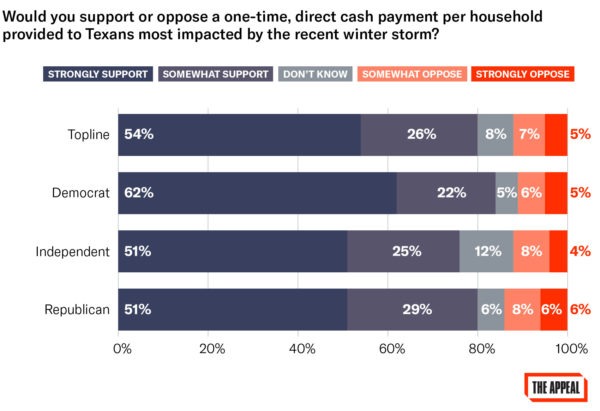
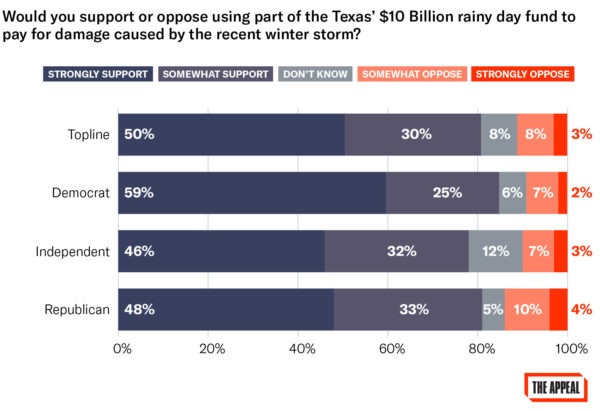
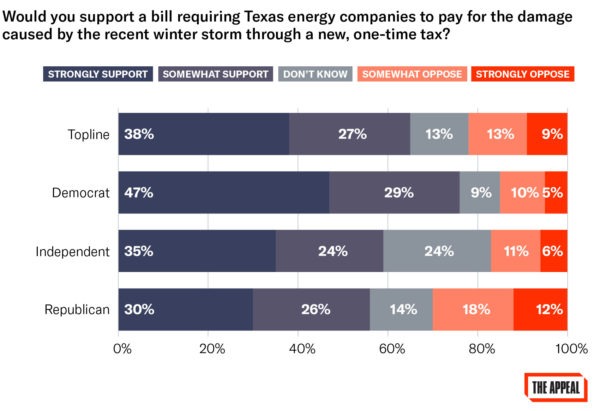
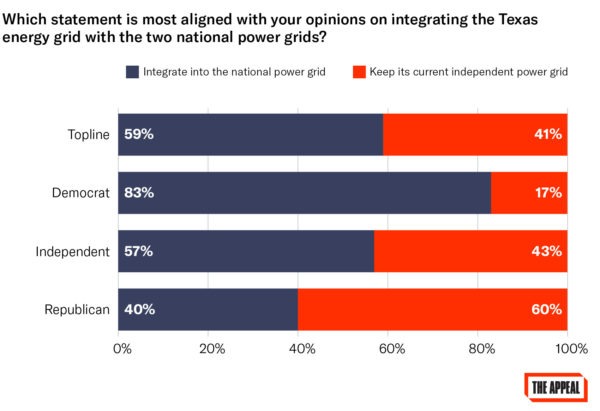
As Texas lawmakers consider relief measures and debate a path forward, a new poll from The Lab, a policy vertical of The Appeal, shows that Texas voters are overwhelmingly united in support of direct cash assistance to those most affected by the storm. And a strong majority, cutting across party lines, want the state’s energy companies to foot the bill for storm damage. Looking ahead, a majority of Texas voters oppose keeping the state’s independent power grid, which was pushed to the brink of collapse by the frigid temperatures. The results show that: 80 percent of likely Texas voters — including 85 percent of Democrats, 76 percent of independents, and 81 percent of Republicans — support a one-time cash payment of $1,000 to $2,500 per household to Texans most impacted by the storm. 81 percent of Texas voters — including 84 percent of Democrats, 77 percent of independents, and 81 percent of Republicans — want to tap into Texas’s $10 billion rainy day fund to pay for damages caused by winter weather. 65 percent of Texas voters — including 74 percent of Democrats, 63 percent of independents, and 60 percent of Republicans — support requiring energy companies to pay for storm damages through a one-time tax. 59 percent of Texas voters believe Texas’s power grid should be integrated with the two national power grids, rather than remain independent.
Direct cash payments provide efficiency and flexibility that is vital in the aftermath of disaster, empowering people to pay for food, rent, transportation, child care, or whatever else they may need to recover. In Harris County, both the county and the city of Houston deployed cash assistance as part of their Covid-relief programs. And Texas State Rep. Ana Hernandez, a Democrat, has introduced legislation that would create a state grant program to fund local, direct payments of between $1,000 and $2,500 to eligible residents affected by the storm.
Satellite images of Houston, Texas, on Feb. 16, after the storm. Dark patches depict areas left without electricity. (NASA, Wikimedia Commons)
Poll Results
Many Texans are facing extensive costs as a result of the recent winter storms. These include high energy bills, home damage, and other costs. Below is a set of proposals that may help Texans deal with some of these costs. Please indicate whether or not you support or oppose each proposal.
Polling Methodology
From Feb. 27 to Mar. 6, 2021, The Appeal conducted a survey of 2,300 Texas adults web panel respondents in English and Spanish.The sample was weighted to be representative of likely voters by age, gender, education, race, and voting history. The survey was conducted in English. The margin of error is ± 2.04 percentage points.