Monday, December 7, 2020

Le Manifeste Travail / The Working Manifesto - Meet the Authors


https://www.youtube.com/watch?v=ZbLlLHor1-A&feature=emb_logo&ab_channel=DemocratizingWork


Latest Jobs Report Bad News for Unemployed Workers


Unless Congress acts, these programs will pay their last benefits for the week ending December 26.


https://portside.org/2020-12-06/latest-jobs-report-bad-news-unemployed-workers


December 6, 2020 Chad Stone CENTER ON BUDGET AND POLICY PRIORITIESPRINTER FRIENDLY

Twitter
Facebook
Mail

,


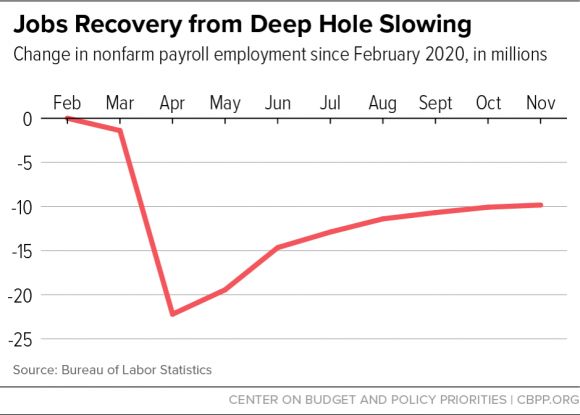
The recovery from the deep economic nosedive of last spring continues to lose steam, the latest jobs report shows. Job growth slowed further in November, long-term unemployment (27 weeks or more) kept rising, and, as in past recoveries, jobs are returning more slowly for Black and Hispanic workers than for white workers in a still-depressed job market. To relieve hardship and promote a strong recovery, policymakers should enact a stimulus package before the end of the year that, among other things, prevents millions of unemployed workers from running out of unemployment benefits right after Christmas.

Payroll employment barely halfway back to pre-crisis level. Nonfarm payroll employment rose by 245,000 jobs in November — the fifth straight month of shrinking job gains — and is still 9.8 million jobs (6.5 percent) lower than when the recession started in February. Private employment rose by 344,000 jobs but remains 6.6 percent below February’s level. State and local government employment is 1.3 million jobs below its February level, with 1.0 million of those job losses in education.


Millions in danger of running out of unemployment insurance (UI) benefits. The number of people who have been unemployed for more than 26 weeks — the maximum duration of regular state UI benefits in most states — has risen from 1.1 million in February to 3.9 million in November. Two-thirds of the Labor Department’s reported number of UI recipients are in temporary programs created by the CARES Act of March that expire right after Christmas. They include people who have exhausted their regular state UI benefits and are getting up to 13 weeks of federally funded Pandemic Emergency Unemployment Compensation and people who have lost their jobs and don’t qualify for regular state benefits but are receiving federal benefits under the Pandemic Unemployment Assistance program. Unless Congress acts, these programs will pay their last benefits for the week ending December 26.

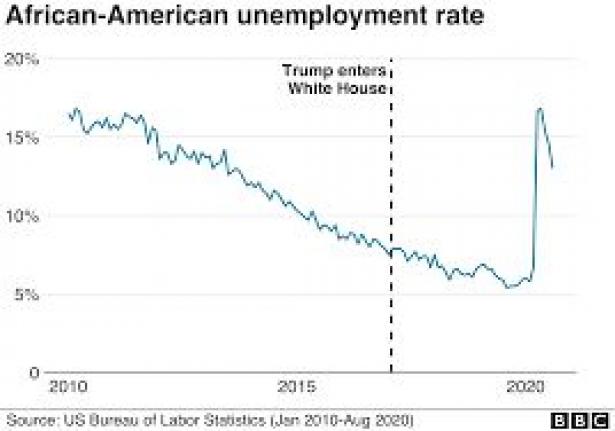
Large racial and ethnic disparities in employment persist. The official unemployment rate, which spiked to 14.7 percent in April, was a still-elevated 6.7 percent in November. Black and Hispanic unemployment rates, while remaining higher than white rates, fell to historically low levels before the crisis of early this year. Unemployment rose sharply for all groups in the recession and remained high in November, but the Black and Hispanic unemployment rates (at 10.3 and 8.4 percent, respectively) were 4.5 and 4.0 percentage points higher in November than in February, while the white rate (at 5.9 percent) was a lesser 2.8 percentage points higher.

These patterns have endured in recessions and recoveries alike and are rooted in this nation’s history of structural racism, which curtails job opportunities for Black people through policies and practices such as unequal school funding, mass incarceration, and hiring discrimination. Black workers tend to be “the last hired and first fired.” High unemployment rates for Hispanic people, which also consistently exceed the white rate, reflect many of the same barriers to opportunity.

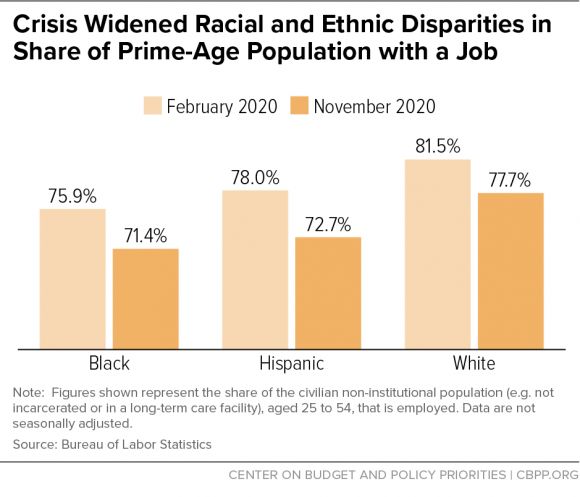
The unemployment rate is an incomplete measure of joblessness because it only includes people who are actively looking for work (or have been laid off but are subject to recall to their former jobs). It doesn’t include people who want a job but haven’t been looking due to the lack of job opportunities. The prime-age employment-to-population ratio — which measures the share of the population aged 25-54 with a job — doesn’t have that shortcoming, and it tells a similar story of large, continuing racial disparities. The employment-to-population ratio was lower for Black and Hispanic workers than for white workers when the recession started and has fallen more for them since. In November, the Black employment-to-population ratio was 4.5 percentage points lower than in February, the Hispanic rate was 5.3 points lower, and the white rate was 3.8 points lower.

More stimulus needed now. With the economy still in a deep hole, policymakers face an imperative to enact a relief and stimulus package quickly to support the recovery and ensure that millions of UI recipients don’t lose their benefits in the coming weeks.


Venezuela's Chavistas hold massive rally for legislative victory in Caracas


https://www.youtube.com/watch?v=g9qgnsRA02M&ab_channel=TheGrayzone


Guaranteed Profits, Broken Promises


How ComEd and Exelon turned utility regulation on its head


December 6, 2020 Illinois PIRG


https://portside.org/2020-12-06/guaranteed-profits-broken-promises


[moderator: Download the full report HERE.]

Commonwealth Edison (ComEd), Illinois’ largest electric utility, first proposed a large capital program to modernize its grid in 2007. Understanding the substantial costs and potential, if uncertain, benefits of so-called “smart grid” investments, state regulators opted to instead launch an innovative statewide process, seeking to ensure “‘that consumers are the primary beneficiaries’ of the smart grid modernization.”

Before this customer-focused process addressed policymaking details, ComEd went to the Illinois General Assembly to pass the Energy Infrastructure Modernization Act (EIMA) in 2011, which paired capital investments with radical, utility-friendly changes to rate-setting and customer protections. ComEd sold EIMA as necessary to move from a grid whose technology had not changed much in the past 100 years and that functioned mainly to dispatch power from centralized power plants to customers, to a modern smart grid capable of integrating power from smaller, clean energy sources, improving efficiency, and empowering customers with more information and control.

We now know that EIMA was passed, in part, through a corrupt and illegal bribery scheme. In a July deferred prosecution agreement with the United States Attorney fo the Northern District of Illinois, ComEd admitted to perpetrating this scheme in an attempt to influence Illinois House Speaker Michael Madigan and win favorable legislation, starting with EIMA.

In the wake of the scandal, ComEd has insisted that the “improper conduct described in the deferred prosecution agreement … does not mean that consumers were harmed by the legislation that was passed in Illinois."

Nine years after EIMA’s passage, the record is clear: EIMA delivered guaranteed, record profits and other benefits to ComEd and its parent company, Exelon Corporation, while leaving ComEd customers and the public with broken promises.

This report examines EIMA; the claims ComEd made to pass it and makes to defend it; its impact on ComEd and Exelon; on its regulator, the Illinois Commerce Commission; and on ComEd customers and the public interest.

In the language of ComEd, EIMA imposed “obligations'' on the utility: $2.6 billion in specified reliability and smart grid investments. In return, EIMA gave the company generous “assurances:” faster and more certain, i.e. guaranteed, revenue and profit with less regulatory oversight through so-called “formula” rate-setting.

ComEd presented these obligations and assurances as a tightly bound, balanced give and take; the company said it “simply can’t make investment without the stability and predictability embodied in the regulatory reform section of the bill.” But the two have little to do with one another. EIMA and its formula built ComEd and Exelon a profit machine entirely out of proportion to the law’s specified investments.

Formula rate setting provided such an advantage over the traditional process that ComEd easily handled its specified investments, deploying smart meters at almost twice the speed as planned, while also increasing profits. This alone demonstrates that EIMA’s assurances were overkill.

But further, formula ratemaking allowed ComEd to add significantly more profits than planned in EIMA; while the specified investments are all but completed, ComEd continues to enjoy formula rates and is planning to spend at even higher levels than it did during the height of its EIMA investment. Since the first formula rate case, ComEd has added more than $5.1 billion, almost twice the amount of specified investments, to its rate base, the value of its assets it will earn a profit off of for years to come.

Not only have formula rates provided ComEd guaranteed, record profits, they have shielded the company’s investments from meaningful scrutiny. The law’s annual rate-setting timeline does not allow time for regulators or other stakeholders to thoroughly examine the company’s filings. Its formula flattens billions of dollars of investment to formula “inputs” taken from one high-level federal form. Not only has this kept the Commission from reviewing all of ComEd’s massive spending but it has reduced the Commission to a rubber stamp. Compared to the more than $5 billion added to ComEd’s rate base through annual formula rate updates, the Commission has disallowed only $23 million. While ComEd spends unprecedented billions, customers bear all the risks that the company wastes money through inefficient or unnecessary spending or that customers would have benefited more from alternative investments.

For customers, the result of the law has been a 37 percent increase in the delivery portion of their bills, without which, because of declines in power supply prices, customer bills would have decreased significantly.

ComEd did not need formula rates to improve reliability after decades of poor performance or to improve service through new technology. Rather, ComEd used promises of achieving adequate service and a sparkling, customer-centered vision of the future to win itself guaranteed profits with less accountability.

ComEd promised customers smart grid-enabled cost savings from increased operational efficiency; rapid advances in clean, distributed energy and energy efficiency; and an exciting new world of information, choice and control. It promised customers a fundamental shift in how they interact with their utility: robust data at their fingertips and a market full of innovative smart meter-enabled products and services to choose from.

It remains an open question whether ComEd is capable of meeting the customer benefit expectations it set. At the same time ComEd leadership was promoting its vision of empowered consumers through its campaign to pass EIMA, then-Exelon Chairman and CEO John Rowe commented “We have looked at most of the elements of smart grid for 20 years and we have never been able to come up with estimates that make it pay.” Rowe further stated that he thought customers would benefit more if, instead of investing in the smart grid, utilities invested in replacing more old cable.

Regardless of whether ComEd oversold the potential benefits of the smart grid, the smart grid does enable direct customer benefits, primarily through energy and cost savings, outcomes that directly threaten Exelon’s revenues. Current Exelon CEO Chris Crane has acknowledged that officials within the company viewed smart meters as representing “value destruction to the generating company.”

Despite large changes to Illinois’ energy laws and the corporate structure of the relevant companies, there remains a fundamental and unaddressed conflict of interest in Exelon’s ownership of ComEd: Exelon’s business interests, generally as a power generator and specifically as an owner of high cost nuclear plants, are at odds with ComEd’s service obligations.

EIMA was carefully drafted so that ComEd could easily avoid delivering on all of its promises, and has notably failed to deliver the promised customer benefits most threatening to Exelon. Instead, ComEd withheld these promised benefits, providing leverage to win even further windfalls for itself and Exelon.

Even the benefits the law has delivered have not been properly analyzed, leaving regulators and the public without the ability to judge whether or not they were “worth” customers paying 37 percent more for delivery service.

EIMA was a radical and unwelcome inversion of traditional utility regulation, which aims to ensure and maximize the public good through the creation of the opportunity for private profit. EIMA, on the other hand, guaranteed ComEd and Exelon’s private profit while failing to adequately ensure the public good.


Plan For Left To Hold Pelosi Accountable. Iran Believes Israel May Strike. Garland In VZ


https://www.youtube.com/watch?v=ctDLm4W-hQs&ab_channel=JamarlThomas


The Supreme Court Wants to Revive a Doctrine That Would Paralyze Biden’s Administration


Even the most basic government functions would grind to a halt.


December 6, 2020 Hannah Mullen and Sejal Singh SLATE


https://portside.org/2020-12-06/supreme-court-wants-revive-doctrine-would-paralyze-bidens-administration


Joe Biden promised us an FDR-sized presidency—starting with bold action to halt the spread of COVID-19, end the worst economic downturn in decades, and stop the climate crisis. Biden could use regulation and executive action to move quickly to decarbonize the economy, cancel student loan debt, and raise wages. But a Biden administration has an even bigger problem than two long-shot special elections in Georgia: the new 6–3 conservative majority on the Supreme Court may soon burn down the federal government’s regulatory powers.

At least five conservative justices have signaled that they are eager to revive the “non-delegation doctrine,” the constitutional principle that Congress can’t give (“delegate”) too much lawmaking power to the executive branch. On paper, the rule requires Congress, when delegating power to an agency, to articulate an “intelligible principle” (like air pollution regulation needed “to protect public health”) to guide the agency’s exercise of that power. But in practice, the nondelegation doctrine is effectively dead. The court has only struck down two statutes on nondelegation grounds—and none since 1935.

Today, most of the government’s work is done through the “administrative state,” the administrative agencies and offices, like the Environmental Protection Agency, the Department of Labor, and the Department of Education, which issue regulations and enforce laws. Congress doesn’t have the capacity to pass laws that nimbly address complex, technical, and ever-changing problems like air pollution, COVID-19 exposure in workplaces, drug testing, and the disposal of nuclear waste. So Congress tasks agencies staffed with scientists and other specialists to craft regulations that directly address those problems. This division of responsibility—Congress legislates policy goals and agencies implement them effectively—is the foundation of functional government.

Take, for example, the Clean Air Act. In 1963, Congress ordered the EPA to regulate air quality standards “at a level that is requisite to protect public health.” Based on that authority, the EPA routinely issues lifesaving regulations limiting lead in the air, air pollutants coming from chemical plants, and, critically, greenhouse gasses. Biden can use the CAA to start tackling the climate crisis on Day One. The dormant nondelegation doctrine is the foundation of thousands of regulations across dozens of agencies, allowing agencies to make technical decisions about, say, hospital reimbursement rates to administer Medicare or wage and hour rules that protect workers from exploitation.

But last year, in a case called Gundy v. United States, four conservative justices announced that they wanted to bring the nondelegation doctrine back to life. Gundy arose out of a national sex offender registry law that explicitly applied to everyone convicted after the law took effect but delegated authority to the Department of Justice to determine when and how it applied to people convicted before the law took effect. Herman Gundy, who was convicted before the registry law took effect, argued that the law violated the nondelegation doctrine. The court upheld the law. But in a dissent joined by Chief Justice John Roberts and Justice Clarence Thomas, Justice Neil Gorsuch wrote that the court should revive the dormant nondelegation doctrine.* Gorsuch’s dissent argued that Congress may only delegate policymaking power to agencies under three narrow circumstances: to “fill up the details” of a legislative scheme; for executive fact-finding to determine the application of a rule; and to assign nonlegislative responsibilities to the executive and judicial branches. Justice Samuel Alito wrote separately to say he’d like to “reconsider” the nondelegation doctrinejust not in a case about sex offenders’ rights.

Justice Brett Kavanaugh wasn’t on the court in time to hear Gundy. But last fall, in a separate opinion, he signaled his support for Gorsuch’s new, revived nondelegation doctrine. That makes five votes for resurrecting the nondelegation doctrine and taking a hatchet to landmark labor, environmental, and consumer protection law—even without Justice Amy Coney Barrett, who, administrative law experts warn, shares the conservative justices’ hostility to the administrative state.

As Justice Elena Kagan pointed out in Gundy if the conservative justices bring back the nondelegation doctrine, “most of Government is unconstitutional.” Exactly how much government would be unconstitutional, though, isn’t clear. What does Gorsuch mean when he writes that Congress may give agencies the power to “fill up the details” of a legislative scheme? What does Kavanaugh’s test—that Congress may not delegate “major policy questions” to agencies—actually forbid in practice? Would Biden’s EPA be permitted to issue regulations about greenhouse gasses or new, dangerous chemicals leaking into our public waters? Congress relies on OSHA experts to set workplace safety standards that are “reasonably necessary or appropriate to provide safe or healthful employment.” Does that “delegate” too much power to OSHA to act fast to issue COVID-19 safety standards for transportation, grocery stores, and meatpacking workers, as Joe Biden has promised to do? What about the EEOC’s power to interpret anti-discrimination to address workplace dress codes that discriminate against Black women’s natural hair? What about the FDA’s authority under the Family Smoking Prevention and Tobacco Control Act to subject “any” tobacco products to federal regulations—is “tobacco products” narrow enough under Gorsuch and Kavanaugh’s tests? Or would an FDA decision to regulate Juul just like cigarettes be a “major policy question” outside agencies’ powers?

The uncertainty alone could give special interests like fossil fuel companies and Juul grounds to sue to stop, or at least hold up, lifesaving regulations issued by the Biden administration. They’re already trying—just last year, e-cigarette company “Big Time Vapes” argued that the FDA’s power to regulate “any” tobacco product violated the nondelegation doctrine. The U.S. Court of Appeals for the 5th Circuit rejected that challenge. But in its opinion, the 5th Circuit hinted that similar challenges could soon be successful, as the Supreme Court “might well decide—perhaps soon—to reexamine or revive the nondelegation doctrine.” And if that happens, all bets are off.

Such a decision would not only threaten existing regulations. It endangers every piece of future progressive legislation, too. Big, transformative legislative packages, like a Green New Deal or “Medicare for All,” would require a million and one technical decisions that Congress is poorly positioned to make. Biden and Congress can pass legislation phasing the United States toward 100 percent clean energy by 2030—but someone will have to actually sweat the details about which engines can be included in which cars.

Government doesn’t work without the administrative state. But that’s sort of the point. The conservative justices have long been hostile to regulation and executive action. And now they may finally have the votes to bring virtually any regulation to a halt. At least five justices are ready to drop a 1,000-pound anvil on any Biden administration rule that displeases them.


Economic Update: Social Movement Gains in L.A.


https://www.youtube.com/watch?v=Kw84KHA2cZk&ab_channel=DemocracyAtWork