skip to main |
skip to sidebar
https://popularresistance.org/countering-the-rightward-drift/
By Margaret Flowers, Popular Resistance.November 1, 2020
| , NEWSLETTER
This week, people are planning protests across the nation beginning the day after the election. Some, like Democratic Party-aligned groups and unions, will only demonstrate if President Trump loses and refuses to leave office. Trump will fail if he tries because the ruling class has clearly shifted its support to Biden. Professor Adrienne Pine explains this in her analysis of the opposition to Trump. Others such as issues-based groups, coalitions and community groups are planning to take the streets no matter what the outcome of the election is.
This is good news because a mass mobilization of left and progressive groups is needed to change the rightward direction in which the United States is headed. Michael J. Smith’s explanation of the “ratchet effect” describes the roles both Republicans and Democrats have played in moving our politics in that direction since 1968. In a nutshell, each time the Republicans moved to the right, the Democrats followed with the excuse that it’s necessary to win votes. This locks in the rightward motion, opening space for Republicans to move to the right again.
But Smith also writes, “the Democratic Party has assumed the role of ensuring that the countervailing pressure from the Left doesn’t happen. The party contains and neutralizes the Left, or what there is of it. Left voters are supposed to support the Democrat, come what may.” This is one of the reasons why the expression “the Democratic Party is the graveyard of social movements” exists. How do we counteract that?

SignsofJustice.com.
2020 vision on who we are
In a recent episode of Eleanor Goldfield’s series, Deception 2020, she and Eugene Puryear discuss why the trope of “this is the most important election ever” is recycled in every presidential election. It serves as a great distractor that puts the focus on personalities rather than the broader social context of where we are. It pits Republican and Democratic voters against each other while the ruling class plays both sides, putting the most money on the one that has the best chance of winning. The people hold their noses and vote for whomever they consider to be the lesser evil while the wealthy class knows their interests will be served no matter who wins.
The year 2020 has brought into clear focus that we are living in a failed state and can’t afford to be drawn into this distraction. The number of new COVID-19 cases surpassed 100,000 in one day. The recession is likely to deepen into a prolonged depression due to Congress’ failure to provide supports for families and their businesses and farms. The climate crisis is raging. And structural racist violence goes on in all of its forms while the Pentagon continues its insatiable consumption of the federal budget leaving austerity for the rest of us
Instead of being caught up in this “political ping pong”, as Kevin Zeese would call it, we need to focus on these grave issues before us. I learned some lessons to avoid this ping pong during my involvement with the health reform process in 2009-10 when we were advocating for national improved Medicare for all while the Democrats were pushing their version of a healthcare bill that protected the profits of the health insurers, pharmaceutical companies and big businesses.
The lesson is best summarized using the acronym “ICU.” Think of it as what is needed, especially in a time of crisis. The “I” stands for independent. It is important not to tie our issue to the agenda of a political party but to maintain independence from them while we press for what we need, lest our struggle be co-opted. The “C” stands for clarity, meaning we must be clear about what we are demanding. Members of the corporate duopoly will always try to water our demands down with proposals that may sound positive but are less than what we need. Look at the Democrat’s Green New Deal as a current example that protects the dirty energy industries and is too little, too late. And the “U” stands for uncompromising. The ruling class will always tell us we are asking for too much but we can’t compromise on fundamentals such as health care, housing, education, financial security and an end to violence against us. These are universal basic needs that nobody should be denied.
With this 2020 vision, we can mobilize a broad movement that puts forth a bold agenda of what we need and fights for it, no matter who is elected. This is how we reverse the ratchet effect. We can look to Chile as a recent example of a people succeeding in their struggle to reverse the ravages of neoliberalism. Patricio Zamorano describes how a similar situation to what we face, great inequality and injustice, drove people to mobilize despite severe repression and win the right to remake their Constitution.

Jeff Bachner/New York Daily News.
Violence on the rise
One reality we must prepare for is the continued rise in right wing violence no matter who wins the election. If Trump wins and people continue to struggle to end the injustices we face, right wing extremists will be emboldened by a president who encourages them. If Biden wins, they will be angered at what they view as a threat to the gains they have made and may lash out.
In light of this, communities need to organize to be vigilant to what is happening around them and to be proactive in creating structures that provide safety and mutual aid, particularly for those who are most vulnerable.
We live in an era of great polarization. This is expected because it goes hand in hand with great inequality and it often precedes moments of social transformation. Think of it as heightening the contradictions and forcing a choice. Who are we and how do we want our society to be?
George Lakey puts the polarization into historical context. Almost one hundred years ago, when extreme polarization existed in Europe, some countries moved to fascist dictatorships while others moved to socialized democracies. The difference was how the people organized and mobilized. Lakey suggests a road map.
If people who consider themselves left or progressive fail to organize and mobilize, we may go the way of a fascist dictatorship no matter who wins this presidential election. If Trump wins, he may do what others have done by trying to further consolidate his power into an authoritarian state. If Biden wins, and he continues the neoliberal and repressive policies that have marked his 47 years in elected office, then the conditions will be created in 2024 or beyond for another Democratic Party loss and an opening for a right wing leader who is more effective than Trump at consolidating power.
Either way we must mobilize and protect our rights. While most of our organizing will take place outside the electoral system because that is where we have power, it will also be necessary to focus on preserving whatever democratic rights exist and strengthening them.
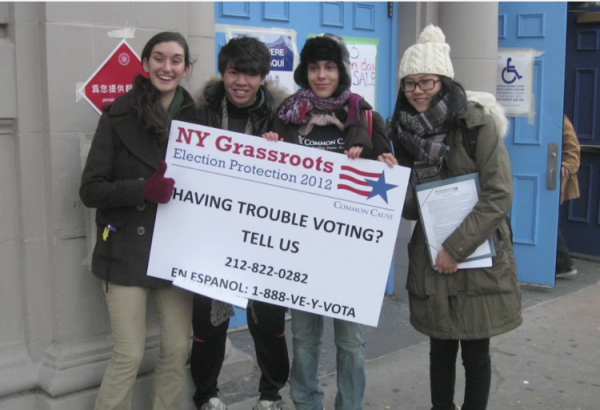
Common Cause NY.
Protecting and improving the election process
As flawed as the electoral process in the United States is, it is the system we currently have. Fair election and third party activists have been working to change it for decades. Now, as it is on so many issues, the major problems with that system – voter suppression, lack of transparency and the process for choosing a president – are more evident.
While the United States has never been a democracy, in fact a look at the founding of the country shows the ruling class who wrote the Constitution were afraid of it, the people believe in democracy. Focusing on democratic rights in this election will bring people together and build momentum to change the system.
Focusing on what President Trump says is a distraction. Recall that Trump was also saying that he would not commit to accepting the outcome in the lead up to the 2016 election. The Democrats and the groups aligned with them are amplifying fears to drive voter turn out, and it seems to be working. The latest Gallup Poll finds almost 70% of registered voters are enthusiastic about the election, which is an increase from the 50% who were enthusiastic in 2016 and similar to 2008 levels. This is highest among registered Democrats.
Five Thirty Eight predicts that due to the electoral process in a few states, for example Pennsylvania is not allowed to start counting mail-in ballots until Tuesday, and the way the states are looking right now, neither of the major party candidates could reach the required 270 electoral votes on election night. It could take a few days.
This is not cause for panic. Instead, let’s take a collective deep breath and watch for problems with the process in our states. Documenting these can be used to challenge and improve the process for the next round. Already, people have been challenging the election process with more than 300 lawsuits filed in 44 states.
There is a small chance that President Trump will be re-elected. If that happens, it will be critical to respect that result. To reject an outcome of the election process we have opens the door to a breakdown of that system and a vacuum that could threaten the hope of building more democratic structures.
Remember, no matter what happens on November 3, our struggle goes on. It is a long term struggle against deeply entrenched structures of racism, capitalism, colonialism and imperialism that will have successes and failures. Our best chance for a better future is to keep our eye on the world we hope to create and keep working toward that goal.
Kevin Reed
https://www.wsws.org/en/articles/2020/11/04/goog-n04.html?pk_campaign=newsletter&pk_kwd=wsws
In a statement before a Senate hearing on October 28, Sundar Pichai, the CEO of Google’s parent company Alphabet, admitted that the dominant online search company has censored the World Socialist Web Site.
At the Senate Commerce Committee hearing, when asked by Republican Senator Mike Lee of Utah to provide the name of one left-wing “high profile person or entity” that has been censored by Google, Pichai named the WSWS.
The hearing—which included testimony from three top tech CEOs--Pichai (Google), Mark Zuckerberg (Facebook) and Jack Dorsey (Twitter)—had been called by the Republican-controlled committee for the purpose of promoting its completely false claim that only right-wing and conservative publishers have been censored by internet and social media corporations in the lead-up to the 2020 elections.
During his allotted time for questioning, Senator Lee asked the three executives, “I think the trend is clear that you almost always censor—meaning block content, fact check or label content or demonetize websites—of conservative, Republican or pro-life individuals or groups or companies... Can you name for me one high profile person or entity from a liberal ideology who you have censored and what particular action you took?”
While both Dorsey and Zuckerberg refused to give names—claiming they would provide a list at a later date—when Lee got to Pichai, the Google executive responded that “we have moderation policies which we apply equally... We have had compliance issues with the World Socialist Review [sic], which is a left-leaning publication.”
Although Pichai used the name “World Socialist Review,” a print newsletter that ceased publication in 2011, it is clear that he was referring to the World Socialist Web Site. In fact, a Google search for “World Socialist Review” actually yields the WSWS in its top two results.
Pichai did not explain what he meant by “compliance issues,” but his response to Senator Lee was absolutely clear. He was saying that Google does in fact take censorship action against left-wing and socialist publishers, and an example is the censorship of the World Socialist Web Site.
The extraordinary admission by Pichai that Google has been suppressing content from the WSWS is a vindication of the campaign launched by the International Committee of the Fourth International against online censorship going back to the spring 2017.
In April 2017, following the implementation by Google of a new search algorithm, the WSWS reported that access to its content and that of other left-wing, anti-war and progressive websites was being heavily censored. In an article published on August 2, the WSWS published data that showed traffic to 13 websites had been reduced by Google between 19 percent and 67 percent. The data showed that “the World Socialist Web Site has been the most heavily affected. Its traffic from Google searches has fallen by two thirds.”
The WSWS characterized the modification of Google’s search algorithm as “a corporate-state conspiracy to drastically curtail democratic rights” and then called for “broad-based collaboration among socialist, left and progressive websites to alert the public and the widest sections of the working class.”
The analysis was then followed on August 25, 2017 by an open letter from David North, chairperson of the WSWS International Editorial Board, to the executive leadership of Google and Alphabet demanding a halt to internet censorship. The letter called on Google to “stop blacklisting the WSWS and renounce the censorship of all the left-wing, socialist, anti-war and progressive websites that have been affected adversely by your new discriminatory search policies.”
The open letter further stated that the censorship of the WSWS “reflects the fear that a genuine socialist perspective, if allowed a fair hearing, will find a mass audience in the US and internationally. There is widespread popular opposition to your efforts to suppress freedom of speech and thought.”
As part of this campaign, the WSWS circulated an online petition that garnered thousands of signatures from readers in 70 countries and on five continents.
Although Google never officially responded to the open letter, the New York Times published an article on September 26, 2017 by Daisuke Wakabayashi that featured an interview with David North and discussed the campaign by the WSWS. Then, in a follow-up article, the Times attempted to discredit the claims of the WSWS that Google was engaged in censorship.
In November 2019, the Wall Street Journal substantiated the position of the WSWS that Google was manipulating its search algorithm to suppress content from being surfaced by its search engine. The Journal wrote, “Despite publicly denying doing so, Google keeps blacklists to remove certain sites or prevent others from surfacing in certain types of results.”
On January 20, 2020, the WSWS published an article titled “Google suppressing World Socialist Web Site content in its search results for the New York Times’ 1619 Project.” This article showed—through independent data analysis—that the authoritative and widely read material published by the WSWS on the historical falsification called “The 1619 Project” was being suppressed in Google search results.
The recent statement by Pichai is the second time he has misnamed the World Socialist Web Site in congressional testimony. In a hearing of the House Committee on the Judiciary on July 29 titled “Examining the Dominance of Amazon, Apple, Facebook, and Google,” Pichai responded in a similar manner to a question from Republican Congressman Greg Steube.
When Steube claimed that Google’s algorithms were exclusively censoring conservative political views online, Pichai said, “We do get complaints across the aisle. For example, the World Socialist Review [sic] complained in January of this year that their site wasn’t found in Google search results. So, we get complaints, we look into it, but we approach our work in a nonpartisan way, and it is in our long-term incentive to serve users across the country.”
Although he did not explain it, the statement by Pichai before the House committee was clearly regarding the WSWS assertion in January that content about “The 1619 Project” was being suppressed.
This public admission was followed by a second open letter on July 31 from WSWS Editorial Board Chairperson David North to CEO Pichai. The open letter stated: “The fact that you referred specifically to the WSWS complaint in your congressional testimony speaks to the seriousness with which the matter was taken. You, the CEO of Google’s parent Alphabet, were notified of the complaint. Six months after the article was published, it remained fixed in your memory.”
David North then asked, “why was the World Socialist Web Site never informed that its claim of suppression was being discussed within Alphabet/Google management, or that an investigation was being conducted into our complaint?” Neither Pichai nor anyone else from the management of Google ever responded to this question or the open letter.
It is highly significant that—after more than three years of stonewalling and refusing to answer any questions or respond to a single demand—CEO Pichai has admitted that the technology firm controlling nearly 90 percent of worldwide search traffic has been suppressing WSWS content all along.
Why is the WSWS being censored by Google? Because the WSWS is the only online source of genuine Marxism and socialist internationalism that stands for the political independence of the working class and fights to put an end to the capitalist system on a world scale. As the struggles of the working class intensify amid the crisis sparked by the global pandemic, the recently relaunched WSWS is increasingly becoming the center of socialist political, theoretical and cultural education for masses of workers and young people throughout the globe.
Given the collaboration of Alphabet and Google with the US intelligence state, the statement by Pichai must be understood as a message to the American political establishment—which did not question him further on the matter—that the censorship of the WSWS will be continued and intensified in the coming period.
Along with the fight for the freedom of WikiLeaks editor Julian Assange, the demand for an end to online censorship and the defense of freedom of speech on the internet are fundamental democratic rights that must be taken up by the international working class.
Nick Beams
https://www.wsws.org/en/articles/2020/11/04/imfb-n04.html?pk_campaign=newsletter&pk_kwd=wsws
As the economic effects of the COVID pandemic spread across the world in March and April, the air was filled with promises that poorer countries would be assisted with aid and debt relief to deal with a crisis that threatened to plunge millions, above all children, into the most abject poverty.
In April, International Monetary Fund Managing Director Kristalina Georgieva announced immediate relief on IMF debt owed by 25 countries. She said the move would help “our poorest and most vulnerable members” to channel scarce resource toward emergency medical and related measures.
In March, the United Nations had issued a call for the G20 to organise a $2.5 trillion relief package to deal with the pandemic.
Six months later, these pronouncements read like a cruel joke. A series of reports makes clear that, while trillions of dollars have been provided to major corporations and the financial system, assistance to the world’s most vulnerable people amounts to virtually nothing.
A report authored by London-based journalist Peter Goodman, and published in the New York Times on November 1, noted that in April the IMF and World Bank “vowed to spare poor countries from desperation.” Their economists warned that “immense relief was required to prevent a humanitarian catastrophe and profound damage to global prosperity.”
Poorer countries have been hit by the fall in remittances sent home by migrant workers, the virtual halt to international tourism, the decline in world trade, and, in some cases, the falling price of oil.
The Times article concluded that the IMF and the World Bank “failed to translate their concern into meaningful support,” even with the World Bank estimating that by next year the pandemic could push 150 million people into extreme poverty, defined as living on less than $1.90 per day, the first increase in more than two decades.
According to the bank, between 9.1 percent and 9.4 percent of the world’s people live in extreme poverty conditions. Close to 25 percent of the world’s population receive below $3.20 per day, and 40 percent, almost 3.3 billion people, receive less than $5.50 per day.
The Times article said what it called a “relatively anaemic response by the IMF and the World Bank” was due in part to the “predilections” of their largest shareholder, the United States. It cited remarks by US Treasury Secretary Steven Mnuchin to the semi-annual virtual meeting of the two organisations last month.
“It is critical that the World Bank manage financial resources judiciously so as not to burden shareholders with premature calls for new financing,” he said.
IMF chief Georgieva told the meeting the fund would not hesitate to draw upon its $1 trillion lending capacity. “This is, in my lifetime, humanity’s darkest hour,” she said.
However, the IMF has lent out only $280 billion. Of this, $31 billion is in loans to 76 member states, with under $11 billion going to low-income countries.
Some 46 countries, many of them in sub-Saharan Africa, have obtained $5.3 billion worth of debt relief. This is not cancellation, but merely deferral, and the debt still has to be paid. According to data from the European Network on Debt and Development, cited in the Times article, the debt deferrals amount to just 1.7 percent of total international debt payments due from all developing countries this year.
Even where money is provided by the IMF, in many cases it is not being used to finance health and other necessary measures to deal with the pandemic, but to pay off private-sector lenders.
According to a report issued in July by the anti-poverty organisation Jubilee Debt Campaign, the IMF is in breach of its own rules, as 28 countries with a high risk of debt default used $11.3 billion to pay private-sector debt holders.
The head of policy at the organisation, Tim Jones, said IMF funding “was effectively bailing out private lenders by enabling poor countries to maintain payments.”
Jones noted that the level of government spending on debt payments in poorer countries last year had risen to more than 14 percent of government revenue, the highest level since 2003, an increase of 110 percent since 2010. In Kenya and Ethiopia, debt servicing reached up to 50 percent of government revenues last year.
Seeking to justify the use of IMF funds for private profit rather than necessary health and social services, while maintaining that “our overriding objective right now is to save lives and livelihoods,” IMF spokesman Gerry Rice said the issue was complicated.
“It sometimes involves dealing with private-sector obligations and without having the country fall into default, which would incur a host of other problems,” he said.
The stranglehold that banks and hedge funds based in London, New York and Frankfurt have on less developed countries, many of them in Africa, is illustrated by data collected by the Institute for International Finance, a financial industry lobby group. It found that by the third quarter of last year, foreign debt levels in the poorest countries of sub-Saharan Africa had risen on average to more than 60 percent of gross domestic product from 38 percent a decade before.
No country in sub-Saharan Africa has been able to obtain any funding from international capital markets since February this year.
In the years following the 2008 global financial crisis, money poured into these countries, as investment houses in the major economies sought higher rates of return. The sub-Saharan governments took on the debt on the basis that higher commodity prices, boosted by rising demand in China, would enable them to repay the loans.
The fall in commodity prices, already in decline even before the pandemic struck, has led to a financial disaster. Lower oil prices mean that the revenues of the Angolan government are now less than what it needs for debt repayments.
As the pandemic struck, the G20 issued a call for private investors to halt debt repayments from poor countries at least until the end of this year. No relief has been provided.
Zambia is another example of the devastation. It raised billions of dollars in loans on the back of rising prices for copper, its main export, with bankers and hedge funds eager to pile in because they were able to earn higher rates of return than elsewhere.
A slowdown in the Chinese economy from around 2015 halved the price of copper. Now the deep recession induced by the pandemic has resulted in a 5 percent contraction in its economy. As a consequence, at least one-third of government revenue is needed just to service debts, a proportion that is expected to rise in coming years.
The collapse in its currency, the kwacha, from five to the dollar in 2012 to around 18 today, means that Zambia has to pay back three times more in local currency than when the loans were taken out.
The social consequences are expressed in figures released by the World Food Programme, which show that at least 6.9 million of the country’s population of 17.4 million do not have sufficient food.
The attitude of the World Bank and the IMF was accurately summed up in comments from Lidy Nacpil, the coordinator of the Manila-based Asian Peoples’ Movement on Debt and Development, cited at the conclusion of the Times article.
“International financial institutions are going to leave countries in much worse shape than they were before the pandemic,” she said. “Their interest is not primarily about getting these countries back on their feet, but to get these countries back into the business of borrowing.”
Mike Head
https://www.wsws.org/en/articles/2020/11/04/bank-n04.html?pk_campaign=newsletter&pk_kwd=wsws
The Reserve Bank of Australia yesterday entered uncharted waters. It announced unprecedented steps to slash official interest rates to near zero and to formally join other central banks internationally in pumping billions of dollars into the financial markets via “quantitative easing.”
The RBA issued a revealing warning of a “downside risk to the outlook” because of the worsening COVID-19 pandemic, “particularly in Europe.” This statement undercut its own anxious efforts, and those of the federal government, to talk up prospects of an early recovery in Australia from the most serious economic breakdown since the Great Depression of the 1930s.
Treasurer Josh Frydenberg declared that the RBA had “confirmed that Australia’s economic recovery is well under way.” Nothing could be further from the truth.
In fact, RBA governor Philip Lowe said the bank board did not expect it would raise interest rates for “at least three years” and might not do so for the next five years. Giving a rare media conference, Lowe said: “We’ve been hit by the biggest economic shock in 100 years. We need to recognise that the pandemic has inflicted significant damage on our economy.”
These remarks are another telling indicator of the depth and long-term nature of the pandemic’s social and economic impact internationally, and therefore in Australia.
Never before, not even in the 1930s, have interest rates been reduced to such low levels—down from an already record low of 0.25 percent to 0.1 percent, and zero for interbank transactions. This is a feverish effort to supply the corporate elite with mountains of more cheap money, on top of the billions already supplied in federal and state “stimulus packages.”
Nor has the RBA ever resorted to such large-scale government bond purchases, saying it will purchase $100 billion worth of five- to ten-year federal and state government bonds over the next six months. This rapid injection of cash is in addition to the more than $63 billion the bank has spent since March on buying three-year government bonds.
Yesterday’s measures are also on top of the RBA’s “Term Funding Facility” to supply big business, via the banks, with low-cost credit. Lowe reported: “To date, authorised deposit-taking institutions have drawn $83 billion under this facility and have access to a further $104 billion.”
A major element in the decision to resort to quantitative easing (QE), as Lowe acknowledged, is to try to drive down the value of the Australian dollar. That requires matching the escalating measures by the US, Japanese and other central banks to lower the values of their currencies.
As market commentators noted, by turning to QE, after months of denying it would go down that path, the RBA has “crossed the Rubicon” and joined the decade-long worldwide “currency wars.” In response to the global crisis, each national-based capitalist elite is seeking to beat down its rivals.
The Australian dollar has fallen in recent weeks in anticipation of the RBA’s moves and was hovering around US70 cents on Monday. A weaker currency should, in theory, prop up export and import-competing industries as local goods and services become relatively cheaper. But the currency wars will only intensify.
Domestically, the RBA is, in effect, printing money to temporarily finance huge deficits incurred by the federal and state governments through their pro-business spending. That is, until these governments can claw back the cost of their corporate handouts from the working class via cuts to jobs, wages and social services. Lowe denied that the bank was directly underwriting government expenditure. Instead, it was “lowering the cost of government finance.”
Regardless of RBA, government and media claims that the lower interest rates will help home buyers, yesterday’s measures will be of little or no benefit to the millions of working class households paying off mortgages. Even if the rate cut were passed on in full by the commercial banks, which is highly unlikely, a household with a $300,000 mortgage would save only about $23 a month.
An even greater fraud is Lowe’s claim that the RBA is “addressing the high rate of unemployment as a national priority.”
In reality, yesterday’s announcement will do nothing to ease the plight of the nearly five million workers who are officially unemployed or underemployed, or trying to survive on meagre JobKeeper wage subsidy payments or JobSeeker welfare benefits. Rather, the funds will be poured into corporate pockets, financing higher profit dividends, share buy-backs and stock market speculation.
The RBA cut its forecast peak for the (vastly understated) official unemployment rate to “a little below 8 percent,” from the 10 percent it previously expected, and predicted a return to growth in the December quarter. But Lowe said the economy was “not out of recession.”
Given the resurging global pandemic and intensifying currency and trade wars, none of the bank’s revised forecasts are any more reliable than the previous ones.
In an effort to revive business and consumer confidence, the RBA said: “Encouragingly, the recent economic data have been a bit better than expected and the near-term outlook is better than it was three months ago.” However, it added: “Even so, the recovery is still expected to be bumpy and drawn out and the outlook remains dependent on successful containment of the virus.”
Long before the pandemic, the RBA had already slashed interest rates to record lows, far below the “emergency” level of 3 percent it set during the global financial crisis of 2008-09. These moves failed to lift the economy out of a deepening slump. Once the pandemic broke out in March, the bank cut its rates from 0.5 percent to 0.25 percent.
Lowe said it was “extraordinarily unlikely” the RBA would follow Switzerland, Denmark, Japan and others down the path of “negative official interest rates,” but that could change too. As recently as last November, Lowe said “I don’t expect” the “threshold” for QE to be reached in the “near future.”
Now, by the middle of next year, the RBA’s holding of federal and state government bonds will have doubled to about 15 percent. Lowe said that was still below the 20 percent of government bonds held by the US Federal Reserve and 30 percent held by the European Central Bank.
Yet, the latest measures are expected to triple the RBA’s holdings of government bonds from about $180 billion before COVID-19 to $550 billion, or 27.5 percent of gross domestic product (GDP). Westpac Bank economist Bill Evans described the increase as “stunning.”
Evans said the RBA was “rapidly closing in on” the US Federal Reserve, which had increased its balance sheet since COVID-19 by 85 percent, from $3.8 trillion to $7.05 trillion, and is now on about 33 percent of GDP.
There is some alarm inside the financial elite about the uncertain fallout from such measures. Ultra-low interest rates push investors away from productive ventures into riskier territory, creating asset price bubbles and accelerating the “search for yield” in murky financial products.
Today’s Australian Financial Review (AFR) editorial asked: “[H]ow does the Reserve Bank ever get out of the whacky world of fixing a near-zero price on money?” It concluded: “Regrettably, this is unlikely to play out smoothly.”
The editorial demanded faster moves to restructure workplace relations, cut jobs, wages and conditions, and reduce social spending to impose the burden of the breakdown on the working class.
At the same time, there is concern in ruling class circles that the RBA’s billions will not be enough to avert a financial crisis. The economy was already sliding into recession before the pandemic. Then it recorded a 0.3 percent contraction in the March quarter and a record 7 percent fall in the June quarter.
An earlier AFR article warned: “There are about 4 million people either on the JobKeeper wage subsidy or JobSeeker unemployment benefit, and a wave of business bankruptcies is about to hit as government supports and insolvency shields phase out.”
In a speech last week, RBA assistant governor Michele Bullock said banks could face losses due to inevitable business failures and mortgage defaults. “There is going to be further pressure on banks’ profits and capital over the coming year,” she warned.
“Business failures are currently much lower than usual because of income support, loan repayment deferrals and temporary insolvency relief. But this can’t last and we expect to see failures rise.”
What this means, in real terms, is that millions of people, including workers and small business operators, are expected to be thrown into financial ruin and poverty, even as the RBA pumps more billions into the hands of the wealthiest layers of society.
According to recent modelling at the Australian National University, the number of people in poverty, after housing costs are included, is set to rise to 5.8 million, or about a quarter of the population, by March.
Jacob Crosse
https://www.wsws.org/en/articles/2020/11/04/ceme-n04.html?pk_campaign=newsletter&pk_kwd=wsws
Just prior to President Donald Trump’s final campaign rally Monday in Grand Rapids, Michigan it was revealed that several tombstones at a nearby Jewish cemetery had been vandalized with pro-Trump graffiti.
Unknown perpetrators spray-painted red letters spelling out “TRUMP” on a row of tombstones at Ahavas Israel Cemetery, while two other gravesites had “MAGA,” an abbreviation for Trump’s campaign slogan, “Make America Great Again,” scrawled in red graffiti.
The discovery comes less than a week after FBI raids on the neo-Nazi group The Base, which resulted in the arrest of Justen Watkins and Alfred Gorman. The two fascist leaders ran a “hate camp” in Bad Axe, roughly 200 miles east of Grand Rapids, where they trained with weapons and explosives.
The vandalism was discovered and reported to police by Rabbi David Krishef of the Congregation Ahavas Israel, one of a handful synagogues in the Grand Rapids area. Of the 200,000 people who live in Grand Rapids, roughly 0.5 percent, or 1,000, are Jewish.

Headstones vandalized at a Jewish cemetery. (Image credit: Anti-Defamation League Michigan) (NOTE: More photos located here: https://twitter.com/ADLMichigan/status/1323367085964185600/photo/1)
The Anti-Defamation League (ADL) of Michigan posted photos of the crime on Twitter on November 2. It is unclear when exactly the vandalism took place. Sergeant John Wittkowski of the Grand Rapids Police Department estimated the attack may have occurred within the last three to five days. Wittkowski was skeptical of discovering the culprits, telling USA Today that he did not have any leads and that “we’re just crossing our fingers at this point.”
A little over a year ago, on October 13, 2019, staff at Temple Emanuel, also located in Grand Rapids, discovered anti-Semitic posters on the synagogue’s doors. The posters were attributed to the Vorherrschaft Division, a neo-Nazi group. One of the posters had a photo of Adolf Hitler with the words, “Did you forget about me?” sprayed across it, while the other read, “A crusade against Semite-led sub-humans.”
At the time of the incident, the Jerusalem Post reported that the Grand Rapids police were “familiar with the posters and have seen them before, but didn’t share where.” Speaking to CNN two days after the incident, Wittkowski stated that no arrests had been made and the department had no leads.
There is no question that fascists and anti-Semites are festering in police departments across the US and internationally. After a student newspaper, the Manual RedEye, on October 30 uncovered Kentucky State Police training material that featured quotes from Hitler in a slideshow, it was announced that State Police Commissioner Rodney Brewer would be resigning on November 4. Brewer had been assigned to the post by Democratic Kentucky Governor Andy Beshear and was commissioner while the presentation was in use at the training academy.
Carolyn Normandin, the ADL’s Michigan regional director, speaking to the Washington Post regarding the cemetery defacement, said that while the “disgusting and vile” vandalism was still under investigation, she would not label it an act of anti-Semitism until more information was revealed.
Rabbi Krishef agreed with Normandin, writing in a statement to USA Today: “It may just have been opportunistic vandalism against a cemetery which is isolated and hard to see from the road, on Halloween weekend, not an attack against the Jewish community. We don’t know.”
In the run-up to the US election and throughout his presidency, Trump has encouraged and fostered anti-Semitic, fascist and racist elements not only in the state apparatus, but in the broader society, as part of his strategy to remain in power. This was sharply expressed in his infamous declaration that there were “very fine people” among the neo-Nazis who marched in Charlottesville, Virginia in August 2017, chanting “blood and soil” and “Jews will not replace us.” This was followed the next day by a murderous vehicle assault by white supremacist James Alex Fields, which injured several anti-fascist protesters and killed 32-year-old activist Heather Heyer.
In subsequent rallies held throughout his presidency, Trump has continued to rail against “globalists,” a well known anti-Semitic trope. More recently he has taken to defending 14 militia members arrested for plotting to kidnap and kill Michigan’s Democratic governor Gretchen Whitmer.
Trump’s words have had their intended effect. In the US, the ADL released a study earlier this year that recorded a total of 2,107 anti-Semitic incidents across the US in 2019, which it noted was “a 12 percent increase from the incidents recorded in 2018.” In 2019, ADL recorded 1,127 incidents of harassment, 919 vandalism incidents and 61 assaults.
Every category increased from the year prior. The largest percentage jump was in the assault category, a 56 percent increase over 2018, resulting in 95 victims, including five fatalities.
“Make no mistake, this heinous act was committed on the eve of the 2020 election to send an intimidating message to the president’s opponents, and particularly Jewish voters,” read a statement issued by the Michigan Jewish Democrats following the incident. Noah Arbit, funder and chair of the Michigan Democratic Jewish Caucus, added: “Time and again, the president of the United States has sided with anti-Semites, white supremacists, racists and bigots of all kinds.”
Following the attack last Friday by a pro-Trump caravan on a Biden campaign bus in Texas, the state Republican Party chairman, Allen West, a former military officer and Florida congressman, concluded a statement dismissing the attack with an anti-Semitic slur: “Maybe Soros [the billionaire Jewish financier] can cut y’all another check in 2022.”
While Trump has certainly stoked anti-Semitic sentiments, he is just the most vile expression of a global process, one that would not end with the election of Joe Biden. In a December 2018 European Union survey, the ADL found that “80 percent of European Jews feel that anti-Semitism in their country has increased over the past five years, and 40 percent live in daily fear of being physically attacked.”
In Germany, world renowned Russian-German pianist Igor Levit has courageously stood firm against not only death threats, facilitated by the state promotion of the fascist Alternative for Germany (AfD) party, but also anti-Semitic slurs from the press.
Far-right forces in Germany are also believed to have been behind a devastating vandalism operation on October 4 that affected 63 priceless artifacts at the Alte Nationalgalerie, Pergamon and Neues Museum in Berlin.
Erik Schreiber
https://www.wsws.org/en/articles/2020/11/04/harr-n04.html?pk_campaign=newsletter&pk_kwd=wsws
For about a century, poets have largely abandoned traditional elements such as rhyme, meter, and fixed verse forms in favor of free verse. Yet formal verse retains an ability to attract and inspire contemporary poets. Ted Berrigan and John Berryman, for example, wrote sequences of “sonnets” that nevertheless disregard certain strictures of the form.
Another contemporary poet who was attracted to a received form was Jim Harrison, whose Collected Ghazals (2020) was recently published.
Harrison was born in Grayling, Michigan, in 1937. His father was a county agricultural agent, and he developed a lifelong love of the outdoors and of hunting and fishing. After studying comparative literature at Michigan State University, Harrison briefly worked as an assistant professor of English. Once he decided to try to establish himself as a writer, he gave up teaching and lived, at first, in near poverty in rural Michigan. He later divided his time between Arizona and Montana.
Harrison published his first book of poems, Plain Song, in 1965. He developed an informal, plainspoken style that abjured pretension and was sometimes blunt. His writing expresses a pleasure in the brute materiality of the world and often describes rural life, animals, and personal experiences.
Harrison later began writing fiction and is perhaps best known as the author of the novella Legends of the Fall (1979), which was the basis for the 1994 movie of the same title. Harrison’s novels sometimes feature complex narratives and address themes such as aging, sexuality and threats to nature and human culture. He also wrote or co-wrote several film scripts. His final book of new poems, Dead Man’s Float (2016), was published the year of his death from a heart attack.
Although he predominantly wrote free verse, Harrison became attracted to the ghazal—a form that originated in seventh-century Arabia—when translations of Persian poets such as Rumi (1207–1273) and Hafiz (1315–1390) became more widely available in the late 1960s. The ghazal is a romantic poem that often expresses the pain of separation or loss. It has five to 15 couplets that stand independently but may be linked thematically. The couplets have the same meter and rhyming pattern and end with the same refrain.
Many of the poems in Collected Ghazals appeared in Harrison’s earlier book Outlyer and Ghazals (1971). In notes printed at the beginning of the new book, Harrison admits that he disregarded all the rules of the ghazal except for the minimum of five couplets. “We choose what suits us and will not fairly wear what doesn’t fit,” he writes, expressing an eclecticism that is also evident in the thematic disunity among the couplets in most of the poems. He chose this form, he says, “to regain some of the spontaneity of the dance, the song unencumbered by any philosophical apparatus, faithful only to its own music.” He succeeded; the modified ghazal form sharpened the focus and heightened the immediacy of Harrison’s writing.
Each poem strikes the reader as a collage of disparate images and seemingly unrelated couplets. A single poem might contain horses and chickens, a plane ticket to Alexandria, a fantasy about actress Lauren Hutton, a self-deprecating joke and a disparaging reference to Congress. Between couplets, the mood might shift abruptly from whimsical to rueful to pensive to romantic. Although some juxtapositions are intriguing, others are merely disorienting. But nearly every couplet, whether it conveys an observation or a wish, offers an element of truth.
The following couplets may begin to give a sense of Harrison’s voice:
I want an obscene epitaph, one that will disgust the Memorial
Day crowds so that they’ll indignantly topple my gravestone.
…
We'll need miracles of art and reason to raise these years
which are tombstones carved out of soap by the world’s senators.
…
From the mailman’s undulant car and through the lilacs
the baseball game. The kitchen window is white with noon.
…
These losses are final—you walked out of the grape arbor
and are never to be seen again and you aren't aware of it.
…
She wants affection but is dressed in aluminum siding and her
edges are jagged; when cold, the skin peels off the tongue at touch.
…
I resigned. Walked down the steps. Got on the Greyhound bus
and went home only to find it wasn’t what I remembered at all.
One major theme that emerges throughout is Harrison’s deep feeling for nature. He is attentive to the motion of a river around a rock and the way in which a skein of leaves scatters light on the ground. His images of nature do not exclude brutality. We see a bear eating a sheep and a deer suddenly wounded by a gunshot. He indulges in silliness in one poem by crawling around to understand animals’ perspective and in fantasy in another by becoming a frog.
Love and sex are recurring themes as well. Most frequent are sexual fantasies or memories of past encounters, but moments of tenderness and romance (replete as well with historical and social suggestion) also arise. “When we were in love in 1956 I thought I would give up Keats / and be in the UAW and you would spend Friday’s check wisely,” he writes strikingly. In another poem, “I hold your / hand and watch suffering take the very first boat out of port.” But he does not hide or apologize for his lust, nor does he refrain from insulting women (or men, for that matter) when he is angry. Harrison frankly acknowledges the human reactions that we all have.
Another theme is manual labor. Harrison, the son of an agricultural agent, describes farm work often and with sensitivity. For example: “Out by the shed, their home, the Chicano cherry pickers / sing hymns on a hot morning.” Another poem mentions a man harnessing horses and drawing a wagon of wheat. In the same poem, “She forks the hay into the mow, in winter is a hired girl / in town and is always tired when she gets up for school.” Harrison mentions industrial work as well. In addition to the auto industry, Harrison refers to loading green beans all night in a canning factory. These glimpses of workers’ lives are refreshing and encouraging.
Also positive are Harrison’s expressions of political rebellion. He rejects President Richard Nixon and fantasizes “that that nasty item, [Spiro] Agnew [Nixon’s vice president], is retired to a hamster farm.” Harrison amusingly pictures himself as “a poisoned ham in the dining room of Congress.” One of his hikes is marred by his fear of stepping into a hidden missile silo, and he calls for a way to earn a living without “blowing my whole life on nonsense.” Commendably, Harrison refuses to accept the given political order and desires a more fulfilling and humane life for everyone. In this regard, Harrison compares favorably to contemporary poets, who generally espouse identity politics when they address politics at all.
The poems appear to date from the 1970s and bear certain marks of that period. The tide of radicalism and left-wing militancy of the late 1960s was ebbing, and a period of reaction beginning. Many erstwhile radicals, particularly those of the middle class, became discouraged and withdrew from politics. They began focusing on themselves rather than on social concerns. These trends find reflection in Harrison’s ghazals. We hear a note of pessimism in lines like “Those poems you wrote won’t raise the dead or stir the / living. …” In Harrison’s desire to “walk deeply into forests” with a woman to “eat animal meat and love,” one might hear a turn from activism toward hedonism. Yet he is too restive to give up the fight and too attached to the social world to renounce it.
Perhaps the greatest strengths of the poems in Collected Ghazals are Harrison’s frankness and close observation of the world around him. Reflections on his regrets, desires and difficulties are balanced by attention to the natural, social and political worlds. This balance, and the way that Harrison used the ghazal to preclude coherent narrative, is a refreshing contrast with the sometimes-self-involved confessional poetry of that time. Harrison’s moments of pessimism are counterbalanced by humor and a restless desire for life in all its variety.
Genevieve Leigh
https://www.wsws.org/en/articles/2020/11/04/covi-n04.html?pk_campaign=newsletter&pk_kwd=wsws
Last week, 61,000 children in the US were diagnosed with COVID-19. This figure is higher than in any other week since the onset of the pandemic, according to data reported Monday by the American Academy of Pediatrics (AAP) and the Children’s Hospital Association.
In total, 853,635 children have been diagnosed with the virus this year, representing 11.1 percent of all US cases. The percentage of pediatric cases has risen dramatically since mid-April, when children accounted for just 2 percent of COVID-19 cases in the country.
Even more concerning, the AAP said it believes the true number of children with COVID-19 is even higher than the reports indicate because the illness tends to be mild in children, making them less likely to be tested.
In a statement released in tandem with the new report, AAP President Sally Goza, an MD, sounded the alarm: “This is a stark reminder of the impact this pandemic is having on everyone, including our children and adolescents. This virus is highly contagious, and as we see spikes in many communities, children are more likely to be infected, too.”
Dr. Goza continued: “On every measure—new infections, hospitalizations and deaths—the US is headed in the wrong direction. We urge policymakers to listen to doctors and public health experts rather than level baseless accusations against them. Physicians, nurses and other health care professionals have put their lives on the line to protect our communities.”
The AAP report found that the biggest increases in pediatric COVID-19 case numbers in October occurred in western states: Alaska, Colorado, Idaho, Montana, New Mexico and Utah. These states saw increases of 25 percent or more. The Dakotas, Kentucky, Michigan and Wisconsin also reported higher rises among children.
Dr. Greg Demuri, a pediatric infectious disease specialist at UW (University of Wisconsin) Health in Madison, Wisconsin, told NBC News that the situation in Wisconsin was extremely serious. “It just keeps going from horrible to even worse,” he said. “There doesn’t seem to be any end in sight.”
Demuri said UW Health is now seeing new pediatric COVID-19 hospitalizations on a daily basis. According to data compiled by NBC News, the total number of cases in the state has risen 88 percent in the past two weeks alone.
There is no doubt that the dramatic spike in cases among children is directly linked to the reckless reopening of K-12 schools for in-person learning. Before the school year began, numerous scientific studies warned that reopening the schools would lead to a significant spike in infections, hospitalizations and deaths.
As of Tuesday, Election Day, 60 percent of K-12 public school students were attending schools that offer in-person learning, a dramatic rise from 38 percent after Labor Day, two months ago, according to an ongoing audit conducted by Burbio.com.
The report states that 35.7 percent of students are presently in schools that offer some face-to-face learning on a daily basis; 26.5 percent have the option of hybrid schedules with two to three in-person days each week; and 37.8 percent attend schools that provide only virtual learning.
The spike in cases among youth should be taken as a sharp warning. The early figures that showed low numbers of infections among youth were used by Democrats and Republicans alike to justify their drive to reopen the schools while the pandemic remained uncontrolled.
This bipartisan campaign has been a central element of a broader policy of “herd immunity“—i.e., allowing the virus to spread without restraint. This policy, opposed by all reputable scientists and medical professionals, has been spearheaded by the Trump administration. However, it has had the full support of the Democratic Party, which has done everything in its power to reopen the schools in districts around the country.
The devastating consequences are now playing out on a daily basis. Not only are children falling ill themselves, they are spreading the disease at home and among friends, infecting many others who may be more vulnerable. Hundreds of educators have fallen ill with the virus since the start of the school year, and many have lost their lives.
The toll on children is also growing. Just this weekend, a healthy 13-year-old eighth grader, Peyton Baumgarth from Missouri, died of COVID-19 just two weeks after catching the virus. He had no preexisting conditions.
Since the start of the fall semester, dozens of previously healthy young people have succumbed to the virus, including 19-year-old Chad Dorrill from North Carolina, 17-year-old Elvia “Rose” Ramirez from North Dakota, 20-year-old Jamain Stevens Jr. of Pennsylvania, 17-year-old Michael Lang, a freshman at the University of Dayton in Ohio, and Jezreel Lowie B. Juan of Hawaii, to name only a few.
New reports emerging almost weekly indicate that there are still many unknowns when it comes to the impact of the virus on children. One recent JAMA Cardiology study suggested that the effects of COVID-19 on the heart can possibly last a lifetime, even in younger and healthier individuals.
Because there were so few cases initially, experts struggled early on to identify long-term symptoms. The recent AAP statement notes an urgent need to collect more data on longer-term impacts on children, including ways the virus may harm the long-term physical health of infected children, as well as its emotional and mental health effects.
Dr. Andrew Pavia with Primary Children’s Hospital explained to Deseret News that “the problem with the view that by and large [children] are not impacted, so there is no reason to take precautions, is like saying there is no reason to wear a seat belt because most of the time you’re driving your car, you don’t have a crash.”
He continued, “Children have much lower rates of serious complications, but that doesn’t help the child that does.”
The unprecedented catastrophe of the pandemic is fundamentally a social and political, not simply a medical, question. There is no reason that in the year 2020, with the immense resources, science and technology available to mankind, that children, teachers and parents should be risking their lives attending unsafe schools amid a raging global pandemic.
The motivations for this homicidal policy, carried out by Democratic and Republican politicians at every level, are determined by the need to protect the profits of the financial oligarchy.
Educators, along with workers, students and their families and loved ones, are being sacrificed in the interests of Wall Street. For this bloodbath to be stopped, the working class must intervene with its own organizations of struggle and its own program.
This fight is underway. Teachers and other school workers have taken the critical step of forming a network of nationally coordinated Educators Rank-and-File Safety Committees to organize the immense opposition that exists to deadly school reopenings. These committees base their demands not on what the corporations and the politicians claim is affordable, but what is necessary to protect the lives and well-being of children, educators and the entire working class.
