Sunday, November 1, 2020
HOW A KEY PENTAGON OFFICIAL TURNED CHINA POLICY OVER TO ARMS INDUSTRY AND TAIWAN SUPPORTERS
By Gareth Porter, Global Research.
October 31, 2020
https://popularresistance.org/how-a-key-pentagon-official-turned-china-policy-over-to-arms-industry-and-taiwan-supporters/
The “Fortress Taiwan” Arms Deal Overseen By Ex-Assistant Secretary Of Defense Randall Schriver Is One Of The Most Provocative U.S. Moves Against China In Years.
And a big win for his think tank’s arms industry and Taiwanese patrons.
When the United States finalized a set of seven arms sales packages to Taiwan in August, including 66 upgraded F-16 fighter planes and longer-range air-to-ground missiles that could hit sensitive targets on mainland China, it shifted U.S. policy sharply toward a much more aggressive stance on the geo-strategic island at the heart of military tensions between the United States and China.
Branded “Fortress Taiwan” by the Pentagon, the ambitious arms deal was the engineered by Randall Schriver, a veteran pro-Taiwan activist and anti-China hardliner whose think tank had been financed by America’s biggest arms contractors and by the Taiwan government itself.
Since assuming the post of Assistant Secretary of Defense for Asian and Pacific Security Affairs in early 2018, Schriver has focused primarily on granting his major arms company patrons the vaunted arms deals they had sought for years.
The arms sales Schriver has overseen represent the most dangerous U.S. escalation against China in years. The weapons systems will give Taiwan the capability to strike Chinese military and civilian targets far inland, thus emboldening those determined to push for independence from China. Although no U.S. administration has committed Washington to defend Taiwan since it normalized relations with China, the Pentagon is developing the weapons systems and military strategy it would need for a full-scale war. If a conflict breaks out, Taiwan is likely to be at its center.
Returning The Favor To Arms Makers And Taiwanese Government Donors
Schriver is a longtime advocate of massive, highly provocative arms sales to Taiwan who has advanced the demand that the territory be treated more like a sovereign, independent state. His lobbying has been propelled by financial support from major arms contractors and Taiwan through two institutional bases: a consulting business and a “think tank” that also led the charge for arms sales to U.S. allies in East Asia.
The first of these outfits was a consulting firm called Armitage International, which Schriver founded in 2005 with Richard Armitage, a senior Pentagon and State Department official in the Reagan and George W. Bush administrations. Schriver had served as Armitage’s Chief of Staff in State Department and then as Deputy Assistant Secretary of State for East Asian and Pacific Affairs. (Armitage, a lifelong Republican, recently released a video endorsement of Joseph Biden for President).
As a partner in Armitage International, Schriver was paid consulting fees by two major arms contractors — Boeing and Raytheon — both of which hoped to obtain arms sales to Taiwan and other East Asian allies to compensate for declining profits from Pentagon contracts.
Schriver started a second national security venture in 2008 as President and CEO of a new lobbying front called The Project 2049 Institute, where Armitage served as Chairman of the Board. The name of the new institution referred to the date by which some anti-China hawks believed China intended to achieve global domination.
From its inception, The Project 2049 Institute focused primarily on U.S. military cooperation with Northeast Asian allies — and Taiwan in particular — with an emphasis on selling them more and better U.S. arms. Schriver, known as the Taiwan government’s main ally in Washington, became the key interlocutor for major U.S. arms makers looking to cash in potential markets in Taiwan. He was able to solicit financial support for Institute from Lockheed Martin, General Atomics, BAE and Raytheon, according to the Institute’s internet site, which provides no figures on the amounts given by each prior to 2017.
Equally important, however, is the Project 2049 Institute’s heavy dependence on grants from the government of Taiwan. The most recent annual report of the Institute shows that more than a third of its funding in 2017 came either directly from the Taiwan government or a quasi-official organization representing its national security institutions.
Project 2049 received a total of $280,000 from the Taiwan Ministry of Defense and Taiwan’s unofficial diplomatic office in Washington (TECRO) as well as $60,000 from the “Prospect Foundation”, whose officers are all former top national security officials of Taiwan. Another $252,000 in support for Schriver’s Institute in 2017 came from the State Department, at a time when it was taking an especially aggressive public anti-China line.
By creating a non-profit “think tank,” Schriver and Armitage had found a way to skirt rules aimed at minimizing conflicts of interest in the executive branch. The Executive Order 13770 issued by President Donald Trump in early 2017 that was supposed to tighten further restrictions on conflicts of interest barred Schriver from participation for a period of two years “in any particular matter that is directly and substantially related to my former employer or former clients….”
However, the financial support for Project 2049 from Boeing, Lockheed-Martin, General Atomics, Northrop Grumman and Raytheon, and from Taiwanese official and quasi-official bodies were considered as outside that prohibition, because they were not technically “clients.”
Big Wins For Schriver’s Corporate Supporters And Anti-China Interests
Brought into the Pentagon at the beginning 2018 to push China policy toward a more confrontational stance, Schriver spent 2018 and the first half of 2019 moving proposals for several major arms sales to Taiwan — including the new F-16s and the air-to-ground missiles capable of hitting sensitive targets in China — through inter-agency consultations. He secured White House approval for the arms packages and Congress was informally notified in August 2019, however, Congress was not notified of the decision until August 2020. That was because Trump was engaged in serious trade negotiations with China and wanted to avoid unnecessary provocation to Beijing.
Lockheed Martin was the biggest corporate winner in the huge and expensive suite of arms sales to Taiwan. It reaped the largest single package of the series: a ten-year, $8 billion deal for which it was the “principle contractor” to provide 66 of its own F-16 fighters to Taiwan, along with the accompanying engines, radars and other electronic warfare equipment.
The seven major arms sales packages included big wins for other corporate supporters as well: Boeing’s AGM-84E Standoff Land Attack Missile (SLAM), which could be fired by the F-16s and hit sensitive military and even economic targets in China’s Nanjing region, and sea surveillance drones from General Atomics.
In February 2020, shortly after Schriver left the Pentagon, the Taiwanese President Tsai Ing-wen received the lobbyist in her office in Taipei and publicly thanked him for having “facilitated the sale of F-16V fighter jets to Taiwan and attached great importance to the role and status of Taiwan in the Indo-Pacific region.” It was an extraordinary expression of a foreign government’s gratitude for a U.S. official’s service to its interests.
Having delivered the goods for the big military contractors and the Taiwan government, Schriver returned to the Project 2049 Institute, replacing Armitage as chairman of the board.
Realizing The Neocon PNAC’s Vision
The arms sales to Taiwan represented a signal victory for those who still hoping to reverse the official U.S. acceptance the People’s Republic of China as the legitimate government of all of China. Ever since the 1982 U.S.-China Joint Communique, in which the United States vowed that had “no intention of interfering in China’s internal affairs or pursuing a policy of “two China’s” or “one China, one Taiwan”, anti-China hardliners who opposed that concession have insisted on making the 1979 Taiwan Relations Act, which called for the United States to sell Taiwan such arms “as may be necessary to enable Taiwan to maintain a sufficient self-defense capability” as keystone of U.S. Taiwan policy.
The neoconservative Project for a New American Century (PNAC) led by William Kristol and Robert Kagan wanted to go even further; it pushed for the United States to restore its early Cold War commitment to defend Taiwan from any Chinese military assault. Thus a 1999 PNAC statement called on the United States to “declare unambiguously that it will come to Taiwan’s defense in the event of an attack or a blockade against Taiwan, including against the offshore islands of Matsu and Kinmen.”
After leaving the World Bank in 2008 amidst a scandal involving his girlfriend, Paul Wolfowitz – the author of that 1999 statement on East Asia – turned his attention to protecting Taiwan. Despite the absence of any business interest he was known to have in Taiwan, Wolfowitz was chairman of the board of the U.S.-Taiwan Business Council from 2008 to 2018. The Project 2049 Institute was a key member of the Council, along with all the major arms companies hoping to make sales to Taiwan.
During the first days of Wolfowitz’s chairmanship, the U.S.-China Business Council published a lengthy study warning of a deteriorating air power balance between China and Taiwan. The study was obviously written under the auspices of one or more of the major arms companies who were members, but it was attributed only to “the Council’s membership” and to “several outside experts” whom it did not name.
The study criticized both the Bush and Obama administrations for refusing to provide the latest F-16 models to Taiwan, warning that U.S. forces would be forced to defend the island directly if the jets were not immediately supplied. It also called for providing Taiwan with land-attack cruise missiles capable of hitting some of the most sensitive military and civilian targets in the Nanjing province that lay opposite Taiwan.
The delicacy of the political-diplomatic situation regarding Taiwan’s status, and the reality of China’s ability to reunify the country it chooses to do so has deterred every administration since George H.W. Bush sold 150 F-16 fighter jets to Taiwan. That was, until Shriver’s provocative “Fortress Taiwan” sale went through.
The triumph of corporate and foreign interests in determining one of the most consequential U.S. decisions regarding China is likely to bedevil U.S. policy for years to come. At a moment when the Pentagon is pushing a rearmament program based mainly on preparation for war with China, an influential former official backed by arms industry and Taiwanese money has helped set the stage for a potentially catastrophic confrontation.

KENTUCKY POLICE TRAINING SLIDESHOW QUOTED HITLER
By Satchel Walton and Cooper Walton, Manual Red Eye.
October 31, 2020
https://popularresistance.org/kentucky-police-training-slideshow-quoted-hitler/
Advocates ‘Ruthless’ Violence.
UPDATE, 4:15 PM: Kentucky Governor Andy Beshear responded to this story with the following statement: “This is absolutely unacceptable. It is further unacceptable that I just learned about this through social media. We will collect all the facts and take immediate corrective action.”
UPDATE, 5:15 PM: Morgan Hall, the Communications Director for the Kentucky Justice and Public Safety Cabinet, sent RedEye this statement: “It is unacceptable that this material was ever included in the training of law enforcement. Our administration does not condone the use of this material. The material is not currently a part of any training materials and was removed in 2013.”
UPDATE, 8:30 PM: Rep. John Yarmuth, who represents Kentucky’s 3rd District in the US Congress, tweeted this in response to the story: “I am angry. As a Kentuckian, I am angry and embarrassed. And as a Jewish American, I am genuinely disturbed that there are people like this who not only walk among us, but who have been entrusted to keep us safe. There needs to be consequences.”
A training slideshow used by the Kentucky State Police (KSP) — the second largest police force in the state — urges cadets to be “ruthless killer[s]” and quotes Adolf Hitler advocating violence.
The slideshow was included in KSP documents obtained via an open records request by local attorney David Ward of Adams Landenwich Walton during the discovery phase of a lawsuit. Ward requested KSP materials used to train a detective who shot and killed a man in Harlan County, and Ward shared the presentation with Manual RedEye.
CLICK HERE TO SEE THE SLIDESHOW.
One slide, titled “Violence of Action,” in addition to imploring officers to be “ruthless killer[s],” instructs troopers to have “a mindset void of emotion” and to “meet violence with greater violence.”
A line from Adolf Hitler’s fascist and anti-Semitic manifesto, Mein Kampf, is featured in the slide: “the very first essential for success is a perpetually constant and regular employment of violence.”
The presentation also links to a Hitler page on Goodreads, a database of quotes and books.
Two other slides quoting Hitler bring his total to three, making him the most quoted person in the presentation.
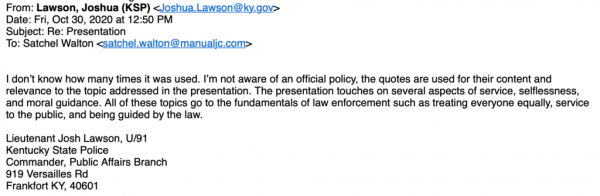
In a statement emailed to RedEye reporters, KSP spokesperson Lieutenant Joshua Lawson wrote, “The quotes are used for their content and relevance to the topic addressed in the presentation. The presentation touches on several aspects of service, selflessness, and moral guidance. All of these topics go to the fundamentals of law enforcement such as treating everyone equally, service to the public, and being guided by the law.”
In a separate email, Lawson also stated that the presentation seems to be seven years old and appears to have been made by an instructor at the academy. It is not clear how long the presentation was used, or if it is still used. (Editor’s note: According to a statement received after publication from Morgan Hall, the Communications Director for the Kentucky Justice and Public Safety Cabinet, the presentation was not used after 2013.)
Although the presentation also features quotes from a variety of other sources including Sun Tzu and Albert Einstein, Dr. Jack Glaser —a professor at the University of California Berkeley who studies police practices — found the Hitler quotes inexcusable.
“Hitler is, justifiably, the archetype of a bad person with the worst, inhumane morals. It’s controversial enough to quote him when trying to illustrate a point about genocidal despots. Quoting him in the manner that these trainings do —prescriptively —is unfathomable,” Glaser wrote in an email to RedEye reporters.
The training materials are coming to light during a national discussion about systemic racism and the role of police in communities, a debate centered on Kentucky after Louisville Metro Police Department officers shot Breonna Taylor in March.
Since 2018, KSP troopers have committed at least 16 fatal shootings according to a Washington Post database of police shootings, the most of any police force in the state. Troopers were not wearing body cameras during any of the shootings.
During the same timeframe, the Louisville Metro Police Department, the largest police force in the state, killed 15 people, including Taylor.
Greg Belzley, a Louisville area criminal rights and police misconduct lawyer, said he was “shocked and dismayed” by the presentation.
“This basically says, when you come into work, you need to have the mindset of getting ready to go out there and kick some ass,” Belzley said.
Belzley described the presentation as “something out of Borat,” referencing the satirical anti-Semitic reporter portrayed by Sacha Baron Cohen.
Glaser worries that the presentation “is a recipe for excessive force.”
“The tenor and substance of this training is very much at odds with contemporary police efforts to improve community relations and minimize excessive use of force,” Glaser stated.
One slide titled “The Thin Gray Line” uses a quote from Robert E. Lee and two photos of seemingly all-white groups of KSP officers in their traditional gray uniforms.
“It’s concerning that the Thin Gray Line slide has a quote from Robert E. Lee, given that Lee was the Confederate commander and Confederate uniforms were famously gray,” Glaser said.

The fifth slide in the presentation quotes Confederate General Robert E. Lee emphasizing the value of “manliness” over “policy.”
A closing slide of the Powerpoint simply states “Über Alles” in large text. The phrase, which was previously part of the German national anthem, translates to “above all” or “above everything else,” commonly used to signify national superiority. Modern Germans heavily associate the phrase with the Nazis.
Sadiqa N. Reynolds, President and CEO of the Louisville Urban League said the presentation was “unbelievable” and “disgusting.”
“The tone and tenor are overtly white, Christian, male, warlike and adversarial,” Reynolds said in a text message.
KSP did not respond to an open records request sent October 14 seeking additional records, which sought to find out how long the presentations were used in trainings and if any complaints had been lodged by cadets or other KSP personnel.
State and local governments and agencies are required to respond to open records requests within ten days during a state of emergency, and Kentucky has been under a state of emergency since March due to the COVID-19 pandemic.
In a deposition on October 14, KSP Captain James Goble said that Lieutenant Curt Hall, whose name is on the slideshow, taught “warrior mentality” trainings at the KSP Academy.
Hall was the Assistant Commander at the KSP Academy from 2005 to 2015, and later became Commander of Internal Affairs at KSP before recently retiring. The internal affairs unit is typically tasked with investigating police misconduct.
The KSP presentation appears to draw heavily from nationally-known police trainer Dave Grossman, who delivers lectures to police forces nation-wide on his theory of “killology” teaching police officers to embrace “the responsibility to kill” and “making it possible for people to kill without conscious thought,” as he said during an interview with PBS’s Frontline.
“The focus on warriors and combat is deeply problematic. It is exceedingly rare that police officers have to fight for their lives,” Glaser wrote in his email. “Even if it is sometimes necessary to use serious physical force, starting with a warrior mindset is not necessary and can make violent conflict more likely.”
A 2019 Florida State University Study found that officers who had a “warrior mentality” were more supportive of excessive use of force than those who believed in a “guardian mentality.”
“The guardian mindset emphasizes communication over commands, cooperation over compliance, and legitimacy over authority. And in the use-of-force context, the Guardian emphasizes patience and restraint over control, stability over action” explained former police officer and current law professor Seth Stoughton in a 2015 Harvard Law Review article.
“The language used places officers in direct opposition to the communities they serve — dehumanizing civilians while propping up law enforcement,” Reynolds stated. “This training is emblematic of the root problems in policing and we should not be surprised with the resulting fruits.”
HELICOPTERS OVER DC PROTESTERS BROKE REGULATIONS
By Katie Bo Williams, Defense One.
October 31, 2020
https://popularresistance.org/helicopters-over-dc-protesters-broke-regulations/
The D.C. National Guard And Pentagon IG Are Fighting Over Who To Blame For The Dangerous Incident That Symbolized Trump’s Militarized Response.
NOTE: This article comes from a defense industry publication. It shows another reason why the military should not be used when people are exercising their First Amendment rights – the military lacks clear communication, knowledge of rules and a chain of command structure that would prevent abuses. The reporter describes the incident as a “bungled game of telephone,” but this should not be accepted as an excuse. In this situation, it was not life-threatening, but soldiers are trained to kill enemies. Allowing the military in domestic situations makes the people an enemy and puts people at risk of harm. Nothing in this article is reassuring. – MF
Two D.C. National Guard helicopters that flew low over protesters in Washington, D.C., on the night of June 1 were not properly authorized to be there — and were directed by a lieutenant colonel who was far from the scene, driving home in his car, according to an initial investigation by the D.C. National Guard.
The superior officer who authorized the deployment claimed he didn’t know that the regulations required him to have higher-level approval to use the helicopters at all, and that in any case, he in no way told the lieutenant colonel that the helicopters should be used for crowd dispersal.
Now the D.C. National Guard and the Defense Department Inspector General’s office appear to be at odds over who should take responsibility for the incident, which became one of the most high-profile examples of President Donald Trump’s militarized response to protests over the killing of George Floyd, a Black man, by police officers in Minneapolis in May.
Senior Army and defense officials have for months claimed that they would soon release their report into the tasking of the helicopters. Yet the report has remained under lock and key, with officials saying nothing more than the report was currently in the hands of Acting Defense Department Inspector General Sean O’Connell, a Trump appointee.
The following article is based on internal Defense Department documents viewed by Defense One and on interviews with officials with knowledge of the events. It paints the most complete picture to date of the circumstances that led two D.C. National Guard helicopters to hover less than 100 feet above street level in what critics described as an unacceptable “show of force” against American citizens — and helps explain why, five months after the fact, there has still been no public explanation.
“Your Helicopters Are Looking Good!”
The whole debacle played out like a bungled game of telephone.
There were 1,200 D.C. National Guardsmen deployed in the Washington, D.C. area on the night of June 1. They had been summoned amid massive protests surrounding the White House, some of which had devolved into looting and other violent behavior. Thousands more had been mustered from other states through a controversial legal loophole, and the 82nd Airborne was staged outside of the city to respond if Trump invoked the Insurrection Act.
The D.C. Guard also had five helicopters on standby, thanks to operations orders signed in the previous two days by Maj. Gen. William Walker, who commands the district’s Guard. The two Lakotas and three Black Hawks were readied to provide medical evacuation, troop transport and other logistics needs, a source familiar with the events of June 1 said.
At roughly 7 p.m. that night, Lt. Col. Jeffrey Wingblade emailed his superior, Brig. Gen. Robert Ryan, to tell him that the Secret Service had given the Guard special permission to fly over the highly restricted airspace above the National Mall and the White House. Wingblade, as the lead aviation staff officer, was the subject matter expert and top advisor to D.C. Guard leadership on all matters involving Army National Guard aviation. Ryan was the commander of the division of the D.C. Guard responsible for responding to the civil unrest.
Shortly afterwards, Ryan called Wingblade, who was in his car driving home. The general told the lieutenant colonel to put the five helicopters into the air over the National Mall. In sworn interviews with D.C. Guard investigators, Ryan insisted that he did not instruct Wingblade to use the helicopters for crowd dispersal or intimidation, but rather to observe the protests, deter looting and other criminal activity, and provide emergency medical evacuation if necessary.
Ryan “believed the presence of military helicopters along the National Mall would be a general deterrent to the rioting and looting that had plagued the capital over the last few days and which necessitated the 1900 curfew and the presence of the D.C. National Guard in the first place,” according to an internal D.C. Guard memo from Aug. 3 detailing the timeline and the rationale behind the investigation’s findings.
Wingblade, in his interviews with D.C. Guard investigators, remembered it differently. He told investigators that Ryan told him “I need you to orbit around the cross to disperse any type of looting, mayhem, whatsoever.”
The D.C. Guard’s senior enlisted leader was also on the call, on speakerphone on Ryan’s end. He told investigators that, “At no time in the conversation did I hear BG Ryan instruct or authorize aviation assets to fly at low altitudes. Nor did BG Ryan speak of utilizing aviation assets to disperse crowds.”
Although every other key official involved in the response to the protests was at work somewhere in the Washington, D.C., area, Wingblade declined to return to Fort Belvoir’s Davison Army Airfield in Arlington, Va., according to the National Guard memo. Instead, he called his unit’s operations officer and the pilot-in-command of the UH-72A Lakota helicopter that would later be seen in viral videos hovering above the heads of protesters. According to the National Guard, Wingblade told none of his superiors that he was headed home.
In his interviews, Wingblade said that he told his two subordinates that “the tasking that I received was to kinda go over the crowds wherever there was any type of looting and then just try to orbit around the crowds, if there was any looting, and whatever that mission is, but just show a presence there if there is anything kinda crazy going on.”
These two pilots briefed the mission to the remaining pilots when they arrived at the airfield. Once the helicopters were in the air, Ryan texted D.C. Guard commander Walker to tell him that he had directed the deployment and that they were currently flying.
“Absolutely outstanding. Thanks,” Walker texted back.
Walker then told Army Secretary Ryan McCarthy of the deployment, who said that the helicopters should continue to “observe and report” on the situation below.
Sometime after the first helicopters launched — before they were seen hovering over frightened protesters — Ryan got a group text from a subordinate commander with a photo of one of the helicopters above the Lincoln Memorial Reflecting Pool.
“LTC Wingblade, your helicopters are looking good!!”
“OMG! I am out here too. Incredible. I got special permission to launch. Full authorities,” Ryan responded.
Not long after that, two of the five helicopters — a Black Hawk and a Lakota marked with the red cross emblem — were whipping up dirt and debris and buffeting tree branches above the heads of protesters gathered near the White House.
It caused an immediate uproar, both inside and out of the Pentagon. According to the D.C. Guard memo, one Army official reached out to Ryan directly the next day to raise concerns about the safety of the maneuver and the optics of using military helicopters in what many interpreted as a “show of force” against Americans exercising their First Amendment rights. Ryan, according to the memo, defended it in a text: “Presidential approval…Fully vetted.”
Outside critics, many of whom were former military, hammered the Guard and the president. In particular, critics homed in on the red cross emblazoned on the side of the low-hovering Lakota — the universal symbol for non-hostile medical intent. Black Hawks, others pointed out, are used in war zones like Afghanistan.
Because Trump has ultimate command over the D.C. National Guard through the Secretary of the Army, critics blamed his bellicose response to the protests.
“Normally, when the Guard goes on a mission in their state status, they’re under the direct authority of a governor or at the request of a governor,” said Mike Taheri, who retired as a two-star from the National Guard Bureau in August. “But in D.C., there’s no political accountability. The secretary of the Army doesn’t care about the people of D.C. — he cares about what Trump thinks.”
“Special Permission” … From Whom?
McCarthy, who as Army secretary heads the chain of the command for the D.C. National Guard, ordered an investigation into the matter. Initially, it was to be completed within weeks. By the first week of July, the results were on Gen. Walker’s desk, and the D.C. National Guard had a news release ready to go.
Walker, after reviewing the findings, concluded that Wingblade had garbled Ryan’s intent when he briefed members of his pilot team over the phone. As a result, the D.C. Guard believed, some of the air crew understood their mission to include flying low and loud to disperse the crowds gathered near the White House. The D.C. Guard believed the pilots acted in good faith and found no fault with Ryan’s conduct.
The investigation found that the low-flying helicopters were operated safely. In particular, the UH-72 Lakota that hovered over protesters near the intersection of 5th and E Streets had two engines, and could have safely made an emergency landing without endangering the protesters below had one failed.
But the report did find one major violation of Army regulations. The use of medical helicopters for non-medical missions requires higher-level approval — approval that was neither sought nor obtained for the June 1 mission. Four of the five helicopters were medevac aircraft. The National Guard laid the blame for that oversight at the feet of the aviation commander, Wingblade, who as the subject matter expert in the chain of command was responsible for knowing the relevant regulation and briefing his superior, Ryan.
In other words, four of the five helicopters over D.C. streets on the night of June 1 lacked the Army’s authorization to fly.
Walker, after reviewing the findings, recommended that Wingblade receive a formal reprimand, known as a GOMOR, for actions resulting in the unauthorized use of four ambulance aircraft. And he ordered the creation of new procedures to prevent the same kind of mix-up from happening again.
That’s when matters hit a snag. The investigation went to McCarthy’s office in the Pentagon. Then the Department of Defense Inspector General, which has first crack at any investigation involving a general officer if the IG wants, raised concerns about the report. The IG’s office argued that the report should have addressed the jurisdictional authorities governing that Guard’s presence in the city. Officials suggested that closer scrutiny of Ryan’s conduct was warranted, in particular suggesting that his lack of knowledge of the regulation governing non-medical use of hospital helicopters shouldn’t shield him from responsibility. The text message he sent to other Guard officials indicating that he had “special permission” to conduct flights in D.C. also created the impression that Ryan knew he needed permission and perhaps misinterpreted a potential directive from Secretary of Army, Gen. James McConville, or the Army Secretary, Ryan McCarthy.
On Aug. 3, D.C. National Guard leaders responded to the inspector general’s concerns with its memo laying out the rationale behind Walker’s ultimate findings.
It dismisses any argument that Ryan should have known that he needed permission from a higher-up to use the hospital helicopters.
“LTC Wingblade, whose job it is to know and to advise his superiors on applicable regulations and policies, appears to have lacked fundamental and essential knowledge or to have been willfully dissembling,” the memo states.
According to the memo, Ryan testified that when the videos of the incident went viral, he reached out to Wingblade for clarification and was told the use of the helicopters was authorized. Only later, Ryan said, did he learn that it had broken Army regulations. Wingblade, for his part, claimed that when he got the call to direct the deployment of the helicopters, Ryan said that he had gotten special permission to launch.
Walker credited Ryan and the senior enlisted officer’s accounts of the phone call over Wingblade’s version of events. The memo suggests that Wingblade may have misinterpreted Ryan’s text message that he got “special permission” to mean he had received a waiver from senior officials to use the hospital helicopters — when, according to Ryan, the “special permission” he was referring to was the authorization from the Secret Service to fly in the restricted airspace of the White House that Wingblade himself had conveyed to him in the earlier email.
The memo emphatically denies that McCarthy or McConville had any prior knowledge of the tasking of the helicopters until they were already in the air, at which point McCarthy said they should stay aloft to “observe.”
The memo also dismisses the inspector general’s concerns about the Guard’s jurisdiction, arguing that the D.C. National Guard’s authority is clear under the federal statute governing the District of Columbia and the long-recognized constitutional authority of the president to employ troops under his command to protect federal property and persons.
A Public Accounting?
But by the time the D.C. Guard sent the Aug. 3 memo to the inspector general, the matter was out of the Guard’s hands and belonged fully to McCarthy, who had tasked the investigation in the first place.
In September, according to a D.C. National Guard official, the Army inspector general refiled the report with the DOD inspector general. It is not clear what changes the Army inspector general made to the D.C. Guard’s original report and recommendations.
>A spokesman for the Defense Department inspector general, Dwrena Allen, said that the office is still reviewing the information provided by the Army IG and that the review is ongoing.
“We have asked additional questions and obtained documentation that was not previously included in the latest Army IG submission,” Allen said.
“As we conduct our oversight review, it may be necessary to obtain additional information from the Army to ensure a complete and final report,” she said in a statement. “At the conclusion of our oversight review, we will notify the Army of our results.”
It is not clear when that might be — or when the results may become public. McCarthy has said publicly that its release depends on the completion of the inspector general’s review of the matter — which he said on Oct. 13 was “imminent” — although the authority to release the report rests solely with the Army. According to an Army official, the Army typically doesn’t consider an investigation complete until all associated reviews are complete, including, in this case, the inspector general’s.
Allen denied that the upcoming election had any bearing on the timing of the IG office’s review.
The debate between the D.C. Guard and officials in the inspector general’s office has clearly become tense. A D.C. Guard official expressed concerns that the inspector general’s handling of the investigation has become politicized.
Sen. Tammy Duckworth, D-Illinois, a combat veteran and former helicopter pilot, in particular has pressured the inspector general and Defense Secretary Mark Esper to provide answers.
The D.C. Guard memo states that it was created for the “historical record” because the Guard is concerned it may never be able to release the findings. It raises specific concerns that the inspector general’s office is “steering” the focus of the investigation onto a more senior officer — Ryan — and “suggest[ing] without evidence that a more senior officer has potentially committed misconduct.”
Meanwhile, some guardsmen who were in the Washington, D.C., area during the protests suspect that what’s really happening is an effort to pin the blame on lower-ranking officials to protect more senior officials — some say Ryan, some say the Army secretary.
“I don’t know what those conversations were, but at the end of the day Ryan was the task force commander and one of the units that he was responsible for violated nearly every FAA law to include international law by using a medevac helicopter to forcibly disperse peaceful protesters,” said one D.C. guardsmen in Washington the night of the protests. “When you look at it in totality, you’re like, ‘Holy shit.’ Ryan needs to be held accountable.”
Others suspect the concern goes higher.
“They may very well be trying to protect the secretary of the Army and the chief of staff,” said Taheri, the retired National Guard Bureau two-star. “I suspect there was a lot more involvement from the highest level that they don’t want to highlight.”
Wolff Responds: No "Tradeoff" Between Fighting COVID-19 and the Economy
https://www.youtube.com/watch?v=W875dUMa0QM&ab_channel=RichardDWolff
Bidenomics: boom or bust?
by michael roberts
With just two days to go, all the public opinion polls indicate that Democratic Party candidate Joe Biden is going to win the US presidential election and oust incumbent Donald Trump. The Democrats will also solidify their majority in the lower house of the US Congress, the House of Representatives; and perhaps take over the upper house, the Senate. But even without the latter, Biden and the Democrats will have the political power to change the course of the COVID pandemic and the US economy over the next few years. But can they or will they do so?
First, let us remind ourselves of the challenges they face. The US economy is suffering the worst economic slump since the 1930s. The US Q3 GDP figures released a few days ago show that the US economy is still well below its pre-pandemic level.

US GDP is still 3.5% below its pre-pandemic level, while business investment is still some 5% below. Indeed, US real GDP is really back only to levels near the bottom of the last slump in the Great Recession of 2008-9.

And out of more than 22 million jobs lost in March and April during the lockdowns, only around 11.3 million have been recovered so far, while a new stimulus bill in the old Congress supposedly to help the unemployed was never approved.
Employed persons (000s)

While the Federal government has been supplied with funds from Congress, raised by the Federal Reserve through the purchase of government bonds, the states and local counties have been starved of funds and forced to lay off hundreds of thousands of public employees.
Meanwhile, the COVID pandemic continues to rage across the country with infection rates at record highs, encouraging people to stay at home to work (if they can); not to meet up, travel or spend on restaurants and leisure activities - even if many state governors continue to say it is fine to do so. As a result, the recovery in transactions and activities that began over the summer has stopped in its tracks. And there is still no ‘silver bullet’ of an effective vaccine in sight.

With business investment in productive activities showing little sign of recovery and employment well down, a return to the pre-pandemic trajectory of economic growth and employment is years away. Indeed, according to Oxford Economics, real GDP growth won't return to its previous trend at all. Far from a V-shaped economic recovery, or even a U-shaped one, it's a reverse square root trajectory, as I argued it would be.

It’s the same trajectory of economic growth that emerged after the Great Recession of 2008-9 that I spelt out in my book, The Long Depression. The US and other major capitalist economies appear to be entering another leg of that depression, ie low growth, low productive investment, low wage employment and, behind all that, low profitability in productive assets - even if the pandemic comes under control.
Remember before this pandemic erupted across the world, most capitalist economies, including the US, were already tipping into a recession, with investment slowing or even falling and production and trade stagnating.
Can a Biden administration do anything about this and is it willing to do so? According to the Biden economic team, the administration plans to increase public sector spending to compensate for the capitalist sector ‘investment strike’. Biden proposes to spend $2trn on infrastructure spending (something Trump never got round to) including ‘clean energy’ projects; just under $2trn on education and child care; $1.6trn on health care; $700bn on research and development; and $500bn on social security and housing. That’s a total of $6.8trn., or just over 30% of current GDP.
Wow! That sounds great. But hold your train; this spend is over 10 years! And this is just a proposal. Nobody expects all of this extra 2% of GDP spending a year to be implemented by Congress. Most estimates reckon that Biden’s proposals would be cut by 60% to about $3tn. The infrastructure and education proposals would be reduced by half, the health proposals would be lowered by 60% and the proposals to invest in R&D and buy American goods would be cut by two-thirds.
And then there is the method of paying for this. Biden proposes to raise taxes by $2.4trn over ten year (or $1.2trn if the spend measures are reduced). So nearly half of the spending plans would be clawed back in taxation. Most of the tax revenue would come from the top income earners particularly those in the million-dollar bracket. Also, corporation tax would be raised from the current 21% under Trump to 24% - but it would still be well under the 28% under Obama, so corporations would continue to benefit from windfall profits. Indeed, the increase would raise only a paltry $725bn over ten years. There would be no increases in property taxes for the rich. Overall, the most likely net spend after taxes under the Biden plan would be just around $1.8tn over 10 years, or no more than 0.8% of GDP a year!
So everything depends on the 'Keynesian multiplier' ie the increase in real GDP growth induced from an increase in government spending. Say the multiplier was as high as 2 or even 3 in the slump environment (that’s way higher than most studies show it would be ‘normally’ - it could be much lower than one), then Biden’s plan would boost real GDP growth next year by say 2% pts above the current likely growth rate next year. Biden’s plans also include boosting net immigration and pulling back on some of the tariffs on Chinese imports. Putting all this together, Oxford Economics reckons Biden’s plans would lead to a real GDP growth rate of 4.9-5.7% in 2021 compared to the status quo under Trump of 2.3-3.7%.
So even if it worked, Biden’s boom would amount to a maximum 2-2.5% pt of GDP boost to the economy over the next two years. That may get the US economy back to pre-COVID levels by the end of next year, but thereafter the growth trajectory would sink below even the weak pre-COVID growth path. The US economy would be trundling along at 1.5% a year for the foreseeable future and under 1% a year per capita GDP growth (after population increase is accounted for).

But these plans are unlikely to deliver anyway. Capitalist economies depend on investment by the capitalist sector. Capitalist investment in the US is about 15% of GDP, while government investment is less than 3% of GDP - that’s five times smaller. So it is the former that decides the pace of real GDP growth. Biden’s plans imply, at the maximum, an extra 1% of GDP in government investment; that's not to be ignored, but hardly enough to compensate for any stagnation or decline in capitalist investment.
And that stagnation is likely unless the profitability of capitalist productive investment rises sharply under Biden. US corporate profitability is currently at a post 1945 low. Don’t be fooled by the huge profits being made by the likes of Apple, Microsoft, Facebook, Google, Netflix etc. The profits of the FAANGs are the exception that proves the rule. Outside this charmed circle, US companies are struggling to make sufficient profit to expand investment, despite historic low interest rates in order to borrow funds for investment. If interest rates do start to rise again in any recovery, particularly for small to medium sized companies which can only just service existing debts (so-called zombie companies), then far from a recovery, there could be a financial bust.

And then there is the public sector debt. Under Biden’s plan, the US Federal budget deficit will rise a cumulative $2 trillion during his first term. Publicly traded federal debt as a percent of GDP will increase from 108% when he takes office to 120% by the end of his term and 130% of GDP by the end of the decade. So even if the Federal Reserve maintains its current ‘zero interest rate’ policy and long-term bond yields remain low, the interest on government debt will rise by at least 1% of GDP. That will eat into available revenue to spend on public services. As public debt and the cost of servicing it rises, the pressure will mount on the Biden administration to ‘balance the budget’, revoke the spending plans and/or apply more tax increases on the general public.
You might say that politicians and mainstream economic policy have learnt their lesson and now realise that ‘austerity’ only makes things worse by reducing spending and ‘effective demand’. So austerity policies won’t be revived. After all, even the IMF is saying ‘spend as much as necessary and don’t worry about the consequences for debt now’. But that’s now - in the depth of the pandemic slump. When debt costs and government measures mount on the capitalist sector, capitalism will look to protect already weak profits by cutting government taxes and spending.
The supporters of Modern Monetary Theory may cry out at this point and argue that governments do not need to borrow money through debt issuance and so run up interest costs. They can just get the central banks to ‘print’ the currency and put it in the government coffers. Rising public debt is then not an obstacle to government investment and spending in order to boost the economy and deliver full employment. In a way, that is right if government spending is productive for the economy. But what is an obstacle is the willingness and capability of the capitalist sector to invest if profitability is low.
How much government investment would be necessary to replace capitalist investment and get the US economy growing at rates that restore and raise real wages, achieve full employment and apply resources and innovation to combat climate change? It would require ‘war economy’ levels when federal government investment rose to 23% of GDP and the government controlled and directed the capitalist sector to invest.
That is not on Biden’s agenda or, for that matter, on the agenda of MMT supporters, because such a move would be way more than just ‘stimulating’ the capitalist sector but actually mean ‘replacing’ its investment role. It would mean an economic revolution not wanted by Biden, and not envisaged by MMT.
In an editorial entitled “Bidenomics can preserve support for capitalism”, the Financial Times put it thus: “Since John Maynard Keynes, the best case for state intervention has not been to abolish the market, but to preserve public support for it”; and while “if implemented, Bidenomics would make life more burdensome for business and for high-earners, it might also avert a larger reckoning further down the line.”
That's the aim of Bidenomics.
Chris Hedges on Biden vs. Trump & the Coming Economic Hunger Games
https://www.youtube.com/watch?v=_I2hqcOhmDE&ab_channel=StatusCoup
Subscribe to:
Posts (Atom)