Tuesday, October 20, 2020

Bolivian Coup against Evo Morales Fails! Democracy and Socialism Restored by Luis Arce and MAS


https://www.youtube.com/watch?v=G3tqZrKMxaU&ab_channel=ChristoAivalis


FaceBook & Twitter Become State Media


https://www.youtube.com/watch?v=o9SPE-rpAQ4&ab_channel=HardLensMedia


The Moment From Amy Coney Barrett’s Hearing You HAVE TO See


https://www.youtube.com/watch?v=50XRR_voMko&ab_channel=TheHumanistReport


The Moment From Amy Coney Barrett’s Hearing You HAVE TO See


https://www.youtube.com/watch?v=50XRR_voMko&ab_channel=TheHumanistReport


The Corrupt Right-Wing Judge Pipeline Explained


https://www.youtube.com/watch?v=ctaQCrydBnI&ab_channel=SecularTalk


Sunday, October 18, 2020

How Lincoln Remade the Supreme Court


Amid national crises, Lincoln and his Republicans remade the Supreme Court to fit their agenda

October 16, 2020 Calvin Schermerhorn THE CONVERSATION


https://portside.org/2020-10-16/how-lincoln-remade-supreme-court

As a political battle over the Supreme Court’s direction rages in Washington with President Donald Trump’s nomination of Amy Coney Barrett, history shows that political contests over the ideological slant of the Court are nothing new.

In the 1860s, President Abraham Lincoln worked with fellow Republicans to shape the Court to carry out his party’s anti-slavery and pro-Union agenda. It was an age in which the court was unabashedly a “partisan creature,” in historian Rachel Shelden’s words.

Justice John Catron had advised Democrat James K. Polk’s 1844 presidential campaign, and Justice John McLean was a serial presidential contender in a black robe. And in the 1860s, Republican leaders would change the number of justices and the political balance of the Court to ensure their party’s dominance of its direction.
Overhauling the Court

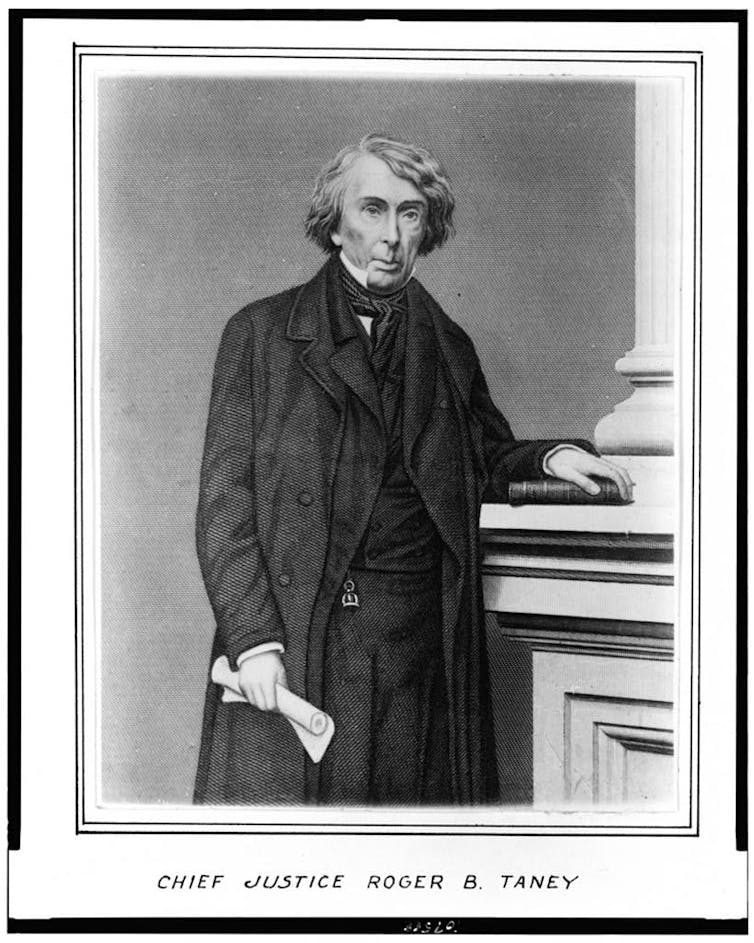
When Lincoln became president in 1861, seven Southern states had already seceded from the Union, yet half of the Supreme Court justices were Southerners, including Chief Justice Roger B. Taney of Maryland. One other Southern member had died in 1860, without replacement. All were Democratic appointees.

The Court was “the last stronghold of Southern power,” according to one Northern editor. Five sitting justices were among the court’s 7-2 majority in the racist 1857 Dred Scott v. Sandford ruling, in which Taney wrote that Black people were “so far inferior that they had no rights which the white man was bound to respect, and that the negro might justly and lawfully be reduced to slavery for his benefit.”

Some Republicans declared it “the duty of the Republican Party to reorganize the Federal Court and reverse that decision, which … disgraces the judicial department of the Federal Government.”

After Lincoln called in April, 1861 for 75,000 volunteers to put down the Southern rebellion, four more states seceded. So did Justice John Archibald Campbell of Georgia, who resigned on April 30.

Chief Justice Taney helped the Confederacy when he tried to restrain the president’s power. In May 1861, he issued a writ of habeas corpus in Ex Parte Merryman declaring that the president couldn’t arbitrarily detain citizens suspected of aiding the Confederacy. Lincoln ignored the ruling.

Chief Justice Roger Taney tried to limit Lincoln’s powers in the Civil War. Library of Congress Prints and Photographs Division
Remaking the Court

To counter the court’s southern bloc, Republican leaders used judicial appointments to protect the president’s power to fight the Civil War. The Lincoln administration was also looking ahead to Reconstruction and a governing Republican majority.

Nine months into his term, Lincoln declared that “the country generally has outgrown our present judicial system,” which since 1837 had comprised nine federal court jurisdictions, or “circuits.” Supreme Court justices rode the circuit, presiding over those federal courts.

Republicans passed the Judiciary Act of 1862, overhauling the federal court system by collapsing federal circuits in the South from five to three while expanding circuits in the North from four to six. The old ninth circuit, for example, included just Arkansas and Mississippi. The new ninth included Missouri, Kansas, Iowa and Minnesota instead. Arkansas became part of the sixth, and Mississippi, the fifth.

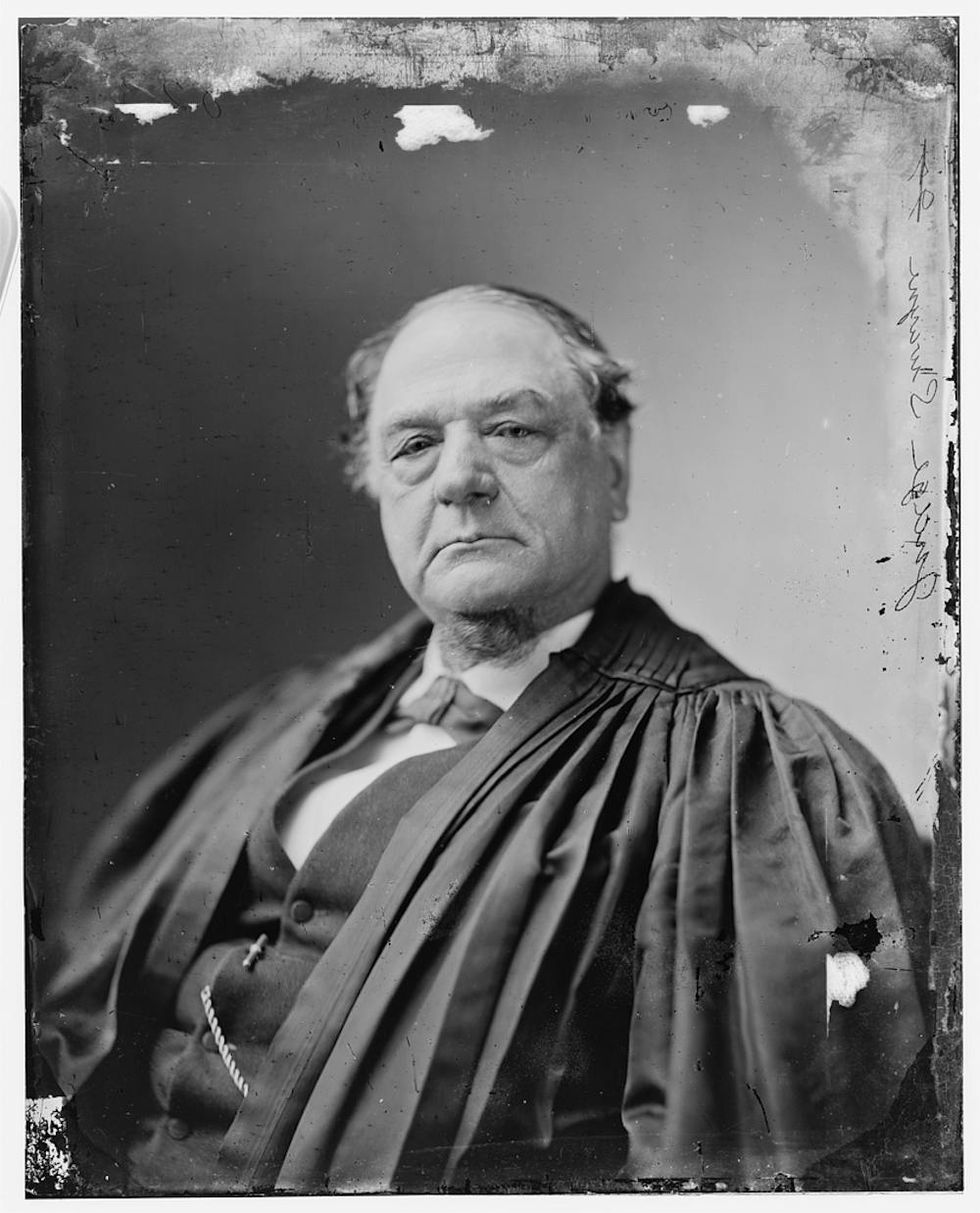
In 1862, after Campbell’s resignation and McLean’s death, Lincoln filled three open Supreme Court seats with loyal Republicans Noah H. Swayne of Ohio, Samuel Freeman Miller of Iowa and David Davis of Illinois. The high court now had three Republicans and three Southerners.

The 1863 Prize cases tested whether Republicans had managed to secure a friendly court. At issue was whether the Union could seize American ships sailing into blockaded Confederate ports. In a 5-4 ruling, the high court – including all three Lincoln appointees – said yes.

Congressional Republicans spied a way to expand the court while solving what amounted to a geopolitical judicial problem. In 1863, Congress created a new tenth circuit by adding Oregon, which had become a state in 1859, to California’s circuit. The Tenth Circuit Act also added a tenth Supreme Court justice. Lincoln elevated pro-Union Democrat Stephen Field to that seat.

And after Chief Justice Taney died in 1864, Lincoln selected his political rival, Treasury Secretary Salmon P. Chase, an architect of national monetary policy, to replace him. With Chase, Lincoln succeeded in creating a pro-administration high court.
Unpacking the Court

After Lincoln’s assassination in April 1865, President Andrew Johnson of Tennessee, who succeeded him, soon began undoing Lincoln’s achievements. He was a Unionist Democrat given the vice presidency as an olive branch to the South. He rewarded that gesture in part by pardoning rank and file Confederates. Johnson also opposed civil rights for newly-freed African Americans.

He also threatened to appoint like-minded judges. But the Republican-dominated Congress blocked Johnson from elevating unreconstructed Rebels to the high court. The Judicial Circuits Act of 1866 shrank the number of federal circuits to seven and held that no Supreme Court vacancies would be filled until just seven justices remained.

The Philadelphia Evening Telegraph’s Democratic editor sighed that at least Republicans “cannot pack the Supreme Court at this moment.”


Lincoln appointed three Republicans to the Court in 1862, including then-Judge Noah H. Swayne. Library of Congress Brady-Handy Collection
Courting paper money

Republicans refused to consider nominating Johnson in 1868, picking General Ulysses S. Grant instead. He won, and after President Grant’s inauguration, Congress passed the Circuit Judges Act of 1869, raising back to nine the number of Supreme Court justices.

Shortly after, Republicans faced a financial problem of their own making.

Beginning in 1862, Congress had passed three Legal Tender Acts – initially to help finance the war, authorizing debt payments using paper money not backed by gold or silver. Then-Treasury Secretary and current Chief Justice Salmon P. Chase had crafted the legislation.

But in an 1870 case, Hepburn v. Griswold, Chase reversed himself in a 4-3 decision, ruling the Legal Tender Acts unconstitutional. That threatened national monetary policy and Republicans’ cozy relationship with industries reliant on government sponsorship.

President Grant, preparing for Chase’s ruling, was already working on a political solution. On the day of the Hepburn decision, he appointed two pro-paper-money Supreme Court nominees, William Strong of Pennsylvania and Joseph P. Bradley of New York. Comparing the Republican administration to “a brokerage office,” a Democratic newspaper howled that “the attempt to pack the supreme court to secure a desired judicial decision … (has) brought shame and humiliation to an entire people.”

It also brought a Republican majority to the high court for the first time.

Chief Justice Chase opposed revisiting the paper money issue. But the Supreme Court about-faced, ruling 5-4 in the 1871 cases Knox v. Lee and Parker v. Davis that the government could indeed print paper money to pay debts. Chase died in 1873, and his successor Morrison Waite championed the Republican pro-business agenda.
Careful what you wish for

Republican transformation of the federal judiciary in the 1860s and 1870s served the party well in the Civil War and constructed a legal framework for a modernizing industrial economy.

[Deep knowledge, daily. Sign up for The Conversation’s newsletter.]

But in the end Lincoln and Grant’s high court appointments ended up being disastrous for civil rights. Justices Bradley, Miller, Strong and Waite tended to constrain civil rights protections like the Fourteenth Amendment, which guarantees equal protection of laws. Their rulings in United States v. Cruikshank in 1876 and Civil Rights Cases in 1883 both sounded the retreat on Black civil rights.

In remaking the court in Republicans’ image, the party got what it wanted – but not what was needed to fulfill the promise of “a new birth of freedom.”

Progressives Sign Letter vs a Corporate Cabinet


"The next White House should belong to the people, not corporate America," said Jamaal Bowman, a New York Democrat.

October 16, 2020 Brett Wilkins COMMON DREAMS


https://portside.org/2020-10-16/progressives-sign-letter-vs-corporate-cabinet


A group of progressive lawmakers, candidates, and organizations have collectively signed a letter urging Democratic presidential nominee Joe Biden to eschew appointing corporate executives and lobbyists to his administration if he is elected, Politico reported Friday.

According to Politico, signatories to the letter include Reps. Alexandria Ocasio-Cortez (D-N.Y.), Rashida Tlaib (D-Mich.), Pramila Jayapal (D-Wash.), RaΓΊl Grijalva (D-Ariz.), Barbara Lee (D-Calif.), and New York congressional candidate Jamaal Bowman.


Groups that signed include Public Citizen, Communications Workers of America, Greenpeace USA, the Progressive Change Campaign Committee—which is closely associated with Sen. Elizabeth Warren (D-Mass.), and Our Revolution, founded by supporters of Sen. Bernie Sanders (I-Vt.).

"One of the most important lessons of the Trump administration is the need to stop putting corporate officers and lobbyists in charge of our government," the letter, which was delivered to Senate Majority Leader Mitch McConnell (R-Ky.) and Senate Minority Leader Chuck Schumer (D-N.Y.) on Friday morning, states.

The letter specifically argues that K Street and Wall Street executives should not be nominated for any position that requires Senate confirmation.

"As elected leaders, we should stop trying to make unsupportable distinctions between which corporate affiliations are acceptable for government service and which are not," it asserted.

Grijalva told Politico that the letter "is not addressed to Biden" specifically, but that "there's an understanding that he’d be in charge and be the person making nominations."

The letter is a reminder of the stark differences between the progressive and the corporate wings of the Democratic Party—Ocasio-Cortez famously said earlier this year that "in any other country, Joe Biden and I would not be in the same party"—that would likely come to the forefront should President Donald Trump be defeated.


Although Trump loves to tout the stock market gains that have occurred during his tenure, Wall Street has donated more money to Biden and Democrats this election cycle than to the president and his party. Biden has praised and reassured corporate leaders, shareholders, and the wealthiest Americans, promising to not "demonize" them and vowing that "nothing would fundamentally change" for them if he is elected.

Many progressives assert that there is much cause for concern, if Biden's tenure in Congress and as vice president are any indicator of how he would run the country if elected.

The former senator from Delaware—a state known as a haven for banks and corporate headquarters—cast key votes to deregulate the banking and financial services industries, which showered him in campaign cash and other support. Biden was also a leading champion of a bill that made it much more difficult for Americans to declare bankruptcy—just before the most devastating economic crisis since the Great Depression.


As vice president during what many progressives derisively called the "Goldman Sachs administration"—for the number of Wall Street and corporate executives it employed, the amount of corporate donations it received, and how it was influenced by big money interests—Biden played a key role in advancing what many saw as President Barack Obama's Wall Street and corporatist agenda.

The new letter addresses some of these concerns, including the so-called "revolving door" between the public and private sectors that has characterized both Republican and Democratic administrations.

"The revolving door needs to stop, not just change direction every few years," it says.

Left-leaning lawmakers including Ocasio-Cortez have previously warned Biden not to take progressives for granted, and to better address the needs of what Sanders and others have called the "99 Percent."

"I think people understand that there are limits to what Biden will do and that's understandable—he didn't run as a progressive candidate," Ocasio-Cortez said earlier this year. "But, at the bare minimum, we should aspire to be better than what we have been before."

Many progressive activists, wary of being spurned and burned again as they feel they were by Obama, are nevertheless preparing to—as Noam Chomsky, Medea Benjamin, and other left activists said in a recent letter of their own—"dump Trump, then battle Biden."

"Bernie has been very clear that after the election ... we're going to hold Biden's feet to the fire on his progressive commitments that he has made," Faiz Shakir, a senior advisor to Sanders, told the Los Angeles Times on Thursday.


Shakir ended on a positive note, acknowledging that Biden "has made some pretty solid commitments" on climate policy.

Progressives note that it was incessant pressure from grassroots activists that made Biden's $2 trillion green energy plan as ambitious as it is, and they're betting and hoping that more of the same persuasive persistence will bear better fruit than the sour grapes of the Obama, Clinton, and Carter presidencies.