Sunday, October 18, 2020

Unemployment was supposed to be temporary. Now, it’s permanent for almost 4 million


PUBLISHED TUE, OCT 13 202010:16 AM EDTUPDATED TUE, OCT 13 20203:25 PM EDT


Greg Iacurci@GREGIACURCI


https://www.cnbc.com/2020/10/13/covid-related-unemployment-is-now-permanent-for-almost-4-million.html


KEY POINTS


Millions of Americans have headed back to work since the depths of the coronavirus-induced recession in the spring.

But nearly 13 million remain unemployed — about 7 million more workers than pre-pandemic levels.


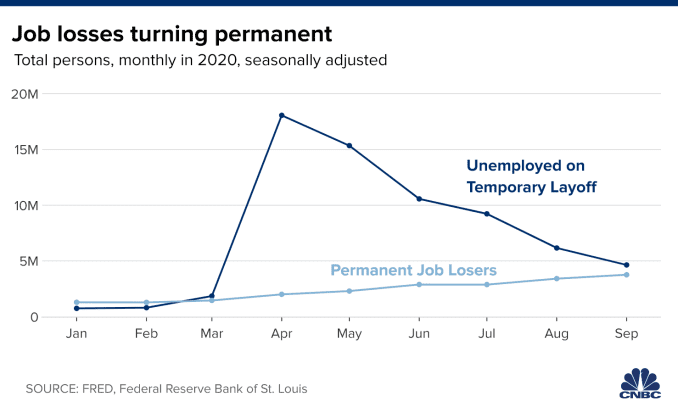
And there are worrying trends emerging among this group. Namely, a growing share of job loss is permanent (rather than temporary) and is longer-term in nature, stretching out beyond six months.

These trends carry negative financial effects for the unemployed and their families, including lost income, reduced likelihood of finding a job and lower earnings when (and if) they get one, according to economists.


The recession has hit lower-wage workers and minorities — who are less likely to be able to withstand these financial shocks — harder than other groups.

“The impacts [this] will have on the community are tremendous,” said Behnaz Mansouri, a senior attorney with the Unemployment Law Project.
Permanent layoffs


The mass unemployment that hit in April was overwhelmingly thought to be a temporary phenomenon that would quickly rebound as businesses reopened, Mansouri said.


Nearly 4 in 5 unemployed workers — representing more than 18 million people — were on temporary layoff at the height of the unemployment crisis and expected to be recalled to work.

That number has since fallen to about 4.6 million, or about 37% of the unemployed, as of September — still higher than any period since modern record keeping began in the 1960s.

The longer you are out [of a job], the more damage it can do.
Heidi Shierholz
DIRECTOR OF POLICY AT THE ECONOMIC POLICY INSTITUTE


That dynamic of the temporarily unemployed being recalled to work is the primary reason the unemployment rate has nearly halved to 7.9% since April, according to economists.

At the time same, “permanent” job loss has been increasing. In September, the number of permanent job losses grew by 345,000 to 3.8 million, according to the Bureau of Labor Statistics. That figure exceeds pre-pandemic levels by 2.5 million people.

This suggests some layoffs once thought temporary have instead become permanent, economists said.


WATCH NOW
VIDEO02:05
Economy is slowing heading into fourth quarter: Economist


Further, companies have begun initiating layoffs on a trajectory similar to traditional recessions, economists said, as slowdowns in consumer demand (rather than state-mandated shutdowns) lead them to cut jobs or close for good.

Companies such as Allstate, American Airlines, Disney, Royal Dutch Shell and United Airlines have each announced plans to cut thousands of workers in recent weeks.

More from Personal Finance:
Unemployment may pay just $5 a week without stimulus deal
What Biden’s tax proposals mean for households
Amazon Prime Day is starting — here are the best deals

More than 800,000 people filed new applications for unemployment insurance last week, which, roughly seven months into the downturn, is significantly higher than the 188,000 who did so at the same time last year, according to the Labor Department.

“We’re still at a high level of layoffs in the economy,” said Susan Houseman, VP and research director at the W.E. Upjohn Institute for Employment Research. “The new job losses will, by and large, be perceived as permanent.”
Long-term unemployment


Long-term unemployment, a period exceeding six months, has increased substantially as this job loss has taken root.

Around 2.4 million Americans were unemployed for 27 weeks or more in September, up 781,000 from the month prior, according to the Bureau of Labor Statistics.

Long-term unemployment last ballooned during the Great Recession, hovering around 40% of the overall jobless population from late 2009 into 2013, according to an Urban Institute report. It had never previously risen above 30% since the Great Depression, the report said. The share is currently around 19% and rising.


During the Great Recession, family incomes fell 40% or more for most long-term unemployed workers, the institute said. This makes it more likely families can’t pay their bills, stay in their home, or afford food and medicine, in addition to related but intangible negative effects like emotional and mental effects, Mansouri said.

The long-term unemployed were almost twice as likely to be poor as those jobless less than six months, and almost four times as likely to be poor as those who hadn’t become unemployed, according to the report.

Further, in late 2011, 63% reported having skipped dental visits, 56% deferring needed health care and 40% not filling a prescription, according to the report. Each instance was about twice the proportion of full-time workers.


WATCH NOW
VIDEO02:48
How unemployment benefits are calculated

‘More damage’


“The longer you are out [of a job], the more damage it can do,” said Heidi Shierholz, director of policy at the Economic Policy Institute, a left-leaning think tank and former chief economist at the Department of Labor during the Obama administration.

Workers’ networks of business contacts often fray, making it harder to find a new job, at a time when employers may not look favorably on hiring a candidate who’s been out of work for months, according to economists.

Similarly, workers’ skills may erode as more time passes, leading to the potential for reduced wages or difficulty finding a new job, according to the Urban Institute.

Low-wage, minority and less-educated workers have been much more likely to lose their jobs in the coronavirus recession given its outsized impact on the hospitality and service sectors.


WATCH NOW
VIDEO04:10
How the pandemic has affected minority-owned small businesses


“They don’t have savings. They don’t have reserves,” Mansouri said.

Enhanced unemployment benefits have helped make up some of the income shortfall associated with losing a job.

Workers received a $600 weekly supplement to state unemployment benefits from a federal relief package enacted in March. Without that enhancement, which ended in July, unemployment benefits pay about 39% of workers’ prior paychecks on average, according to the Labor Department.

A Trump administration program created in August paid up to $1,800 in extra federal benefits to workers. But that benefit has ended in many states.

Lawmakers have been debating the contours of another relief package for weeks but remain in limbo as to whether any additional aid is coming.

Wolff Responds: Critique of Libertarianism and Crony Capitalism


https://www.youtube.com/watch?v=POtqYiBAgTM&ab_channel=RichardDWolff


Trump’s COVID Rally - Jordan Klepper Fingers The Pulse | The Daily Social Distancing Show


https://www.youtube.com/watch?v=SH329MmRikQ&feature=emb_logo&ab_channel=TheDailyShowwithTrevorNoah


The Nightmare Facing the Poor and Working Class If There’s Not Another Stimulus


With time running out and Republicans balking at more Covid relief, U.S. workers are facing a future of financial misery.
JEFF SCHUHRKE OCTOBER 12, 2020


https://inthesetimes.com/article/stimulus-covid-pandemic-gop-checks-relief


As mil­lions of U.S. work­ers face unem­ploy­ment, food inse­cu­ri­ty and evic­tion amid the coro­n­avirus pan­dem­ic, the lim­it­ed aid pro­vid­ed by the fed­er­al government’s flawed CARES Act from March has long since dried up.

Last week, fol­low­ing more than six months of stalled nego­ti­a­tions with con­gres­sion­al Democ­rats over a new eco­nom­ic relief pack­age, Pres­i­dent Trump abrupt­ly announced he was halt­ing talks until after the Novem­ber election.

While the pres­i­dent quick­ly back­tracked and is now report­ed­ly con­tin­u­ing to nego­ti­ate, the fed­er­al government’s ongo­ing fail­ure to pass a new relief pack­age spells cat­a­stro­phe for a U.S. work­ing class already pushed to the brink by an eco­nom­ic cri­sis seem­ing­ly on par with the Great Depression.

Here’s a break­down of what the con­tin­ued lack of fed­er­al help means for workers:

Sig­nif­i­cant­ly reduced unem­ploy­ment checks

Per­haps the most ben­e­fi­cial part of the CARES Act was the extra $600 a week it pro­vid­ed to work­ers on unem­ploy­ment — a tem­po­rary life­line that the GOP-led Sen­ate allowed to expire on July 31.

Week­ly unem­ploy­ment ben­e­fits vary wide­ly by state, rang­ing from $44 in Okla­homa to $497 in Wash­ing­ton. The $600 week­ly sup­ple­ment was an across-the-board ben­e­fit that ensured unem­ployed work­ers in any state main­tained a decent income despite los­ing their jobs due to the pandemic.

The Eco­nom­ic Pol­i­cy Insti­tute found that the con­sumer spend­ing gen­er­at­ed by that extra $600 per week sup­port­ed over 5 mil­lion jobs, and that con­tin­u­ing the sup­ple­ment through the mid­dle of next year would have raised U.S. gross domes­tic prod­uct (GDP) by a quar­ter­ly aver­age of 3.7 percent.

After this ben­e­fit expired, rather than agree to Democ­rats’ demands to extend it, Pres­i­dent Trump signed an exec­u­tive order slash­ing it by 50 per­cent — allow­ing states to use fed­er­al funds to pro­vide only a $300 week­ly unem­ploy­ment sup­ple­ment. At least sev­en states have already exhaust­ed these funds.

Mean­while, by los­ing the week­ly $600 boost, unem­ployed work­ers saw their incomes drop by two-thirds, mak­ing it more dif­fi­cult to pay the bills and afford gro­ceries. There are cur­rent­ly 25.5 mil­lion work­ers receiv­ing unem­ploy­ment ben­e­fits. With at least 14 mil­lion more job­less work­ers than job open­ings, mil­lions will be forced to rely on unem­ploy­ment insur­ance for the fore­see­able future — but now with a great­ly reduced check.

Mass fur­loughs in the air­line industry

Anoth­er one of the CARES Act’s most help­ful pro­vi­sions was the Pay­roll Sup­port Pro­gram (PSP), which pro­vid­ed $32 bil­lion in grants to the avi­a­tion indus­try for the sole pur­pose of keep­ing work­ers on pay­roll and pro­vid­ing ben­e­fits dur­ing the Covid-19 cri­sis. The avi­a­tion indus­try employs 750,000 work­ers, many of them union­ized, and accounts for 5 per­cent of GDP.

The Sen­ate allowed the PSP to expire on Octo­ber 1, result­ing in 40,000 air­line work­ers imme­di­ate­ly being fur­loughed with­out pay or health insur­ance. The industry’s unions are wag­ing an aggres­sive cam­paign to extend the pro­gram. With­out the fed­er­al gov­ern­ment con­tin­u­ing the PSP, more fur­loughs are like­ly to come as pas­sen­ger air­lines suf­fer a loss in busi­ness due to the pandemic.

More lay­offs at small businesses

The Pay­check Pro­tec­tion Pro­gram (PPP), anoth­er com­po­nent of the CARES Act, offered up to $659 bil­lion in for­giv­able loans to small busi­ness­es to keep work­ers on pay­roll. The pro­gram has been crit­i­cized for allo­cat­ing mil­lions of dol­lars to large cor­po­ra­tions and com­pa­nies con­nect­ed to politi­cians, but it has also offered much-need­ed finan­cial sup­port to small busi­ness­es across the country.

The appli­ca­tion dead­line for PPP loans was on August 8. While the Trump admin­is­tra­tion claims the pro­gram saved 51 mil­lion jobs, econ­o­mists have put that num­ber at any­where from only 2.3 mil­lion to 13.6 mil­lion.

What­ev­er the pre­cise num­ber, the PPP’s impact is quick­ly run­ning out of steam. Bor­row­ers say they expect to lay off work­ers with­in six months, while a Nation­al Restau­rant Asso­ci­a­tion sur­vey indi­cates that a whop­ping 40 per­cent of all U.S. restau­rants could go out of busi­ness in the com­ing months, lead­ing to mil­lions of more layoffs.

No sec­ond $1,200 stim­u­lus check

While Sen. Bernie Sanders and pro­gres­sive Democ­rats have been call­ing on the fed­er­al gov­ern­ment to pro­vide a $2,000 month­ly check to every U.S. adult for the dura­tion of the pan­dem­ic, the CARES Act instead pro­vid­ed a one-time check of $1,200 — which exclud­ed many undoc­u­ment­ed immi­grants and col­lege-age adults. Econ­o­mists report that the checks did vir­tu­al­ly noth­ing to stim­u­late the econ­o­my, though they did help poor and unem­ployed work­ers par­tial­ly cov­er a few weeks’ worth of basic expenses.

Pres­i­dent Trump and con­gres­sion­al lead­ers have been say­ing for months that a sec­ond $1,200 check is on the way. But with­out anoth­er relief bill, even this mea­ger finan­cial assis­tance will not materialize.

An uncer­tain future

On Octo­ber 1, the Demo­c­ra­t­ic-con­trolled House of Rep­re­sen­ta­tives passed a scaled-down ver­sion of the HEROES Act, an eco­nom­ic relief pack­age they orig­i­nal­ly passed in May that extends the lim­it­ed aid from the CARES Act.

Among oth­er things, the $2.2‑trillion bill would con­tin­ue the $600 week­ly unem­ploy­ment sup­ple­ment to the end of Jan­u­ary (mak­ing it retroac­tive to Sep­tem­ber 6), allo­cate anoth­er $25 bil­lion for air­line work­ers, allow small busi­ness­es to apply for a sec­ond PPP loan, send out a sec­ond $1,200 stim­u­lus check, pro­vide $50 bil­lion in emer­gency rental assis­tance, and give an addi­tion­al $10 bil­lion to the Sup­ple­men­tal Nutri­tion Assis­tance Pro­gram (SNAP).

Over the week­end, the Trump admin­is­tra­tion coun­tered with a small­er, $1.8‑trillion pro­pos­al that would include a $400-per-week unem­ploy­ment sup­ple­ment, $20 bil­lion for air­lines, anoth­er $330 bil­lion for PPP loans, and a sec­ond $1,200 check, among oth­er mea­sures — but nei­ther House Speak­er Nan­cy Pelosi nor Sen­ate Repub­li­cans appear ready to push this bill in their caucus.

While mil­lions of U.S. work­ers are left in the lurch and mass lay­offs con­tin­ue to mount, Trump and Sen­ate Repub­li­cans are instead focus­ing their atten­tion on ensur­ing right-wing, anti-union judge Amy Coney Bar­rett is hasti­ly con­firmed to the Supreme Court in time for the election.

“If this gov­ern­ment doesn’t work for us, then we need to focus on the fact that it is our labor that gives all the val­ue to this coun­try,” Asso­ci­a­tion of Flight Atten­dants pres­i­dent Sara Nel­son — who famous­ly called for a gen­er­al strike to end Trump’s fed­er­al shut­down in Jan­u­ary 2019—said last week. ​“This coun­try doesn’t run with­out us as work­ers. So we have to think about that option as well.”

Even Other Senate Democrats Are Mad at Dianne Feinstein—And Rightfully So


https://www.youtube.com/watch?v=JFtq2tO0GUc&ab_channel=TheHumanistReport


Push to pursue COVID-19 herd immunity called 'dangerous'


https://www.youtube.com/watch?v=_3ZqORDLM5M&ab_channel=CBCNews%3ATheNational


White House Blocked C.D.C. From Requiring Masks on Public Transportation


The order would have mandated that both passengers and employees wear face coverings on planes, trains, buses and subways and in airports, stations and depots.


By Sheila Kaplan
Oct. 9, 2020


https://www.nytimes.com/2020/10/09/health/coronavirus-covid-masks-cdc.html?smtyp=cur&smid=tw-nytimes


The Centers for Disease Control and Prevention drafted a sweeping order last month requiring all passengers and employees to wear masks on all forms of public and commercial transportation in the United States, but it was blocked by the White House, according to two federal health officials.

The order would have been the toughest federal mandate to date aimed at curbing the spread of the coronavirus, which continues to infect more than 40,000 Americans a day. The officials said that it was drafted under the agency’s “quarantine powers” and that it had the support of the secretary of health and human services, Alex M. Azar II, but the White House Coronavirus Task Force, led by Vice President Mike Pence, declined to even discuss it.

The two officials, who spoke on condition of anonymity because they were not authorized to comment, said the order would have required face coverings on airplanes, trains, buses and subways, and in transit hubs such as airports, train stations and bus depots.

A task force official said the decision to require masks should be left up to states and localities. The administration requires the task force to sign off on coronavirus-related policies.


“The approach the task force has taken with any mask mandate is, the response in New York City is different than Montana, or Tuscaloosa, Alabama,” said the official who asked not to be identified because he did not have permission to discuss the matter. “Local and state authorities need to determine the best approach for their responsive effort depending on how the coronavirus is impacting their area.”


Most public health officials believe that wearing masks is one of the most effective ways to protect against the spread of the virus, particularly in crowded, poorly ventilated public places that attract people from all over, like transportation venues. Many feel that the Trump administration has turned the wearing — or not wearing — of masks into a political expression, as seen most dramatically on Monday evening when President Trump whipped off his surgical mask at the White House door after returning from the hospital where he was treated for Covid-19.


“I think masks are the most powerful weapon we have to confront Covid and we all need to embrace masks and set the example for each other,” Dr. Robert R. Redfield, the C.D.C. director, who oversaw the drafting of the order, said in a recent interview.

Dr. Redfield has been publicly at odds with President Trump for promoting mask wearing along with social distancing, and for warning that a vaccine for the virus won’t be widely available until next year.

The thwarting of the mask rule is the latest in a number of C.D.C. actions stalled or changed by the White House. Late last month, the coronavirus task force overruled the C.D.C. director’s order to keep cruise ships docked until mid-February. That plan was opposed by the tourism industry in Florida, an important swing state in the presidential election. Political appointees at the White House and the Department of Health and Human Services have also been involved in rewriting the agency’s guidelines on reopening schools and testing for the virus, bypassing the agency’s scientists.


Some other members of the White House Task Force support a mask mandate. But others do not, among them Dr. Scott W. Atlas, a radiologist who has become Mr. Trump’s closest adviser on the coronavirus, and Mr. Pence, who runs the panel and sets the agenda.


Representative Peter A. DeFazio, Democrat of Oregon and chairman of the House committee on transportation and infrastructure, criticized Mr. Trump for ignoring public health experts from his own administration on the mask issue.

“It’s especially outrageous because the science is so clear: masks save lives,” Mr. DeFazio said. “The millions of Americans who work in and use our transportation systems every day — from bus drivers, train conductors and flight attendants, to the frontline workers who rely on public transit — deserve to know their president is relying on experts’ best advice and doing everything possible to keep them safe.”

The transportation trades department of the A.F.L.-C.I.O., which represents 33 unions with what it describes as “millions” of transportation workers, said that the administration last week rejected its July petition to require passengers to wear masks on public transportation.

Larry Willis, president of the department, said his members were being endangered by a patchwork of rules regarding face coverings on airplanes, trains and buses around the country, as well as in airports, train stations and bus depots.

“Some airports are all in and they require masks when you walk in the door,” Mr. Willis said. “Some places where masks have become too politicized, the right mandates are not in place.”

“I think it creates an uncertain level of health and safety for workers and passengers,” he said. “This is a global pandemic, this is a national emergency. We should have a national standard.”


Sara Nelson, international president of the Association of Flight Attendants, said that while airlines do technically require passengers to wear face coverings, enforcement can be difficult.

“If there is a requirement by regulation or law, then there’s typically a consequence for not following that regulation or law,” Ms. Nelson said. “So that gives us backing and it often serves as a deterrent from bad behavior.”