Saturday, October 17, 2020

An Arrest in Canada Casts a Shadow on a New York Times Star, and The Times


Almost singular these days, the Times media critic does a salient institutional self-criticism of a wayward reporter and the indulgence of top management in fostering a string of poorly sourced when not fabricated international news stories.

October 15, 2020 Ben Smith NEW YORK TIMES


https://portside.org/2020-10-15/arrest-canada-casts-shadow-new-york-times-star-and-times


Derek Henry Flood wasn’t looking for work in March of 2018, when he sent a direct message to a New York Times reporter he admired, Rukmini Callimachi, to congratulate her on the announcement of her big new podcast about the terror group known as the Islamic State.

By that time, major American news outlets had mostly stopped hiring freelancers like Mr. Flood in Syria, scared off by a wave of kidnappings and murders.

But when Mr. Flood mentioned that he was in the northern city of Manbij, Ms. Callimachi wrote back urgently, and quickly hired him for a curious assignment. She sent him to the local market to ask about a Canadian Islamic State fighter called Abu Huzayfah.

The assignment, Mr. Flood recalled thinking, was both hopeless and quite strange in its specificity, since the extremist group had been forced out of Manbij two years earlier. But he was getting $250 a day, and so he gamely roamed the bazaar, reporting on all he saw and heard. Ms. Callimachi was singularly focused. “She only wanted things that very narrowly supported this kid in Canada’s wild stories,” he told me in a phone interview.


Mr. Flood didn’t know it at the time, but he was part of a frantic effort at The New York Times to salvage the high-profile project the paper had just announced. Days earlier, producers had sent draft scripts of the series, called Caliphate, to the international editor, Michael Slackman, for his input. But Mr. Slackman instead called the podcast team into the office of another top Times editor, Matt Purdy, a deputy managing editor who often signs off on investigative projects. The editors warned that the whole story seemed to depend on the credibility of a single character, the Canadian, whose vivid stories of executing men while warm blood “sprayed everywhere” were as lurid as they were uncorroborated. (This scene and others were described to me in interviews with more than two dozen people at The Times, many of whom spoke on condition of anonymity because of the sensitive internal politics.)

The Times was looking for one thing: evidence that the Canadian’s story was true. In Manbij, Mr. Flood wandered the marketplace until a gold merchant warned him that his questions were attracting dangerous attention, prompting him to quickly board a bus out of town. Across the Middle East, other Times reporters were also asked to find confirmation of the source’s ties to ISIS, and communicated in WhatsApp channels with names like “Brilliant Seekers” and “New emir search.” But instead of finding Abu Huzayfah’s emir, they found that ISIS defectors had never heard of him.

In New York, Malachy Browne, a senior producer of visual investigations at The Times, managed to confirm that an image from Abu Huzayfah’s phone had been taken in Syria — but not that he had traveled there.

Still more Times reporters in Washington tried to find confirmation. And one of them, Eric Schmitt, pulled a thread that appeared to save the project: “What two different officials in the U.S. government at different agencies have told me is that this individual, this Canadian, was a member of ISIS,” he says on the podcast. “They believe that he joined ISIS in Syria.” But Mr. Schmitt and his colleagues, Times journalists told me, never determined why those government officials viewed him as part of ISIS, or if indeed they had any evidence of his ISIS connections other than the professed terrorist’s own social media pronouncements.
A month later, The Times’s audio team moved forward. The first episode of Caliphate appeared on April 19, 2018, marking a major step toward The Times’s realization of its multimedia ambitions. It was promoted with a glossy marketing campaign that featured an arresting image, with the rubble of Mosul on one side and Ms. Callimachi’s face on the other. The series was 10 parts in all, including a new, sixth episode released on May 24 of that year detailing doubts about Abu Huzayfah’s story and The Times’s efforts to confirm it. The presentation carried an obvious, if implicit assumption: the central character of the narrative wasn’t making the whole story up.


That assumption appeared to blow up a couple of weeks ago, on Sept. 25, when the Canadian police announced that they had arrested the man who called himself Abu Huzayfah, whose real name is Shehroze Chaudhry, under the country’s hoax law. The details of the Canadian investigation aren’t yet public. But the recriminations were swift among those who worked with Ms. Callimachi at The Times in the Middle East.

“Maybe the solution is to change the podcast name to #hoax?” tweeted Margaret Coker, who left as The Times’s Iraq bureau chief in 2018 after a bitter dispute with Ms. Callimachi and now runs an investigative journalism start-up in Georgia.

The Times has assigned a top editor, Dean Murphy, who heads the investigations reporting group, to review the reporting and editing process behind Caliphate and some of Ms. Callimachi’s other stories, and has also assigned an investigative correspondent with deep experience in national security reporting, Mark Mazzetti, to determine whether Mr. Chaudhry ever set foot in Syria and other questions opened by the arrest in Canada.
The crisis now surrounding the podcast is as much about The Times as it is about Ms. Callimachi. She is, in many ways, the new model of a New York Times reporter. She combines the old school bravado of the parachuting, big foot reporter of the past, with a more modern savvy for surfing Twitter’s narrative waves and spotting the sorts of stories that will explode on the internet. She embraced audio as it became a key new business for the paper, and linked her identity and her own story of fleeing Romania as a child to her work. And she told the story of ISIS through the eyes of its members.

Ms. Callimachi’s approach and her stories won her the support of some of the most powerful figures at The Times: early on, from Joe Kahn, who was foreign editor when Ms. Callimachi arrived and is now managing editor and viewed internally as the likely successor to the executive editor, Dean Baquet; and later, an assistant managing editor, Sam Dolnick, who oversees the paper’s successful audio team and is a member of the family that controls The Times.


She was seen as a star — a standing that helped her survive a series of questions raised over the last six years by colleagues in the Middle East, including the bureau chiefs in Beirut, Anne Barnard, and Iraq, Ms. Coker, as well as the Syrian journalist who interpreted for her on a particularly contentious story about American hostages in 2014, Karam Shoumali. And it helped her weather criticism of specific stories from Arabic-speaking academics and other journalists. Many of those arguments have been re-examined in recent days in The Daily Beast, The Washington Post, and The New Republic. C.J. Chivers, an experienced war correspondent, clashed particularly bitterly with Mr. Kahn over Ms. Callimachi’s work, objecting to her approach to reporting on Western hostages taken by Islamic militants. Mr. Chivers warned editors of what he saw as her sensationalism and inaccuracy, and told Mr. Slackman, three Times people said, that turning a blind eye to problems with her work would “burn this place down.”

Ms. Callimachi’s approach to storytelling aligned with a more profound shift underway at The Times. The paper is in the midst of an evolution from the stodgy paper of record into a juicy collection of great narratives, on the web and streaming services. And Ms. Callimachi’s success has been due, in part, to her ability to turn distant conflicts in Africa and the Middle East into irresistibly accessible stories. She was hired in 2014 from The Associated Press after she obtained internal Al Qaeda documents in Mali and shaped them into a darkly funny account of a penny-pinching terrorist bureaucracy.

But the terror beat lends itself particularly well to the seductions of narrative journalism. Reporters looking for a terrifying yarn will find terrorist sources eager to help terrify. And journalists often find themselves relying on murderous and untrustworthy sources in situations where the facts are ambiguous. If you get something wrong, you probably won’t get a call from the ISIS press office seeking a correction.

“If you scrutinized anyone’s record on reporting at Syria, everyone made grave, grave errors,” said Theo Padnos, a freelance journalist held hostage for two years and now working on a book, who said that The Times’s coverage of his cellmate’s escape alerted his captors to his complicity in it. “Rukmini is on the hot seat at the moment, but the sins were so general.”

Terrorism coverage can also play easily into popular American hostility toward Muslims. Ms. Callimachi at times depicted terrorist supersoldiers, rather than the alienated and dangerous young men common in many cultures. That hype shows up in details like The Times’s description of the Charlie Hebdo shooters acting with “military precision.” By contrast, The Washington Post’s story suggested that the killers were, in fact, untrained, and noted a video showing them “cross each other’s paths as they advance up the street — a type of movement that professional military personnel are trained to avoid.” On Twitter, where she has nearly 400,000 followers, Ms. Callimachi speculated on possible ISIS involvement in high-profile attacks, including the 2017 Las Vegas shooting, which has not been attributed to the group. At one moment in the Caliphate podcast, Ms. Callimachi hears the doorbell ring at home and panics that ISIS has come for her, an effective dramatic flourish but not something American suburbanites had any reason to fear.

Ms. Callimachi told me in an email that she’d received warnings from the F.B.I. of credible threats against her, and that in any event, that moment in the podcast “is not about ISIS or its presence in the suburbs, but about how deeply they had seeped into my mind.”Her work had impact at the highest levels. A former Trump aide, Sebastian Gorka, a leading voice for the White House’s early anti-Muslim immigration policies, quoted Ms. Callimachi’s work to reporters to predict a wave of ISIS attacks in the United States. Two Canadian national security experts wrote in Slate that the podcast “profoundly influenced the policy debate” and pushed Canada to leave the wives and children of ISIS fighters in Kurdish refugee camps.

The haziness of the terrorism beat also raises the question of why The Times chose to pull this particular tale out of the chaotic canvas of Syria’s collapse.

“The narrative her work perpetuates sensationalizes violence committed by Arabs or Muslims by focusing almost exclusively on — even pathologizing — their culture and religion,” said Alia Malek, the director of international reporting at the Newmark Graduate School of Journalism at CUNY and the author of a book about Syria. That narrative, she said, often ignores individuals’ motives and a geopolitical context that includes decades of American policy. “That might make for much more uncomfortable listening, but definitely more worthwhile.”

Ms. Callimachi told me that she has been focused on “just how ordinary ISIS members are” and that her work “has always made a hard distinction between the faith practiced by over a billion people and the ideology of extremism.”

Mr. Baquet declined to comment on the specifics of Ms. Callimachi’s reporting or the internal complaints about it, but he defended the sweep of her work on ISIS.

“I don’t think there’s any question that ISIS was a major important player in terrorism,” he said, “and if you look at all of The Times’s reporting over many years, I think it’s a mix of reporting that helps you understand what gives rise to this.” (Mr. Baquet and Mr. Kahn, I should note here, are my boss’s boss’s boss and my boss’s boss, respectively, and my writing about The Times while on its payroll brings with it all sorts of potential conflicts of interest and is generally a bit of a nightmare.)

While some of her colleagues in the Middle East and Washington found Ms. Callimachi’s approach to ISIS coverage overzealous, others admired her relentless work ethic.


“Is she aggressive? Yes, and so are the best reporters,” said Adam Goldman, who covers the F.B.I. for The Times and has argued in favor of the kind of reporting on hostages that alienated Ms. Callimachi from other colleagues like Mr. Chivers. “None of us are infallible.”

What is clear is that The Times should have been alert to the possibility that, in its signature audio documentary, it was listening too hard for the story it wanted to hear — “rooting for the story,” as The Post’s Erik Wemple put it on Friday. And while Mr. Baquet emphasized in an interview last week that the internal review would examine whether The Times wasn’t keeping to its standards in the audio department, the troubling patterns surrounding Ms. Callimachi’s reporting were clear before Caliphate.

Take, for example, one story from 2014.
The New York Times

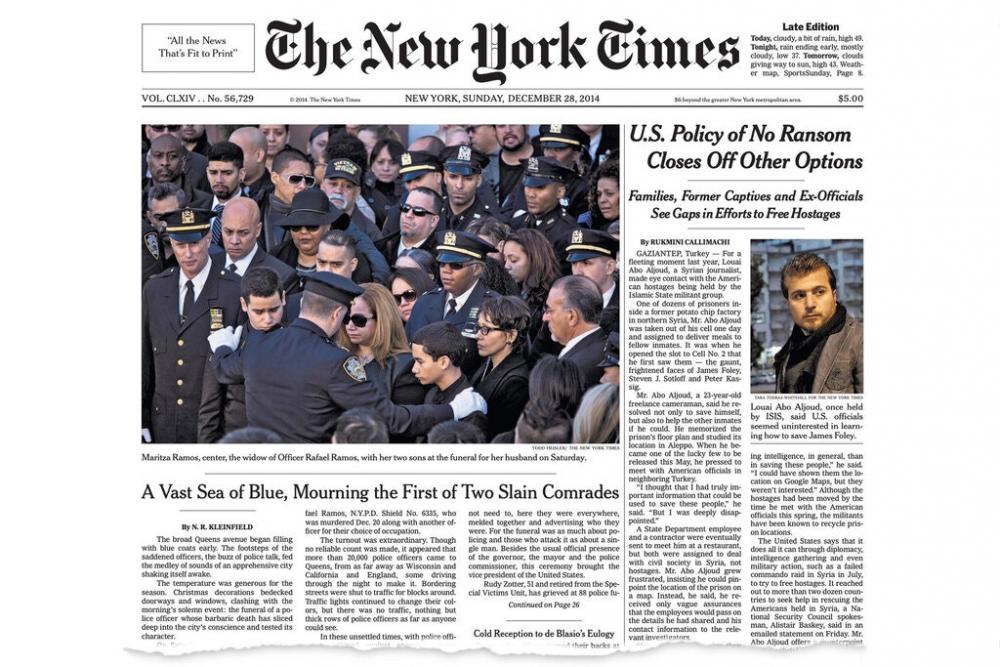
The article, which led the front page on Dec. 28, describes a Syrian captive of ISIS, who was going by the name of Louai Abo Aljoud, who “made eye contact with the American hostages being held by the Islamic State militant group” at a prison at an abandoned potato chip factory in Aleppo and tried to report them to an indifferent American government.

“I thought that I had truly important information that could be used to save these people,” Ms. Callimachi quoted him as saying. “But I was deeply disappointed.”

The story is told with verve and confidence. As a reader, you feel as if you were there.

But elements of the story were shaky: By the time, in Mr. Abo Aljoud’s telling, that he was trying to alert the U.S. government that he had seen the hostages, the Islamic State no longer controlled the area the prison was said to be in. Mr. Abo Aljoud had told The Wall Street Journal the same story, and The Journal passed on it because journalists there didn’t believe him, two of those involved told me. And the Syrian journalist who assisted Ms. Callimachi on the story and interpreted the interview, Mr. Shoumali, told me that he “warned” her not to trust Mr. Abo Aljoud “before, during and after” the interview, in vain. (Ms. Callimachi said that she didn’t recall the warnings before publication, and noted that they don’t appear in correspondence between her and Mr. Shoumali before publication.)

Mr. Shoumali said he came away from the experience alarmed by her methods.

“I worked for so many reporters, and we were seeking facts. With Rukmini, it felt like the story was pre-reported in her head and she was looking for someone to tell her what she already believed, what she thought would be a great story,” said Mr. Shoumali, who was a reporter for The Times from 2012 to 2019 and had a freelance byline this August. He spoke to me by phone from Berlin, where he is now working on a project for a think tank.


Eight days after the story was published, Mr. Shoumali wrote to Ms. Callimachi and other Times reporters, in an email exchange I obtained, saying that “Syrian contacts are raising more and more questions about the credibility of one of our sources” and that Mr. Abo Aljoud had changed details of the story in a conversation the two men had after the story was published.

Ms. Callimachi emailed back that details of the prison scene were “confirmed independently by European hostages held in the same location or else by the State Department” — a response that seems puzzling, given that the story presented Mr. Abo Aljoud’s observations as his eyewitness account.

The Times was worried enough about that 2014 story to send a different reporter, Tim Arango, back to southern Turkey soon after it was published to re-interview Mr. Abo Aljoud, who gamely repeated his story to him and Mr. Shoumali. I tried again in early October. Like Ms. Callimachi, I don’t speak Arabic and hired another Syrian journalist to ask Mr. Abo Aljoud my questions. In that interview, he told a version of the story that appeared in The Times, but with elements that muddied the clean narrative. He said he had only seen one hostage, not the three The Times suggests. And he said he didn’t realize until after his release that he’d seen any of them — contrary to the impression left by The Times article.

Ms. Callimachi said in an email that she wished that the story had been clearer about the “limitations” of reporting on terrorists. “Looking back, I wish I had added more attribution so that readers could know the steps I took to corroborate details of his account,” she said.

Mr. Kahn, the International editor at the time, continues to stand by the story.

“Questions that were raised about a source in a story Rukmini wrote about American hostages in Syria were thoroughly examined at the time by reporters and editors on the International desk and by The Times’s public editor, and the results of those reviews were published,” he said in an email. “I am not aware of new information that casts doubt on the way it was handled.”

Those questions aside, the article arguably had an impact in Washington, pushing the United States government to reconsider its ban on paying ransom. But the piece itself now rests under an uncomfortable cloud of doubt. It remains on The Times website, with no acknowledgment of the questions surrounding the opening anecdote. The only correction says that the story, when first published, did not make clear that Mr. Abo Aljoud had used a pseudonym.

Last month, that same cloud of doubt descended on Caliphate. And Ms. Callimachi now faces intense criticism from inside The Times and out — for her style of reporting, for the cinematic narratives in her writing and for The Times’s place in larger arguments about portrayals of terrorism.

But while some of the coverage has portrayed her as a kind of rogue actor at The Times, my reporting suggests that she was delivering what the senior-most leaders of the news organization asked for, with their support.

THE US IS ON A PATH TO WAR WITH CHINA


By K. J. Noh, Popular Resistance.

October 15, 2020


https://popularresistance.org/the-us-is-on-a-path-to-war-with-china/


What Is To Be Done?

It was gripping , stunning testimony. Before congress, a 15 year old volunteer nurse, Nayirah, struggled to compose her trembling voice, barely holding back tears, as she testified that marauding soldiers had thrown babies out of incubators in a hospital, leaving them to die on the floor.

Later, Amnesty International confirmed authoritatively that 312 babies had been killed this way[i]. All the news agencies ran with the story, and the country and congress were in a total uproar.

There was only one problem: it was completely, utterly, totally fraudulent. It was engineered, perjured, coached testimony concocted by PR experts, designed to manufacture consent for a US war on Iraq.

At the time, it was also crystal clear that the claims were absurd—Kuwait had a population of less than 1.5 million at the time, and given its birthrate, would have had a few hundred premature babies a year. It’s inconceivable that over 300 of them could have been clustered in a single hospital on a single day.

Nevertheless, this was the story that was sold to the US people. Representative John Porter stated, “We have never heard…[such] a record of inhumanity and brutality and sadism…I don’t know how the people of the civilized countries of this world can fail to do everything within their power to remove this scourge from the face of the earth”.

Not long afterward, the US went to war with Iraq. It would wage war again, 12 years later, doubling down with even more monstrous lies about WMD.

Today, we are facing a similar situation: the US is escalating rapidly towards a shooting war with China, and similar absurd, astonishing, and monstrous lies are being spread. In fact, the US is already engaged in “multi-domain” “hybrid warfare” with China. This is warfare just below the threshold of direct military engagement. On the ground this involves:
Economic Warfare: trade sanctions and tariff war, as well as technological warfare: attempted seizure of Chinese companies (TikTok); attacks on China’s international 5G contracts; sanctions on the primary & secondary supply chains of key sectors of Chinese industry (e.g. Huawei’s semiconductor supply chain); attacks on Ant Finance’s IPO.
Legal Warfare, or “lawfare”, including over 380 anti-China bills in Congress, and 14 individual and state lawsuits against China for over $30 Trillion in “Covid damages”; the long arm “legal” kidnapping of Huawei’s executive
Diplomatic Warfare, including consulate shutdowns, harassment of diplomats, breaching of diplomatic pouches and compounds, and calls for regime change.
Military Brinksmanship and posturing in the South China Sea, the East China Sea, the Taiwan straits; complete encirclement of China with strategic weapons, surveillance, and 400 offensive bases (“The Pacific Pivot”), the use of airbases in Taiwan for military surveillance, and plans to station intermediate range nuclear missiles all along China’s periphery[ii].
Civil Subversion: color revolution, urban terror, destabilization & delegitimation operations in Hong Kong (and other places where China has interests), including millions of dollars of funneled for organization & training, and encrypted communications infrastructure built to coordinate anti-government activities.
Academic Warfare: through the FBI’s China Initiative, every 10 hours a case is opened against a Chinese student or researcher in the US (currently 2700 cases) and all Chinese students are considered potential “non-traditional” “collectors, spies” involved in a “thousand grains of sand” collection strategy.
Information Warfare: last but not least, we are seeing total Information warfare.
The stories about so-called “massive human rights abuses”, “Chinese concentration camps”, “Chinese-made-and-released Covid”, “China has harmed us economically”, “China has stolen its way to the top”, “China is oppressing independent Hong Kong”, are part of this information warfare.

This is mass propaganda to incite people to hate China irrationally and unconditionally, to manufacture consent for war. The US military calls this information warfare, “the firehose of falsehoods” and we are all being drenched with these lies. This is necessary to justify war against an enemy and to curtail any rational discussion or questioning.

Some of the questions that the public are kept from asking are:
Are these allegations supported by any facts?
Has China threatened us? Is the US at risk from China?
Is this war justifiable by any means? Is it legal?
Do the citizens of the US want to go to war? Could the US even fight, let alone win a war with China?

A careful, reasoned approach to these questions, would lead one to say, No.

Before we try to play whack-a-mole with the blatant war propaganda, a more useful and clarifying approach is to ask, why is the US telling these lies to go to war?

For this, we have to look at history.
Why The US Is At War:

Culture shock: the challenge to supremacy

The earliest European travelers, were astonished to discover in China a country, in many ways, far more advanced than the West: a rich, diverse, multi-cultural civilization with sophisticated systems of governance, and vibrant cities built with complex systems of planning and management. Above all, they marveled at a harmonious multi-religious, multi-ethnic society, free of sectarian strife, and an inclusive merit-based[iii] system of political power that selected the most competent people to govern and rule, regardless of creed, color, background, or religion[iv]. This contrasted with the Western system of hereditary aristocratic rule within a society torn apart regularly with religious strife. These ideas of diversity, tolerance, inclusion, and earned—not inherited–privilege, would strongly influence the leaders of the Enlightenment, so much so that Western philosophers such as Voltaire and Leibnitz believed that the Chinese had “perfected moral science”, and that Chinese statecraft was the model for the West to emulate, if it wanted to develop into an enlightened civilization.

These discoveries struck a hard blow at Christian and Western supremacy. Western colonization was built on a foundational belief that the West was more advanced, more evolved—closer to God—than the “barbarous” countries it was invading, subjugating, exploiting, and destroying. It needed at least the pretense of being more “advanced” to justify its colonial “civilizing mission”. Reactionary thinkers like Herder—who had never visited China—lashed back rapidly by propagating a theory of the depravity of Chinese: that China was an “immoral land with no honor”, an “embalmed mummy” characterized by stagnation, in contrast with Western “dynamism”.

In addition, the Chinese system of meritocratic government was deeply troubling to a West built on stratified class privilege. A civilization without hereditary aristocrats was unfathomable and terrifying to the Western ruling class. Montesquieu, (borrowing from Giovanni Botero) thus concocted the trope that China’s more egalitarian system had to be “despotic”,–despotic for him because it threatened the “liberties” (aristocratic privileges) of his class. Hegel chiselled this canard into the Western consciousness with an armchair theory of “Oriental Despotism”, whereby the Chinese had failed to evolve due to inherent, characterological flaws in its people and its political culture. Marx chimed in with the “Asiatic mode of production”, and Weber and Wittfogel also reinforced it. These allegations of “despotism”—despite being total distortions of Chinese governance–have infused all Western discourses about China since.

Enter the Bandits

At the same time, “embalmed” Chinese “inferiority” notwithstanding, the West craved the exquisite consumer goods of China–tea, silk, porcelain—and this created huge trade imbalances. The Western response to balance the books was narco-trafficking: smuggling in industrial amounts of opium—at its peak, up to 9 million pounds a year. When China objected and opposed this on sovereign and moral grounds and confiscated the drugs, war was declared. Reparations were forced, concessions extracted, and the country plundered, looted, and destroyed. In one show of force to the Chinese, the Summer Palace of the Emperor was sacked by Lord Elgin, which Victor Hugo described thus:


There was, in a corner of the world, a wonder of the world…All that can be begotten of the imagination…was there…Build a dream, a dazzling cavern of human fantasy with the face of a temple and palace….This edifice, as enormous as a city, had been built by the centuries…This wonder has disappeared.

One day two bandits entered the Summer Palace. One plundered, the other burned.
All the treasures of all our cathedrals put together could not equal this formidable and splendid museum of the Orient. It contained not only masterpieces of art, but masses of jewelry…One of the two victors filled his pockets,..the other…filled his coffers. And back they came to Europe, arm in arm, laughing away. Such is the story of the two bandits [England & France].

This violence, banditry, and racism, justified by the belief in the subhuman nature of the Chinese, became normalized practice against the Chinese over two centuries, and great American fortunes—Perkins, Astor, Forbes, Cabot, Delano (Roosevelt)–and Ivy league institutions at Harvard, Yale, Princeton, Columbia were built on this extraction and narco-trafficking. Hewing to the belief that the Chinese were less than human, Drug Barons pushed opium that addicted 10% of the population, essentially “roofie-ing” an entire nation and stealing its wealth. Just as US Southern wealth had been built on the decimation of black bodies through the slave trade, US East Coast wealth was built on the destruction of Chinese bodies through the drug trade, in what historian John K. Fairbank described as “the most long-continued and systematic international crime of modern times”.

Dehumanization, humiliation, assault, theft, rape, colonization, appropriation–these became the standard Western approach towards China and the Chinese; the Chinese people were “filthy yellow hordes”, an inferior, subhuman race, lacking agency, fit only to be colonized, exploited, enslaved, lynched, erased, and wherever possible, extinguished through race war. It would get worse.

Cold and Hot war: A Chinaman’s Chance

Inside US territory itself, the mythology of “yellow peril”—originally a German colonial war trope—became pervasive. Newspaper editor Horace Greeley, argued that the Chinese were “uncivilized, unclean, and filthy beyond all conception, without any of the higher domestic or social relations; lustful and sensual in their dispositions; every female is a prostitute of the basest order.” Greeley, a progressive (who employed a young Marx as a reporter), was simply mouthing the platitudes of his day; much worse than rhetoric was the routine violence. Prefiguring similar present-day fears that Chinese were stealing jobs, wealth, or threatening America, thousands of Chinese were massacred, lynched, set on fire, expelled from their communities in the late 19th Century: in 1871, the LA Chinatown massacre, in 1880, the Denver Yellow Peril pogrom, in 1885 Wyoming Rock Springs massacre, the Issaquah Valley attack, the Arson of Seattle’s Chinatown, the Tacoma riot, in 1886 the Seattle Riot of 1886, the Oregon Hell’s Canyon massacre. “A Chinaman’s chance” became a common term: to be Chinese was to be subject to sudden death at any time at the whim of white people.

In response, the Chinese hid themselves inside ghettoes where they could; fled pogroms, arson, and mass lynchings, and kept their heads down, “eating bitter” and trying to stay alive. Where they managed to settle down without being killed, they were subjected to cultural erasure, economic blockade, social isolation, a ban on owing property and businesses, and a proscription on marrying and having children, in short, planned elimination.

A minor respite during WWII, when the US allied itself with the Chinese KMT (Kuomintang) against the Japanese gave a small glimmer of reprieve, as local leaders tried to establish breathing space, and the Japanese took on the role of the bad “Asians”. This lasted until the Chinese communists liberated themselves in 1949, and wrested back their own country. “China has stood up”, Mao declared, igniting jubilation throughout the third world, and sending shockwaves of horror through the colonial west. This arrant act of self-liberation and self-determination—along with the US’s astonishment that the monstrous KMT fascists they had courted and funded had been trounced–unleased a hysterical new wave of Sinophobia during the McCarthy era. High-ranking Congressional committees demanded “Who lost China?”—as if it had been theirs—and purged the State Department of the moderate “China-hands”, who had been sympathetic or informed about China and its political institutions. A paroxysm of anti-China and anti-Asian hatred would shiver and fester throughout the cold war, burning, stoking and consuming itself through two hot wars (The Korean war and the Vietnam war), counterinsurgencies (Malaya), politicide (Indonesia), and smoldering on through the Nixon era, and crackling back alive to the flushed, red hot heat of the current moment.

In a country built on settler-colonial racism, this violent, racist, anti-China hatred–one of the most enduring legacies and traditions of the West–is the noxious Petri dish in which this propaganda for war is being cultured and vectored.

To this day, these stereotypes—ideological templates–are readily applied, for example, as regards Covid. In the Sinophobic Western press, Covid-19 is allegedly caused by dirty Chinese eating habits, dishonest cover-up, depraved indifference to life, despotic suppression of information, and dangerous intent towards the west. In a word, the Chinese are dirty, dishonest, depraved, despotic, and dangerous. Every day, these racist slanders are plastered and repeated, ad nauseam and ad infinitum, in Western outlets like The Guardian, The Washington Post, or The NY Times, and then catapulted into orbit by Twitter and Facebook. White Supremacy and its attendant anti-Asian fear and hatred are some of the oldest, most enduring, most deep-rooted hatreds in the Western mind: underneath the shallow topsoil of civility and liberal tolerance, it festers and simmers in angry, molten layers of the subconscious, quick to erupt and flare up in white-hot violence and rage at any perceived slight or challenge to white superiority; and rapidly weaponized as political expediency requires.
Realpolitik: Opening And Closure:

Miraculously, during the 70’s, a battered and bruised US, humbled from defeats in the Vietnam war, and seeking a realpolitik to untangle the quagmire, decided to open relations with China to counterbalance against Soviet Union. Despite over a century of hatred, and the containment of the Russians for being an “Asiatic Race”, the US normalized relations with Chinese, and thus began a short, temporary, realist honeymoon, a brief respite from this race-baiting and race hatred.

This idyll was not to last. After the fall of the Soviet Union in 1989, two things became readily apparent: 1) there was no further political need to engage with China, since the primary reason (the threat of the Soviet Union) had gone away, and 2) it was clear for anyone understanding history and geography that China could become a challenger to the United States itself, due to its size, capacity, and dynamism.

Thus the long, unabated, and persistent thread of anti-China hatred, red-scare-yellow-peril-thinking, reinvigorated again with the persistent white fragility about new challenges to supremacy, came back with a vengeance. Despite continued engagement with China from the Nixon to the Clinton era, Sinophobia remained a silent, underground political force with a tremendous gravitational pull. Two groups were important in giving these forces concrete shape and form.
The Empire Strikes Back: Yoda And His Jedis:

Andrew Marshall, who died last year in March, was often referred to as “Yoda“. He was the Pentagon’s Oracle, directing its secretive internal think tank, the Office of Net Assessment, for 42 years, and was top advisor to 12 Secretaries of Defense. Originally part of an elite group of econometric thinkers at RAND (Herman “Strangelove” Kahn, James Schlesinger, Daniel Ellsberg, Albert Wohlstetter), they worked on game theoretic & stochastic modeling of complex phenomena, and on how to strategize the unthinkable and the insane: how to win at nuclear Armageddon.

Throughout his long tenure at the inner sanctum, Marshall had two key obsessions: US Military supremacy, first against the Soviet Union; then after the fall of the USSR, against China: preventing China’s rise to power. Using a deft mixture of threat inflation (through recondite “net” assessments & heterodox “team B” reviews), classified white papers, cryptic pronouncements to the power elite, and the incessant cultivation of a cult of loyalists, Marshall kept the Pentagon’s gravy train running on time, while instilling in his followers a paranoid, “long duree” mindset of endless and moving threat inflation.

Marshall’s proteges, Wolfowitz, Cheney, Rumsfeld, Cohen, Krepinevich, Pillsbury, Herman Kahn, Richard Perle, Richard Armitage, Michael O’Hanlon, and countless other neocon heavyweights were graduates of “St. Andrew’s Prep School”, or the “Church of St. Andrew”, mentored into Marshall’s world view and strategies. These ideologues had suckled at the woozy philosophical teat of Leo Strauss (imagining they were imbibing Plato, Hegel, or Kojeve) and graduated from Ivy institutions funded from Chinese opium smuggling. Marshall fed them solid food, C-rations, and the bloody red meat that cut and sharpened their fangs for ideological and political battle.

In 1992, a fully teethed group of Marshall’s neocon proteges penned the Defense Guidance Planning (DPG) document that came to be known as the “Wolfowitz Doctrine”. A preposterous, overweening document, embarrassing upon leakage for its hubris, irrationality, and illegality, it was immediately disavowed but not discarded. A few years later, it was redacted and upgraded into the PNAC (“The Project for a New American Century”)’s Mein Kampf-like document, “Rebuilding Americas Defenses”. This was, in essence, an unhinged plan for total world domination (“unipolar global dominance”) in all domains of war (“full spectrum dominance”), unfettered by international law or any sense of proportion, rationality, or morality. Borrowing from the DPG its call for the unencumbered use of aggressive, pre-emptive war, including the use of nuclear and biological warfare, it postulated a “Pearl Harbor-like” incident to operationalize. Not long after, this doctrine became realized under Rumsfeld and Cheney, bringing us the chaos, murder, tragedy of Iraq and Afghanistan and the endless catastrophic wars of the post-Bush years.

Contemporaneously, with the Soviet Union dissolved, and the US pressing NATO right up against the flank of Russia, the US also began to cross-hatch the contours of a containment strategy against an emerging China, the next potential challenger to US global domination.

Marshall and his Jedis began explicit, long term countermoves. Even as the Middle East continued to spiral into chaos, yet more wide-ranging and ambitious plans were hatched against the Middle Kingdom. A strategy to withdraw from the Intermediate Nuclear Forces Treaty (INF) was initially floated (and later, with the blessing of the CFR, circulated, and eventually implemented). Aggressive forward bases were planned in the early 2000’s, then built in East Asia, along the first island chain, placing deadly and destabilizing strategic weaponry right up against China’s throat and belly. New alliances and strategies were drawn up, and old alliances reinforced and rekindled, and a dangerously empire-nostalgic Japan was enabled in erasing history and remilitarizing to the hilt as the spear tip against China. Eventually, as all these pieces fell into place, Hillary Clinton would stage the coming out party: the declaration in 2011, of the “Pacific Pivot/Pivot to Asia” in Foreign Policy Magazine. Clinton’s debutante declaration was a dog-whistle marvel of cant and obfuscation. A plan to move 60% of US firepower to encircle and contain China through bases, weaponry, and alliances, while engaging in multi-domain hybrid warfare, was sold as a “historical rebalancing”. With the blessing of Obama’s cabinet, Marshall’s China threat was finally getting policy primetime.

During this time, another of Andrew’s busy, brainy proteges, military officer Andrew Krepinevich, started to work out the nuts and bolts of actual war with China. Krepinevich, at the CSBA (Center for Strategic Budgetary Assessment), under Marshall’s guidance and funding, wrote out the details of the war doctrine against China, “AirSea Battle“—a China-directed counterpart to the Soviet-era “AirLand Battle”– involving decapitating and blinding strikes deep into Chinese territory, and instantiating Marshall’s “revolution in military affairs” for US supremacy in the Western Pacific theater of war. RAND and the CFR chimed in, rendering into granular and global detail the strategies and order of battle.

Another of Andrew’s powerful proteges was Michael Pillsbury. A serious operator, Pillsbury had assisted in the creation of the regime change “governmental” NGO known as the NED, the weaponization of the Mujahideen in Afghanistan, the implementation of politicide in Latin America (known as the Reagan Doctrine), but most importantly, he was credited with initiating the idea of the “China card” in 1973. Under the good offices of Marshall, Pillsbury published a book called “The Hundred Year Marathon” , scripting a fact-free document of paranoid threat inflation, racist scare-mongering, and orientalist slander that is now standard China doctrine. In an alphabetic royal flush of Sinophobes (Lighthizer-Mnuchin-Navarro-O’Brien-Pillsbury-Pompeo-Pence-Ross), Pillsbury is now currently the most important “China authority” of Everything Under the Heavens in the Trump Kingdom of Sinophobia.

China Syndrome: Blue team, Red Peril

As the original US reason for allying with Beijing–to counterbalance Moscow–became moot, another group of China-bashers, far-right ideologues with sharp axes to grind from the cold war also began to crawl out of the cracks. Calling themselves the “Blue team” or “Panda sluggers”, they derided the US “panda-hugging” business class who wanted continued engagement with China, seeing China only as a mortal and irreconcilable communist threat. During the Clinton administration, they formed a loose coalition, coming together with funding under PNAC, using the Washington Times and Weekly Standard as their platforms. Although the “Blue Team” had no official members, published no formal policy statements, and had no offices–initially meeting in a garage, then at the Tabard Inn on N Street–they included key Congress members and staff; think tankers, journalists, and lobbyists.

Among them, former CIA analyst William C. Triplet and congressional staffer Edward Timperlake went on to write to a lurid series of conspiracy books alleging quid-pro-quo between Clinton and China (Year of the Rat; Red Dragon Rising). This was a bizarro world where Taiwanese lobbyists with Chinese Mafia connections were acting as agents for the PRC government and manipulating the White House. They also alleged Chinese theft of military secrets, slave labor, the proliferation of WMD to Iran and other “rogue” states, and insinuated that Clinton’s “constructive engagement” was knowingly undermining the US for the benefit of the Chinese. These allegations put into ink a conspiratorial mythology about a dangerous, corrupt, and belligerent China, echoes that fed into an existing subterranean current of paranoid lies about China.

These “blue team” members, cross-pollinating with Marshall’s proteges, were a rogues gallery of high-powered political operators: Michael Ledeen, Frank Gaffney, Robert Kagan, Bill Kristol, Michael Pillsbury, Bill Gertz, Gary Bauer, Peter Navarro, Elliot Abrams, Richard Scaiffe, John Bolton were among those listed as “members”; Dana Rohrabacher, Tom DeLay, Nancy Pelosi, Robert Byrd were also considered to be fellow travelers.

These people built powerful commissions and institutions focused on attacking China, including the Congressional Executive Commission on China, the US-China Security Review Commission. The Taiwan Security Enhancement Act was also written at this time. In particular, the CECC appointed itself watchdog of Chinese trade, technology, labor and human rights, saturating Congress with an unending “blue team” litany of Chinese “abuses”.

The most virulent and extreme of all these China hawks was Frank Gaffney, who recycled the alarmist cold war group, “Committee on the Present Danger”, into the current “Committee on the Present Danger: China,” contending that “there is no hope of coexistence with China”. Gaffney’s ideology and guiding principles coincide with official positions on China and key US foreign policy; Secretary of State Mike Pompeo’s speech and actions on China reflect his close affiliation and affinity with Gaffney.

What the Pivot is: the Geostrategics of China-bashing

Much of the “blue team’s” ideology and theorizing followed pre-existing currents of ideological posturing and hate-speech but have incorporated sharper geopolitical and geo-economic dimensions.

Western history can be seen as having several inflection points: one was 1492, the advent of the “Columbian Era”. The Columbian era is the era of sea-faring, sea-power-based Western colonial and imperial empires. The demise of the Columbian era, was foreshadowed by an Oxford geographer in 1904 who put forth what is now known as the “Heartland Theory”. In a nutshell, it is a land-based theory of power that predicts the end of sea-based powers: “Who rules East Europe (Eurasia) commands the Heartland; who rules the Heartland commands the World-Island; who rules the World-Island commands the world.” It also concluded, “Were the Chinese…to…conquer its territory [of the Russian Empire], they might constitute the yellow peril to the world’s freedom.” This maxim and the anxiety it provoked was red-lined in Brezinski’s “Grand Chess game”: “No Eurasian challenger should emerge that can dominate Eurasia and thus also challenge U.S. global pre-eminence.”

In 1992, Marshall’s protégé, Paul Wolfowitz formulated the above strands into a formal doctrine, in the above mentioned DPG (Defense Planning guidance) document:


“Our first objective is to prevent the re-emergence of a new rival… that poses a threat on the order of that posed formerly by the Soviet Union…to prevent any hostile power from dominating a region to generate global power…The U.S. must… protect a new order that [convinces] potential competitors that they need not aspire to a greater role or pursue a more aggressive posture to protect their legitimate interests. In non-defense areas, we must… discourage them from challenging our leadership or seeking to overturn the established political and economic order. We must maintain the mechanism for deterring potential competitors from even aspiring to a larger regional or global role.”

This can be better understood by looking at a map:


This is a map of the world, drawn from a topologist’s eye. It shows relationships, not distances or area. From this map you can note the following things:
China has more borders than any other country in the world. This also gives it the possibility of connecting with more countries than any other.
Blue lines/corridors are oceans: The top two thirds is the “world island” or “pivot state”–it contains most of the world’s population, resources, and wealth, and it can be connected as a single entity through overland routes or short ocean hops.
The bottom is the Americas. It is topologically isolated from the world island. As sea lane control becomes less important, it will also lose prominence and relative power if the world island unifies. It’s clear that that unifying power will probably arise in China, whose overland paths using high-speed rail, roads, pipelines, and ports can be easily built and connected, in a “new silk road”.
The US needs to fracture the world island to maintain its global power. If you color in the places where China is encircled, or where the US is waging war/fracturing societies/creating chaos, this is exactly where the fault lines of the global conflict are, and reveal what US strategy is.

Here is a second map:


CSBA: Shipping Lanes through the South China Sea.

The US has actually surrounded China with 400 military bases, bristling with strategic and tactical weaponry. It also has war-gamed out China’s key vulnerability: the chokepoint of the South China Sea. War in the South China Sea would disrupt $5.3 Trillion of China’s external trade and 77% of China’s oil imports[i]. In this scenario, the US does not have to win a shooting war with China in the South China Sea. The war just has to happen, and the disruption to trade could crash China’s economy. The map shows the shipping lanes that would be disrupted.

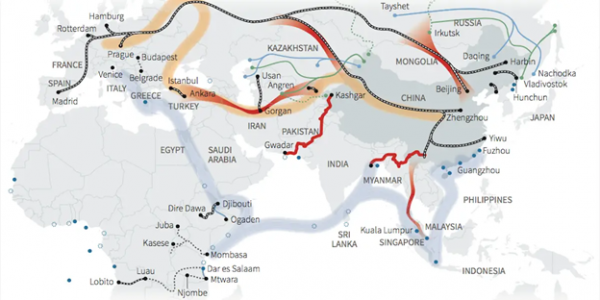
China’s first response to the US pivot and encirclement, especially in the South China Sea–its key chokepoint–was to build defensive military facilities along some of the islands, to deter US incursion and to raise the cost of interference. Its other response, much more ambitious, was the Belt & Road Initiative (BRI), which constitutes a long overland escape from the encirclement, similar to its “long march” during its encirclement by the fascist KMT. The BRI travels through SE Asia, then overland through Central Asia, to the Mediterranean, and then Europe and Africa. In particular:
CMEC (China-Myanmar Economic Corridor) travels through Rakhine State andexits to the Indian Ocean at Kyaukphyu port (bypassing the Strait of Malacca).
CPEC (China-Pakistan Economic Corridor) to Gwadar port transits directly to the Arabian Sea andthe Persian Gulf.
Xinjiang is the key overland route for BRI to exit China to Central Asia, with Iran also a key node.
Djibouti at the horn of Africa is the entry node to Africa (the Sahel, andthe South)

BRI as it does this, becomes the physical realization of Mackinder’s “heartland” in Eurasia—the “pivot state” connecting the “world island” into a single economic bloc, and raising China to the status of the key regional power, exactly what Brezinski and Wolfowitz, sought to prevent.


Mercator Institute for China Studies: Belt and Road Initiative.

Mindful of this development, and aware of the rapidly ticking biological clock on US power, the US is currently rapidly escalating hostilities in the SCS, most recently with war games, U2 incursions, belligerent passages of aircraft carriers, guided missile destroyers, submarines; China’s response has been to launch “carrier killer” missiles into the region.

Until recently, the US claimed that it was not an interested party to the SCS, just that it was concerned about “Freedom of Navigation”. Now it is openly taking about blockade and strangulation of China and outright piracy against Chinese ships through media proxies.

It has also recently conducted drone war exercises for assaulting islands in the South China Sea, with down-to-the-smallest detail precision and preparation.

The US is also going directly after the BRI. It is sanctioning the Chinese companies alleged to have done construction in the SCS (all the claimants have done construction, including airfields; China is not unique). These companies are also involved in construction of the BRI; for example, China Communications Construction Company (CCCC) alone is reportedly involved 923 projects in 157 countries. This is an explicit attempt to dismantle the BRI. Likewise, the another “road” of the BRI is the accompanying “digital silk road” (communications-5G-blockchain infrastructure). This is yet another of the reasons why Huawei has been targeted for destruction.

The US is also in the process of stationing intermediate range missiles all across the SCS, and around the first island chain surrounding China, as well as attempting to press gang South Korea into hosting them. This is yet another layer of dangerous escalation, and very, very destabilizing.

Twilight of Capitalism

The final dimension to the US-China competition is economic: this is the uncanny fact that China’s “Socialism with Chinese characteristics” works and outclasses Western neoliberal capitalism by leaps and bounds. In terms of developing an economy, raising living standards, creating public wealth, serving and meeting its people’s needs, and dealing with crises, China beats the capitalist west hands down.

Even the Trump administration, even as they claimed that such a state-led economy could never compete against the superior free-market economy of the US, have insistently demanded that China dismantle their planned economy in trade negotiations, because of its superior advantages over capitalism.

This was not supposed to be: Clintonite “Panda Huggers” had always justified, hubristically, that their engagement with China would result in China’s liberalization and total transformation—the inevitable, inexorable result of engaging with a superior Western political ideology and economic system. They also insisted that if China continued as it had with its planned economy and ”autocratic“ ways in a modern era, it would simply fail: it would end up like the Soviet Union or North Korea—it had no choice but to become more Western, more neoliberal, more capitalist. But a funny thing happened on the way to the market.

China built a system that has brought 850+ Million people out of poverty in few short decades, is slated to end extreme poverty this year, and that has already surpassed the US in PPP economy size and healthy life expectancy.

China’s thriving, effective Central government–with a 93.1% approval rate—breaks all Western conceptions of development, governance, legitimacy, and of course, superiority.

With 80% of its top leadership scientists or engineers, China also outranks the US in patents filed, top scientific papers published, and is a world leader in fields such as AI, Robotics, Quantum Computing, 5G, highspeed rail, advanced industrial production, next generation IT, materials science, and sustainable energy development, low-carbon eco-cities, and reforestation. It has also pledged to go carbon neutral by 2060, essentially giving the world an outside chance to still beat global warming—despite being a historical carbon creditor. With its scientific leadership, whole-of-society public health strategies, and its valuing of every human life, it has also shown that it can organize to defeat a mass pandemic in weeks—and by overriding capitalist markets whenever and wherever it sees fit.

Meanwhile the US still struggles with the largest number of cases and deaths from Covid–a death rate 200 times that of China’s—and is incapable of preventing Covid among its own top leadership. To boot, first in 2008, and then in 2020, the US neoliberal capitalist economy was shown up to be a jacked-up deck of cards, rescued only by massive Chinese debt-purchasing and endless printing of fiat money.

In contrast, China has demonstrated that it has developed an alternative, non-Western, non-capitalist model of development—without war, invasion, colonization, slavery, regime change, primitive accumulation—that the world can emulate and follow.

Once you realize that, you understand why the US ruling classes are so desperate to erase China and its example: China offers a threatening alternative model of development that is non-capitalist, non-Western, and non-colonial. As such, it undermines the west’s neocolonial domination of the third world and its debt-trap-based forced underdevelopment, subservience, and expropriation. It also offers a model of state-led ecological development. All this signals new possibilities of hope and transformation for the world. The ruling classes in the west will go to war to prevent this.
Where Does This All End?

Despite China’s assurances that it does not want war, hot or cold, that it seeks win-win cooperation and co-existence with all countries, and that it disdains hegemony, the US is continually escalating, provoking, and threatening China, even as it dismantles off-ramps, channels of communication and global institutions for cooperation and de-escalation.

The conclusion to draw is hard, but obvious: if things continue as they have, this can only lead to direct military confrontation and kinetic war.

The Democratic ticket as it stands, just as it silences the demands for viable reform and change by the Sandernistas, BLM, Me Too, also ignores the non-interventionist, peace-demanding wishes of the majority of the people, and their demands for a better system and less violent foreign policy. It doubles down on racism, sexism, capitalism, and militarism.

Biden’s doctrine toward China, if he is elected, will be a continuation of this noxious arc of history and planning. The think tank advising Biden on foreign policy, CNAS, a near-rhyming clone to PNAC, has grandfathered in most of existing anti-China doctrine, and has mapped out in obsessive detail, the next steps of a highly destructive and dangerous strategy of confrontation with China. The key difference is that it will “unite” countries more skillfully against China, pivot away from Trump’s neomercantilism towards a more “globalist” approach, and likely implement some revised version of the TPP, the 12 nation economic bloc against China.

Here are some key points to understand:
Escalation to war is bipartisan: there is no lesser evil here. The racist, capitalist, imperial ruling classes cannot and will not tolerate a rising or equal China in a multi-polar world. They would rather see the end of the world than an end to Capitalism or White Supremacy.
One subset of this group believes that they can actually win a war against China, or at the very least force its subjugation to the US. This submission will not happen, given the actual balance of forces and Chinese determination to resist.
US wants global supremacy but if the ruling class can’t have ordered supremacy, they are not averse to global disintegration and chaos. Proteges of Hayek and Leo Strauss, they thrive on “revolutionary disorder”. One fallback model of US supremacy is to plunge the rest of the world back into the dark ages through hybrid warfare–while the US controls the key systems of communication, information, surveillance, finance, rent extraction, along with the corridors of maritime transport.
There is a third group of elite hawks who are millenarian Christians. Although a minority, they hold powerful positions. These believe in the salvation and rapture of the faithful as existing “contradictions” are heightened into Armageddon. These are religious zealots with no brakes or constraints on their appetite for war.
War, if it happens, could rapidly turn nuclear. The US no longer has “overmatch” in conventional weapons, and no longer subscribes to deterrence. Instead, its declaratory policy allows nuclear weapons to be used against “significant non-nuclear strategic attacks”[i]. Since the 2002 Nuclear Posture Review, the US has explicitly prepared for nuclear war with China, and threatens “intolerable damage” in response to “non-nuclear or nuclear aggression.”[ii] The Chinese have disavowed nuclear first strike—their nuclear capacity is currently minimal and purely defensive—but in case of war the US military could easily resort to the use of low-yield nuclear weapons[iii] or even decapitating nuclear first strikes to overcome its conventional weaknesses. China’s deterrence would then have to shift to “hair trigger”, “launch on warning”. This means that war could rapidly escalate to large scale nuclear strikes, which many scientists predict would result in nuclear winter, dooming most forms of organic life on the planet.
Modern “democracies” require constant media manipulation and propaganda, to “manufacture consent” for war. As a result, we are living in time of “total deceit”, as Orwell put it: “Every war when it comes, or before it comes, is represented not as a war but as an act of self-defense against a homicidal maniac…Political language…is designed to make lies sound truthful and murder respectable, and to give an appearance of solidity to pure wind.” William Casey, CIA director summarized this succinctly: “We’ll know when our disinformation program is complete when everything the American public believes is false.”[iv]
What Then, Is To Be Done?

Our work is cut out for us: “In war, the first casuality is truth”. Our task is to prevent the first casualty, challenge the lies; the second, to organize and work for peace.

Think Critically:

As we approach elections, the possibility of an October surprise increases. Remember:
Information war precedes, justifies, and enables kinetic war, therefore you must think critically and defensively; do not take anything attacking China at face value.
Evaluate everything for a) source b) logic, sense, rationality c) bracket & evaluate emotional triggers or trigger words d) look at counter-evidence/arguments
Make your own judgments, draw your own conclusions: seek truth from facts

Don’t Be Fooled by the engineering of “truthiness”:

Stories and lies seem credible when they are 1) repeated incessantly 2) resemble pre-existing stories (especially ones that are projected from our own disowned flaws), 3) have some tiny grain of plausibility mixed in 4) seem coherent or manufacture coherence through multiple sources, and 5) tug at your heartstrings:

This means that we have to:
Watch out for memes and repetition: watch out for stories are seem self-replicating, self-distributing, repetitive, and create an echo chamber: this makes them seem real and convincing even when they are lies. Even debunked stories serve as compost for more lies. Remember also that US social media is handmaiden to the war machine—the worst is Twitter[v]—it promotes war propaganda and routinely purges counter-narratives.
Distinguish the coherence and validation of a story that has multiple sources of verification from planted-and-echo-chambered-stories (for example, anything about China connected to WUC (World Uighur Congress)-Adrian ZenzASPI-Nathan Ruser-nexus; the Lausan-Jacobin-Nation-DemocracyNow-tendency; or The Guardian-NYTimes-Washington Post-CFR-cabal or other combinations thereof). Outlets like these are not channels of independent verification, they are often a set of single sourced memes skillfully distributed out and repeated through different channels, part of the fire hose[vi] strategy of war propaganda.
Watch out for emotional trigger words: “genocide”, “slavery”, “concentration camp”,“trafficking”, “sterilization”, “theft/IP theft”, “espionage”, “cyber warfare”, attributed without any proof. These are trigger words designed to bypass critical evaluation, appealing to your emotions: fear, pity, and outrage.
Watch out for projection and gaslighting: the US has a long history of slave and prison slave labor[vii], of third world debt-traps, of mistreating/torturing/killing muslims, of genociding indigenous peoples, of mass incarceration, of police brutality, of cultural genocide, mass sterilization, medical testing without consent[viii]. If you see these words or allegations alleged against China, especially in a context where it makes no sense, evaluate[ix] whether it seems real because there is actual proof, or because it is a convenient projection of the US/West’s own disowned violence, criminality, and brutality.
Speak up and simply call out the propaganda for what it is: lies to enable war and war-profiteering. But don’t get trapped in the weeds of debunking—they will spread a 1000 new lies before you’ve refuted a single one: “don’t expect to counter the firehose of falsehood with the squirt gun of truth”; cut it off at the root.
Do not allow yourself to be silenced. Be prepared to be criticized as a “human rights denier”. Not having truth on their side, this is what the worst human rights abusers will always resort to: shut the f*ck up [or else]. Don’t be intimated, and don’t let them silence you. Make your voice heard!
Last but not least, organize! Despair is not an option! The following are good places to start:

https://peacepivot.org/

https://www.codepink.org/china

https://www.nocoldwar.org/

https://www.popularresistance.org/tag/china/

This article was written with gratitude for the memory and inspiration of Kevin Zeese, a tireless fighter for truth, peace, and justice. Many thanks also to John Pilger for his kind feedback and encouragement.
Endnotes:

[1] Amnesty International Iraq/Occupied Kuwait Human Rights Violations, MDE 14/16/90: p56 https://www.amnesty.org/download/Documents/MDE140161990ENGLISH.PDF


[2]For a possible missile placement map, see Barrie, Elleman, Nouwens: The End of the Intermediate-range Nuclear Forces Treaty: Implications for Asia, P31 Map 2.2 https://www.iiss.org/-/media/files/publications/rsa-2020/rsa20-chapter-2—the-end-of-the-intermediate-range-nuclear-forces-treaty-implications-for-asia.pdf


[3] For example, the German Jesuit Missionary, Adam Schall was appointed to high bureaucratic office in the court of the Ching Dynasty


[4] Du Halde, Jean-Baptiste (1741), Brookes, Richard (ed.), The General History of China, 3rd ed., Vols. I, II, III, & IV, London: J. Watts.
& Du Halde, Jean-Baptiste (1735), Description Geographique, Historique, Chronologique, Politique, et Physique de l’Empire de la Chine et de la Tartarie Chinoise [A Geographical, Historical, Chronological, Political, and Physical Description of the Empire of China and of Chinese Tartary], Vol. I, II, III, & IV, Paris: P.-G. le Mercier.


[5]Department of Defense China Military Power Report, p133 https://media.defense.gov/2020/Sep/01/2002488689/-1/-1/1/2020-DOD-CHINA-MILITARY-POWER-REPORT-FINAL.PDF


[6] 2018 US Nuclear Posture Review, p21. https://media.defense.gov/2018/Feb/02/2001872886/-1/-1/1/2018-NUCLEAR-POSTURE-REVIEW-FINAL-REPORT.PDF


[7] 2018 US Nuclear Posture Review, p32. https://media.defense.gov/2018/Feb/02/2001872886/-1/-1/1/2018-NUCLEAR-POSTURE-REVIEW-FINAL-REPORT.PDF


[8]2018 US Nuclear Posture Review, pp54-55 https://media.defense.gov/2018/Feb/02/2001872886/-1/-1/1/2018-NUCLEAR-POSTURE-REVIEW-FINAL-REPORT.PDF


Also, Chinese PLA assessment: http://www.81.cn/jfjbmap/content/2019-06/20/content_236472.htm


[9] Ray McGovern, Russia Gate’s Last Gasp, Consortium News https://consortiumnews.com/2020/06/29/ray-mcgovern-russiagates-last-gasp/


[10] As news of horrific assaults by HK rioters on journalists spread through the mediasphere on June 12th, within hours, Twitter shut down 170,000 accounts on the ground that they were “promoting narratives favorable to the CPC”: https://blog.twitter.com/en_us/topics/company/2020/information-operations-june-2020.html. According to the Guardian, “The major themes of the tweets were that that Hong Kong protesters were violent, and the US was interfering with the protests; accusations about Guo; the Taiwan election; and praise of China’s response to the Covid-19 pandemic”—which turned out to be true. Twitter coordinates with ASPI, a key source of anti-China propaganda.


[11] RAND offers a good analysis of this technique here, although it fails to mention that this is what is being used against China by the West: https://www.rand.org/content/dam/rand/pubs/perspectives/PE100/PE198/RAND_PE198.pdf


[12] For example, ASPI makes unfounded allegations of Chinese slave labor while being funded by US corporations that are confirmed to use US prison slave labor


[13] For example, the NY Times concocted an article on “non-consensual” Chinese vaccine testing, which doesn’t hold up to any scrutiny. Among other things, it confounds the risk profiles of Western m-RNA & ADV-vectored vaccines that have never been approved for human use, with the time-tested inactivated vaccines that the Chinese are using.


[14] Some good resources are available at Qiao Collective:
https://www.qiaocollective.com/en/education/xinjiang


https://www.qiaocollective.com/en/articles/sinophobia-inc


The Grayzone: https://thegrayzone.com/tag/uighurs/


Popular Resistance: https://popularresistance.org/xinjiang-and-uyghurs-what-youre-not-being-told/

World Affairs Blog: https://worldaffairs.blog/2020/09/20/uyghur-xinjiang-explained-in-four-minutes/
Roderick Day: https://threader.app/thread/1287411708374454273

Nancy Pelosi Claims "We Feed Them" During Interview


https://www.youtube.com/watch?v=W-ibwN1mPOQ&ab_channel=TheConvoCouch


BOOK REVIEW: ‘CAPITALISM ON A VENTILATOR’

By Ted Kelly, Workers.org.

October 15, 2020


https://popularresistance.org/book-review-capitalism-on-a-ventilator/


The Impact Of COVID-19 In China And The U.S.

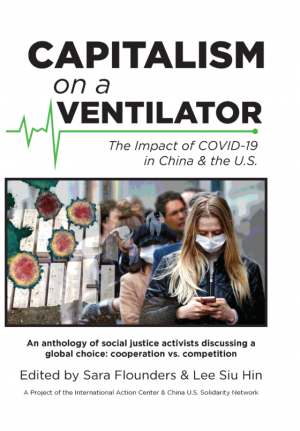
“Capitalism on a Ventilator: The Impact of COVID-19 in China & the U.S” chronicles the terminal decline of capitalism. The book itself is an example of what can be accomplished through cooperation by progressive working-class organizations.

This anthology is a collaboration by social justice advocates like Ajamu Baraka of the Black Alliance for Peace, Margaret Flowers and the late Kevin Zeese from Popular Resistance, The Grayzone’s Max Blumenthal, historian and journalist Vijay Prashad, and Workers World Party leaders Monica Moorehead and Deirdre Griswold. The brilliant political prisoner and jailhouse professor, Mumia Abu-Jamal, contributes an essay dictated to Prison Radio. Firsthand accounts and analysis come from Lee Siu Hin of the China-U.S. Solidarity Network, who co-edited the book with Sara Flounders of the International Action Center.

The compilation of these works is an act of internationalism and working-class unity. The result demonstrates the successes and true potential of a socialist system and exposes the cruelty and injustice of the capitalist system.

In reviewing this groundbreaking anthology, I had foremost in mind that many of our readers have lost a loved one to the novel coronavirus that broke out in late 2019 and quickly spread across the Earth. Some of you reading this may have contracted COVID-19 yourself. The virus does not discriminate in its indifference to race, gender, nationality and even class, as has become abundantly clear since the U.S. White House “super spreader event” in early October.

But capitalism, on the other hand, does discriminate — in order to survive. It must draw borders and then enforce them at the barrel of a gun. It must isolate communities from their neighbors, and it must pit co-workers against each other. It must make a virtue of competition while outlawing cooperation.

“Capitalism intentionally breaks down social cohesion,” writes Sara Flounders in the book’s introduction. “Mass mobilizations, unions and community self-control organizations are a threat to exploitation. Police repression and racism are an essential part of the fabric of this society, used like Krazy Glue to forcibly hold together a crumbling system.”
Capitalist COVID’s Toll On Workers

Thirty-six and a half million workers in the U.S. joined the ranks of the unemployed as of October. As their jobs vanished, so did their health insurance. The lucky ones who kept their jobs faced the danger of exposure to a deadly virus. Grocery store and food distribution workers relied on pitiful wages without any guaranteed hazard pay. Even hospitals faced mass shortages of personal protective equipment (PPE), as nurses and other health care workers had to reuse disposable facemasks and fashion smocks out of trashbags and tarps.

One of the fastest growing job sectors in the U.S. is warehouse work, and the average salary is about $13 an hour. But none of these massive distribution networks were mobilized by the U.S. government to allocate dwindling supplies of PPE. Many of the 1.5 million warehouse workers are asking themselves if the risk of distributing cheap consumer goods during a pandemic is really “essential.”

The lives of our family members and friends and colleagues have been flung like coal into a furnace to keep the engine of capital running. For capitalism, this human sacrifice was, indeed, “essential” — essential to the functioning of a system whose sole purpose is to enable a small cohort of property owners to keep for themselves all the wealth that we create with our work. The stolen value of our collective labor is what they call profit.

This theft isn’t a secret. It’s a capitalist crime that’s committed in broad daylight, on the books, with the sanction of the courts and the approbation of the corporate press — just like the state murder of George Floyd.

The COVID-19 pandemic death toll in the U.S. had already surpassed 100,000 by May 25, 2020, when workers of the world saw with clarity what this capitalist state considers truly essential to its survival. On that day, the lynching of George Floyd by Minneapolis police was murder and not a “mistake.” It was an atrocity, and it is not an aberration.

Only with naked force can such a relatively small group of people — the capitalist class — maintain control over so many human beings. This class scatters and divides us with racist myths, xenophobic paranoia, the pseudoscience of “biological gender” and other outright lies, until workers and oppressed people lose sight of who our enemies really are.

As the virus festers, and we try to reckon with the fact that nearly a quarter of a million of us are now gone, we can come to only one conclusion: Mass death is the policy of the capitalist state.
Socialism Pushes Back COVID

But it doesn’t have to be this way. We know this because socialist states have shown us a different world is possible.

“The success of China’s struggle against the virus and the U.S. failure demonstrates the success of China’s socialist system and the failure and dysfunction of the U.S. capitalist system,” writes Lee Siu Hin. “It also shows that the arrogance of the U.S. — due to the ceaseless anti-communist cold war against China — meant that the U.S. could not put aside differences and learn from China’s successful experience.”

Lee Siu Hin, who has appeared on Workers World Party’s weekly live broadcasts (every Thursday at 8 p.m. ET), was in China in January and on his return to the U.S. followed closely the mass mobilization of worker power to contain the spread of the virus.

According to the World Health Organization: “In the face of a previously unknown virus, China has rolled out perhaps the most ambitious, agile and aggressive disease containment effort in history.” (“Truth and Propaganda about Coronavirus,” Vijay Prashad, Weiyan Zhu and Du Xiaojun)

The working class of China, Cuba, Vietnam and other socialist countries have provided us with an example of this truth. Every day, those of us living under capitalism confront unemployment, racism, ecological destruction, sexism and transphobia, poverty and homelessness and terror. Capitalism tells us that’s “just the way the world works.”

But socialism shows that they are obstacles which can be overcome through the power of a united and uncompromising working class.

Trump copies Hitler


https://www.youtube.com/watch?v=Z2UYZg5Vkyg&ab_channel=WorldSocialistWebSite


TOP BOLIVIAN COUP PLOTTERS TRAINED BY US MILITARY


By Jeb Sprague, The Grayzone.

October 15, 2020


https://popularresistance.org/top-bolivian-coup-plotters-trained-by-us-military/


Commanders Of Bolivia’s Military And Police Helped Plot The Coup And Guaranteed Its Success.

They were previously educated for insurrection in the US government’s notorious School of the Americas and FBI training programs.

Lee este artículo en español aquí.

Lire cet article en français ici.

The United States played a key role in the military coup in Bolivia, and in a direct way that has scarcely been acknowledged in accounts of the events that forced the country’s elected president, Evo Morales, to resign on November 10.

Just prior to Morales’ resignation, the commander of Bolivia’s armed forces Williams Kaliman “suggested” that the president step down. A day earlier, sectors of the country’s police force had rebelled.

Though Kaliman appears to have feigned loyalty to Morales over the years, his true colors showed as soon as the moment of opportunity arrived. He was not only an actor in the coup, he had his own history in Washington, where he had briefly served as the military attaché of Bolivia’s embassy in the US capital.

Kaliman sat at the top of a military and police command structure that has been substantially cultivated by the US through WHINSEC, the military training school in Fort Benning, Georgia known in the past as the School of the Americas. Kaliman himself attended a course called “Comando y Estado Mayor” at the SOA in 2003.

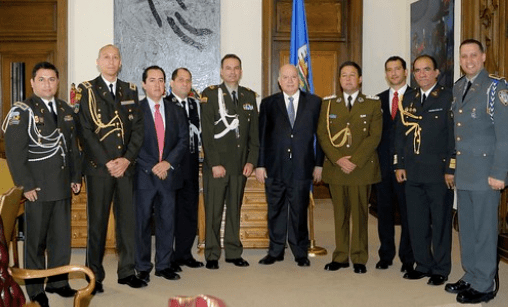
At least six of the key coup plotters are alumni of the infamous School of the Americas, while Kaliman and another figure served in the past as Bolivia’s military and police attachés in Washington.

Within the Bolivian police, top commanders who helped launch the coup have passed through the APALA police exchange program. Working out of Washington DC, APALA functions to build relations between U.S. authorities and police officials from Latin American states. Despite its influence, or perhaps because of it, the program maintains little public presence. Its staff was impossible for this researcher to reach by phone.

It is common for governments to assign a small number of individuals to work at their country’s embassies abroad as military or police attachés. The late Philip Agee, a one-time CIA case officer who became the agency’s first whistleblower, explained in his 1975 tell-all book how US intelligence traditionally relied on the recruitment of foreign military and police officers, including embassy attachés, as critical assets in regime change and counter-insurgency operations.

As I found from the more than 11,000 FOIA documents I obtained while writing my book on the paramilitary campaign waged in the lead up to the February 2004 ouster of Haiti’s elected government and the post-coup repression, U.S. officials worked for years to ingratiate themselves and establish connections with Haitian police, army, and ex-army officials. These connections as well as the recruitment and information gathering efforts eventually paid off.

In Bolivia, too, the role of military and police officials trained by the US was pivotal in forcing regime change. U.S. government agencies such as USAID have openly financed anti-Morales groups in the country for many years. But the way that the country’s security forces were used as a Trojan Horse by US intelligence services is less understood. With Morales’s forced departure, however, it became impossible to deny how critical a factor this was.

As this investigation will establish, the coup plot could not have succeeded without the enthusiastic approval of the country’s military and police commanders. And their consent was influenced heavily by the US, where so many were groomed and educated for insurrection.
Leaked Audio Exposes School Of The Americas Grads Plotting A Coup

Leaked audio reported on Bolivian news website La Época, and by elperiodicocr.com and a range of national media outlets, reveals that covert coordination took place between current and former Bolivian police, military, and opposition leaders in bringing about the coup.


The leaked audio recordings show that former Cochabamba mayor and former presidential candidate Manfred Reyes Villa played a central role in the plot. Reyes happens to be an alumnus of WHINSEC (formerly known as the School of the Americas), who currently resides in the United States.

The other four who are introduced or introduce themselves by name in the leaked audio are General Remberto Siles Vasquez (audio 12); Colonel Julio César Maldonado Leoni (audio 8 and 9); Colonel Oscar Pacello Aguirre (audio 14), and Colonel Teobaldo Cardozo Guevara (audio 10). All four of these ex-military officials attended the SOA.

Cardozo Guevara, in particular, boasts about his connections amongst active officers.

The identities of these individuals are confirmed by cross-checking the data of the School of Americas Watch lists of alumni with Facebook and local Bolivian news articles and the leaked audio recordings.

The School of the Americas is a notorious site of education for Latin American coup plotters dating back to the height of the Cold War. Brutal regime change and reprisal operations from Haiti to Honduras have been carried out by SOA graduates, and some of the most bloodstained juntas in the region’s history have been run by the school’s alumni.

For many years, anti-war protesters have staged a protest vigil outside the SOA’s headquarters at the Fort Benning military base near Columbus, Georgia.

The leader of those protests, Father Roy Bourgeois, has described the SOA as “a combat school. ” He continued:

“Most of the courses revolve around what they call counter insurgency warfare. Who are the insurgents? We have to ask that question. They are the poor. They are the people in Latin America who call for reform. They are the landless peasants who are hungry. They are health care workers, human rights advocates, labor organizers, they become the insurgents, they’re seen as ‘el enemigo’ — the enemy. And they are those who become the targets of those who learn their lessons at the School of the Americas.”

Bourgeois was deported from Bolivia in 1977 when he spoke out against the human rights abuses of Gen. Hugo Banzer, a right-wing dictator who rose to power through a US-backed coup that toppled a leftist government. History repeats itself today as Banzer’s ideological heirs drive another socialist leader from power through time-tested destabilization tactics.

In the recently leaked audio recordings, coup plotters discuss plans to set ablaze government buildings, get pro-business unions in the country to carry out strikes, as well as other tactics – all straight out of the CIA playbook.

Also alluded to in the leaked audio is that the coup attempt would be supported by various evangelical groups as well as by Colombian President Iván Duque, ex-Colombian President Álvaro Uribe, and most notably Brazil’s neo-fascist President Jair Bolsonaro.

The plotters also mention the strong support of ultra-right U.S. senators Ted Cruz, Bob Menéndez, and Marco Rubio, who is said to have the ear of President Donald Trump when it comes to U.S. foreign policy in the Western Hemisphere.
Military And Police Attachées In DC: A Breeding Ground For U.S. Intelligence Networking

As tensions built over recent weeks, it was the commanding general of the Bolivian Police, Vladimir Yuri Calderón Mariscal, who broke the stalemate by leading large parts of the police force to revolt on November 9th, just a day prior to the resignation of Morales.

In 2018 Calderón Mariscal served as President of Police Attachés of Latin America in the United States of America (APALA), which is based in Washington, DC.

APALA has been described as a “multidimensional security” program that works to build relations and connections between U.S. authorities and police officials from many of the Organization of American States members.

At APALA’s founding in 2012, then-OAS Secretary General José Miguel Insulza (center in photo below) met with the group’s leadership.


Today APALA hosts police attachés from 10 countries: Brazil, Bolivia, Colombia, Chile, Ecuador, El Salvador, Panama, Peru, Mexico and the Dominican Republic.

According to its Facebook page, the group “was created, with the objective of generating, promoting, and strengthening ties of solidarity, friendship, cooperation and support between the members of the group and their families through social, cultural activities, which allow to generate integral development.”

It claims to be facilitating the “integration and exchange of the police institutions that comprise it, in addition to promoting the exchange of successful experiences developed by the different police forces of Latin America.”

A mysterious organization, APALA has shut down its website ApalaUSA.com and does not answer phone calls. It functions in some capacity as an arm of U.S. federal agencies as its social media platform and now defunct website showcase numerous meetings and photos of APALA officials and participants alongside FBI, DEA, ICE, and other U.S. officials.

As Philip Agee explained in his book Inside the Company, the CIA often uses other U.S. government agencies such as the FBI and USAID, as well as various front-organizations, to carry out its clandestine activities without leaving fingerprints.

Below: APALA participants at the FBI headquarters in Washington DC


One of APALA’s key local members is Alex Zunca, a police officer in Baltimore who is the director of international affairs for the Hispanic National Law Enforcement Association, which is based in Washington, DC.

APALA’s street address listed on its now defunct website is the same address as the embassy of Mexico in Washington, DC. The group was apparently run out of the Mexican Embassy, at least between 2017 and 2018 when its website was active during the administration of the US friendly former Mexican President Enrique Peña Nieto.

Interestingly, a colleague of Calderón Mariscal’s and also a former President of APALA is an associate minister of the Federal Police of Mexico named Nicolás González Perrin.

Below, he can be seen seated beside a Mexican national flag and an FBI hat.


In a 2017 interview with the Washington Hispanic, a DC-based Spanish language newspaper, González Perrin declared “that APALA holds meetings, permanently, with the most significant federal agencies in the United States, ‘from INTERPOL to DEA, ICE and the FBI, who work with us, based on mutual needs.’”

Another important APALA participant is Hector Ivan Mejia Velasquez, the former General Commissioner of Honduras’s National Police, who has led brutal operations against protesters in his own country, and regularly posts anti-leftist screeds on social media.


Calls to APALA’s public contact, whose name appears to be Alvaro Andrade, went unanswered. My calls to his number, which is listed as being located in Rockville, Maryland, went straight to a voicemail stating that it was restricted. The webmaster of APALA’s former website is Mario Ruiz Madrigal, a system’s engineer in Mexico.

APALA, whose Facebook page Andrade appears to operate, has worked with other Bolivian police officials as well, such as Bolivian police attaché Heroldina Henao.


The other key official that helped to bring about the November 10th coup is General Williams Kaliman, the head of Bolivia’s military. He served as a military attaché for his country’s embassy in Washington, D.C. in 2013. A decade prior, he had taken part in training at the SOA. Little is known about his time in the United States.

After the coup, Kaliman was replaced. Some Latin American media outlets reported that Kaliman was paid a large sum of money and fled the country, potentially to the United States, although this has not been independently confirmed.

At different times both Kaliman and Calderón Mariscal appear to have either been loyal to or feigned loyalty to the constitutional government, but ultimately split from it or were convinced over time to carry out a military putsch.

For his part, deposed President Morales has claimed that a member of his own security team was offered $50,000 to betray him.

The November 10 coup d’état did not materialize out of thin air. Events that have transpired inside Bolivia are intimately connected to U.S. efforts to influence military and police forces abroad through programs like SOA and APALA.

While U.S. President Donald Trump cheers on a “a significant moment for democracy in the Western Hemisphere,” Bolivians are suddenly under the control of a de facto military regime.