Saturday, October 17, 2020
TEN REASONS WHY THE ASSANGE TRIAL THREATENS FREEDOM OF SPEECH
By Fidel Navaez and Ben Norton, The Grayzone.
October 14, 2020
https://popularresistance.org/ten-reasons-why-the-assange-trial-threatens-freedom-of-speech/
The Ecuadorian Diplomat Who Gave Julian Assange Political Asylum Reports From The Extradition Hearing Against The WikiLeaks Journalist, And Explains Why It Is “The Most Important Case Against The Freedom Of Expression In An Entire Generation.”
Translated by Ben Norton.
Puedes leer este artículo en español aquí.
Editor’s note: Fidel Narváez served as Ecuador’s consul in the UK from 2010 until July 2018. He helped get Julian Assange political asylum, and regularly communicated with the WikiLeaks publisher when he was trapped in the London embassy. In a previous article for The Grayzone, Narváez debunked 40 media lies and distortions about Assange. In this piece, he summarizes the key points from the British extradition hearings against Assange in September 2020.
At the end of the hearings that seek to extradite journalist Julian Assange to the United States, on October 1, his defense team should have felt triumphant. Because with more than 30 witnesses and testimonies, throughout the whole month of September, they gave a beating to the prosecution representing the U.S.
If the case in London were decided solely on justice, as it should in a state based on law, this battle would have been won by Assange.
However, this “trial of the century” is, above all, a political trial, and there remains the feeling that the ruling was made beforehand, regardless of the law.
The court kicked off on September 7 with hundreds of protesters outside, in contrast with the restrictions that the court imposed inside — in what is the most important case against the freedom of expression in an entire generation.
It only permitted the entry of five people on the list of “family members,” and five people from the public, who were put in an adjacent room, where they were barely able to follow the video transmission.
The judge Vanessa Baraitser, who is overseeing the case, without a convincing reason cut the access to the video stream that had previously been authorized to nearly 40 human rights organizations and international observers, including Amnesty International, Reporters Without Borders, and PEN International.
Each day, starting at 5 am, selfless activists stood in line so that observers like Reporters Without Borders, for example, could enter and take one of the five available seats. Thanks to them, and to family members of Assange, I was able to be in court to attend the majority of the hearings.
Julian himself was also woken up, every day, at 5 am and, naked and handcuffed, subjected to humiliating inspections and x-ray scans, before being put into a police car and crossing through London traffic for more than an hour and a half.
At 10 am, when court was finally in session, Julian had already endured five hours of insult, before being put in a glass cage for the rest of the day.
To communicate with his lawyers, Julian had to get on his knees to talk to them through a slit in the cage, just a few meters away from the ears of the prosecution’s attorneys — something that clearly violates due process.
The defense began by requesting deferment of the hearings, in light of the fact that the U.S. had filed a new extradition request at the last minute, with new accusations that not Assange himself was able to look over.
In the previous six months, Julian had practically no access to his lawyers. The judge, however, rejected any deferment.
The defense had based its strategy on proving that the legal process was being abused in many interrelated ways. In this extensive summary, allow me to explain 10 reasons that I identified as important factors against the extradition.
For this exercise I have relied, furthermore, on the reporting of American journalist Kevin Gosztola and that of the former British diplomat Craig Murray, next to whom I shared a seat in the court.
1) The Accusation Is For A “Political Crime,” Which Is Not Subject To Extradition. Publishing Classified, And Truthful, Information Is Not A Crime.
Julian Assange would be prosecuted under the Espionage Act of the United States for a political “crime,” which is excluded from the extradition agreements between the United Kingdom and U.S.
The U.S. attorney general’s office has furthermore said that Assange, as a foreigner, would not be able to exercise the right of the First Amendment. That is to say, punishments apply to foreigners in the U.S., but not legal protections.
The director of the Freedom of the Press Foundation, Trevor Timm, told the court that the extradition of Assange would be the “end of national security journalism” because it would criminalize all reporters who receive secret documents.
He criticized the accusation that having a SecureDrop is a crime, as The Guardian, Washington Post, New York Times, and more than 80 other news organization, including the International Consortium of Investigative Journalists, also currently use SecureDrop.
Timm said the Department of Justice has a political orientation, that the prosecution cannot decide who is a journalist and who is not, and that the charges against Assange “would radically rewrite” the First Amendment.
This was also affirmed in the written testimony by the director of the Knight First Amendment Institute at Columbia University, Jameel Jaffer, who insisted that the accusation against Assange is meant to discourage journalism that is essential for democracy, and represents a grave threat to the freedom of the press.
The professor of journalism and former investigative reporter Mark Feldstein testified that leaks are a “vital element” of journalism, that the collection of classified information is a “standard operating procedure” for journalists, and that WikiLeaks’ publications are constitutionally protected.
The US lawyer Eric Lewis, a former law professor at Georgetown University, noted that the Obama administration had finally decided not to try Assange Assange because of what is known as “the New York Times problem” — that is to say, there was not a way to prosecute him for publishing classified information without the same principle applying to many other journalists.
Lewis testified that the Trump administration had put pressure on prosecutors from the Eastern District of Virginia, and cited a New York Times article that referenced Matthew Miller, the former Justice Department spokesman under Obama, who warned the case could establish a precedent that threatens all journalists.
This same concern was expressed before the court by the lawyer Thomas A. Durkin, a former assistant United States attorney and professor of law, who warned that “the Trump administration ordering the reopening of the case was clearly a political decision.”
Both Durkin and Lewis affirmed that Assange would be condemned for life, given that the sentences for spying in the U.S. are generally life in prison, and the most lenient are from 20 to 30 years.
The lawyer Carey Shenkman, who wrote a book about the history and use of the Espionage Act, testified that the law is “extraordinarily broad” and one of the most divisive laws of the United States. “Never, in the history of the Espionage Act, has there been an accusation against an American editor … and neither has there been an extraterritorial accusation against a non-American editor.”
The prosecution, for its part, in what was one of the most terrifying admissions heard in the court, recognized that, while the Espionage Act had never been used against a journalist, its extensive scope would allow them to use it in this occasion.
The lawyer Jennifer Robinson, a member of Assange’s legal team, submitted to the court a written testimony detailing an offer of a pardon by President Trump, in exchange for Assange identifying the source of the leaks that WikiLeaks published from the Democratic National Committee (DNC) in 2016.
The offer was made through the US Representative Dana Rohrabacher during a visit to the embassy of Ecuador. The congressman had explained that the information from Assange about the source of the leaks would be “interest, value, and assistance” for the president, and would “resolve the ongoing speculation about Russian involvement.”
The offer from the White House demonstrated the politicized nature of the case, given that the charges were made after Assange refused to provide any information.
The award-winning journalist Patrick Cockburn, who has written for The Independent for more than 30 years, submitted written testimony in which he said that Assange is being persecuted because he “exposed the way the US, as the world’s sole superpower, really conducted its wars – something that the military and political establishments saw as a blow to their credibility and legitimacy.”
For his part, the journalist Ian Cobain, who worked for The Guardian during the publication of WikiLeaks materials in 2010, said in written testimony that Assange is being persecuted because, “There is always the understanding – one that is so clear that it needs not be spoken – that anyone who has knowledge of state crimes, and who comes forward to corroborate allegations about those crimes, may face prosecution.”
The renowned professor Noam Chomsky told the court in written testimony that Assange “has performed an enormous service to all the people in the world who treasure the values of freedom and democracy and who therefore demand the right to know what their elected representatives are doing. His actions in turn have led him to be pursued in a cruel and intolerable manner.”
Yet, if there remain doubts about the political nature of the case, there was also the Judge Baraitser herself, who in the court said her original intention was to have the verdict before the U.S. presidential elections, and who asked the defense and the prosecution what implications a ruling would have had after said elections.
Why is a British judge, who is supposed to impart justice solely based on facts and evidence, waiting for a purely political event in another country to reveal her verdict?
2) There Was Never A Reckless Disclosure Of Names. No One Has Been Hurt Due To WikiLeaks Publications.
The legendary leaker of the Pentagon Papers, Daniel Ellsberg, told that court that he “totally disagrees with the ‘good Ellsberg / bad Assange’ theory.” He said Julian did “everything possible” to redact and withhold damaging information, working with media outlets in the redaction process.
The Pentagon Papers were top secret, but WikiLeaks’ documents were not classified as restricted and hence, by definition, there should be nothing that is truly sensitive.
Ellsberg said that Assange withheld 15,000 files from the Afghan War Diary to protect names, and also requested help from the State Department and Defense Department to redact names, but the U.S. government refused to help, despite the fact that it is standard journalistic practice to consult with officials to minimize damage.
In the court-martial of Chelsea Manning, Ellsberg noted, the Defense Department admitted that it could not identify a single death caused by WikiLeaks publications.
The co-founder of the organization Iraq Body Count (IBC), John Sloboda, whose work has been recognized by the United Nations and European Union, testified that he worked with WikiLeaks and media outlets to prepare the Iraq War Logs before their publication. Sloboda recounted that Assange demanded and directed a “very strict redaction process” to prevent possible harm.
WikiLeaks used a software that was able to edit thousands of documents, identifying each word that was not in the English-language dictionary and automatically removing it, such as Arab names for example. Then, the files were scanned again to remove occupations, such as “doctor” or “driver,” in order to better protect identities.
This editing took “weeks” and was a “meticulous process,” Sloboda recounted. “There was considerable pressure on WikiLeaks because other media outlets wanted to push it to publish more quickly,” but “the position of Assange and WikiLeaks was to be excessively cautious.”
John Goetz, the current director of investigations for German public television NDR, confirmed that when he worked with Assange in 2010, representing Der Spiegel, WikiLeaks had a “rigorous redaction process,” and that Assange was obsessed with keeping classified documents secure and preventing harmful disclosures.
“I remember being very irritated by Assange’s constant and endless reminders that we needed to be safe,” and that WikiLeaks “ended up removing more things than even the Defense Department,” Goetz said. Assange frequently discussed “how to find confidential names so that we can redact them and take measures to make sure that nobody is at risk.”
The journalist Nicky Hager, author of the book “Other People’s Wars: New Zealand in Afghanistan, Iraq and the war on terror,” testified that one of his jobs was to “identify any cable that should not be released for reasons like the personal security of people mentioned,” and that WikiLeaks personnel were “committed to a careful and responsible process.”
He was “shocked” to see the level of care that they were taking to redact information that could hurt third parties. “People were working in silence for hours and hours” reviewing documents,” he recalled.
The veteran Italian journalist Stefania Maurizi, whose persistent reporting showed how British prosecutors pressured their Swedish counterparts to not interrogate Assange in London, said in her written testimony:
I myself was given access to 4,189 cables… I sat down with Mr Assange and went through the cables as systematically as possible… Everything was done with the utmost responsibility and attention… That was the first time I had ever worked in any publishing enterprise involving strict procedures of that kind. Even experienced international colleagues found the procedures burdensome, involving protections considerably beyond those which any of them were accustomed to exercising… Not even the work done by close colleagues about the Italian mafia required such extreme precaution and security, it never rose to those levels.
3) WikiLeaks’ Publications Are Truthful Information That Is Historically Relevant.
The British-American lawyer Clive Stafford Smith, the founder of the human rights organization Reprieve, testified that WikiLeaks shined a light on torture of detainees in Guantánamo, and revealed that many were not terrorists, but rather had been arrested in Afghanistan in a bounty system. The worst accusations had been “staged” against prisoners, who were sometimes forced to admit to them under torture.
Stafford Smith explained that it was thanks to WikiLeaks that the use of these torture techniques are known, such as the pulley, or hanging someone by their wrists until their shoulders are dislocated, and cited as an example Binyam Mohamed, a UK citizen whose genitals were on a daily basis cut with a shaving razor.
The lawsuits against the United States’ drone assassination program in Pakistan would have been impossible without WikiLeaks, Stafford Smith said.
John Sloboda of Iraq Body Count said that the Iraq War Logs constitute “the greatest contribution to public knowledge about civilian casualties in Iraq,” revealing around 15,000 deaths that had previously been unknown.
Patrick Cockburn, of The Independent, insisted, “Wikileaks did what all journalists should do, which is to make important information available to the public, enabling people· to make evidence-based judgments about the world around them and, in particular, about the actions of their governments.”
The files published by WikiLeaks convey the reality of war “far better than even the most well-informed journalistic accounts,” Cockburn added, showing how “the dead were automatically identified as ‘terrorists’ caught in the act, regardless or evidence to the contrary.”
The former journalist Dean Yates, who was chief of Reuters’ Baghdad bureau in 2007 and 2008, said in his written declaration that it was not until 2010, when WikiLeaks published the famous Collateral Murder video, that he knew the truth about the death of his journalist colleagues Namir Noor-Eldeen and Saeed Chmagh.
Yates recounted the attempts by the United States to cover up the truth, and that the military only showed him part of the video. The only person who told the truth was Assange.
“Had it not been for Chelsea Manning and Julian Assange, the truth of what happened to Namir and Saeed, the truth of what happened on that street in Baghdad on July 12, 2007, would not have been brought to the world,” Yates said. “What Assange did was 100% an act of truth-telling, exposing to the world what the war in Iraq in fact was and how the US military behaved and lied.”
On this point, Judge Baraitser interrupted Yates’ testimony, due to repeated pressure by the prosecution. It is ironic that a court would seek to criminalize journalism, while refusing to hear about the crimes exposed by journalism.
That is what happened in the much-anticipated testimony by the German-Lebanese citizen Khaled el-Masri, who was kidnapped and tortured by the CIA — and who for “technical problems” with the online transmission was not able to testify in person.
The judge stopped listening to him, also under pressure by the prosecution. This is what provoked an indignant reaction from Julian Assange, who shouted, “I will not censor the testimony of a torture victim before this tribunal… I will not accept it!”
The prosecution, finally, allowed the summary of the written statement to be read: El-Masri was brought to a CIA black site in Afghanistan, where he was beaten, strip searched, sodomized, force-fed with a tube through his nose, and subject to total sensory deprivation and other cruel forms of inhumane treatment for six months.
Finally, when the torturers realized that they had the wrong man, El-Masri was abandoned with his eyes blindfolded on a remote road in Albania. When he returned to Germany, his house was empty and his wife and kids had gone.
The journalist John Goetz, on German public television, demonstrated that El-Masri’s story was true, and tracked down the CIA agents who were involved. German prosecutors sent out orders for the arrest of the kidnappers, but they were never executed.
WikiLeaks’ publications proved that the United States put pressure on the German government to block a legal investigation into the crime.
The European Court of Human Rights, using the WikiLeaks cables, agreed with El-Masri, who wrote to the court:
WikiLeaks publications have been essential to accept the truth of the crime and the cover-up… without dedicated and brave exposure of the state secrets in question, what happened to me would never have been acknowledged and understood.
4) WikiLeaks Was Not The First To Publish The Diplomatic Cables Without Redaction, But Only Julian Assange Is Being Persecuted.
Three of the 18 charges against Assange accuse him specifically of publishing US diplomatic cables without redactions. But the defense and its witnesses showed that WikiLeaks was not the first media outlet to publish these files, and those who did it were not prosecuted. WikiLeaks was careful to encrypt the archive, but actions out of Assange’s control led to its publication.
The German computer science professor Christian Grothoff testified about an investigation into the chronology of the events of 2011. Grothoff reviewed the timeline: In the summer of 2010, WikiLeaks shared the cables with The Guardian journalist David Leigh, through a file on a temporary website protected with a very strong encryption password. Assange only wrote part of the password on paper. WikiLeaks and its media partners began to publish the edited cables in November 2010.
WikiLeaks suffered constant attacks on its servers and mirror copies of its archive were created around the world to protect the information. Those copies were not accessible without a secure code. In February 2011, The Guardian journalists David Leigh and Luke Harding published a book in which the title of a chapter was the complete password for the unredacted cables. When the book published the key, WikiLeaks no longer had the ability to delete the mirror archives or change the encryption.
On August 25, 2011, the German newspaper Der Freitag published an article in which it explained that the password revealed by Leigh and Harding could be used, and in a few days the complete archive, without redaction or editing, appeared on Cryptome.org, a page created in the United States. The websites MRKVA and Pirate Bay also published copies of the archive. On September 1, the U.S. government accessed the unredacted cache for the first time, through Pirate Bay.
Professor Grothoff testified that he had not been able to find a single example of the code published online before The Guardian journalists published it in their book.
Assange and his WikiLeaks colleague Sarah Harrison called the U.S. State Department to warn that the unredacted cables were online, but their warnings were ignored. The journalist Stefania Maurizi recounted in her testimony that she was meeting with WikiLeaks the same day that she found out that the cables had been published, out of Assange’s control.
“I remember that when I arrived there were fierce discussions as to what to do. Julian was clearly acutely troubled by the situation with which Wikileaks was faced,” she recalled. For more than a year, he had been taking all of the possible measures to prevent this. “Assange was himself making urgent attempts to inform the (US) State Department the information was circulating out of Wikileaks’ control.”
WikiLeaks had to release the cables on September 2, 2010, and published an editorial note indicating that “A Guardian journalist has negligently disclosed top secret WikiLeaks’ decryption passwords to hundreds of thousands of unredacted unpublished US diplomatic cables.”
The journalist Glenn Greenwald, who won the Pulitzer Prize for the Edward Snowden revelations, wrote that day:
Once WikiLeaks realized what had happened, they notified the State Department, but faced a quandary: virtually every government’s intelligence agencies would have had access to these documents as a result of these events, but the rest of the world — including journalists, whistleblowers and activists identified in the documents — did not. At that point, WikiLeaks decided — quite reasonably — that the best and safest course was to release all the cables in full, so that not only the world’s intelligence agencies but everyone had them, so that steps could be taken to protect the sources.
The journalist Jakob Augstein, editor of Der Freitag, confirmed in his written testimony that, in August 2010, his media outlet published an article titled “Leak at WikiLeaks,” about the about the release of the password by The Guardian journalists. Assange called him and requested that he not publish anything that could reveal where the archive could be found, worried about “the security of the informants” of the U.S. government.
Finally, John Young, the representative of Cryptome.org, confirmed in his written testimony that his U.S.-based website first published the unredacted diplomatic cables, before WikiLeaks republished it:
I published on Cryptome.org unredacted diplomatic cables on September 1, 2011… and that publication remains available at the present… no US law enforcement authority has notified me that this publication of the cables is illegal, consists or contributes to a crime in any way, nor have they asked for them to be removed.
5) Assange Never Helped Chelsea Manning Access National Security Information
One of the charges against Julian Assange is that he supposedly conspired with the soldier Chelsea Manning to obtain greater access to government databases y hid his identity to do it.
The argument is that Manning spoke in an encrypted chat with the user “Nathaniel Frank” (who the United States alleges, but has not proved, was Assange) and requested help from him to open an encrypted part of a password. The defense argues that Manning asked for help to protect her identity, something that journalists are obligated to do with their sources.
The defense brought before the court the best possible expert on the material: Patrick Eller, a forensic digital expert who worked for two decades for the U.S. Army and now is a professor of forensic evidence and the president of Metadata Forensics, which investigates civil and criminal cases. Eller reviewed the transcriptions from the court-martial of Manning in 2013 and came to the following conclusions:
a) The attempt to decrypt the password was technologically impossible and “computationally not viable” in March 2010, when the conversation took place between Manning and “Nathaniel Frank.”
b) Even if it were feasible, it would not have given Manning greater access to the government databases. At the date of Manning’s chat with “Nathaniel Frank” about the decryption of the key, Manning had already leaked all of the documents to Wikileaks, excluding the State Department cables, that were being stored on a network that did not require login information, because Manning already had access to it.
c) And even if it were feasible, the purpose would not have been to conceal Manning’s identity. What is much more probable, testified Eller, who interviewed members of Manning’s military unit, was that they wanted to use the administrative account to download unauthorized movies, music, and games, and this required decrypting the password. Manning, Eller said, was the “person to go to” in her unit to help her colleagues do this.
In his testimony, Eller also established that neither he nor the U.S. government can prove that “Nathaniel Frank” was truly Julian Assange, or any other person.
6) Assange Would Not Have A Fair Trial In The U.S. “Spy Court”
Julian Assange would be tried in the “Spy Court” of the United States, where “national security” cases go, and which in 2010 opened a “secret” investigation against WikiLeaks and Assange, for which he requested political asylum from Ecuador.
This is the Eastern District of Virginia, where the CIA and major national security contractors are based. The jury, therefore, comes from the place with the largest concentration of the U.S. intelligence community, where Assange would have no change of getting a fair trial.
Daniel Ellsberg told the court that those accused of espionage cannot even argue reasons that justify their actions. “I did not have a fair trial, no one since me had a fair trial on these charges, and Julian Assange cannot remotely get a fair trial under those charges if he were tried.”
This was also confirmed by the lawyer Carey Shenkman, who told the court that the Espionage Act does not allow the accused to argue their defense in the “public interest.”
Trevor Timm noted in the court that 99.9 percent of grand juries make charges based on what the prosecution establishes, and that a study of 162,000 grand juries revealed that just 11 rejected the request of a federal prosecutor to press charges.
Eric Lewis said the judge of the Eastern District of Virginia would give Assange an extremely aggressive sentence.
The professor Mark Feldstein told the court that a large amount of academic material demonstrates that grand juries are maleable and do what the prosecutors tell them to do.
7) Assange Would Face Inhumane Conditions In The U.S.
By being accused of spying, Julian Assange would be imprisoned under “Special Administration Measures” (SAMs). He would be in solitary confinement, would not be allowed any contact with family, and would only be able to speak with lawyers, who could not be able to communicate any messages from him or would face criminal punishment. Such conditions are a sentence to a living death.
For his entire trial, Assange would be imprisoned in Alexandria Detention Center (ADC), and he would later serve a life sentence in the maximum security prison ADX Florence in Colorado.
The prosecution has tried to whitewash the conditions, in the written testimony of the assistant United States attorney in the Eastern District of Virginia, Gordon Kromberg, who tried to depict the hell of maximum-security prisons as friendly, which the defense’s witnesses said was a fiction.
Yancey Ellis, a former defense lawyer for the U.S. Marines, who has defended many clients from ADC, told the court that the situation with Assange would be “cruel and oppressive,” with an unknown time in solitary confinement, where he would be subjected to “torture and inhumane and degrading punishment.”
Assange would pass 22 to 23 hours per day without any contact in a cell of less than five square meters. Normally, food is eaten inside the cell, and he would not have access to therapeutic programs of any kind. There is no outside area for recreation or exercise in the Alexandria prison.
The lawyer Joel Sickler, an expert on prison conditions and founder of the Justice Advocacy Group in Virginia, who also has clients in ADC and is familiar with ADX Florence prison in Colorado, told the court that Assange “absolutely won’t have communication with other inmates.” He added, “Your whole world is the four corners of that room.”
In general, they allow one phone call with family for 15 to 30 minutes per month, and all of the calls are monitored, he explained. Sickler described the system as “feudal.” He added that the possibility of appealing SAMs cases is “remote to nil,” and said that he had a client who was in solitary confinement for 23 years.
The witness Maureen Baird, a former director of three U.S. prisons, including Metropolitan Correctional Center (MCC) of New York, where there are prisoners under SAMs measures, said that Assange would face “desolate and degrading” conditions before and after the trial.
SAMs is not discretionary; it is a directive imposed only by the attorney general, with the backing of intelligence agencies. The prisoners that they put under SAMs are technically in isolation for 24 hours per day. The conditions are so bad that it is hard to believe they still exist, given all of the studies and reports on the horrible physical and psychological effects it has on the prisoners.
Another witness was Lindsay Lewis, the lawyer for the British Muslim preacher Abu Hamza al-Masri, who is detained in ADX Florence in Colorado, despite the fact that the United States guaranteed British courts and the European Court for Human Rights that he would not be detained in such conditions, without an adequate medical examination.
Abu Hamza is an amputee who lost both hands, is blind in one eye, and suffers a skin condition called hyperhidrosis. He has been imprisoned under SAMs and in solidarity confinement for the past eight years. His bed, toilet, and sink were not adequate given his disabilities and other medical conditions, including severe diabetes, hypertension, and depression, which are not adequately treated.
Lewis said that the “unreliable nature of the U.S. government’s assurances” should be a concern for British authorities on whether or not to extradite Assange to the United States.
The lawyer said the restrictions are so absurd that Abu Hamza was accused of violated SAMs when he tried to express his love for his grandson, in a letter to one of his children, because the grandchild, a 1-year-old baby, was not a pre-approved contact.
8) Assange Faces A High Risk Of Suicide In The U.S.
The conditions surrounding the physical and emotional health of Julian Assange were discussed in great detail in the court. This was the only area in which the prosecution presented its mere two witnesses.
It is important to remember that, soon after Assange was detained in Belmarsh prison, United Nations specialists specialists examined him and determined that he was suffering from several effects of psychological torture, a result of nearly a decade of persecution, made even worse by his last year of confinement in the Ecuadorian embassy, when the government of President Lenín Moreno subjected him to isolation and cruel harassment — something that I have personal knowledge of.
Doctor Michael Kopelman, a professor emeritus of neuropsychiatry at King’s College London, testified that Assange has been diagnosed with clinical depression and Asperger syndrome, for which he runs a high risk of suicide if he were extradited. Kopelman cited a study that found that suicide is nine times more likely in patients with Apserger’s.
Chelsea Manning attempted suicide in the same facilities where Assange would be held in pre-trial detention.
Dr. Kopelman found that Assange showed a “loss of sleep, loss of weight, a sense of pre-occupation and helplessness as a result of threats to his life, the concealment of a razor blade as a means to self-harm and obsessive ruminations on ways of killing himself.”
“I am as certain as a psychiatrist ever can be that, in the event of imminent extradition, Mr. Assange would indeed find a way to commit suicide,” Kopelman wrote.
His diagnosis was supported by Assange’s entire medial history since infancy, multiple interviews with family members and longstanding friends, and a surprising family history of suicide, possibily indicating a genetic disposition.
Assange’s depressive state was especially severe in December 2019 when he sent goodbye letters to family members and friends, wrote a will, and even confessed to a Catholic priest.
Doctor Quinton Deeley, a neuropsychiatry specialist in autism and professor at King’s College London, testified that Assange took an Autism Diagnostic Observation Schedule (ADOS) test and was diagnosed as having “high-functioning autism” with “rigidity of thought,” a typical symptom of Asperger’s.
Assange “ruminates about prospective circumstances at length,” and it causes a “sense of horror,” Deeley said. He believes an “example is being made out of him,” which enormously increases the risk of suicide.
Doctor Sondra Crosby, a professor of medicine at Boston University and expert on the psychological impact of torture, visited Assange in the Ecuadorian embassy and Belmarsh prison. In 2018, Crosby published her professional opinion that the continued isolation of Assange was physically and mentally dangerous and a clear violation of his human right to health care.
In the embassy, Assange showed symptoms of post-traumatic stress disorder (PTDS) and psychological distress, an “acute psychological trauma, comparable to refugees fleeing war zones,” Crosby said. She added that he runs a high risk of suicide if he is extradited.
“He is in the same psychological state as someone who was being chased by a man with a knife and then locks themselves in a room and won’t come out,” Dr. Crosby explained. In October 2019, Assange “met all of the criteria for major depression… and he had suicidal thoughts every day,” she testified.
9) Assange And His Lawyers Were Illegally Spied On By The U.S., Which Makes A Fair Trial Impossible
The testimonies of two protected witnesses, former employees of the Spanish security firm UC Global, which spied on Julian Assange in the Ecuadorian embassy, were partially read in court.
The witnesses confirmed that the company, following the instructions of the director David Morales, recorded conversations between Assange and his lawyers and gave the information to U.S. intelligence officials.
Morales, a former Spanish military officer who called himself a “mercenary,” even discussed poisoning Assange or allowing him to be kidnapped.
According to the witnesses, around 2016, Morales attended a security conference in the United States, where he obtained a lucrative contract with the firm Las Vegas Sands, the property of a close friend and billionaire financier of Donald Trump.
Upon returning, Morales met with his employees and told them, “from now on we are playing in the Big Leagues.” Later, he privately admitted that they had passed over to the “dark side,” referring to their cooperation with U.S. authorities, and that “the Americans will get us contracts across the world.”
Morales began to make regular trips to the United States to speak with “our American friends,” and when he was asked who those friends were, he replied, “U.S. intelligence.”
According to protected Witness #1, Morales developed a sophisticated system to compile information in the embassy, replacing the internal camera system to be able to record audio. UC Global put together reports that Morales personally brought to the U.S. authorities, with details that violated the privacy of Assange, his lawyers, doctors, and other visitors.
Morales was obsessed with recording the lawyers of the “guest,” Assange, because “the American friends” had told him to, the witness said.
The protected Witness #2 admitted to the court that he had installed secret microphones and new cameras with audio recording, and that, at David Morales’ orders, denied to Ecuadorian diplomats that the cameras could record audio.
Around June 2017, Morales requested that the cameras be able to livestream, so that “our friends in the United States” could have access to the inside of the embassy in real time.
The witness confessed, “I did not want to collaborate in an illegal act of that magnitude,” adding that “Morales told me to put a microphone in the meeting room… and another microphone in the bathroom at the end of the embassy, a place that had become strategic for Mr. Assange, who suspected that he was a target of spying, and held many meetings there to try to keep them private.”
“All of the embassy came to have microphones,” the witness said. Morales also insisted on “putting certain decals on all of the external windows of the embassy,” which would allow sophisticated external laser microphones to “capture all of the conversations” for “our American friends.”
Witness #2 also said, “On one occasion, David [Morales] said the Americans were so desperate that they even suggested taking extreme measures against the ‘guest.’” He added, “In concrete, the suggestion was that they leave open the door of the embassy, which would allow them to argue it was an accidental error, and which would allow people to enter and kidnap the asylee.”
Moreover, the witness continued, “they discussed the possibility of poisoning Mr. Assange. All of those suggestions, Morales said, were being considered in negotiations with his contacts in the United States.”
A professor of international law at Oxford University, Guy Goodwin-Gill, gave written testimony in which he said that, when he attended a meeting in the embassy about “international legal aspects of asylum,” on June 16, 2016, his electronic devices were spied on by UC Global.
This was confirmed by protected Witness #2, who recalled that one of the employees of UC Global showed him the iPad of Goodwin-Gill with “many messages and emails in the home screen,” assuring him that “the contents of the iPad had been copied.”
Professor Goodwin-Gill called the spying a form of “legal interference” in the “sovereign affairs” of Ecuador, with the goal of carrying out a trial against a person whom the embassy was trying to protect. “The violation of one state’s sovereignty would then be joined by the likely violation of the individual’s fundamental rights to due process and equality of arms,” he said.
He added that the spying and exchange of “confidential privileged information” should be considered a sign of political motivation, with the intention and goal of influencing the extradition request.
On this point, I should add that, in my capacity as a former diplomat in the embassy of Ecuador in London, I am a witness in the criminal investigation against UC Global in Madrid, and I have been able to review, personally, an abundance of evidence not only against Assange and his lawyers, but also against all of his visitors and even the officials at the embassy.
The spying included, furthermore, tracking my activities outside of the embassy, which has been confessed by witnesses under oath.
As for the U.S. spying, the prosecution instructed the court to neither confirm nor deny if the statements by the witnesses are “true or false.”
Nevertheless, former CIA director Leon Panetta told German state television, “It does not surprise me… That kind of thing goes on all the time. In intelligence business, the name of the game is to get information any way you can, and I’m sure that’s what was involved here.”
10) Ecuador Illegally Gave The U.S. Confidential Materials About Assange, Including Documents About His Legal Defense
The renowned human rights lawyers Gareth Peirce, a member of Julian Assange’s legal team, submitted her own written testimony to the court, affirming that since April 8, 2019 — three days before the arrest of Assange in the embassy — the U.S. Department of Justice had ordered Ecuador to confiscate property and give “evidence” to a “representative of the UK FBI,” as journalist Kevin Gosztola documented.
A document from April 9, 2019, marked “highly confidential from the Deputy Director’s Office of International Affairs,” contained instructions to give Assange’s property to the U.S. government.
“One record of [Assange’s] entire archive” was basically robbed, and without that it has been more difficult for the defense to make the case against his extradition. According to Peirce, the day Assange was arrested, she “made immediate contact with the embassy in regard to legally privileged material, an issue of huge concern,” but “Repeated requests by telephone, email and recorded delivery mail were entirely ignored by the embassy.”
When Assange’s legal team was able to gather his belongings soon after, “All legally privileged material was missing save for two volumes of Supreme Court documents and a number of pages of loose correspondence.”
The UK Metropolitan Police denied any involvement in seizing legally privileged materials. This suggests that it was Ecuador, then, that illegally gave the documents to the United States.
Gareth Peirce testified that, in the days following the arrest of Assange, security guards “went in and out of relevant rooms” of the embassy, along with a diplomatic official named Pablo Roldan, who is related to the Ecuadorian ambassador and close to President Lenín Moreno.
“Although rooms were purported to be sealed, Embassy staff who were not permitted to return for approximately one week saw the original seals had been replaced, the re-seals marked ‘for judicial purpose,’” Peirce testified.
As Gosztola also reported, Carlos Poveda, an Ecuadorian attorney representing Assange, requested that the prosecutor in Ecuador make a copy of the documents on Assange’s belongings for December 2019 extradition proceedings.” But Peirce noted, “The Ecuadorian prosecutor refused that request.”
Among the documents reviewed by Assange’s lawyer were photographs that showed that the seals on doors in the embassy were broken.
In her testimony, Peirce confirmed that she was spied on when she attended legal meetings in the embassy.
In January 2021, Judge Vanessa Baraitser will issue a ruling on the most important extradition of the century, deciding, for the first time in history, if a journalist will be prosecuted under the U.S. Espionage Act.
The importance of that decision is that it not only threatens the life of Julian Assange, which is already being destroyed in a London prison, but rather the very future of investigative journalism.
I would add, moreover, that that verdict will determine the validity of the rule of law, and even the sovereignty of the United Kingdom.
The judge has an entire legal arsenal on the table to prevent this extradition, protect the future of journalism, and put herself on the right side of history. The question is, will she do it?

Sheldon Whitehouse Embarrasses Amy Coney Barrett Yet Again
https://www.youtube.com/watch?v=rPQ9oF43SXI&ab_channel=TheMajorityReportw%2FSamSeder
SKILLS FOR REVOLUTIONARY SURVIVAL: COMMUNICATIONS
By The Javelina Network of the IAF-FAI.
October 14, 2020
https://popularresistance.org/skills-for-revolutionary-survival-communications/
Face the facts. We are tied to our devices in ways that are incredibly useful for organizing, but that also expose us to isolation should the state and companies take away these technologies. Cell phones and the internet rely on corporate infrastructure and is subject to both government surveillance and service denial. What do we do when social media bans anti-capitalists and anti-colonialists? What do we do when our cell phones fully become monitoring devices we willingly keep by our side, all to the benefit of state intelligence services? What happens when our cell phone numbers are blocked from service? How will the revolutionaries continue to communicate locally, regionally, and internationally?
These are the questions that have been left in the dust, forgotten or ignored in favor of more romantic visions of armed struggle. People forget; no struggle has ever been successful without robust communication networks that are not subject to state control. From the French resistance in WWII to the Zapatistas in the Lacandon Jungle, communications matter!
Here, we will propose ways that you can start building this infrastructure, TODAY. As we slip further into the fascist future, we must build, lest we be left defenseless and disconnected from each other.
Building Nodes Of Communication
In order for us to build useful infrastructure, we must understand what needs we need to fill. Simply, these can be broken down into four categories: 1) immediate comrades /affinity group, 2) larger community of accomplices, 3) regional networks of resistance, 4) national/international news & resource sharing. We will examine the technologies and skills you will need to fill each of these.
1. Immediate Comrades / Affinity Group / Collective (Your Squad)
This group can use cheap, commonly available radios such as the 5 watt Boafeng UV-5R, to communicate at longer ranges of up to 10 miles, much further using repeaters. With an antenna upgrade, you can receive signals from much further away. For UHF/VHF a Dual Band Slim Jim antennas with 16 foot cable, tied up high, in a tree for example, can help a lot with range.
The issue with these radios for small group tactics and real time coordination is a lack of encryption. There are patches to allow for encrypted transmission, but to implement these, you need to understand that a) this is illegal, b) this requires technical skill to implement. Encryption should only be used for transmitting sensitive information to protect immediately actionable information.
Another option to investigate for Immediate Comrades / Affinity Group / Collective would be business band radios. These radios are sold with encryption, but are much more expensive. You can get an FCC license if you have a registered business or non-profit, something to leverage to get equipment / experience if this is a route your group decides to take. This is a really expensive option, but might be worth trying. An additional benefit to this type of license is the ability to set up repeaters. GMRS is the only radio option other than Ham that allows radio repeaters.
Remember, encryption only delays decoding of messages. Good for immediate actions, but you still need to be careful not to transmit sensitive names/locations. Encryption is best used for small groups. If there are thirty affinity groups, all operating on multiple frequencies with encrypted transmissions, it reduces the opportunity for the compromise of the entire network. Instead of one snitch, they would need thirty. This horizontal organizing and compartmentalization is extremely important. VHF/UHF would be the preferred band for this type pf line of sight, close communications.
2. Larger Community Of Accomplices
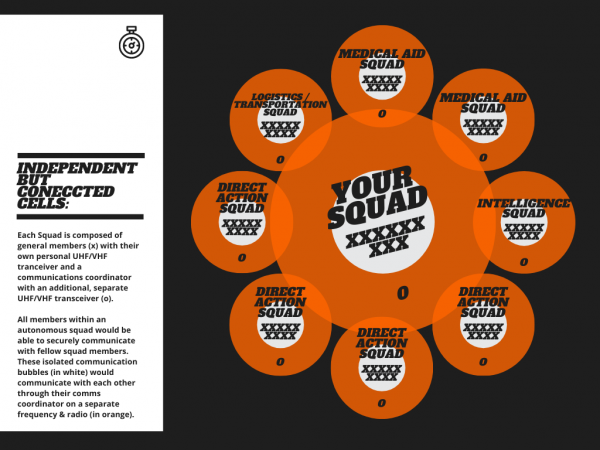
Now let’s imagine there are thirty groups operating in a city. Some providing medical services, some providing intelligence, some providing direct action. How can they coordinate if they are all operating on encrypted radios? They need to have a general band for communication. This band would be accessible using any of the personal radios used by the previously mentioned Immediate Comrades / Affinity Groups / Collectives, but would not use encryption. That means this could be used to coordinate.
During actions, one person per Affinity Group / Collective (referred to as a ‘squad’) would act as the comms coordinator. They would have both a radio dedicated for their immediate comrades encrypted communications, and a separate radio tuned to the general band. Should a need arise, say with a direct-action group for medical assistance, the call would go out from the comms coordinator to all other comms coordinators. This would allow medical squads to determine who is closest and send assistance, while also keeping situational awareness for all of the people on the general band. VHF would be ideal for this communication between small groups, only limited by the horizon.
3. Regional Networks Of Resistance
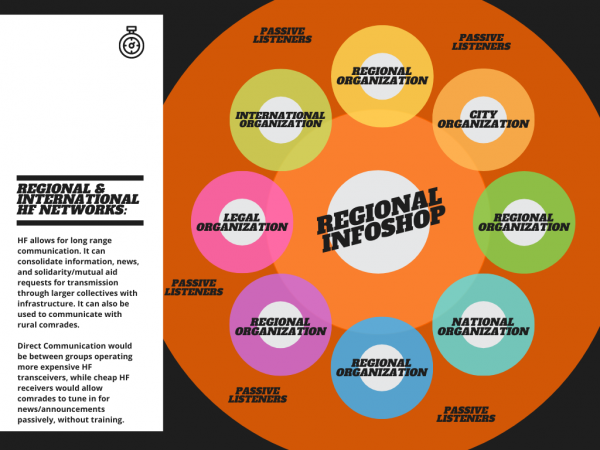
Moving out of the city or the affinity group, long distance communications will be needed for regional coordination, news, and resource sharing. This will require range over anything else. HF radio is what will be needed for this to be completely autonomous, but VHF can be used via repeaters, if that is the only affordable option.
Regional communications via radio should only speak of things that are not security critical. Security critical information needs to be transmitted using code, but again, this is crack-able, so be very careful. HF can be used to transmit data, files, and images, over long distance without the use of internet. This is a huge benefit. HF will also be useful for broadcasting public news, though pirate FM transmitters would be preferable even to that.
It is important to get people experienced in the local ham radio landscape, so to speak, so that you understand what frequencies would be useful for creating a regional band plan. Band plans share designated frequencies for sharing information, coordinating, data transfer, image sharing, and socializing. They basically create spots in the radio spectrum where you can tune in and connect with like-minded people. Remember, band plans give some level of pre-planning for frequency use, but anyone can listen or transmit on those frequencies. We will be sharing an article on creating band plans soon.
Do not neglect the value of runners passing information orally and in person. Runners are still an important part of information sharing in Indigenous communities today. This should be your primary means of sharing extremely sensitive information.
4. National/International News & Resource Sharing
Communication between comrades nationally and internationally has long been important. HF provides the ability to communicate with comrades without the censoring of the internet or phone calls. HF radios used for regional communications can also be used to spread messages for the world to hear. Let us say that Alaska blocks all communication regarding Indigenous resistance. An HF transmitter could broadcast news and images to comrades in so-called Canada who could propagate it through the internet. It also allows for direct communication with communities in rebellion across this hemisphere and globally with the right technical expertise. HF receivers like the Tecsun PL-365 Pocket AM/FM/SSB Receiver are also cheap enough to spread across your community to allow them to receive news using these radios.
What Should I Buy?
Handheld Radios for Individual Use in Small Groups
These are small handsets that would be used to primarily communicate during actions between individuals and small groups. They are self contained, portable, lightweight, and simple to use while moving.
The following devices are our recommendations for options. Buy what suits you best. Our recommendation for best affordable handheld transceiver is the Alinco DJ-VX50 for its rugged build and weatherproofing. The Yaesu VX-6R is even more rugged (submersible!) and has tri-band capabilities, but is $150 more, so that is for you to decide if it is worth the additional cost. The Kenwood TH-D74A is extremely expensive but opens up a world of digital transmission possibilities and location sharing. Again, that is for you to decide if it is worth the additional cost.
Also remember, if you are in an Urban situation where arrest is common, don’t buy expensive handheld radios that will get confiscated or destroyed. Use a UV-5r for temperate climate with little precipitation or a UV-9r for cities with lots or rain or dust. These radios are cheap enough that their loss is not going to impact your finances in the same way as losing an expensive Kenwood for example.

Packable Radios for Individual/Group Use Regionally/Internationally
These systems are designed to work out of a backpack or a vehicle, allowing you to vary transmission location to avoid having equipment confiscated. All you need to run one of these is a transceiver, a power supply, and a microphone or digital interface.
These radios use the HF band, meaning you can make contacts around the world with enough experience and know-how. HF also can be used in digital modes to send text, photos, and location. These require experience to operate effectively, which is why we recommend getting a License and practicing field deployments while hiking or driving regularly. This will hone your skills and make this equipment more valuable when transmission become more critical to resistance. Practice, practice, practice with HF!

The top recommendation we have for HF would be the only weatherized transceiver on the market, the Lab559 Discovery TX-500. Light weight and with very low power consumption, this radio can operate off-grid for a very long time. It also has a very intuitive user interface, making the learning curve a little less steep.
As for the required ancillary equipment, for a power supply we recommend the PowerFilm Lightsaver Max, which provides enough power for longer sessions (18Ah!), charging of other devices, and integrates the solar panel into a compact, packable unit. For the antenna, we recommend the CHAMELEON ANTENNA MPAS 2.0 Portable HF Antenna for the Xeigu G90 or the Elecraft KX3, which have internal antenna tuners (optional on the KX3) and the Super Antenna MP1 (MP1DXMAX is a good model) for all of the transceivers as it doesn’t require a tuner (you tune it manually). External automatic antenna tuners can be used with radios lacking an internal antenna tuner to work with the Chameleon MPAS 2.0, which is the best of the bunch.
Building Based Transceiver
a. These are permanent, fixed installations. That means you need to be licensed and observing the law while transmitting, lest all of your expensive equipment be confiscated. Recommended options are really dependent on the location of your transmitter and methods being used to communicate. Building based should only be considered after becoming familiar with using some of the above options, or if disability makes a stationary, building based system preferable.
If you are disabled or are an elder and want to build a home based station, there are lots of good reasons to do this. Base stations have capabilities that the above options do not have. You can provide valuable assistance to the cause simply by monitoring the airwaves for intelligence or interacting with other people on the air to get information. Again, you will have to follow the law and protect your true intentions because your location is fixed.
A go-to for tranciever is the Icom IC-7300. This radio offers almost every functionality you can ask for and is on the affordable side of the spectrum for base stations, at around $1100.
Legality
If you are operating a base station from your home or from a co-op, get your licence & follow the law. They can quickly track down fixed locations of transmission.
If you are interested in transmitting outside of the law, make sure that your equipment is discrete while being transported and make sure you widely vary the location and timing of transmission. Vehicle based systems should use removable or discrete/camouflaged external antenna.
If you decide to get your HAM licence, never transmit anything potentially comprimising from your home or workplace. Never share your call sign in relation to your politics.Your address is known to the FCC or equivalent National Regulatory Agency and therefore, everyone else.Websites like QRZ.com make it very easy to find someone once you know their callsign.
If you decide to get your ham licence, get a PO Box to list as your address. Getting one at the UPS or FedEx store is even better.
Becoming active in the ham community can get you lots of useful experience and technical knowledge. It also will clue you in to the best places to gather intelligence, should that need ever arise (this is a skill that can be practiced now).
Decolonize Your Airwaves
As you get into broadcasting, realize that the strict control of the ability to transmit is do to the fear of the state. They realize that radio is a decentralized form of communication that can be used by freedome loving people to question their power. The air has always been free.Around the world, our Indigenous ancestors used the air to communicate with smoke, with fire, with drums, and with flags. That air was not the colonizers’ to take. It is time to reclaim it and put it to Indigenous use for our liberation and for the liberation of all of humanity from colonialism & capitalism. Hope to hear from you soon!
Video Resources:
OH8STN – Off Grid Communications Techniques & Equipment
OH8STN provides extremely valuable, field tested information about communications preparedness. He also does equipment tests that are very objective. We recommend exploring his channel, starting with the Ham Radio Emergency Comms series.
Also OH8STN has some videos about wilderness operating and equipment that might help if you are injured or older.
David Casler (KE0OG) Licensing Test Tutorials
David Casler has an excellent series for people to study for their Technician and General License. If you want to get practice and practical knowledge, getting licenses allows you to start learning by gaining experience. The material for the tests is less relevant than what you will learn once you start transmitting, so don’t sweat it. Pass the test, then the real learning starts.
The Arrest of a cop watcher shows injustice is the American way
https://www.youtube.com/watch?v=t4A1Ggj0RGs&ab_channel=TheRealNewsNetwork
MILITARY BASES NEVER GO UNUSED
By David Swanson, Let's Try Democracy.
October 14, 2020
https://popularresistance.org/military-bases-never-go-unused/
If, like me, you have the unfortunate habit of pointing out the dishonesty of the cases made for various wars, and you begin to persuade people that the wars are not actually for the eradication of the weapons of mass destruction that they proliferate, or the elimination of the terrorists that they generate, or the spreading of the democracy that they stifle, most people will soon ask “Well, then, what are the wars for?”
At this point, there are two common mistakes. One is to suppose there’s a single answer. The other is to suppose that the answers must all make rational sense. A basic response that I’ve given a gazillion times is that wars are for profit and power and pipelines, for control of fossil fuels and territories and governments, for electoral calculations, career advancement, and media ratings, payback for campaign “contributions,” for the inertia of the current system, and for an insane, sadistic lust for power and xenophobic malevolence.
We know that wars do not correlate with population density or resource scarcity or any of the factors used by some in U.S. academia to try to pin the blame for wars on their victims. We know that wars hardly overlap at all with the locations of the manufacture of weapons. We know that wars do correlate strongly with the presence of fossil fuels. But they correlate with something else as well that provides a different sort of answer to the question of what the wars are for: bases. I mean, we’ve all known for decades now that the latest U.S. permawars consist largely of coating various countries with bases, and that the goals include the maintenance of some number of permanent bases and over-sized embassy-fortresses. But what if the wars are not only motivated by the goal of new bases, but also driven in significant part by the existence of current bases?
In his new book, The United States of War, David Vine cites research by the U.S. Army showing that since the 1950s, a U.S. military presence has correlated with the U.S. military starting conflicts. Vine modifies a line from Field of Dreams to refer not to a baseball field but to bases: “If you build them, wars will come.” Vine also chronicles countless examples of wars begetting bases begetting wars begetting bases that not only beget yet more wars but also serve to justify the expense of more weapons and troops to fill the bases, while simultaneously producing blowback — all of which factors build momentum toward more wars.
Vine’s previous book was Base Nation: How U.S. Military Bases Abroad Harm America and the World. This one’s full title is The United States of War: A Global History of America’s Endless Conflicts, From Columbus to the Islamic State. It’s not, however, a detailed account of every U.S. war, which would require many thousands of pages. It’s also not a move away from the topic of bases. It’s a chronicle of the role bases have played and still play in the generation and conduct of wars.
There is, in the back of the book, a long list of U.S. wars, and of other conflicts that for some reason are not labeled wars. It’s a list that rolls on steadily from before the beginning of the United States to today, and that doesn’t pretend the wars against Native Americans didn’t exist or weren’t foreign wars. It’s a list that shows distant wars around the globe long-predating the completion of “manifest destiny” to the U.S. west coast, and shows small wars happening in numerous places at once and right through the occurrence of major wars elsewhere. It shows short wars and extremely long wars (such as a 36-year war against the Apache) that render obscene the constant announcements that the current war on Afghanistan is the longest U.S. war ever, and that render ridiculous the idea that the past 19 years of war is something new and different. While the Congressional Research Service once claimed the United States had been at peace for 11 years of its existence, other scholars say the correct number of peaceful years is zero thus far.
The mini-U.S. suburban paradises sprinkled across the globe as military bases are gated communities on steroids (and Apartheid). Their residents are often immune from criminal prosecution for their actions outside the gates, while the locals are only admitted within to do the yard work and cleaning. The travel and conveniences are great perks for military recruits and for budget-controlling Congress members touring base world. But the notion that the bases serve a protective purpose, that they do the opposite of what Eisenhower warned of, is just about upside down from reality. One of the main products of U.S. bases in other people’s countries is the bitter resentment that Vine reminds us pre-U.S. residents felt toward the British military occupation of North American colonies. Those British troops behaved lawlessly, and colonists registered just the sorts of complaints of looting, rape, and harassment that people who live near U.S. bases have been lodging for many decades now.
U.S. foreign bases, far from first sprouting up in 1898, were built by the budding new nation in Canada prior to the 1776 Declaration of Independence and grew rapidly from there. In the United States there are over 800 current or past military sites with the word “fort” in their names. They were military bases in foreign territory, as were countless other locations without “fort” in their current names. They preceded settler colonists. They provoked blowback. They generated wars. And those wars generated more bases, as the frontier was pushed ever outward. During the war for independence from Britain, as during most major wars that most people have heard of, the United States went right on waging numerous smaller wars, in this case against Native Americans in the Ohio Valley, western New York, and elsewhere. Where I live in Virginia, monuments and elementary schools and cities are named for people credited with expanding the U.S. empire (and Virginia’s empire) westward during the “American Revolution.”
Neither base construction nor war-making has ever let up. For the War of 1812, when the U.S. burned the Canadian Parliament, after which the British burned Washington, the U.S. built defensive bases around Washington, D.C., that did not serve their purpose remotely as well as most U.S. bases around the world do. The latter are designed for offense, not defense.
Ten days after the War of 1812 ended, the U.S. Congress declared war on the North African state of Algiers. It was then, not in 1898, that the U.S. Navy began establishing stations for its ships on five continents — which it used during the 19th century to attack Taiwan, Uruguay, Japan, Holland, Mexico, Ecuador, China, Panama, and Korea.
The U.S. Civil War, fought because the North and South could agree only on endless expansion but not on the slave or free status of new territories, was not only a war between North and South, but also a war fought by the North against the Shoshone, Bannock, Ute, Apache, and Navajo in Nevada, Utah, Arizona, and New Mexico — a war that killed, conquered territory, and forced thousands into a military-run concentration camp, Bosque Redondo, of the sort that would later inspire the Nazis.
New bases meant new wars beyond the bases. The Presidio in San Francisco was taken from Mexico and used to attack the Philippines, where bases would be used to attack Korea and Vietnam. Tampa Bay, taken from the Spanish, was used to attack Cuba. Guantanamo Bay, taken from Cuba, was used to attack Puerto Rico. And so on. By 1844, the U.S. military had access to five ports in China. The U.S.-British Shanghai International Settlement in 1863 was “Chinatown reversed” — much like U.S. bases across the globe right now.
Prior to WWII, even including much of the base expansion of WWI, many bases were not permanent. Some were, but others, including most in Central America and the Caribbean, were understood to be temporary. WWII would change all that. The default status of any base would be permanent. This began with FDR’s trading of old ships to Britain in exchange for bases in eight British colonies — none of which had any say in the matter. Neither did Congress, as FDR acted alone, which created a horrible precedent. During WWII the United States built and occupied 30,000 installations on 2,000 bases on every continent.
A base in Dhahran, Saudi Arabia, was supposedly for fighting the Nazis, but after Germany surrendered, the base construction was still completed. The oil was still there. The need for planes to land in that part of the globe was still there. The need to justify the purchase of more planes was still there. And the wars would be there as surely as rain follows storm clouds.
WWII was only ever partially ended. Huge military forces were kept permanently stationed abroad. Henry Wallace thought the foreign bases should be handed over to the United Nations. Instead he was quickly shuffled off the stage. Vine writes that hundreds of “Bring Back Daddy” clubs were formed across the United States. They didn’t all get their way. Instead the radical new practice was begun of shipping families off to join their patriarchs in permanent occupations — a move largely aimed at reducing rapes of local residents.
Of course, the U.S. military was significantly reduced after WWII, but not nearly to the extent it had been after other wars, and much of that was reversed as soon as a war could be started up in Korea. The Korean war led to a 40% increase in overseas U.S. bases. Some might call the war on Korea an immoral horror or a criminal outrage, while others would call it a tie or a strategic blunder, but from the point of view of base construction and the establishment of weapons-industry power over the U.S. government, it was, exactly as Barack Obama claimed during his presidency, a tremendous success.
Eisenhower spoke of the military industrial complex corrupting the government. One of many examples offered by Vine is that of U.S. relations with Portugal. The U.S. military wanted bases in the Azores, so the U.S. government agreed to support Portugal’s dictator, Portuguese colonialism, and Portuguese NATO membership. And the people of Angola, Mozambique, and Cape Verde be damned — or rather, let them build up hostility toward the United States, as a price to pay for keeping the United States “defended” by a global array of bases. Vine cites 17 cases of U.S. base construction displacing local populations around the world, a situation that exists side-by-side with U.S. text books claiming that the age of conquest is over.
NATO served to facilitate the construction of U.S. bases in Italy, which Italians might never have stood for had the bases been called “U.S. bases” rather than being marketed under the false banner of “NATO bases.”
Bases have continued to proliferate around the globe, with protests usually following. Protests against U.S. bases, often successful, often not successful, have been a major part of the past century of world history rarely taught in the United States. Even the well-known peace sign was first used at a protest of a U.S. military base. Now bases are spreading across Africa and up to the borders of China and Russia, while U.S. culture grows accustomed to ever more routine wars fought by “special forces” and robot planes, nuclear weapons are being built like mad, and militarism is unquestioned by either of the two big U.S. political parties.
If the wars are — in part — for the bases, shouldn’t we still ask what the bases are for? Vine recounts Congressional investigators concluding that many of the bases are kept in place by “inertia.” And he recounts various military officials indulging in fear (or, more accurately, paranoia) that sees aggressive war creation as a form of defense. These are both very real phenomena, but I think they depend on an overriding drive for global domination and profit, combined with a sociopathic willingness (or eagerness) to generate wars.
Something that I never think any book focuses on enough is the role of weapons sales. These bases create weapons customers — despots and “democratic” officials who can be armed and trained and funded and made dependent upon the U.S. military, making the U.S. government ever more dependent upon the war profiteers.
I hope every person on earth reads The United States of War. At World BEYOND War we have made working to close bases a top priority.
How Republicans Bought The Courts With Dark Money
https://www.youtube.com/watch?v=f-ZRg2XY9ak&ab_channel=HardLensMedia
TWO MASSIVE NEW LEAKS SHOW DIRTY UNDERBELLY OF EMPIRE
By Lee Camp, Consortium News.
October 14, 2020
https://popularresistance.org/two-massive-new-leaks-show-dirty-underbelly-of-empire/
Shhhh, Don’t Tell Americans About The Blue Leaks And The Syria PR Leaks.
The mainstream media’s virtual blackout must mean they aren’t supposed to know.
Most Americans don’t know reality.
They know their personal reality, but unfortunately their reality is thoroughly detached from real pure, uncut reality. For example, do they know that police across the country work with corporations to criminalize journalism? Do they know that large PR companies created a false reality to justify U.S. intervention in Syria? Do they know the word “intervention” acts as a euphemism for “cold-blooded murder under false pretenses”?
Americans don’t know these aspects of reality. You and I wouldn’t know either if it weren’t for leaks and whistleblowers.
Two recent massive leaks have received a near blackout in the mainstream media , and yet again only leaks allow us to glimpse the dirty underbelly of the empire. The Blue Leaks revealed the corruption and incompetence behind police departments across the country, and the Syria PR Leaks revealed that large U.S. & U.K.-funded PR companies helped sell regime change efforts in Syria.
The Blue Leaks
Let’s start with the Blue Leaks — thousands of documents revealing corruption, wrongdoing and incompetence by American police departments and the Department of Homeland Security (DHS). As the Intercept reported, some documents “show police agencies including DHS share thinly-sourced conspiracy theories as if they are truth. …For example, Homeland Security’s Office of Intelligence and Analysis circulated a tweet to law enforcement agencies across the country reporting that Antifa was stashing bricks to ‘fuel protests.’ As Mainer magazine reported, the original source of the information was a pro-Trump biker who called himself ‘The Wolfman’ and previously spread conspiracy theories online.”
So, the Wolfman can just tweet that protesters are preparing to hit cops with bricks and that’s all it takes? I’ve been tweeting true shit for years, yet it never results in a national police bulletin. What do I have to do to have an over-inflated impact on society? Dress up like a biker and start going by “Squirrel Boy?” I’ll do it. I have no shame. (I haven’t had any dignity since the middle school mooning incident of 1993.)
But the leaks don’t just reveal our little boys in blue chase lies around the country; they’ve also been illegally surveilling people. “DHS officials in San Diego oversaw a sweeping, binational intelligence gathering operation targeting lawyers, journalists, and asylum-advocates associated with the migrant caravans…”
In a normal universe, this type of behavior would be exceedingly illegal. In a rational dimension, the whole country would be up in arms as much as following the unveiling of New Coke. In a logical and free country, no one would stand for this level of government overreach and injustice. But alas, we don’t live there. We live here — a nation where the media hardly even reports on the DHS spying on lawyers, activists and journalists.
Well, at least they weren’t accusing peaceful protesters of being terrorists — riiiight?
Back to the Intercept, “…a substantial portion of the intelligence on Black Lives Matter protests flowed through the Northern California Regional Intelligence Center’s Terrorism Liaison Officer program… The terror info program became a clearinghouse for information on upcoming demonstrations.”
Yeah, we’re not calling you terrorists — we’re just putting all the information about your peaceful demonstrations in the Terror Info Program. But in their defense, to the overwhelmingly white police officers across this country, it is terrifying that black people could actually gain equality — like being able to stand in line at a fast food place without fearing they’ll be tackled and arrested, sending Chalupa sauce all over their children. White cops probably do view equality as a form of terrorism.
One more from the myriad Blue Leaks —“Amid terror warnings, a Railroad Industry Group passed intel on environmental journalists to the cops” and made the cops think that the journalists were linked to terrorism. … And there was extensive communication between private industry and public law enforcement —allowing the industry to influence law enforcement and national security policy.”
Basically, corporations are not only guiding law enforcement, they’re also tricking them into thinking a standard environmental journalist is a terrorist. Yes, the 24-year-old blogger with the acne problem — he’s the true terrorist. Not the corporate CEO who mourns as much for the people he blew up in Wheeling, West Virginia, with a bomb train as a race car driver mourns the flies splattered across his windshield during a race.
The Blue Leaks consist of thousands more documents I can’t go into here, but seeing as the mainstream media and big tech social media platforms are scared to death you’ll read theleaked documents, you should totally NOT read them. Do not look up the Blue Leaks and find out what they say. Definitely don’t.
PR Wars
Next up in this Showcase Showdown of “Leaks That Expose the Empire,” you might recall that throughout the U.S. attacks on Syria, the mainstream media told Americans that a bunch of awesome rebels were fighting for a free Syria and the U.S. government was helping them. When those stories were in full force, I don’t know about you, but I thought, “Everything the corporate media is telling us must be absolutely true. They would never lie to us about this. Sure, they’d lie about everything else. But THIS – they are totally telling the truth because they just want to help the poor people in Syria. All the other times the corporate media has lied us into war (Iraq, Libya, Vietnam, the Spanish American War, the Great Wet T-Shirt Contest of 1872) notwithstanding, when it comes to Syria, our military media industrial complex are basically Oscar Schindler. No doubt.”
Alas, much to my shock, I was wrong.
The Grayzone has reported on a new leak of hundreds of documents that show “Western government-funded intelligence cutouts trained and funded Syrian opposition leaders, planted stories in media outlets from BBC to Al Jazeera, and ran a cadre of journalists. …UK government contractors developed an advanced infrastructure of propaganda to stimulate support in the West for Syria’s political and armed opposition.”
That’s right — government contractors — meaning we taxpayers in the U.S. and U.K. funded the propaganda that manufactured consent for destroying Syria. (Quick note for the oligarchs: If you’re going to lie to us and enlist our consent in nearly collapsing a country of 20 million people, the least you can do is not make us pay for it ourselves. That’s just poor sportsmanship.)
But how much impact could these few planted news stories possibly have? I mean, I’m sure this false crap wasn’t that prevalent.
Well, according to the leaked documents — “These UK-funded firms functioned as full-time PR flacks for the extremist dominated Syrian armed opposition. One contractor, called InCoStrat, said it was in constant contact with a network of more than 1,600 international journalists and influencers, and used them to push pro-opposition talking points.”
Sixteen hundred media people, many calling themselves “journalists,” were simply printing hack stories by pro-war government cut-outs?! Compare that number to those of us reporting the truth. …I count, um, seven. …Nine if you include the two who only do their “reporting” on the telephone to telemarketers who are unlucky enough to accidentally call them. A single PR company used 1,600 people and millions of dollars pouring in from the U.S. and U.K. With that kind of money, they should’ve won a goddamn Oscar — like Schindler’s List.
…Wait. I now remember. They DID win an Oscar. A documentary about the White Helmets in Syria won an Oscar!
You recall the White Helmets — the amazing people in Syria who just rescue children from rubble. And America — who bombs children all over the world —happens to care about these particular children. Nothing to see here. Nothing unusual. We Americans just really care about Syrian children. Don’t give a tip of a turd about any other children crushed by our wars (hot, cold or lukewarm) around the world. Only Syrians caught in rubble rescued by the White Helmets pull at heartstrings.
Perhaps this next part won’t shock you. The new leaks confirm earlier reporting by The Grayzone and others showing the White Helmets were funded by Western governments and claimed to be saving innocent civilians while also trying to get America to bomb more. They literally called for more air strikes. It’s not so dissimilar from all those emergency room doctors who spend their days trying desperately to save lives and then run around at night trying to start gang wars by making fun of Li’l Boom-Boom’s swastika tattoo before yelling “WEST SIDE!” and running away. That’s super common among doctors.
“The White Helmets were founded in collaboration with USAID’s Office of Transitional Initiatives — the wing that has promoted regime change around the world — and have been provided with $23 million in funding from the department.”
So, the U.S. helped create the war, helped create the destruction, created the so-called heroes (who want more destruction), created the award-winning documentary about the “heroes,” and created the news reports about the documentary about the “heroes.” That isn’t just wag the dog; that’s wag the whole fuckin’ kennel and the buildings next to the kennel and everything down the street and the whole city.
Putting further flesh on the (dog) bone — the leaked documents also show another Western contractor called “ARK admitted that it sought to whitewash Syria’s armed opposition, which had been largely dominated by Salafi-jihadists, by ‘Softening the FSA Image.’”
One should not be shocked that taking terrorists who sometimes behead innocent people and making them look like “moderate rebels” does indeed require a great deal of “softening.” In my experience terrorists often need just a bit of smoothing over before you bring them home to meet your parents. (It’s useful to remind them just before you walk in the door, “If my dad asks what you do, rather than say ‘I yank the infidels out of their beds and execute them,’ say ‘I’m a door-to-door knife salesman.’ It’s sort of true.”)
But these PR companies didn’t stop at creating false stories. Ben Norton at The Grayzone reports, “U.S. and European contractors trained and advised Syrian opposition leaders at all levels, from young media activists to the heads of the parallel government-in-exile.”
These Western-funded PR firms actually helped create the Syrian government-in-exile. It’s clear that at every level the catastrophic events in Syria have been stage-managed by the U.S., U.K. and Western-backed PR firms trying to create regime change, trying to manifest a failed state thousands of miles away from your average Americans or Brits who don’t know about the crimes perpetrated in their names. And sadly, even many in the somewhat-independent media — who are often adversarial to U.S. imperial aims — still fall hook-line-and-sinker for this garbage propaganda.
Here’s an easy rule of thumb to follow in the future — any time the U.S. government says they care about human beings, you know some awful shit is going down.
Subscribe to:
Posts (Atom)