Friday, October 16, 2020
Conservative Think-Tank Finds Biden Tax Hike Only Hurts the Rich
Biden is not going to quadruple anybody’s taxes, but he will increase the tax burden on the very rich. The richest 5 percent of taxpayers would bear almost the entire burden of Biden’s plan, which would raise $2.8 trillion over the next decade...
October 15, 2020 Jonathan Chait NEW YORK MAGAZINE
https://portside.org/2020-10-15/conservative-think-tank-finds-biden-tax-hike-only-hurts-rich
President Trump has been hysterically warning the American people that Joe Biden’s economic plan will “quadruple your Taxes” and cause a “Depression!!!” And yet, despite Trump’s fame as a business mogul, you might be surprised to learn these claims are not credible.
The American Enterprise Institute, a right-of-center think tank, has published a study of Biden’s tax plan. Biden is not going to quadruple anybody’s taxes, but he will increase the tax burden on the very rich. The richest 5 percent of taxpayers would bear almost the entire burden of Biden’s plan, which would raise $2.8 trillion over the next decade, mostly by taxing people who own businesses directly, or through stock.
But is Biden’s plan to soak the rich going to hurt the economy? Not really. AEI finds that it would reduce Gross Domestic Product by 0.16 percent over the next decade, a trivial amount. Since those tax cuts will finance social investments — at least some of which will yield positive returns — it may well increase economic growth, while spreading the proceeds more equitably.
So does that mean Republicans are going to support it? No, of course course not. Republicans are fervent believers in supply-side economics, a theological conviction that lowering taxes on the rich is the single best way to ensure of economic growth. If decades of failed predictions haven’t budged the party’s commitment to this creed, the say-so of an esteemed conservative think tank won’t, either. One reason is that, in addition to believing low taxes on the rich help everybody, many conservatives believe low taxes on the rich are simply the right thing to do, since redistributing money from rich to the poor through tax and transfer schemes is immoral.
Should Biden win, Republican rhetoric will pick back up where Trump left off, warning about depressions and socialism. But intelligent right-of-center analysts have laid down a marker. Biden’s tax hike on the rich might lighten their wallets, but the economy will do just fine.

This Shocking Graphic Shows How Poorly Red States Have Handled COVID-19
https://www.youtube.com/watch?v=Qm3tMgxqwA8&ab_channel=TheHumanistReport
Amy Coney Barrett Refuses to Answer BASIC Questions About the Constitution
https://www.youtube.com/watch?v=W0T6DGzhdVA&ab_channel=TheHumanistReport
The Working-Class Cinematic Legacy of Film Noir
In the stiflingly reactionary cultural atmosphere of postwar America, most filmmakers didn’t talk much about class. But there was one significant exception: film noir was the most class-conscious genre of motion picture America has ever produced.
October 15, 2020 Leonard Pierce JACOBIN
https://portside.org/2020-10-15/working-class-cinematic-legacy-film-noir
What do you know about anything? You probably had your bread buttered on both sides since the day you were born.
–Joe Sullivan, Raw Deal.
If you want to start an argument among film critics — and who wouldn’t? — ask any three of them to define film noir. You won’t get three answers; you’ll get nine or ten, punctuated by a great deal of exception-making, special pleading, and brow-furrowing. The very term is what Jean-François Lyotard referred to as a “phrase in dispute”: the people who made films noir did not call them that, preferring the prosaically descriptive term “crime drama.” “Film noir” was coined, decades after such films had stopped being made, by clever French critics like Lyotard, who seemed to understand American culture more than their American counterparts, and when the term became commonplace, arguments about what qualities such films must possess were immediate and vociferous. Many argued that noir was not even truly a style, but a period.
But one thing is certain, and it is what makes this genre, despite having largely vanished sixty years ago, so important and electrifying today: film noir was the most class-conscious genre of motion picture America has ever produced.
Noir arose in the postwar period, with its classical period generally defined as lasting from 1945 to 1960. These years are often thought of, from the distance of the twenty-first century, as the golden years of empire at its peak, of the neon-washed tint of suburban nostalgia, of conformity and anti-communist hysteria and the ascendance of the American dream. This is the image of the country that has persisted in the cultural presentation of the era, from Happy Days to Mad Men.
But the reality was far darker. Many were left out of the postwar narrative of an America of endless possibility. Certainly, the realities of queer lives, women’s lives, and the lives of people of color were not present in most films of the period, and it is part of the genius of noir that it managed to subvert and avoid the strictures of the Motion Picture Production Code that kept these realities from being discussed. But class, the bedrock of socialism’s material analysis and the inescapable fact of life under capitalism, could be portrayed.
But it rarely was — except in noir, in which class was not only an essential quality of storytelling but was also crucial to understanding everything: its writers and directors, its origins, and the fatalistic desperation and fierce clawing for a piece of the action that drove its characters and plotlines.
Aware of Where They Stood
There’s nothing so different about them. After all, crime is only a left-handed form of human endeavor.
–Alonzo Emmerich, The Asphalt Jungle.
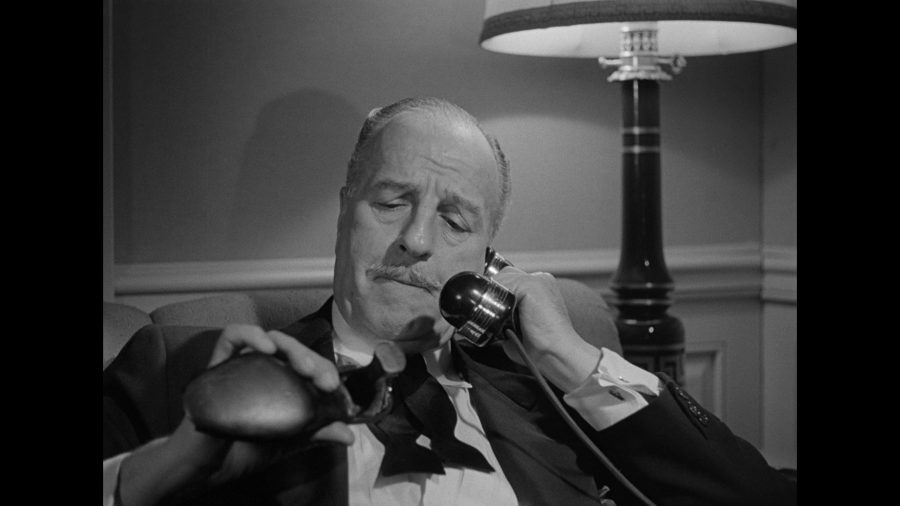
Louis Calhern as Alonzo Emmerich in The Asphalt Jungle (1950).
Noir’s greatest directors often found themselves on the outside looking in, pushed and pulled by the vagaries of finance, the economy, and political reaction: Fritz Lang fled Germany after the Nazis took over the film industry; Orson Welles found himself at the mercy of studio bosses who found him too extreme and extravagant; Jules Dassin reversed Lang’s exile by leaving America for France after facing persecution for his membership in the Communist Party. Its literary origins lay in the pulp magazines of the prewar era: cheap, hastily assembled rags meant for mass consumption and printed on the cheap paper that gave them their name, written by low-paid and often disreputable writers who would sometimes adapt their own work for the big screen.
Even the stars of films noir were actors plagued with scandal, known for being too independent or uncooperative, or simply seen as possessing insufficient star power to carry a big-budget picture on their own. These were men and women who were keenly aware of where they stood on the steel-walled class divide of the motion picture industry: the wrong side.
Not all film noir heroes were outlaws; the genre labored as much as any labored under the constraints of the Hays Code, which, animated by religious moralism and a distrust of the susceptible minds of the working class, forbid the portrayal of criminals as justified, sympathetic, or able to escape punishment. But the status of noir films as B- and C-pictures, often cheaply made by low-rent “Poverty Row” studios and attached as a package to more reputable mainstream films often gave them the ability to duck under the notice of the censors.
Still, criminals were often the central characters, and their motivations were almost always the same: they were poor. They were society’s losers, castoffs, and hard-luck cases, and they were out to make a score that would give them a break for once in their miserable lives.
But it would be another great mistake to believe that these films delivered the message that money was salvation. In the doom-struck world of noir, no one ever gets lucky, and money is a fleeting dream. Those who have it are compromised, corrupted, or enslaved by it, and those without it never end up with it.
Dirty Money
I’ve seen all the troubles of the world, and they boil down to just those two. You’re broke or you’re lonely. Or both.
—Pat, Act of Violence.
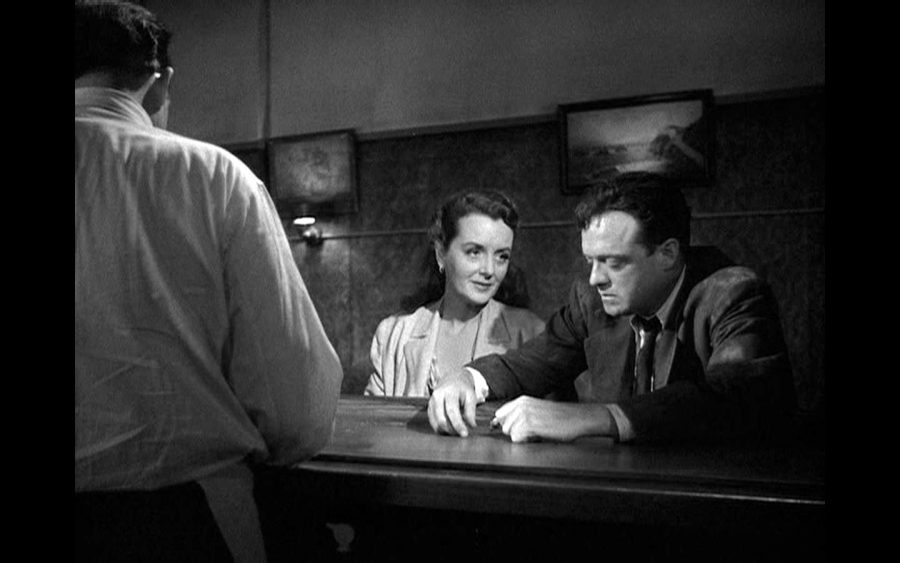
Mary Astor as Pat in Act of Violence (1949).
In the stark class struggles of crime dramas, the thugs and hoodlums and heist men might be villains, but the truly contemptible figures are the bankers, the moneymen. The people doing the stealing are at least comprehensible to us. We can relate to them. But the rich, whether from the straight world or the crooked ones, are monsters, soulless things, icons of cruelty who will double-cross and dirty deal to protect the wealth they already possess in abundance. Even in a rigged game, they refuse to play fair.
This dynamic plays out memorably in John Huston’s 1950 noir The Asphalt Jungle; when banker Alonzo Emmerich (Louis Calhern) sells out a gang of thieves, revealing that he hasn’t got the money he promised them in exchange for the take of a jewel heist. Gunman Dix Handley (Sterling Hayden) sneers at him with contempt: “What’s inside of you? What’s keeping you alive?” Dix is a thug and a brute, but he immediately recognizes in Emmerich something every working person understands: the two-faced boss who demands the lion’s share of the profit while assuming none of the risk he pawns off on his hirelings.
One of the most menacing villains in all of film noir is The Big Combo’s Mr Brown (Richard Conte), and he’s not a psychotic killer, a hulking goon, or a ruthless hitman; he’s a moneyman for the syndicate. Money is always poison, and profit is never gotten cleanly.
Police and Women in Film Noir
For sixteen years, I’ve been a cop. For sixteen years, I’ve been living in dirt, and take it from me, some of it’s bound to rub off on you. You get to hate people. Everyone you meet.
–Barney Nolan, Shield for Murder.
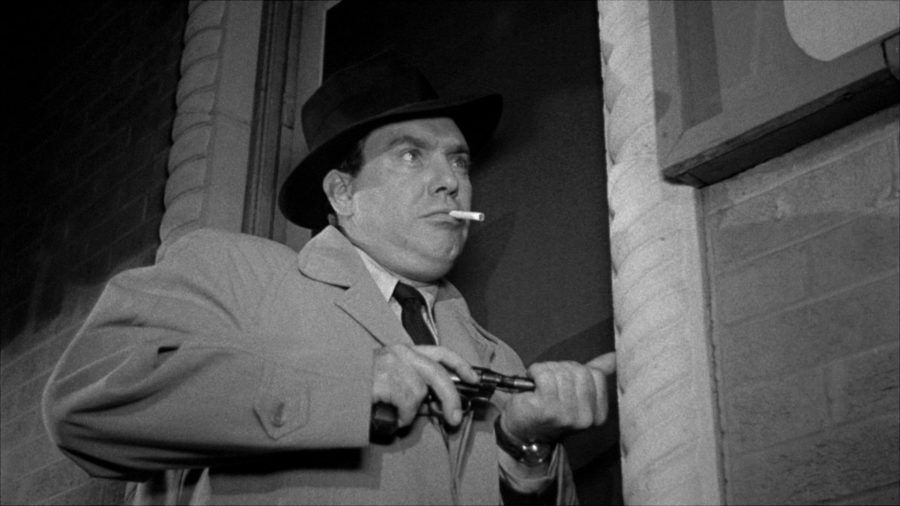
Edmond O’Brien as Barney Nolan in Shield for Murder (1954).
The presence of the police is controversial in noir. Thanks largely to the constraints of the Hays Code, cops were rarely portrayed as actively malevolent, even in what was a rich period for police racism and brutality. Many noirs featured cops as heroes, and only the most stringent purist would exclude from the canon movies with a protagonist somehow connected with law enforcement. But noir was never quite comfortable with cops as an idea; its creators were all too familiar — often personally — with the dark side of the law.
Some films noir such as Stanley Kubrick’s masterful The Killing actually got away with portraying corrupt cops; others made them shadowy presences, silent figures of finality and failure who only showed up at the end of the movie to make the doomed hero’s fate explicit; and still others, such as 1951’s The Prowler (written by blacklisted screenwriter Dalton Trumbo), portray them as overbearing creeps. But the most common way of dealing with the police was to sidestep them altogether by making the hero a private detective: an independent actor, usually a struggling “cockroach capitalist,” who was of law enforcement but not in it.
The paragon of this model is Philip Marlowe, the recurring figure in the works of Raymond Chandler, who despised the police. Marlowe, too — played in noirs by Dick Powell, Humphrey Bogart, Robert Montgomery, and others in the classic era — disliked and distrusted cops, seeing them as a necessary evil at best and petty tyrants at worst. As Marxist critic Fredric Jameson notes in his 2016 book on Chandler, the figure of the detective allows for a reconstitution of the faded picaresque novel: because of his position in society, the private dick alone can form a link between the lowest rungs of the working class and the dizziest heights of the ultra-wealthy, allowing the reader to contrast their lives without illusions. Although noir is often ambiguous in its treatment of the police, the question of who they serve is never in doubt.
Women, too, have a contentious position in noir. It is true that crime dramas were products of their time, meaning that women often had subservient roles as mothers, wives, or love interests, and were almost never the main characters in film noirs, or their creators. (The British actress Ida Lupino was a notable exception, using her studio connections to become one of Hollywood’s first notable female directors and the only one to helm a noir herself, and many noir films were based on novels written by women.) One reason that noir began to fall out of favor was the rise of feminist film critics in the late ’60s and ’70s, who saw the femmes fatale — the murderous, dark-hearted female villains often seen in the genre — as stereotypical and insulting archetypes of the woman as temptress, leading good-hearted and innocent men astray with the power of their sexuality.
But this is only part of the picture of the trope. It is just as valid, and often more accurate, to see femmes fatale as women who evenly match their male counterparts in their awareness of their class status, compounded by rampant misogyny and the lack of opportunities given to women at the time. If they use their sexuality as a weapon, it is only because it is the only one available to them.
For every femme fatale portrayed as little more than a serpent in human flesh, there are more complex and psychologically deep characters like the luckless Agnes Lowzier (Sonia Darrin) in The Big Sleep, trapped by her poor choices in “half-smart guys,” or Gun Crazy’s Annie Laurie Starr (Peggy Cummins), beaten down figuratively and literally time and time again by men and determined to “start kicking back.” It isn’t hard to detect in noir’s terror of these women a sublimated fear of the working class.
The Values of Neorealism
I don’t like to get pushed around. I don’t like people I like to get pushed around. I don’t like anybody to get pushed around!
–Sam Masterson, The Strange Love of Martha Ivers.
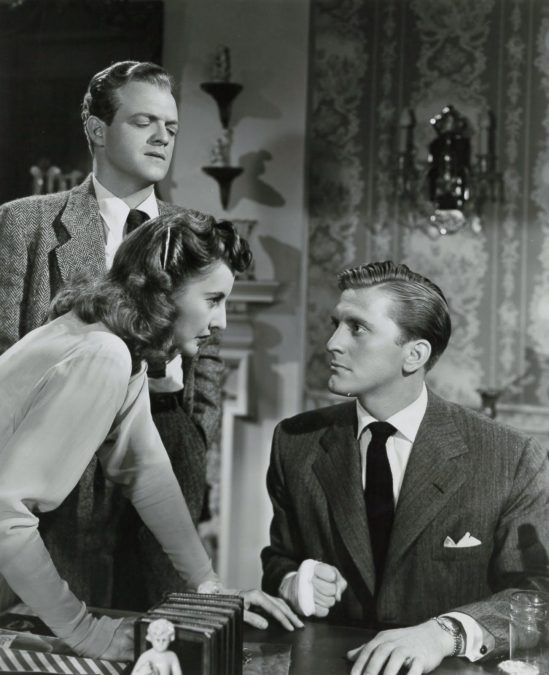
Van Heflin (left) as Sam Masterson in The Strange Love of Martha Ivers (1946).
If film noir has a true analogue in cinema, it is another genre that arose around the same time, dealing with many of the same issues, and often presented in the same style, albeit a continent away: the neorealist movement in postwar Italy. Both tended to deal with working-class issues; both focused on the lives of the downtrodden and the marginalized; and both were associated with memorable lighting, naturalistic acting, and innovative camerawork.
The Italian neorealists, like the directors of American crime dramas, were often associated with the political left, and both concerned themselves with the people left behind by a society that wrongly believed itself to have transcended its own history. But in Italy, with a strong leftist tradition and less prone to anti-communist panics, the filmmakers could be more open and obvious in their class consciousness and didn’t need to dress it up with guns and sharp suits.
Still, the messages were clear in both genres: the stories of ordinary people were more compelling than those of aristocrats and socialites. Bullying was intolerable, and even more so when it came from positions of authority. And if you found yourself on the bottom rungs of the economy, there were few people you could rely on and no help on the way from anywhere.
Neorealism, with its focus on the poor and working class and its appearance after the repression of the fascist regime of Mussolini had been destroyed, at least emerged from a sociopolitical position where it was possible to speak of class openly and to show the value of solidarity and community, even if you ultimately lost the struggle. Film noir, in its context of American individualism, had to resort to coded messages and a sense of inevitable defeat.
Bigs and Littles
It’s a bitter little world full of sad surprises, and you don’t go around letting people hurt you.
–Evelyn Hahn in Hollow Triumph.
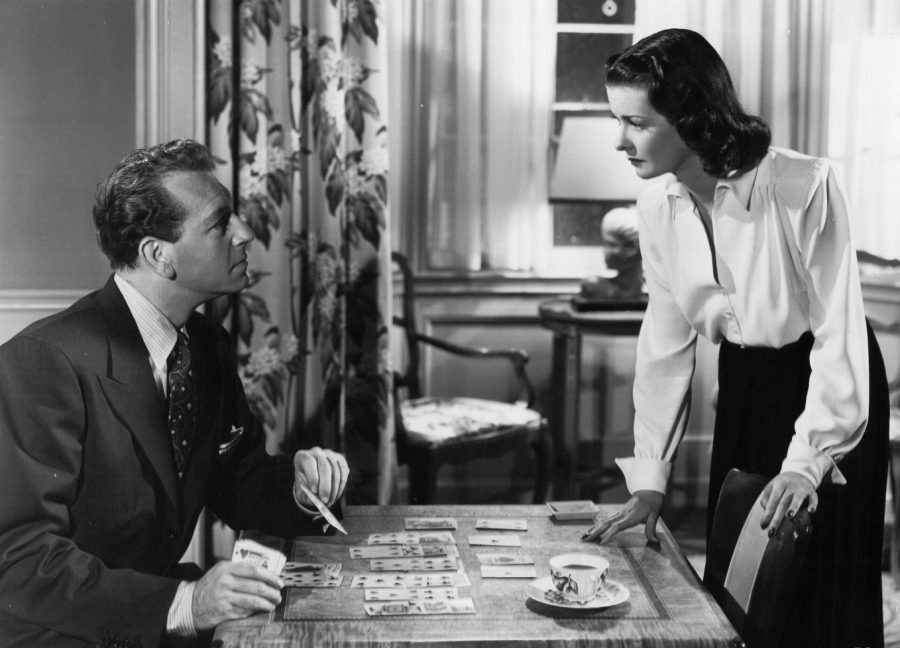
Joan Bennett as Evelyn Hahn in Hollow Triumph (1948).
With the dawn of the radical sixties, American culture began to fissure and break apart, and this was reflected in cinema. The old crooks and hoods, motivated only by money, didn’t seem so scary anymore, and on-screen, villains began to transform into more existential and less understandable creatures of the capitalist id: roving gangs of nonwhites looking for revenge, monsters of the id, psychopaths and serial killers who motivations could never be understood. Society’s underpinnings seemed far less certain, and so filmgoers forsook realism for escapism.
By the 1970s, noir was a relic of the past, and while it influenced the maverick directors of the decade, it was fit only for homage, parody, or the odd stylistic revival. It could still score an occasional hit (there are few indictments of capitalism in American cinema fiercer than Roman Polanski’s 1974 neo-noir Chinatown), but it wasn’t the same. The studio system was dead, the blockbuster economy was being constructed, and crime films became more grandiose, more epic, and less relatable and human. Movies were now a billion-dollar business, and the stakes had to be raised and the consequences had to be escalated to match.
Noir never quite left us, though. Although it’s been revived from time to time, neo-noirs have largely been bloodless affairs, all style and surface, with all the guts and sinew filtered out; most have lost their class sensibilities. Most contemporary crime films valorize the police, fetishize surveillance technology and expensive paramilitary weaponry, and portray their antiheroes as themselves as wealthy, stylish, and familiar with the upper echelons of the class ladder as any of their victims.
But noirs of the old school — filmed with or without the visual trademarks of the classic era, but with the class markers restored — began to emerge in international cinema with films like Fabien Bielinsky’s The Aura (2005), Chan-Wook Park’s Sympathy for Mr. Vengeance (2002), and Mathieu Kassovitz’s The Crimson Rivers (2000). And just as Kelly Reichardt has overseen a mini-renaissance of neorealism with a distinctly modern American flavor, so too have some directors in recent years discovered the richness of thematic meaning and potential in a good class-forward crime drama, from the works of Jeremy Saulnier to films like Noah Buschel’s Glass Chin, Debra Granik’s Winter’s Bone, and Paul Thomas Anderson’s Inherent Vice.
As long as we live under capitalism, insightful artists will remember the words of Luis van Rooten in the 1949 boxing noir Champion: “There are only two kinds of people in this world: the big and the little. It’s very seldom anyone gets the chance to decide for himself which he’s going to be.”
The Race War Starts November 3... Riots Planned To Hand Trump A Coup! Greg Palast Joins
https://www.youtube.com/watch?v=WGIoK541TnY&ab_channel=act.tv
They Keep Global Trade Afloat – Now 400,000 Seafarers, Stranded Since the Start of the Pandemic, Just Want to Go Home
Stranded seafarers and port workers are facing physical and mental exhaustion, trapped on shipboard since the pandemic began. They do not have access to shore leave; some have been denied emergency medical treatment.
October 15, 2020 Cristina Belda Font EQUAL TIMES
https://portside.org/2020-10-15/they-keep-global-trade-afloat-now-400000-seafarers-stranded-start-pandemic-just-want-go
We’re exhausted, we’ve been working non-stop for months,” says Vij*, the captain of an oil tanker currently stranded in Malaysian waters. “Most of the contracts have been extended more than once and the crew has no other option but to wait to be allowed ashore,” he tells Equal Times. “Several people have been on the ship for more than a year.”
Crew changes were suspended in March (due to the coronavirus pandemic) in order to avoid supply chain disruptions, as more than 80 per cent of the world’s trade is carried by sea. Worldwide border closures, travel restrictions and the disruption of commercial flights to contain the virus have prevented Vij, a native of India, and his crew from setting foot on dry land.
According to estimates by the International Maritime Organisation (IMO), a specialised agency of the United Nations, 400,000 seafarers and port workers are currently stranded. They are facing physical and mental exhaustion, and repatriation to their home countries has become a matter of urgency. A similar number of people are waiting on land to board ships and relieve those currently at sea.
Some people have spent up to 17 months at high sea, as the IMO report confirms. This is illegal under Maritime Labour Convention of the International Labour Organization (ILO), which sets the maximum continuous period a seafarer should serve aboard a ship at 11 months.
“Since March, we have received more than 5,200 emails from seafarers desperate to get off ships, an estimated more than 2,000 requests for help through Facebook, and more than 500 messages via Whatsapp,” says Fabrizio Barcellona, assistant secretary of the seafarers section of the International Transport Workers’ Federation (ITF).
The situation has led to a “humanitarian and safety crisis,” about which both António Guterres, the UN secretary general, and Pope Francis have spoken out. While restrictions in many countries have been eased to some extent following the international maritime summit held in London in July, as the recent World Maritime Day Summit on 24 September made clear, the problem is still far from being resolved – and time is running out.
In a joint letter addressed to Guterres, senior officials from 30 consumer goods companies call for immediate action on crew changes, describing a situation that has “also inadvertently created a modern form of forced labour”.
“Seafarers are still facing the same challenges that they were at the beginning of the pandemic: extended contracts due to the lack of repatriation possibilities, longer working hours due to a lack of inspections […]. In addition, seafarers do not have access to shore leave and, in some cases, they have even been denied emergency medical treatment,” explains Barcellona.
Restrictions on crew changes
For months, international organisations and even shipping companies have been lobbying governments to designate seafarers as ‘key workers’ regardless of their nationality. This would exempt them from visa requirements and allow them to travel to and from ships.
The IMO has also proposed a series of safe disembarkation protocols for use by ports, airports, health, customs and immigration authorities, and governments. So far, only 15 countries worldwide have opened their ports and followed the protocols. Now, some are tightening restrictions again in response to the anticipated second wave of the virus.
“A second wave could result in the continued denial of the basic rights of seafarers in order to maintain commercial activity,” says Barcellona. “Unfortunately, some governments are backtracking in their implementation of the crew change protocols,” he warns.
For example, the association InterManager has criticised Singapore for its recent decision to give priority to crew change applications from ships registered in that country and only to applications for signing off crews without signing on new ones.
For its part, Hong Kong has limited crew changes to ships that import and export cargo from its territory, and has reinstated airport restrictions. This makes things difficult, as crew changes are complex processes and the majority of the world’s 1.6 million seafarers come from the Philippines, Indonesia, China, Russia, Ukraine and India.
“We have seen several countries introduce incredibly narrow windows, of 48 hours for example, for a merchant ship to enter a berth with a new crew from other parts of the world. Given the shortage of direct flights, this policy alone could prevent thousands of crew changes,” says Barcellona.
Exhaustion and risk of accidents
Under normal circumstances, being a seafarer involves tasks that require constant concentration and long days that range from 10 to 12 hours, seven days a week, with little in the way of social life. Add to this the exhaustion, fatigue and anxiety of not knowing when they will return home and the result is an exponential increase in the risk of maritime accidents.
“Ships with fatigued seafarers cannot operate indefinitely,” Natasha Brown, head of public information services at the IMO, tells Equal Times. “The situation is unsustainable, both for the safety and wellbeing of the seafarers as well as for the safe operation of maritime trade.”
According to the IMO, the increasing fatigue of seafarers also threatens the security of shipping and the uninterrupted flow of supply chains, which transport everything from raw materials to medical supplies. Commercial fishing is facing a similar problem, which puts food security at risk.
“When ships are held up, so is everything else,” says Marc Engel, chief supply chain officer at Unilever, one of the world’s leading consumer goods companies. “We are approaching a turning point which could impact the economy and push companies and countries to the limit.”
Vij is well aware of the risk. “My role as captain is to keep up morale and ensure that people are not mentally stressed,” says the captain, who has 40 people in his charge. “We have daily meetings to motivate the crew. Most of them need to go home for fear of the coronavirus…their families insist that they return as soon as possible.”
To pass their free time on the ship, the crew has organised table tennis, basketball and cricket tournaments. It keeps them distracted. But they can’t help but get frustrated, especially when quarantine and visa regulations change suddenly with little coordination between countries. “In Malaysia, for example, even if you have a negative Covid certificate, you still have to spend 14 days in quarantine before taking a flight to your country of origin, followed by 14 days in your country of origin,” Vij explains.
Crews themselves are increasingly refusing to extend their contracts. This was the case on the ship Marvin Confidence, which was in Chile when a crew member became ill and after many difficulties was able to dock in Panama when the crew refused to continue working under such conditions and exercised their right to request assistance.
Those who remain ashore: “When will I go back to work?”
The crisis has many dimensions and the number of stranded seafarers reflects an equal number of people who are currently unable to make a living. The fatigue is also evident in those who are stuck at home, without employment, and in many cases without aid, waiting to relieve their fellow seafarers.
“I planned on joining the ship in March, but my contract was postponed because the flights were cancelled and border closures began on 26 March 2020 in my country, Bangladesh,” says Mohin U, an able seaman. He is now unemployed until further notice and says he feels powerless. “Governments aren’t interested in the situation of foreign sailors and there’s nothing we can do about it from here.”
A survey conducted by the maritime organisation Stella Maris of 363 participating seafarers, mostly from the Philippines, indicates the scope of the impact: 69 per cent of participants said that Covid-19 had economically impacted their lives “a lot” or “very much”. In addition to merchant ships and fishing vessels, this also applies to the cruise industry, which has 70,000 seafarers awaiting repatriation and is currently facing the titanic challenge of regaining its customers’ confidence.
“The inability of governments to find an adequate and coherent solution to the problem of crew changes and the expected second wave of the virus could result in many seafarers opting for different professions, which could lead to crew shortages in the near future,” says Barcellona.
“When the coronavirus began, I was on board and felt that the ship was the safest place in the world,” says seafarer Amit Schedge via telephone from a cruise ship. “My contract ended on 30 May, it was extended and I am still in Sweden, on board.” Fatigue has taken its toll and now all he can think about is returning to India, hopefully next week. But the feeling is bittersweet, he says, because while he is looking forward to returning to his loved ones, he doesn’t know when he will sign his next contract.
Meanwhile, as this article goes to press, Captain Vij and his crew are still trying to get ashore, spend two weeks in quarantine in a hotel in Malaysia, a country they do not know, after which Vij will spend another 14 days in a hotel in India before finally being able to join his family. “It’s a battle of mental endurance,” he says.
Amy Coney Barrett Has Never Been A Judge; Never Tried A Case
https://www.youtube.com/watch?v=Kqd9Ft7983w&ab_channel=act.tv
Subscribe to:
Posts (Atom)