Tuesday, October 13, 2020
In a First, New England Journal of Medicine Joins Never-Trumpers
Editors at the world’s leading medical journal said the Trump administration “took a crisis and turned it into a tragedy.”
October 11, 2020 Gina Kolata NEW YORK TIMES
https://portside.org/2020-10-11/first-new-england-journal-medicine-joins-never-trumpers
Throughout its 208-year history, The New England Journal of Medicine has remained staunchly nonpartisan. The world’s most prestigious medical journal has never supported or condemned a political candidate.
Until now.
In an editorial signed by 34 editors who are United States citizens (one editor is not) and published on Wednesday, the journal said the Trump administration had responded so poorly to the coronavirus pandemic that they “have taken a crisis and turned it into a tragedy.”
The journal did not explicitly endorse Joseph R. Biden Jr., the Democratic nominee, but that was the only possible inference, other scientists noted.
The editor in chief, Dr. Eric Rubin, said the scathing editorial was one of only four in the journal’s history that were signed by all of the editors. The N.E.J.M.’s editors join those of another influential publication, Scientific American, who last month endorsed Mr. Biden, the former vice president.
The political leadership has failed Americans in many ways that contrast vividly with responses from leaders in other countries, the N.E.J.M. said.
In the United States, the journal said, there was too little testing for the virus, especially early on. There was too little protective equipment, and a lack of national leadership on important measures like mask wearing, social distancing, quarantine and isolation.
There were attempts to politicize and undermine the Food and Drug Administration, the National Institutes of Health and the Centers for Disease Control and Prevention, the journal noted.
As a result, the United States has had tens of thousands of “excess” deaths — those caused both directly and indirectly by the pandemic — as well as immense economic pain and an increase in social inequality as the virus hit disadvantaged communities hardest.
The editorial castigated the Trump administration’s rejection of science, writing, “Instead of relying on expertise, the administration has turned to uninformed ‘opinion leaders’ and charlatans who obscure the truth and facilitate the promulgation of outright lies.”
President Trump mocked Mr. Biden’s mask wearing during the presidential debate on Sept. 29. Ruth Fremson/The New York Times
The uncharacteristically pungent editorial called for change: “When it comes to the response to the largest public health crisis of our time, our current political leaders have demonstrated that they are dangerously incompetent. We should not abet them and enable the deaths of thousands more Americans by allowing them to keep their jobs.”
Scientific American, too, had never before endorsed a political candidate. “The pandemic would strain any nation and system, but Trump’s rejection of evidence and public health measures have been catastrophic,” the journal’s editors said.
The N.E.J.M., like all medical journals these days, is deluged with papers on the coronavirus and the illness it causes, Covid-19. Editors have struggled to reconcile efforts to insist on quality with a constant barrage of misinformation and misleading statements from the administration, said Dr. Clifford Rosen, associate editor of the journal and an endocrinologist at Tufts University in Medford, Mass.
“Our mission is to promote the best science and also to educate,” Dr. Rosen said. “We were seeing anti-science and poor leadership.”
Mounting public health failures and misinformation had eventually taken a toll, said Dr. Rubin, the editor in chief of The New England Journal of Medicine.
“It should be clear that we are not a political organization,” he said. “But pretty much every week in our editorial meeting there would be some new outrage.”
“How can you not speak out at a time like this?” he added.
Dr. Thomas H. Lee, a professor of medicine at Harvard Medical School and a member of the journal’s editorial board, did not participate in writing or voting on the editorial.
But “to say nothing definitive at this point in history would be a cause for shame,” he said.
Medical specialists not associated with the N.E.J.M. applauded the decision.
“Wow,” said Dr. Matthew K. Wynia, an infectious disease specialist and director of the Center for Bioethics and Humanities at the University of Colorado. He noted that the editorial did not explicitly mention Mr. Biden, but said it was clearly “an obvious call to replace the president.”
There is a risk that such a departure could taint the N.E.J.M.’s reputation for impartiality. While other medical journals, including JAMA, the Lancet and The British Medical Journal, have taken political positions, the N.E.J.M. has dealt with political issues in a measured way, as it did in a forum published in October 2000 in which Al Gore and George W. Bush answered questions on health care.
But it is hard to imagine such a deliberative debate in today’s acrimonious atmosphere, said Dr. Jeremy Greene, a professor of medicine and historian of medicine at Johns Hopkins University.
The Trump administration, he said, had demonstrated “a continuous, reckless disregard of truth.”
“If we want a forum based on matters of fact, it strikes me that no form of engagement could work,” Dr. Greene added.

Evidence-Free ‘Lab Leak’ Speculation Boosts Trump’s Xenophobic Approach to Coronavirus
Even if it is exceedingly difficult to prove a negative, there’s little reason to entertain a lab origin theory when no actual evidence is presented that the virus originated at any particular lab.
October 11, 2020 Joshua Cho FAIR
https://portside.org/2020-10-11/evidence-free-lab-leak-speculation-boosts-trumps-xenophobic-approach-coronavirus
Ever since the outbreak of Covid-19 was first detected in Wuhan, China has been the target of relentless hostile and racist media coverage, depicting the country as a uniquely nefarious source of disease (FAIR.org, 3/24/20, 5/7/20).
NBC News (8/10/20) was the first foreign news organization to visit the Wuhan Institute of Virology (WIV), which it described as having “become the focus of intense speculation and conspiracy theories” about whether the SARS-CoV-2 coronavirus that causes Covid-19 “leaked from the facility.” While NBC noted that there is “no credible proof to back up claims that the coronavirus was either manufactured at or accidentally leaked from the lab,” the Washington Post’s Josh Rogin (Twitter, 8/10/20) suggested that NBC was “toeing the [Chinese Communist] Party line,” criticism that was amplified by Fox News (8/10/20), which later (8/11/20) cited US officials claiming that “the virus likely originated in the lab.”
While the notion that the novel coronavirus was intentionally or unintentionally leaked from a Wuhan lab has been taken less seriously by corporate media than other criticisms of China’s Covid response (possibly because US officials want to avoid attracting attention to the US’s own biowarfare programs), it has nevertheless been mainstreamed. Ever since Republican Sen. Tom Cotton went on Fox News (2/16/20, 2/18/20) to boost speculation that had been circulating in conservative media and fringe Facebook posts for weeks prior, noting the proximity between the Huanan Seafood Wholesale Market in Wuhan and Wuhan’s “biosafety level four super laboratory,” and decrying “China’s duplicity and dishonesty,” evidence-free speculation about a lab origin has been a media undercurrent that buoys up President Donald Trump’s xenophobic references to the “China virus.”
The lab leak theory started gaining an aura of respectability with Washington Post columnist David Ignatius’ “How Did Covid-19 Begin? Its Initial Origin Story Is Shaky” (4/2/20). He argued for the plausibility of a lab accident, writing that “scientists don’t rule out that an accident at a research laboratory in Wuhan” might have “spread a deadly bat virus that had been collected for scientific study.” Ignatius cited Dr. Richard Ebright, a biosecurity expert at Rutgers University who has been a go-to source for several other reports after he spoke publicly about supposed unsafe operating practices at the WIV.
Rogin, Ignatius’ Post colleague, followed up with a piece (4/14/20) about a previously unreleased State Department cable from 2018 that cited “scientists at the WIV laboratory” saying that “the new lab has a serious shortage of appropriately trained technicians and investigators needed to safely operate this high-containment laboratory,” and asking for additional help from US researchers. Rogin managed to quote Xiao Qiang—a National Endowment for Democracy–funded regime change activist and “research scientist” at Berkeley’s “School of Information”—as well as an otherwise unidentified “US official,” but no actual virologists or epidemiologists.
Rogin also depicted Shi Zhengli—the head of the WIV project studying bat coronaviruses—as a reckless scientist taking “unnecessary risks” by linking to an article (Nature, 11/12/15) about experiments that were mostly conducted in the US; the only experiment described in the paper the article critiques (Nature Medicine, 11/9/15) that was actually conducted in Wuhan involved pseudoviruses, which are partial copies of viruses that lack their virulent potential or the ability to reproduce. The Nature article questioned the wisdom of “gain-of-function” (GOF) research in general, not Shi or the WIV’s competence as Rogin implied, as neither of them are mentioned in the article. The safety protocols at the WIV are not only practiced by scientists all over the world, but were also shaped by WIV scientists due to their excellence (NPR, 4/23/20).
Grayzone journalists Max Blumenthal and Ajit Singh (4/20/20) pointed out that Rogin’s column depended on State Department cables that undermined his insinuations throughout the article: US officials emphasized the value of the Wuhan lab’s research to predict and prevent coronavirus outbreaks, rather than safety concerns. Still, Rogin’s column was promoted on Twitter by liberal commentators like MSNBC’s Chris Hayes (4/14/20) and New York‘s Yashar Ali (4/14/20).
More recently, there was further media buzz over Fox News host Tucker Carlson (9/17/20) defending the credibility of Dr. Yan Li Meng, a discredited defector who makes inflated claims to have worked at the “top coronavirus lab in the world.” She asserted that the Communist Party of China “intentionally” released the coronavirus, and that “the scientific world” is keeping silent because it “works together” with the Chinese government (Forbes, 9/17/20). She co-authored a non-peer-reviewed “study” which made a number of dubious, irrelevant, or false claims published by the Rule of Law Society and the Rule of Law Foundation, which are New York City-based groups Steve Bannon and wanted Chinese billionaire Guo Wengui helped found (National Geographic, 9/18/20).
There are, broadly speaking, two types of lab leak theories: One holds that the virus was created in a lab, the other that the virus evolved naturally in the wild before being collected by a lab. The former theory has an advantage as a scientific hypothesis because it’s falsifiable, meaning that it’s possible to imagine evidence that would prove or disprove it; unfortunately for its proponents, it’s widely viewed by scientists as having been falsified.
Most reports acknowledge the strong scientific consensus around Covid-19 likely originating naturally in wildlife, most likely bats. In February, the Lancet (2/19/20) published an open letter by 27 health researchers from eight countries defending the integrity of Chinese officials and health professionals combating the disease, and strongly condemned “conspiracy theories suggesting that Covid-19 does not have a natural origin.” The open letter also stated that scientific findings to date “overwhelmingly conclude that this coronavirus originated in wildlife, as have so many other emerging pathogens.”
One widely cited study, published in the scientific journal Nature (3/17/20) and written by a team of American, Australian and British researchers, stated that they “do not believe that any type of laboratory-based scenario is plausible,” and that their “analyses clearly show that SARS-CoV-2 is not a laboratory construct or a purposefully manipulated virus.” The authors of the Nature study reached this conclusion because SARS-CoV-2’s adaptations from the original SARS-CoV virus, the pathogen that causes SARS, are too effective for humans to have engineered.
Coronaviruses get their name from the spikes covering the virion’s surface, resembling the sun’s corona. However, the spikes that cover the SARS-CoV-2 virion’s surface bind to the same functional host cell receptor in humans (ACE2) 10 times more tightly than does SARS-CoV. SARS-CoV-2’s second notable adaptation is the acquisition of a polybasic cleavage site (a part of the spike that has to be cleaved before the spike can latch onto a human cell), and SARS-CoV-2’s cleavage sites are made of amino acids that attract furin enzymes, which are essential for infecting lung cells.
Bob Garry (Vice, 3/20/20), an assistant professor of microbiology and immunology at the Tulane University School of Medicine, and coauthor of the Nature study, explained that no computer programs scientists use to model the interactions between the virus’s spikes and ACE2 receptors could predict that SARS-CoV-2 would bind very well, let alone 10 times better—which is evidence in favor of the alterations being selected by natural selection rather than human engineering.
Furthermore, the virus’s genetic makeup isn’t a mishmash of known viruses, which would likely be the case if it were truly human-made, which is why the Nature study’s authors concluded that the “genetic data irrefutably show that SARS-CoV-2 is not derived from any previously used virus backbone.”
Following Rogin’s article, Fox News’ Bret Beier published another op-ed, “Sources Believe Coronavirus Outbreak Originated in Wuhan Lab as Part of China’s Efforts to Compete With US” (4/15/20). Beier claimed that “there is increasing confidence that the Covid-19 outbreak likely originated in a Wuhan laboratory,” coming from “classified and open-source documents” he acknowledged he hadn’t read, relying instead on the accuracy and integrity of anonymous sources.
Corporate media then gave a wide platform to Secretary of State Mike Pompeo (ABC News, 5/3/20; CNN, 5/3/20; New York Times, 5/3/20), who has a long record of dishonesty, to promote the lab leak theory. He claimed there is “enormous evidence” the virus originated in a Chinese lab before walking back those pronouncements. Of course, if the US government really did have “enormous evidence” of a lab leak, one can simply ask why it hasn’t already presented a smoking gun.
Other proponents of the lab leak origin claim that the Nature study doesn’t prove what it purports to, because it discounts the possibility of the virus being collected in the wild and studied before somehow being released from a lab. However, this scenario is largely a circular and unfalsifiable argument—because a virus that came from the wild through a lab looks exactly like one that began infecting humans in the wild.
It’s true that there is a troubling history of accidental lab leaks of potential pandemic pathogens. And some of the professionals who authored the Lancet’s open letter and the Nature study have connections to the US government and the bioweapons industry, as much viral research in the US is funded by the Pentagon’s biological arms race (Salon, 4/24/20).
In fact, one compelling reason to think that Covid-19 is not an intentionally leaked bioweapon is that there are plenty of other pathogens that are much more deadly. For example, the Ebola and Marburg viruses have case fatality rates ranging from 24% to 90%, and while we don’t know the true death rate for Covid-19—because it varies widely in different regions—it is much lower than that across the board. If Covid-19 is the result of an intentionally released bioweapon, it would make a lot more sense to select a deadlier pathogen than SARS-CoV-2.
It also doesn’t make any sense for the Chinese government to intentionally release a novel pathogen like SARS-CoV-2 onto its own population in the hopes that it would do even worse damage to its geopolitical rivals. This is simply a fantastical scenario that doesn’t merit further discussion.
US researchers who have worked at the WIV have attested to the safety standards and quality of research there, denied that the WIV is a bioweapons research lab, and explained that the Chinese government issuing new biosafety directives isn’t a sign of concealing a lab breach, but standard practice when dealing with a novel pathogen (Health Feedback, 3/2/20).
The WIV’s Shi Zhengli, disparaged by Rogin as reckless, is an accomplished virologist whose pioneering research is responsible for giving a headstart in understanding SARS-CoV-2; she attested that none of the bat coronaviruses previously studied at her lab match the new virus’s genetic sequence (Scientific American, 6/1/20). And there’s no reason to think that the WIV was the source of SARS-CoV-2 just because it was already researching bat coronaviruses. Even a virus studied there called RaTG13, which shares 96% of its genome with the new virus, already has huge differences in evolutionary terms, as Vox (4/29/20) noted:
“The level of genome sequence divergence between SARS-CoV-2 and RaTG13 is equivalent to an average of 50 years (and at least 20 years) of evolutionary change,” said Edward Holmes, a professor at the University of Sydney who has published six academic papers this year on the genome and origin of SARS-CoV-2, in a statement. “Hence, SARS-CoV-2 was not derived from RaTG13.”
The WIV lab is a joint collaboration between China and France, and has been certified by officials in both countries, as well as by the International Organization for Standardization. The French government, which has the most knowledge of and experience with the WIV, has stated there is
no factual evidence corroborating the information recently circulating in the United States press that establishes a link between the origins of Covid-19 and the work of the P4 laboratory of Wuhan, China.
Perhaps the strongest argument to be made in favor of the idea of a lab leak derives from reports of the WIV performing animal passage and GOF research (Independent Science News, 6/2/20; Newsweek, 4/27/20). These are experiments designed to create pathogens with pandemic potential by passing a virus through animals (rather than cell culture) to induce faster mutation, or deliberately creating new viruses by cutting and pasting known viruses or via in vitro mutation to prepare for future pandemics.
Numerous labs perform this kind of risky research. The argument that the virus came out of the WIV in particular depends heavily on the city of Wuhan being the site of the original outbreak, because as an urban area like Wuhan is on its face an unlikely place for animal-to-human transmission to have occurred, and the proximity of the WIV and its animal passage experiments, proponents say, is a suspicious coincidence.
But Wuhan has not been proven to be the original location of the global Covid-19 outbreak. That it was the first city to detect an outbreak of Covid-19 does not necessarily mean it originated there.
Many pandemics have disputed origins. The 1918 influenza pandemic was called the “Spanish Flu” because neutral Spain had less censorship than European countries fighting in World War I, and so journalists there were free to write about an outbreak that was emerging across the continent. While the origins of the pandemic are still murky, very few believe the pandemic actually originated in Spain (Conversation, 3/17/20).
French doctors have discovered a case of Covid-19 dated back to December 2019 in someone in who has never traveled to China, and Spanish virologists found traces of SARS-CoV-2 in Barcelona wastewater collected in March 2019—nine months before the virus was detected in China (though these reports don’t necessarily prove that SARS-CoV-2 originated in Europe). Shi Zhengli believes that the crossover from bats to humans occurred outside of Hubei Province (where Wuhan is located), as years of bat virus surveillance there haven’t turned up any bat coronaviruses similar to SARS-CoV-2.
In an exclusive interview with Science Magazine (7/24/20), Shi revealed that over the past 15 years, the Wuhan lab has only isolated and grown in culture three bat coronaviruses related to any that infect humans, and these are related to SARS-CoV, not SARS-CoV-2. The other 2,000+ bat coronaviruses the lab detected (including RaTG13) are merely genetic sequences, and incapable of replicating themselves without being cultured in host cells. This would explain why her lab first learned about the virus when receiving patient samples on December 30, 2019, after the virus was first reported by Dr. Zhang Jixian at Hubei Provincial Hospital on December 27 (FAIR.org, 6/21/20). Shi’s full explanations can be read here.
In the end, the lab leak theory depends on the idea of the virus leaping from animals to humans being improbable–which it is not (Vox, 4/23/20). Due to humans altering three-quarters of terrestrial environments and two-thirds of marine environments, and thereby increasing the nature and frequency of human contact with wildlife, two-thirds of emerging infectious diseases in humans—and almost all recent epidemics like Ebola, MERS, HIV, Zika and H1N1—came from animals, with 70% of those originating in wildlife (LA Times, 4/2/20). This is one reason scientists have been urging climate action and stopping deforestation as ways to prevent new pandemics from emerging (Scientific American, 5/1/18, 6/1/20).
Lab leak proponents primarily depend on making negative arguments that urge us not to discount the possibility of a leak, but not every possibility is probable. Even if it is exceedingly difficult to prove a negative, there’s little reason to entertain a lab origin theory when no actual evidence is presented that the virus originated at any particular lab. Speculation about possibilities does not constitute persuasive evidence that Covid-19 is the result of a lab leak in Wuhan, or anywhere else. While journalists should continue to report on the dangers of bioweapons research and demand more transparency, they should also exercise caution when reporting on coronavirus origin theories that play into New Cold War propaganda against China (FAIR.org, 5/15/20).
A Bunch of Union Organizers Explain What's Wrong with Unions
We asked the real experts about the gap between public enthusiasm for unions and the lack of actual union members.
October 11, 2020 Hamilton Nolan IN THESE TIMES
https://portside.org/2020-10-11/bunch-union-organizers-explain-whats-wrong-unions
Here is the most fundamental quandary of unions in America: Polls show that 65% of Americans approve of unions, and half of workers say they would join a union. But only about 10% of workers are actually union members. In the yawning gap between those numbers lies the entire story of the American labor movement’s decline.
The systematic decades-long assault on labor power by right-wing business interests is the biggest contributor to union weakness, but by itself it is not a sufficient explanation. Why is there such an enormous disparity between the number of people who want to be union members, and the number who are union members? And how do unions close that divide? There is no shortage of opinions on these questions, but we asked the one group of people who know the most and appear in the media the least: professional union organizers.
A dozen organizers responded to our call and shared their thoughts about how unions got so deep in a hole, and how to get out.
How did we get here?
Fear
“I do not honestly believe it is possible to separate ‘political issues’ from that gap between support and membership. Yes, stuff like Right to Work and anti-worker National Labor Relations Board appointments harm working people, but right-wing austerity, gutting of the public safety net, and lack of universal health coverage is a huge factor here as well. To me, the biggest reason people don’t join a union or organize their workplace is because their boss has too much power over their lives. When I worked on an external new organizing campaign at United Healthcare Workers West I spent a ton of time talking with workers who were terrified of losing their job if they organized or publicly supported the union because it would mean losing healthcare coverage or financial ruin for their family. A lot of people truly just feel lucky to have a job. And while in theory, yes, they would love to have a union, they are more afraid of rocking the boat. I went to work on the Bernie campaign with the purpose of trying to change that. While card check or the Protecting the Right to Organize (PRO) Act would certainly make it easier to win unions and first contracts, until losing your job doesn’t mean losing your healthcare coverage and ability to cover rent, it is always going to be an uphill battle.”
— Danny Keane, organizer-representative with Service Employees International Union (SEIU) 221
Service unionism
“I’ve seen union-busting both hard and soft, and these employers have gotten so good at narrowing the focus of the union. Sure, people support unions in broad strokes, but when it gets down to the possibility of you forming a union, the boss is so good at either scaring people or convincing people that union dues are not a worthwhile ‘investment.’
While right-wing forces have eagerly tried to turn unions into irrelevant third parties, unions have alienated themselves from workers as well. I think that unions have simply shifted away from empowering workers. Through an overzealous focus on contract enforcement through grievances and through some anti-democratic measures, unions have, in effect, made themselves a third party to the workers. These shifts didn’t happen overnight, and I think intentions behind them were good, just misguided.
Take grievances, for instance, which appear to be a win-win: Workers get their issues heard with legal support, and unions get to justify their increasingly bureaucratic structures by bogging themselves down in the drawn-out grievance procedure. But in the long-term, relying too much on the grievance system hurts worker power. Grievance procedures are purposefully slow and bureaucratic, and, by design, grievances are limited solely to narrow contract enforcement. They take the power out of the workers’ hands and put the decisions into the hands of lawyers and an ostensibly neutral arbitrator. They limit workers’ imaginations from dreaming of ways to improve and transform their workplaces. And they turn the union into a third-party service that tries to clean up messes for the price of biweekly dues.
Unions have also taken anti-democratic measures internally. I think that workers are largely shut out from the campaign decision making that union staffers lead. As organizers, we’re trained to follow the workers’ lead, but I see that teaching only goes so far. While I respect the perspective that trained organizers know the best practices for organizing, I believe that workers know their employers and their industries best and need to be more included in the decisions that affect organizing campaigns.”
— Daniel Luis Zager, Campaign Organizer at SEIU Healthcare-Illinois Indiana Missouri Kansas
The nature of the modern workplace
“Even before the pandemic lengthened average hours worked by those still employed, working an eight-hour workday doesn’t leave much time for all else that needs to get done. Committing to weekly organizing meetings and hours of one-to-one conversations with coworkers — the backbone of any union campaign — is daunting, and for many, untenable. The workers who have the most to gain from a union at their company — those who are over-worked, underpaid, and under-valued — are also the most likely to take on second or third jobs and manage care-taking responsibilities that make it harder to engage in a sustained union campaign. And unfortunately, because of the necessary clandestine nature of organizing efforts, these meetings must take place outside of the workplace, off work time, and through tedious (yet illuminating) conversations.
Those who see issues in their workplace and would be most supportive of a union are often ones who are on their way out of a company. While there’s similarly a contingent of workers who organize because they love their company and want it to be a place they can remain employed long-term, there are always workplace leaders whose persistent grievances push them to simply find a new job instead of committing to a long campaign.
Along those same lines, the ‘career jobs’ of the past are largely lost in the 21st century. Even those who are satisfied with their jobs and enjoy the work are encouraged to continue gaining skills elsewhere for fear they’ll lose their edge, or miss out on opportunities elsewhere. The decline in long-term commitments to employers poses challenges for union campaigns, whose core philosophies rely on workers digging into their own self interest and organizing around the kind of workplace they desire. If employees already see themselves leaving within two to five years at any given company, putting in the work it takes to build a union may not add up.
We are taught to see ourselves as mobile employees who are poised to climb the ladder in our workplace. Receiving a promotion to a management position is aspirational. And once in that management or supervisory position, employees are no longer eligible for a union. Even if a majority of workers support unions and would like to see one in their own workplace, the distance between seeing themselves as ‘workers’ who would be part of that, and their own endeavors to promote out of the union-eligible designation, can be great.”
— Grace Reckers, northeast lead organizer, Office and Professional Employees International Union
Polarization
“Over 20 years of generational change, [the old demographics of affinity for unions] has faded a lot, and attitudes to unionization break down much more clearly along conventional right to left lines. Younger people and nonwhite people and liberals or Democrats — especially African Americans — are the main supporters, and white, working-class people — especially older ones — have as a group slotted unions in with the rest of right-left issues. The same political polarization that exists in most other issues, basically.
Additional dynamics have been: The youngest generation in the workforce now is the most left-wing and interested in redistribution, but also has the least familiarity with any of the concepts of unions and is not necessarily strong likely union supporters.
There is an increasingly regional background to whether unions are a thing you see operate. Blue states and red states have become much more polarized on labor stuff than the simple Right to Work map indicates. Blue states like New England, the West Coast and the Northeast have become much more proactive in working with unions to unionize more people and get them some stuff, and red or purple states (especially the whole Midwest) have gotten much more hostile to that stuff.
The educational polarization we see on right to left stuff has become a huge factor in whether young, working-class people want to unionize. Industries populated with poor, younger adults who are generally overeducated like (ahem) digital media or higher education, are super ripe slam dunks where you can transform an industry with hot-shop organizing. Ones with mostly poorer, younger adults who are not educated, and are not mostly based in urban areas, like retail and supply chain logistics, have had cold workers that are not responsive enough to union drives to make winning a possibility. (Part of the equation holding them back, of course, is how that generation of big-box retail and its supply chain were built from scratch in such a way that unions could be kept out completely and any rare component that got infected could be easily shut down and dissolved. But there’s an attitudinal difference in the constituencies as well.)
A bright spot exception to this has been fast food where, despite the workforce being young and not educated and rarely staying long at particular jobs, people just hate their job and boss so much they are eager to unionize.
What I find myself wanting to impress upon fellow labor-fan lefties is this: It is truly not just the unfair playing field, or the power of the boss’s fight to scare people, that prevents a majority of a workplace from voting to unionize. In many many workplaces, skepticism and disinterest in doing a collective fight thing is widespread, organic and real among the majority in the middle. Not among social science adjuncts, or journalists, or in large urban service job clusters where almost all the workers are poor and nonwhite. In those types of workplaces, I think any competent organizing program should be able to grow the union. But in places that reflect the educational or political diversity of the country as a whole, I think you’re working with fewer total supporters and that’s why you wind up chasing stuff like card check neutrality.”
— Jim Straub, veteran union organizer
The organizing model
“The shop-by-shop model of unionizing in the United States makes it really hard to scale organizing. It saddles both union organizers and employees who want a union with a ton of strategic, legal and bureaucratic work just to organize a workplace of even five or 10 people. It’s as if any worker who wanted healthcare had to form their own insurance company before signing up. We need to build a new model — like sectoral or multi-employer bargaining — so we can organize entire industries together.
Often those most in need of unions have the least resources and bandwidth to form them. Staff working long hours in dangerous or overwhelming jobs just don’t have the bandwidth to sit on a bunch of evening Zoom calls to learn the ins and outs of determining an appropriate bargaining unit under the National Labor Relations Act (NLRA). The only way to bridge this gap would be if unions had the resources to offer more organizing support to workplaces that need it.
A lot of workers ‘support unions’ but think they are for other workers. ‘White collar’ workers in particular think unions are for workers in other eras, in other industries, at other workplaces. Helping people understand that if they sell their labor then they are a part of the working class and deserve a union is often the first hurdle. More broadly, our country doesn’t teach or celebrate collective action as something people should aspire to participate in. In fact, many people internalize the idea that organizing is inconsistent with the idea of becoming a leader in their field.”
— Daniel Essrow, organizer, Nonprofit Professional Employees Union
No popular labor history
“I find that there is a huge gap between people’s general support for unions and having any idea of how they really work, what it takes to start one, etc. I think there are two primary and related reasons for this. One is that labor processes are complex and arcane to most people. Elections, grievances, Weingarten rights, just cause, right to work — all of these terms are either totally foreign to or completely misunderstood by most non-union workers. I’m currently working on a campaign in a Right to Work state, and many of the workers there thought Right to Work means unions are forbidden! Others tend to think that unions are something for just factory workers and the like, even though the service industry is [a rapidly growing unionized sector]. Relatedly, I think many who supported unions in that poll might have answered differently if asked, ‘Would forming a union improve working conditions at your job?’ I see a lot of folks who generally support unions, but don’t see their field or company as being a place to organize.
The other is that labor history and processes aren’t part of our basic education, nor are they ever explained or even really referenced in the media. I think it’s a big issue that our history lessons don’t generally address the role of labor in increasing living standards for workers globally, nor any of the big laws (NLRA, Taft-Hartley) and what they have done. Why don’t we learn about the NLRA in high school when we study the New Deal or McCarthyism? How come we don’t learn about the Congress of Industrial Organizations and the Industrial Workers of the World, and the gains made by the working class in that era?”
— Steven Morelock, organizer, National Nurses United
Hold my jacket…
“There’s always going to be a gulf between supporting something in the abstract and being willing to risk your ass to achieve it in a real way. This is a dynamic that plays out on the ground during organizing constantly, as you have plenty of people who are willing to support the union, but don’t want to actually be public about it. The analogy I use is someone offering to hold your jacket before you get into a fight. Getting workers to overcome that fear is a key part of organizing, and it maps out to the broader trend. Institutionally, the union movement has tried to narrow this divide through passing laws like the Employee Free Choice Act or the PRO Act that reduce the risk of organizing a union. I don’t think that approach is a viable or realistic option: I severely doubt Congress will pass a version of the PRO Act if by some miracle Biden wins and the Democrats have undivided control of the Congress.”
— Bryan Conlon, union organizer
How do we fix it?
Start early
“Stronger visibility earlier in people’s lives. When I talk to my friends about whether or not they’re unionized, even those who are really progressive or social justice inclined, they often tell me that their wages are good enough or that they already have good benefits. They don’t realize all the things that unions can do just in terms of making your workplace more livable (grievance procedures, etc.) or how crucial unions will be in bringing about the change we want to see in the world. This means stronger alliances with the Black Lives Matter movement, the Sunrise movement, and stronger presences on universities, community colleges and trade schools. It also means striking more often or making use of other visible direct action. The more backroom deals that are cut between union presidents and management, the less visible unions are to the public, and the less workers see a role for themselves in the work of the union. Basically, we have to fight harder, fight more visibly, and fight in a way that really relies on union membership and makes people see the value and the power of their union membership.”
— Joey Flegel-Mishlove, political organizer, SEIU
We’ve done it before
“*Partner with worker centers to organize and build unions with folks connected to them and community organizations.
*Fight for organizing rights, i.e. the PRO Act.
*Visibly fight for legislation that helps workers not in unions — e.g. higher minimum wage, Covid relief, anti-poverty. Connect with Biden now on serious job producing industrial policy and government purchasing policy.
*Adopt best organizing practices and train to them.
*Invest in organizing. Nobody grows without investing in growth.
We grew the labor movement in 2007 and 2008 by more than in 30 years. We can organize, but it ain’t easy.”
—Stewart Acuff, former AFL-CIO organizing director
Embrace social justice
“In order to capture the growing pro-union sentiment in the United States and get new members, a few things need to happen: Unions need to invest resources in new organizing, unions need to take a social justice orientation to the organizing by directly supporting and connecting the union to the movements like the Movement for Black Lives, the fight to abolish ICE, the fight for a Green New Deal, and the movement for economic justice and socialism. Unions need to be open to new models of organization and organize workers in the growth areas of the economy: tech, etc. We also need comprehensive campaigns and a real investment in organizing from the AFL-CIO that meets our moment.”
— Justin Molito, organizing director, Writers Guild of America, East
Stronger union staff
“What a lot of union staff who don’t grow up poor or working class — and a ton of the kids they bring in to do these jobs aren’t — don’t understand is how big of a risk it is for the people they’re organizing. When you don’t have rich, middle-class parents or a college degree to fall back on, rock bottom is a lot closer. I’ve also, unfortunately, learned through the years that a lot of the fears these members have actually play out more often than we as union reps would like to admit. One strategy for SEIU at least is to make sure your external organizers have a lot of turnover so they literally don’t know that’s the case so they just repeat whatever line they’re given to get the worker past it. It also doesn’t necessarily mean the risk isn’t worth it, obviously, but people can tell when you’re giving them a rap and they can definitely tell when you’re full of shit. A lot of these organizers are doing one or both. Ultimately the solution for me is honesty, transparency and more member involvement. The more the members and workers who are organizing — are genuinely, truly involved in the decision-making process — the less likely I think you’ll have fear winning out. If they trust the people they’re working with, then they’ll be less likely to believe the bullshit their bosses spin. In my relatively long experience, the way to build trust is through honesty, transparency and collaboration.
We in union circles always talk about ‘member power’ but that’s very often used by people who literally don’t understand what it means because they’ve never been a member or even worked directly with members in their lives or they understand member power but just as a tool to some loftier goal — whether that be their own power within the movement or generalized working class power. Real member power would be members working with staff (some of whom used to be members, maybe some who weren’t) in an open, transparent, honest way to keep their union strong. The teachers have done that and they’re the strongest union in the country. Service workers and other unions need to figure out how to do that too or they’ll never get past the astroturf stage. Populating the staff with people who can actually relate to working people would be a great start.”
— Chris, a union rep in Chicago
Bargain for the common good
“In addition to shop-floor contract enforcement, unions need to engage with workers’ broader communities in their campaigns, such as in the model known as Bargaining for the Common Good. Part of the way that unions have alienated themselves from workers is by narrowing the focus of organizing campaigns to workplace issues like wages and benefits — not being fully receptive to the issues that affect working people at home. But by engaging the community and organizing workers as whole people, unions can tap into and become part of the potentially powerful communities to which workers go home outside of their time at work. Unions can form coalitions with community organizations and make themselves available as resources for working communities beyond just members. Workers could see unions as not only vehicles to build power at work, but also resources to build power and improve their lives in their home communities. I fully believe in the model of Bargaining for the Common Good as a strategy to utilize the power of the communities that surround local unions. The boss has his money invested in places that affect every aspect of people’s lives. So why can’t unions expand their organizing to include more aspects of workers’ lives?”
— Daniel Luis Zager
Focus
“*Re-sort all unions to clear industrial lines so that we have a public sector union, a healthcare and longterm care union, an education union, a construction union, a retail union, a transportation union. Also, no more separate federations and free-riders: Every union is in one Federation.
*Focusing on non-offshoreable industries, every union increases its budget spend on new organizing, with a chunk of that pooled and directed to lowest hanging fruit or places we’re having most success. Possibly make a new organizing department an entity that exists across different unions.
*Focus heavily on blue states where there is low hanging fruit to pick up, and on purple states where we can flip the legislature. It is more meaningful for us to get 20,000 new members in North Carolina or Pennsylvania than New York or California.”
— Jim Straub
The world breaks
“How do you get people to overcome their fear and take action? One way is things get so bad that most working people have nothing left to lose. The human misery it’d generate is incalculable, but it might provoke a fundamental rupture in how things are done similar to what happened in 1934. It could also be the death knell for labor unions in their current form and nothing immediately takes their place. For obvious reasons, this is not an outcome the union movement should actively work towards, but it does need to plan for it.”
— Bryan Conlon
Debt disaster with no escape
https://thenextrecession.wordpress.com/2020/10/12/debt-disaster-with-no-escape/
The IMF-World Bank semi-annual meeting starts this week. Earlier the IMF kicked off the show with a warning that the poor countries of the world are heading for a catastrophe from the pandemic slump, leading to defaults on the debts that their governments and companies owe to investors and banks in the ‘global north’.
According to the IMF, about half of Low Income Economies (LIEs) are now in danger of debt default. ‘Emerging market’ debt to GDP has increased from 40% to 60% in this crisis.

And there is little room to boost government spending to alleviate the hit. The ‘developing’ countries are in a much weaker position compared with the global financial crisis of 2008-09. In 2007, 40 emerging market and middle-income countries had a combined central government fiscal surplus equal to 0.3 per cent of gross domestic product, according to the IMF. Last year, they posted a fiscal deficit of 4.9 per cent of GDP. The government deficit of ‘EMs’ in Asia went from 0.7 per cent of GDP in 2007 to 5.8 per cent in 2019; in Latin America, it rose from 1.2 per cent of GDP to 4.9 per cent; and European EMs went from a surplus of 1.9 per cent of GDP to a deficit of 1 per cent.
For example, Brazil is now running a consolidated government deficit of 15% of GDP. India’s is 13%. Both countries will see their sovereign debt levels rise towards 90% of GDP by the end of next year and approach 100% of GDP in 2022.
New World Bank chief economist Carmen Reinhart warned that the global south faces “an unprecedented wave of debt crises and restructurings”. Reinhart said: “in terms of the coverage, of which countries will be engulfed, we are at levels not seen even in the 1930s.” Debts owed by non-financial companies in the 30 largest emerging markets rose to 96 per cent of gross domestic product in the first quarter of this year, more than the amount of corporate debt in advanced economies, at 94 per cent of GDP, according to the IIF.
Over the next two years the top 30 emerging economies face the highest level ever of maturing debt, both private and public.

And so these poor countries will be forced to raise even more debt to deal with the pandemic slump and meet repayments on existing debt. Nevertheless, Reinhart argued that “while the disease is raging, what else are you going to do? First you worry about fighting the war, then you figure out how to pay for it.”
This was ironic coming from somebody who is best known for her work with fellow Harvard economist Kenneth Rogoff on the economic damage inflicted by high debt levels throughout history. In their famous (infamous?) book, This time is different, they argued that high public debt levels were unsustainable and governments would have to apply ‘fiscal austerity’ to reduce them or face a banking and debt collapse.
Worse, much of the debt is denominated in US dollars and as that hegemonic currency increased in value as a ‘safe haven’, the burden of repayment will mount for the dominated economies of the ‘south’. The level of EM corporate ‘hard currency’ debt is significantly higher now than in 2008. According to the IMF’s October 2019 Financial Stability Report, the median external debt of emerging market and middle-income countries increased from 100 per cent of GDP in 2008 to 160 per cent of GDP in 2019.
Capitalist investors and banks are now no longer investing in the stocks and bonds of the ‘global south’ – apart from China. So the flow of private capital has dried up to fund existing debt.

As a result, the currencies of the major emerging markets have dived relative to the dollar and other ‘hard’ currencies, making it even more difficult to repay debts.

This impending debt crisis only compounds the impact of the pandemic slump on the global south. In its report for the semi-annual meeting, the World Bank reckons that the pandemic will push between 88m and 115m people into extreme poverty this year, which the bank defines as living on less than $1.90 a day (a pathetically low threshold anyway).
More than 80 per cent of those who will fall into extreme poverty this year are in ‘middle-income’ countries, with south Asia the worst-hit region, followed by sub-Saharan Africa. “We are likely to see people who previously escaped poverty falling back into it, as well as people who have never been poor falling into poverty for the first time,” said Carolina Sánchez-Páramo, director of the bank’s poverty and equity division. “Even under the optimistic assumption that, after 2021, growth returns to its historical rates . . . the pandemic’s impoverishing effects will be vast,” the World Bank said.
The global economy is expected to contract by between 5 and 8 per cent this year on a per-capita basis, and that would set poverty levels back to their 2017 levels, undoing three years of progress in improving living standards, the World Bank estimated.

Progress in reducing poverty had been slowing before the pandemic, according to the report. About 52m people worldwide rose out of poverty between 2015 and 2017 but the rate of poverty reduction had slowed to less than half a percentage point a year during that period, after reductions of about 1 per cent a year between 1990 and 2015.
What is also clear from the report is that all the reduction in poverty rates since 1990 have been in Asia, in particular East Asia, and in particular China. Strip China out and there has been little or no improvement in absolute poverty in 30 years.

Nearly 7 per cent of the world’s population will live on less than $1.90 a day by 2030, the report said, compared with a target of less than 3 per cent under the UN’s Sustainable Development Goals.
In an attempt to head off the impending debt defaults, a debt service moratorium was approved by the G20 and runs until the end of this year. The IMF has also provided about $31bn of emergency financing to 76 countries, including 47 of the poorest countries under the Catastrophe Containment and Relief Trust. Most of these countries had high economic dependence on single commodity exports or tourism and suffered a classic external financing seizure and economic collapse when Covid-19 struck.
But mostly it’s all talk; with speeches like those of IMF chief Georgieva and Reinhart at the World bank. As Oxfam says in a devastating new report on inequality and the lack of public services and workers’ rights, “emergency programmes have focused on closing the huge budget and balance of payments financing gaps produced by coronavirus-related revenue collapses, and on allowing more space for health and limited social protection spending to confront the crisis.” And the “IMF’s global, regional and national reports are already warning of the need for ‘fiscal consolidation’ i.e. austerity, to reduce debt burdens once the pandemic has been contained.”
Virtually all the national emergency loan documents emphasize the need for governments to make anti-corona virus spending temporary and to take fiscal adjustment measures to reduce deficits after the pandemic. For example, in June 2020, the IMF agreed a 12-month, $5.2bn loan programme with Egypt, which detailed a FY2020/21 primary budget surplus target of 0.5% to allow for spending related to the coronavirus pandemic, but demanded that it be restored to the pre-crisis primary surplus of 2% in FY 2021/22. The IMF has also been linked to large cuts in health spending, which have left countries ill-prepared for the crisis.
The World Bank has pledged $160bn in emergency funding over the next 15 months, and has advocated debt relief by other creditors, but has so far refused to cancel any debt owed to it, despite low-income countries repaying $3.5bn to the World Bank in 2020. Oxfam’s analysis shows that only 8 of 71 World Bank COVID-19 health projects included any measures to reduce financial barriers to accessing health services, even though a number of these projects acknowledge high out-of-pocket health expenditure as a major issue. Such expenditures bankrupt millions of people each year and exclude them from treatment.
The only effective way to avoid debt defaults is to cancel the debts of the poor countries owed to the banks and multinationals. But that is the one policy that is no going to happen.
The Jubilee Debt Campaign (JDC) called for the IMF to sell some of its stockpile of gold to cover the debt payments owed by the world’s poorest countries for the next 15 months. The JDC said selling less than 7% of the IMF’s gold would generate a $12bn profit, which is enough to cancel the debts owed by the 73 poorest countries until the end of 2021 and still leave the Washington-based organisation with $26bn more gold than it held at the start of the year. The JDC and others have also called for a new issuance of Special Drawing Rights (SDR), in effect international money, to fund the poor countries. Both these suggestions have been rejected.
Reinhart wails that “At the country level, at the multilateral level, at the G7 level, who has the financing to fill in all the big fiscal gaps that have been created or exacerbated by the pandemic?” Answer there is none.
Richard Wolff: Neoliberal Capitalist Dystopia And How Biden Could Fix It
https://www.youtube.com/watch?v=IiTrD46L4Qg&ab_channel=act.tv
RICHARD D. WOLFF
PROFESSOR OF ECONOMICS, AUTHOR, RADIO HOST, SPEAKER
https://www.rdwolff.com/books
BOOKS
The System is the Sickness: When Capitalism Fails to Save Us from Pandemics or Itself (2020)
Understanding Socialism (2019)
Understanding Marxism (2018)
Capitalism's Crisis Deepens: Essays on the Global Economic Meltdown (2016)
Democracy at Work: A Cure for Capitalism (2012)
Occupy the Economy: Challenging Capitalism (2012)
Contending Economic Theories: Neoclassical, Keynesian, and Marxian (2012)
Capitalism Hits the Fan: The Global Economic Meltdown and What to Do About It (2009)
New Departures in Marxian Theory (2006)
Economics: Marxian versus Neoclassical (1987)
Rethinking Marxism (1985)
Economics of Colonialism: Britain and Kenya, 1870-1930 (1974)
CONTRIBUTING AUTHOR:
An Inheritance for Our Times: Principles and Politics of Democratic Socialism (2020)
Imagine: Living in a Socialist USA (2014)
A Marxian Analysis of the Economic Crisis and Greece (Greek language, 2014)
Class Struggle on the Homefront (2009)
State Capitalism, Contentious Politics and Large-Scale Social Change (1998)
AUTHOR
The Sickness is the System: When Capitalism Fails to Save Us from Pandemics or Itself (2020)
The coronavirus pandemic, the deepening economic crash, dangerously divisive political responses, and exploding social tensions have thrown an already declining American capitalist system into a tailspin. The consequences of these mounting and intertwined crises will shape our future. In this unique collection of over 50 essays, The Sickness is the System: When Capitalism Fails to Save Us from Pandemics or Itself, Richard D. Wolff argues clearly that "returning to normal" no longer responds adequately to the accumulated problems of US capitalism. What is necessary, instead, is transition toward a new economic system that works for all of us.
The Sickness is the System is published by Democracy at Work. Professor Wolff generously donated his time and work so that all sales revenue could go to support d@w.
“A blueprint for how we got here, and a plan for how we will rescue ourselves.”
Chris Hedges, American Pulitzer Prize-winning journalist, New York Times best-selling author
“A magnificent source of hope and insight.”
Yanis Varoufakis, Greek economist, academic, philosopher, politician, author of Talking to my daughter about the economy
“In this compelling set of essays, and with his signature clarity, intensity, accessibility and deference to historical and present perspective, Wolff has issued not just a stark warning, but concrete reasoning, as to why this time really should be different.”
Nomi Prins, geopolitical financial expert and investigative journalist, author of Collusion: How Central Bankers Rigged the World
“One of the most powerful and incisive voices in America. As an economist he transcends that “dismal science”, he is a tribune of Main St, a voice of the people.”
George Galloway, British politician, broadcaster and writer
“Wolff clearly explains the ways that capitalism exacerbates unemployment, inequality, racism, and patriarchy; and threatens the health and safety of workers and communities - i.e., most of us.”
Jessica Gordon-Nembhard, Ph.D. Author of Collective Courage: A History of African American Cooperative Economic Thought and Practice.
“If you care about deeper measures of social health as Americans suffer the worst economic crisis since the Great Depression, you will find here a wealth of insight, statistics, and other ammunition that we all need in the fight for a more just society.”
Adam Hochschild, author of Lessons from a Dark Time, Rebel Cinderella, and other books
“The current failed system has a noose around all of our necks. Richard Wolff offers an economic vision that gets our society off the gallows.”
Jimmy Dore, American comedian, political commentator, and author of Your Country Is Just Not That Into You
Purchase The Sickness is the System
Understanding Socialism (2019)
Understanding Socialism is Prof. Wolff's latest and Democracy at Work's second published book.
Understanding Socialism tackles the taboos and unveils the often hidden histories of socialism, but most importantly it offers a way forward: a socialism built on democracy in the workplace. A blend of history, analysis and opinion, Understanding Socialism is an honest and approachable text that knocks down false narratives, confronts failures, and offers a path to a new socialism based on workplace democracy.
Understanding Socialism not only explains what socialism is and has meant to various proponents, it also looks at the past transition from feudalism to capitalism as a model to help us visualize the next transition out of capitalism. Understanding Socialism explores how socialist theory was used and applied to shape the histories of countries like Russia and China principally, and many other countries in smaller but important ways. It analyzes the successes and defeats of those countries, the world's reactions to them (anti-socialism and fascism), and how all of those factors offer important lessons for the building of a 21st century socialism.
Understanding Socialism is published by Democracy at Work. Professor Wolff generously donated his time and work so that all sales revenue could go to support d@w.
"Richard Wolff's book is the best accessible and reliable treatment we have of what socialism is, was, and should be. It is clear, concise, and compelling. In a time in which socialism is more popular than capitalism among the young, we now have a strong and powerful case for why socialism is what radical democracy looks like." - Cornel West
“Rick Wolff puts the social back in socialism by centering the people, the places and the passions that other economists strip out. In the same accessible style that has made his programs and lectures such a hit, he explains his subject in a way that's not only smart, but makes the rest of us feel smart. It's actionable intelligence for the every person.” - Laura Flanders
“There are few economists who are the equal of Richard Wolff, which he once again proves with his latest book. Lucid, brilliant and uncompromising in his dissection of the capitalist system he also provides a sane and just socialist alternative to capitalist exploitation, one we must all fight to achieve.” - Chris Hedges
Purchase "Understanding Socialism"
Understanding Marxism (2018)
Why should we pay attention to the great social critics like Marx? American, especially now, confront serious questions and evidences that our capitalist system is in trouble. It clearly serves the 1% far, far better than what it is doing to the vast mass of the people. Marx was a social critic for whom capitalism was not the end of human history. It was just the latest phase and badly needed the transition to something better. We offer this essay now because of the power and usefulness today of Marx’s criticism of the capitalist economic system.
Understanding Marxism is published by Democracy at Work. Professor Wolff generously donated his time and work so that all sales revenue could go to support d@w.
Purchase "Understanding Marxism"
Capitalism's Crisis Deepens (2016)
The crisis that erupted in 2007 continues to inflict immense and uneven costs on modern society. "Recovery" becomes yet another luxury that bypasses the vast majorities in capitalist nations. The articles and essays gathered in Capitalism’s Crisis Deepens: Essays on the Global Economic Meltdown written between 2010-2014 explore the specifics of the deepening crisis as they became clear, caught the public’s attention, or defined a particular historic moment. As the table of contents below illustrates, the organization of the essays, at once topical but also chronological, seeks to enable readers to grasp the crisis as a moving, evolving stage in capitalism’s history. This book makes a great companion to any introductory or advanced course covering economics or the study of contemporary capitalism.
Purchase "Capitalism's Crisis Deepens"
Democracy at Work: A Cure for Capitalism (2012)
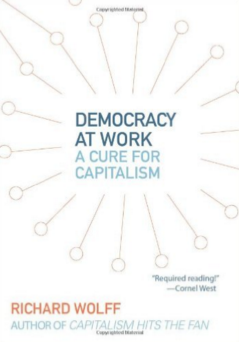
A new historical vista is opening before us in this time of change, Wolff writes in this compelling new manifesto for a democratic alternative based on workers directing their own workplaces.
Purchase "Democracy at Work: A Cure for Capitalism"
Richard Wolff is the leading socialist economist in the country. This book is required reading for anyone concerned about a fundamental transformation of the ailing capitalist economy!" - Cornel West
Ideas of economic democracy are very much in the air, as they should be, with increasing urgency in the midst of today's serious crises. Richard Wolff's constructive and innovative ideas suggest new and promising foundations for much more authentic democracy and sustainable and equitable development, ideas that can be implemented directly and carried forward. A very valuable contribution in troubled times." - Noam Chomsky
Bold, thoughtful, transformative-a powerful and challenging vision of that takes us beyond both corporate capitalism and state socialism. Richard Wolff at his best!" - Gar Alperovitz, author of America Beyond Capitalism
Occupy the Economy: Challenging Capitalism (2012)
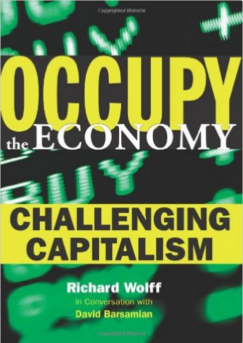
Today's economic crisis is capitalism's worst since the Great Depression. Millions have lost their jobs, homes and healthcare while those who work watch their pensions, benefits and job security decline. As more and more are impacted by the crisis, the system continues to make the very wealthy even richer. In eye-opening interviews with prominent economist Richard Wolff, David Barsamian probes the root causes of the current economic crisis, its unjust social consequences and what can and should be done to turn things around.
While others blame corrupt bankers and unregulated speculators or the government or even the poor who borrowed, the authors show that the causes of the crisis run much deeper. They reach back to the 1970s when the capitalist system itself shifted, ending the century-old pattern of rising wages for U.S. workers and thereby enabling the top 1% to become ultra-rich at the expense of the 99%. Since then, economic injustice has become chronic and further corrupted politics. The Occupy movement, by articulating deep indignation with the whole system, mobilizes huge numbers who seek basic change. Occupying the Economy not only clarifies and analyzes the crisis in U.S. capitalism today, it also points toward solutions that can shape a far better future for all.
Purchase "Occupy the Economy"
Contending Economic Theories: Neoclassical, Keynesian, and Marxian (2012)
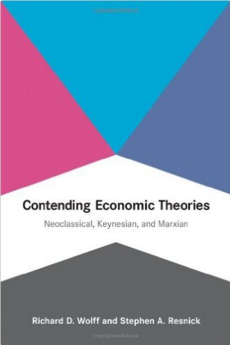
With Stephen A. Resnick, Professor of Economics Emeritus at the UMass Amherst
Contending Economic Theories offers a unique comparative treatment of the three main theories in eco- nomics as it is taught today: neoclassical, Keynesian, and Marxian. Each is developed and discussed in its own chapter, yet also differentiated from and compared to the other two theories. The authors identify each theory’s starting point, its goals and foci, and its internal logic.
The authors, building on their earlier book Economics: Marxian versus Neoclassical, offer an expanded treatment of Keynesian economics and a comprehensive introduction to Marxian economics, including its class analysis of society. Beyond providing a systematic explanation of the logic and structure of standard neoclassical theory, they analyze re- cent extensions and developments of that theory around such topics as market imperfections, information economics, new theories of equilibrium, and behavioral economics, considering whether these advances represent new paradigms or merely adjustments to the standard theory. They also explain why economic reasoning has varied among these three approaches throughout the twentieth century, and why this variation continues today—as neoclassical views give way to new Keynesian approaches in the wake of the economic collapse of 2008.
Purchase
Capitalism Hits the Fan: The Global Economic Meltdown and What to Do About It (2009)
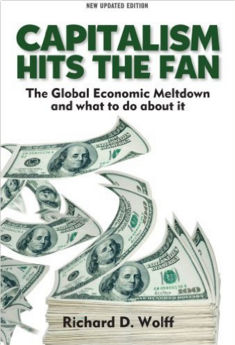
Capitalism Hits the Fan chronicles one economist’s growing alarm and insights as he watched, from 2005 onwards, the economic crisis build, burst, and then dominate world events. The argument here differs sharply from most other explanations offered by politicians, media commentators, and other academics. Step by step, Professor Wolff shows that deep economic structures—the relationship of wages to profits, of workers to boards of directors, and of debts to income—account for the crisis. The great change in the US economy since the 1970s, as employers stopped the historic rise in US workers’ real wages, set in motion the events that eventually broke the world economy.
The crisis resulted from the post-1970s profit explosion, the debt-driven finance-industry expansion, and the sequential stock market and real estate booms and busts. Bailout interventions by the Federal Reserve and the US Treasury have thrown too little money too late at a problem that requires more than money to solve.
We must now ask basic questions about capitalism as a system that has now convulsed the world economy into two great depressions in 75 years (and countless lesser crises, recession, and cycles in between). The book’s essays engage the long-overdue public discussion about basic structural changes and systemic alternatives needed not only to fix today’s broken economy but to prevent future crises.
Purchase "Capitalism Hits the Fan"
With unerring coherence and unequaled breadth of knowledge, Rick Wolff offers a rich and much needed corrective to the views of mainstream economists and pundits. It would be difficult to come away from this… with anything but an acute appreciation of what is needed to get us out of this mess.” - Stanley Aronowitz, Distinguished Professor of Sociology and Urban Education, City University of New York
New Departures in Marxian Theory (2006)

This book brings together key contributions and underscores different interpretations of Marxian theory generally and of Marxian economics in particular. In facing and trying to resolve contradictions and lapses within Marxism, the authors have confronted the basic incompatibilities among the dominant modern versions of Marxian theory, and the fact that Marxism seemed cut off from the criticisms of determinist modes of thought offered by post-structuralism and post-modernism and even by some of Marxism’s greatest theorists.
Purchase "New Departures in Marxian Theory"
Purchase "New Departures in Marxian Theory" (Chinese version)
Economics: Marxian versus Neoclassical (1987)
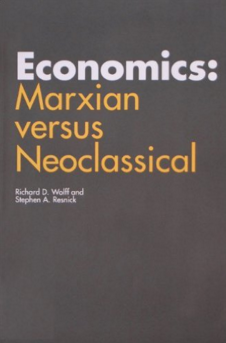
Wolff and Resnick provide a unique, balanced explication of the differing assumptions, logical structures, and arguments of neoclassical and Marxian economics. They address broader aspects of evaluating or choosing between alternative theories, but their conclusions are nonpolemical. Throughout, math is used simply and sparingly.
Purchase "Economics: Marxian versus Neoclassical"
Rethinking Marxism (1985)
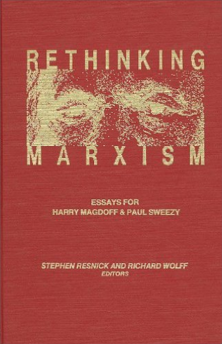
This festschrift volume honors the works of Harry Magdoff and Paul Sweezy. An introductory essay by the editors examines the evolution of their contributions to Marxian theory and analysis. A bibliography provides the most complete listing of their work to the point of publication. Internationally renowned Marxist scholars (including Ernest Mandel, Charles Bettelheim, Immanuel Wallerstein and many others) contributed original essays in fitting tribute to the importance of the honorees' works.
Purchase "Rethinking Marxism"
Economics of Colonialism: Britain and Kenya, 1870-1930 (1974)

From the Yale Series in Economic History.
Purchase "Economics of Colonialism: Britain and Kenya"
CONTRIBUTING AUTHOR
An Inheritance for Our Times: Principles and Politics of Democratic Socialism (2020)
Edited by GREGORY SMULEWICZ-ZUCKER and MICHAEL J. THOMPSON
“Brought together in this great volume are works by scholars, activists and scholar-activists who address the on-going crisis of socialism. Both visionary and practical, this work offers the readers a glimpse into potential scenarios that can advance a truly revolutionary, democratic, and emancipatory socialism. This volume is the sort of provocative catalyst needed to push those on the Left beyond traditional parameters. More than ever, this approach is needed now." — Bill Fletcher, Jr., coauthor of Solidarity Divided and "They're Bankrupting Us" and Twenty Other Myths about Unions, executive editor of globalafricanworker.com
“Socialism has suddenly emerged as a public politics in the United States. If you want to think about why, and about what socialism could mean in the 21st century post-industrial America, this anthology is an excellent place to start. It contains a few blasts from the past, but many of the essays grapple with how socialism can make sense in a society very different from the one Marx wrote about or Eugene Debs ran for president in. The editors are to be congratulated." — John B. Judis, author of The Populist Explosion and of The Nationalist Revival
Purchase
Imagine: Living in a Socialist USA (2014)
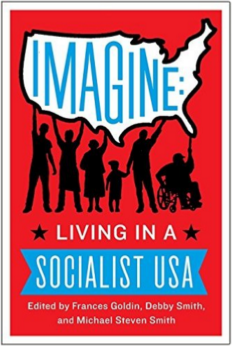
Imagine: Living In a Socialist U.S.A., edited by Francis Goldin, Debby Smith, and Michael Steven Smith, is at once an indictment of American capitalism as the root cause of our spreading dystopia and a cri de coeur for what life could be like in the United States if we had economic as well as a real political democracy. This anthology features essays by revolutionary thinkers, activists, and artists—including Academy Award-winning filmmaker Michael Moore, civil rights activist Angela Davis, incarcerated journalist Mumia Abu Jamal, and economist Rick Wolff— addressing various aspects of a new society and, crucially, how to get from where we are now to where we want to be, living in a society that is truly fair and just.
Purchase
A Marxian Analysis of the Economic Crisis and Greece (Greek language, 2014)
The collective volume Economic Crisis and Greece (Athens: Gutenberg, 2011) is an initiative of the Greek Scientific Association of Political Economy and has been edited by Andriana Vlachou (Associate Professor at the Athens University of Economics and Business), Nicholas Theocarakis (Assistant Professor at the National and Kapodistriako University) and Dimitris Milonakis (Associate Professor at the Crete University). The contributors challenge the orthodox Economics which is considered responsible for not being able to predict and explain the current financial crisis.
PDF Format (Greek)
Class Struggle on the Homefront (2009)

Home Front examines the gendered exploitation of labor in the household from a postmodern Marxian perspective. The authors of this volume use the anti-foundationalist Marxian economic theories first formulated by Stephen Resnick and Richard Wolff to explore power, domination, and exploitation in the modern household.
Purchase
State Capitalism, Contentious Politics and Large-Scale Social Change (1998)
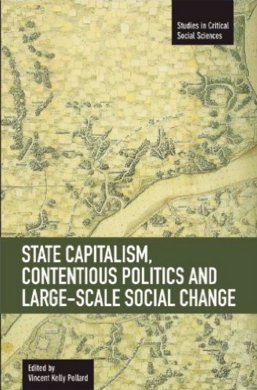
With Vincent Kelly Pollard (Editor)
State capitalism is back. It never went away. This book looks at the role of state capitalism in major European and Asian societies. It confronts neo-liberal pieties about the role of markets and private property in capitalist development and radical accounts which see the state as the antithesis of capitalism. State capitalism is a normal form of capitalist development. Its extremes may vary but it has been, and remains, central to an understanding of modern capitalism. This is especially the case in the so called Communist and Communist worlds of Russia and China, and for alternative economies like that of India and the Philippines, which are the focus of this timely and challenging book.
Purchase
Richard Wolff's books
Richard Wolff demonstrates that CAPITALISM HAS FAILED
https://www.youtube.com/watch?v=qFy4GOZTHIo&ab_channel=SavvyFew
Subscribe to:
Posts (Atom)