Tuesday, September 29, 2020

Black Man Cuffed At Home


https://www.youtube.com/watch?v=NKtvkN_pbJ0&ab_channel=act.tv


The world has reached the grim milestone of one million COVID-19 deaths


https://www.wsws.org/en/articles/2020/09/28/coro-s28.html?pk_campaign=newsletter&pk_kwd=wsws


By Benjamin Mateus
28 September 2020

According to the Worldometer coronavirus dashboard, the number of COVID-19 deaths globally surpassed 1 million on Sunday morning, US Eastern Time. The Johns Hopkins dashboard, more commonly cited in the American media, puts the figure over 995,000, and by all accounts, will register one million deaths today.

This massive tragedy is an indictment of the ruling classes which have allowed such misery to rain on the working class populations who have suffered the brunt of this pandemic.
The United States, with 209,361 deaths, leads every other nation in this horrific category. Brazil takes second place with 141,503 deaths, followed by India, with 95,162 deaths, and Mexico, with 76,243 deaths.

Right-wing authoritarian rulers in the first three countries, Donald Trump, Jair Bolsonaro and Narendra Modi, and the “left” populist demagogue Andrés Manuel López Obrador, in the fourth, have embraced identical policies of letting the infection rip through the population without serious resistance. These four horsemen of death account for half the world’s total.

Mexico has consistently averaged close to 500 deaths daily, and by all experts, the official reports have been gross underestimates. Earlier this month, the government shamefully announced they had run out of death certificates. By Aug. 1, the official death count was 69,095 though the government had announced excess deaths at 122,765.
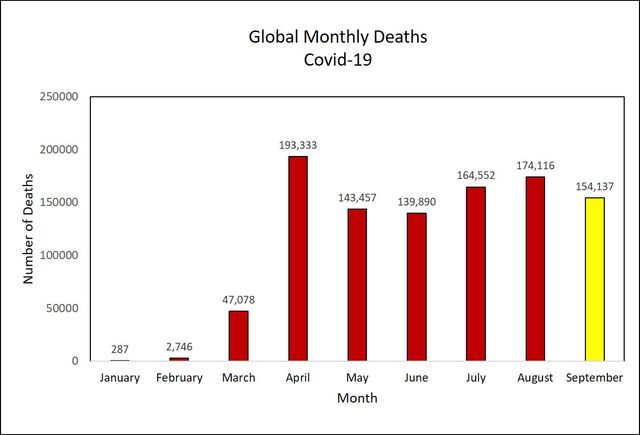
Graph of monthly global deaths. Credit: wsws.org

As Figure 1 demonstrates, daily global deaths have remained nearly stable since peaking in April. The column for September marked in yellow is a projection that the last four days will see, on average, about 5,300 deaths per day using the latest seven-day average estimate. By all accounts, the limited response and measures that have been employed throughout the pandemic have only stabilized the impact of the virus around the world. However, as winter approaches for the far more populous northern hemisphere, case numbers and deaths are expected to begin climbing again.

To the figure of one million officially killed by COVID-19 must be added hundreds of thousands who have perished with the cause of death signed off by the medical examiners or health authorities as unknown, or cardiopulmonary or organ failure, concealing the true impact of the pandemic from family members and the public at large.
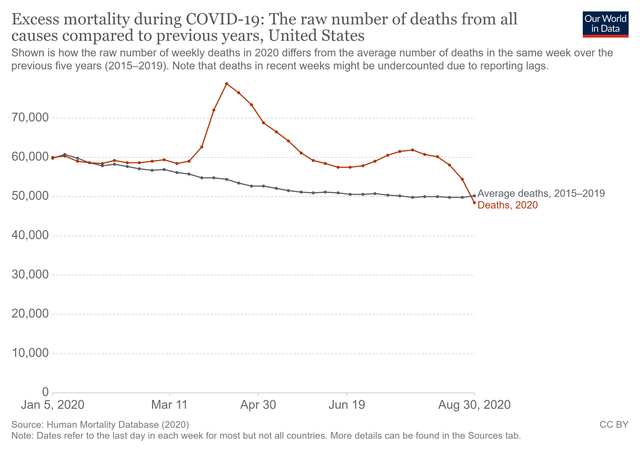
Excess death in the United States. Credit: Our World in Data


According to the Economist, between March and August, all-cause mortality data for western Europe, some Latin American countries, the United States, Russia and South Africa from March to August showed 900,000 excess deaths. However, only 580,000 fatalities were attributed to COVID-19. This suggests that the real number of fatalities due to COVID-19 is 55 percent higher than the tallies maintained by Worldometer and Johns Hopkins, which are based on official death reports.

the Economist also remarks that the US death toll may be underestimated by 30 percent, placing the actual figure closer to 300,000. By their estimates, the real global death toll due to the pandemic may be closer to two million.

Some of these excess deaths are a byproduct of the social impact of the pandemic rather than the virus itself. The social crisis surrounding lockdowns and financial hardships have led people to avoid seeking medical attention for health issues out of legitimate fear of contracting the coronavirus.

Tom Inglesby, director of the Center for Health Security at Johns Hopkins University, told the Wall Street Journal, “For a long period of time there was a pretty dramatic drop-off in ER visits, elective-surgery screenings, things that Americans do all the time to keep themselves healthy.”

Weekly estimates for deaths due to heart attacks, Alzheimer’s and dementia, diabetes and strokes consistently have been above the baseline in the months from March to August. According to data from Boston University, the Robert Wood Johnson Foundation and the University of Pennsylvania, 20 percent of excess deaths were linked to other factors than COVID-19, with poor communities hit worst.

Providing context for the magnitude of this preventable tragedy, the US Centers for Disease Control and Prevention registered 2,813,503 deaths in 2017. The “normal” death toll in 2020 would have been roughly similar. This means that COVID-19 has already accounted for a nearly ten percent increase in US deaths this year, with several months still left to go.
The one million COVID-19 deaths worldwide is more than the 690,000 people who succumbed to AIDS-related illnesses in 2019, according to World Health Organization figures. In 2016, malaria, which afflicted 216 million people, led to 445,000 deaths. In 2018, tuberculosis killed 1.5 million people.

The economic impact from the pandemic falls hardest on the poorest people, with the closure of schools leading to setbacks in education gains, a halt in critical vaccination programs and lessened access to health care and pharmaceuticals. This means that the impact of the pandemic will continue to ripple across the globe for many years after it subsides or a vaccine is found.

The World Bank predicts that the number of impoverished people who live on less than two dollars a day will climb from 70 to 100 million this year. In July, Oxfam wrote in a media brief that by the end of the year, 12,000 people per day could die from hunger linked to COVID-19, more than the number dying now from the disease itself.

Oxfam wrote, “The pandemic is the final straw for millions of people already struggling with the impacts of conflict, climate change, inequality, and a broken food system that has impoverished millions of food producers and workers. Meanwhile, those at the top are continuing to make a profit: eight of the biggest food and drink companies paid out over $18 billion to shareholders since January, even as the pandemic was spreading across the globe.”

In 2019, over 821 million people were categorized as food insecure, with approximately 149 million suffering from “crisis-level hunger or worse.” The World Food Program estimates that the number will rise to 270 million by year’s end, an increase of 82 percent.

The critical question that remains is to what extent has the globe acquired sufficient immunity that most of the population is protected from the transmission of the virus. In a cross-sectional study published in the Lancet on Friday on the prevalence of SARS-CoV-2 antibodies in a large nationwide sample of patients on dialysis found that less than ten percent of the US adult population had been exposed and developed an immune response.

An estimate on 279 serological surveys conducted across 19 countries found that approximately 500 to 730 million people worldwide, or 6.4 to 9.3 percent of the total, have been infected.

Critical also in this global equation is vaccine development against SARS-CoV-2 and access to these potentially life-saving measures. Should these trials for the vaccines be conducted ethically and appropriately, by all accounts, the necessary data will not be available until the spring or summer of next year. Additionally, the manufacturing and distribution of vaccines will most likely be used as a political ploy to force lopsided trade deals and financial traps.

The death of these million-plus people is a clear indication that the financial oligarchs and the capitalist mode of production have abdicated any responsibility for their criminal response to the pandemic. By any measure, the pandemic still has much fuel to burn through, and only the working class has a vital interest in putting this fire out immediately. Only they have the capacity to prevent this further loss of life.

Intelligence Agencies Illegally Spying On Protesters


https://www.youtube.com/watch?v=ggj_BQ6HBlI&ab_channel=SecularTalk


Armenian-Azeri conflict erupts in Caucasus, threatening wider war


https://www.wsws.org/en/articles/2020/09/28/cauc-s28.html?pk_campaign=newsletter&pk_kwd=wsws


By Ulaş Ateşçi and Alex Lantier
28 September 2020

Large-scale military clashes erupted yesterday in the disputed Nagorno-Karabakh region between Armenia and Azerbaijan in the Caucasus. Artillery, drone and tank fire killed many soldiers and civilians on both sides, with each one accusing the other of starting the conflict.

Armenia said that there were 16 killed and over 100 injured, while Azerbaijan acknowledged taking significant losses without giving figures. Yerevan and Baku posted videos of strikes against each other’s forces and pictures of a blackout in Nagorno-Karabakh. The Azeri defense ministry claimed it seized seven border villages in the region, while Armenia claimed to have destroyed four helicopters and hit 10 tanks and 15 drones.

This is the most intense Armenian-Azeri fighting since the 1988-94 conflict between the two former Soviet republics that began before the 1991 Stalinist dissolution of the Soviet Union. This war is, in the final analysis, a disastrous product of the restoration of capitalism of the Soviet Union and the reactionary character of the nation-state system. It is now directly caught up with global geopolitical rivalries stoked by the imperialist wars in Iraq, Syria and Libya.
An Armenian-Azeri war could rapidly spiral out of control and escalate into a broader conflict involving Russia, Turkey and the other NATO powers in Europe and North America.

In July, Armenian-Azeri clashes erupted at Tayush in northeastern Armenia and the Toyuz district in Azerbaijan, killing 12 Azeri and four Armenian soldiers.

Since then, military tensions have escalated. Turkey, a NATO member state and key ally of Azerbaijan, conducted joint military exercises of air and ground forces with Azerbaijan in Baku, Nakhchivan, Ganja, Kurdamir and Yevlakh immediately after the July clashes. Russia, backing Armenia, announced a “surprise combat readiness check” involving 150,000 troops, over 26,000 weapon systems, 414 aircraft and 106 warships.

NATO wars in Libya and Syria have undermined the ability or willingness of states that brokered earlier Armenian-Azeri ceasefires—the United States, France, and Russia—to do so again. Their relations with Turkey have collapsed: Russia is waging a proxy war against Turkish-backed forces in Libya, France is backing Greece against Turkey in eastern Mediterranean oil disputes, and America is backing Kurdish-nationalist guerrillas opposed by Turkey in Syria. Armenia declared its support for Greece in the eastern Mediterranean, and Azerbaijan announced it was backing Turkey.

Olesya Vartanyan, an International Crisis Group analyst, wrote on Twitter: “There were numerous signals, all saw them and did nothing for weeks. There was a need for proactive international mediation. Many found reasons to OK this attack. If they stay silent now, expect a real war.”

Instead of brokering peace, however, the major powers are in fact preparing for war with each other. Across the Black Sea, US and British troops together with German, Polish and Lithuanian advisers conducted joint exercises with Ukraine last week. The Ukrainian Defense Ministry stated: “For the first time, the military units of the armed forces of NATO member states will be involved in the strategic command and staff exercises.”

Russia’s Kavkaz-2020 (Caucasus-2020) war games involving 80,000 troops have also begun in the North Caucasus and the Black and Caspian seas. Up to 1,000 troops from China, Armenia, Belarus, Iran, Myanmar and Pakistan participated, as well as 250 tanks, 450 armored personnel carriers, and 200 artillery or multiple rocket launcher systems.

Statements by Armenian and Azeri officials make clear that all-out regional and even global war is a real and imminent danger in the South Caucasus.

Armenian Prime Minister Nikol Pashinyan stated: “A full-scale military confrontation in the South Caucasus, which we stand on the brink of now, can have the most unpredictable consequences. It can spill outside the region and acquire a much larger scale, threatening international security and stability.” He called on “the international community to pull every available lever to deter Turkey from any possible involvement.”

A few hours earlier, however, he had announced martial law and full war mobilization in Armenia: “Based on a decision by the government, martial law and a full mobilization have been declared in the Republic of Armenia. These decisions take effect immediately after official publication. I urge all personnel attached to the military to report at their territorial military commissions.”

Azerbaijan’s equally belligerent government responded by declaring a state of siege in several cities and regions. According to Turkey’s state-owned Anadolu Agency, the Azeri parliament passed a “measure partially and temporarily restricting the constitutional and property rights and freedoms of Azerbaijani citizens and foreigners in the country as long as the war situation continues.”

The ruling elites in both countries are pursuing an aggressive militaristic policy amid the explosive social tensions caused by the COVID-19 pandemic. Armenia has reported nearly 50,000 cases and 951 deaths in its population of less than three million, the highest death rate in Asia, but Pashinyan said on Thursday that Armenia “must live with the coronavirus.” Azerbaijan, with a population of 10 million, has registered over 40,000 cases and 586 deaths.

Both countries have drastically raised military spending at the expense of the working class. In 2019, military spending rose to nearly $1.8 billion in Azerbaijan, an all-time high, and nearly $650 million in Armenia—nearly five percent of its GDP, one of the highest rates in the world.

After bloodshed escalated yesterday, officials internationally began to call for the fighting to stop. UN Secretary General Antonio Guterres called on Armenia and Azerbaijan to “immediately stop fighting, deescalate tensions and return to meaningful negotiations without delay.” NATO stated that it is “deeply concerned by reports of large scale military hostilities along the line of contact in the Nagorno-Karabakh conflict zone,” calling on both sides to “immediately cease hostilities.”

European Union Foreign Policy chief Josep Borrell called for “an immediate cessation of hostilities,” while the French government declared it is “extremely concerned by the confrontation.”


The Russian and Iranian foreign ministries each called for “self-restraint,” with Moscow calling on “all parties to immediately cease fire and begin negotiations in order to stabilize the situation.”

Turkish officials denounced Armenia as the aggressor, declaring their full support for Azerbaijan. While President Recep Tayyip Erdoğan labeled Armenia, one of the region’s poorest countries with a population of only three million, as the “biggest threat to regional peace,” Turkish Defense Minister Hulusi Akar called his Azeri counterpart to say: “Turkey will always stand by Azeri Turks by all means in their struggle to protect their territorial integrity.”

A 2010 Turkish-Azeri military pact requires both to respond militarily if either party is attacked by a third country. Pro-government Turkish media outlets are working to provide a pretext for Turkish military intervention, making unsubstantiated claims that the Kurdistan Workers Party (PKK) and People’s Protection Units (YPG) militias have gone to Nagorno-Karabakh to train Armenian militias. Both Kurdish groups are labeled as “terrorist” by Ankara.

Turkey’s bourgeois opposition is again lining up behind the government’s aggressive policy. The Republican People’s Party (CHP) denounced an “Armenian attack,” while the CHP’s far-right ally, the Good Party, declared that “Armenia's attacks on Azerbaijan are unacceptable,” and that it is “standing with Azerbaijan in its legitimate cause.”

While Turkey aggressively backs Azerbaijan, Russia has traditionally supported Armenia and has a large military base in the country at Gyumri. Were full-scale war to ensue between Armenia and Azerbaijan, an intervention by either Russia or Turkey to avert defeat of their ally could lead to all-out war between Moscow and Ankara. This would inevitably pose the question of whether the entire NATO alliance would side with Turkey against Russia.

The growing war danger across the Caucasus, as well as in Syria and the eastern Mediterranean, underlines the urgent necessity of building an international movement against war and herd immunity policies in the COVID-19 pandemic, unifying the working class on a socialist program.
COVID-19 Reinfections Are a Thing: Here’s What We Know So Far


https://www.youtube.com/watch?v=-JcoFa5ieyA&ab_channel=SciShow


Republicans Can't Put Anti-Mask Genie Back In Bottle


https://www.youtube.com/watch?v=uguWgBoSrYo&ab_channel=TheMajorityReportw%2FSamSeder


Is Trump preparing an “October Surprise”?


https://www.wsws.org/en/articles/2020/09/28/pers-s28.html?pk_campaign=newsletter&pk_kwd=wsws


28 September 2020

With the US presidential election barely five weeks away, Washington is stoking dangerous conflicts across the globe. With the danger that any one of them could escalate into a military confrontation, the question that is increasingly being discussed in US foreign policy circles and by worried governments around the world is whether US President Donald Trump is preparing an “October Surprise.”

There is a long history of events taking place in October, either planned or unplanned, which have major effects on an upcoming presidential election. In 1956, the eruption of the Sinai War and the Hungarian Revolution helped solidify support behind President Dwight D. Eisenhower. In 1968, the Johnson government’s announcement that it would suspend the bombing of North Vietnam almost swung the election to Democrat Hubert Humphrey. In 1972, Henry Kissinger infamously declared that “Peace Is at Hand” in Vietnam, giving Nixon a boost in the polls over George McGovern.

But the phrase “October Surprise” was coined by William Casey, Republican candidate Ronald Reagan’s campaign manager in 1980 and subsequent CIA director. In the case of Reagan and Casey, the “surprise” in question was the prospect that Iran would release US personnel taken hostage in the 1979 seizure of the American Embassy by Iranian students. According to both US and Iranian officials, Casey and the Reagan campaign conducted secret negotiations with Teheran to prevent the hostages’ release until after the election.
Today, the threat is that the “October Surprise” will come in the form of an eruption of American militarism.

Washington Post columnist David Ignatius wrote in a column last week warning, “Iraq is the place where a U.S.-Iran confrontation could explode in the next few weeks, creating an ‘October surprise’ before the U.S. presidential election.” It is doubtful that Ignatius, who has close connections with the US military-intelligence apparatus, is using this phrase loosely.

He was referring to an ultimatum delivered by US Secretary of State Mike Pompeo to Iraq’s new Prime Minister Mustafa al-Kadhimi that Washington will close its Baghdad embassy unless the regime cracks down on Iraqi Shi’a militias aligned with Iran that have lobbed rockets in the general vicinity of the US facility. Such a crackdown would likely trigger the government’s downfall.

Ignatius pointed out that the embassy’s “closure could also be a prelude to heavy U.S. airstrikes against the militias.”

Such military action could quickly escalate into a confrontation with Iran, which is already escalating on other fronts. A US Navy carrier strike group has been sent through the strategic Strait of Hormuz into the Persian Gulf for the first time since last November. The deployment comes as the Trump administration has arrogantly claimed the right to unilaterally reimpose United Nations sanctions that were lifted under the 2015 nuclear agreement between Teheran and the major powers, a deal that Washington unilaterally abrogated.

Chief among the sanctions that the US is now claiming is the right to enforce a ban on the export of conventional weapons to Iran that is set to expire in the middle of next month. Both Russia and China are prepared to resume such exports. The US vow to continue enforcing the ban raises the prospect of American warships seizing Russian or Chinese vessels in the Persian Gulf or on the high seas.

The threat of direct conflict between US imperialism and its two major nuclear rivals continues to escalate across a wide field of military operations.

The Pentagon is staging nearly continuous provocative military exercises on Russia’s borders. Last week, it brought along NBC’s chief foreign correspondent Richard Engel, who flew in an Air Force F16 as US warplanes simulated large-scale “dogfights” on the border with Russia. As an “embedded” reporter, Engel cast the aerial provocation in heroic terms.

This operation follows by only weeks, live fire exercises in Estonia involving what the US Army described as “multiple launch rocket systems” in shooting range of Russia. Moscow’s embassy in Washington described the action as “provocative and extremely dangerous for regional stability.” It asked, “How would the Americans react in the event of such shooting by our military at the US border?”

Meanwhile, Washington is staging relentless provocations against China, particularly over the island of Taiwan, where a pair of visits by high-level US officials over the past two months, combined with multibillion-dollar arms sales, have been directed at strengthening US-Taiwanese relations and effectively overturning the “One China” policy that has been central to US-China relations for more than 40 years.

In what Beijing has justifiably interpreted as a gross provocation and unconcealed threat, Military Review, the US Army’s principal publication, dedicated its entire September-October issue to the prospect of a US war with China over Taiwan, based on the premise of Beijing’s military takeover of the island.

One article in the Army journal is titled “Drive Them into the Sea” and advocates “dispatching an Army heavy corps to Taiwan” that “will drive the enemy into the sea.”

Another, written by a US Marine Corps officer, titled “Deterring the Dragon: Returning U.S. Forces to Taiwan,” expresses concern over the People’s Liberation Army’s (PLA) military advances, particularly in terms of intermediate range missiles, and calls for deploying American troops to Taiwan. It concludes, “America needs to posture its forces in a way that would inevitably trigger a larger conflict and make plain its commitment to Taiwanese defense,” adding “it would be extremely unlikely that the U.S. government would not commit to a larger conflict after U.S. ground forces were engaged in Taiwan.”

The triggering of a direct military conflict in any one of these arenas could provide Trump with his “October surprise” at the potential cost of a massive loss of life and a spiraling conflict leading to world war. The aim would not be so much to sway voters, as Trump is not pursuing a strategy based on the popular vote which he failed to win in the 2016 election, but rather on creating the conditions for a coup d’état aimed at consolidating a presidential dictatorship and violently suppressing all opposition. War could serve as the pretext for making good on his threats to invoke the Insurrection Act and impose martial law.

Trump’s ostensible political opposition, the Democratic Party and its presidential candidate Joe Biden, have only helped to create the conditions for such a military provocation and its far-reaching political consequences. They have repeatedly denounced Trump for being too “soft” on Russia and China, including in the wake of a recent crash between US and Russian armored cars in Syria, in which they demanded retaliation for the minor injuries suffered by American soldiers.

Given this reality, in the event of a US military engagement against Russia or China, the Democrats would throw their support behind Trump’s war effort.

Underlying the threat of war is the insoluble crisis of the capitalist system and the turn by US imperialism toward military aggression as a means of offsetting the decline of its global hegemony. This has only been intensified by the uncontrolled spread of the COVID-19 pandemic, mass unemployment, poverty and growing social unrest. America’s ruling oligarchy seeks to divert these intense and insoluble domestic tensions outward in the form of an eruption of militarism.

The struggle against war, along with the fight against the devastation of jobs, living standards and the very lives of workers, as Republicans and Democrats alike pursue the homicidal back-to-work and back-to-school agenda, cannot be waged within the framework of the Trump-Biden electoral contest. Regardless of the outcome of the 2020 election, the drive toward war and dictatorship will continue.

The threat of war and all of the life-and-death questions confronting the vast majority of the American people can be confronted only by means of the independent political mobilization of the working class in the fight for socialism. This poses the need for the formation of rank-and-file workplace and neighborhood committees to organize this struggle and the fight for a political general strike to halt Trump’s dictatorial conspiracies and topple his government.


Bill Van Auken