Monday, September 7, 2020
I Danced in the Streets after Allende’s Victory in Chile 50 Years Ago. Now I See its Lessons for Today
The death of Chilean democracy and inauguration of a reign of terror also turned the country into a ruthless laboratory for neoliberal economics, the same savage capitalism that is being vigorously contested in the United States today.
September 6, 2020 Ariel Dorfman LOS ANGELES TIMES
https://portside.org/2020-09-06/i-danced-streets-after-allendes-victory-chile-50-years-ago-now-i-see-its-lessons-today
Fifty years ago today, on the night of Sept. 4, 1970, I was dancing, along with a multitude of others, in the streets of Santiago de Chile. We were celebrating the election of Salvador Allende, the first democratically elected socialist leader in the world.
President Allende’s victory had historical significance beyond Chile. Before then, political revolutions had been violent, imposed by force of arms. Allende and his left-wing coalition used peaceful means, proclaiming it unnecessary to repress one’s adversaries to achieve social justice. Radical change could happen within the confines and promises of a democracy.
It was a thrilling moment to be alive. Anything seemed possible. I remember the people — workers who had built that country and been denied its riches, women from shantytowns with children in tow — pouring into the city center, their rebellious presence portending a new social order.
I have often fantasized about how different the world would be if Allende had not been overthrown, three years later, in a bloody coup. I wonder where humanity would be if his peaceful revolution had been allowed to run its course and become a template for other countries.
Commemorating this anniversary should not be an exercise in personal nostalgia, however. Allende’s victory still matters because it continues to speak to us in many ways, especially now, as the United States faces a momentous election of its own.
Socialism is not on the ballot this November, despite President Trump’s deranged efforts to portray his opponents as extremists. But voters will be deciding whether this country will embrace sweeping change or remain trapped in the past. If Joe Biden wins, American citizens, of which I am now one, will have to ask themselves major questions about how to implement much-needed reforms, as we did in Chile all those decades ago.
Any process of systemic change will always run into difficulty. In the case of the U.S., critical transformations like police reform can either be accelerated to ensure there is no turning back or slowed to avoid a debilitating backlash. In some instances, negotiations will be crucial. In others — climate change, COVID-19 — demands must be doggedly non-negotiable.
The Biden administration will also have to work constructively with throngs of inspiring activists who are eager to advance further and more quickly than the majority of the nation is willing to go. Even more crucial, the administration will have to isolate and outmaneuver the well-armed and well-financed fanatics who are virulently opposed to any limitation of their privileges and ready to resort to violence.
If we had resolved similar challenges in Chile, we might have prevented Augusto Pinochet’s catastrophic dictatorship — 17 years of executions, torture, persecution and exile, the effects of which we are still suffering today.
There was another factor that contributed to our failure: The United States promoted the overthrow of Allende, then nurtured the tyrannical regime that ensued. Chile is far from the only country whose sovereignty the U.S. has flouted, of course. America has helped to overthrow democratically elected governments in Iran, Guatemala, Indonesia, and the Congo, among others. But the destabilization of Chile — the squashing of the hope that flooded the streets of Santiago 50 years ago — had particularly perverse consequences. Just as this country must confront the mistreatment and marginalization of many of its own people, so must it face up to its legacy of imposing suffering on other lands.
The death of Chilean democracy and inauguration of a reign of terror — symbolized by Allende’s death at the Presidential Palace on Sept. 11, 1973 — also turned the country into a ruthless laboratory for neoliberal economics, the same savage capitalism that is being vigorously contested in the United States today. It would be naïve to suggest that the Allende government could have precluded that neoliberal paradigm from conquering the world. Plenty of other nations were primed for the experiment. But it is sobering to think that if Chile’s revolution had not been thwarted, it may have provided a model for how the U.S. could emerge from its current crisis of inequality and division.
I expect Americans will have cause to dance in the streets this November, as another electoral victory announces the dawn of a new era. And if so, I hope some among them might remember that they are not alone — that, once upon a time, other men and women danced toward justice in a land that is not, after all, that far away.

A Win Against Dark Money Eight Years in the Making
A federal court has ruled in favor of stronger disclosure requirements just in time for the November 2020 elections.
September 6, 2020 Ciara Torres-Spelliscy BRENNAN CENTER FOR JUSTICE
https://portside.org/2020-09-06/win-against-dark-money-eight-years-making
Good news is infrequent when you’re on the anticorruption beat. Notable recent incidents, for example, have included the sentencing of a former U.S. congressman’s wife for misuse of campaign funds and the resignation of a North Carolina state legislator who had pled guilty to tax evasion charges. However, in a rare positive development, the D.C. Circuit Court ruled last month that the Federal Elections Commission (FEC)’s disclosure rules on dark money were too weak.
In the case at hand, CREW v. FEC (which should not be confused with other cases, including a 2018 case of the same name), the plaintiffs were led by the Citizens for Responsibility and Ethics in Washington (CREW), a nonpartisan nonprofit organization whose mission is to hold government officials accountable to ethics rules, campaign finance laws, and the Constitution. Meanwhile, the defendant was the FEC, the agency responsible for administering federal campaign finance laws, including transparency rules. CREW sues the FEC often because the agency is known for failing to achieve its main objective — the enforcement of campaign finance laws. While many critics scream at the FEC, “you had one job!”, CREW actually does the hard work of litigation in order to prompt the agency toward action.
The case started eight years ago when CREW filed a complaint at the FEC against Crossroads GPS, a dark money group that had engaged in secret spending during the 2012 election cycle. When the FEC failed to take action, CREW then sued the FEC — and won their case in a federal district court in August 2018. The 2020 case involves an appeal of that lower court opinion.
The CREW v. FEC case literally turns on the difference between the words “an” and “the”. While this may seem like an infinitesimal difference, it actually matters for how our democracy works. In fact, the difference created a huge loophole in campaign finance law that allowed for $1 billion dollars in dark money spending in federal elections over the past decade.
The issue in the case was the 1979 version of the Federal Election Campaign Act (FECA) at 52 USC § 30104, which requires disclosing the identity of anyone who contributed more than $200 toward independent expenditures — ads that promote or attack political candidates. The key language in the statute from subsection 30104(c)(2)(C) requires independent expenditure makers to disclose “each person who made a contribution in excess of $200 . . . for the purpose of furthering an independent expenditure.” Note the use of the word “an.”
However, when the FEC promulgated their regulations (11 C.F.R. § 109.10(e)(1)(vi)) in 1980 implementing this statute, they used language that required disclosing the identity only of persons whose contributions were “made for the purpose of furthering the reported independent expenditure.” Note the use of the word “the” — a choice that allowed election lawyers representing dark money groups to argue successfully for decades that donors only had to be disclosed if they had earmarked funds for a particular political ad. And the FEC has enshrined this pro-dark money approach in its instructions for FEC forms used by contributors.
The FEC’s traditional approach to “disclosure” led to Alice-in-Wonderland filings at the agency that reported millions in spending that all appeared to come from no one at all. For example, if you pull the independent expenditure report for the U.S. Chamber of Commerce for the 2018 election, you will find a listing for $7,458,414.89 in spending and $0 from donors. Similarly, if you look at the FEC filings for the National Rifle Association Institute For Legislative Action (NRA-ILA) — the biggest dark money spender in the 2016 presidential election cycle — you will find a listing for $33,341,464.65 spending and $0 from donors.
The recent ruling in CREW v. FEC throws out the FEC rule that never matched up with its controlling statute. This shuts down a big avenue for dark money just in time for the 2020 federal elections. Now donors who bankroll political ads that meet the independent expenditure definition need to disclose their role in attacking or supporting candidates.
This change is long overdue. Open Secrets, a nonpartisan research group that tracks dark money in politics, has noted that “more than $116 million in political spending and 2020 contributions can be traced back to ‘dark money’ groups aligned with Democratic or Republican party leadership.” The group also noted that dark money conduits are also funding super PACs during the 2020 cycle.
The bad news is that the FEC is without a quorum for the second time in the 2020 election cycle. This could delay the FEC from complying with the D.C. Circuit Court’s good CREW v. FEC decision in a timely fashion.
Spanish Trial Brings Hope of Justice for Victims of Salvadoran Death Squads
Thirty years after murder of eight people, including six Jesuits, those who ordered deaths may finally face consequences
September 6, 2020 Sam Jones THE GUARDIAN
https://portside.org/2020-09-06/spanish-trial-brings-hope-justice-victims-salvadoran-death-squads
A few hours before he was shot dead in the campus garden of his university in San Salvador, Ignacio Martín-Baró rang his family back in Spain to let them know he was OK. “It’s all fine,” the Jesuit, psychologist and academic told his parents. “The army is all around us.”
The following morning, Martín-Baró was dead, murdered by a military death squad along with five Jesuit colleagues, a housekeeper and her 15-year-old daughter.
The priests, five of them Spanish, became some of the best known victims of El Salvador’s civil war, the 12-year conflict between the US-backed military junta and the leftwing guerrillas of the Farabundo Martí National Liberation Front (FMLN) that cost more than 75,000 lives.
While the US government and the Salvadoran military fought to snuff out what they saw as a communist uprising, the Jesuits, who worked at the Central American University (UCA) in San Salvador, sought a negotiated peace agreement.
Looking back across the gulf that separates the present from the events of 16 November 1989, Martín-Baró’s elder brother, Carlos, thinks he knows what Ignacio – Nacho to those who knew him – was up to when he called home for the last time. “It was a very Nacho way of telling them not to worry, but it wasn’t without irony.
“He also spoke to my sister Alicia that night and held up the receiver and told her to listen to the firefight outside. I think it was an elegant, ironic way for him to say goodbye to them and to life itself.”
Today, more than three decades after that farewell, Carlos is quietly hopeful that Nacho and the seven others killed in one of the most infamous atrocities of the civil war may finally receive some measure of posthumous justice.
Using proceedings brought under the principle of universal jurisdiction – which allows human rights crimes committed in one country to be investigated in another – a former Salvadoran army colonel who was also a security minister has been on trial in Madrid, accused of involvement in the “decision, design and execution” of the murders.
During nine sessions spread across June and July, Col Inocente Orlando Montano sat in a wheelchair in the Spanish courtroom, his hair closely cropped and a blue mask covering his mouth, and argued his innocence
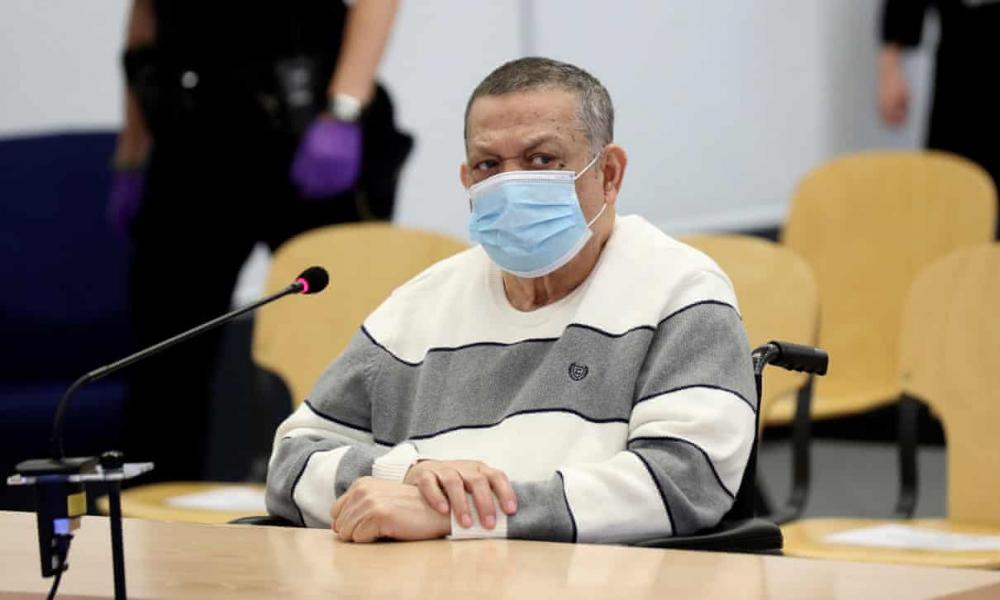
Col Inocente Orlando Montano in court in June. Photograph: Kiko Huesca/EPA
Yes, he told the court, he had been a member of La Tandona, a group of violent and corrupt senior army officers whose members had risen to the top of El Salvador’s political and military elite.
But Montano insisted that he had “nothing against the Jesuits”. Nor had he ever participated in a meeting where plans were hatched to kill the priests and blame their deaths on the FMLN in a bid to derail peace talks that would have curtailed La Tandona’s power and reach.
His claims, however, were contradicted by Yusshy René Mendoza, another Salvadoran former soldier who acted as a prosecution witness after proceedings against him were dropped because the statute of limitations had expired and because of the remorse and cooperation he had shown.
Mendoza told the court that members of the military high command – including Montano – had met and decided that “drastic” measures were needed to tackle the FMLN guerrillas, their sympathisers and others.
On the night of 15 November 1989, Mendoza added, he and others were informed that the order had been given to “eliminate” the UCA’s rector, Father Ignacio Ellacuría, a liberation theologian and a pivotal figure in the push for peace.
In the early hours of the following day, members of the elite, US-trained counter-insurgency Atlacatl battalion entered the priests’ lodgings and launched an attack on the pretext of searching the campus for rebels. With them they carried an AK-47 rifle taken from the FMLN guerrillas.
Ellacuría, 59 and originally from Bilbao, was shot dead, as were Nacho Martín-Baró, 47, and Segundo Montes, 56, both from Valladolid; Juan Ramón Moreno, 56, from Navarra; and Amando López, 53, from Burgos.
The death squad killed a Salvadoran Jesuit, Joaquin López y López, 71, in his room before murdering Julia Elba Ramos, 42, and her daughter, Celina, 15. Ramos was the housekeeper for another group of Jesuits, but lived on the university campus with her husband and daughter.
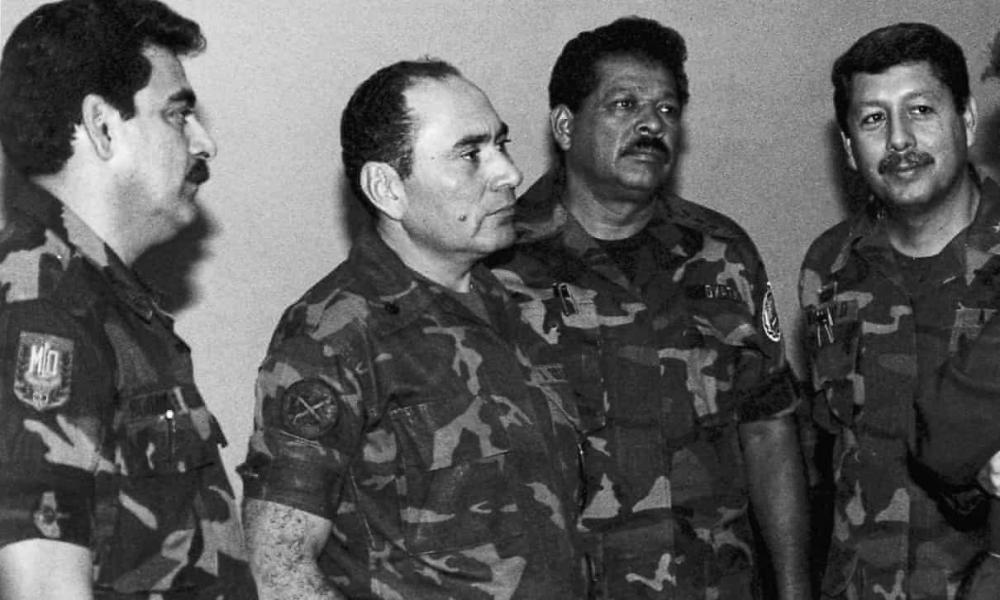
From left: Col Rene Elilio Ponce, Gen Rafael Humberto Larios, Col Inocente Orlando Montano and Col Juan Orlando Zepeda in July 1989. Photograph: Luis Romero/AP
Carlos has little doubt that his brother knew what was coming. Two or three months earlier, Nacho had come to visit him in Madrid. He had not been in good shape. Nacho’s physical health had deteriorated – his bedside table was stacked with different medicines – and the noise of passing planes made him jump.
“He’d become infected by the psychological reality he was living in,” says Carlos. “And he was living in the middle of a war.”
Even so, Nacho refused to abandon El Salvador. Like his fellow Jesuits, he was deeply committed to bringing an end to the war and to the suffering of its people.
“He knew where he needed to be,” says Carlos. “And that knowledge gave him the strength and resolve to carry on and to be a true Salvadoran. I always say that Nacho was most real when he was in El Salvador. His love for the country and determination to fight for its people only grew right until the end.”
As a larger-than-life boy – “he seemed too big to fit into his own body” – Nacho had been an obsessive and prodigious magician, his brother remembers. “But,” he adds, “it was El Salvador that gave him the gift of reality.”
Once Carlos’s wife had ironed his clothes and the goodbyes had been said, Nacho headed back to El Salvador, all too aware that he might be about to give his life to the country that had given him the truest sense of his calling, and of his own self.
Even before news of his murder reached the family in Spain, Nacho and Carlos’s father had a sense that his son was dead.
Such foresight eluded both the architects of the murders and the US government of President George Bush. The operation would prove as counterproductive as it was savage, and provoked an international outcry that contributed to the US’s decision to pull its support for El Salvador’s military regime.
“These assassinations demonstrated to the US government – the military’s most important ally – that efforts to reform the officer corps had failed,” says Terry Karl, Gildred professor emeritus of political science and Latin American studies at Stanford University.
“The US public, seared by Vietnam, never supported intervention in Central America. Pressured by Congress, the George Bush administration finally cut off most US aid and supported the UN-sponsored negotiated settlement the Jesuits had sought all along.”
Karl, who served as an expert witness in the proceedings, points out that the murders were “a landmark event in the US” – at least until the country moved on to its next intervention, in Iraq.
“This dramatic lesson regarding the costs of aiding brutal allies who kill unarmed civilians at will – which should have been the central takeaway from this university slaughter – was set aside,” she says.
“This led to the same type of death-squad activities, linked to official militaries, that had plagued El Salvador – not only in Iraq, but also in Syria.”
But, she adds, there may still be room for a flicker of optimism. “El Salvador stands virtually alone in that a successful trial regarding criminal acts in its civil war has yet to occur. The Madrid trial of these murders, whatever its outcome, has shone a very bright light on this solitary and isolated position.”
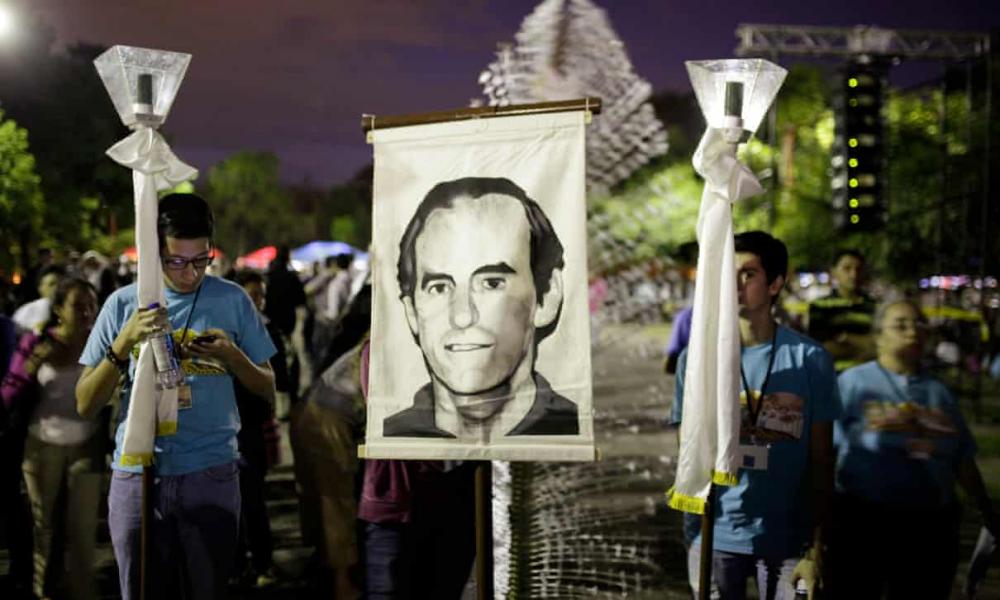
A 2014 procession in San Salvador commemorating the 25th anniversary of the massacre. The banner shows Father Ignacio Ellacuria. Photograph: Reuters
Or as Almudena Bernabéu, a Spanish human rights lawyer who helped build the case against Montano and get him extradited from the US, puts it: “It’s not just a crime that happened 30 years ago, it’s about what impunity really means.”
A verdict is expected this month. For Carlos, the trial has not been about revenge or hatred – “it wouldn’t really make any sense” – but about an end to that impunity.
Thirty long years have passed, but they have done nothing to lessen his love for his brother, nor his pride in Nacho’s social and intellectual achievements.
But the pain, like the love, lingers, and the photographs taken in the campus garden after the attack often creep into his mind.
“In the pictures, you can see Nacho very clearly, lying stretched out with the others in the Jesuits’ garden. With a mixture of horror and tenderness, I noticed that he was wearing one of the shirts my wife had ironed for him here in Madrid before he went back to El Salvador. It was a short-sleeved blue shirt.”
Carlos will always remember his brother as a man whose heart was rivalled in size only by his intelligence, and as a scholar and teacher who left behind an important body of work. But the photos have never left him and never will.
“They stir horror and love and point me back towards my childhood,” he says. “But I have moved forward and understood, with a deep sadness, how those soldiers cut him down. This is how I have lived my brother’s life and death. And I’m still living it.”
STOP treating this like a normal election!
https://www.youtube.com/watch?v=nIDsi5SARvo&feature=emb_logo
Inclusion of far-right candidates deepens gaps within Venezuelan opposition
https://www.youtube.com/watch?v=4AjLeENNykI
Subscribe to:
Comments (Atom)