Saturday, September 5, 2020
US PUNISHES ICC FOR INVESTIGATING POTENTIAL WAR CRIMES
By Susan M. Akram, The Conversation.
September 3, 2020
https://popularresistance.org/us-punishes-icc-for-investigating-potential-war-crimes/
The Trump administration has sought to weaken or abandon various international agencies since 2016. Now it’s taking aim at the International Criminal Court, a global tribunal that investigates and prosecutes war crimes, torture and genocide.
Claiming the ICC’s investigation into alleged war crimes by U.S. forces in Afghanistan poses a national security threat, President Donald Trump issued an executive order on June 11 effectively criminalizing anyone who works at the ICC. Its lawyers, judges, human rights researchers and staff could now have their U.S. bank accounts frozen, U.S. visas revoked and travel to the U.S. denied.
On Sept. 2, Sec. State Mike Pompeo announced the new sanctions would be applied for the first time, against ICC special prosecutor Fatou Bensouda and her top aide.
The executive order does not target U.S. citizens. But Americans can be sanctioned if they “materially support” the ICC by, say, filing an amicus brief to support a case. Such language usually applies to foreign terrorist organizations and their enablers – not human rights lawyers.
The retired Gen. Wesley Clark called Trump’s order a “tragic mistake” in foreign policy. He says the U.S. “has nothing to fear from the ICC,” which exists to deter and punish the kinds of atrocities committed by Germany and Japan during World War II.
I am an international human rights lawyer who has defended and advocated for victims of gross human rights violations in American courts and at the United Nations. For these people, the ICC is the only real means to hold their persecutors accountable, even if few of them will ever set foot in the court.
Brief History Of The ICC
The ICC is the only criminal court with near global jurisdiction.
Since its founding in 2002 in The Hague, it has successfully prosecuted over 40 high-ranking politicians, warlords and heads of state for genocide, war crimes and crimes against humanity. Those imprisoned include Thomas Lubanga, a warlord who recruited child soldiers and forced them to fight in the Democratic Republic of the Congo, and Bosco Ntaganda, convicted of rape, murder and sexual slavery in the same conflict.
The ICC also issues warrants for the arrests of leaders who’ve fled the court’s justice, such as Sudan’s Omar al-Bashir, who stands charged with genocide for the rape, killing and torture of civilians in Darfur. Fugitive suspects are prosecuted by the ICC if and when they are extradited to The Hague.
Occasionally, special war tribunals are established outside the ICC to prosecute specific cases in specific countries. Recently, a special international tribunal convicted a Hezbollah member for the 2005 assassination of Lebanese prime minister Rafik Hariri.
Together, the ICC and these complementary special tribunals enforce international human rights law. The ICC is a court of last resort. It acts only when national governments cannot or will not investigate and prosecute war crimes. Its jurisdiction is intentionally narrow. It means countries with a strong rule of law need not fear international investigation.
US Fearful Of International Justice
In the early 1990s, the U.S. was deeply involved in United Nations negotiations in the Rome Statute, the treaty that created the ICC. But in 1998 President Bill Clinton decided not to ask Congress to ratify the Rome Statute, claiming there was no protection against “politicized prosecutions.”
Despite not being one of the court’s 123 member countries, the U.S. has often facilitated the ICC’s work. Successive U.S. administrations have imposed a series of sanctions against people under ICC investigation, including members of the Assad regime suspected of committing war crimes in Syria.
The U.S. has also championed the ICC’s ongoing examination of crimes committed by the Taliban in Afghanistan and its investigation of Myanmar for possible genocide against the Rohingya Muslims. The U.S. also got involved in the hunt for the infamous Ugandan guerrilla leader Joseph Kony, who was indicted by the ICC in 2005 for using children as sex slaves and insurgents.
But some of the ICC’s newest cases hit close to home.
One is a pending investigation of American military actions in Afghanistan between 2003 and 2004. Dozens of people claim to have been tortured during interrogation by the CIA in “black sites” created by the Bush administration. Two current Guantanamo detainees, Sharqawi Al Hajj and Guled Duran, who are represented by legal counsel, have provided detailed testimonies to the ICC.
Another is the ICC’s investigation into possible crimes by Israel related to Jewish settlements in the West Bank and East Jerusalem. Israel, like its ally the U.S., is not a member of the ICC.
In May, Secretary of State Mike Pompeo warned the ICC to end its “illegitimate” probes into the U.S. and Israel or else face “consequences.”
Limited Jurisdiction
The ICC persisted, saying the U.S. could fend off the ICC by investigating the alleged war crimes itself.
“The I.C.C. is not intent on ‘hauling’ Americans up to trial before it,” wrote ICC president Eboe-Osujiin in a June 18 New York Times op-ed responding to Trump’s Executive Order. It is simply committed to seeing credible claims against U.S. security personnel in Afghanistan investigated, Eboe-Osuji said.
But the U.S., like Israel, has refused to acknowledge that war crimes may have been committed. Such standoffs trigger ICC involvement as the court of last resort.
Historically, the International Criminal Court has almost exclusively prosecuted individuals from weaker nations, primarily in Africa. Some critics have dubbed it the “African criminal court.” Yet most African countries, like other ICC members, remain supportive of the court’s work.
The ICC is also a slow, cumbersome and expensive form of justice. It has spent over US$1.2 billion over the past 12 years to successfully punish only three individuals of the dozens it has prosecuted.
But the court’s importance goes beyond its verdicts. Without its watchful eye and long arm, war criminals would roam free.
In undermining its work, the Trump administration claims to protect American security. But if the U.S. won’t cooperate with the ICC in international criminal investigations of its own citizens, other countries are less likely to help when the U.S. wants terrorists and war criminals brought to justice.

Marianne Williamson Tells Biden To Fire His Campaign Strategist
https://www.youtube.com/watch?v=_Q_wBofjDG0
POLICE FATALLY SHOOT MAN 20 TIMES AFTER SUSPECTED BIKE VIOLATION
By Lucy Nicholson and Steve Gorman, Reuters.
September 3, 2020
https://popularresistance.org/police-fatally-shoot-man-20-times-after-suspected-bike-violation/
Note: The context of this killing must be viewed in the context of a nation where approximately 1,000 people each year are killed by police and these people are disproportionately from communities of color. The Los Angeles Times reports:
“Since 2000, there have been nearly 900 killings by local police that were ruled a homicide by county medical examiners. Almost all of the dead were men, nearly 80% were black or Latino. More than 98% were shot to death.
“Criminal charges are rare. In nearly all cases, the use of force was deemed legally justified by the Los Angeles County district attorney’s office, which conducts an investigation into each incident. Since 2000, only two officers have been charged as a result of shooting a civilian while on duty.”
Both in the city of Los Angeles and nationally, there are constant reports of killings of Black and brown people by police. It is an epidemic police violence against civilians.
KZ
Los Angeles – A Black man who was stopped on his bicycle for an alleged “vehicle code” violation was shot to death by two Los Angeles sheriff’s deputies, who fired 15 to 20 rounds after the man punched one officer and dropped a pistol on the ground, authorities said on Tuesday.
A semiautomatic handgun apparently fell from a bundle of clothes that the man, identified as Dijon Kizzee, 29, had been clutching and dropped when he struck an officer in the face, said Lieutenant Brandon Dean, a Los Angeles County sheriff’s spokesman.
Dean said the two officers opened fire when Kizzee made “a motion that he’s going to pick up the firearm.”
“Whether the firearm was actually in his hand, if he was motioning towards it, I don’t have those specifics because we haven’t interviewed the actual deputies who were there yet,” Dean said.
Initial news of Monday afternoon’s shooting drew scores of angry demonstrators to the scene of the Westmont community on the southern edge of Los Angeles, becoming the latest flashpoint in a summer of protests over African-Americans killed at the hands of police.
“You don’t kill any race but us, and it don’t make any sense,” Fletcher Fair, Kizzee’s aunt, told reporters on Tuesday at the shooting scene, where activists called for an independent investigation by California’s attorney general.
A protest march was being organized for Tuesday evening by local activists from the Coalition for Community Control Over the Police.
Prominent civil rights attorney Ben Crump, who was retained to represent Kizzee’s family, posted on Twitter: “They say he ran, dropped clothes and a handgun. He didn’t pick it up, but cops shot him in the back 20+ times then left him for hours.”
A neighbor who said she watched the scuffle and the shooting that followed from her home directly across the street from the scene told Reuters on Tuesday that she never saw Kizzee throw a punch, never saw a gun, and that he “wasn’t a threat.”
Deja Roquemore, 31, said the two deputies kept firing at Kizzee even as he lay motionless, face down, on the ground.
“I watched him go from living, to dying to dead,” Roquemore said in a telephone interview. Roquemore, who is home during the day overseeing her 6-year-old’s online school lessons, said she was interviewed by investigators.
Dean told Reuters that the deputies, together, fired a total of 15 to 20 gunshots. He said Kizzee sustained several wounds to his upper torso, but the number of bullets that struck him would not be known until an autopsy was performed.
The two officers involved have been removed from patrol duty for the time being, he said.
According to Dean, events leading to the shooting began when the deputies saw a man, since identified as Kizzee, riding his bike “in violation of the vehicle code” and tried to stop him.
Kizzee jumped off his bike and darted away on foot, before the two officers caught up with him a short distance away, where the deadly encounter occurred.
In the version of events given by Roquemore, she said she witnessed Kizzee and one of the officers “tussling” over the clothes bundle before it fell to the ground.
At that point, she recounted, Kizzee threw both hands in the air, yelling, “I don’t have anything. What do you want?” before turning to run away. She said an officer then fired a Taser into Kizzee’s legs, and the two deputies gunned him down when he pivoted back toward them.
Dean denied that officers ever deployed a Taser, and he offered no explanation for the differing accounts.
Dean said he did not know what vehicle code Kizzee was suspected of violating. He told reporters on Monday: “It is not uncommon for deputies to conduct vehicle stops of bicycles. They have to adhere to the same rules of the road as a vehicle does.”
https://popularresistance.org/police-fatally-shoot-man-20-times-after-suspected-bike-violation/
Note: The context of this killing must be viewed in the context of a nation where approximately 1,000 people each year are killed by police and these people are disproportionately from communities of color. The Los Angeles Times reports:
“Since 2000, there have been nearly 900 killings by local police that were ruled a homicide by county medical examiners. Almost all of the dead were men, nearly 80% were black or Latino. More than 98% were shot to death.
“Criminal charges are rare. In nearly all cases, the use of force was deemed legally justified by the Los Angeles County district attorney’s office, which conducts an investigation into each incident. Since 2000, only two officers have been charged as a result of shooting a civilian while on duty.”
Both in the city of Los Angeles and nationally, there are constant reports of killings of Black and brown people by police. It is an epidemic police violence against civilians.
KZ
Los Angeles – A Black man who was stopped on his bicycle for an alleged “vehicle code” violation was shot to death by two Los Angeles sheriff’s deputies, who fired 15 to 20 rounds after the man punched one officer and dropped a pistol on the ground, authorities said on Tuesday.
A semiautomatic handgun apparently fell from a bundle of clothes that the man, identified as Dijon Kizzee, 29, had been clutching and dropped when he struck an officer in the face, said Lieutenant Brandon Dean, a Los Angeles County sheriff’s spokesman.
Dean said the two officers opened fire when Kizzee made “a motion that he’s going to pick up the firearm.”
“Whether the firearm was actually in his hand, if he was motioning towards it, I don’t have those specifics because we haven’t interviewed the actual deputies who were there yet,” Dean said.
Initial news of Monday afternoon’s shooting drew scores of angry demonstrators to the scene of the Westmont community on the southern edge of Los Angeles, becoming the latest flashpoint in a summer of protests over African-Americans killed at the hands of police.
“You don’t kill any race but us, and it don’t make any sense,” Fletcher Fair, Kizzee’s aunt, told reporters on Tuesday at the shooting scene, where activists called for an independent investigation by California’s attorney general.
A protest march was being organized for Tuesday evening by local activists from the Coalition for Community Control Over the Police.
Prominent civil rights attorney Ben Crump, who was retained to represent Kizzee’s family, posted on Twitter: “They say he ran, dropped clothes and a handgun. He didn’t pick it up, but cops shot him in the back 20+ times then left him for hours.”
A neighbor who said she watched the scuffle and the shooting that followed from her home directly across the street from the scene told Reuters on Tuesday that she never saw Kizzee throw a punch, never saw a gun, and that he “wasn’t a threat.”
Deja Roquemore, 31, said the two deputies kept firing at Kizzee even as he lay motionless, face down, on the ground.
“I watched him go from living, to dying to dead,” Roquemore said in a telephone interview. Roquemore, who is home during the day overseeing her 6-year-old’s online school lessons, said she was interviewed by investigators.
Dean told Reuters that the deputies, together, fired a total of 15 to 20 gunshots. He said Kizzee sustained several wounds to his upper torso, but the number of bullets that struck him would not be known until an autopsy was performed.
The two officers involved have been removed from patrol duty for the time being, he said.
According to Dean, events leading to the shooting began when the deputies saw a man, since identified as Kizzee, riding his bike “in violation of the vehicle code” and tried to stop him.
Kizzee jumped off his bike and darted away on foot, before the two officers caught up with him a short distance away, where the deadly encounter occurred.
In the version of events given by Roquemore, she said she witnessed Kizzee and one of the officers “tussling” over the clothes bundle before it fell to the ground.
At that point, she recounted, Kizzee threw both hands in the air, yelling, “I don’t have anything. What do you want?” before turning to run away. She said an officer then fired a Taser into Kizzee’s legs, and the two deputies gunned him down when he pivoted back toward them.
Dean denied that officers ever deployed a Taser, and he offered no explanation for the differing accounts.
Dean said he did not know what vehicle code Kizzee was suspected of violating. He told reporters on Monday: “It is not uncommon for deputies to conduct vehicle stops of bicycles. They have to adhere to the same rules of the road as a vehicle does.”
Protest in Front of Netanyahu's Residence in Jerusalem
youtube.com/watch?v=KE27Vn9VuQs&ab_channel=Sputnik
Working In These Times--links to articles
Hello my friends,
Happy almost Labor Day. The state of things for working people is—I’m not going to sugar coat this—bad. Hey, it is statistically likely that next year will be somewhat better, probably! We must all find strength in solidarity now. The best way to do that? By making sure you have signed up for the In These Times 44th anniversary celebration, “Labor Power in a Time of Crisis,” happening online September 12.
See you there. And now the news.
This Week in Working

Why Every Job in the Renewable Energy Industry Must Be a Union Job
By Mindy Isser
In order to get unions on board with green jobs, the environmental movement will have to fight for those jobs to be union. And unions will have to loosen their grip on fossil fuels in an effort to embrace renewables.
A Brief History of the U.S. Government’s Targeting of Left-Wing Immigrants
By Shaun Richman
A new book by lawyer and historian Julia Rose Kraut, Threat of Dissent: A History of Ideological Exclusion and Deportation in the United States, comprehensively lays out America’s long history of using the denial—and even the threatened removal—of citizenship in order to restrict some forms of political action.
In California, a “Labor Slate” Aims to Redefine the Relationship Between Unions and Politics
By Hamilton Nolan
A new grassroots group of union activists has recruited a slate of candidates to run for local positions in the Bay Area—all backing a labor-centric platform. They hope to be a model for a larger move into union-friendly political power not beholden to one of the two main parties.
The Working People Podcast
Cops—Labor: Which Side Are You On? (w/ Kim Kelly, Halimat Alawode, & Julia Wallace): Working People closes out Season Three with a critical discussion about why cops have no place in the labor movement and about the rank-and-file push from groups like No Cop Unions (AFL-CIO) and Drop the Cops (SEIU) to get them out. Listen here.
The Big Issue: Labor Day
For Labor Day, everyone who writes about Labor in America is legally required to publish a long and ponderous essay with a title like “What Labor Must Do to Turn Things Around.” I will skip that this year (you can just reread all the ones from past years, they never seem to change very much) and just say:
If you work at a non-union workplace, unionize it. (If you need help getting in touch with a union organizer, try here, or ask me.)
If you have a union, get involved with it. If your union sucks, take it over. If your union is weak, make it hardcore. A union is as good as you make it.
If you cannot unionize, go talk to your coworkers next week—not just about what is bad at work, but how you can work together to deal with the boss to fix it. You do the work. Without you all, there is no business.
And don’t do any work on Labor Day, if you can help it.
Labor News This Week
A funny thing that happened this week was that Amazon got exposed for spying on its employees online and also for putting up a job ad seeking a spy to keep tabs on internal worker organizing and then immediately had to be like “Uh, that’s canceled, we don’t do that any more.” Yeah right. Someone please take Jeff Bezos’s money away.
A new study from Rutgers about wage theft finds that “For each percentage point increase in a state’s unemployment rate, there was almost a full percentage point increase in the probability that a worker would experience a minimum wage violation.”
The union representing the workers of the ACLU in Kansas says that the ACLU has suspended the staff’s unit chair in an act of retaliation against the union. Unbelievable.
Also, employees at Surly Brewing Co. in Minneapolis say that the company has laid off more than 100 of them in an act of retaliation for unionizing.
If your employer is considering layoffs, grab them by their lapels and MAKE SURE THEY HAVE CONSIDERED WORK SHARE ARRANGEMENTS FIRST.
As companies force their employees to stand in line for various security checks before and after their work shifts, we are still, incredibly, fighting over the question: Do companies need to pay their employees for all of the time they make them do stuff? (Yes.)
Unionized workers are more likely to be able to have safe workplaces. Unionize your workplace.
The union-backed government airline bailout, that has kept airline workers on the payroll since the pandemic began, is set to expire at the end of this month, and airline unions say they need it to be extended, or the industry will face an unemployment catastrophe. This is the program that the government should have given to every industry. And still can!
The podcast studio Parcast has unionized with the Writers Guild of America East, meaning the WGAE now has organized three Spotify-owned podcast companies. Yeah baby … the future.
New York City’s teachers union gestured at a credible strike threat over the city’s inadequate and unsafe plans to reopen schools, and the city has delayed reopening by weeks. Strikes work.
Final Thought
“Bullying creates a moral drama in which the manner of the victim’s reaction to an act of aggression can be used as retrospective justification for the original act of aggression itself.” —David Graeber, RIP
For Years, Journalists Cheered Assange’s Abuse. Now They’ve Paved His Path To a US Gulag
Jonathan Cook September 3, 2020
https://citizentruth.org/for-years-journalists-cheered-assanges-abuse-now-theyve-paved-his-path-to-a-us-gulag/
Journalists had a chance to join Assange in his struggle to rebuild journalism. Instead, they fled the battlefield, leaving him as a sacrificial offering to their corporate masters.
(Common Dreams) Court hearings in Britain over the US administration’s extradition case against Julian Assange begin in earnest next week. The decade-long saga that brought us to this point should appall anyone who cares about our increasingly fragile freedoms.
A journalist and publisher has been deprived of his liberty for 10 years. According to UN experts, he has been arbitrarily detained and tortured for much of that time through intense physical confinement and endless psychological pressure. He has been bugged and spied on by the CIA during his time in political asylum, in Ecuador’s London embassy, in ways that violated his most fundamental legal rights. The judge overseeing his hearings has a serious conflict of interest—with her family embedded in the UK security services—that she did not declare and which should have required her to recuse herself from the case.
All indications are that Assange will be extradited to the US to face a rigged grand jury trial meant to ensure he sees out his days in a maximum-security prison, serving a sentence of up to 175 years.
None of this happened in some Third-World, tinpot dictatorship. It happened right under our noses, in a major western capital, and in a state that claims to protect the rights of a free press. It happened not in the blink of an eye but in slow motion—day after day, week after week, month after month, year after year.
And once we strip out a sophisticated campaign of character assassination against Assange by western governments and a compliant media, the sole justification for this relentless attack on press freedom is that a 49-year-old man published documents exposing US war crimes. That is the reason—and the only reason—that the US is seeking his extradition and why he has been languishing in what amounts to solitary confinement in Belmarsh high-security prison during the Covid-19 pandemic. His lawyers’ appeals for bail have been refused.
Severed head on a pike
While the press corps abandoned Assange a decade ago, echoing official talking points that pilloried him over toilet hygiene and his treatment of his cat, Assange is today exactly where he originally predicted he would be if western governments got their way. What awaits him is rendition to the US so he can be locked out of sight for the rest of his life.
There were two goals the US and UK set out to achieve through the visible persecution, confinement, and torture of Assange.
First, he and Wikileaks, the transparency organization he co-founded, needed to be disabled. Engaging with Wikileaks had to be made too risky to contemplate for potential whistleblowers. That is why Chelsea Manning—the US soldier who passed on documents relating to US war crimes in Iraq and Afghanistan for which Assange now faces extradition—was similarly subjected to harsh imprisonment. She later faced punitive daily fines while in jail to pressure her into testifying against Assange.
The aim has been to discredit Wikileaks and similar organizations and stop them from publishing additional revelatory documents—of the kind that show western governments are not the “good guys” managing world affairs for the benefit of mankind, but are in fact highly militarized, global bullies advancing the same ruthless colonial policies of war, destruction, and pillage they always pursued.
And second, Assange had to be made to suffer horribly and in public—to be made an example of—to deter other journalists from ever following in his footsteps. He is the modern equivalent of a severed head on a pike displayed at the city gates.
The very obvious fact—confirmed by the media coverage of his case—is that this strategy, advanced chiefly by the US and UK (with Sweden playing a lesser role), has been wildly successful. Most corporate media journalists are still enthusiastically colluding in the vilification of Assange—mainly at this stage by ignoring his awful plight.
Story hiding in plain sight
When he hurried into Ecuador’s embassy back in 2012, seeking political asylum, journalists from every corporate media outlet ridiculed his claim—now, of course, fully vindicated—that he was evading US efforts to extradite him and lock him away for good. The media continued with their mockery even as evidence mounted that a grand jury had been secretly convened to draw up espionage charges against him and that it was located in the eastern district of Virginia, where the major US security and intelligence services are headquartered. Any jury there is dominated by US security personnel and their families. His hope of a fair trial was non-existent.
Instead, we have endured eight years of misdirection by the corporate media and its willing complicity in his character assassination, which has laid the ground for the current public indifference to Assange’s extradition and widespread ignorance of its horrendous implications.
Corporate journalists have accepted, entirely at face value, a series of rationalizations for why the interests of justice have been served by locking Assange away indefinitely—even before his extradition—and trampling his most basic legal rights. The other side of the story—Assange’s, the story hiding in plain sight—has invariably been missing from the coverage, whether it has been CNN, the New York Times, the BBC or the Guardian.
From Sweden to Clinton
First, it was claimed that Assange had fled questioning over sexual assault allegations in Sweden, even though it was the Swedish authorities who allowed him to leave; even though the original Swedish prosecutor, Eva Finne, dismissed the investigation against him, saying “There is no suspicion of any crime whatsoever,” before it was picked up by a different prosecutor for barely concealed, politicized reasons; and even though Assange later invited Swedish prosecutors to question him where he was (in the embassy), an option they regularly agreed to in other cases but resolutely refused in his.
It was not just that none of these points was ever provided as context for the Sweden story by the corporate media. Or that much else in Assange’s favor was simply ignored, such as tampered evidence in the case of one of the two women who alleged sexual assault and the refusal of the other to sign the rape statement drawn up for her by police.
The story was also grossly and continuously misreported as relating to “rape charges” when Assange was wanted simply for questioning. No charges were ever laid against him because the second Swedish prosecutor, Marianne Ny—and her British counterparts, including Sir Keir Starmer, then head of the prosecution service and now leader of the Labour party—seemingly wished to avoid testing the credibility of their allegations by actually questioning Assange. Leaving him to rot in a small room in the embassy served their purposes much better.
When the Sweden case fizzled out—when it became clear that the original prosecutor had been right to conclude that there was no evidence to justify further questioning, let alone charges—the political and media class shifted tack.
Suddenly Assange’s confinement was implicitly justified for entirely different, political reasons – because he had supposedly aided Donald Trump’s presidential election campaign in 2016 by publishing emails, allegedly “hacked” by Russia, from the Democratic party’s servers. The content of those emails, obscured in the coverage at the time and largely forgotten now, revealed corruption by Hillary Clinton’s camp and efforts to sabotage the party’s primaries to undermine her rival for the presidential nomination, Bernie Sanders.
Guardian fabricates a smear
Those on the authoritarian right have shown little concern over Assange’s lengthy confinement in the embassy, and later jailing in Belmarsh, for his exposure of US war crimes, which is why little effort has been expended on winning them over. The demonization campaign against Assange has focused instead on issues that are likely to trigger liberals and the left, who might otherwise have qualms about jettisoning the First Amendment and locking people up for doing journalism.
Just as the Swedish allegations, despite their non-investigation, tapped into the worst kind of kneejerk identity politics on the left, the “hacked” emails story was designed to alienate the Democratic party base. Extraordinarily, the claim of Russian hacking persists even though years later—and after a major “Russiagate” inquiry by Robert Mueller—it still cannot be stood up with any actual evidence. In fact, some of those closest to the matter, such as former UK ambassador Craig Murray, have insisted all along that the emails were not hacked by Russia but were leaked by a disenchanted Democratic party insider.
An even more important point, however, is that a transparency organization like Wikileaks had no choice, after it was handed those documents, but to expose abuses by the Democratic party—whoever was the source.
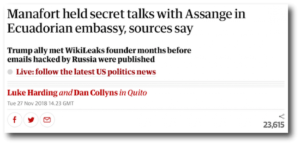
The reason that Assange and Wikileaks became entwined in the Russiagate fiasco—which wasted the energies of Democratic party supporters on a campaign against Trump that actually strengthened rather than weakened him—was because of the credulous coverage, once again, of the issue by almost the entire corporate media. Liberal outlets like the Guardian newspaper even went so far as to openly fabricate a story—in which it falsely reported that a Trump aide, Paul Manafort, and unnamed “Russians” secretly visited Assange in the embassy—without repercussion or retraction.
Assange’s torture ignored
All of this made possible what has happened since. After the Swedish case evaporated and there were no reasonable grounds left for not letting Assange walk free from the embassy, the media suddenly decided in chorus that a technical bail violation was grounds enough for his continuing confinement in the embassy—or, better still, his arrest and jailing. That breach of bail, of course, related to Assange’s decision to seek asylum in the embassy, based on a correct assessment that the US planned to demand his extradition and imprisonment.
None of these well-paid journalists seemed to remember that, in British law, failure to meet bail conditions is permitted if there is “reasonable cause”—and fleeing political persecution is very obviously just such a reasonable cause.
Similarly, the media willfully ignored the conclusions of a report by Nils Melzer, a Swiss scholar of international law and the United Nations’ expert on torture, that the UK, US, and Sweden had not only denied Assange his basic legal rights but had colluded in subjecting him to years of psychological torture – a form of torture, Melzer has pointed out, that was refined by the Nazis because it was found to be crueler and more effective at breaking victims than physical torture.
Assange has been blighted by deteriorating health and cognitive decline as a result, and has lost significant weight. None of that has been deemed worthy by the corporate media of more than a passing mention—specifically when Assange’s poor health made him incapable of attending a court hearing. Instead, Melzer’s repeated warnings about the abusive treatment of Assange and its effects on him have fallen on deaf ears. The media has simply ignored Melzer’s findings, as though they were never published, that Assange has been, and is being, tortured. We need only pause and imagine how much coverage Melzer’s report would have received had it concerned the treatment of a dissident in an official enemy state like Russia or China.
A power-worshipping media
Last year British police, in coordination with an Ecuador now led by a president, Lenin Moreno, who craved closer ties with Washington, stormed the embassy to drag Assange out and lock him up in Belmarsh prison. In their coverage of these events, journalists again played dumb.
They had spent years first professing the need to “believe women” in the Assange case, even if it meant ignoring evidence, and then proclaiming the sanctity of bail conditions, even if they were used simply as a pretext for political persecution. Now that was all swept aside in an instant. Suddenly Assange’s nine years of confinement over a non-existent sexual assault investigation and a minor bail infraction were narratively replaced by an espionage case. And the media lined up against him once again.
A few years ago the idea that Assange could be extradited to the US and locked up for the rest of his life, his journalism recast as “espionage”, was mocked as so improbable, so outrageously unlawful that no “mainstream” journalist was prepared to countenance it as the genuine reason for his seeking asylum in the embassy. It was derided as a figment of the fevered, paranoid imaginations of Assange and his supporters, and as a self-serving cover for him to avoid facing the investigation in Sweden.
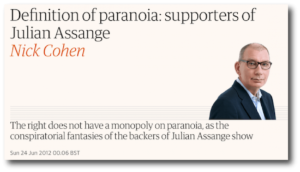
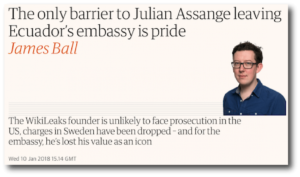 But when British police invaded the embassy in April last year and arrested him for extradition to the US on precisely the espionage charges Assange had always warned were going to be used against him, journalists reported these developments as though they were oblivious to this backstory. The media erased this context not least because it would have made them look like willing dupes of US propaganda, like apologists for US exceptionalism and lawlessness, and because it would have proved Assange right once more. It would have demonstrated that he is the real journalist, in contrast to their pacified, complacent, power-worshipping corporate journalism.
The death of journalism
Right now every journalist in the world ought to be up in arms, protesting at the abuses Assange is suffering, and has suffered, and the fate he will endure if extradition is approved. They should be protesting on front pages and in TV news shows against the endless and blatant abuses of legal process at Assange’s hearings in the British courts, including the gross conflict of interest of Lady Emma Arbuthnot, the judge overseeing his case.
They should be in uproar at the surveillance the CIA illegally arranged inside the Ecuadorian embassy while Assange was confined there, nullifying the already dishonest US case against him by violating his client-lawyer privilege. They should be expressing outrage at Washington’s maneuvers, accorded a thin veneer of due process by the British courts, designed to extradite him on espionage charges for doing work that lies at the very heart of what journalism claims to be—holding the powerful to account.
Journalists do not need to care about Assange or like him. They have to speak out in protest because approval of his extradition will mark the official death of journalism. It will mean that any journalist in the world who unearths embarrassing truths about the US, who discovers its darkest secrets, will need to keep quiet or risk being jailed for the rest of their lives.
That ought to terrify every journalist. But it has had no such effect.
Careers and status, not truth
The vast majority of western journalists, of course, never uncover one significant secret from the centers of power in their entire professional careers—even those ostensibly monitoring those power centers. These journalists repackage press releases and lobby briefings, they tap sources inside government who use them as a conduit to the large audiences they command, and they relay gossip and sniping from inside the corridors of power.
That is the reality of access journalism that constitutes 99 percent of what we call political news.
Nonetheless, Assange’s abandonment by journalists—the complete lack of solidarity as one of their number is persecuted as flagrantly as dissidents once sent to the gulags—should depress us. It means not only that journalists have abandoned any pretense that they do real journalism, but that they have also renounced the aspiration that it be done by anyone at all.
It means that corporate journalists are ready to be viewed with even greater disdain by their audiences than is already the case. Because through their complicity and silence, they have sided with governments to ensure that anyone who truly holds power to account, like Assange, will end up behind bars. Their own freedom brands them as a captured elite—irrefutable evidence that they serve power, they do not confront it.
The only conclusion to be drawn is that corporate journalists care less about the truth than they do about their careers, their salaries, their status, and their access to the rich and powerful. As Ed Herman and Noam Chomsky explained long ago in their book Manufacturing Consent, journalists join a media class after lengthy education and training processes designed to weed out those not reliably in sympathy with the ideological interests of their corporate employers.
A sacrificial offering
Briefly, Assange raised the stakes for all journalists by renouncing their god—“access”—and their modus operandi of revealing occasional glimpses of very partial truths offered up by “friendly”, and invariably anonymous, sources who use the media to settle scores with rivals in the centers of power.
Instead, through whistleblowers, Assange rooted out the unguarded, unvarnished, full-spectrum truth whose exposure helped no one in power—only us, the public, as we tried to understand what was being done, and had been done, in our names. For the first time, we could see just how ugly, and often criminal, the behavior of our leaders was.
Assange did not just expose the political class, he exposed the media class too—for their feebleness, for their hypocrisy, for their dependence on the centers of power, for their inability to criticize a corporate system in which they were embedded.
Few of them can forgive Assange that crime. Which is why they will be there cheering on his extradition, if only through their silence. A few liberal writers will wait till it is too late for Assange, till he has been packaged up for rendition, to voice half-hearted, mealy-mouthed or agonized columns arguing that, unpleasant as Assange supposedly is, he did not deserve the treatment the US has in store for him.
But that will be far too little, far too late. Assange needed solidarity from journalists and their media organizations long ago, as well as full-throated denunciations of his oppressors. He and Wikileaks were on the front line of a war to remake journalism, to rebuild it as a true check on the runaway power of our governments. Journalists had a chance to join him in that struggle. Instead, they fled the battlefield, leaving him as a sacrificial offering to their corporate masters.
Socialist Appeal weekly bulletin
Welcome to the latest Socialist Appeal weekly bulletin, with the highlights of this week's news and analysis from www.socialist.net.
Boris Johnson's Tory government is one of chaos and crisis: unable to control the virus; forced to U-turn over exam grading and evictions; and presiding over a sharp economic collapse.
On top of this, a tsunami of job cuts and austerity lies ahead for the working class. As the economic life support is removed, a deep depression looms. We are facing an unparalled crisis of the capitalist system.
Instead of providing a real opposition, Keir Starmer is siding with the Tories, condemning Black Lives Matter activists, and paying off right-wing saboteurs.
This is why we need to build a strong Marxist organisation - in the labour movement and on the streets. We therefore urge all our readers to join us today in the fight for socialism.
We are also proud to invite readers to Revolution 2020 - a three-day festival of Marxist ideas, hosted online and across Britain from 23-25 October. Buy your ticket now for this exciting and inspiring festival - and join the revolution!
The latest issue of the paper (no. 334) is out now, with articles on: The Corbyn movement - 5 years on; BLM and the shooting of Jacob Blake; Unison general secretary elections; and much much more.
Support the struggle for socialism - subscribe today to Socialist Appeal and make a donation to our special financial appeal.
DONATE

LATEST
A world gripped in crisis

Socialist Appeal Editorial Board
There are no parallels to the current chaos wreaking havoc on society. This is no normal capitalist crisis. Revolutionary developments are exploding to the surface across the world. We need a leadership that is up to the task.
Read more
The socialist case against 'lesser-evil” politics

Socialist Revolution Editorial Board
Elections are approaching in the USA, and voters are faced with the dire 'choice' of Trump or Biden. Neither will serve the interests of the working class. Workers must mobilise to kick out Trump and kick out capitalism!
Read more
The Tories and the migrant crisis: A divisive distraction

Scott Shaw
Desperate to avoid poverty and war, thousands of migrants are risking their lives attempting to reach Britain by boat. The Tories are cynically exploiting this crisis to distract from their own chaos at home. Capitalism is horror without end.
Read more
A reply to Richard Burgon: No half-measures – We need socialism!

Joe Attard
Left-wing MP Richard Burgon recently outlined a 10-point policy proposal to galvanise the left. But the Keynesian ideas put forward are not enough. We need to mobilise workers and youth around bold socialist demands.
Read more
Subscribe to:
Comments (Atom)