Thursday, September 3, 2020

DOCUMENTARY – THE WAR ON JOURNALISM: THE CASE OF JULIAN ASSANGE


https://www.youtube.com/watch?v=90OIGGpfHDo&ab_channel=StoptheWarCoalition


Heartbreaking: Millions of Families Facing Eviction While Politicians Take Care of Wall Street


https://www.youtube.com/watch?v=-CW_pKwMYCI
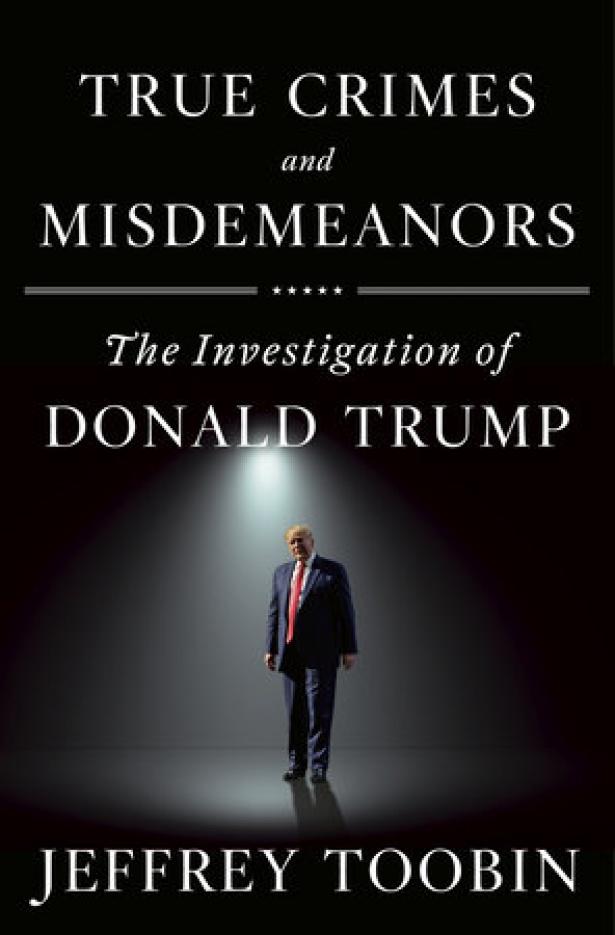

True Crimes


Reviewer Elving describes this book as "a condensation of the best evidence against the presidency and character of Donald Trump, a summation offered up much as a prosecutor would do in seeking to sway a jury."

September 2, 2020 Ron Elving NPR


https://portside.org/2020-09-02/true-crimes


True Crimes and Misdemeanors

The Investigation of Donald Trump
Jeffrey Toobin
Doubleday
ISBN 9780385536738

At some point in the future, it is entirely possible that the full details of Donald Trump's business affairs, personal imbroglios and political maneuverings will be laid bare to the public. Should that happen, it is easy to imagine much of the world wondering how the man got away with so much for so long.

In that hour, readers may well turn to True Crimes and Misdemeanors: The Investigation of Donald Trump. This tome by Jeffrey Toobin, the longtime CNN legal analyst and contributor to The New Yorker, analyzes Trump's survival in the face of two major investigations during his first years in the presidency. It also asks whether the magic charm that saw Trump through these travails will suffice for him to survive the coronavirus pandemic.

This 450-page work is more than a journalist emptying his notebook of all his interviews and insights. It is more than a legal expert analyzing how the best work of talented and committed lawyers could be frustrated by governmental rules and rivalries within the executive and legislative powers in our federal system.

Perhaps its highest function is as a condensation of the best evidence against the presidency and character of Donald Trump, a summation offered up much as a prosecutor would do in seeking to sway a jury.

Few who are familiar with Toobin's career, or his previous seven books about law and power, will be surprised that he finds fault with Special Counsel Robert Mueller's two-year investigation of Trump and the extensive interference by Russian operatives in the 2016 election.

"Mueller's caution and reticence led him to fail at his two most important tasks," Toobin writes. "Thanks to the clever actions (and strategic inaction) of Trump's legal team, Mueller failed to obtain a meaningful interview with Trump himself. Even worse, Mueller convinced himself — wrongly — that he had to write a final report that was nearly incomprehensible to ordinary citizens in its legal conclusions."

Worst of all, Toobin contends, the form and manner of Mueller's report played directly into the hands of Mueller's immediate boss, Attorney General William Barr, who was able to suppress the document and distort it as a total exoneration of the president.

In the end, of course, Toobin concedes he faces the same dilemma as Mueller himself. There's a wealth of evidence indicating the Russians strove mightily to interfere in the 2016 election and did so with a conscious wish of defeating Hillary Clinton and electing Donald Trump. Moreover, the Trump campaign's response was to be fascinated, intrigued. "Certainly Mueller found abundant evidence that Trump and his campaign wanted to collude and conspire with Russia," Toobin says, "but they hadn't been able to close the deal."

Yet the best admissible evidence Mueller or Toobin could find suggests the Russians did their thing and Trump's campaign did its own. They may have shared goals, but there was not enough beyond that to sustain a charge of conspiracy in a court of law.

There may have been a far clearer case for charging Trump with obstruction of justice, as he attempted several times to have someone fire Mueller and end the special counsel's investigation. There were also indications that pardons were being dangled to persuade Manafort and others not to "flip" and testify against the president. But without an actual firing of the special counsel or the actual granting of pardons, Mueller had less to work with.

Complicating all this was the decades-old policy of the Justice Department saying that a president could not be indicted while in office. This was a relic of the 1970s era when President Richard Nixon was on the brink of impeachment, a legal opinion rendered by the department's Office of Legal Counsel (OLC) and never repudiated.

Whatever the legal merits of the OLC policy itself, Toobin is dismayed that Mueller took it a step further. Mueller's report clearly stated that it was not exonerating the president, adding that it would have done so if the evidence supported exoneration. Yet Mueller refused to say explicitly that he was only withholding an indictment because of the OLC-imposed ban. Instead, Mueller insisted that such an "if only I could" statement, in the absence of an actual indictment, would leave the president standing accused de facto with no means of clearing his name.

Toobin tells us this attitude, combined with Mueller's studied air of dispassion and detachment, left the prodigious work product of the special counsel's team vulnerable to misinterpretation and dismissal. And that was precisely what happened. Barr, who had denounced Mueller's investigation almost from the moment it began (when Barr was still a private citizen), received Mueller's report and called it total exoneration. Mueller raised mild objections in a statement, but the president and his supporters celebrated and never looked back.

But Toobin is not writing exclusively about the Mueller saga, as he segues in the book's later chapters to the subsequent scandal and impeachment trial over Trump's dealings with Ukraine. The shift is foreshadowed when Trump's former campaign chairman, Paul Manafort, is convicted of tax evasion and bank fraud based on his alliances with pro-Russian factions in Ukraine. Even after agreeing to cooperate with federal authorities, Manafort is still adjudged to be lying to protect those connections.

We also see Rudy Giuliani, former mayor of New York and presidential candidate, traveling to Ukraine to collect dirt on the son of Joe Biden, a probable Democratic candidate against Trump at the time. Soon we have Trump himself calling the president of Ukraine and speaking of military aid to that country in the same breath with his personal desire for an investigation of the Bidens. The rest, as we know, is history. The phone call led to Trump's becoming the third president in history to be impeached.

Ultimately, Trump was acquitted in the Senate, so the impeachment process came up as empty as Mueller's probe. Yet Toobin is far more respectful of the managers of impeachment, starting with Speaker Nancy Pelosi, who is nearly always described in magisterial terms. Toobin is also impressed with Adam Schiff, the Southern California congressman featured in the impeachment proceedings in the House and Senate.

But no amount of evidence or lawyering was enough to break the phalanx of the Republican majority's resistance in the Senate. With the lone exception of Mitt Romney of Utah, every member of the president's party voted for acquittal.

There is a great deal of detail amassed here that even hardcore Trump investigation junkies will not have seen. Much of it has to do with behind-the-scenes strategizing and negotiating by the myriad lawyers involved on all sides — the FBI, Mueller's team, the White House, other executive offices and both parties in both chambers of Congress. Toobin is fascinated not only by the language of, say, the impeachment articles themselves, but by the individuals who drafted them, reviewed them or lent their imprimatur.

In fact, while True Crimes offers a one-stop catalog of the legal proceedings surrounding the Trump presidency, it can also be read as a who's who of the legal profession in Washington and New York. More than a dozen key attorneys each rate pages of description and detailed narrative, while dozens more make cameo appearances or get drive-by mentions.

Many will recognize the main names, but most have mercifully forgotten the likes of Michael Avenatti, the lawyer for porn star Stormy Daniels' suit against Trump. Most of us had also forgotten the early phases of Trump's negotiations with Mueller that were handled by the likes of Ty Cobb and John Dowd. Later we meet Jay Sekulow, who plays a role in both the Mueller matter and the impeachment struggle and continues to represent Trump in current cases. Toobin has plenty to say about them all.

One attorney after another appears, like Shakespeare's "poor player who struts and frets his hour upon the stage and is heard no more." In a few cases, these players continue strutting and fretting right out the back end of the book and remain very much in the news today. One such is Michael Cohen, one of a host of Trump's personal lawyers who seem willing to do anything for him. Cohen gets caught up in Mueller's web, handed off to the U.S. Attorney in New York City for prosecution on unrelated crimes and then sent to jail on an ill-advised and poorly rewarded guilty plea. Cohen has recently been in and out of prison, and is now at work on what is touted to be an explosive tell-all.

We also hear Trump bellowing "Where's my Roy Cohn?" –- a familiar wail to those who have tried in vain to please him on legal matters. Cohn advised Trump and his father on a federal discrimination-in-housing case in the 1970s and later became a kind of mentor for the younger Trump. Cohn was also known for his work for red-baiting Sen. Joseph McCarthy and later for various figures from organized crime.

Another intriguing figure highlighted at length is Donald McGahn, who was chairman of the Federal Election Commission and then a campaign law advisor to Trump before becoming his first White House attorney. McGahn is an unusually colorful figure, known for his lead guitar work with a cover band in East Coast rock clubs as well as for being a partner in the nationally eminent law firm of Jones Day. McGahn had some 30 hours of interviews with Mueller's team, souring his relationship with the president and leading to a quiet departure from the White House (he called it his "Irish exit").

It is a notable irony that while Toobin expressed disappointment with Mueller's key decisions, he always describes Mueller himself in terms of respect that border on reverence. His treatment of Giuliani the person, by contrast, is critical to the point of contempt. He finds some of Giuliani's TV appearances cringe-worthy, as when he tells NBC's Chuck Todd: "Truth isn't truth."

Yet he tips his professional cap to Giuliani the lawyer, saying "his methods had been unconventional, to be sure, but his public advocacy for Trump had transformed Robert Mueller's image from that of a revered public servant into that of just another partisan actor." Beyond that, Toobin credits Giuliani's leadership when the Trump team avoids an interview with Mueller and negotiates "a nearly risk-free substitute of written questions and answers, only about the campaign period."

Toobin is often most respectful of people such as Marie Yovanovitch and William Taylor, ambassadors who represented the U.S. in Ukraine and held out against White House pressure. Their testimony was key to the House hearings on impeachment, as was that of former Army Lt. Col. Alexander Vindman. Each of these witnesses has paid a professional price for telling what they knew of Trump and the ways he deals with business rivals, political opponents, critical journalists, former wives and associates and employees and, yes, even foreign leaders.

Most of what is new here is at the level of detail. The broad outlines and the key quotations from the Mueller saga and from the subsequent impeachment and trial of the president have been the stuff of nightly news, daily papers and constant Twitter feeds for years.

But Toobin has gathered such a weight of evidence and such a chorus of witnesses that his summation is more damning than the sum of its parts. By integrating the Russian interference story with all the twists and turns of Trump's defensive moves and the segue to the Ukraine arms-for-favors deal, Toobin presents a persuasive summation to the jury of his readers.

Lebanon struggles to rebuild after Beirut blasts


https://www.youtube.com/watch?v=oF99u7Vg6jQ


It Has Come to This: Ignore the C.D.C.


The agency’s new guidelines are wrong, so states have to step up on their own to suppress the coronavirus.

September 2, 2020 Harold Varmus and Rajiv Shah THE NEW YORK TIMES


https://portside.org/2020-09-02/it-has-come-ignore-cdc

We were startled and dismayed last week to learn that the Centers for Disease Control and Prevention, in a perplexing series of statements, had altered its testing guidelines to reduce the testing of asymptomatic people for the coronavirus.

These changes by the C.D.C. will undermine efforts to end the pandemic, slow the return to normal economic, educational and social activities, and increase the loss of lives.

Like other scientists and public health experts, we have argued that more asymptomatic people, not fewer, need to be tested to bring the pandemic under control. Now, in the face of a dysfunctional C.D.C., it’s up to states, other institutions and individuals to act.

Understanding what needs to be done requires understanding the different purposes of testing. Much of the current testing is diagnostic. People should get tested if they have symptoms — respiratory distress, loss of smell, fever. There is no argument about this testing, and the altered C.D.C. guidelines do not affect it.

But under its revised guidelines, the C.D.C. seeks to dissuade people who are asymptomatic from being tested. Yet this group poses both the greatest threat to pandemic control and the greatest opportunity to bring the pandemic to an end. It is with this group that our country has failed most miserably.

Consider the logic. Without tests or a highly effective vaccine, the only certain way to prevent further spread of the virus would be to isolate everyone from everyone else. In theory, this would work, but it is untenable — if not impossible — because of the economic and social consequences of shutdowns.

Tests, however, can reduce the number of people who need to be isolated — and only for as long as they are shown to be infected. If those tests were to be performed frequently (even daily) and widely (even universally), it is almost certain that the pandemic would evaporate in just a few weeks.

That much diagnostic testing is not feasible, given the costs and logistics, as well as the likelihood that some would refuse to comply.

So it makes sense to modulate the strategy by testing those who are at greatest risk of infection, and those who are most likely to spread the virus if they become infected.

We can make well-informed predictions about those who should be given priority. Most obviously, testing is essential for those who are known to have been significantly exposed to an infected person, as determined by “contact tracing.” But testing is also important for those who have been or will soon be mixing with large groups in close quarters at work; entering the schools and colleges that are now reopening; and attending public events like concerts and sports matches.

The financial and other practical demands of widespread testing can be lowered by making rational decisions about the optimal times for performing the tests — a few days after being in contact with an infected person, for instance, or just before congregating with many others.

The logistics and costs can be further reduced by simplifying the tests — using saliva samples collected at home, rather than uncomfortable nasal swabs that require trained personnel at specific locations; or by using so-called antigen tests, a cheap and rapid method to look for viral proteins, rather than expensive laboratory machines to find viral RNA. Even if these tests are a bit less accurate, their lower cost, higher speed and more frequent use make up for it.

Some of these new methods have already been authorized for use by the Food and Drug Administration. And the Department of Health and Human Services has also committed to purchasing large quantities of antigen tests.

These are practical and essential actions that need to be taken now. In the absence of sensible guidance from the C.D.C., what can the country do to control the pandemic? We urge at least three actions.


State and local leaders should be emboldened to act independently of the federal government and do more testing. Some governors and local public health officials, from both parties, are already doing so and are ignoring the C.D.C.’s revisions. This position is legally sound, since the C.D.C. is an advisory agency, not a regulatory one. Still, such discord undermines confidence in public health directives.


Insurance companies, city and state governments, and the Center for Medicare and Medicaid Services should recognize the economic and health benefits of testing prioritized, asymptomatic populations and provide reasonable reimbursement for these tests. A major impediment to more widespread testing has been the lack of coverage in the absence of symptoms or known contacts with infected individuals. The costs of testing are decreasing as new methods, like antigen testing, are introduced, and may be further reduced as the pooling of samples makes testing more efficient.


While more widespread testing for the virus is an essential factor in pandemic control, we need to make it part of a broad program that helps prevent transmission — mask-wearing, hand-washing, quarantining and use of personal protective equipment.

The C.D.C., the federal agency that should be crushing the pandemic, is promoting policies that prolong it. That means that local, state and organizational leaders will have to do what the federal government won’t.

Nancy Pelosi Makes INSANE claim that she was 'set up' by San Francisco hair salon


https://www.youtube.com/watch?v=JyyM_qMVn9w&ab_channel=ChristoAivalis


Trump's Incitements to Violence have Crossed an Alarming Threshold


Faced with the prospect of losing power, the President has gone beyond mere scaremongering and resorted to fomenting unrest from the White House.

September 2, 2020 John Cassidy THE NEW YORKER

https://portside.org/2020-09-02/trumps-incitements-violence-have-crossed-alarming-threshold

In December, 2016, Steven Levitsky and Daniel Ziblatt, two political scientists at Harvard, published an opinion piece in the Times that posed the question “Is Donald Trump a Threat to Democracy?” Relying on a set of criteria for anti-democratic leaders created by Juan José Linz, a Spanish expert on totalitarianism, which includes the incitement of violence for political purposes, the two scholars determined that Trump “tests positive.” During that year’s Presidential campaign, they reminded readers, Trump had incited violence by encouraging his supporters to rough up protesters at his rallies.

In their Times piece, and at greater length in their book, “How Democracies Die,” from 2018, Levitsky and Ziblatt developed the theme that Trump had authoritarian inclinations—and they also emphasized the fact that he took over the Presidency during a period of intense political polarization, when other right-wing extremists were already questioning the legitimacy of their political opponents. While American democracy wasn’t in imminent danger of collapsing, they wrote, “We must be vigilant. The warning signs are real.”

Right now, those signs couldn’t be flashing any brighter. Over the weekend, Trump cheered on a caravan of his supporters that confronted groups of Black Lives Matters demonstrators in Portland, Oregon, the site of months of ongoing protests, some of which have turned violent. In the clashes that ensued, one person—Aaron (Jay) Danielson, a supporter of the far-right group Patriot Prayer—was shot and killed. Not content with fanning the flames in Portland, Trump retweeted a message that was supportive of Kyle Rittenhouse, the seventeen-year-old Illinois teen-ager who shot three protesters in Kenosha, Wisconsin, last week, killing two of them. Then, at a press conference on Monday, Trump defended Rittenhouse, suggesting that he had acted in self-defense.

“I find it, frankly, terrifying,” Levitsky told me on Monday, when I called to ask him about Trump’s latest rhetorical escalations. Although the language that the President has adopted over the past few days is entirely consistent with his 2016 campaign, the inflammatory statements he issued at rallies then were “on a micro scale” compared with what he is doing now on a national stage, Levitsky said. And the political environment, following months of protests against police racism and brutality, is even more incendiary. “We now have the potential in towns and cities across the country for pretty significant violence, with a large number of deaths,” he said. “Trump is either unaware of this or he doesn’t care. I don’t normally like to make these comparisons, but this sort of encouragement of violence for political purposes is worryingly similar to what the Fascist movement did in Europe during the nineteen-twenties and nineteen-thirties.”

In these hyper-polarized, hyper-online times, the word “fascist” gets bandied around a great deal. For this reason, among others, I have avoided using it when writing about the Trump Administration. But Levitsky isn’t the only expert on democratic erosion who sees some alarming parallels between interwar Europe and what is happening in the United States today. Ruth Ben-Ghiat, a historian at New York University, is the author of a forthcoming book on authoritarian leaders, “Strongmen: Mussolini to the Present.” In a telephone conversation, she reminded me that the Fascist Italian dictator, before he ascended to power, in October, 1922, exploited violent clashes between groups of his armed supporters, known as the Blackshirts, and their left-wing opponents. “He used the violence to destabilize Italian society, so he could position himself as the person to stop this violence,” Ben-Ghiat said. That’s what Trump is doing now, she added.

To be sure, the historical parallels aren’t exact. After King Victor Emmanuel III appointed Mussolini as Italy’s Prime Minister, Mussolini quickly obtained dictatorial powers and seized control of the state, converting the Blackshirts into a state-sanctioned official militia. Trump has already been President for nearly four years. He’s said and done some terrible things, but, when checked by the courts or by other institutions of state, he has generally backed down, at least for a while. During the protests for racial justice in Washington, earlier this year, for example, Pentagon chiefs successfully resisted Trump’s calls to send in federal troops.

Still, these recent events are extremely alarming. By cheering on the members of the Portland caravan—“great patriots,” he called them on Twitter—and defending Rittenhouse, despite the fact that he has been charged with two counts of first-degree homicide, the President has crossed a threshold. Faced with the prospect of losing an election, and power, he has gone beyond mere scaremongering and resorted to fomenting violent unrest from the White House. “The public embrace of militias and paramilitaries is clearly recognizable authoritarian behavior,” Levitsky said of Trump’s incitements. “You see it in India, in the nineteen-nineties and two-thousands. You see it in the American South, during Reconstruction and the Jim Crow era. What Trump is doing—encouraging this violence—is a time bomb. We had three political deaths last week. We should not be watching the political death count rise in a mature democracy like the United States.”

One of these deaths, in Portland, appears to have been the result of a left-wing protester shooting a Trump supporter in the chest. The Oregonian has identified the suspect as Michael Forest Reinoehl, a forty-eight-year-old Portland man whose online postings identify him as a supporter of Black Lives Matter and Antifa. I asked Levitsky and Ben-Ghiat what can be done to arrest a downward spiral into more bloodshed. Both of them said that it was essential for leading politicians of both parties to denounce violence and call for calm.

This is what Joe Biden, Trump’s opponent, did on Monday. “I’m going to be very clear about all of this,” the former Vice-President said, in a speech in Pittsburgh. “Rioting is not protesting. Looting is not protesting. Setting fires is not protesting. None of this is protesting. It’s lawlessness. Plain and simple. And those who do it should be prosecuted. Violence will not bring change.” Shortly after Biden spoke, Trump launched his defense of Rittenhouse and described the Portland caravan as a peaceful protest. Almost equally disturbing was the silence from other elected Republicans. “The most influential figures in the conservative movement—the commentators on Fox News and the Republican Party leaders—must come out and renounce this violence,” Levitsky said. “If they don’t, we are in terrible trouble.”

Ben-Ghiat echoed Levitsky’s call for political leaders to distance themselves from Trump and stand up for peaceful democratic values. She added that leaders of other institutions that have a vital interest in preserving the American system of government, such as businesses, should join this effort. “In this case, the business community has not stepped up and been vocal enough,” she said. If the country’s leaders don’t push back against Trump’s incitements now, the violence could take on a momentum of its own, raising the possibility of an authoritarian reaction. That is what has happened in other failed democracies. “The only way you can avoid violence, and perhaps a constitutional crisis, is if the political leadership moves to de-escalate things and demobilize their bases,” Levitsky said. “Trump is doing precisely the opposite of that.”