Thursday, September 3, 2020

Seeking Asylum? Not Here!


https://consortiumnews.com/2020/09/02/seeking-asylum-not-here/

By Joseph Chamie
Inter Press Service

Although the right to seek asylum is recognized nearly universally, governments across the globe are increasingly declaring, “Not Here!”

Those governments view the large and growing numbers of men, women and children seeking asylum in their countries as serious threats to their native populations, ways of life and cultures.

They also believe that most asylum claims are not legitimate or are scams, largely being made by economic migrants, criminals, terrorists, invaders, infiltrators, rapists, free loaders and benefits seekers.

Existing asylum policies and laws, in their view, encourage unauthorized border crossings and permit economic migrants and many others to misuse humanitarian protections to gain employment, assistance and other benefits while their cases are adjudicated, which can take many months.

In the aftermath of World War II with millions forcibly displaced, deported and/or resettled, the right to seek and enjoy in other countries asylum from persecution was established in 1948 by the United Nations in Article 14 of the Universal Declaration of Human Rights. Today virtually all members of the international community of nations have signed on to this historic agreement.

UN Codifies Right of Asylum


The 1951 Convention Relating to the Status of Refugees and its 1967 Protocol relating to the Status of Refugees codified the right of asylum for anyone having “a well-founded fear of being persecuted for reasons of race, religion, nationality, membership of a particular social group or political opinion.” The Convention also stipulated that those seeking asylum should not be penalized for their unauthorized entry or stay.

However, the Convention did not require governments to grant asylum to those who qualified. It only stated that countries should apply the provisions of the Convention without discrimination as to race, religion or country of origin.

At the end of 2019 there were more than 4 million asylum seekers worldwide, a four-fold increase over the level a decade earlier. Increases in the numbers seeking asylum have been even greater in some individual countries. For example, between 2008 and 2018 the numbers of new asylum requests jumped six-fold in the United States, seven-fold in Germany and 12-fold in Spain.

During the recent past many millions have sought asylum largely in Europe and North America (Figure 1). Among OECD countries 60 percent of the more than 12 million new asylum requests since the start of the 21st century have been in six countries, namely, Germany (19 percent, United States (15 percent), France (9 percent, United Kingdom (6 percent), Sweden (6 percent) and Italy (5 percent).


Source: OECD

Globally, governments of rich and poor countries alike are closing their borders to those fleeing poverty, human rights abuse, violence, failing states and most recently climate change. Despite the internationally recognized right for people to cross borders to seek asylum, in reality governments in virtually every region of the world are increasingly preventing, discouraging and complicating attempts of men, women and children to cross into their territories and claim asylum.

In the United States, for example, the Supreme Court ruled in 2019 that the Administration can deny asylum to anyone who has crossed a third country en route to the U.S. border without seeking protection there. In a more recent decision the Court said that asylum claims threatened to overwhelm the immigration system and ruled that asylum seekers have no right to appeal to U.S. courts if their claims were rejected at the border.

Trump Policies

Another policy of the Trump administration to deter those seeking asylum was family separation, i.e., separating children from their undocumented asylum-seeking parents who were imprisoned. The administration has also been using health concerns from the coronavirus pandemic as a national security threat to turn away those seeking asylum with no access to due process, often without explanation.

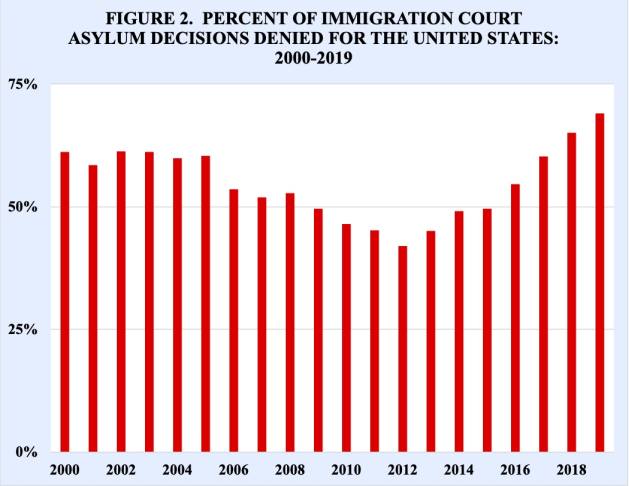
The proportion of asylum court decisions that have been denied in the United States has increased markedly during the last several years (Figure 2). After hitting a low of 42 percent in 2012, the proportion of immigration court asylum decisions denied in the U.S increased to 69 percent in 2019, a record high for the 21st century.

Source: TRAC Immigration

Various European countries, including Austria, Croatia, Greece, Hungary, Italy, Malta, Poland, Serbia and Spain, are also tightening borders and applying pushbacks to those seeking asylum and sending them back to Libya, Morocco, Turkey, Tunisia or neighboring countries.

The United Kingdom has also called upon its Royal Navy and Air Force to help police and monitor the increasing migrant crossings in the English Channel and end demand by returning boats back to France.

Similarly, many Asian countries, including Indonesia, Malaysia and Thailand have refused port – or “push back” – boats filled with asylum seekers and migrants. Those governments maintain that their pushback policies are intended to fight human smuggling.

Also, Australia has forcibly intercepted asylum seeker boats and push them back to where they had come from. Other countries, such as South Korea, Japan and China, choose to provide monies and humanitarian assistance to address the asylum and refugee crisis, but typically say “Not Here!” to accepting asylum seekers.

Pandemic Worsens the Situation

In many African countries, such as Cameroon, Mozambique, Niger and South Africa, those seeking asylum have encountered resistance, onerous restrictions and abuse, with many wishing to relocate to other countries. The coronavirus pandemic has made the plight asylum seekers even more difficult, as they are frequently seen as virus carriers.

Latin American asylum seekers are also encountering difficulties finding welcoming safe havens. Many, especially those from Central America, are reluctant to seek asylum in countries that can be just as dangerous with violence, robbery, extortion and sexual abuse as the places that they are fleeing.


The situation in the region has become more challenging as 4.5 million Venezuelans had left the country by the end of 2019, with the large majority not recognized as asylum seekers or refugees.

The world for asylum seekers has changed greatly since the adoption of the Universal Declaration of Human Rights more than a lifetime ago. Mass displacement is vastly more widespread than in the past.

It is also no longer a short-term and temporary phenomenon with growing numbers of men, women and children forced from their homes for long periods of time.

At the end of 2019 a record breaking 80 million people globally, double the number a decade ago, were forcibly displaced from their homes due to persecution, conflict, violence, human rights violations or events seriously disturbing public order. No less than one-third of them were refugees and more than 4 million were asylum seekers.


In addition, the world is experiencing a great migration clash between the many millions who want out of their poor and violence ridden countries and the many millions who want others to keep out of their wealthy and stable countries.

Lacking legal authorization to emigrate, men and women and increasingly even children are willing to risk their safety and lives to reach their desired destinations, with many relying on human smugglers.

In response to the growing unauthorized migration flows, migrant-destination countries are resisting the entry of irregular migrants, combating migrant smuggling, repatriating those unlawfully resident, objecting to accepting refugees and increasingly denying asylum claims.

In 2019 the large majority of first instance decisions on asylum applications were rejected (Figure 3). Countries where the proportions of first instance asylum applications rejected exceeded 70 percent included Hungary (92 percent), Czechia (90 percent), Poland (89 percent), Italy (80 percent), France (75 percent) and Sweden (71 percent).


Source: Eurostat and TRAC Immigration

Moreover, the world’s population is nearing 8 billion, approximately four times its size at the end of World War II.

Over the next 30 years the planet is expected to gain an additional 2 billion people.

Most of that projected population growth will take place in poor failing states, places where even now millions are facing hunger, poverty, corruption, violence and human rights abuse.

Also, a landmark ruling by the United Nations Human Rights Committee found that it is unlawful for governments to return people to countries where their lives might be threatened by a climate crisis. Under such a judgment, tens of millions of people could be displaced and seek asylum due to life-threatening climate and environmental changes.

So, get ready; it should no longer be a surprise. Future numbers of men, women and their children desperately seeking asylum are likely to be substantially greater than today’s record-breaking levels. And government leaders simply declaring, “Not Here!”, is certainly not going to be the solution to one of the defining issues of the 21st century.

Eugene Debs Believed in Socialism Because He Believed in Democracy


SHAWN GUDE

Eugene Debs’s unswerving commitment to democracy and internationalism was born out of his revulsion at the tyranny of industrial capitalism. We should carry forth that Debsian vision today — by recognizing that class struggle is the precondition for winning a more democratic world.


https://jacobinmag.com/2020/09/eugene-debs-democracy-antiwar-canton


In January 1917, John Hays Hammond, a balding, mustachioed mining engineer, appeared before the convention of the National Civic Federation, an alliance of business leaders and conservative unions, to deliver a stark warning: the country’s workers and farmers were dead set against entering World War I.

“Some influence or combination of influences has certainly brought about a weakening of the patriotic sprit in this country,” Hammond lamented. “We find that neither the workingmen nor the farmers . . . are taking any part or interest in . . . movements for national preparedness.”

By the following year, however, a combination of government propaganda, repression, and wartime hysteria had shoved anti-war views out of the political mainstream. President Woodrow Wilson’s declaration of war in April 1917 was the opening shot, and a fusillade of jingoism soon followed: suppression of radical publications, sacking of dissident organizations’ offices, tarring and feathering of war opponents, hyperpatriotic displays at sporting events, a $50 state bounty for draft dodgers, government-financed cartoons comparing Germans to barbarous, rampaging animals.

Eugene Debs, the fiery elder statesman of American socialism, knew he was risking his freedom by delivering speeches questioning Wilson’s war. Undeterred, Debs condemned Wilson’s war in front of audiences that spring. On June 16, 1918, in Canton, Ohio, the Indiana native gave the speech that would soon land him in prison garb.

“The master class has always declared the wars,” Debs proclaimed, his hands in motion, his voice ringing through the city park. “The subject class has always fought the battles.” He ridiculed the idea that Wilson was trying to “make the world safe for democracy.” Just look, Debs insisted before the crowd, a sea of hats in the summer heat: the American ruling class had consorted with the German aristocrats they now chided as reactionary. They upheld an economic system that exploited workers and enriched bankers, defended a political system where money trumped popular rule. How did they have any standing to wage a war for democracy?

If any American could level the charge, it was Debs. From his time heading the American Railway Union and spearheading strikes against business titans, to his peripatetic journeys throughout the country speaking to hyper-exploited workers, to his quadrennial runs for president decrying “industrial despotism,” Debs was a leading critic of the way capitalism corroded American democracy. The “cooperative commonwealth” he extolled was self-government incarnate, the internationalism he professed a challenge to tyrants everywhere. “Where liberty is not,” Debs declared, “socialism has a mission, and, therefore, the mission of socialism is as wide as the world.”

Today, Debs is widely hailed for his courage and convictions, treated as a sort of saint of the American left. Contemporary observers couldn’t help but reach for ethereal comparisons either — for all his militant rhetoric, Debs’s disarming compassion made even his prison wardens melt.

But canonization doesn’t admit much room for scrutiny, and for a man committed to worker self-emancipation (“I would not lead you into the promised land if I could, because if I could lead you in, someone else would lead you out”), it isn’t in keeping with his legacy, either.

Much more interesting is to bring Debs down from his otherworldly perch and examine his life and politics as we would any other human being. Safely removed from that rarefied position, we can nonetheless see a remarkable man whose unswerving commitment to democracy and internationalism inspired millions — and who realized, after participating in the tectonic strikes of the late nineteenth century, that class struggle is the precondition for winning a more democratic world.
From Moderate to Socialist

The end of the Civil War in 1865 quickened America’s turn toward industrial capitalism. Railroads snaked across the country, establishing new towns and fortunes overnight. Industrial corporations, a recent invention, amassed immense wealth and political power.

This new economic form razed established social relations and pressed people into factories, mills, and mines — dangerous, frequently lethal places where workers lost limbs and toiled, often for the first time, under the authority of a boss. Economic growth would surge, only to seize up, throwing millions out of work and pummeling others with steep wage cuts. Moving from job to job was extremely common, reinforcing the sense that nothing was permanent. Across the ocean, Karl Marx observed that under capitalism, “all that is solid melts into air.” And a lot was melting into air.

Born November 5, 1855 to French immigrant parents in the then-booming city of Terre Haute, Indiana, Eugene Victor Debs was spared most of these vagaries. He enjoyed a comfortable, middle-class life as the son of successful grocers. At the age of fourteen, he left school to go to work on the railroad, more out of a sense of adventure than destitution. After working as a paint scraper and then a locomotive fireman, he returned to Terre Haute and, with his father’s help, found a job as an accountant for a wholesale grocer.

The young Debs was no radical. Handsome, the picture of ambition, he confidently strode into the world of mainstream trade unionism and Democratic Party politics. He began editing the Brotherhood of Locomotive Firemen’s magazine — where he preached sobriety and upstanding citizenship rather than class struggle — and was elected city clerk (1879) and then state representative (1884). Debs’s rise to political office failed to spook local elites, who viewed this future socialist firebrand as a responsible spokesperson for clean government and modest reform — pro-worker, to be sure, but not one to visit revolutionary doctrines upon their fair city.


Around the same time, Debs married Kate Metzel, the daughter of a well-known Terre Haute druggist. Historians have painted sharply divergent portraits of Debs’s lifelong spouse. Nick Salvatore, one of Debs’s most capable biographers, depicts Kate as status obsessed and hostile to socialist politics. In a recent journal article, Michelle Killion Morahn, a member of the Debs Foundation, presents a much different Kate: one whose family background predisposed her to radicalism, who was a socialist in her right, and who shaped her husband’s intellectual development. She was, in this telling, “Gene’s true partner.”

There’s more scholarly consensus about Debs’s relationship with his younger brother, Theodore. Early in his career, Gene began leaning heavily on Theodore for all manners of labor, emotional and otherwise. “When his older brother was on the road,” Salvatore writes, “it was Theodore who answered the mail, kept the books, and edited the journal for the printer.” He was Debs’s “alter ego,” someone who “understood that his brother’s public career depended upon the intense dedication and unquestioning emotional support of the family.”

By the late 1880s, Debs had started his trek away from conservative unionism. A railroad walkout in 1888 convinced Debs, who served as strike leader, that a harmonious relationship with massive corporations was impossible without the counterweight of organized workers. He also began to criticize the craft unionism that dominated the labor movement. Rather than self-balkanize according to job task, “federationists” like Debs insisted that workers — whether conductor or fireman, engineer or brakeman — organize “under one common fold,” as Debs explained in May 1893. That same year, he cofounded the American Railway Union (ARU), putting his vision of a fighting industrial unionism into practice.

For many workers, Debs’s vision made instinctive sense. As companies blacklisted union members, sicced private security guards on strikers, and mowed down obstreperous workers to safeguard corporate property and prerogatives, what were they to conclude, except that liberty for capitalists meant tyranny for them?

The country heaved with worker discontent, producing a string of bloody walkouts that became metonyms for “the labor question”: the Great Strikes of 1877, the Great Southwest Railroad Strike of 1886, the Homestead Strike of 1892, and, finally, the 1894 Pullman strike — the battle that would rocket Debs to national prominence and help transform him into a socialist. “I was to be baptized in socialism in the roar of conflict,” Debs would later write. “In the gleam of every bayonet and the flash of every rifle the class struggle was revealed.”

Pullman, Illinois, located right outside of Chicago, was supposed to be the paragon of company towns, a model of employer benevolence that would deliver clean, decent living to employees at the same time it molded them into loyal workers. It ended up being neither. When an economic depression hit in 1893, Pullman’s Palace Car Company slashed wages while refusing to lower rents or utility rates. The workers who built the company’s luxury sleeping car fleet walked out on May 11, 1894.

Debs, already a household name for leading a successful strike that spring, decried the “paternalism of Pullman” at a union assembly a few days later. To Debs, a great believer in “republican liberty,” noblesse oblige was another name for tyranny, a prettified despotism where masters and slaves persisted despite the accoutrements of goodwill.

At the same assembly, Debs pushed the strikers to include black workers. Decades away from their own industrial labor struggles — where they would unionize under the leadership of famed Socialist and Debs admirer A. Philip Randolph — black workers toiled on the line as porters. Working for tips, they served passengers in plush surroundings with heads bowed, pride suppressed, swallowing any words of protest at being called “George,” the catchall name that denoted servility to their employer, George Pullman. Debs rightly saw the porters as fellow workers resisting potentates. But the majority at the assembly disagreed. Debs’s motion failed.

Hampered by the lack of cross-racial solidarity, the strikers nonetheless seemed to have momentum on their side. By the end of June, one hundred thousand railroad workers were out on strike, with the Midwest, the West, and the Southwest all brought to a standstill. The corporate media howled: the ARU president was a tyrant; this “Debs rebellion” was anarchy incarnate. Railroad companies likewise brooked no compromise. They obtained court injunctions to halt the fast-spreading labor action and applauded President Grover Cleveland when he dispatched federal troops to Chicago. Bludgeoned by the strong arm of the state, the strikers were forced to stand down.
On July 17, 1894, Debs and other ARU officers were hauled in on charges of defying a court injunction. He would eventually spend six months incarcerated at a county prison fifty miles northwest of Chicago, though in relatively humane settings. He was invited to join the county sheriff’s family for dinner, read socialist pamphlets and books he obtained through the mail (the writings of German Marxist Karl Kautsky were among his favorites), and received numerous visitors (the Milwaukee Socialist Victor Berger, later one of his greatest intraparty rivals, brought Debs all three volumes of Marx’s Capital).
An 1894 political cartoon depicting “the condition of the laboring man at Pullman.” (Wikimedia Commons)


The prison stint further inflated Debs’s stature in the minds of America’s workers. True, the Pullman strike had been lost. But Debs had stared down George Pullman, that besuited embodiment of corporate capitalism, and gone to jail to stand against their oppression. When Debs was released in November 1895, one hundred thousand people, braving a downpour, packed into Battery D at the Chicago train depot to listen to him thunder: “I greet you tonight as lovers of liberty and as despisers of despotism.”

Debs was still not prepared to mouth the “s” word quite yet. He lent his increasingly influential imprimatur to William Jennings Bryan’s populist-tinged presidential candidacy in 1896. He brushed aside various attempts to enlist him to the Socialist cause.

But on January 1, 1897, less than two months after Bryan’s resounding loss and his own forty-second birthday, Debs made a ringing announcement to the ARU membership: “The issue is Socialism versus Capitalism. I am for Socialism because I am for humanity. We have been cursed with the reign of gold long enough.”

American socialism — still an inchoate force with no mass party of its own — now had its one of leaders, and a nationally known one at that.
The Socialist Party of America

The turn of the century was a halcyon time for the budding socialist movement. In Europe, socialism was already a mass phenomenon, with working-class clubs, educational organizations, and cultural institutions that rooted workers in strong unions and parties that seemed to poll better with every passing year. For most European socialists, the goal was to first win workers the vote, then net parliamentary majorities, and finally — backed by a united working class — inaugurate a socialist society.

The Socialist Party of America — formed in 1901 out of the fusion of the Social Democratic Party of America, of which Debs was a member, and the smaller Socialist Labor Party — had a seemingly easier task. Though many workers were disenfranchised (particularly African Americans), suffrage rights reached a much larger share of the population than in Europe. And capitalism, its booms and busts already on full display, seemed headed toward the cliff. Many in the Socialist Party thought that the “cooperative commonwealth” was an election cycle or two away — and Debs was no exception.

“Viewed today from any intelligent standpoint, the capitalist not excepted, the outlook for socialism is luminous with incomparable hope, certain of realization,” Debs wrote in 1902. “It is the light upon the horizon of human destiny and it has no limitations but the walls of the universe.”

Debs quickly got to work removing any remaining impediments. Always an agitator and organizer more than a theoretician, Debs zigzagged the country, spreading the good word. He waxed poetic about the coming cooperative order at lyceums, spoke of the unbridgeable divide between workers and capitalists at labor halls, and lamented the unchristian world capitalists had created at socialist encampments, which were modeled on tent revivals.

The characteristic Debs speech was by turns hopeful and remonstrative, revolutionary and religious. He aimed to grab his audience by the overalls and shake them into action: once they realized they no longer had to live in the bondage of industrial despotism, once they awoke from their capitalism-induced slumber and embraced the Socialist Party, freedom — true freedom, not the ersatz capitalist variety — was theirs. “Debs talks to us with his hands, out of his heart, and we all understood everything he said,” one Polish socialist commented, explaining Debs’s allure. Others resorted to comparisons of the divine. “When Debs comes out, you’ll think it’s Jesus Christ,” one woman told another before a speech in Illinois.

Debs appealed to his audiences with a socialism that took seriously the proclaimed ideals of American democracy. While the United States was marred from the beginning by chattel slavery, he insisted that it could realize its avowed principles (popular sovereignty, equality, republican liberty) if workers took on their bosses at the workplace and the polling station.Presidential campaigns lent Debs his biggest platform. Having run in 1900 on the Social Democratic Party ticket, the Hoosier socialist launched bids again in 1904 and 1908. The party went all out for his third run, raising funds for a campaign train they dubbed the Red Special. From August 31 until the November election, the locomotive — carrying Debs, a host of speakers and support staff, and a fifteen-piece band — sounded its whistle at appointed stops, where the presidential candidate would trumpet the wonders of socialism as party members distributed campaign literature. The band — “excellent,” in the estimation of the Iowa City Citizen — would then entertain the crowd. At night, Debs would display his oratorical prowess before large audiences at convention halls and auditoriums.

The unity the party displayed during presidential elections obscured the deep divisions within. Ideological factions — left, center, right — clashed ferociously, with trade unionism, electoral strategy, and racial equality all inspiring mountains of barbed words.

Debs was a denizen of the party’s Left, miles away from the cautious reformism of his youth. In his mind, unions must be militant and industrial (taking in workers of all races and skill sets), electoral campaigns must educate workers for the class struggle (rather than push middle-class-friendly reforms), and Socialists must never waver in their anti-racist commitments (no matter the short-term electoral consequences).

Victor Berger, the imperious leader of the Milwaukee Socialists, thought this was ultraleft nonsense. A former schoolteacher of Austrian descent who personified the party’s right wing, Berger had built an impressive local organization with close ties to Milwaukee’s trade union movement. The “Sewer Socialists” touted “clean government,” public provision, and prudent regulation. Class struggle, that propelling force of Debsian socialism, was nowhere to be found in their campaign literature. “I can say from actual experience,” Berger bragged in 1906, “that the Social-Democrats in this city have opposed almost every strike that has ever been declared here.” Others on the Right eagerly publicized millionaire converts to the party, seeing in them totems of moderation that could attract other reform-minded members of the middle and upper class.


Debs tended to hover above intraparty disputes, much preferring speaking tours to factional fighting. But no one doubted where he stood on key questions. In 1905, he cofounded the Industrial Workers of the World (IWW), a radical alternative to the “labor-dividing and corruption breeding craft unions.”

While he stepped away from the IWW before the decade’s conclusion — thinking its focus on direct action at the workplace was crowding out political action — Debs never second-guessed its basic principles. Any effort in the political arena that failed to forge the working class into a fighting force — or elevated professional and affluent classes above workers as the catalyst of social transformation — was unworthy of the Socialist Party. Nationalization, for instance, was desirable only if it gave workers more control over the economy. Similarly, a party without a strong working-class foundation would become indistinguishable from middle-class reformism, averse to attacking the roots of tyranny and oppression in society.

“The Socialist Party is necessarily a revolutionary party,” Debs wrote in 1902, “and its basic demand is the collective ownership of the means of production and distribution and the operation of all industry in the interest of all the people. This will mean an economic democracy, the base of the real republic yet to be.”

Racial equality was another source of fierce debate inside the party. Debs refused to address segregated crowds, lamented “that the white heel is still upon the black neck is simply proof that the world is not yet civilized,” and urged black people — as Ira Kipnis writes in his 1952 history of the Socialist Party — to “reject the false doctrines of ‘meekness and humility’” and fight for their equality through the labor and socialist movement. In 1915, when Birth of a Nation was released to critical acclaim, Ida B. Wells praised Debs for denouncing the virulently racist film: “Of all the millions of white men in this country,” she said to Debs, “you are the only one I know that has had the courage to speak out against this diabolical production as it deserves.” Recounting the Pullman Strike, Debs would inform his audiences that “one of the factors in our defeat” was the union’s failure to include black workers. He vigorously opposed a 1910 party resolution — supported by Berger and mirroring the mainstream labor movement’s position — that called for excluding Asian immigrants from the country.

Many others in the Socialist Party, particularly on the Right, held shockingly racist views. Berger, only slightly less contemptuous of black people than of nonwhite immigrants, insisted in 1902 that “negroes and mulattoes constitute a lower race.” An anonymous party member complained to Debs in a 1903 letter that “you will jeopardize the best interest of the Socialist Party if you insist on political equality of the Negro.”

Debs’s response was withering:


The Socialist Party would be false to its historic mission, violate the fundamental principles of Socialism, deny its philosophy and repudiate its own teachings if, on account of race considerations, it sought to exclude any human being from political equality and economic freedom . . . Of course the Negro will “not be satisfied with ‘equality with reservation.’” Why should he be? Would you? Suppose you change places with the Negro just a year, then let us hear from you — “with reservation.”

Despite these explosive debates, by the end of the decade, Debs and the rest of the party could boast that theirs was a truly mass movement. Jewish garment workers in New York City, German brewery workers in Milwaukee, white tenant farmers in Oklahoma, black lumber workers in Louisiana — all carried the “red card.” And with Debs’s preternatural ability to speak to the rank and file, the party posted its highest-ever vote total in the 1912 presidential election: 900,000, or 6 percent of the electorate.
Debs’s Wartime Stand

Eugene Debs turned fifty-seven on Election Day 1912. His blond hair had long since receded, and years of unstinting travel had taken their toll on his slim frame. Every extended trip would send him staggering back to his bed, where he would spend weeks or months convalescing, often doted on by his younger brother and wife.

It was in this state that Debs found himself five years later — desperately attempting to recover from a rash of speaking engagements — as comrades like Kate Richards O’Hare, the charismatic Socialist orator from the prairies of Kansas, were prosecuted for fulminating against US involvement in World War I.

American socialists had distinguished themselves for their stance against the war. The European Socialist parties, so inspirational to Debs and others in the US movement, had bowed to their respective ruling classes, either out of perceived pragmatism or nationalist fervor. Even the German Socialists, ardent foes of Prussian autocracy, had assented to the war. But in the United States, the popular mood was against involvement, and Socialists happily carried the anti-war torch. When the Socialists proposed an amendment to the party constitution that would make voting for war or war credits punishable by expulsion from the party, well over 90 percent of members voted “yea.”Debs on the November 1920 cover of Di Tsukunft (“the Future”), a Yiddish-language socialist magazine. (Tobias Higbie / Flickr)


Anti-war antipathy failed to recede when the United States entered the war. While prominent Socialist intellectuals like Upton Sinclair defected to the pro-involvement side, the great bulk of the Socialist Party’s elected officials, publications, and members dug in their heels against the war.

And they suffered for it. Postmaster general Albert Burleson, a conservative Texan with a sly grin who segregated the postal service upon his appointment, revoked the mailing privileges of publications he saw as undermining the war effort. Scores of Socialist publications ended up on his blacklist.

At the same time, the government ramped up its propaganda campaign to remake public opinion, and “patriotic groups,” typically led by businessmen, unleashed violent vigilantism across the country. In Terre Haute, historian Ernest Freeberg writes, “vigilantes attacked stores owned by German-Americans, beat the editor of the local Socialist paper ‘almost to death,’ and lynched an immigrant coal miner who was unwilling to buy war bonds.” Still the Socialists refused to budge. In the summer of 1917, party delegates congregated in St Louis to write an anti-war resolution that declared “the working class of the United States has no quarrel with the working class of any other country.”

As his fellow Socialists were putting together the St. Louis Proclamation, Debs was lounging at a sanitarium run by Seventh Day Adventists in Boulder, Colorado, trying desperately to recover his lost vigor. Doctors had told him he was risking his life by keeping up the feverish pace he had set. And so, in 1916, Debs only ran for an Indiana congressional seat — not his customary presidential bid — and in the summer of 1917, he took a long vacation, first in Minnesota and then in Colorado. He hoped that the “cool night air, cold water, daily massages, and regular exercise” — coupled with a no-alcohol and doctor-prescribed vegetarian diet — would extend his life. “After decades on the front line of social struggle,” Freeberg writes, “Debs was now strangely removed from these conflicts, insulated by the structured daily routine of his mountain idyll.”

It wouldn’t last. After finishing his convalescence in Terre Haute, Debs returned to the speaking circuit the following May, fired with the spirit of a new moral crusade. “I cannot be free,” he insisted to a Socialist Party organizer, “while my comrades and fellow workers are jailed for warning people about this war.”

On June 16, 1918, he traveled to Canton, Ohio, to deliver an address at a Socialist Party picnic. It would go down as one of the greatest orations in US history. Now known as “The Canton Speech,” Debs’s lengthy talk to the 1,200 assembled jumped from subject to subject — the German Socialists’ persecution under the kaiser, the revolutionary politics of Jesus Christ, the promise of the Russian Revolution, the role of industrial unionism in socialist politics — while driving home a central point: workers around the world must unite against their despotic oppressors.Reading the speech today, it’s striking how little Debs trained his fire on the war effort itself. Nowhere did he call on workers to resist the draft or soldiers to desert their company. He simply insisted, in typically Debsian hortatory fashion, that ordinary men and women must carry forth the Socialist banner, “destroy[ing] all enslaving and degrading capitalist institutions” instead of allowing themselves to be “cannon fodder” for the country’s political and economic autocrats. Federal authorities arrested him the following month.

At Debs’s trial in Cleveland, the government sought to tar him as a crazed radical, a dangerous insurrectionist impeding America’s prosecution of the war. Debs’s defense was simple: the Espionage Act was unconstitutional, an affront to a free, democratic society. But the jury — “drawn exclusively from the city’s established Yankee middle class” rather than its “growing, assertive, and ethnically diverse working class” — wasn’t swayed, not even by his final statement to the court.

“Years ago,” Debs began, “I recognized my kinship with all living beings, and I made up my mind that I was not one bit better than the meanest on earth. I said then, and I say now, that while there is a lower class, I am in it, and while there is a criminal element, I am of it, and while there is a soul in prison, I am not free.”

He excoriated the rule of Mammon over the world, and registered his opposition to “a social order in which it is possible for one man who does absolutely nothing that is useful to amass a fortune of hundreds of millions of dollars, while millions of men and women who work all the days of their lives secure barely enough for a wretched existence.” He confidently predicted the coming of the socialist republic. Then he became Convict No. 9653.

Debs ultimately landed in a federal penitentiary in Atlanta, where he would launch his fabled 1920 presidential bid. The campaign was, in many ways, the last hurrah of his political career. Allowed to write weekly dispatches, Debs again implored workers to reject the perfidies of the two major parties and vote for the movement that would stamp out the iniquities of capitalism. The Socialist Party, meanwhile, insisted that a vote for Debs was a vote for civil liberties. On Election Day, nearly 1 million people pulled the lever for the jailed socialist, the fifth and final time he would run for president.

Debs was well treated by his prison wardens, but he nevertheless saw his environs as the brutal product of capitalism. He refused to look down on his fellow prisoners, insisting that the social conditions that had produced their penury and shoved them into a life of crime were the true culprits.

Debs later compared the domination of the cell block to that of the workplace:


On the outside of the prison walls the wage slave begs his master for a job; on the inside he cowers before the club of his keeper. The entire process is a degenerating one and robs the human being, either as a wage slave walking the street or as a convict crouching in a cell, of every attribute of sovereignty and every quality that dignifies his nature.

The prisoners loved Debs. He gave them many of the gifts (flowers, cakes, boxes of fruit) that streamed in from supporters around the country. (He held on to the “silk pajamas monogrammed in red” that one union sent.) He helped them write letters, offered them counsel on their cases, provided advice about their personal problems.

When Debs was finally released on Christmas Day 1921, the incarcerated — let out of their cells to watch their fellow prisoner walk free — gathered to offer a final goodbye. As Debs strode down the sidewalk outside, hat and cane in hand, attired in a black suit and winter jacket, noticeably more haggard than when he entered, the prisoners roared from inside.


A Debsian Politics for Today

Eugene Debs died on October 26, 1926, his health never having fully recovered from his time behind bars, his party — the victim of factional fighting following the Russian Revolution — in shambles. He worried that his life’s work was for naught. But he never wavered in his belief that the hierarchies of capitalist society stunted human life.

In Walls and Bars, his first and only full-length book, published posthumously in 1927, Debs drew a historical comparison:


The capitalist of our day, who is the social, economic and political successor of the feudal lord of the Middle Ages, and the patrician master of the ancient world, holds the great mass of the people in bondage, not by owning them under the law, nor by having sole proprietorship of the land, but by virtue of his ownership of industry, the tools and machinery with which work is done and wealth produced. In a word, the capitalist owns the tools and the jobs of the workers, and they are his economic dependents.

The great mass of people in bondage. They are his economic dependents. Here was a man who observed not just capitalism’s horrid miasmas (poverty, inequality, racism) but climbed into its boiler room, gazed at its machinery, and saw the unfreedom that powered it all. Capitalism was an unjust system because it ran on autocracy rather than industrial democracy; the socialist movement’s historic purpose was to win the “working-class republic.”

We still haven’t, of course. But in thinking about Debs’s relevance today, it’s useful to start there: democracy — understood as the drive to replace unaccountable hierarchies with something approximating an equality of power — should be our animating principle, and reforms should be judged based on whether they tilt the balance of power away from those who unjustly wield it. Are heavily policed neighborhoods gaining power at the expense of cops? Are workers gaining power at the expense of fossil-fuel companies? Are tenants and women gaining power at the expense of landlords and abusive spouses? A benevolent employer giving a worker a raise is a nice sentiment. What’s better, and qualitatively different, is a set of workers winning a union so they can hold their boss to account, or a pro-worker government pouring investment into a long-neglected neighborhood so it doesn’t have to prostrate itself before a vulture capitalist.Debs neve wavered in Commons)

Based on his experience in the labor movement, Debs knew that workers harbor immense untapped power, despite their subordinate status. The middle class could act as adjuncts in the struggle, additional numbers to swell the ranks, but workers would have to be the core. The last century has confirmed what Debs understood instinctually from agitating on the railroads and in mining camps: only workers, organized into parties and unions, have the structural wherewithal to tug back when plutocrats are pulling. Democratic struggles — even those outside the workplace, like efforts to roll back police power — are at their most potent when workers flex their muscles and disrupt the economy or pool their resources to organize independently of the wealthy.

In Debs’s day, he was sure the Socialist Party was the only home for workers; even labor parties didn’t pass his litmus test for “class independence.” Today’s political landscape — dominated by a Democratic Party hostile to social-democratic reform and a Republican Party that celebrates untrammeled corporate power — leaves much room for debate about the best way forward electorally. But more important than the individual form electoral activity takes — a local third-party run, an insurgent bid in the Democratic Party — is the character of the campaign: Is the candidate dedicated to fostering working-class self-organization, not merely passing reforms from on high? Are they financially autonomous from the business class? Do they want to attack corporate power?

Then there was Debs’s internationalism. If democracy was the aim, and the working class the primary agent of change, it made no sense to stop at the border’s edge. Socialists around the world were fighting for the same thing: “the universal commonwealth — the harmonious cooperation of every nation with every other nation on Earth.” Only workers had an interest in winning this order, though — left to their own devices, the ruling classes of various countries would war with one another, and capitalists would seek out the most exploitable labor force. Global hierarchies of power, just like the most intimate imbalances, must be undone.

The “universal commonwealth” isn’t on the horizon. For those in the United States, we can fight to cut the military budget and reduce the shadow of American imperialism, allowing workers and popular movements in other countries the space to fight their own democratic battles, free of the United States’ boot. We can push for debt relief and transfers of technology and resources to Global South countries. But in “the belly of the beast,” as the radical left used to say, some of this will be a heavy lift.

And herein lies Debs’s final lesson: democratic struggles aren’t always popular.

The socialist left’s agenda seems to have more popular appeal today than in years. Majorities support Medicare for All. The Green New Deal polls well. But the US military — the enforcer of global inequality — is the most well-regarded institution in American society. Prisons and police, despite their diminished stature, are still viewed as legitimate. And worker control over the means of production isn’t quite a majority position.

Where does this leave us? Should socialists drop the less popular planks of our platform, solemnly concluding that the people have spoken and that holding out a vision of open borders or prison abolition or, indeed, socialism itself, is an act of self-marginalization?

Debs would shake his head vigorously. “[W]hat is said here in regard to abolishing the prison,” Debs wrote in Walls and Bars, “will be met with incredulity, if not derision, and . . . the theory and proposal I advance will be pronounced visionary, impractical and impossible. Nevertheless, my confidence remains unshaken that the time will come when . . . man will think too well of himself to cage his brother as a brute, place an armed brute over him, feed him as a brute, treat him as a brute, and reduce him to the level of a brute.”

Debs was a comfortable lone wolf, a reflexive dissenter. He admitted when he ran for president that he didn’t actually want to sit in the Oval Office. Yet he never allowed his sometimes-unpopular opinions to deliver him into the hovels of marginality. His essential optimism, his belief in the working class, his deep conviction that socialist politics had to be a mass politics — each allowed him to hold out hope that opinions would change, workers would coalesce, and the masters of the world would be toppled.

Debs’s approach to the “popularity question” differs from one of his ideological heirs, Bernie Sanders. After languishing in minor party obscurity through the 1970s, Sanders dropped the most radical planks of his platform (including socializing the economy’s commanding heights) and gained political office by pursuing policies thwarted not by lack of popularity but by the plutocratic order. Often, his goal has been less to gainsay prevailing opinion — though he’s done plenty of that, too — than to press for public sentiment to be reflected in public policy. Popular social democratic reforms like taxing the rich, funding public programs, and boosting worker power are his bread and butter.

We can think of these as the two poles of democratic socialist politics. Both approaches —the minoritarianism of Debs and the majoritarianism of Sanders — carry pitfalls. Debs, perhaps channeling his hero John Brown, seemed at times to bask in the moral clarity of his dissension. Sanders, eager to expand the socialist and progressive ranks as broadly as possible, is much more inclined to take on Jeff Bezos than to talk about defunding the police. An effective socialist politics depends on balancing these two impulses, resisting the extremes of self-satisfied marginalization and vote-getting reticence.

But for anyone who doubts Debs’s abiding relevance, who questions his ability to speak to our own world of mass inequality and autocratic rule, they need only dig up his piercing remarks about a social order that confused freedom for the propertied with freedom for the many — yet also contained within it the possibility of a vastly different world, shorn of tyrants, big and small.

For to read Debs is to be reminded of what it means to be a socialist in the first place, to believe in democracy for all:


If socialism, international revolutionary socialism, does not stand staunchly, unflinchingly, and uncompromisingly for the working class and for the exploited and oppressed masses of all lands, then it stands for none and its claim is a false pretense and its profession a delusion and a snare.

Wednesday, September 2, 2020

Trump visits Kenosha to defend killer police and vigilantes


https://www.wsws.org/en/articles/2020/09/02/trum-s02.html?pk_campaign=newsletter&pk_kwd=wsws

By Barry Grey
2 September 2020

President Donald Trump made an appearance in Kenosha, Wisconsin on Tuesday as demonstrations against police violence continued in the aftermath of the August 23 police shooting of Jacob Blake, a 29-year-old African American worker. Kenosha police shot the unarmed Blake seven times in the back, leaving him paralyzed from the waist down.

On the eve of the visit, yet another unarmed man was shot and killed by US police, this time in Los Angeles, provoking protests in that city. Since May 25, the day George Floyd was brutally murdered by a Minneapolis police officer, at least 235 people have been killed by police in the US. The pace of killings is on track to surpass 1,000 this year, with nearly three people shot dead by the police every day.

Trump went to Kenosha, an impoverished “rust belt” Democratic-run city in a Democratic-run state, to escalate the law-and-order campaign attacking social protest and socialism and promoting police repression and right-wing vigilante violence that was the theme of last week’s Republican National Convention. The strategy of Trump and the Republicans in the final two months of the presidential campaign is to incite far-right forces and hold the November 3 election under conditions of violence, political instability and the threat of civil war.
Trump and the Republicans are seeking to make an amalgam between the right-wing Democratic campaign of Joe Biden and Kamala Harris and left-wing protesters, whom the White House demonizes as criminal anarchists and looters, in line with Trump’s goal of establishing a presidential dictatorship.

At a White House press conference on Monday, Trump defended Kyle Rittenhouse, the 17-year-old Trump supporter who joined with a band of vigilantes on the night of August 25 to confront protesters in Kenosha and fatally shot two peaceful demonstrators. Rittenhouse also shot and wounded a third protester.

The Kenosha police, as recorded on cell phone video watched by millions, thanked the fascistic gunmen, gave them water, and allowed the automatic rifle-toting Rittenhouse to walk through police lines after his shooting spree and return home to Illinois. Rittenhouse was subsequently charged with first-degree homicide and is facing extradition to Wisconsin.

Trump, however, said Rittenhouse acted in self-defense and otherwise would have been killed by the protesters. At the same press conference, he defended Trump supporters who drove a truck caravan into downtown Portland on Saturday and fired paintballs and pepper spray on demonstrators. The provocation resulted in the shooting death of a right-wing activist under circumstances that remain unclear.

Trump’s efforts to project an image of authoritarian strength during his visit to Kenosha were belied by the extraordinary security measures taken to wall him off from the population of the Midwest city of 100,000 people. Hundreds of police, sheriff’s deputies and National Guard troops patrolled the streets, helicopters circled overhead, hulking armored vehicles were deployed, and those areas toured by Trump were blocked off by rows of gigantic construction vehicles and trucks. All commuter train traffic between Kenosha and Chicago was shut down.

Trump visited an emergency management center, toured small businesses damaged by rioting that followed police crackdowns against protesters, and held a one-hour roundtable discussion with local and state police and National Guard officials. Also on hand was Attorney General William Barr and Department of Homeland Security Acting Secretary Chad Wolf. Democratic Governor Tony Evers and Mayor John Antaramian, both of whom had publicly urged Trump not to come to the city, were not present.

No mention was made in the course of the roundtable, or the scattered questions from reporters that followed, of the vigilante murder of protesters in Kenosha. In his rambling remarks, Trump repeatedly praised the “great job” by the police and National Guard troops in Kenosha and made a blanket condemnation of protesters as anarchists, looters and rioters. He said the demonstrations in Kenosha were not “acts of peaceful protest, but really domestic terror.”

Trump once again presented Biden as a stalking horse for “reckless far-left politicians” who portray the police as “repressive or racist.”

Asked by a reporter if he would condemn the shooting of Blake, Trump alibied for the cop, seven-year-veteran Rusten Shesky, saying the case was “complicated” and “under investigation.” He repeated a statement he had made the previous night in an interview with Fox News host Laura Ingraham, saying police who shot unarmed civilians in many cases “choked,” like a golfer who missed a three-foot putt.

Attorney General Barr denounced “mob violence” and claimed that the protests in Kenosha were organized by “the same people using the same tactics that have been used in various cities—Washington DC, Atlanta, Chicago, now Kenosha and Portland.”

He said federal and state officials were reviewing all video of the thousands of protests since last May to identify people who threw rocks or carried out vandalism, adding, “The federal government is willing to use all our tools and all our laws to bring these people to justice.” He said nothing about right-wing, pro-Trump vigilantes who have not only attacked protesters, but to date killed at least three of them.

Despite the attempt to project the image of the great and all-powerful “leader,” the roundtable, totally insulated from the population, including the family of Blake, had the character of a meeting under siege. The Trump administration and the entire ruling class are petrified at the growth of social opposition. They fear that the ever-rising death toll from the coronavirus pandemic and mounting working-class opposition to the deadly back-to-work and back-to-school drives could spell the demise of the capitalist system.

In a telling remark, Trump at one point noted the many police and military agencies represented at the meeting and gushed, “Even me. I’m here today and I feel so safe.”

Trump gave further expression to the mood of fear gripping the ruling elite in his Monday night interview with Ingraham, during which he spoke of “dark forces” and a “shadowy group of people” who were behind the mass protests and who controlled Biden “like a puppet.”

At one point he told Ingraham: “Biden won’t calm things down. They will take over. They will have won… They will have taken over our cities. It’s a revolution. You understand that, it’s a revolution.”

The greatest advantage held by Trump and the fascistic faction of the ruling class for which he speaks is their nominal political opposition—the Democratic Party. This right-wing party of American imperialism is no less hostile to and fearful of a mass movement of the working class. The Biden campaign expresses the Democratic Party’s ever more rapid movement to the right.

The Democratic convention was focused on two things: seeking to divide the working class by promoting racial and identity politics, and appealing for support to the military, the intelligence agencies, Wall Street and disaffected Republicans. It put forward no social program to address mass unemployment and the coming wave of evictions and growth of hunger, after the Democrats conspired with the Republicans to end the $600 federal unemployment supplement.

It barely mentioned the back-to-work and back-to-school drives, which the Democrats support in full knowledge that the result will be an exponential rise in infections and deaths. It said virtually nothing about the multitrillion-dollar bailout of Wall Street in the CARES Act, for which the Democrats voted nearly unanimously, or the ongoing pumping of money into the stock market by the Federal Reserve.

Biden’s response to the Republican convention and Trump’s law-and-order demagogy is to shift further to the right and declare his own law-and-order credentials. On Monday, he gave his first speech since the convention, whose centerpiece was an unequivocal denunciation of looting and arson, and the demand that protesters who engage in such things be prosecuted.

His basic argument was that he is the man to suppress violence, whether on the left or the right, and keep America “safe.” He combined this attempt to attack Trump from the right on law and order with an attack on Russia, based on the fabricated claim of Russian bounties against US troops in Afghanistan, a continuation of the Democrats’ attacks on Trump for being too “soft” on Russia and China.

Even this, however, is not enough for the New York Times, which published an op-ed column Tuesday by Brett Stephens declaring Biden’s law and order speech insufficiently right-wing. Stephens wrote: “He can publicly call out far-left ugliness (not just violence) the next time he sees it. He can pay a visit to the people who’ve had their businesses burned to the ground in Kenosha and tell them that their grievances will be heard, and their property protected, in a Biden administration. He can even call the family of the right-wing activist killed on Saturday in Portland.”

The working class faces immense dangers from the efforts of the ruling elite to cultivate a fascistic movement and create the conditions for police-military dictatorship, despite workers’ immense social power and their growing leftward radicalization. However, that danger is centered not in any inherent strength of Trump and company, but rather in the dead weight of the Democratic Party and all those who seek to channel social opposition behind it.

The fight against Trump requires a complete break with the Democratic Party and the building of a mass independent socialist movement of the working class. This is the program being fought for by the Socialist Equality Party and its 2020 candidates, Joseph Kishore for president and Norissa Santa Cruz for vice president. All those who agree with the fight for socialism should support the campaign and join the SEP.

Teachers union and Democrats agree to resume in-person learning in New York City schools


https://www.wsws.org/en/articles/2020/09/02/newy-s02.html?pk_campaign=newsletter&pk_kwd=wsws

By Jerry White
2 September 2020

New York City educators have reacted with horror and anger over the announcement by the United Federation of Teachers (UFT) that it has agreed to a plan to reopen the largest school district in the United States by mid-September. The deal with Democratic Mayor Bill de Blasio will delay the opening from September 10 to September 16, with a resumption of in-person schooling for hundreds of thousands of children beginning on September 21.

For weeks, educators, parents and students have been denouncing and protesting the reckless and chaotic plans to open schools for more than a million students and 135,000 teachers and support staff. New York City, an earlier epicenter of the pandemic with nearly 24,000 coronavirus-related deaths, is the only large urban district that will open this fall with in-person learning.

With anger reaching a boiling point, UFT President Michael Mulgrew announced last week that the union would seek authorization from union delegates to call a strike as a “last resort.” On Monday evening, the union’s 100-member executive board unanimously backed the proposal, and the delegate assembly, made up of building reps from more than 1,600 schools, was set to vote on Tuesday.
Teachers protest against unsafe school reopening, August 3, 2020, in New York. (AP Photo/Bebeto Matthews)

By Tuesday morning, however, Mulgrew and other union leaders appeared at a press conference with de Blasio, along with Schools Chancellor Richard Carranza, who said district officials “have been working night and day with our labor partners” to put together the plan. Mulgrew claimed the city had “the most aggressive policies and greatest safeguards of any school system in the United States of America.” The union’s delegate assembly approved the deal Tuesday night by an 82-18 percent margin.

The union officials never intended to wage any serious fight. The same ploy was used by the Detroit Federation of Teachers over the past two weeks. After 91 percent of Detroit teachers voted in favor of a “safety strike,” the DFT announced a deal last week to open the schools under a hybrid model of in-person and online learning, combined with “hazard pay,” to entice teachers to return to schools in another city that has been an epicenter of the virus.

The claim that the schools can be reopened safely in New York City or anywhere else is a patent lie. Many if not most of the city’s schools are dilapidated and poorly ventilated, making them a vector for the spread of the virus. Under the union-backed plan, 10-20 percent of students and staff will be randomly tested starting on October 1 and only every month thereafter. In his remarks to Tuesday’s delegate assembly, Mulgrew absurdly claimed this partial testing was adequate, stating, “We wanted to test everyone, but our experts said that would only be good for three days. Would’ve made people feel better but would not be effective.”

Rank-and-file teachers immediately denounced the deal on social media and on other outlets. One teacher told the WSWS, “I’m told by my union rep that over 1,000 schools were inspected, and the UFT has enough to bring safety issues to court. That being said they’re telling us, ‘We will see you inside school on the 8th.’ What a sellout!”

In a post on social media, an educator gave voice to the widespread sentiment for a strike, writing, “So, once again, it will be left up to TEACHERS to figure out what the city didn't figure out in the past 5 months. STOP SELLING US OUT!!! FULL REMOTE OR WE STRIKE!!!”

Another tweeted, “Just to be clear, we never asked for more planning time. We don’t need more planning time, we proved that in March when we established a non-existent curriculum platform in a week. We need safety. We asked for safety measures. This is March all over again.”

Last March, the UFT colluded with de Blasio to conceal the extent of infections and block demands by teachers to close schools, a delay that would cost the lives of at least 121 educators. With the school openings expected to lead to a resurgence of COVID-19, another catastrophe is in the making. This is exacerbated by the fact that New York City hospitals will not be able to count on out-of-state volunteers this time because hospitals are now overrun with COVID-19 patients across the country.

If this homicidal policy is to be stopped, educators in New York City and other districts must take matters into their own hands by building rank-and-file safety committees, independent of the teachers unions, to mobilize the strength of the working class to halt the unsafe opening of schools.

No confidence can be placed in the American Federation of Teachers (the parent organization of the UFT) and the National Education Association, which are opposed to any mass struggle that would expose the anti-working class character of the Democratic Party, particularly on the eve of the presidential elections.

Whatever their rhetorical and tactical differences, both the Democrats and Republicans are fully behind the back-to-school campaign. Getting children back in school, no matter what the cost in lives, is critical from the standpoint of herding workers back into the factories and other workplaces where they can produce the profits demanded by Wall Street.

President Trump, Education Secretary Betsy DeVos and Republican governors are most naked in their opposition to science and the use of bullying threats against districts that do not fully open and resistant teachers that do not comply. Last week, Dr. Scott Atlas, Trump’s quack doctor brought onto the coronavirus task force because of his support for the murderous “herd immunity” policy, toured Florida schools with Governor Ron DeSantis, saying, “We are the only country of our peer nations in the Western world who are so hysterical about reopening schools. … We seem to be the only country willing to sacrifice our children out of fear.”

Afraid that such statements are only throwing gasoline on the fire, which could provoke a revolt by teachers and parents, the Democrats have professed their concern about “safe schools” and worked with the trade unions to suppress opposition. On Tuesday, Jill Biden, the wife of Democratic presidential nominee Joe Biden and current teacher, began a two-week “Back to School” tour with a stop at a Wilmington, Delaware school. She plans to visit 10 cities, including Grand Rapids, Michigan; Las Vegas, Nevada; Phoenix, Arizona and Jacksonville, Florida, where teachers have organized repeated protests and have set up the Duval Educators Rank-and-File Safety Committee, independent of the unions.

Over the weekend, AFT President Randi Weingarten hosted an online meeting with House of Representatives Speaker Nancy Pelosi, which, while denouncing Trump and the Republicans, deliberately concealed the role of the Democrats, including de Blasio and the governors of New York, California, Michigan, Hawaii, Colorado and other states that are forcing teachers and students back to school.

On Wednesday, the AFT is holding a series of “Day of Action” online rallies to promote Biden, whose campaign has already pledged to oversee a regime of austerity that would eclipse the eight years of brutal budget cuts and attacks on teachers that Biden helped carry out under the Obama administration.

The unions falsely present Biden and the Democrats as champions of workers and public education because the Democrats rely on them to suppress strikes and other forms of resistance. In return for this, the Democrats protect the institutional and financial interests of the union apparatus, including the deduction of dues from workers’ paychecks that has enabled Weingarten to become a multimillionaire, with an annual salary of more than $500,000.

Last month, the Educators Rank-and-File Safety Committee was established to unite and organize opposition to the unsafe opening of schools, independently of the unions. In addition to the Duval Educators Rank-and-File Safety Committee in Florida, many more are being built in New York, Michigan, Texas, Oklahoma, Hawaii and other states. The Educators Rank-and-File Safety Committee is calling on teachers to unite with other sections of workers and actively prepare for a national general strike.

At the same time, these committees demand full funding for internet access, computers and remote-learning, and income protection for parents who must stay at home to care for their children. No return to school must be permitted until there is regular universal testing, the revamping of heating and ventilation systems, a permanent reduction in class sizes and safe school conditions overseen by rank-and-file safety committees answerable to educators, parents and students, not the corporate and financial elites. To pay for this, teachers must demand that the trillions handed over to Wall Street in the CARES Act be rediverted to meet social needs.

We urge all those who wish to build a local or statewide rank-and-file safety committee in your area to sign up today and join our Facebook group.


The author also recommends:

Teachers unions intensify efforts to suppress growing class struggle in the US
[20 March 2018]

The profits of August


https://www.wsws.org/en/articles/2020/09/02/pers-s02.html?pk_campaign=newsletter&pk_kwd=wsws


2 September 2020


Over 30,000 people died in the US last month from the COVID-19 pandemic, while corporations carried out mass layoffs amid soaring unemployment, hunger and poverty.

At the same time, the US stock market recorded its biggest increase for the month since 1986. All three major American stock indexes have risen for five consecutive months since plunging in mid-March. The benchmark S&P 500 index has risen 65 percent, its biggest five-month gain since 1938.

Last month saw the wealth of Amazon chief Jeff Bezos climb to $200 billion. Tesla became the world’s biggest car company by share value, as its market capitalization rose to $465 billion, taking the personal fortune of its chief executive, Elon Musk, to more than $100 billion. Apple became the first company in the world with a market capitalization of more than $2 trillion.

Since the Federal Reserve’s bailout of major corporations in March, Apple’s stock has more than doubled, while Tesla’s stock has risen more than six-fold.

These figures underscore the nature of the Wall Street bonanza. It is taking the form of what has been called a “K-shaped recovery,” in which a group of corporate giants enjoy massive profits, driven by the run-up in stock prices, while most of the economy stagnates.

In 1914, the rolling out of the guns of August at the outbreak of World War I marked the start of a process that saw arms manufacturers rake in millions in profits amid death and destruction, the like of which had never been seen.

Likewise, the COVID-19 pandemic, which has brought devastation to the working masses in the US and around the world, has served as the occasion for all arms of the capitalist state to be mobilised to organise the greatest-ever redistribution of wealth to the heights of society.

There are two immediate causes for the massive stock run-up in August. First, the Federal Reserve carried out a far-reaching change in how it evaluates the risk of inflation, with the aim of ensuring ultra-low interest rates in perpetuity.

The announcement by the Fed last week that it was changing its basic monetary policy framework to aim for an “average” inflation rate of two percent meant that it could refrain from raising rates even if inflation hit and surpassed the two percent mark, allowing it to continue injecting money into the financial markets through asset purchases. In other words, as the Wall Street Journal put it, “Low Rates Forever.”

But even more important was the cutoff of the weekly $600 extended unemployment benefit provided to unemployed US workers under the CARES Act passed in March, which both the Democratic and Republican parties simply allowed to expire. Bypassing Congress’s exclusive constitutional power to tax and spend, Trump signed an executive order last month restoring, for a limited period, part of the weekly benefit; but the move was largely symbolic, with most workers getting no additional relief.

The Trump administration, backed by the Democrats, has provided some $2 trillion to bail out the corporations while cutting off what limited aid was provided to workers. At the same time, the Fed has funnelled $4 trillion into the financial system, functioning as the backstop for every financial market.

These measures are being accompanied by a murderous assault on the working class. The policy of governments around the world, spearheaded by the Trump administration, is to force workers back to work, no matter what the dangers to their health and lives, in order that profit accumulation can continue.

The fate of millions of workers who face destitution, including the prospect of being evicted in the coming weeks, is ignored. Democratic presidential candidate Joe Biden did not even bother to mention the cutoff of emergency unemployment benefits it in a major speech he delivered this week.

This is because the cutting off of federal aid directly serves the interests of the corporations and the financial aristocracy, whom the Democrats and Republicans serve.

In the period leading up to the pandemic, concerns were growing that the labour market was becoming “tight.” The COVID-19 outbreak has been seized upon to solve that problem. It has opened up the way for corporations to proceed with restructuring operations, based on making permanent what were initially announced as temporary layoffs, as well as lowering wages for those who remain and intensifying their exploitation.

While the orgy of speculation on Wall Street is hailed by Trump as indicating the power and strength of US capitalism, the run-up of the markets is an indication not of strength, but weakness.

In the post-World War II period, American and world capitalism rested on the strength of the US dollar. But the American dollar is being undermined by the endless supply of cheap money by the Fed. At the end of July, Goldman Sachs warned there were “real concerns” about the longevity of the US dollar as the world reserve currency, as well as the stability of the entire international monetary system, as governments debased their fiat currencies. These warnings have proliferated in the month since.

US capitalism is confronted by the confluence of mounting social, economic and political crises and the growth of social opposition centred in the working class. Every measure taken by the ruling class to respond to the crisis, grounded in the class interests of a parasitic oligarchy, has the effect only of exacerbating the crisis.

Up to this point, the response to the pandemic has been dominated by the social prerogatives of the ruling class. But another social force is entering onto the scene: the working class, which is increasingly coming into struggle against the ruling elite’s back-to-work campaign.

Capitalism’s homicidal response to the COVID-19 pandemic has exposed this bankrupt social order before the eyes of the entire world. As workers enter into struggle, they will take up the demand for the expropriation of the capitalist class and the socialist reorganization of society.

Nick Beams

80,000 Small Businesses Bankrupt & Hardly Any Coverage


https://www.youtube.com/watch?v=Yf5VcYyGNb8


Progressives BLEW An Easy Victory In MA-04, Get Corporate Democrat Elected Instead


https://www.youtube.com/watch?v=3hIh96XpY0o