Tuesday, September 1, 2020
Generous Ellen Grants Bare Standard of Living to Her Serfs
You know you’re not doing great when you make a public show of giving some new privileges and benefits to your employees in the wake of a scandal, and the general reaction is “Wait, you weren’t letting people take paid time off to go to the doctor?"
August 30, 2020 William Hughes AV CLUB
https://portside.org/2020-08-30/generous-ellen-grants-bare-standard-living-her-serfs
You know you’re not doing great, HR/PR-wise, when you make a big, public show of giving some new privileges and benefits to your employees in the wake of a major scandal, and the general reaction is not “Oh, nice!” but instead, “Wait, you weren’t letting people take paid time off to go to the doctor?” Such is the fate of Ellen DeGeneres (and, more generally, the recently reshuffled producers of The Ellen DeGeneres Show), who, per Variety, have just announced that they’re going to dance away all those nasty reports about their workplace being a toxic, conformity-inducing environment that was also allegedly rife with sexual harassing behavior by… handing out a few new bennies to the staff.
Specifically, staffers on the series will now receive five paid days off, plus paid time off for “doctors appointments and family matters.” They’ll also get their birthdays off, which is, for some reason, very funny to us as an attempt at a humanitarian gesture.
More importantly, the show is also adding a third-party HR representative, one who will not be directly answerable to its various bosses, and who will supposedly act as an actual place for staff members to report grievances. That’s the sort of thing that could, presumably, have short-circuited a lot of the complaints that have been made against the show’s management in the past, especially the accounts of sexual misconduct, racist comments, and more that saw producers Ed Glavin, Kevin Leman, and Jonathan Norman get booted off the series earlier this week.
All of this came as part of the apparently pretty-weepy Zoom call DeGeneres gave to her staff back on Monday, during which she reiterated that she had no knowledge of all the awful things happening to people in her name. DeGeneres says she only learned about the issues on her series by reading Variety, which, hey, haven’t we all been there.

The NBA Work Stoppage is a Perfect Model for a Wildcat Strike
Abdul Malik analyzes the major league sports stoppages from an organizing perspective.
August 30, 2020 Abdul Malik ORGANIZING WORK
https://portside.org/2020-08-30/nba-work-stoppage-perfect-model-wildcat-strike
Players in four major American sports leagues went on a wildcat strike yesterday, with other leagues and sports watching closely.
This strike began in the NBA. Players were responding to what they felt was the league’s inaction around issues of racial justice, including in the wake of the police shooting of Jacob Blake in Kenosha, Wisconsin on August 23rd. Fred VanVleet of the Toronto Raptors noted in an extraordinary interview that a stoppage of play would put owners’ finances under threat, and force them to leverage their political capital to push authorities to prosecute the police who shot Blake.
His analysis shows these workers understand the power they hold in the workplace. The strike was also the outcome of years of organizing on the shop floor, poor concessions from management, and worker frustration on the job.
Not the first NBA wildcat
Make no mistake: despite the #NBABoycott hashtag, this was a wildcat strike, arguably the most visible one in years.
To understand this wildcat, it’s vital to know about the last one.
1964 was a big year for the NBA. The first ever televised All-Star game was happening, and the flagging league needed it to be a success in order to secure ongoing television contracts.
Meanwhile, negotiations around a pension plan between the Players’ Association and the Board of Governors had broken down, with the Board stalling for months.
Hours before tip-off at the All-Star game, the players took an informal strike vote: 11-9 in favour. They told the owners they wouldn’t play unless they got their pension plan. This was a do-or-die moment for the league, with its lucrative, near-guaranteed TV deal hanging in the balance.
Minutes before the game was supposed to start, the players’ demand was met. It was the first pension plan in the history of professional sports. To this day, it remains the best one.
Covid-19, the bubble, and worker power
56 years after the 1964 wildcat, when the NBA made its plans to restart play after the COVID-19 shutdown, in a “bubble” system at Disneyland, it did so amidst the ongoing protests around police violence in the wake of George Floyd’s murder.
In meetings prior to the bubble being codified, mass Zoom calls with players and the union were a forum to voice thoughts openly. Many players in the NBA, a majority black league, understandably expressed discomfort around playing a game for entertainment while there were serious issues of social justice and anti-racism that needed to be addressed.
The majority of them still committed, with key outliers. In the WNBA, league superstar Maya Moore took off the entire season in order to support the case of Jonathan Irons, a black man serving a 50-year sentence for assault and robbery, widely believed to have been wrongly convicted and imprisoned by an all-white jury.
Then Jacob Blake was shot in the back seven times, and two protestors were murdered at the hands of white supremacist militia, with the officers who shot Blake given administrative leave. The Toronto Raptors indicated that they were looking at withholding labor for their first semifinal game against the Boston Celtics, and were in conversation with the Celtics about making it a mutual decision. Raptors head coach Nick Nurse went as far as to say some players were considering leaving the bubble entirely.
A few hours later, the Orlando Magic took the court to play the Milwaukee Bucks, who, without any warning, didn’t show up. They had struck, staying in the locker room and requesting a line to the Wisconsin Attorney General, Josh Kaul. Unlike past actions around racial justice, this was not sanctioned by management.
Immediately, this sparked a domino effect. All games for August 26 and 27 were cancelled. Color commentators walked away from their desks. Referees and coaches both issued statements in support.
Most importantly, three of the other four active major sports leagues in America joined the strike: Major League Baseball, Major League Soccer, and the WNBA. Despite its brevity, this was the most prominent sector-wide wildcat in recent memory.
Steady organizing to get to this point
Miraculously, the August 26 wildcat occurred four years to the day Colin Kaepernick first took a knee during the national anthem at an NFL game, and it should be noted that it took four years of pressure, organizing, and state violence to reach this point.
Watching vlogs and reporting from the NBA bubble is fascinating. There are ongoing conversations about racial justice behind the scenes.
It’s clear many players are uneasy about being insulated from the world while so much is happening. Watching these videos, which are quite earnest, and hearing anecdotes about conversations that weren’t filmed, suggests that players were pushing each other to confront the idea that taking action was more important than playing basketball. Constant conversations and informal one-on-ones as well as a guiding hand from the union provided an excellent opportunity for players to educate, agitate, and organize one other to challenge league management.
Compromises around racial justice fought for and won by the union were considered inadequate by many players: the league would commit to Black Lives Matter messaging throughout the remainder of the season, and players could choose pre-selected messaging around social justice to put on their jerseys. The outrage, while simmering, was present. Players who would have preferred to wear blank jerseys were told they wouldn’t be allowed to play. Despite the league’s efforts to be “woke,” including allowing kneeling for the anthem, putting Black Lives Matter on the court, and vague racial justice messaging, it’s clear that wasn’t enough. Many players continued to express stress and dissonance with what they were doing versus what was happening across America.
It would be foolish to assume that all the players were in complete agreement about what was going on outside the bubble, or the steps that should be taken to address it. There’s already a large diversity of opinions on police violence, police abolition, and police reform.
However, players presented a united front against league management. In the Milwaukee Bucks’ statement to the public about withholding their labor, all players were present. Throughout the bubble games, nearly every player (really, all but a few) kneeled.
Also key, however, were opportunity, pressure, and demand. The NBA was slated to take a staggering loss on the season’s Covid interruption, and the bubble presented a last second, three-point play to recoup economic losses. Every game counts. By instituting a stoppage of play at this moment, with all eyes Kenosha, the players put the ball in the owners’ courts. Without knowing for sure, one suspects Bucks ownership is trying desperately to reach the governor’s office.
Things may have been different if the NBA had allowed players to express themselves the way they wanted. For now, it’s scrambling to figure out what’s going on, blindsided by a wildcat and lagging a step behind worker action.
The multi-sector nature of the strike is also the outcome of a well-seized opportunity. Three other major leagues stopped play the same day. The two larger of them have nothing close to the political culture of the NBA, a league dominated by black athletes who have historically been told to “shut up and dribble.” The NBA is also smaller in terms of revenue than the MLB, but the MLB fell in line. A successful strike is not just a numbers game, it’s also based on who is best to lead in the moment. The MLS and WNBA could not have done this on their own and made an impact, but their presence is obviously deeply felt as they withheld their labor in solidarity.
It’s worth reasserting the timeline: four years. Good organizing, a good strike, and most importantly, a good outcome, is a confluence of time, effort, and opportunity. The time part is largely where organizing falters. You can’t rush good organizing, and no grueling hour spent organizing is ever wasted.
A single aggrieved worker, four years ago, eventually led to an environment in which players can organize a total shutdown of three of North America’s five largest sports leagues (plus one of the smaller ones).
What now?
The collective bargaining agreement between the NBA and the Players’ Association explicitly forbids strikes, and labor relations after 1964 have instead been marked by several lockouts, the most notable of which was considered a major loss for the union.
When the Milwaukee Bucks players walked, they were in flagrant breach of their CBA. But they’re protected because it was a cohesive effort — they can’t all be fired — and because the optics around workers being punished for reasons of justice would be disastrous for NBA management.
This upends the relationship between athletes and owners in significant ways, with the players flexing power outside the boundaries of their union, their CBA, and their own upper management.
At one point, the superstar LA Clippers and LA Lakers voted to boycott the season, which had the potential to cancel the entire remainder of play. Those two teams, led by LeBron James and Kawhi Leonard, perhaps the two most dominant players currently in the sport, are at a revenue and audience level all their own.
Following a meeting of the NBA board of governors this morning, there are some rumors that players have chosen to resume play, although that remains unclear. The details of what concessions owners are offering are not yet public, but likely will be soon.
It’s easy to point to this and indicate the degree of privilege these players hold. They are some of the most well-compensated in pro sports (due in no small part to their extraordinarily powerful union), but comparing player salaries to owner revenue largely shows a scaled-up version of a typical worker-manager pay imbalance.
It’s still a management-worker paradigm, and the fundamentals of what led to this moment — a problem, management’s inability to address this problem, difficult conversations on the shop floor, and a flashpoint that led to a total work stoppage — are repeatable in every workplace. In every sector.
Why U.S. Political Scientists Are Arguing That Evo Morales Should Be the President of Bolivia
The commander of Bolivia’s armed forces General Williams Kaliman—trained by the U.S. military—“suggested” that Morales resign. Morales offered a re-election. It was rejected in place of a coup. There has been no election in Bolivia since the coup.
August 30, 2020 Vijay Prashad and Manuel Bertoldi MONTHLY REVIEW
https://portside.org/2020-08-30/why-us-political-scientists-are-arguing-evo-morales-should-be-president-bolivia
Three political scientists from the United States closely studied allegations of fraud in the Bolivian election of 2019 and found that there was no fraud. These scholars—from the University of Pennsylvania and Tulane University—looked at raw evidence from the Bolivian election authorities that had been handed over to the New York Times. They suggest late-counted votes came from rural regions where the candidacy of incumbent President Evo Morales Ayma was popular; the character of these votes, and not fraud, accounts for the margin of victory announced by the Supreme Electoral Tribunal (TSE) on October 21, 2019.
Allegations of fraud were made most sharply by the Organization of American States (OAS). It is the OAS report that is closely scrutinized by Professors Nicolás Idrobo, Dorothy Kronick, and Francisco Rodríguez, and it is found wanting on statistical and analytical grounds. If what the professors say is correct and if the OAS allegations were incorrect, then Evo Morales should have been serving his fourth term as president of Bolivia rather than be exiled to Argentina. Because Morales was removed from power by a coup d’état, his country’s democratic system is being suffocated by an interim presidency.
What Happened in October 2019
As the Idrobo, Kronick, and Rodríguez study published in July 2020 reports, at 7:40 p.m. on October 20, after the voting ended, Bolivia’s TSE paused the public transmission of the results for the election. The government had previously announced that the transmission would be paused so that the 7:50 p.m. press conference by election officials could be held in a calm manner. At this press conference, the officials said that 83 percent of the voting booths had reported to the central office, and that of these votes Morales (with 45.71 percent) was in the lead over Carlos Mesa (with 37.84 percent). The gap between the two at that point was 7.87 percent, short of the 10 percent margin needed for Morales to avoid a runoff.
The election officials did not publish any more results until the following evening; they said that they had no intention of posting any more results on October 20. On October 21, the officials said that Morales had a lead of 10.15 percent; three days later (on October 24), the Plurinational Electoral Organ announced that Morales (with 47.05 percent) had defeated Carlos Mesa (with 36.53 percent) by 10.52 percent, above the 10 percent threshold. Morales had won the election.
What the OAS Said
At 10:35 p.m., two and a half hours after the TSE held its press conference on October 20, the OAS sent out a tweet asking the TSE to explain why the transmission of results had been stopped. Here begins the mischief.
Days before the election, Bolivian authorities and their contracted firm for providing administration and support during the election—Neotec—had said that they would not be able to publish all the results on October 20 due to the lack of internet connectivity in rural parts of Bolivia. On the day of the election, Marcel Guzmán de Rojas, manager of Neotec, said that it would “take one or two more days” to confirm the official numbers; he had made this point as early as October 9. This simple explanation for the delay was not considered by the OAS or by European and U.S. ambassadors who began to whisper the phrase “election fraud” to the media.
During the break from the transmission of the results on October 20, the Panamanian cybersecurity firm Ethical Hacking that had been hired by the Bolivian government to oversee the process issued a “maximum alert” about activity on the servers. We were told by a former TSE official that Morales’ party—Movement for Socialism (MAS)—had objected to the work of Neotec, which had overseen the Bolivian elections for years; Neotec was hired to do the election five weeks before October 20 at the urging of the opposition.
The TSE brought in Ethical Hacking on September 19, 2019, just a month before the election, according to former TSE officials. The first meeting between Neotec and Ethical Hacking did not take place before October 4. The process was fraught, and any implementation was going to produce trouble. This was the backdrop to Ethical Hacking’s alert; simpler explanations—such as a lack of communication—better explain the chaos. Continued conflict into the present between Neotec and Ethical Hacking demonstrates the deep rot in the system.
Neither the timeline laid out by Neotec nor the open evidence of confusion between Neotec and Ethical Hacking entered the mainstream news. The focus was on the OAS tweet from October 20 and the OAS statement of October 21. The OAS statement spoke of its “deep concern and surprise at the drastic and hard-to-explain change in the trend of the preliminary results revealed after the closing of the polls.” There was nothing “hard-to-explain” if Neotec’s own timeline is taken seriously: no final numbers would be released before October 21, and the results followed the already established trendline.
The United States government (and its allies in Argentina, Brazil, and Colombia) issued a statement against the election results based on the OAS report; Carlos Mesa and Luis Fernando Camacho of the Committee for Santa Cruz used the OAS claims to call the election results fraudulent. The OAS report was used as the instrument to overthrow Morales.
What the Professors Say
The day before the election, the TSE held a press conference where its president María Eugenia Choque said that the system for the transmission of election results was safe. She responded to a news report that anonymously quoted a TSE official who complained that the TSE had hired Ethical Hacking to deliberately slow the process of the transmission down. The TSE tried desperately to defend the integrity of the process, but it was already clear—as many of us knew—that the accusation of fraud was going to be used to overthrow the government of President Morales.
Two U.S. scholars from the MIT Election Data and Science Lab—Jack R. Williams and John Curiel—published a paper in February 2020 that showed no “evidence of an irregular trend.” It was clear to these scholars that the precincts that remained “to be counted already highly favored Morales.” Williams and Curiel found that after the interruption on October 20 “there was no clear change in favor of a single party.” Because of this analysis, Williams and Curiel wrote, “We find it is very likely that Morales won the required 10 percentage point margin to win in the first round of the election on October 20, 2019.”
The new paper by Idrobo, Kronick, and Rodríguez—published in July 2020—went further. It demonstrated two main points. First, building on Williams and Curiel, it argued that the precincts being counted after the pause in the transmission were largely in the highlands of Bolivia and in its rural districts, both areas that favored Morales by a landslide. “The changing composition of voting booths—rather than fraud—explains the pro-Morales shift in vote share over the reporting window,” the more recent paper stated.
Second, looking at the models used by the OAS and others, Idrobo, Kronick, and Rodríguez showed that the jumps found by the OAS were “the artifact of using an estimator not designed for regression discontinuity analysis”; in other words, the statisticians who claim fraud used the wrong analytical framework for their assessment. Looking at one precinct in the town of Llallagua, Potosí, the scholars found that “MAS’s margin increases with reporting time even before the government stopped transmitting updated results.… This is not an isolated case.”
What Morales Wanted
On November 10, 2019, Morales offered an important concession: he announced new elections that would be overseen by a new electoral body. The oligarchy and its parties smelled blood. They were uninterested in strengthening Bolivian democracy. Two hours after the announcement, the commander of Bolivia’s armed forces General Williams Kaliman—trained by the U.S. military—“suggested” that Morales resign.
Morales offered a re-election. It was rejected in place of a coup. There has been no election for a year in Bolivia since the coup.
The Young Eugene V. Debs
A pair of leftist historians has undertaken compiling a six-volume collection of Eugene Debs’s writings and speeches. We spoke with one who detailed Debs’s journey from moderate young trade union leader to courageous socialist militant.
August 30, 2020 Tim Davenport, Shawn Gude JACOBIN
https://portside.org/2020-08-30/young-eugene-v-debs
"In the gleam of every bayonet and the flash of every rifle the class struggle was revealed,” Eugene V. Debs wrote in 1902, recalling the state violence used to put down the Pullman Strike he had led eight years earlier. “This was my first practical lesson in Socialism.”
Debs had come a long way. Known today for his blistering denunciations of militarism and Gilded Age plutocracy, Debs — born in 1855 — started out as a moderate trade union leader. The Pullman Strike, which broke out among workers with the Pullman Palace Car Company in 1894 and quickly rocketed across the railroad, was one in a series of events that pulled Debs to the left.
The first two volumes of The Selected Works of Eugene V. Debs, an ambitious new collection that will eventually comprise six installments, cover these earlier years of Debs’s life. Jacobin’s Shawn Gude spoke with Tim Davenport, one of the coeditors of The Selected Works, about how he got into the project, Debs’s transformation from moderate to militant, and the socialist leader’s relevance to today’s struggles for justice and democracy.
SG
What’s your background, and how did you get into this project? As you note on the project’s website, it’s a massive undertaking — six volumes, millions of words to pore over.
TD
Going through college in the early 1980s, I was planning on pursuing a PhD in Russian history. Unfortunately, I didn’t care for academia. After a few years making punk rock records to keep myself engaged, there came the great epiphany: I may have been an inferior Russian language student with insufficient skills, but I was a very intense history student. So why try to work in Russian?
I switched gears from the Soviet 1930s to the American 1920s, concentrating on the history of American radicalism. I began building a new personal library and started typing up documents for a planned magnum opus, an ecumenical three-volume history of American radicalism covering the absolutely critical period from the war hysteria of 1916 through the destruction of what was shaping up to be a mass communist party in 1924. Included in that period and looming large was, of course, the split of the Socialist Party of America in 1919–1920, including in its ranks Eugene V. Debs.
As I was getting ready to start work on this book, I put together a little website as a mechanism for storing and rapidly accessing typed documents as I would need them. I had managed to scrape together enough money to buy the first twenty-five or so reels of the Communist Party’s archive held in Moscow by the Communist International — this was just being published at the time via financial assistance from the Library of Congress. What a treasure trove! My unique content caught the attention of one of the volunteers at the Marxists Internet Archive (MIA), and he persuaded me to join forces with them.
SG
Was this how you met your now-coeditor, David Walters?
TD
Yeah. Once I was aboard with MIA I made the acquaintance of David Walters, one of the founders and the most active volunteers at the site. David saw this slew of previously unknown Debs documents that I was finding and typing up for my site — unknown outside of a couple scholars, I should say — and he was most enthusiastic: “Oh, this is great — you need to do a Debs Collected Works!”
I put him off for a long time, several years, but I did make a point of typing up every “new” Debs document that I came across, and he dutifully began building a first-rate “Eugene V. Debs Internet Archive” as part of MIA. This went on for several years: David gently pushing me toward doing a true Collected Works and me resisting because I knew how big the job would be. I told him at one point that it would take a team of five dedicated scholars a decade to do the job and that it would run to twenty or more thick volumes.
The key event came when I discovered the existence of The Papers of Eugene V. Debs, 1834–1945 microfilm edition. Back in the early 1980s, Debs historian Bob Constantine had worked with NYU’s Tamiment Library archivist Gail Malmgreen and made a solid attempt to list and film all the known publications and correspondence of Gene Debs. In 1990 Constantine had taken this project to the next step, publishing three volumes of selections from the correspondence as Letters of Eugene V. Debs. However, for whatever reason he had never adapted Debs’s published writing for similar treatment.
This was the real aha! moment — the “team of scholars” had already done most of the hard work of discovery, so the job was already half done! It was now possible for one or two people to resume that dropped project and carry it forward. Instead of ten years, the job actually could be done in five, I now guessed.
SG
Why do you think Debs continues to be such a compelling figure? As you write in the introduction to the first volume, he’s been claimed by everyone from liberals to communists, and nearly a hundred years after his death, many young leftists still identify with his legacy.
TD
Gene Debs is probably the most iconic figure in the history of American radicalism. He was the great evangelist for the Socialist Party of America during its period of greatest popular support. He ran for president five times, twice racking up over nine hundred thousand votes in third-party electoral efforts.
He, thus, is symbolic of a promising electoral past, of an attempt to remake the country through the ballot box that never quite achieved its goal or implemented its program, but which remains a promise of sorts for the future.
Debs is also a figure of incorruptible honesty and total life commitment to the cause. When many intellectuals folded their red silk flags, and began waving the stars and stripes and praising the so-called “war to end all wars” after American entry into the European bloodbath, Debs unflinchingly held true to principle and went to jail rather than renounce, retract, or soften his views. He was, figuratively and very nearly literally, a martyr for the cause of socialism, internationalism, and anti-militarism.
This is very attractive, very potent stuff.
This country has its political heroes, but they tend to come from other wings of the liberation movement: Rosa Parks, Martin Luther King Jr, Malcolm X, Daniel Ellsberg, Cesar Chavez, Harvey Milk, and so on. Debs is a political icon springing from the international socialist movement.
SG
The Debs we find in the first volume is a much different Debs than the one people are used to — namely, he’s much more conservative. What was Debs up to in those years, and what were his politics?
TD
The historian of American socialism David Shannon published a journal article in 1951 with the provocative title “Eugene V. Debs: Conservative Labor Editor.” I don’t think any serious Debs biographer has missed the fact since. That’s where he began.
The great legend of Debs was that he was a locomotive fireman who became a trade union official, fought a mighty strike in 1894 for which he bravely went to jail. In jail he was won over to socialism through a timely gift of a copy of Das Kapital, and he emerged a committed international socialist who founded the Socialist Party and led it to near victory before being cruelly repressed during World War I. This is a fast and easy oversimplification, of course, but there’s probably a lot of head nodding taking place as I recite that brief trajectory.
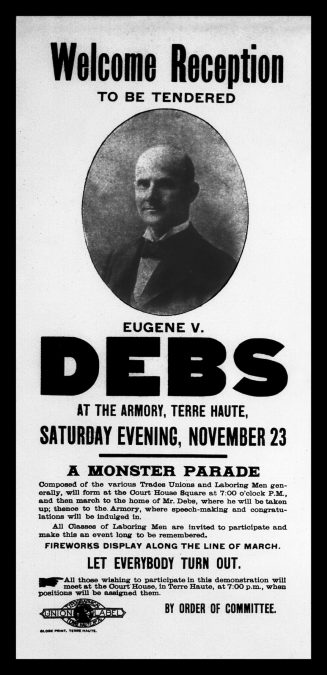
A flyer for Debs’s welcome home parade after his release from Woodstock jail in 1895.
Actually, Debs was a well-loved middle-class kid that dropped out of school in his early teens to pursue a career as a railroader, attending business school in his spare time. Then he worked as a warehouseman and bookkeeper for a large grocery wholesaler.
He was elected the city clerk of Terre Haute, Indiana at the age of twenty-four, served two terms in that capacity, and was elected to the Indiana state legislature as a Democrat before he was thirty. A skilled public speaker who actively studied the orator’s art, he was a golden boy of the Democratic Party of Indiana. His future was bright.
He became a top functionary of the Brotherhood of Locomotive Firemen in the early 1880s. This was not a modern union that engaged in collective bargaining, but was rather a fraternal benefit society that provided low-cost insurance to its members, and which published a magazine which attempted to edify the rough-hewn firemen. Debs was the chief money manager and the magazine editor for this organization for more than a decade, and he was very well compensated for his services.
Debs began life as a pro-labor Democrat with a very modest, thoroughly parochial worldview. He introduced pro-labor legislation in the Indiana legislature and saw it gutted. He lost his faith in the Democratic Party, hitching his wagon to the emerging People’s Party as a more forthright vessel for his views.
He also, as an active and talented labor magazine editor, watched the emerging strike movement with open eyes and gained class consciousness watching the battles of underpaid and physically abused railway workers against the powerful companies they worked for.
That’s the really interesting storyline of Debs Volume 1 — what he was and what he gradually became.
SG
The vast majority of the material in the first two volumes hasn’t been published since their original appearance. Were there any particular selections that stood out to you as encapsulating the young Debs?
TD
His first truly great, epochal, landmark, everybody-should-read-it speech came when he was released from Woodstock jail, delivered at the National Guard armory in Chicago in 1895, and published and republished and republished again under the title “Liberty.” But I will really need to think hard to figure out a single piece that epitomizes his early ideas about individualistic self-improvement.
For now I guess a tiny little Locomotive Firemen’s Magazine piece from June 1882 called “Sand” gets us there. Here is part of it:
Sand means grit; it means the power to hold on. When an engine is called upon to exert its greatest strength it needs sand to give it a better grip on the track. When men are called upon to exert their greatest mental strength, sand is necessary. Men who have plenty of sand in their boxes never slip on the path of duty. Wet weather and greasy tracks do not affect them, their sand will not let them fail…. Be it at the bedside of the suffering or in the wild rush of the midnight train, the man of sand does what he is called upon to do, quickly, calmly, boldly — no quiver in his iron nerve. Death alone can conquer the man of sand.
That’s early Debs in 125 words.
Now, the thing that really interests me from the first volume of the Selected Works, speaking as a historian and a socialist, isn’t the output of the early Debs so much as his first, failed effort to federate the various railway brotherhoods into a de facto single entity under the aegis of the Supreme Council of the United Orders of Railway Employees. The railway brotherhoods gradually transformed from fraternal benefit societies to true trade unions during the course of the 1880s.
The failure of the 1888 Burlington Railroad strike due to strikebreakers and the inability of the craft brotherhoods of the so-called “running trades” — engineers, firemen, conductors, and brakemen, together with their rowdy cousins, the switchmen — to remain united and win this long and bitter work stoppage fundamentally changed Debs’s thinking.
He moved from becoming a simple labor editor and started becoming a true labor organizer, attempting to build a structure that would bring these stodgy and independently minded brotherhoods together under a single commanding staff, composed of a committee of their own elected leaders, that could issue simultaneous strike instructions and hold together these different trades in a single phalanx that could actually win such a strike.
The best paid crafts — the conservative, anti-strike engineers and conductors — refused to join. Then the brakemen and the switchmen got into a nasty jurisdictional battle, and the whole Supreme Council idea suffered an ignominious collapse.
SG
And then out of this grew the American Railway Union (ARU), which dominates the second volume. Can you talk about the ARU, the Great Northern strike, and then the most monumental of walkouts, the 1894 Pullman Strike?
TD
The ARU was a pioneering attempt at true industrial unionism — bringing together workers of all crafts within a single industrial group. Debs, in this period, was not thinking in terms of politics, he was committed to labor organization to go to battle with capital on the industrial field.
The successful Great Northern strike of April 1894, settled in favor of the ARU by arbitration, reinforced in Debs the belief that he was on the right track with the ARU idea. United action brought the Great Northern Railroad to the bargaining table, and Debs cleverly agreed to accept binding arbitration by a body which included leading shippers of the region.
Unable to have federal troops dispatched to settle the strike by force, Great Northern president James J. Hill agreed to the arbitration scheme. Much to his chagrin, the arbitrators ruled against his wage rollback, and Debs was hailed as a hero.
To some extent this early victory set up the devastating, union-crushing loss of the Pullman Strike of the summer of 1894. Delegates to the regularly scheduled “First Quadrennial Convention” in June were overconfident; the railroads, on the other hand, were united by a loathing of the new industrial union. They feared the consequences down the road if early success was allowed.
The ARU ended up walking into a buzzsaw and was annihilated by the alliance of railroad managers, the federal government and its military, and a pliable federal bench.
SG
Debs ended up in prison for his role in the Pullman Strike, which became one of the central stories in the myths surrounding his conversion to socialism and subsequent exploits. Could you talk about Debs’s tendency to encourage this mythmaking? What do we actually know about his move toward socialism?
TD
Debs was a massive figure in the history of American socialism and worthy of great honor, so don’t get me wrong here, but Debs definitely scattered misinformation over the course of his life. He pretended to have won a Bible as a prize for excellent spelling as a schoolboy but never to have read it. “Read and Obey!” his teacher wrote in it. “I never did either!” Debs added, telling the story to friends.
In reality, Debs absolutely cannot be understood outside the context of the Protestant social gospel movement of this era. He was well versed in the Bible, and believed that the life and words of the historical Jesus had important lessons to teach to the modern man. He was, to my way of thinking, the most radical of Christian socialists.
This doesn’t make Debs a good guy or a bad guy, but it was deeply a part of who he was.
Similarly, Debs was not always a reliable narrator of his social origins, his early aspirations, the reasons he left one profession for another, the story of his conversion to socialism, and so forth. He was not a liar or a megalomaniac or a falsifier, but he had his own particular slightly skewed truth. The two main biographers — Ray Ginger and Nick Salvatore — have caught on to this. Read them closely and think if you really want to understand the essence of the man.
Again, this doesn’t lessen Debs’s achievements in the slightest. But don’t confuse hagiography with biography. There is plenty of the former as well as the latter.
In terms of Debs’s commitment to socialism, we know that he and his ARU comrades had books by Laurence Gronlund and Karl Kautsky, and constituted themselves the “Cooperative Colony of Liberty Jail,” so you will forgive me for rolling my eyes when Debs thanks the most powerful figure in the Socialist Party of that time, Victor Berger, in a high-profile article published six years after his release thanking him for his conversion via a signed copy of Marx’s Capital.
Did Debs himself believe the story he told? Probably. Does the evidence support it? No.
SG
Looking ahead, I was wondering if you had any thoughts about the upcoming volumes? I know the third is due out this winter.
TD
Here’s what’s coming down the pike:
Volume 3 is subtitled The Path to a Socialist Party, 1897–1904. That pretty much sums up the main story arch, beginning with Debs’s public declaration that he was a socialist on January 1, 1897 through to the end of his second run for president in 1904.
This is a book for the political junkies and the historians of socialist organizational structure. I eat this stuff up, personally. It’s a story of half-baked utopian schemes and fledgling political parties and interpersonal, interorganizational machinations leading to the rarest of all birds: socialist unification, rather than split.
What readers will learn is that Debs was not the father of the Socialist Party of America. He quickly came to embrace the new party and dedicated the rest of his life to it, mind you, but he was not the intellectual father or the founder, or really much more than a disgruntled, defeated factionalist at the moment of its creation.
It’s a pretty interesting story, one that has been more or less missed by the biographers, but one that becomes very clear with the documents. This volume still needs to be indexed, but should be out on schedule in December.
Volume 4 is subtitled Red Union, Red Paper, Red Train, 1905–1910 and deals largely with those three things: the red union being the founding of the Industrial Workers of the World (IWW), the red paper being the Appeal to Reason and Debs’s high profile as a contributor to that mass circulation publication, and the red train being his legendary 1908 presidential campaign side by side with his brother, friend, and co-thinker Theo Debs. I’m guessing this will be out in the middle of 2021.
Volume 5, my current focus, is subtitled Breakthroughs and Breakdowns, 1911–1916. This one will deal with Debs’s reaction to the Socialist Party as a successful mass political party, with hundreds of elected officials nationwide. Then comes the fascinating campaign of 1912 — which was really the Socialist Party’s best chance to win, the Republican Party having split between incumbent president William Taft and former president Theodore Roosevelt. This volume will deal not only with the breakdown of socialist unity but with Debs’s own health breakdowns — his first two of three “nervous breakdowns.” This one will probably roll out at the end of 2021.
Volume 6 is subtitled The Perils of Pacifism, 1917–1926 and will deal largely with Debs’s anti-militarist writing, his imprisonment, his fifth and final presidential campaign from behind prison bars, and his work as an advocate for political prisoners and prison reform in the aftermath.
It will also deal extensively with his reaction to the Bolshevik Revolution and the foundation of the American communist movement. This book will include a decade’s worth of output whereas all the other volumes are about half a decade, but Debs was in jail for two and a half of these years, and his output dwindled as his health declined, so I think we’ll be able to pull it off. This will be a 2022 publication.
I hope that the Selected Works of Eugene V. Debs project helps in some small way to restore Gene Debs to the ranks of American socialist writers and commentators. I have a feeling it might. Debs as a writer and orator has been given short shrift, I believe — he had something to say and a style of saying it, and ideas about democracy and liberty and solidarity and empowerment that should resonate today. Liberty and freedom are authentic left-wing concepts — we need to embrace them and stop surrendering these ideas to the Right. They are the oppressors, not us.
Debs’s life has been held up as an exemplar of commitment and honor and virtue and incorruptibility. When we look at these things with the historian’s magnifying glass, that may be an oversimplification of a complex and flawed human being, but that’s okay — graded on a curve, Debs still earns his A+ as a committed fighter and willing martyr for a great cause. The new generation taking a good look at our collective past, at the life and ideas of Gene Debs and people of his milieu like Morris Hillquit and even Victor Berger, is all for the good.
There is a valid American socialist tradition which needs to be discovered and embraced. Our past powers the future.
He was elected the city clerk of Terre Haute, Indiana at the age of twenty-four, served two terms in that capacity, and was elected to the Indiana state legislature as a Democrat before he was thirty. A skilled public speaker who actively studied the orator’s art, he was a golden boy of the Democratic Party of Indiana. His future was bright.
He became a top functionary of the Brotherhood of Locomotive Firemen in the early 1880s. This was not a modern union that engaged in collective bargaining, but was rather a fraternal benefit society that provided low-cost insurance to its members, and which published a magazine which attempted to edify the rough-hewn firemen. Debs was the chief money manager and the magazine editor for this organization for more than a decade, and he was very well compensated for his services.
Debs began life as a pro-labor Democrat with a very modest, thoroughly parochial worldview. He introduced pro-labor legislation in the Indiana legislature and saw it gutted. He lost his faith in the Democratic Party, hitching his wagon to the emerging People’s Party as a more forthright vessel for his views.
He also, as an active and talented labor magazine editor, watched the emerging strike movement with open eyes and gained class consciousness watching the battles of underpaid and physically abused railway workers against the powerful companies they worked for.
That’s the really interesting storyline of Debs Volume 1 — what he was and what he gradually became.
SG
The vast majority of the material in the first two volumes hasn’t been published since their original appearance. Were there any particular selections that stood out to you as encapsulating the young Debs?
TD
His first truly great, epochal, landmark, everybody-should-read-it speech came when he was released from Woodstock jail, delivered at the National Guard armory in Chicago in 1895, and published and republished and republished again under the title “Liberty.” But I will really need to think hard to figure out a single piece that epitomizes his early ideas about individualistic self-improvement.
For now I guess a tiny little Locomotive Firemen’s Magazine piece from June 1882 called “Sand” gets us there. Here is part of it:
Sand means grit; it means the power to hold on. When an engine is called upon to exert its greatest strength it needs sand to give it a better grip on the track. When men are called upon to exert their greatest mental strength, sand is necessary. Men who have plenty of sand in their boxes never slip on the path of duty. Wet weather and greasy tracks do not affect them, their sand will not let them fail…. Be it at the bedside of the suffering or in the wild rush of the midnight train, the man of sand does what he is called upon to do, quickly, calmly, boldly — no quiver in his iron nerve. Death alone can conquer the man of sand.
That’s early Debs in 125 words.
Now, the thing that really interests me from the first volume of the Selected Works, speaking as a historian and a socialist, isn’t the output of the early Debs so much as his first, failed effort to federate the various railway brotherhoods into a de facto single entity under the aegis of the Supreme Council of the United Orders of Railway Employees. The railway brotherhoods gradually transformed from fraternal benefit societies to true trade unions during the course of the 1880s.
The failure of the 1888 Burlington Railroad strike due to strikebreakers and the inability of the craft brotherhoods of the so-called “running trades” — engineers, firemen, conductors, and brakemen, together with their rowdy cousins, the switchmen — to remain united and win this long and bitter work stoppage fundamentally changed Debs’s thinking.
He moved from becoming a simple labor editor and started becoming a true labor organizer, attempting to build a structure that would bring these stodgy and independently minded brotherhoods together under a single commanding staff, composed of a committee of their own elected leaders, that could issue simultaneous strike instructions and hold together these different trades in a single phalanx that could actually win such a strike.
The best paid crafts — the conservative, anti-strike engineers and conductors — refused to join. Then the brakemen and the switchmen got into a nasty jurisdictional battle, and the whole Supreme Council idea suffered an ignominious collapse.
SG
And then out of this grew the American Railway Union (ARU), which dominates the second volume. Can you talk about the ARU, the Great Northern strike, and then the most monumental of walkouts, the 1894 Pullman Strike?
TD
The ARU was a pioneering attempt at true industrial unionism — bringing together workers of all crafts within a single industrial group. Debs, in this period, was not thinking in terms of politics, he was committed to labor organization to go to battle with capital on the industrial field.
The successful Great Northern strike of April 1894, settled in favor of the ARU by arbitration, reinforced in Debs the belief that he was on the right track with the ARU idea. United action brought the Great Northern Railroad to the bargaining table, and Debs cleverly agreed to accept binding arbitration by a body which included leading shippers of the region.
Unable to have federal troops dispatched to settle the strike by force, Great Northern president James J. Hill agreed to the arbitration scheme. Much to his chagrin, the arbitrators ruled against his wage rollback, and Debs was hailed as a hero.
To some extent this early victory set up the devastating, union-crushing loss of the Pullman Strike of the summer of 1894. Delegates to the regularly scheduled “First Quadrennial Convention” in June were overconfident; the railroads, on the other hand, were united by a loathing of the new industrial union. They feared the consequences down the road if early success was allowed.
The ARU ended up walking into a buzzsaw and was annihilated by the alliance of railroad managers, the federal government and its military, and a pliable federal bench.
SG
Debs ended up in prison for his role in the Pullman Strike, which became one of the central stories in the myths surrounding his conversion to socialism and subsequent exploits. Could you talk about Debs’s tendency to encourage this mythmaking? What do we actually know about his move toward socialism?
TD
Debs was a massive figure in the history of American socialism and worthy of great honor, so don’t get me wrong here, but Debs definitely scattered misinformation over the course of his life. He pretended to have won a Bible as a prize for excellent spelling as a schoolboy but never to have read it. “Read and Obey!” his teacher wrote in it. “I never did either!” Debs added, telling the story to friends.
In reality, Debs absolutely cannot be understood outside the context of the Protestant social gospel movement of this era. He was well versed in the Bible, and believed that the life and words of the historical Jesus had important lessons to teach to the modern man. He was, to my way of thinking, the most radical of Christian socialists.
This doesn’t make Debs a good guy or a bad guy, but it was deeply a part of who he was.
Similarly, Debs was not always a reliable narrator of his social origins, his early aspirations, the reasons he left one profession for another, the story of his conversion to socialism, and so forth. He was not a liar or a megalomaniac or a falsifier, but he had his own particular slightly skewed truth. The two main biographers — Ray Ginger and Nick Salvatore — have caught on to this. Read them closely and think if you really want to understand the essence of the man.
Again, this doesn’t lessen Debs’s achievements in the slightest. But don’t confuse hagiography with biography. There is plenty of the former as well as the latter.
In terms of Debs’s commitment to socialism, we know that he and his ARU comrades had books by Laurence Gronlund and Karl Kautsky, and constituted themselves the “Cooperative Colony of Liberty Jail,” so you will forgive me for rolling my eyes when Debs thanks the most powerful figure in the Socialist Party of that time, Victor Berger, in a high-profile article published six years after his release thanking him for his conversion via a signed copy of Marx’s Capital.
Did Debs himself believe the story he told? Probably. Does the evidence support it? No.
SG
Looking ahead, I was wondering if you had any thoughts about the upcoming volumes? I know the third is due out this winter.
TD
Here’s what’s coming down the pike:
Volume 3 is subtitled The Path to a Socialist Party, 1897–1904. That pretty much sums up the main story arch, beginning with Debs’s public declaration that he was a socialist on January 1, 1897 through to the end of his second run for president in 1904.
This is a book for the political junkies and the historians of socialist organizational structure. I eat this stuff up, personally. It’s a story of half-baked utopian schemes and fledgling political parties and interpersonal, interorganizational machinations leading to the rarest of all birds: socialist unification, rather than split.
What readers will learn is that Debs was not the father of the Socialist Party of America. He quickly came to embrace the new party and dedicated the rest of his life to it, mind you, but he was not the intellectual father or the founder, or really much more than a disgruntled, defeated factionalist at the moment of its creation.
It’s a pretty interesting story, one that has been more or less missed by the biographers, but one that becomes very clear with the documents. This volume still needs to be indexed, but should be out on schedule in December.
Volume 4 is subtitled Red Union, Red Paper, Red Train, 1905–1910 and deals largely with those three things: the red union being the founding of the Industrial Workers of the World (IWW), the red paper being the Appeal to Reason and Debs’s high profile as a contributor to that mass circulation publication, and the red train being his legendary 1908 presidential campaign side by side with his brother, friend, and co-thinker Theo Debs. I’m guessing this will be out in the middle of 2021.
Volume 5, my current focus, is subtitled Breakthroughs and Breakdowns, 1911–1916. This one will deal with Debs’s reaction to the Socialist Party as a successful mass political party, with hundreds of elected officials nationwide. Then comes the fascinating campaign of 1912 — which was really the Socialist Party’s best chance to win, the Republican Party having split between incumbent president William Taft and former president Theodore Roosevelt. This volume will deal not only with the breakdown of socialist unity but with Debs’s own health breakdowns — his first two of three “nervous breakdowns.” This one will probably roll out at the end of 2021.
Volume 6 is subtitled The Perils of Pacifism, 1917–1926 and will deal largely with Debs’s anti-militarist writing, his imprisonment, his fifth and final presidential campaign from behind prison bars, and his work as an advocate for political prisoners and prison reform in the aftermath.
It will also deal extensively with his reaction to the Bolshevik Revolution and the foundation of the American communist movement. This book will include a decade’s worth of output whereas all the other volumes are about half a decade, but Debs was in jail for two and a half of these years, and his output dwindled as his health declined, so I think we’ll be able to pull it off. This will be a 2022 publication.
I hope that the Selected Works of Eugene V. Debs project helps in some small way to restore Gene Debs to the ranks of American socialist writers and commentators. I have a feeling it might. Debs as a writer and orator has been given short shrift, I believe — he had something to say and a style of saying it, and ideas about democracy and liberty and solidarity and empowerment that should resonate today. Liberty and freedom are authentic left-wing concepts — we need to embrace them and stop surrendering these ideas to the Right. They are the oppressors, not us.
Debs’s life has been held up as an exemplar of commitment and honor and virtue and incorruptibility. When we look at these things with the historian’s magnifying glass, that may be an oversimplification of a complex and flawed human being, but that’s okay — graded on a curve, Debs still earns his A+ as a committed fighter and willing martyr for a great cause. The new generation taking a good look at our collective past, at the life and ideas of Gene Debs and people of his milieu like Morris Hillquit and even Victor Berger, is all for the good.
There is a valid American socialist tradition which needs to be discovered and embraced. Our past powers the future.
4pm ET TODAY join the Movement for a People's Party for their virtual convention
At 4pm ET TODAY
join the Movement for a People's Party for their virtual convention!
Speakers include Cornel West, Nina Turner, Marianne Williamson, Mike Gravel, Chris Hedges, Eleanor Goldfield, Jimmy Dore, Danny Glover, and clips from Lee Camp (me) and others.
It's free to attend. Spread the word.
Keep fighting!
- Lee

(You can also view this email in your browser.)
All rights reserved.
Click to subscribe to Redacted Tonight youtube page.
Click to unsubscribe from this mailing list.

ReplyForward
(You can also view this email in your browser.)
All rights reserved.
Click to subscribe to Redacted Tonight youtube page.
Click to unsubscribe from this mailing list.
ReplyForward
FLASHBACK: Ed Markey's Battles With Wall Street
The Democrat facing a tough primary is known for the Green New Deal — but a classic book notes that he also was "farther ahead of the curve on the financial crisis than almost any elected official."

David Sirota
Aug 31


Editor’s Note: Today we are launching a new occasional feature called FLASHBACK. Each edition will be an unearthed story from history that remains relevant today. This is the first installment. Please provide feedback on this new feature in the comments below! - D

The Democratic establishment is trying to kick Ed Markey out of the Senate in tomorrow’s Massachusetts primary. It is difficult to overstate how devastating a Markey loss would be. Joe Kennedy III defeating the working-class author of the Green New Deal during a climate crisis would make 2020 an even worse year than it has already been.
Markey, though, is not merely a Johnny-come-lately or a good environmental legislator — you can detect his deeper commitment to economic justice by taking a look back on his career as one of the lawmakers willing to wage the toughest possible fight in Congress: the battle to prevent Wall Street’s takeover of our economy.
This key part of Markey’s career is lost history — but it is the most revelatory because combating the financial industry is not like any other policy battle for a Democrat. It is not like taking on the fossil fuel industry or the gun industry, which has gone all-in with the Republican Party. Being a Democrat and challenging Wall Street means going up against both the GOP and your own Democratic Party, which has its own deep and lucrative ties to a financial industry that bankrolls the party’s candidates.
This is why so many Democrats have gone along with schemes to deregulate Wall Street. It probably has something to do with Kennedy refusing to co-sponsor legislation to repeal the special “carried interest” tax break for the hedge fund industry whose donors have supported him — until he was called out in the press. And it is definitely why so few Democratic lawmakers question Wall Street’s supremacy.
Markey, though, has often been one of those few. He was one of just a handful of lawmakers who voted against deregulation in the late 1990s and who co-sponsored a bill to end the carried interest tax loophole. He also was the guy sounding an early-warning alarm about the risky derivatives that were boosting Wall Street profits before they helped blow up the economy during the financial crisis.
Ron Suskind’s classic book Confidence Men — which is about the Obama-era fight over financial reform — tells that forgotten story. Suskind notes that “Markey could bid fair claim to being farther ahead of the curve on the financial crisis than almost any elected official in Washington.”
Back in the early months of Obama’s first term, Markey led the battle to prevent Wall Street firms from using taxpayer bailout money to pay their executives huge bonuses. Here’s the press release from Markey’s office at the time:
“This is complete March madness. You don’t blow the big game and then still get a trophy,” said Markey. “Not one single penny of taxpayer funds should be used to reward the reckless executives whose irresponsible risk-taking has done massive damage to our economy. And this bill will ensure that they are not rewarded.”...
The Bonus Recoupment Tax Bill will impose a 90 percent tax on bonuses for those individuals earning more than $250,000 at companies that have received at least $5 billion in government funds from the Troubled Asset Relief Program.
From 1987 to 1995, Rep. Markey was the chairman of the House Subcommittee on Telecommunications and Finance. In that role, Markey held five oversight hearings on the risks financial derivatives posed to the markets. He then introduced The Derivatives Market Reform Act of 1994, a bill which would have regulated derivatives transactions by affiliates of insurance companies like AIG to protect the financial system. Markey introduced similar legislation in 1995, 1999 and 2008, but it never was adopted due to opposition from the Republican majority and the financial services industry.
Importantly, Markey led this fight even as President Obama was trying to fight off the bonus tax proposal after having just run a campaign that had raked in more Wall Street money than any previous candidate in the history of presidential campaigns. So it took a lot of guts for Markey to fight the good fight.
In Confidence Men, Markey recounts how he realized Wall Street’s schemes were getting out of control right after the 1987 stock market crash.
“Something very basic, very fundamental, had changed on the Street, and we on the subcommittee couldn’t put a finger on what was different,” Markey said. He recounted how one of the major Wall Street figures convicted of securities fraud in that era would tell lawmakers that finance industry executives “figured out how to turn the investing of other people’s money into a kind of game, where they were constantly changing the rules in a way that was subtly fraudulent, against the basic principles of fairness or fiduciary duty.”
No doubt, Markey hasn’t opposed every bill Wall Street has wanted — he voted for the 2008 emergency bailout and both he and Kennedy supported the recent CARES Act coronavirus relief legislation that provided a giant bailout to corporate America. But he (and Kennedy) also most recently opposed bipartisan legislation to roll back the modest Dodd-Frank reforms passed in the wake of the financial crisis.
The financial industry has near-complete control of Washington — and its moguls are right now funding both sides of the national election as Wall Street continues growing ever-larger and more powerful. In light of that, the Massachusetts race is a proxy battle over the whole issue of plutocracy.
If Democratic voters nominate Kennedy, they will be rewarding a wealthy scion whose closing ad promotes a Game of Thrones-style argument effectively insisting that his lineage makes him the One True King of Massachusetts.
If voters instead choose Markey, they will help keep a crucial Senate seat in the hands of a legislator who has been willing to challenge the most powerful industry on the planet as it tries to swallow our entire economy.
In this age of oligarchy, that would be no small thing.
SENATE DEMOCRATS’ NEW CLIMATE REPORT DISAPPOINTS
https://popularresistance.org/senate-dems-new-climate-report-disappoints/
By Marlee Kokotovic, Nation of Change.
August 30, 2020
| EDUCATE!
“The Report Fails To Address The Vital Need To End The Extraction, Processing, And Burning Of Fossil Fuels, And Instead Sees A Future For Fossil Fuels Tied To The False Promise Of Carbon Capture.”
Senate Democrats released a climate action report earlier this week leaving green groups, environmental activists, and progressive campaigners disappointed.
Critics of the report are saying there is not nearly enough action involved to fight the threat of global heating that is caused by human activity.
Senate Democrats are calling the report “The Case for Climate Action: Building a Clean Economy for the American People” and only mentions the Green New Deal, that was created last year, once in their report.
According to Common Dreams, the newly-released report, which is the result of dozens of hearings and closed-door meetings, calls on the government to spend over $400 billion annually with the goal of eliminating greenhouse gas emissions by the year 2050. It also aims to create at least 10 million new U.S. jobs in clean energy manufacturing, research, and development, while reforming lobbying laws to curtail the outsize influence of the fossil fuel industry.
“We have the opportunity to build more and better jobs for the American people, jobs that’ll help re-stimulate the economy and aid in our transition to clean energy. When Democrats retake the majority in the Senate, we will unify to move swiftly on legislation to tackle the climate crisis,” he added. “Passing climate legislation will be a top priority for Senate Democrats and me,” says Senate Minority Leader Chuck Schumer (D-N.Y.).
Climate activists, however, blast the report saying it inadequate tackles one of the greatest threats to Earth’s future.
“[The report] fails to address the vital need to end the extraction, processing, and burning of fossil fuels, and instead sees a future for fossil fuels tied to the false promise of carbon capture. It even fails to include a call to ban new fossil fuel extraction on public lands, a position that was endorsed by virtually all candidates in the Democratic presidential primary,” states Mitch Jones, director of policy for Food & Water Action.
| EDUCATE!
“The Report Fails To Address The Vital Need To End The Extraction, Processing, And Burning Of Fossil Fuels, And Instead Sees A Future For Fossil Fuels Tied To The False Promise Of Carbon Capture.”
Senate Democrats released a climate action report earlier this week leaving green groups, environmental activists, and progressive campaigners disappointed.
Critics of the report are saying there is not nearly enough action involved to fight the threat of global heating that is caused by human activity.
Senate Democrats are calling the report “The Case for Climate Action: Building a Clean Economy for the American People” and only mentions the Green New Deal, that was created last year, once in their report.
According to Common Dreams, the newly-released report, which is the result of dozens of hearings and closed-door meetings, calls on the government to spend over $400 billion annually with the goal of eliminating greenhouse gas emissions by the year 2050. It also aims to create at least 10 million new U.S. jobs in clean energy manufacturing, research, and development, while reforming lobbying laws to curtail the outsize influence of the fossil fuel industry.
“We have the opportunity to build more and better jobs for the American people, jobs that’ll help re-stimulate the economy and aid in our transition to clean energy. When Democrats retake the majority in the Senate, we will unify to move swiftly on legislation to tackle the climate crisis,” he added. “Passing climate legislation will be a top priority for Senate Democrats and me,” says Senate Minority Leader Chuck Schumer (D-N.Y.).
Climate activists, however, blast the report saying it inadequate tackles one of the greatest threats to Earth’s future.
“[The report] fails to address the vital need to end the extraction, processing, and burning of fossil fuels, and instead sees a future for fossil fuels tied to the false promise of carbon capture. It even fails to include a call to ban new fossil fuel extraction on public lands, a position that was endorsed by virtually all candidates in the Democratic presidential primary,” states Mitch Jones, director of policy for Food & Water Action.
Subscribe to:
Comments (Atom)