Sunday, August 30, 2020

Chris Hedges -- Why We Must Break Away From Two Party System


https://www.youtube.com/watch?v=TXl3jJTV5CU


COVID-19 outbreaks continue unabated at schools, putting millions at risk


https://www.wsws.org/en/articles/2020/08/29/reop-a29.html

By Renae Cassimeda
29 August 2020

The past week has seen a deepening of the disastrous crisis surrounding the reopening of schools. As outbreaks continue to erupt and cases rise throughout the country, the ruling class has made made clear it will march teachers, students and their families toward death in the homicidal policy of reopening of the schools, a linchpin to fully reopening the economy.

One of the biggest lies advanced by the Trump administration to justify reopening schools is that children are less susceptible to COVID-19 or at low risk of facing serious repercussions. Yet in the last month, as more schools and districts have opened their doors to in-person instruction, more than 74,000 children in the US tested positive for the coronavirus, a 21 percent increase between August 6 and August 20.

Over the past two weeks, significant outbreaks have occurred in schools throughout multiple states.

Florida, which has reported a total of 615,806 COVID-19 cases and 11,009 deaths since the onset of the pandemic, recently confirmed that within 15 days of schools reopening almost 9,000 new COVID-19 cases in the state have been among children. During this time, the number of children hospitalized due to COVID-19 rose from 436 to 602, and one more child died from the virus, bringing the state’s total number of child deaths to eight.

Texas has reported a total of 624,513 cases and a staggering 12,439 deaths. Several districts throughout the state that have reopened have reported cases in recent weeks, including over 150 school employees in districts throughout Central Texas. Burnet CISD reported three positive COVID-19 cases August 27, with eight students placed in quarantine. On August 19, Leander Independent School District announced that one of its employees at Akin Elementary School died “from complications due to COVID.”

Mississippi has reported a total of 81,294 COVID-19 cases and 2,413 deaths. There have been reports of positive cases at over 720 schools in 74 of the state's 82 counties, which is 90 percent of the K-12 schools in the state that have recently opened to in-person instruction.

Biloxi High School recently reported that fifteen students tested positive, placing 324 students in quarantine. The school will shift to online classes until after Labor Day. The entire fourth grade class, or 200 students, at Lafayette Upper Elementary School has been quarantined for two weeks after one student and six fourth grade teachers tested positive for the virus last Monday.

The disastrous conditions unfolding in schools throughout the US are taking place as the Centers for Disease Control and Prevention (CDC), the Trump administration, and state governments are systematically working to curtail testing and censor outbreaks. Recently modified testing guidelines from the CDC have dropped recommendations for all those who have been exposed to someone with COVID-19 to get tested.

The change in CDC guidelines will have immense implications and further spread the pandemic throughout schools, workplaces, homes and communities. Undermining the validity of their new guidelines, the CDC itself has estimated that 50 percent of coronavirus transmission occurs before symptoms appear, with an upper-end estimate as high as 70 percent.

The official position of the Trump administration is to carry out less testing and cook the numbers in order to make it appear as if positive cases are declining.

School district and state officials are implementing additional measures to cover up the spread of COVID-19 in the schools. Citing the protection of “medical privacy,” a growing number of states and school districts across the US—from Maine to Virginia, Oklahoma, California, Alabama, Pennsylvania, Georgia, and Florida—are deliberately concealing COVID-19 outbreaks in reopened schools from the public.

In Florida, state officials are encouraging districts not to report cases and Republican Governor Ron DeSantis retracted a report by his own administration showing large infections among schools, which had been released to the public. Desantis demanded the report be redacted arguing that the school-related data was “misrepresented” to the public. DeSantis falsely claimed, “It was acting like this was something that was triggered by the school year, which is totally not true.”

The Duval County Department of Health in Florida instructed schools not to publish “school specific data related to COVID-19” without their permission. As a result, the district’s public dashboard of cases went static. The action by the county was taken after 24 cases were reported in the schools within the first three days of in-person instruction.

There is immense opposition to these criminal and deadly policies. The Educators’ Rank-and-File Safety Committee has begun holding weekly meetings to organize this opposition and strategize a way forward. All educators, workers, students, and parents who are committed to stopping the deadly reopening of schools should attend today’s call-in meeting at 3:00 PM Eastern Daylight Time.

From the beginning, we have warned that the Democratic-led states and cities that have announced plans to start the school year under a fully online model would implement in-person learning as quickly as possible. The decision by some districts to start the school year fully online, worked out in conjunction with the teacher unions, is proving to be a delaying tactic to bide time to implement a full reopening.

Multiple districts in Southern California are planning to reopen schools to in-person instruction in the coming weeks and months. San Diego Unified School District recently reached a tentative agreement with the San Diego Education Association which allows for one-on-one or small group TK-5 appointments on site. Sweetwater Union High School District will be online until October 2, but will have a plan for reopening in-person instruction by September 20.

Chula Vista Elementary School District in Southern California will start mostly online August 31. However, the district is starting an in-school academic enrichment program tentatively scheduled for September 8 for the children of essential workers (including staff), and homeless and foster youth.

Detroit Public Schools, Michigan’s largest school district, reached a sellout agreement Thursday with the Detroit Federation of Teachers (DFT), which sets terms for reopening schools to in-person instruction in the coming weeks. Under this agreement, 20 percent of the student population will start the school year with face-to-face instruction. The district will maintain paltry and inadequate safety measures such as temperature checks, social distancing, and mask wearing, and only certain students will be offered COVID-19 tests.

Underscoring the immense opposition to these policies, a staggering 85 percent of Detroit teachers opted for online teaching for the start of the semester until November 11. The remaining fifteen percent of teachers will be required to be at school sites to teach face-to-face. This Letter of Agreement does nothing to protect the lives of teachers and students, and runs roughshod over last week’s massive 91 percent vote in favor of holding a “safety strike.” The DFT stands completely exposed as an enemy of teachers and education workers.

In Hawaii, a one-week, in-person orientation for all students and staff resulted in multiple positive cases throughout Hawaii Public Schools. The district will remain mostly online until September 21, while schools will remain open to in-person instruction for certain Special Education classes and have staff report to school sites for work. Due to a spike in cases on the island of Oahu, Governor Ige issued an emergency shutdown throughout the island, yet the Department of Education, which includes all public schools, will remain open.

In New York City, the nation’s largest school district, a hybrid model is planned for its reopening. As of this week, there are still not enough teachers signed up for online teaching to meet the needs of hundreds of thousands of students who have opted for remote learning. The plan requires each class to have one teacher for in-person and one for online instruction, causing understaffing in virtual classrooms.

Last week, United Federation of Teachers (UFT) President Michael Mulgrew said that he might call a strike if the reopened schools prove to be unsafe, i.e., after outbreaks are already confirmed.

The commonality of the two capitalist parties pervades in the drive to reopen schools. From “Red” to “Blue” states, from DeSantis to Newsom, the same murderous policies are being carried out, with the unions facilitating this process wherever they have a presence. Independent organizations of struggle must be built in each district to put an immediate stop to school reopenings.

The Educators’ Rank-and-File Safety Committee has been formed to coordinate and facilitate the building of a network of rank-and-file safety committees in every school and neighborhood to organize the immense opposition to the murderous plan to reopen schools. All those who agree with this perspective should contact us today, join our Facebook group and make plans to attend our next online call-in meeting today, August 29. Register today and share the event widely with your coworkers!

Saturday, August 29, 2020

Johnny Carson Also Mocked Trump


https://www.youtube.com/watch?v=jU25NAT9xkU


George Lopez will be at United to Save the Vote


https://www.youtube.com/watch?v=2W7CQfctcfQ


EU imposes sanctions on Lukashenko as strikes continue in Belarus


https://www.wsws.org/en/articles/2020/08/29/bela-a29.html
By Alex Lantier
29 August 2020

After a two-day summit in Berlin, European Union (EU) foreign ministers voted yesterday to impose sanctions on top Belarusian officials. The EU accuses these as-yet unnamed officials of helping incumbent President Aleksandr Lukashenko steal the August 8 presidential election and crack down on protests against the election outcome. Three people died in the crackdown, which provoked an ongoing wave of strikes and protests at factories and schools across Belarus.

EU foreign policy chief Josep Borrell said around 20 Belarusian officials or perhaps more could be targeted. The EU, wrote the German daily Sueddeutsche Zeitung, “wants to intensify pressure on the country’s leaders and give a sign of solidarity with the people of Belarus.”
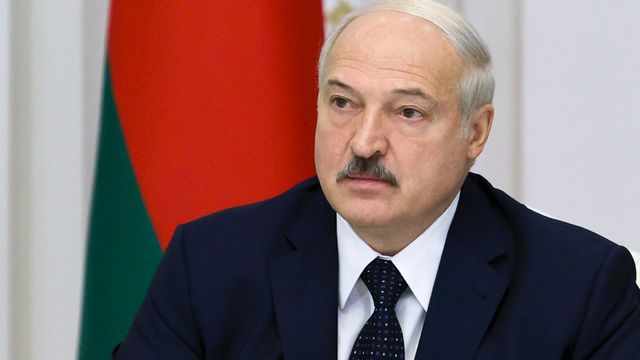
Belarusian President Alexander Lukashenko speaks during a meeting with officials in Minsk, Belarus, August 27, 2020 [Credit: Sergei Sheleg, BelTA Pool via AP]

Conflicts erupted at the summit, however, over the EU decision not to sanction Lukashenko, who is responsible for the policies it is supposedly condemning. Lithuanian Foreign Minister Linas Antanas Linkevičius, whose government is offering protection and asylum to Belarusian opposition presidential candidate Svetlana Tikhonovskaya, said the EU reaction is “too symbolic. … This definitely does not go far enough. This is not a serious reaction.”

The EU’s vote is a clumsy, hypocritical attempt to maximize its influence in Belarus, while dealing with an event that is largely unexpected and unwelcome in EU circles: an initial intervention of the working class into political life in a former Soviet republic.

Yesterday, German Chancellor Angela Merkel said the Belarusian people are fighting for rights to protest “which we take for granted” in Europe. Merkel criticized Russian President Vladimir Putin, who on Thursday offered to send “reserve police” to Belarus to back Lukashenko against protesters.

Putin said this police reserve would “not not be used until the situation gets out of control, and until the extremist elements, hiding behind political slogans, cross certain boundaries such as looting, setting fire to cars, seizing administrative buildings and so on. We came to the conclusion that there is no such need now, and, I hope, it will not exist, and therefore we will not use this reserve.”

While Merkel said, “I hope that troops won’t be deployed,” French President Emmanuel Macron told reporters in Paris: “We don’t want a repeat of what happened in Ukraine. All external intervention in Belarus, starting with Russian forces, military or police, would breach international rules and internationalize this conflict.”

The EU’s protestations of outrage at Lukashenko’s attack on democratic rights and Putin’s threat to intervene in Belarus are utterly false and hypocritical. Macron’s security forces detained 10,000 people, killed two bystanders and authorized the French army to open fire on “yellow vest” protests. And ever since the Stalinist regime’s dissolution of the Soviet Union in 1991, NATO has intervened militarily across Eastern Europe, from the 1999 bombing of Serbia to its support for the fascist-led putsch in Kiev that toppled a pro-Russian government in Ukraine in 2014.

Behind lying phrases about democratic rights and non-intervention, however, the most ruthless sections of European capital are working out their political strategy. A key concern, of course, is strengthening the EU’s military position in Eastern Europe against Russia, building on the NATO military build-up in neighboring Poland and Lithuania. It has backed the Coordination Council set up by right-wing opposition parties around Tikhonovskaya, which is calling for talks with Lukashenko on constitutional change for the post-Soviet capitalist state in Belarus.

The EU has not yet decided to burn its bridges with Lukashenko, however, particularly as mounting workers’ militancy and an upsurge of class struggle spreads not only in Belarus, but across Europe and internationally. Political grievances driving strikes against Lukashanko—social inequality, low wages and the disastrous official handling of the COVID-19 pandemic—are shared by European workers. The EU senses that Lukashenko, who has threatened to draft protesting youth into the army to crush the “bacchanalia” of protests, could yet serve its interests.

The critical issue for the emerging movement of workers and youth in Belarus is to struggle against both the ex-Stalinist strongman Lukashenko and the corrupt, pro-EU opposition. Like the EU itself, this opposition could under many conditions easily and happily support a crackdown by Lukashenko, if it targeted the working class.

There were continuing reports yesterday of strikes and protests by teachers, as well as planning for more strike and work-to-rule actions by miners and industrial workers in Belarus. After Lukashenko responded to the protests by declaring that all teachers should support the state ideology, many teachers resigned or stopped teaching. Parents joined teachers on picket lines in Minsk, and appeals by teaching staff to broader layers of workers to join in strikes spread on social media.

One such appeal, written by someone claiming to teach at the Belarusian State Technological University in Minsk, declares: “I believe students are full members of civil society, and that student strikes could be an important part of an all-Belarusian general strike. I want to use this platform to tell all Belarusian students: you are the majority, and professors will support you, too!”

Strikes and work-to-rule actions by potash miners against fertilizer export firm Belaruskali have reportedly cut output to only 60 to 70 percent of normal levels, and the company has confirmed it is several days behind in terms of its output. Fitch Ratings reported that a continued strike there could cut Belarusian exports and raise global fertilizer prices on spot markets. The Belarusian ruble has fallen over 10 percent against the euro since the presidential elections.

Political activists linked to Tikhonovskaya’s EU-backed opposition are intervening in workplaces that led the strikes against Lukashenko. Activists told news site belzabastovka.org they are meeting with workers at the Minsk Auto Factory (MAZ) and discussing further action: “Our goal is to obtain as many signatures as possible and to launch a big strike. … We are certain that we will defend our rights and civic position and that we will contribute to the struggle for liberty!”

As the working class re-emerges into struggle in Belarus and across Europe, it faces complex issues of political strategy and perspective. These flow from the false, decades-long identification of Stalinism, the Soviet bureaucracy and its allies and descendants with Marxism and socialism. But long and bitter experience of workers in Eastern Europe has confirmed a central thesis of Leon Trotsky’s theory of Permanent Revolution against Stalinism and Popular Frontism: workers cannot establish or defend democratic rights by supporting one or another faction of the capitalist class.

Against the threats of Lukashenko, the best allies of Belarusian workers are the European and international working class. It is not the pro-imperialist opposition around Tikhonovksaya, which, like the EU itself, is seeking a deal with the Lukashenko regime. Rather, it is the millions of workers across Europe and the world, who are entering into struggle against the reactionary social order that emerged from the Stalinist restoration of capitalism in Eastern Europe in 1991.

Forces influenced by the Tikhonovskaya opposition who are intervening in workers’ struggles are putting forward a political line hostile to the working class. Gleb Sandros, cited in news reports as a Belaruskali strike committee spokesman, explained he hoped the potash strike will provoke a collapse of the Belarusian currency on world markets: “The critical issue here is to punish the government with the ruble.”

He told the website Global Voices, linked to the New America think-tank in Washington, that he hopes an economic collapse will shame workers into backing the Belarusian opposition: “If the economic crisis in Belarus, which we can now justifiably talk about, intensifies, then this will motivate more people—and I mean workers—to wake up and take a sober look at the situation and their conscience.”

Plans to exploit workers’ struggles to provoke capitalist shock therapy and imperialist-backed regime change are reactionary and offer nothing to workers. The way forward is an international struggle based on revolutionary, socialist opposition to Lukashenko, Putin, the EU-backed opposition and the EU itself, based on a common struggle of the working class for the United Socialist States of Europe.
Republicans defend Kenosha gunman as nationwide protests continue


https://www.wsws.org/en/articles/2020/08/29/prot-a29.html

By Jacob Crosse
29 August 2020

Defying curfews, National Guard soldiers, militarized police, federal agents and gun-toting fascists, protesters from across the country continue to turn out in major US cities to demand justice for victims of police murder. Protests have continued, in some cases for over 90 days, in US cities throughout the week, with major events scheduled this weekend in places such as Chicago, Washington D.C., New York City, Los Angeles, Seattle and Portland, as well as Kenosha and Madison, Wisconsin.

In the largest single protest, tens of thousands gathered in Washington D.C. for the “Get Your Knee Off Our Necks” march, commemorating 57 years since the first “March on Washington for Jobs and Freedom,” led by Martin Luther King Jr. in 1963.

The turnout was substantial, given the threat of the coronavirus pandemic as well as the atmosphere of violent intimidation whipped up by Trump even before a pro-Trump vigilante gunman opened fire on protesters in Kenosha, Wisconsin, Tuesday night, killing two people and wounding a third.
One group of about 50 people marched on foot from Wisconsin to Washington, encountering occasional hostility along the way in rural areas. One of this group was shot and lightly wounded in Bedford County, Pennsylvania, by a local man using a rifle, in an incident that was live-streamed.

The politics of the protest, however, were those of its Democratic Party organizers, particularly the Reverend Al Sharpton, who has long specialized in turning class issues of poverty and police violence into occasions for racial demagogy.

While the speakers included survivors and family members of victims of police violence, they also included Democratic vice-presidential candidate Kamala Harris, US Representative Joyce Beatty of the Congressional Black Caucus, American Federation of Teachers President Randi Weingarten and Sharpton himself.

In their speeches, the capitalist politicians and union executives painted police murder in purely racial terms, obfuscating the class character of police repression, and urged a vote for the Democrats in November as the only solution. Meanwhile, Democratic mayors and governors continue to work hand-in-glove with Trump and his federal thugs from the FBI, ICE and the Border Patrol, while the police departments they run help suppress protests and arrest “agitators.”

Despite the bankrupt politics of the speakers, the multitudes of multiracial and multiethnic attendees gathered testified to the broad support within the population for equality and an unequivocal rejection of the fascistic politics being put forward by Trump and the US ruling class.
In his acceptance speech Thursday night, Trump spoke for more than an hour without ever mentioning the specific events in Kenosha, or acknowledging that a political supporter, acting on the basis of his political slogans, had opened fire on protesters and murdered two of them.

A direct line can be drawn between the fascistic screeds delivered by Trump over the last four years and repeated endlessly at the Republican National Convention this past week, and the vigilante killings in Kenosha perpetrated by Kyle Rittenhouse.

The 17-year-old fervent Trump supporter and former police cadet—who attempted to enlist in the Marine Corps in January but was turned down—Rittenhouse remains in custody in Illinois after the judge ruled Friday morning to delay his extradition request hearing for another month in order to allow him to retain a private attorney.

He has been charged with five felonies including first-degree intentional homicide for the death of 26-year-old Silver Lake resident Anthony Huber, first-degree reckless homicide for the death of Joseph Rosenbaum, 36, of Kenosha, and attempted first-degree intentional homicide for the shooting of Gaige Grosskreutz, 26, of West Allis, and two counts of recklessly endangering safety.

Currently Rittenhouse is being represented by a public defender and by private attorney Lin Wood, whose Twitter profile proudly displays his allegiance to QAnon with the hashtag #WWG1WGA (When We Go One, We Go All, a slogan of the fascist conspiracy theory).

Rittenhouse is fast becoming a symbol for fascists. He has been elevated by Fox News personalities such as Tucker Carlson, with an average nightly viewership of roughly 4 million, and Ann Coulter, who boasts 2.2 million followers. On Wednesday Coulter replied to a follower, who stated that they wanted Rittenhouse as their bodyguard, stating, “I want him as my president.”

The night after the shooting, local Wisconsin radio personality 52-year-old Vicki McKenna, whose morning talk show is carried in the two largest cities, Madison and Milwaukee, asked her listeners, “Do you have enough ammo?” McKenna continued, “Are you going to prepare by finding that old set of white sheets so that you can raise the flag of surrender? Or are you going to be ready to defend your property, your people, against the imminent violence being unleashed by people whose end game is total destruction of our way of life?”

During Wednesday night’s taping of his prime-time show, Carlson devoted an entire segment to defending the fascist gunman while blaming “leaders” and “authorities” for abandoning Kenosha and allowing it to “devolve” into “anarchy.” He ended the segment by rhetorically asking, “How shocked are we that 17-year-olds with rifles decided they had to maintain order when no one else would?”

Far from abandoning the city, Democratic Governor Tony Evers, along with Democratic Mayor John Antaramian, have made clear they are willing to use any and all means to suppress the protests. As of this writing over 1,000 National Guard military police soldiers from four states in addition to hundreds of federal agents and local police have poured into the area to attack demonstrators, even as the police allow the self-proclaimed militias, such as the Kenosha Guard, to violate curfew, intimidate and in some cases kill protesters.

Protests have continued throughout the week in Kenosha despite the fact that a curfew remains in effect from 7 p.m. to 7 a.m. thru Sunday, August 30. Daily emergency texts warning of “Civil Unrest” have been sent to cell phones throughout Kenosha County, demanding “citizens … to be off the streets for their safety.”

The Kenosha murders are only the tip of the iceberg when it comes to right-wing violence against the protests that have erupted throughout America since the May 25 police killing of George Floyd in Minneapolis.

Critical data published in a recent article for the Huffington Post, which was collected by Alexander Reid Ross, a doctoral fellow at the Center for Analysis of the Radical Right, revealed that the overwhelming amount of violence committed at protests throughout the summer has been by elements associated with the far-right as opposed to protesters. So far, there have been at least 497 instances of far-right actors and vigilantes confronting, assaulting and/or murdering protesters.

Speaking on the staggering levels of violence instigated by far-right counterprotesters, Ross admitted to the Huffington Post , “I’ve never seen anything like this in my life.” So far Ross has confirmed 387 incidents of intimidation, 64 cases of simple assault, 38 vehicle attacks and nine instances of protesters being shot at, of whom six were injured and three killed.

Even the specific form of the events in Kenosha has extensive precedent. Ross documented over 20 instances of police encouraging the formation of militias to help “suppress lawlessness.”

On July 30, Pinal County Sheriff Mark Lamb created a “civilian posse” to allegedly help with “widespread unrest” in the central Arizona county. Sioux Rapids Police Chief Tim Porter in South Dakota was suspended for two weeks earlier this summer after posting a reply to a June 23 Facebook post from his own account in which he likened Black Lives Matter protesters to “speed bumps” and encouraged fascists to “HIT THE GAS AND HANG ON” as they committed vehicular manslaughter.

The response of the Democratic presidential ticket to the violent attacks on protesters is a combination of identity politics and outright cowardice. Former Vice President Joe Biden said that Trump hoped to profit from the upheaval in Kenosha. “I think he views it as a political benefit,” he told MSNBC, saying Trump was “just pouring gasoline on the racial flames that are burning now.”

He complained that Trump was attacking the Democrats although the Republicans are actually in power and should be held responsible. “The violence we’re witnessing is happening under Donald Trump,” Biden said, “Not me. It’s getting worse, and we know why.”

Senator Kamala Harris said, “We must always defend peaceful protest and peaceful protesters,” but added that “we should not confuse them with those looting and committing acts of violence.”

Neither Biden nor Harris pointed to Trump’s role as the moral author of the Kenosha murders or to the growing danger of ultra-right violence against anyone who publicly denounces the crimes of the Trump administration or the police.


The author also recommends:

Trump runs for Führer
[28 August 2020]

The Republican National Convention: A frightened ruling class incites fascist violence
[27 August 2020]

Police violence continues unabated three months after the murder of George Floyd
[26 August 2020]

Trotsky’s Last Year


https://www.wsws.org/en/articles/2020/08/29/ann4-a29.html

Part Four
By David North
29 August 2020

This is the fourth part in a series. The first part was published on August 20. The second part was published on August 21. The third part was published on August 25. Part five will be published on September 3.

Trotsky’s miraculous survival of the assassination attempt of May 24, 1940, proved to be only a reprieve. The GPU immediately set into motion an alternate plan for the murder of Trotsky. The next attempt would be carried out not by a heavily armed squad of killers, but by a lone assassin. Ramon Mercader, the Spanish agent chosen for the assignment by the GPU, had been introduced as early as 1938 into the milieu of the Fourth International by his girlfriend Sylvia Ageloff. Her specific relationship to the Socialist Workers Party remains unclear, though she seems to have functioned as a courier for the Fourth International and SWP.


It is hard to reconcile Ageloff’s high-level connections to the Fourth International with her personal and political naïveté. In the course of an intimate relationship that spanned nearly two years, she either did not notice or suppressed concerns over the glaring anomalies, contradictions and mysteries that swirled around her very strange companion: his multiple identities (Frank Jacson, Jacques Mornard, Vandendresched), highly dubious business activities and unlimited supply of ready cash. It never occurred to Ageloff—or so she claimed in the aftermath of the assassination to suspicious and unbelieving Mexican prosecutors—that there was something very wrong about her boyfriend, and that he was definitely not the sort of person who should be allowed anywhere near Trotsky.

In the spring of 1940, Jacson-Mornard utilized the opportunity provided by Ageloff to make himself a familiar presence to Trotsky’s guards, even though he evinced no interest in meeting the revolutionary leader. Frequently driving Ageloff to the villa on the Avenida Viena, Jacson-Mornard appeared content to wait outside until she had completed her work. But he chatted with the guards and carefully cultivated a relationship with Trotsky’s close friends, Alfred and Marguerite Rosmer. Despite decades in the revolutionary movement, they found nothing peculiar about Jacson-Mornard, the supposedly apolitical businessman with plenty of money and a great deal of free time. The French-born couple failed to detect an accent in the Spanish-born agent who claimed to be Belgian.

It was not until four days after the May 24 assault that Jacson-Mornard entered the compound for the first time and briefly met Trotsky. On one of his trips to Coyoacán, Jacson-Mornard approached the guards, who were strengthening the external walls of the villa. They told him that they were preparing for another assault by the GPU. Jacson-Mornard remarked, with studied casualness, that the GPU’s next attempt on Trotsky’s life would use a different method.

Trotsky’s work continued at his customarily grueling pace. Though intensely occupied with the exposure of the May 24 conspiracy and the refutation of the brazen claims by the Mexican Communist Party and the Stalinist-controlled trade unions and press that the attack was a “self-assault” planned by Trotsky and executed by his supporters, he carefully followed the unfolding of World War II. By mid-June, France had surrendered and Hitler’s armies ruled over Western Europe. A tragedy of unprecedented dimensions had befallen the working class. In a brief note written on June 17, 1940, two days after France’s defeat, Trotsky wrote:


The capitulation of France is not a simple military episode. It is part of the catastrophe of Europe. Mankind can no longer live under the regime of imperialism. Hitler is not an accident; he is only the most consistent and the most bestial expression of imperialism, which threatens to crush our whole civilization. [1]

The monstrous crimes of Hitler arose out of capitalism and the noxious global politics of imperialism. But Hitler’s conquest of Western Europe was made possible by the assistance he received from Stalin. The dictator’s betrayals of the working class—first through his “popular front” alliances with the democratic imperialists, then followed suddenly by his agreement with Hitler—disoriented the working class and strengthened Nazi Germany’s military position. “By demoralizing the popular masses in Europe, and not solely in Europe, Stalin played the role of an agent provocateur in the service of Hitler. The capitulation of France is one of the results of such politics,” Trotsky wrote. Stalin has taken the USSR “to the very brink of the abyss.” Trotsky warned that Hitler’s “victories in the West are only preparation for a gigantic move toward the East.” [2] Almost exactly one year later, on June 22, 1941, Hitler launched Operation Barbarossa, the invasion of the Soviet Union.

The political and security issues arising from the May 24 raid and the epochal events in Europe necessitated a visit to Mexico by a delegation of SWP leaders, headed by party founder and leader James P. Cannon. Between Wednesday, June 12, and Saturday, June 15, Trotsky participated in a comprehensive discussion of the SWP’s political work under conditions of war. Participants in this discussion included, in addition to Trotsky and Cannon, Charles Cornell, Farrell Dobbs, Sam Gordon, Antoinette Konikow, Harold Robins and Joseph Hansen. Long suppressed documents obtained in the 1970s and 1980s by the International Committee of the Fourth International were to establish that Hansen was a GPU plant inside Trotsky’s secretariat.
An unedited stenographic report of this discussion was circulated to the SWP membership. The discussion on the first item on the agenda, which was a report on the Fourth International’s Emergency Conference, was not transcribed. The verbatim record of the discussions begins with the second item on the agenda, “War and Perspectives.” Trotsky’s contributions to this discussion emphasized that the party’s principled opposition to the imperialist war should not be confused or in any way associated with petty-bourgeois pacifism.

The entry of the United States into the war was inevitable. Trotsky insisted that the SWP had to translate principled opposition to the war into effective revolutionary agitation that intersected with the consciousness of the workers, without adapting to national chauvinism.


Militarization now goes on on a tremendous scale. We cannot oppose it with pacifist phrases. The militarization has wide support among the workers. They bear a sentimental hatred against Hitler with confused class sentiments. They have a hatred against the victorious brigands. The bureaucracy utilizes this to say help the defeated gangster. Our conclusions are completely different. But this sentiment is the inevitable base for the last period of preparation. [3]

The challenge confronting the SWP was to develop an approach to the young workers which, even as they were being drawn into the military, developed their class consciousness. The party had to place its agitation “on a class basis.” [4] Trotsky provided examples of the approach the party should take:


We are against the bourgeois officers who treat you like cattle, who use you for cannon-fodder. We are concerned about the deaths of the workers, unlike the bourgeois officers. We want workers’ officers.

We can say to the workers: We are ready for revolution. But you aren’t ready. But both of us want our own workers’ officers in this situation. We want special workers’ schools which will train us to be officers…

We reject the control of the Sixty Families. We want an improvement of conditions for the worker-soldier. We want to safeguard his life. Not waste it. [5]

The discussion turned on Thursday, June 13, to the SWP’s policy for the 1940 presidential election. The Democratic incumbent, Franklin Roosevelt, was running for a third term. The party had not nominated a candidate of its own. “What do we tell the workers when they ask which president they should vote for?” Cannon replied, “They shouldn’t ask such embarrassing questions.” [6]

Trotsky asked why the SWP had not called for a congress of trade unions to nominate a candidate in opposition to Roosevelt. “We cannot remain completely indifferent,” he argued. “We can very well insist in unions where we have influence that Roosevelt is not our candidate and the workers must have their own candidate. We should demand a nationwide congress connected with the [demand for an] independent labor party.” [7]

Trotsky raised the question of the presidential candidacy of the American Communist Party. Since the signing of the Non-Aggression Pact, the Communist Party had adopted a position of opposition to the entry of the United States into the war. No doubt, this maneuver by the Stalinist leadership was determined entirely by the foreign policy of the Kremlin. But it was taken seriously by sections of the Communist Party membership. Did this not provide an opportunity for the SWP to intervene among the Stalinist workers? Trotsky proposed that the SWP, having no candidate of its own, consider giving critical support to the presidential campaign of Communist Party leader Earl Browder. However disoriented by the Stalinist leadership, the membership of the party included a significant layer of class-conscious workers. A timely political maneuver by the SWP—extending critical support to the Communist Party campaign on the basis of its present opposition to American entry into the war—would open up the possibility of approaching the Stalinist workers.

Trotsky’s proposal was vehemently opposed by Cannon and virtually all the other participants in the discussion. In the course of years of bitter struggle against the Stalinists, the SWP’s influence within the trade unions had required the development of alliances with “progressive” sections of the trade union bureaucracy. The maneuver proposed by Trotsky would undermine these relations.

Trotsky was critical of the SWP’s approach to the “progressive bureaucrats,” who were aligned politically with Roosevelt and the Democratic Party. “These progressive bureaucrats,” Trotsky noted, “can lean on us for advisors in the fight against the Stalinists. But the role of an advisor to the progressive bureaucrat doesn’t promise much in the long run.” [8]

Countering Trotsky, Antoinette Konikow—who had been one of the first American supporters of the Left Opposition back in the 1920s—stated that unlike the Stalinists, American AFL leaders like Dan Tobin (leader of the Teamsters) and John L. Lewis (leader of the United Mine Workers) would not try to kill Trotskyists.

“I am not so sure,” Trotsky replied. “Lewis would kill us very efficiently if he were elected and war came.” [9]

Trotsky did not insist that the SWP adopt the policy he proposed. But as the discussion continued on Friday, June 14, he made a trenchant criticism of the party’s orientation to the progressives.


I believe we have the critical point very clear. We are in a bloc with so-called progressives—not only fakers but honest rank and file. Yes, they are honest and progressive but from time to time they vote for Roosevelt—once in four years. This is decisive. You propose a trade union policy, not a Bolshevik policy. Bolshevik policies begin outside the trade unions. The worker is an honest trade unionist but far from Bolshevik politics. The honest militant can develop but it is not identical with being a Bolshevik. You are afraid to become compromised in the eyes of the Rooseveltian trade unionists. They on the other hand are not worried in the slightest about being compromised by voting for Roosevelt against you. We are afraid of being compromised. If you are afraid, you lose your independence and become half-Rooseveltian. In peacetimes this is not catastrophic. In wartimes it will compromise us. They can smash us. Our policy is too much for pro-Rooseveltian trade unionists. I notice that in the Northwest Organizer [the newspaper of Teamsters Local 544 in Minneapolis, edited and controlled by the SWP] this is true. We discussed it before, but not a word was changed; not a single word. The danger—a terrible danger—is adaptation to the pro-Rooseveltian trade unionists. You don’t give any answer to the elections, not even the beginning of an answer. But we must have a policy. [10]

Trotsky continued his criticism of the SWP’s adaptation to the trade union progressives on Saturday, June 15, the final day of the discussion.


It seems to me that a kind of passive adaptation to our trade union work can be recognized. There is not an immediate danger, but a serious warning indicating a change in direction is necessary. Many comrades are more interested in trade union work than in party work. More party cohesion is needed, more sharp maneuvering, a more serious systematic theoretical training; otherwise the trade unions can absorb our comrades. [11]

As the discussion on the SWP’s policy in the 1940 election drew to a conclusion, one final issue arose: could the Communist Party be considered a legitimate part of the workers’ movement? Trotsky replied emphatically:


Of course the Stalinists are a legitimate part of the workers’ movement. That it is abused by its leaders for specific GPU ends is one thing, for Kremlin ends another. It is not at all different from other opposition labor bureaucracies. The powerful interests of Moscow influence the Third International, but it is not different in principle. Of course we consider the terror of the GPU control differently; we fight with all means, even bourgeois police. But the political current of Stalinism is a current in the workers movement. [12]

Despite the crimes committed by the Stalinists—and only three weeks had passed since the attempt on his life—Trotsky insisted upon an objective appraisal of Stalinism. “We must consider them from the objective Marxist viewpoint,” Trotsky insisted. “They are a very contradictory phenomenon. They began with October as the base, they have become deformed, but they have great courage.” [13] The purpose of the maneuver proposed by Trotsky was to exploit this contradiction in the loyalties of the Stalinist rank and file:


I think that we can hope to win these workers who began as a crystallization of October. We see them negatively; how to break through this obstacle. We must set the base against the top. The Moscow gang we consider gangsters but the rank and file don’t feel themselves to be gangsters, but revolutionists… If we show that we understand, that we have a common language, we can turn them against their leaders. If we win five percent, the party will be doomed. [14]


Trotsky and the SWP delegation did not come to an agreement on the proposal for the extension of critical support to the Communist Party candidate, which he did not insist on. The difference did not undermine Trotsky’s relationship with the Socialist Workers Party, and the discussions ended amicably. In any event, to the extent that the SWP had evinced a detectable level of adaptation to the progressive bureaucrats, Trotsky’s criticism had a salutary impact on the party. Within weeks, Trotsky noticed and commented favorably on the political strengthening of the Northwest Organizer.
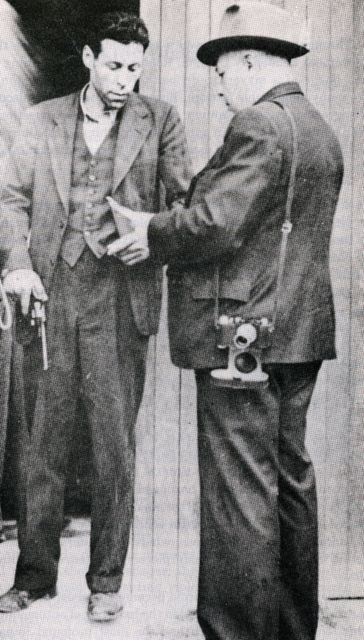
Harold Robins in May 1940

One of the participants in the discussion later recalled a remarkable incident that cast light on Trotsky’s pedagogical approach to political discussions. Harold Robins, a New York-born worker who had traveled to Mexico in 1939 and become the captain of Trotsky’s guard, took part in the morning discussion on June 13, during which Trotsky raised the question of critical support for the CP’s presidential candidate. In an obituary that I wrote following Robins’ death in 1987 at the age of 79, I included an account of his personal experience that he had relayed to me.


When his turn to speak came, Harold launched into a vitriolic denunciation of the Stalinists, enumerating their many betrayals of the working class, and their slavish collaboration with the bourgeois politicians. Harold proclaimed that there wasn’t “any god-damn difference between the Stalinists and the Democrats.”

Trotsky raised his hand and broke into Harold’s speech. “Permit me a question, Comrade Robins. If there exist no differences between the Stalinists and the Democrats, why do they retain an independent existence and call themselves Communists? Why do they not simply join the Democratic Party?”

Harold was taken aback by these simple questions. This elementary lesson in dialectics immediately made it clear to Harold that his own position was wrong. But the story did not end there.

With the issue still undecided, the meeting broke for lunch. Trotsky approached Harold and asked him what his position was.

“Well, I now think you’re right, Comrade Trotsky.”

The “Old Man” beamed with satisfaction. “Then, Comrade Robins, I propose we form a bloc and conduct the struggle together when the meeting resumes.”

Harold remembered thinking that he could not believe the “Old Man” was serious.

“Why the hell would Trotsky want or need a bloc with Harold Robins?”

At any rate, he accepted Trotsky’s offer and looked forward to the start of the afternoon session. However, as the lunch break was coming to a close, Robins was approached by another guard, Charles Cornell, who was bitterly disappointed that he was to remain on duty during the afternoon and would not be able to participate in the discussion with Trotsky. Cornell pleaded with Robins to change places with him, and Robins relented. And so Cornell went into the discussion while Robins patrolled the premises.

Late in the afternoon, soon after the meeting ended, Harold found himself suddenly confronted by an obviously angry Trotsky. “Where were you, Comrade Robins?,” Trotsky demanded.

Harold sought to explain the circumstances which had intervened during the lunch break. Trotsky brushed his arguments aside. “We had a bloc, Comrade Robins, and you betrayed it.”

Harold recounted such incidents without the slightest sense of embarrassment, even though they hardly placed him in the best light. But for Harold, these events were precious examples of Trotsky’s utter completeness as a revolutionary, inflexibly devoted to principles in all aspects of his life and under all conditions.

Here was a man, Harold seemed to be saying, who had led the greatest revolution in history, organized an army of millions, and participated in epochal political struggles alongside of the legendary figures of the international Marxist movement. And yet the same man, Trotsky, could propose a bloc with an unknown rank-and-file “Jimmy Higgins” and view it as seriously as he once viewed an alliance with Lenin! Harold was more than happy to “diminish himself” and recount his own youthful mistakes in order to convey the moral grandeur of Trotsky. [15]

In the course of their trip to Coyoacán, the SWP leaders inspected the villa and approved construction work that would fortify the compound against attack. Despite their sincere commitment to Trotsky’s defense, their efforts were undermined by a disturbing level of personal carelessness. Even though there remained unanswered questions about the role of Sheldon Harte in the May 24 assault, there is no indication that SWP leaders were taking a more cautious attitude toward their personal associations. Given the continuing campaign against Trotsky in the Stalinist press, it should have been clear to the SWP leaders that the political environment in Mexico City was dangerous, and that the capital was crawling with GPU agents intent on eliminating Trotsky.
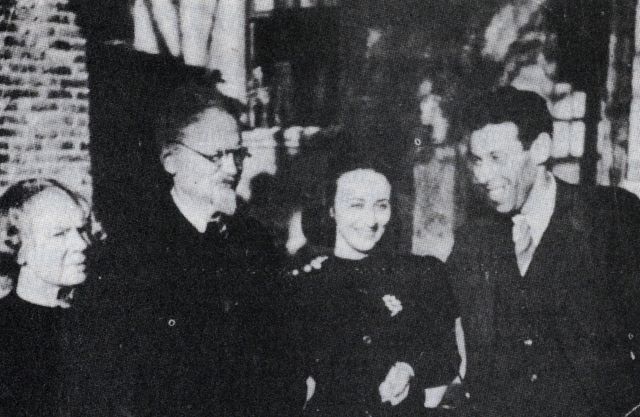
Natalia Sedova, Trotsky, a friend and Harold Robins

Nevertheless, on the evening of June 11, James P. Cannon and Farrell Dobbs accepted an invitation to dinner at the Hotel Geneva, followed by drinks at another locale. The host of the two SWP leaders was Jacson-Mornard. [16] This encounter was reported by Cannon in the course of a brief internal investigation conducted by the SWP leadership following the assassination. This information was, however, concealed from the rank and file party membership.

To be continued

[1] “The Kremlin’s Role in the European Catastrophe,” in Writings of Leon Trotsky 1939–40 (New York: 1973), p. 290

[2] Ibid, pp. 290–91

[3] “Discussions with Trotsky,” in Writings of Leon Trotsky 1939–40, p. 253

[4] Ibid, p. 254

[5] Ibid

[6] Ibid, p. 260

[7] Ibid, pp. 260–61

[8] Ibid, p. 266

[9] Ibid, p. 267

[10] Ibid, pp. 271–73

[11] Ibid, pp. 280–81

[12] Ibid, p. 282

[13] Ibid

[14] Ibid

[15] A Tribute to Harold Robins, Captain of Trotsky’s Guard, by David North (Detroit: 1987), pp. 8–10

[16] Trotsky: Downfall of a Revolutionary, by Patenaude, Bertrand M. (p. 270). Harper Collins e-books. Kindle Edition.