https://www.youtube.com/watch?v=ykADDXSUvzs
Wednesday, August 26, 2020

First week back on campus amid the COVID-19 pandemic: A US college student’s first-hand account
https://www.wsws.org/en/articles/2020/08/25/albi-a25.html
By an Albion College student
25 August 2020
Schools and universities across the US are reopening for in-person classes amid the raging COVID-19 pandemic. Outbreaks on college campuses where students have returned have already forced some colleges to cancel in-person classes and switch to online learning. The experiments at UNC and Notre Dame show the inevitability of outbreaks on reopened campuses is the rule, not an exception.
Albion College—a small, private liberal arts college located in Albion, Michigan—is one of those colleges which has already brought students back to campus. An Albion student, who wishes to remain anonymous, has documented his first week after returning to campus in a diary.
Albion promised a safe return with the installation of automatic doors, a testing routine for students and staff and sanitization. But his experience reveals a different picture, one of unsanitary rooms, a lack of sanitization supplies, failing protocols and a testing regime full of holes.
This student’s account provides just one example of what is taking place on college campuses throughout the country.
The WSWS urges college students, faculty and staff to contact us and tell us your school reopening story. Sign up for the WSWS Educators Newsletter and help build the Educators Rank-and-File Safety Committee.
***
Day 1, 12 days until classes start
Date: 12/08/2020
I arrived at Albion in the morning with my father and sister who would help me move in. A series of tents had been set-up for check-in.
At one station, I received a fabric mask and a bag filled with one digital thermometer, two pairs of thin plastic gloves, a small bottle of hand sanitizer, and one disposable paper mask. I then completed a nostril swab test. I expected to receive the results at the end of the day but did not. I should note that my father and sister were not tested, only receiving screening, which does not account for asymptomatic cases.
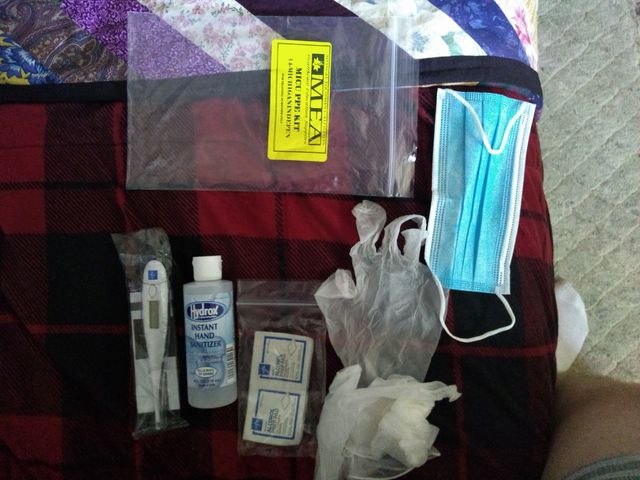
Finishing check-in, we drove to the Seaton dorm hall where I would be moving in and living with a roommate presumably until late November when classes end.
Inside the dorm building we found tight, crowded hallways which lacked proper air circulation. There were large groups unable to social distance and some individuals not wearing masks. The elevators were off-line due to social distancing, making the thin stairwells the only way for me to reach my dorm on the top floor.
Later, once I was alone in my room, I noticed how filthy the room was. I found dirt, dust and grime in every corner of the room and around furniture. My only “assurance” that the room had in fact been cleaned came from a sticker on the door indicating that staff had “cleaned” it days prior.
Exploring the rest of the dorm building later in the day, I discovered that there is only one water fountain, meaning that it will become a hot spot for potential infections.
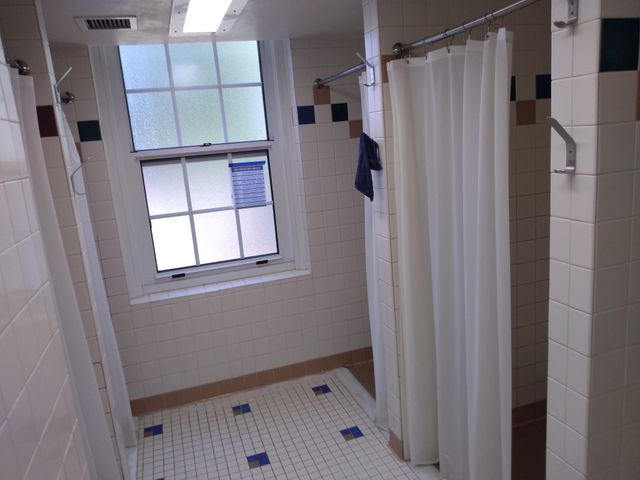
The laundry room, which only had a few machines operational and will likely not be disinfected regularly, will probably be another point of infection.
Finally, there are the shared bathrooms and showers, which already showed signs of uncleanliness. I have serious concerns over my safety when using the stalls and the cramped showers given that these facilities are fully public and only cleaned once a day. The sinks were also not updated with sensor activations, meaning spread is possible from the handles as well.
Day 2, 11 days until classes start
Date: 13/08/2020
Today is my first full day of living on campus. At noon, I entered the dining hall where a staff member sitting behind a plastic barrier directed me to follow a line of “six-feet apart” stickers on the ground. Currently, all students must choose a to-go meal option until classes start.
But, already, students are eating in groups. The administration expected students to get their food and eat alone in their dorm rooms. In other words, they expected students to act like machines for the whole semester.
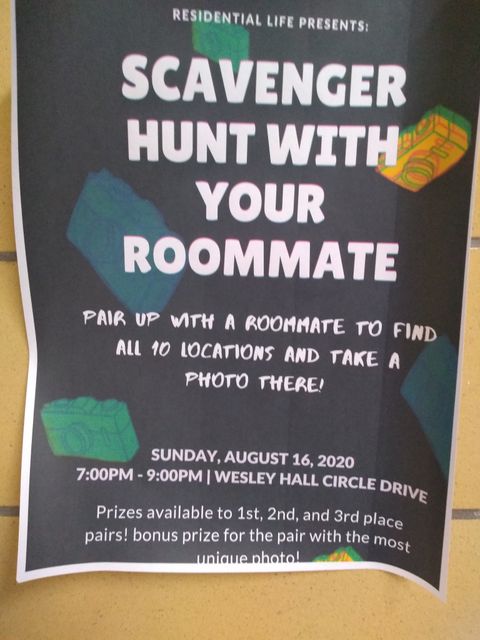
Later in the day, I happened upon a poster advertising a scavenger hunt for roommates in which they would travel around campus looking for locations to photograph. While Albion asks students to stay as isolated as possible before classes begin, they, at the same time, actively encourage students to freely walk around campus.
Day 3, 10 days until classes start
Date: 14/08/2020
I finally received my test results today, and I tested negative for the virus. Of course, it is possible that I and others on campus have already been exposed to the virus since getting tested.
However, I received an alarming email from Albion’s president announcing a positive case on campus. The email didn’t give any information as to whether the person was a staff member or student, or what dorm they lived in if they were the latter. It only stated the person never came in contact with anyone longer than fifteen minutes in the last 14 days (no closer than six-feet with or without a mask), which I assume the school expects us to think means that no one has been exposed.
Recently, I’ve noticed in the past few days a growing concern among those on campus regarding the app called Aura which Albion is using for contact tracing. Students have raised concerns over the app’s invasive big-brother style tracking of users’ locations. While contract tracing is necessary, I am alarmed at the potential the app has for enforcing a jail-life environment for students on campus.
Day 4, 9 days until classes start
Date: 15/08/2020
Albion’s president informed us again by email that another infection has appeared on campus. This time, however, the administration admitted that the positive individual had come into contact with other members of the community.
As expected, the administration failed again to provide any information on the identity, living location, travel locations or occupation of the infected individual. The same is the case for those whom the school has identified as exposed individuals, who will be contacted secretly by the school. This secretive process is keeping vital health information from students, faculty and staff.
Given the speed and lack of understanding of the spread on campus, I don’t think it’s out of bounds to say Albion is in the early stages of an outbreak. While those who know they are infected will remain in quarantine rooms on campus for 14 days, others unknowingly exposed to the virus are spreading the virus further than administrators and students are aware.
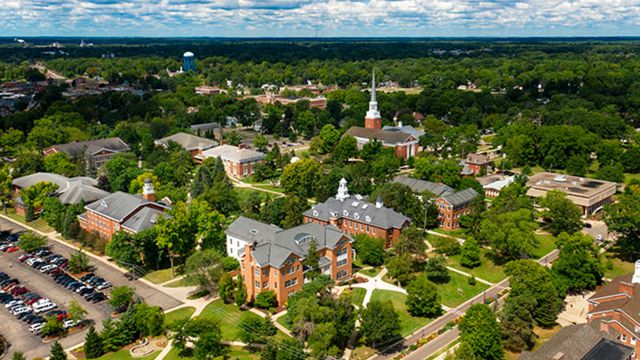 Albion College, Michigan (Photo: albion.edu)
If a widespread outbreak occurs and the school decides then to shut down the campus, presumably, all students face bringing the virus home with them. My mother is over 50 and suffers from asthma, making her at risk of severe health repercussions if infected. I’m sure I’m not the only one in this situation, and I can’t imagine the devastation this will cause, all of which we could have been avoided with online learning.
It is alarming that cases are rising this early when classes have not even started yet, most of which will be in-person. Whether infections are spreading primarily among the student or staff body will not matter once the two collide in classrooms five days a week, starting on the 24th.
Day 5, 8 days until classes start
Date: 16/08/2020
There have been no new announcements of new COVID-19 cases on campus, and, perhaps more critically, no word on the scale or spread of currently announced cases. The student body, and presumably the faculty and staff, have been left in the dark by the administration.
I have come across new advertisements for in-person events today, this time a flowerpot planting. Once again, I cannot wrap my brain around the contorted and dangerous logic on display in these ads. The school is publicly advising students to stay safe, socially isolated, and not gather with their peers, and yet they promote activities violating all three.
By bringing students back to campus, they were already playing Russian roulette, and these advertisements are essentially encouraging students to put another bullet in the cylinder.
Day 6, 7 days until classes start
Date: 17/08/2020
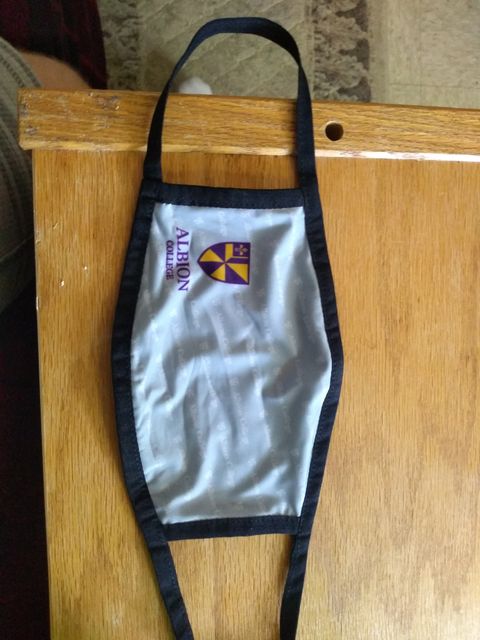
Things are continuing to deteriorate. For instance, while the school should be refilling hand-sanitizer dispensers regularly, today, I noticed most were running empty in my dorm building. I also saw paper towels empty in the bathroom.
In an email I was sent today, the president reinforced the narrative of student responsibility for controlling the spread of the pandemic, stating, “It will take ALL of us working together to be able to remain at home on campus for the semester,” adding, “following the Together Safely protocols and policies is both an individual and community responsibility.”
The president also revealed the school’s growing fears of their policies falling apart:
I want to acknowledge that over the last few weeks, inaccurate, misleading, and, in some cases, false information about the Together Safely plan has been shared. Some have tried to encourage the press to investigate our approach to suggest we are incapable of being together safely. Others have suggested reporting violations of our Together Safely protocols and policies to the Calhoun Department of Public Health (DPH). I hope that you will join me in showing them we can, and will, succeed.
Day 7, 6 days until classes start
Date: 18/08/2020
The president of Albion released another statement today blaming students for potential outbreaks on campus after two incidents, a small party and a gathering near the dining hall, occurred. The introduction of the email directly referenced the administration’s real fear, a campus shutdown, as it referenced outbreaks at the University of North Carolina Chapel Hill and Notre Dame.
The president, gaslighting students, stated that two incidents involving Albion students risked “undermining public trust in a way that could lead to the Calhoun County Health Department or the Governor’s office ordering us to close.” This comment reinforces the fact that the administration’s focus is not on our safety, but whether or not they can remain open and continue to draw in revenue from students.
He then vaguely expresses that the administration will punish violators of protocol: “Students who are alleged to have violated College standards, including our public health protocols, are subject to the College’s judicial process.”
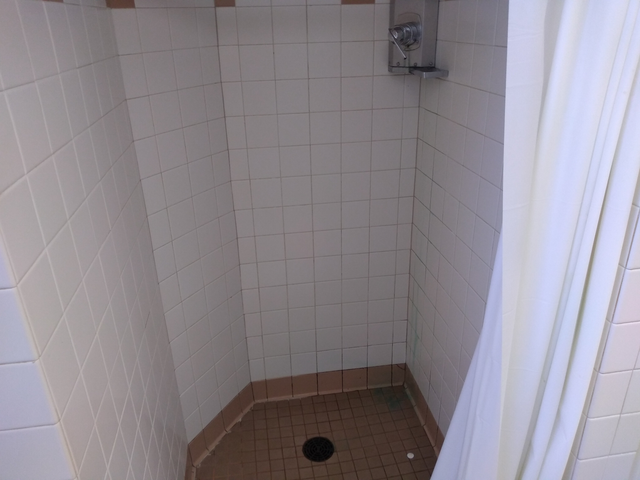
This last message only makes clear that if we bite the bullet during their forced game of Russian roulette and contract COVID-19, we will be the ones to blame.
Unquestionably, there is growing distrust and discontent among students. I found a petition online calling for the “safe reopening” of Albion, which includes the expansion of online learning options, lower costs, and the improvement of assistance from the college administration. While it is lacking in a few areas (e.g., not calling for a shutdown of in-person living and learning, not mentioning the safety of faculty and staff, and veering into identity politics), the petition has attracted nearly 200 signatories (one-tenth of the student population), most of them from today.
If Albion refuses to close before an outbreak occurs and forces a shutdown, the virus will run rampant throughout the campus. When a shutdown finally does happen, students will return to their homes across the country and internationally, spreading the virus further. My fear of bringing the virus home to my high-risk mother may soon become a reality if Albion is not closed immediately.
The author also recommends:
For a nationwide general strike to halt the drive to reopen schools!
[5 August 2020]
UNC Chapel Hill, Notre Dame and Michigan State University forced to revert to online learning after COVID-19 outbreaks
[19 August 2020]
Thai protest movement spreads across country’s northeast
https://www.wsws.org/en/articles/2020/08/25/thai-a25.html
By Owen Howell
25 August 2020
Thailand’s student-led protest movement shows no signs of diminishing, as major rallies erupted over the past few days in the northeastern region of Isan. For more than a month now, large anti-government protests have been held almost daily.
Last week’s police operation, in which seven student leaders were arrested on charges including sedition, has done little to intimidate or stifle the growing movement.
On Thursday, a protest in the northeastern city of Khon Kaen was organised by a local student group called Khon Kaen’s Had Enough. Around 1,000 people, mostly high school students, gathered at the Chao Por Lak Muang Shrine, where numerous students were invited on stage to deliver speeches.
The protest’s organisers also performed a Buddhist ritual, intended to chase Prime Minister Prayut Chan-o-cha out of power. A main road was closed for the event, which drew a much larger crowd than anticipated.
Siwakorn Namnuad, a leader of Khon Kaen’s Had Enough, told Khaosod reporters that Thursday was the first large-scale protest in the city centre. He noted the crowd’s enthusiastic response to the three demands of the protest movement: to dissolve parliament, end intimidation of political opponents, and rewrite the constitution.
“If our demands are not met, we will increase the scale of our operations. Students are ready to call for change; we are waiting for working age people to join us,” Siwakorn said. Opposition in Thailand’s rural north and northeast to Prayut’s military-controlled government has meant that the movement is expanding beyond high schools and universities in the region.
Another large demonstration was held on Thursday at the Yo Ma Monument in the city of Nakhon Ratchasima. As in Khon Kaen, the crowd was estimated at over 1,000, while the stage was dominated by high school pupils.
Speakers denounced the 250 senators in office, all of them appointed by the military junta that assumed power in 2014, under Prayut’s leadership. They also made special appeals for the resignation of Deputy Prime Minister Prawit Wongsuwan, widely despised for his critical role in the military coup and involvement in a 2018 corruption scandal.
Khon Kaen was the location for another rally on Saturday, arranged by student organisations from nine provinces under the name of the Isan Liberation Network. At the same time, a protest in Ubon Ratchathani was notable for the appearance of Parit Chirawak, a central leader of the Free Youth movement that has orchestrated the Thai protests.
In the north, a significant student rally within the grounds of Chiang Mai University was held by student group Community of MorChor. Attendance was so much greater than expected that the venue overflowed with students, and barriers had to be dismantled to accommodate members of the public drawn to the event. Police officers were reportedly scattered through the crowd taking pictures of the organisers.
According to Prachatai, student representatives on stage read out a list of Chiang Mai University students who had been killed during the bloody Thammasat University massacre in 1976. They also read the names of members of the Farmers’ Federation of Thailand (FFT), involved in the peasant revolts of the 1970s, who died in the massacre.
One student leader called on the Red Shirts movement to participate more openly in upcoming protests. The Red Shirts, supporters of former Prime Minister Thaksin Shinawatra, staged mass demonstrations in Bangkok in 2010, and were largely based in the north and northeast.
Anti-government activity in Bangkok, meanwhile, has continued since the August 16 rally, which drew tens of thousands of people and was the largest demonstration since the 2014 coup.
Around 400 high school students from across the capital besieged the Ministry of Education on Wednesday, showing the three-fingered salute in solidarity with the protests. When Education Minister Nataphol Teepsuwan and his aides appeared outside, the students treated them with contempt, jeering loudly and making thumbs-down gestures and then ordered them to the back of the crowd.
Some students blew whistles as he tried speaking to them, a disruptive tactic notoriously used in the 2014 protests that helped trigger the military coup, in which Nataphol himself had played a role.
Students from Rajini School, a private girls’ school in Bangkok, yesterday wore white ribbons (a symbol of the protests), even after the school’s administration banned all forms of political expression on campus. A group of nearly 1,000 alumnae have signed an open letter to protest the ban.
On Sunday, students from four major Bangkok universities—Kasetsart, Silpakorn, Bangkok, and Rangsit—assembled on Sunday at the Lan Khon Meaung Square in Phra Nakhon district.
They were campaigning against the state persecution of political activists, in particular those condemned under the country’s draconian lèse majesté law, which criminalises any alleged criticism of the Thai monarchy. The student leaders announced that they would gather more often every time the government used the law to arrest protesters.
The response of Prayut’s government to the protest movement changed markedly after a rally on August 3, when student leaders added to the three initial demands a call to reform the monarchy.
King Vajiralongkorn’s ties with the military-backed government, along with his personal possession of crown assets, has provoked hostility throughout the population. This was demonstrated in the outrage on social media when Thanathorn Juangroongruangkit, leader of the disbanded Future Forward Party, exposed a steep rise in the annual budget for Palace agencies over the last three years.
The amount was pegged at $US285 million for the next fiscal year—up 16.8 percent from last year, compared to a 3.1 percent rise in the overall national budget, Nation Thailand reported.
After the seven arrests last week, protest leader and vocal critic of the monarchy Panupong Jaadnok was arrested yesterday on sedition charges related to his participation in the August 10 rally, where a manifesto of 10 demands for monarchy reform was declared. Yesterday evening, he was transported to a police station in Pathum Thani, where Parit Chirawak said a protest would be held in his defence.
Two organisers of a student rally in the northern city of Lamphun have been ordered to report to police and hear charges against them. One of the students, Thanatorn Vitayabenjang, said in an interview with Al Jazeera: “There’s been many cases where [police] tried to report protesters, but at the end of the day, after everyone is over that fear, it becomes a catalyst to come out more and go against the government.”
Many more protests are planned for the coming weeks. In Nakhon Ratchasima, protesters announced that a major student rally would take place on September 19 at Thammasat University’s main Tha Prachan campus in Bangkok. Free Youth has not yet revealed details, but stated its plans to camp out overnight, in what could be a massive rally of students and broader sections of society.
The Bangkok Post reported that security agencies were fearful of the upcoming protests. A meeting between Prime Minister Prayut and high-ranking military generals was held on Friday, in which preparations for possible mass upheavals were discussed.
US stages military buildup to enforce deal to steal Syria’s oil
https://www.wsws.org/en/articles/2020/08/25/syri-a25.html
By Bill Van Auken
25 August 2020
The US military over the past week has been sending convoys across the border from Iraq into Syria in what appears to be a significant escalation of the US military intervention in the war-ravaged country.
According to sources in Syria, the convoys have come across at the al-Tanf crossing, where the US military maintains a garrison near the triple frontier between Iraq, Syria and Jordan. They have then traveled to US bases in the northeastern Syrian governorates of Deir ez-Zor and Al-Hasakah. Witnesses said that the convoys included tanks, armored vehicles, oil tankers and trucks bearing weapons and logistical equipment.
The buildup of the US forces east of the Euphrates River follows the revelation that Washington has concocted a deal with a newly minted American oil company, Delta Crescent Energy LLC, which has been signed by the so-called Syrian Democratic Forces, the proxy ground troops employed by Washington in Syria, which consist mainly of the Syrian Kurdish YPG militia.
Among the equipment being trucked in by the US military are believed to be components for two modular refineries to assist the company in exploiting and marketing Syrian oil.
This agreement constitutes a war crime under the Geneva Conventions, which bar the exploitation of the natural resources of an occupied country for the benefit of the occupier. In the case of the US occupation of Syria, this constitutes an even more blatant act of international piracy, as the US military presence in the country has been authorized neither by the Syrian government nor the United Nations.
The existence of the deal brokered by Washington between Delta Crescent Energy and the Pentagon’s Kurdish proxies was first revealed by Republican Senator Lindsey Graham during a July 30 Senate Foreign Relations Committee.
Graham told US Secretary of State Mike Pompeo that he had been informed by the commander of the Syrian Kurdish forces, known as Mazlum Kobani, of the deal to “modernize the oil fields in northeastern Syria”, and asked whether the Trump administration was supporting it.
“We are,” Pompeo replied. “The deal took a little longer than we had hoped, and now we're in implementation; it could be very powerful.”
It has since emerged that the principals in Delta Crescent Energy include James Cain, a North Carolina Republican Party official and former US ambassador to Denmark who gained brief notoriety by calling for the execution of Chelsea Manning, the courageous US soldier who was imprisoned for her role in exposing US war crimes in Afghanistan and Iraq by leaking to WikiLeaks hundreds of thousands of military war logs and diplomatic cables. Also on the company’s board is James Reese, a former Delta Force officer who became a private security consultant and Fox News contributor after retiring from the military.
There is every reason to suspect that the company was formed as an act of political cronyism. The deal was reportedly “negotiated” under the auspices of the chief of the US Central Command (CENTCOM), Gen. Kenneth McKenzie, while US military is facilitating its implementation.
As for Pompeo’s claim that this agreement could prove “powerful,” it certainly is not a matter of its global economic significance, given that Syria accounts for just 0.1 percent of the world's oil reserves. Rather, the deal serves as a means of starving the Syrian government and people of resources that are desperately needed for reconstruction after nearly a decade of war, while simultaneously providing a pretext for the continued US military occupation and dismemberment of the country.
The deal is the outcome of the shift in US tactics initiated by Trump in October of last year, when he provided a green light for a Turkish invasion of northeast Syria for the purpose of driving Washington’s erstwhile Kurdish allies from the border. At the time, Trump spouted a great deal of demagogy about ending Washington’s “forever wars” and pulling all US troops out of Syria.
Facing a firestorm of criticism from within the US military and intelligence apparatus, Trump backed down, announcing that he would retain a US force in Syria to “keep the oil.”
At the time he stated, “We’ll work something out with the Kurds so that they have some money, so that they have some cash flow. Maybe we’ll get one of our big oil companies to go in and do it properly.”
The announcement of the oil deal provoked bitter criticism from the Syrian government. Syria’s Ambassador to the United Nations Bashar Ja’afari spoke before the Security Council last week, denouncing Washington for “stealing Syrian oil and depriving the Syrian state and Syrian people of the basic revenues necessary to improve the humanitarian situation, provide for livelihood needs and reconstruction.” He also charged both the US and the European Union with enforcing a sanctions regime that serves to “prevent the Syrians from obtaining their basic needs of food, medicine and medical equipment, especially in light of the spread of the corona pandemic and its dire effects.”
The principal allies of the Damascus government of President Bashar al-Assad, Iran and Russia, also denounced the US oil deal as a violation of Syria’s national sovereignty. Also condemning the agreement was the government of Turkey, which is continuing its own occupation and de facto annexation of Syrian territory.
The government of President Recep Tayyip Erdoğan issued a statement hypocritically denouncing Washington for “disregarding international law, violating territorial integrity, unity and sovereignty of Syria,” while going on to charge that the oil deal amounted to “financing terrorism.” Ankara regards the Syrian Kurdish YPG as a branch of the PKK (Kurdistan Workers’ Party) Kurdish separatist movement inside Turkey, which is designated by both the US and Turkey as a “terrorist” organization. The Erdogan government regards the consolidation of any Kurdish-controlled entity near its border with Syria as a threat to Turkish national security.
The oil deal has ratcheted up dangerous tensions in northeastern Syria, where US, Russian, Turkish, Syrian government and Kurdish YPG forces, along with remnants of the Islamic State (ISIS) militia, are all operating in close proximity.
Last week, on the same day, August 18, a US base near Syria’s Conoco oil field in Deir ez-Zor—now under the control of the American military and its Kurdish proxies—came under rocket attack for the first time, and a Russian major general was killed by an improvised explosive device.
The Pentagon blamed the rocket attack on Iran and Iranian-aligned militias, while the killing of the senior Russian officer was initially blamed on ISIS. There is no proof that either is the case, and there is reportedly substantial speculation that the killing of the Russian general may have been the work of Washington and its Kurdish proxies.
A day earlier, on August 17, a US convoy engaged in a firefight with Syrian government forces at a checkpoint in al-Hasakah, leaving one Syrian soldier dead and two others wounded. US and Syrian accounts of the incident were at odds, with the Pentagon claiming that the convoy came under attack from unknown elements after passing through the checkpoint, and the Syrian government reporting that the shooting began when the Syrians tried to stop the convoy. Apache helicopters were escorting the US armored vehicles.
US military officials have reported that encounters between US and Russian soldiers are virtually a daily occurrence. For its part, Russia has built up its forces in the region, strengthening its base at the Qamishli airport on the Turkish border and bringing in attack helicopters. Meanwhile, Russia has deployed some two dozen tanks and armored vehicles to the village of Mazloum, little more than a mile from a US base.
US imperialism has been at war in Syria since launching a regime change operation in 2011, using CIA-backed Islamist militias as its proxies in a bid to topple the Assad government and impose a US puppet government in Damascus. It subsequently launched a direct military intervention in Syria as well as Iraq on the pretext of combating ISIS, an offshoot of the very Islamist militias that it had previously armed and funded. The toll of these interventions numbers in the hundreds of thousands of dead and millions of displaced.
Now the US remains in Syria for the purpose of controlling and exploiting the country’s oil, as part of a broader military campaign to impose a neo-colonial US hegemony in the Middle East at the expense of Iran, and the countries the Pentagon defines as “great power” rivals, China and Russia.
These aims, combined with the profound political instability driven by the economic and social crisis within the United States itself, pose a growing danger that the heightened military frictions in Syria can metastasize into a broader war, drawing in regional and major powers alike.
Subscribe to:
Posts (Atom)