https://www.youtube.com/watch?v=P8GAFZbxxyU
Tuesday, August 25, 2020

RESPONDING TO VOTER SUPPRESSION, UNDERSTANDING MANIPULATED ELECTIONS
By Kevin Zeese and Margaret Flowers, Popular Resistance.
August 23, 2020
https://popularresistance.org/responding-to-voter-suppression-understanding-manipulated-elections/
Voter suppression in the 2020 election has become a topic of great concern. In reality, voter suppression has been part of US politics since the founding of the country. The oligarchs who wrote the US Constitution enabled voter suppression by not including the right to vote in it and only allowing white male property owners to vote, suppressing the votes of 94 percent of the population.
Five of 16 states had white-only voting in 1800 and after 1802, every new state, free or slave, except for Maine banned Black people from voting. In 1807, New Jersey, which originally gave voting rights to “all inhabitants,” excluded women and Black men from voting. Maryland banned Jewish people from its polls until 1828. After the Civil War expanded voting rights to Black men, the Black vote was suppressed through intimidation campaigns and Jim Crow laws. After decades of protests, the Voting Rights Act was passed in 1965 and voting by Black people increased, but in recent years suppression tactics are reducing that vote.
This year, the Republican Party and President Trump are working to suppress the votes of Black people, the working class, immigrants, and others, especially by attacking the US Postal Service to decrease mail-in voting.
TAKE ACTION: National day to save the Post Office on Tuesday, August 25. Find more information here.
The Democrats are also guilty of voter suppression as they do all they can to keep third parties off the ballot. Green Party presidential nominee Howie Hawkins explains party suppression is voter suppression because millions of people refuse to choose between two Wall Street-funded candidates and so they don’t vote. Sanders-Democrats also point to an unfair nomination process resulting in Joe Biden becoming the nominee.

Voter Suppression is Violence, From Cool revolution.
Voter Suppression Today
Voter suppression has gotten more sophisticated in recent elections through the massive de-registering of voters, abuse of voter ID laws, cutting the number of polling places in minority communities, felony disenfranchisement, not counting provisional ballots, and voter intimidation at the polls. In 2020, the battle over mail-in ballots and the Post Office is also a major issue.
On March 30, President Trump said in an interview on FOX, if there was high voter turnout “you’d never have a Republican elected in this country again.” Trump was explaining why he opposed more money being spent to help states conduct the 2020 election during the pandemic. More recently, Trump floated the idea of delaying the November 3 election, an idea rejected by even Republican allies and something he does not have the power to do.
Removing people from voter registration lists has become a common practice. A Brennan Center study found that almost 16 million voters were purged from the rolls between 2014 and 2016. Jurisdictions with a history of racial discrimination, which are no longer subject to pre-clearance after the Supreme Court gutted the Voting Rights Act in Shelby County v. Holder in 2013, had a median purge rate 40% higher than other jurisdictions.
Voter ID laws have become a key tool in voter suppression. The ACLU reports that: “Thirty-six states have identification requirements at the polls. Seven states have strict photo ID laws.” Over 21 million U.S. citizens do not have government-issued photo identification resulting in ID laws reducing voter turnout by 2-3 percentage points, according to the US Government Accountability Office.
This year voter intimidation is making a comeback. Trump’s response to the closing night of the DNC was to tell Fox News that on election day he’s going to send law enforcement, sheriffs, US Attorneys, and Attorney Generals to polling locations. While Trump has no control over sheriffs and police, making the threat is part of an intimidation campaign.
Republicans are recruiting an estimated 50,000 volunteers to act as “poll watchers” in November, part of a multi-million-dollar effort to control who votes. This campaign includes a $20 million fund for legal battles as well as the GOP’s first national poll-patrol operation in nearly 40 years.
Poll watchers in some states can challenge the eligibility of voters. After the 1981 election, Democrats sued over voter intimidation and a federal “consent decree” stopped the practice but the decree was allowed to expire at the end of 2017, and a judge declined to extend it in 2018.
The ACLU points to some of the impacts of these voter suppression efforts and how they are targeted at people of color and youth, writing:
Seventy percent of Georgia voters purged in 2018 were Black.
Across the country, one in 13 Blacks cannot vote due to disenfranchisement laws.
One-third of voters who have a disability report difficulty voting.
Only 40 percent of polling places fully accommodate people with disabilities.
Counties with larger minority populations have fewer polling sites and poll workers per voter.
Six in ten college students come from out of state in New Hampshire, the state trying to block residents with out of state drivers’ licenses.

Stop privatization of the Postal Service from PostalReporter.com.
Voting during the pandemic, mail-in voting and the Postal Service
The COVID-19 pandemic has created new issues for voting in 2020. More people will be voting by mail as 20 states expanded or eased access to voting by mail as a public health measure. The election could be decided by a fight over which mail ballots are counted. One of the most common reasons for invalidating a vote is if the ballot arrives late, making postal delivery of critical importance. In the primaries, more than 540,000 mail ballots were rejected during primaries across 23 states this year, nearly a quarter in key battlegrounds for the fall, i.e. Florida, Maine, Michigan, Nevada, North Carolina, Ohio, Pennsylvania and Wisconsin.
Last week, the Democrats in the House passed $25 billion in emergency funding for the Post Office. While this is insufficient, it is opposed by President Trump. Senator Mitch McConnell may not take the issue up in the Senate, saying it is too much money and other COVID-19 relief proposals should be included in it.
Trump is also trying to undermine the ability of the Post Office to deliver ballots on time. Trump crony, Louis DeJoy, who was appointed Postmaster General, is a prominent Trump donor, deputy finance chairman for the Republican National Committee, and the former lead fundraiser for the Republican National Committee. DeJoy donated more than $2.5 million to the Republican Party and its candidates, so he is heavily invested in a Republican electoral victory.
DeJoy fired people with experience running the Postal Service on August 17, and twenty-three postal executives were reassigned or displaced in a new organizational structure that centralizes power around DeJoy. He stopped overtime work and mail sorting machines and mailboxes have been removed. As a result of public pressure, he says he stopped further removals until after the election, although people are reporting finding locked mail boxes.
The Democrats, who have been complicit with the attack on the Post Office, are paying attention now that it is affecting the election. Unfortunately, their proposal falls far short of the $75 billion investment needed by the Postal Service, and doesn’t address the long term problems created by the Congress and president in 2006 when they required the Postal Service to fund 75 years worth of pension and healthcare costs.
We need to act now because they are likely to ignore the efforts at privatization of the postal service after November. We need to demand more money for the Post Office and insist on the end of any privatization of the Postal Service so it remains a public agency serving the public good. The so-called ‘Postal Accountability and Enhancement Act‘ of 2006, which was designed to weaken the Post Office, must be repealed. And, the Post Office should be given greater power to provide other services like a Postal Bank for the millions of people who do not have access to banking services.
Join the #SaveThePostOffice August 25, National Day of Action.
Showing up by protesting for the Postal Service gives postal workers the power to defy the Postmaster General and speak out. Postal workers in Washington State are refusing to take mail sorting equipment offline. Postal workers have been ordered not to speak to the press so people are not aware how bad the situation is. If workers see the public is on their side, they may have the courage to speak or anonymously leak documents to the media.
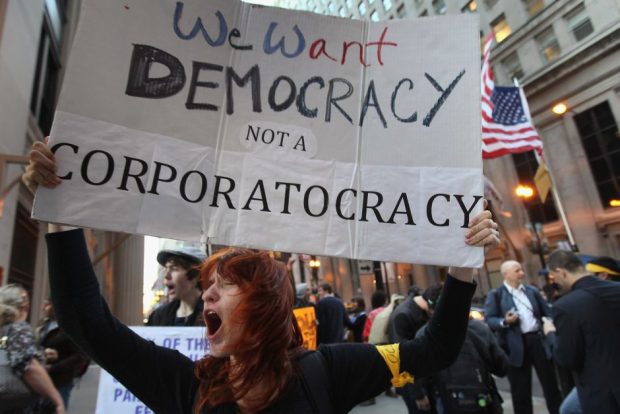
Protests in the US in 2011 targeted greed and corruption among banking and business leaders. By Scott Olson for AFP-Getty Images.
2020 Highlights Mirage Democracy
The failure of US democracy is on display in the 2020 election but these are long-term problems. The United States is not a democracy; it is a plutocracy. Elections give people the illusion of choice when in reality the power elites are the ones who choose the candidates, as we described in this 2013 article.
Some people choose not to participate in the elections for this reason. Others choose to use the election to make a point by rejecting the corporate candidates and voting for third-party candidates who support their positions, such as national improved Medicare for All, acting on climate change, ending police violence and imperialism, and more or only voting in down-ballot races.
If you choose to participate in the election, here are some actions you can take to protect your vote:
If you want to vote in 2020, order your mail-in ballots, if they are available, as soon as possible. In our state, Maryland, the Board of Elections warns they may run out of ballots.
Know your rights. It is illegal to intimidate or coerce voters. If you experience it or see it happening to someone else, record it by video or in writing to poll workers.
If you are told you are not registered, demand a provisional ballot. Due to Voter-ID laws, each state has different requirements. Understand what is required in your state, and come prepared.
Finally, it is important to remember when we are inundated with a constant focus on the 2020 elections that the power of the people does not derive from elections. Our task is to build people’s power outside of elections.
People have the power to make the country ungovernable. Both parties are ignoring issues supported by a majority of the people, including, improved Medicare for all, a robust Green New Deal, a guaranteed basic income, a tax on the wealth to shrink the wealth divide, cuts to the bloated military budget, free college and vocational education and confronting the climate crisis, which is already wreaking havoc across the nation.
The Occupy Movement, the Fight for $15, the student debt movement, labor strikes and the uprising against police violence show people have power. We have only begun to scratch the surface of our potential. We have to build the power to rule from below, no matter who is elected president in 2020.
You are invited to a webinar – “After the DNC and RNC – Keep the struggle in the streets” on Sunday, Aug. 30 at 2:00 pm Eastern/11:00 am Pacific.
https://popularresistance.org/responding-to-voter-suppression-understanding-manipulated-elections/
Voter suppression in the 2020 election has become a topic of great concern. In reality, voter suppression has been part of US politics since the founding of the country. The oligarchs who wrote the US Constitution enabled voter suppression by not including the right to vote in it and only allowing white male property owners to vote, suppressing the votes of 94 percent of the population.
Five of 16 states had white-only voting in 1800 and after 1802, every new state, free or slave, except for Maine banned Black people from voting. In 1807, New Jersey, which originally gave voting rights to “all inhabitants,” excluded women and Black men from voting. Maryland banned Jewish people from its polls until 1828. After the Civil War expanded voting rights to Black men, the Black vote was suppressed through intimidation campaigns and Jim Crow laws. After decades of protests, the Voting Rights Act was passed in 1965 and voting by Black people increased, but in recent years suppression tactics are reducing that vote.
This year, the Republican Party and President Trump are working to suppress the votes of Black people, the working class, immigrants, and others, especially by attacking the US Postal Service to decrease mail-in voting.
TAKE ACTION: National day to save the Post Office on Tuesday, August 25. Find more information here.
The Democrats are also guilty of voter suppression as they do all they can to keep third parties off the ballot. Green Party presidential nominee Howie Hawkins explains party suppression is voter suppression because millions of people refuse to choose between two Wall Street-funded candidates and so they don’t vote. Sanders-Democrats also point to an unfair nomination process resulting in Joe Biden becoming the nominee.
Voter Suppression is Violence, From Cool revolution.
Voter Suppression Today
Voter suppression has gotten more sophisticated in recent elections through the massive de-registering of voters, abuse of voter ID laws, cutting the number of polling places in minority communities, felony disenfranchisement, not counting provisional ballots, and voter intimidation at the polls. In 2020, the battle over mail-in ballots and the Post Office is also a major issue.
On March 30, President Trump said in an interview on FOX, if there was high voter turnout “you’d never have a Republican elected in this country again.” Trump was explaining why he opposed more money being spent to help states conduct the 2020 election during the pandemic. More recently, Trump floated the idea of delaying the November 3 election, an idea rejected by even Republican allies and something he does not have the power to do.
Removing people from voter registration lists has become a common practice. A Brennan Center study found that almost 16 million voters were purged from the rolls between 2014 and 2016. Jurisdictions with a history of racial discrimination, which are no longer subject to pre-clearance after the Supreme Court gutted the Voting Rights Act in Shelby County v. Holder in 2013, had a median purge rate 40% higher than other jurisdictions.
Voter ID laws have become a key tool in voter suppression. The ACLU reports that: “Thirty-six states have identification requirements at the polls. Seven states have strict photo ID laws.” Over 21 million U.S. citizens do not have government-issued photo identification resulting in ID laws reducing voter turnout by 2-3 percentage points, according to the US Government Accountability Office.
This year voter intimidation is making a comeback. Trump’s response to the closing night of the DNC was to tell Fox News that on election day he’s going to send law enforcement, sheriffs, US Attorneys, and Attorney Generals to polling locations. While Trump has no control over sheriffs and police, making the threat is part of an intimidation campaign.
Republicans are recruiting an estimated 50,000 volunteers to act as “poll watchers” in November, part of a multi-million-dollar effort to control who votes. This campaign includes a $20 million fund for legal battles as well as the GOP’s first national poll-patrol operation in nearly 40 years.
Poll watchers in some states can challenge the eligibility of voters. After the 1981 election, Democrats sued over voter intimidation and a federal “consent decree” stopped the practice but the decree was allowed to expire at the end of 2017, and a judge declined to extend it in 2018.
The ACLU points to some of the impacts of these voter suppression efforts and how they are targeted at people of color and youth, writing:
Seventy percent of Georgia voters purged in 2018 were Black.
Across the country, one in 13 Blacks cannot vote due to disenfranchisement laws.
One-third of voters who have a disability report difficulty voting.
Only 40 percent of polling places fully accommodate people with disabilities.
Counties with larger minority populations have fewer polling sites and poll workers per voter.
Six in ten college students come from out of state in New Hampshire, the state trying to block residents with out of state drivers’ licenses.
Stop privatization of the Postal Service from PostalReporter.com.
Voting during the pandemic, mail-in voting and the Postal Service
The COVID-19 pandemic has created new issues for voting in 2020. More people will be voting by mail as 20 states expanded or eased access to voting by mail as a public health measure. The election could be decided by a fight over which mail ballots are counted. One of the most common reasons for invalidating a vote is if the ballot arrives late, making postal delivery of critical importance. In the primaries, more than 540,000 mail ballots were rejected during primaries across 23 states this year, nearly a quarter in key battlegrounds for the fall, i.e. Florida, Maine, Michigan, Nevada, North Carolina, Ohio, Pennsylvania and Wisconsin.
Last week, the Democrats in the House passed $25 billion in emergency funding for the Post Office. While this is insufficient, it is opposed by President Trump. Senator Mitch McConnell may not take the issue up in the Senate, saying it is too much money and other COVID-19 relief proposals should be included in it.
Trump is also trying to undermine the ability of the Post Office to deliver ballots on time. Trump crony, Louis DeJoy, who was appointed Postmaster General, is a prominent Trump donor, deputy finance chairman for the Republican National Committee, and the former lead fundraiser for the Republican National Committee. DeJoy donated more than $2.5 million to the Republican Party and its candidates, so he is heavily invested in a Republican electoral victory.
DeJoy fired people with experience running the Postal Service on August 17, and twenty-three postal executives were reassigned or displaced in a new organizational structure that centralizes power around DeJoy. He stopped overtime work and mail sorting machines and mailboxes have been removed. As a result of public pressure, he says he stopped further removals until after the election, although people are reporting finding locked mail boxes.
The Democrats, who have been complicit with the attack on the Post Office, are paying attention now that it is affecting the election. Unfortunately, their proposal falls far short of the $75 billion investment needed by the Postal Service, and doesn’t address the long term problems created by the Congress and president in 2006 when they required the Postal Service to fund 75 years worth of pension and healthcare costs.
We need to act now because they are likely to ignore the efforts at privatization of the postal service after November. We need to demand more money for the Post Office and insist on the end of any privatization of the Postal Service so it remains a public agency serving the public good. The so-called ‘Postal Accountability and Enhancement Act‘ of 2006, which was designed to weaken the Post Office, must be repealed. And, the Post Office should be given greater power to provide other services like a Postal Bank for the millions of people who do not have access to banking services.
Join the #SaveThePostOffice August 25, National Day of Action.
Showing up by protesting for the Postal Service gives postal workers the power to defy the Postmaster General and speak out. Postal workers in Washington State are refusing to take mail sorting equipment offline. Postal workers have been ordered not to speak to the press so people are not aware how bad the situation is. If workers see the public is on their side, they may have the courage to speak or anonymously leak documents to the media.
Protests in the US in 2011 targeted greed and corruption among banking and business leaders. By Scott Olson for AFP-Getty Images.
2020 Highlights Mirage Democracy
The failure of US democracy is on display in the 2020 election but these are long-term problems. The United States is not a democracy; it is a plutocracy. Elections give people the illusion of choice when in reality the power elites are the ones who choose the candidates, as we described in this 2013 article.
Some people choose not to participate in the elections for this reason. Others choose to use the election to make a point by rejecting the corporate candidates and voting for third-party candidates who support their positions, such as national improved Medicare for All, acting on climate change, ending police violence and imperialism, and more or only voting in down-ballot races.
If you choose to participate in the election, here are some actions you can take to protect your vote:
If you want to vote in 2020, order your mail-in ballots, if they are available, as soon as possible. In our state, Maryland, the Board of Elections warns they may run out of ballots.
Know your rights. It is illegal to intimidate or coerce voters. If you experience it or see it happening to someone else, record it by video or in writing to poll workers.
If you are told you are not registered, demand a provisional ballot. Due to Voter-ID laws, each state has different requirements. Understand what is required in your state, and come prepared.
Finally, it is important to remember when we are inundated with a constant focus on the 2020 elections that the power of the people does not derive from elections. Our task is to build people’s power outside of elections.
People have the power to make the country ungovernable. Both parties are ignoring issues supported by a majority of the people, including, improved Medicare for all, a robust Green New Deal, a guaranteed basic income, a tax on the wealth to shrink the wealth divide, cuts to the bloated military budget, free college and vocational education and confronting the climate crisis, which is already wreaking havoc across the nation.
The Occupy Movement, the Fight for $15, the student debt movement, labor strikes and the uprising against police violence show people have power. We have only begun to scratch the surface of our potential. We have to build the power to rule from below, no matter who is elected president in 2020.
You are invited to a webinar – “After the DNC and RNC – Keep the struggle in the streets” on Sunday, Aug. 30 at 2:00 pm Eastern/11:00 am Pacific.
Corporate Dems Want You To Shut Up While They Get Loud
Progressives are told to keep quiet until after the election — meanwhile, corporate Dems are blasting out divisive ideological messages that could demoralize Democratic voters and depress turnout.

David Sirota
Aug 24


No doubt, you have been told to keep quiet. Just put on your big boy pants, they say, and find the impulse control to at least muzzle yourself for the next 72 days until the election happens. After that, fine — then and only then will you maybe be permitted to speak your mind and politely ask the Democratic Party to match its rhetoric with its policy agenda.
But until then, you are told to ‘“shut the hell up and grow up,” as former Obama and Mike Bloomberg pollster Cornell Belcher put it during an emblematic MSNBC segment berating progressives.
This kind of hectoring has become a defining part of the Democratic Party’s culture. As the late great journalist Bill Greider lamented in this must-watch clip: “The way the Democratic Party is run for quite a number of presidential cycles is they pick a nominee in a kind of half-assed process that doesn’t really represent much of anybody and then they tell everybody to just shut up -- don’t bring up anything that will complicate life for your nominee... shut up, turn off your brains.”
There’s a superficial logic to this call for omerta — after all, Donald Trump is destroying everything and he must be defeated. But here’s the problem: The demand to shut up is only being aimed at the progressive base of the party, while the corporate wing floods the zone with rhetoric that could demobilize voters.
Indeed, at the very moment many good progressives are blunting their criticism and making clear that defeating Trump is of utmost importance, Corporate Democrats aren’t being asked to wait or hold their tongues. In fact, they are doing the opposite: Rahm Emanuel — who has been advising Biden — just went on television to show that the corporate wing of the party is intent on using the stretch run of the Most Important Election Of Our Lifetime™ not to doggedly focus on actually winning the election, but to instead try to predetermine post-election policy outcomes.
Emanuel and his ilk depict themselves as evincing a non-ideological “just win, baby” attitude. But they are most decidedly pushing a very clear corporate ideology — and they are doing so in dangerously divisive ways that could depress the big turnout that’s desperately needed to defeat Trump.
‘There’s No New Green Deal, There’s No Medicare For All’
The larger dynamic at play was exemplified by Emanuel’s television appearance on a CNBC segment dubbed “Democrats 2020 Agenda: What’s at stake for business?” As progressives are being told to keep quiet and not even so much as tweet their concerns, Emanuel used the platform to demand that during this health care and climate emergency, a prospective Biden administration must reject the two major initiatives that polls show are popular.
“Two things I would say if I was advising an administration,” said Emanuel, who left the Chicago mayoralty in disgrace after his city officials suppressed a video of the police murder of a teenager. “One is no there’s no new Green Deal, there’s no Medicare For All, probably the single two topics that were discussed the most. That’s not even in the platform.”
 Haymarket Books @haymarketbooksChicago to Rahm Emanuel
September 4th 20181,363 Retweets4,929 Likes
Emanuel is hardly a disinterested observer here. As Obama’s chief of staff, Emanuel helped kill the idea of a public health insurance option. Now, he works for a Wall Street firm that advises big health care and fossil fuel companies on mergers, acquisitions and bankruptcy restructuring. Earlier this year, Emanuel was set to be part of the featured entertainment at an oil lobbying group's annual meeting, during a $125-per-plate luncheon with GOP strategist Karl Rove, before the event was cancelled due to COVID.
Emanuel also isn’t just some random blowhard pundit spewing a corporate line. The Chicago Tribune in May reported that “Emanuel is having regular conversations with presumptive Democratic presidential nominee Joe Biden and his top advisers about economic policy.”
So when Emanuel is refusing to self-censor in the name of “unity” and making these kinds of divisive declarations that stomp on progressive voters, he’s speaking from a position of real power. And he’s not just tweeting these comments, which could depress voter enthusiasm. He’s making them to a giant national television audience.
Corporate Democrats Are Not Holding Their Tongues
Now sure, you could try to write off Emanuel’s rhetoric as just the anomalous bloviations of notorious super-villain who pushed NAFTA and anti-immigration policies and who famously called progressives “f-ing retarded.” But sorry, this isn’t a one-off — this is part of a larger pattern over the last few weeks and months.
As progressives are told to keep quiet, Democratic Party officials engineered a convention light on policy proposals, but one that gave prime convention speaking slots to the anti-climate-science, anti-union former Republican Gov. John Kasich of Ohio and to Colin Powell, who lied America into a war that killed hundreds of thousands of people. In his CNBC interview, Emanuel said “this will be the year of the Biden Republican” — and he noted that promoting these figures was designed to help Biden deliberately send an anti-progressive message to voters because “John Kasich and Colin Powell don’t exactly endorse (or) support big-P progressive policies.”
This is the kind of move that is potentially disillusioning for Democratic voters who were previously told that a Democratic victory isn’t just a return to status quo — but a step forward in strengthening the movements for climate action, worker rights and a more sane foreign policy.
Similarly, as progressives are told to shut the hell up, Democratic aides on Capitol Hill leaked word that the party’s lawmakers may immediately replay the 2009 debacle and block a public health insurance option after the election — a move that is potentially demotivating for millions of Americans currently losing their private health insurance.
As progressives are told to mute themselves, Team Biden last week publicly signaled that a new Democratic president might prioritize deficit reduction and budget austerity in the middle of an economic crisis — a move that is potentially deflating for millions of voters who have previously been told that President Biden’s agenda makes him the next FDR.
As progressives are told to keep quiet, Biden’s campaign leaks to Politico that the transition team building Biden’s prospective administration is being advised by Wall Street pal Larry Summers and former corporate super-lobbyist Steve Richetti.
And as progressives are told to muzzle themselves, Corporate Democrats went scorched earth and spent $15 million to intervene in primaries, stymie progressive Democratic candidates and tilt intraparty contests to business-friendly candidates. Meanwhile, House Speaker Nancy Pelosi works to unseat Democratic Sen. Ed Markey, one of the Senate’s few progressive lawmakers, and to crush a spirited primary challenge to Rep. Richard Neal, who has used his committee chairmanship to block even modest health care reforms.
‘Hold the line. Win. Lead.’
Clearly, this is a coordinated campaign by the right-wing of the Democratic Party to prioritize its policy goals above everything — even motivating core Democratic voters to turnout in record numbers during the general election.
The best response to such an onslaught isn’t to ignore it or succumb to dishonest unity-themed demands for silence and fealty. After all, the folks making those demands don’t actually want unity — they are aiming for corporate victory at all costs, even if waging a war for that intraparty win could depress enthusiasm for the Democratic ticket.
The smarter response is to follow the lead of Democratic Rep. Alexandria Ocasio-Cortez, who last week pushed back against the Corporate Democrats’ attempt to resurrect GOP-style austerity politics. Rather than just sitting there and staying silent, she declared that if the party wins in November, it must make “massive investment in our country or it will fall apart. This is not a joke. To adopt GOP deficit-hawking now, when millions of lives are at stake, is utterly irresponsible. Hold the line. Win. Lead.”
 Alexandria Ocasio-Cortez @AOCThis is extremely concerning. The pantry is absolutely not bare. We need massive investment in our country or it will fall apart. This is not a joke. To adopt GOP deficit-hawking now, when millions of lives are at stake, is utterly irresponsible. Hold the line. Win. Lead.
 Stephanie Kelton @StephanieKelton“When we get in, the pantry is going to be bare,” said Mr. Kaufman, who is leading Mr. Biden’s transition team. “When you see what Trump’s done to the deficit…all the deficits that he built with the incredible tax cuts. So we’re going to be limited.”
August 20th 20205,264 Retweets26,255 Likes
The brilliance of this kind of response is that it accomplishes two objectives: It stands up for a real change, and it reassures Democratic voters that there are at least some people who are serious about going to Washington and fighting for what the party purports to believe in.
Put another way, it fortifies the progressive agenda and it helps energize Democratic voters to turn out, because it casts the election not just as a meaningless charade that won’t matter after November because everyone will sell out anyway. It instead depicts the election as an event with high stakes beyond Trump — a turning point that can create new policies that will actually matter in people’s lived experience.
This is how you avoid the 1988-Dukakis-collapse debacle and motivate the big turnout that can defeat Trump.
You don’t tell voters that “nothing would fundamentally change.”
You don’t blast out a story about how the Democratic presidential nominee told his Wall Street donors that he isn’t proposing new legislation to change corporate behavior.
You don’t turn your party convention into a pageant for Republican icons.
You don’t have the disgraced-mayor-turned-Wall-Street guy advise your presidential candidate — or have him go on Corporate America’s favorite television station during a health care emergency and a climate crisis to effectively laugh at progressives who are pushing Medicare for All and a Green New Deal.
To paraphrase one of the best tweets in history, you don’t try to turn the election into a centrist rally for the idea that better things aren’t possible — and you sure as hell don’t ask progressives to shut up.
You instead focus intently on telling your party’s voters how the election will materially improve their lives.
Of course, the Democratic Party machine and the Biden campaign aren’t really interested in doing that right now. They want to run an anti-Trump campaign, and nothing else.
In light of that, progressives shouldn’t unilaterally disarm and stay silent when Corporate Democrats are getting bolder and more brazen about using this pre-election period to push their depressing, better-things-aren’t-possible policy agenda.
Staying quiet in the face of that pablum doesn’t help. The real way to help boost turnout and energize voters is for progressives to push back against the corporate propaganda and make clear that — whether the establishment likes it or not — this election can and will offer the opportunity to achieve something even bigger than just getting rid of Trump.
Monday, August 24, 2020
Trump isn’t solely responsible.
My wife and I have been warned that we may need to evacuate because of ravaging wildfires in the Bay Area.
The climate crisis is largely to blame for these fires, which are growing in number and intensity every year. It’s also to blame for the increasing number and virulence of hurricanes hitting the Gulf and south-east, flash floods along the eastern seaboard, and fierce winds across middle America.
Two tropical storms are developing in the Gulf of Mexico. The Gulf has never before had two hurricanes at the same time. Both are moving toward Louisiana.
In early August, Illinois and Iowa were hit with winds of up to 110mph. Homes were leveled. At least 10 million acres of crops were destroyed. Many are still without power.
Trump isn’t singularly responsible for the climate crisis, of course. But he’s done nothing to stop it. In fact, he’s done everything he can to accelerate it.
This coming week, he’ll be nominated for a second term. I doubt he or anyone else at the Republican convention will mention his abandonment of the Paris agreement, his rollback of environmental regulations or his boundless generosity to the fossil fuel industry.
Yet I’ll be thinking about all this, and in a newly personal way. So will many others, including, I suspect, some who voted for Trump last time, who reside in the Gulf states, the eastern seaboard and the Midwest.
It’s one thing to understand the climate crisis in the abstract. It’s another to live inside it.
I recently got an email from a woman living in North Carolina whose house was destroyed in a flash flood. She describes herself as a lifelong Republican who’s now a “born-again environmentalist.” She said she’ll be voting for Joe Biden.
It’s much the same with the coronavirus. The gross numbers tell a horrible story. Last Thursday alone, the virus killed 1,090 Americans. Only five died from the virus in Canada the same day, six in the UK, 12 in France, 16 in Japan, 16 in Spain and 10 in Germany.
Yet not even these numbers hit home the way it does when you know someone who has perished or nearly perished from this disease. I know two who have died. A good friend came close. Like me, a growing number of Americans are experiencing the coronavirus personally.
Trump isn’t solely responsible. America’s public health system was never up to the task of dealing with a pandemic. But Trump’s stream of lies, denials and refusals to take responsibility have allowed the disease to ravage America.
If he mentions the pandemic at all during the Republican convention, he’ll probably blame China and claim the official numbers are exaggerated. Many of his followers will believe him. But just as with the floods and windstorms and fires, an increasing number who have experienced Covid-19 personally have become hardened against his lies.
So, too, with the economic devastation that has come in the wake of the pandemic. Tens of millions are unemployed. Many are growing desperate. Almost everyone knows someone who has lost a job, or whose wages have been cut.
There’s an old saying that “the personal is political.” People understand politics most profoundly when it’s connected to their own lived experience.
At the Republican convention, Trump and his enablers can be expected to claim Democrats want to turn America into a socialist state. They’ll issue racist dogwhistles about “rioters and looters” in American cities. They’ll conjure up “deep state” conspiracies. They’ll lie about Biden.
Some Americans will believe this drivel, but I suspect the lived experience of most others – including many who voted for Trump in 2016 – will be more convincing.
After almost four years, we’ve felt the consequences of his rotten presidency first-hand. Trump’s malfeasance is now more palpable than his fearmongering. The personal is political.
Thanks for reading,
Robert Reich
PS: If you can, please support our work as we continue to call out Trump and the Republicans' willingness to destroy our planet to line the pockets of fossil fuel companies.
Protecting food from the hungry
By Vijay Prashad
https://consortiumnews.com/2020/08/21/protecting-food-from-the-hungry/
Young children marvel at an obvious contradiction in capitalist societies: why do we have shops filled with food, and yet see hungry people on the streets? It is a question of enormous significance; but in time the question dissipates into the fog of moral ambivalence, as various explanations are used to obfuscate the clarity of the youthful mind.
The most bewildering explanation is that hungry people cannot eat because they have no money, and somehow this absence of money — the most mystical of all human creations — is enough reason to let people starve. Since there is ample food to eat, and since a lot of people do not have enough money to buy food, the food must be protected from the hungry people.
To that end, we — as human beings — allow for the creation of a police force and for the use of violence to defend food against the hungry. In one of his earliest journalistic reports, Karl Marx wrote of the violence used against the peasants of the Rhineland who collected fallen wood to feed their fires.
The peasants, Marx wrote, know the punishment — including death — but they simply do not know the crime. For what reason are they being beaten and killed? The collection of wood that has fallen on the forest floor cannot be seen as an act of criminality, nor can the basic human need for hungry people to forage for food. And yet, social wealth in a society in which the hierarchies of class are entrenched is sluiced off to build larger and larger repressive institutions, from the police to the military.
You would think that amid a pandemic, when employment has collapsed and hunger has risen, social wealth would be diverted from the police to erase starvation, but that is not how the society of entrenched class hierarchy works. In July, the Food and Agricultural Organization (FAO) and other UN agencies released a report – “The State of Food Security and Nutrition in the World” – which showed that the trend before 2014 was for a decline in world hunger; since then the numbers have climbed dramatically, and since the Great Lockdown they have climbed exponentially.
Half of the world’s hungry are in Asia, with the majority in India. About 3 billion people cannot afford a healthy diet. Storehouses of food are opened only briefly, relief distributed only fleetingly. Afflicted by the hunger pandemic, when people go onto the streets to demand food or to defend their rights, they face the cold steel of state repression.
In August 2020, our office in South Africa published dossier no. 31, “The Politic of Blood: Political Repression in South Africa,” a powerful text that demonstrates a painful fact: that the violent state institutions germinated by the apartheid era have been carried over since 1994 into the post-apartheid South African state. During the transition, “a struggle waged by millions for the construction of popular democratic power and participatory forms of democracy was reduced to elections, the courts, a free commercial press, and the substitution of NGOs, now described as ‘civil society,’ for democratic forms of popular organization.”
After apartheid, “independent forms of self-organisation and popular demands for more participatory forms of democracy were frequently treated as criminal.” The situation has deteriorated to such an extent, authors argue, that in South Africa, “the police kill people, the vast majority of them impoverished and black, at a per capita rate that is three times higher than that of the police in the United States.” The numbers are stunning, the range of violence shocking.
In South Africa, repression against popular organizations — trade unions and shack dwellers’ formations — has not lessened during the pandemic. Almost 300,000 people have been arrested in these months; public gatherings have been banned, which means that the people’s organizations have had a difficult time building resistance against the harshness of state violence. One of the test areas is Durban, where the shack dwellers’ movement — Abahlali baseMjondolo — has led land occupations, and where the local government has been harsh in its violence against the people in these new settlements.
On July 28, for instance, the African National Congress-led municipality attacked the eKhenana Occupation in Cato Manor, a historic, popularly initiated working-class neighborhood, which — in 1959 — had been where women such as Dorothy Nyembe and Florence Mhize forged the uprising against the apartheid state that began to win popular support for the African National Congress. All that is forgotten now, as state violence was used — despite court orders to protect the residents — to evict them from their homes, their urban farming project and their cooperative that afforded them food sovereignty.
The eKhenana Occupation flew the flag of Abahlali and, as part of their ethos of international solidarity, the flag of their comrades in the Movimento dos Trabalhadores Rurais Sem Terra (MST), the landless workers movement of Brazil.
Last week, in Brazil, the ruthlessness of state violence was on full display against the Quilombo Campo Grande community. After 60 hours of resistance against the military police, the community had to retreat from what they had built. Noam Chomsky and I wrote a message of solidarity to the families of the community, which is given below.
Statement by Noam Chomsky and Vijay Prashad on the Eviction of 450 families from Quilombo Campo Grande
“On 12 August, Governor Romeu Zema of Minas Gerais sent in the military police to evict 450 families from the twenty two-year old Quilombo Campo Grande. For three days they surrounded the camp, intimidating families, in an attempt to force them to leave their land, but the landless families resisted. On 14 August, using tear gas and sound grenades, they were finally successful. They destroyed a community that had built homes and grew organic crops (including coffee, sold as Café Guaîi). In 1996, the families, organized by the Landless Workers Movement (MST), had taken over an abandoned sugar plantation (Ariadnópolis, which was owned by the Azevedo Brothers Agricultural Company). Jodil Agricultural Holdings, one of Brazil’s largest coffee producers, owned by João Faria da Silva, wanted the eviction so that it could take over production from the cooperative.
As a sign of disregard, the Governor and the military police destroyed the Eduardo Galeano Popular School, which educated children and adults. As friends of Eduardo Galeano (1940-2015), the conscience of South America, we are especially pained by the eviction and the destruction.
This eviction took place a few days after the death of Bishop Pedro Casaldáliga (1928-2020), whose life was a tribute to the struggles for the emancipation of the poor. This eviction is an insult to his memory, the man who sang:
I believe in the International
of heads held high,
of speaking as equal to equal,
and of hands linked together.
That is the way to live, hands linked together, not through tear gas and bullets fired at the peasantry by the military police.
We condemn the eviction of the families, and the destruction of their land and their school. We stand with the families of Quilombo Campo Grande.”
‘Tell the People the Struggle Must Go On’
Benjamin Moloise, a factory worker and poet, was born in Alexandra, in Johannesburg, South Africa, in 1955. He joined the then-banned African National Congress (ANC) and wrote poetry. In 1982, Moloise was accused of having killed Philipis Selepe, a warrant officer. The ANC leadership in Lusaka (Zambia) admitted that it had ordered the execution of Selepe, but said that Moloise did not kill him. An international campaign to free Moloise did not dent the determination of the apartheid government to murder Moloise.
On the day of his execution on Oct. 18, 1985, Pauline Moloise — Benjamin’s mother – saw him for 20 minutes. He told her that while he did not kill Selepe, “I do not regret my involvement. Tell the people that the struggle must go on.” Almost 4,000 people spread across Johannesburg mourning his death. Mayihlome, the people cried out, a call to arms to deepen their struggle against apartheid.
A study published in mid-July showed that two out of five adults in South Africa said that their households had lost a main source of livelihood since March 27, 2020, when the lockdown started in the country. The impact that this has on starvation is dramatic, with government policies to shield the population from hunger being minimal. Instead of sending out armed men to tear down the shacks of the people and uproot their farms, it would be far better for a state to work with local structures to arrange the distribution of necessary supplies.
This is where things are confusing: the protection of private property is far more important for these states than the protection of precious life. “Tell the people that the struggle must go on,” said Moloise before he was hung inside a cold prison surrounded by jacaranda trees.
Genomic analysis reveals many animal species may be vulnerable to SARS-CoV-2 infection
https://www.sciencedaily.com/releases/2020/08/200821161423.htm
Humans are not the only species facing a potential threat from SARS-CoV-2, the novel coronavirus that causes COVID-19, according to a new study from the University of California, Davis.
An international team of scientists used genomic analysis to compare the main cellular receptor for the virus in humans -- angiotensin converting enzyme-2, or ACE2 -- in 410 different species of vertebrates, including birds, fish, amphibians, reptiles and mammals.
ACE2 is normally found on many different types of cells and tissues, including epithelial cells in the nose, mouth and lungs. In humans, 25 amino acids of the ACE2 protein are important for the virus to bind and gain entry into cells.
The researchers used these 25 amino acid sequences of the ACE2 protein, and modeling of its predicted protein structure together with the SARS-CoV-2 spike protein, to evaluate how many of these amino acids are found in the ACE2 protein of the different species.
"Animals with all 25 amino acid residues matching the human protein are predicted to be at the highest risk for contracting SARS-CoV-2 via ACE2," said Joana Damas, first author for the paper and a postdoctoral research associate at UC Davis. "The risk is predicted to decrease the more the species' ACE2 binding residues differ from humans."
About 40 percent of the species potentially susceptible to SARS-CoV-2 are classified as "threatened" by the International Union for Conservation of Nature and may be especially vulnerable to human-to-animal transmission. The study was published Aug. 21 in the Proceedings of the National Academy of Sciences.
"The data provide an important starting point for identifying vulnerable and threatened animal populations at risk of SARS-CoV-2 infection," said Harris Lewin, lead author for the study and a distinguished professor of evolution and ecology at UC Davis. "We hope it inspires practices that protect both animal and human health during the pandemic."
Endangered species predicted to be at risk
Several critically endangered primate species, such as the Western lowland gorilla, Sumatran orangutan and Northern white-cheeked gibbon, are predicted to be at very high risk of infection by SARS-CoV-2 via their ACE2 receptor.
Other animals flagged as high risk include marine mammals such as gray whales and bottlenose dolphins, as well as Chinese hamsters.
Domestic animals such as cats, cattle and sheep were found to have a medium risk, and dogs, horses and pigs were found to have low risk for ACE2 binding. How this relates to infection and disease risk needs to be determined by future studies, but for those species that have known infectivity data, the correlation is high.
In documented cases of SARS-COV-2 infection in mink, cats, dogs, hamsters, lions and tigers, the virus may be using ACE2 receptors or they may use receptors other than ACE2 to gain access to host cells. Lower propensity for binding could translate to lower propensity for infection, or lower ability for the infection to spread in an animal or between animals once established.
Because of the potential for animals to contract the novel coronavirus from humans, and vice versa, institutions including the National Zoo and the San Diego Zoo, which both contributed genomic material to the study, have strengthened programs to protect both animals and humans.
"Zoonotic diseases and how to prevent human to animal transmission is not a new challenge to zoos and animal care professionals," said co-author Klaus-Peter Koepfli, senior research scientist at Smithsonian-Mason School of Conservation and former conservation biologist with the Smithsonian Conservation Biology Institute's Center for Species Survival and Center for Conservation Genomics. "This new information allows us to focus our efforts and plan accordingly to keep animals and humans safe."
The authors urge caution against overinterpreting the predicted animal risks based on the computational results, noting the actual risks can only be confirmed with additional experimental data. The list of animals can be found here.
Research has shown that the immediate ancestor of SARS-CoV-2 likely originated in a species of bat. Bats were found to be at very low risk of contracting the novel coronavirus via their ACE2 receptor, which is consistent with actual experimental data.
Whether bats directly transmitted the novel coronavirus directly to humans, or whether it went through an intermediate host, is not yet known, but the study supports the idea that one or more intermediate hosts was involved. The data allow researchers to zero in on which species might have served as an intermediate host in the wild, assisting efforts to control a future outbreak of SARS-CoV-2 infection in human and animal populations.
Additional authors on the study include: Marco Corbo, UC Davis Genome Center; Graham M. Hughes and Emma C. Teeling, University College Dublin, Ireland; Kathleen C. Keough and Katherine S. Pollard, UC San Francisco; Corrie A. Painter, Nicole S. Persky, Diane P. Genereux, Ross Swofford, Kerstin Lindblad-Toh and Elinor K. Karlsson, Broad Institute of MIT and Harvard, Cambridge, Massachussetts; Michael Hiller, Max Planck Institute of Molecular Cell Biology and Genetics, Dresden, Germany; Andreas R. Pfenning, Carnegie Mellon University, Pittsburgh; Huabin Zhao, Wuhan University, Wuhan, China; Oliver A. Ryder, San Diego Zoo Institute for Conservation Research, Escondido, and UC San Diego; Martin T. Nweeia, Harvard School of Dental Medicine, Boston, and Smithsonian Institution, Washington D.C.
The research in this study was coordinated as part of the Genome 10K Organization, which includes the Bat1K, Zoonomia, the Vertebrate Genomes Project and the Earth BioGenome Project. Genomic information for the study was also provided the National Center for Biotechnology Information's GenBank, the San Diego Zoo's Frozen Zoo and the Smithsonian's Global Genome Initiative. This work was supported by the Robert and Rosabel Osborne Endowment.
Story Source:
Materials provided by University of California - Davis. Original written by Lisa Howard. Note: Content may be edited for style and length.
Journal Reference:
Joana Damas, Graham M. Hughes, Kathleen C. Keough, Corrie A. Painter, Nicole S. Persky, Marco Corbo, Michael Hiller, Klaus-Peter Koepfli, Andreas R. Pfenning, Huabin Zhao, Diane P. Genereux, Ross Swofford, Katherine S. Pollard, Oliver A. Ryder, Martin T. Nweeia, Kerstin Lindblad-Toh, Emma C. Teeling, Elinor K. Karlsson, Harris A. Lewin. Broad host range of SARS-CoV-2 predicted by comparative and structural analysis of ACE2 in vertebrates. Proceedings of the National Academy of Sciences, Aug. 21, 2020; DOI: 10.1073/pnas.2010146117
Subscribe to:
Posts (Atom)