Saturday, August 15, 2020

The Unraveling of America


Discussion article - Never in our lives have we experienced such a global phenomenon. COVID-19 attacks our physical bodies, but also the cultural foundations of our lives. COVID didn’t lay America low; it simply revealed what had long been forsaken.

August 13, 2020 Wade Davis ROLLINGSTONE

https://portside.org/2020-08-13/unraveling-america

For the first time in the history of the world, all of humanity, informed by the unprecedented reach of digital technology, has come together, focused on the same existential threat, consumed by the same fears and uncertainties, eagerly anticipating the same, as yet unrealized, promises of medical science.

In a single season, civilization has been brought low by a microscopic parasite 10,000 times smaller than a grain of salt. COVID-19 attacks our physical bodies, but also the cultural foundations of our lives, the toolbox of community and connectivity that is for the human what claws and teeth represent to the tiger.

Our interventions to date have largely focused on mitigating the rate of spread, flattening the curve of morbidity. There is no treatment at hand, and no certainty of a vaccine on the near horizon. The fastest vaccine ever developed was for mumps. It took four years. COVID-19 killed 100,000 Americans in four months. There is some evidence that natural infection may not imply immunity, leaving some to question how effective a vaccine will be, even assuming one can be found. And it must be safe. If the global population is to be immunized, lethal complications in just one person in a thousand would imply the death of millions.

Pandemics and plagues have a way of shifting the course of history, and not always in a manner immediately evident to the survivors. In the 14th Century, the Black Death killed close to half of Europe’s population. A scarcity of labor led to increased wages. Rising expectations culminated in the Peasants Revolt of 1381, an inflection point that marked the beginning of the end of the feudal order that had dominated medieval Europe for a thousand years.

The COVID pandemic will be remembered as such a moment in history, a seminal event whose significance will unfold only in the wake of the crisis. It will mark this era much as the 1914 assassination of Archduke Ferdinand, the stock market crash of 1929, and the 1933 ascent of Adolf Hitler became fundamental benchmarks of the last century, all harbingers of greater and more consequential outcomes.

COVID’s historic significance lies not in what it implies for our daily lives. Change, after all, is the one constant when it comes to culture. All peoples in all places at all times are always dancing with new possibilities for life. As companies eliminate or downsize central offices, employees work from home, restaurants close, shopping malls shutter, streaming brings entertainment and sporting events into the home, and airline travel becomes ever more problematic and miserable, people will adapt, as we’ve always done. Fluidity of memory and a capacity to forget is perhaps the most haunting trait of our species. As history confirms, it allows us to come to terms with any degree of social, moral, or environmental degradation.

To be sure, financial uncertainty will cast a long shadow. Hovering over the global economy for some time will be the sober realization that all the money in the hands of all the nations on Earth will never be enough to offset the losses sustained when an entire world ceases to function, with workers and businesses everywhere facing a choice between economic and biological survival.

Unsettling as these transitions and circumstances will be, short of a complete economic collapse, none stands out as a turning point in history. But what surely does is the absolutely devastating impact that the pandemic has had on the reputation and international standing of the United States of America.

In a dark season of pestilence, COVID has reduced to tatters the illusion of American exceptionalism. At the height of the crisis, with more than 2,000 dying each day, Americans found themselves members of a failed state, ruled by a dysfunctional and incompetent government largely responsible for death rates that added a tragic coda to America’s claim to supremacy in the world.

For the first time, the international community felt compelled to send disaster relief to Washington. For more than two centuries, reported the Irish Times, “the United States has stirred a very wide range of feelings in the rest of the world: love and hatred, fear and hope, envy and contempt, awe and anger. But there is one emotion that has never been directed towards the U.S. until now: pity.” As American doctors and nurses eagerly awaited emergency airlifts of basic supplies from China, the hinge of history opened to the Asian century.

No empire long endures, even if few anticipate their demise. Every kingdom is born to die. The 15th century belonged to the Portuguese, the 16th to Spain, 17th to the Dutch. France dominated the 18th and Britain the 19th. Bled white and left bankrupt by the Great War, the British maintained a pretense of domination as late as 1935, when the empire reached its greatest geographical extent. By then, of course, the torch had long passed into the hands of America.

In 1940, with Europe already ablaze, the United States had a smaller army than either Portugal or Bulgaria. Within four years, 18 million men and women would serve in uniform, with millions more working double shifts in mines and factories that made America, as President Roosevelt promised, the arsenal of democracy.

When the Japanese within six weeks of Pearl Harbor took control of 90 percent of the world’s rubber supply, the U.S. dropped the speed limit to 35 mph to protect tires, and then, in three years, invented from scratch a synthetic-rubber industry that allowed Allied armies to roll over the Nazis. At its peak, Henry Ford’s Willow Run Plant produced a B-24 Liberator every two hours, around the clock. Shipyards in Long Beach and Sausalito spat out Liberty ships at a rate of two a day for four years; the record was a ship built in four days, 15 hours and 29 minutes. A single American factory, Chrysler’s Detroit Arsenal, built more tanks than the whole of the Third Reich.

In the wake of the war, with Europe and Japan in ashes, the United States with but 6 percent of the world’s population accounted for half of the global economy, including the production of 93 percent of all automobiles. Such economic dominance birthed a vibrant middle class, a trade union movement that allowed a single breadwinner with limited education to own a home and a car, support a family, and send his kids to good schools. It was not by any means a perfect world but affluence allowed for a truce between capital and labor, a reciprocity of opportunity in a time of rapid growth and declining income inequality, marked by high tax rates for the wealthy, who were by no means the only beneficiaries of a golden age of American capitalism.

But freedom and affluence came with a price. The United States, virtually a demilitarized nation on the eve of the Second World War, never stood down in the wake of victory. To this day, American troops are deployed in 150 countries. Since the 1970s, China has not once gone to war; the U.S. has not spent a day at peace. President Jimmy Carter recently noted that in its 242-year history, America has enjoyed only 16 years of peace, making it, as he wrote, “the most warlike nation in the history of the world.” Since 2001, the U.S. has spent over $6 trillion on military operations and war, money that might have been invested in the infrastructure of home. China, meanwhile, built its nation, pouring more cement every three years than America did in the entire 20th century.

As America policed the world, the violence came home. On D-Day, June 6th, 1944, the Allied death toll was 4,414; in 2019, domestic gun violence had killed that many American men and women by the end of April. By June of that year, guns in the hands of ordinary Americans had caused more casualties than the Allies suffered in Normandy in the first month of a campaign that consumed the military strength of five nations.

More than any other country, the United States in the post-war era lionized the individual at the expense of community and family. It was the sociological equivalent of splitting the atom. What was gained in terms of mobility and personal freedom came at the expense of common purpose. In wide swaths of America, the family as an institution lost its grounding. By the 1960s, 40 percent of marriages were ending in divorce. Only six percent of American homes had grandparents living beneath the same roof as grandchildren; elders were abandoned to retirement homes.

With slogans like “24/7” celebrating complete dedication to the workplace, men and women exhausted themselves in jobs that only reinforced their isolation from their families. The average American father spends less than 20 minutes a day in direct communication with his child. By the time a youth reaches 18, he or she will have spent fully two years watching television or staring at a laptop screen, contributing to an obesity epidemic that the Joint Chiefs have called a national security crisis.
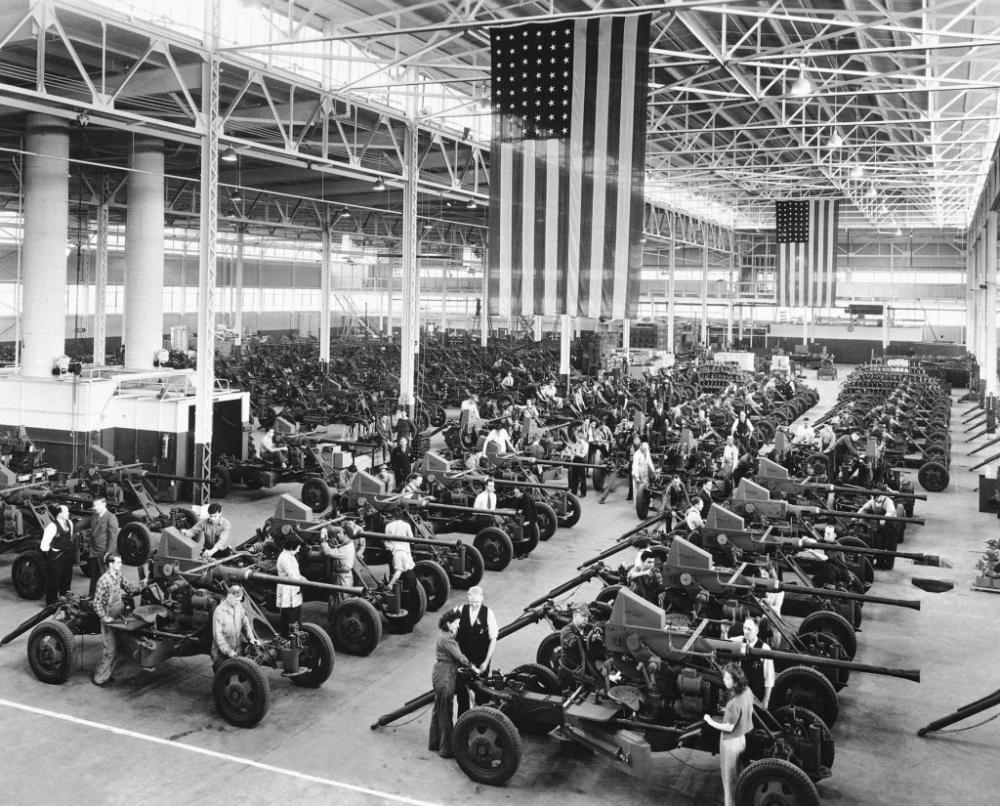

Firestone Tire & Rubber Co. in Akron, Ohio on April 3rd, 1944. When the Japanese within six weeks of Pearl Harbor took control of 90 percent of the world’s rubber supply, the U.S. dropped the speed limit to 35 mph to protect tires, and then, in three years, invented from scratch a synthetic-rubber industry.
AP photo // Rollingstone

Only half of Americans report having meaningful, face-to-face social interactions on a daily basis. The nation consumes two-thirds of the world’s production of antidepressant drugs. The collapse of the working-class family has been responsible in part for an opioid crisis that has displaced car accidents as the leading cause of death for Americans under 50.

At the root of this transformation and decline lies an ever-widening chasm between Americans who have and those who have little or nothing. Economic disparities exist in all nations, creating a tension that can be as disruptive as the inequities are unjust. In any number of settings, however, the negative forces tearing apart a society are mitigated or even muted if there are other elements that reinforce social solidarity — religious faith, the strength and comfort of family, the pride of tradition, fidelity to the land, a spirit of place.

But when all the old certainties are shown to be lies, when the promise of a good life for a working family is shattered as factories close and corporate leaders, growing wealthier by the day, ship jobs abroad, the social contract is irrevocably broken. For two generations, America has celebrated globalization with iconic intensity, when, as any working man or woman can see, it’s nothing more than capital on the prowl in search of ever cheaper sources of labor.

For many years, those on the conservative right in the United States have invoked a nostalgia for the 1950s, and an America that never was, but has to be presumed to have existed to rationalize their sense of loss and abandonment, their fear of change, their bitter resentments and lingering contempt for the social movements of the 1960s, a time of new aspirations for women, gays, and people of color. In truth, at least in economic terms, the country of the 1950s resembled Denmark as much as the America of today. Marginal tax rates for the wealthy were 90 percent. The salaries of CEOs were, on average, just 20 times that of their mid-management employees.

Today, the base pay of those at the top is commonly 400 times that of their salaried staff, with many earning orders of magnitude more in stock options and perks. The elite one percent of Americans control $30 trillion of assets, while the bottom half have more debt than assets. The three richest Americans have more money than the poorest 160 million of their countrymen. Fully a fifth of American households have zero or negative net worth, a figure that rises to 37 percent for black families. The median wealth of black households is a tenth that of whites. The vast majority of Americans — white, black, and brown — are two paychecks removed from bankruptcy. Though living in a nation that celebrates itself as the wealthiest in history, most Americans live on a high wire, with no safety net to brace a fall.

With the COVID crisis, 40 million Americans lost their jobs, and 3.3 million businesses shut down, including 41 percent of all black-owned enterprises. Black Americans, who significantly outnumber whites in federal prisons despite being but 13 percent of the population, are suffering shockingly high rates of morbidity and mortality, dying at nearly three times the rate of white Americans. The cardinal rule of American social policy — don’t let any ethnic group get below the blacks, or allow anyone to suffer more indignities — rang true even in a pandemic, as if the virus was taking its cues from American history.

COVID-19 didn’t lay America low; it simply revealed what had long been forsaken. As the crisis unfolded, with another American dying every minute of every day, a country that once turned out fighter planes by the hour could not manage to produce the paper masks or cotton swabs essential for tracking the disease. The nation that defeated smallpox and polio, and led the world for generations in medical innovation and discovery, was reduced to a laughing stock as a buffoon of a president advocated the use of household disinfectants as a treatment for a disease that intellectually he could not begin to understand.

As a number of countries moved expeditiously to contain the virus, the United States stumbled along in denial, as if willfully blind. With less than four percent of the global population, the U.S. soon accounted for more than a fifth of COVID deaths. The percentage of American victims of the disease who died was six times the global average. Achieving the world’s highest rate of morbidity and mortality provoked not shame, but only further lies, scapegoating, and boasts of miracle cures as dubious as the claims of a carnival barker, a grifter on the make.

As the United States responded to the crisis like a corrupt tin pot dictatorship, the actual tin pot dictators of the world took the opportunity to seize the high ground, relishing a rare sense of moral superiority, especially in the wake of the killing of George Floyd in Minneapolis. The autocratic leader of Chechnya, Ramzan Kadyrov, chastised America for “maliciously violating ordinary citizens’ rights.” North Korean newspapers objected to “police brutality” in America. Quoted in the Iranian press, Ayatollah Khamenei gloated, “America has begun the process of its own destruction.”

Trump’s performance and America’s crisis deflected attention from China’s own mishandling of the initial outbreak in Wuhan, not to mention its move to crush democracy in Hong Kong. When an American official raised the issue of human rights on Twitter, China’s Foreign Ministry spokesperson, invoking the killing of George Floyd, responded with one short phrase, “I can’t breathe.”

These politically motivated remarks may be easy to dismiss. But Americans have not done themselves any favors. Their political process made possible the ascendancy to the highest office in the land a national disgrace, a demagogue as morally and ethically compromised as a person can be. As a British writer quipped, “there have always been stupid people in the world, and plenty of nasty people too. But rarely has stupidity been so nasty, or nastiness so stupid”.

The American president lives to cultivate resentments, demonize his opponents, validate hatred. His main tool of governance is the lie; as of July 9th, 2020, the documented tally of his distortions and false statements numbered 20,055. If America’s first president, George Washington, famously could not tell a lie, the current one can’t recognize the truth. Inverting the words and sentiments of Abraham Lincoln, this dark troll of a man celebrates malice for all, and charity for none.

Odious as he may be, Trump is less the cause of America’s decline than a product of its descent. As they stare into the mirror and perceive only the myth of their exceptionalism, Americans remain almost bizarrely incapable of seeing what has actually become of their country. The republic that defined the free flow of information as the life blood of democracy, today ranks 45th among nations when it comes to press freedom. In a land that once welcomed the huddled masses of the world, more people today favor building a wall along the southern border than supporting health care and protection for the undocumented mothers and children arriving in desperation at its doors. In a complete abandonment of the collective good, U.S. laws define freedom as an individual’s inalienable right to own a personal arsenal of weaponry, a natural entitlement that trumps even the safety of children; in the past decade alone 346 American students and teachers have been shot on school grounds.

The American cult of the individual denies not just community but the very idea of society. No one owes anything to anyone. All must be prepared to fight for everything: education, shelter, food, medical care. What every prosperous and successful democracy deems to be fundamental rights — universal health care, equal access to quality public education, a social safety net for the weak, elderly, and infirmed — America dismisses as socialist indulgences, as if so many signs of weakness.

How can the rest of the world expect America to lead on global threats — climate change, the extinction crisis, pandemics — when the country no longer has a sense of benign purpose, or collective well-being, even within its own national community? Flag-wrapped patriotism is no substitute for compassion; anger and hostility no match for love. Those who flock to beaches, bars, and political rallies, putting their fellow citizens at risk, are not exercising freedom; they are displaying, as one commentator has noted, the weakness of a people who lack both the stoicism to endure the pandemic and the fortitude to defeat it. Leading their charge is Donald Trump, a bone spur warrior, a liar and a fraud, a grotesque caricature of a strong man, with the backbone of a bully.

Over the last months, a quip has circulated on the internet suggesting that to live in Canada today is like owning an apartment above a meth lab. Canada is no perfect place, but it has handled the COVID crisis well, notably in British Columbia, where I live. Vancouver is just three hours by road north of Seattle, where the U.S. outbreak began. Half of Vancouver’s population is Asian, and typically dozens of flights arrive each day from China and East Asia. Logically, it should have been hit very hard, but the health care system performed exceedingly well. Throughout the crisis, testing rates across Canada have been consistently five times that of the U.S. On a per capita basis, Canada has suffered half the morbidity and mortality. For every person who has died in British Columbia, 44 have perished in Massachusetts, a state with a comparable population that has reported more COVID cases than all of Canada. As of July 30th, even as rates of COVID infection and death soared across much of the United States, with 59,629 new cases reported on that day alone, hospitals in British Columbia registered a total of just five COVID patients.

When American friends ask for an explanation, I encourage them to reflect on the last time they bought groceries at their neighborhood Safeway. In the U.S. there is almost always a racial, economic, cultural, and educational chasm between the consumer and the check-out staff that is difficult if not impossible to bridge. In Canada, the experience is quite different. One interacts if not as peers, certainly as members of a wider community. The reason for this is very simple. The checkout person may not share your level of affluence, but they know that you know that they are getting a living wage because of the unions. And they know that you know that their kids and yours most probably go to the same neighborhood public school. Third, and most essential, they know that you know that if their children get sick, they will get exactly the same level of medical care not only of your children but of those of the prime minister. These three strands woven together become the fabric of Canadian social democracy.

Asked what he thought of Western civilization, Mahatma Gandhi famously replied, “I think that would be a good idea.” Such a remark may seem cruel, but it accurately reflects the view of America today as seen from the perspective of any modern social democracy. Canada performed well during the COVID crisis because of our social contract, the bonds of community, the trust for each other and our institutions, our health care system in particular, with hospitals that cater to the medical needs of the collective, not the individual, and certainly not the private investor who views every hospital bed as if a rental property. The measure of wealth in a civilized nation is not the currency accumulated by the lucky few, but rather the strength and resonance of social relations and the bonds of reciprocity that connect all people in common purpose.

This has nothing to do with political ideology, and everything to do with the quality of life. Finns live longer and are less likely to die in childhood or in giving birth than Americans. Danes earn roughly the same after-tax income as Americans, while working 20 percent less. They pay in taxes an extra 19 cents for every dollar earned. But in return they get free health care, free education from pre-school through university, and the opportunity to prosper in a thriving free-market economy with dramatically lower levels of poverty, homelessness, crime, and inequality. The average worker is paid better, treated more respectfully, and rewarded with life insurance, pension plans, maternity leave, and six weeks of paid vacation a year. All of these benefits only inspire Danes to work harder, with fully 80 percent of men and women aged 16 to 64 engaged in the labor force, a figure far higher than that of the United States.

American politicians dismiss the Scandinavian model as creeping socialism, communism lite, something that would never work in the United States. In truth, social democracies are successful precisely because they foment dynamic capitalist economies that just happen to benefit every tier of society. That social democracy will never take hold in the United States may well be true, but, if so, it is a stunning indictment, and just what Oscar Wilde had in mind when he quipped that the United States was the only country to go from barbarism to decadence without passing through civilization.

Evidence of such terminal decadence is the choice that so many Americans made in 2016 to prioritize their personal indignations, placing their own resentments above any concerns for the fate of the country and the world, as they rushed to elect a man whose only credential for the job was his willingness to give voice to their hatreds, validate their anger, and target their enemies, real or imagined. One shudders to think of what it will mean to the world if Americans in November, knowing all that they do, elect to keep such a man in political power. But even should Trump be resoundingly defeated, it’s not at all clear that such a profoundly polarized nation will be able to find a way forward. For better or for worse, America has had its time.

The end of the American era and the passing of the torch to Asia is no occasion for celebration, no time to gloat. In a moment of international peril, when humanity might well have entered a dark age beyond all conceivable horrors, the industrial might of the United States, together with the blood of ordinary Russian soldiers, literally saved the world. American ideals, as celebrated by Madison and Monroe, Lincoln, Roosevelt, and Kennedy, at one time inspired and gave hope to millions.

If and when the Chinese are ascendant, with their concentration camps for the Uighurs, the ruthless reach of their military, their 200 million surveillance cameras watching every move and gesture of their people, we will surely long for the best years of the American century. For the moment, we have only the kleptocracy of Donald Trump. Between praising the Chinese for their treatment of the Uighurs, describing their internment and torture as “exactly the right thing to do,” and his dispensing of medical advice concerning the therapeutic use of chemical disinfectants, Trump blithely remarked, “One day, it’s like a miracle, it will disappear.” He had in mind, of course, the coronavirus, but, as others have said, he might just as well have been referring to the American dream.

Supreme Court ruling prevents 1.4 million from voting in Florida


https://www.youtube.com/watch?v=9nYlkXaN64A


An Interview with Karl Marx


Labor journalist John Swinton visited the Marx family on vacation in Southern England and wrote this dispatch showing Marx in his last years - no less astute, productive and committed to the class struggle than at any time in his adult life.

August 13, 2020 John Swinton PEOPLE'S WORLD

https://portside.org/2020-08-13/interview-karl-marx

The following interview with Karl Marx, published in the New York Sun on Sept. 6, 1880, was written by John Swinton, printer, journalist, and editor, when he visited Europe. It first appeared in our pages as part of the May 5, 1940 edition of the Sunday Worker. Swinton’s enthusiastic appreciation of Marx gives a vivid picture of Marx with his family and expresses the admiration of an American journalist who could not help but feel the genius of the working class leader. A few of Swinton’s ideas were somewhat inaccurate, as, for example, his reference to the “stormy Bakunin” and to “the brilliant Lassalle” as “pupils of Marx.” Bakunin was an inveterate enemy of Marx, and Lassalle never represented Marxism, but, on the contrary, distorted it. Nevertheless, readers may find interesting what was written by an American journalist about Marx in 1880, just three years before his death.


One of the most remarkable men of the day, who has played an inscrutable but puissant part in the revolutionary politics of the past forty years, is Karl Marx. A man without desire for show or fame, caring nothing for the fanfaronade of life or the pretense of power, without haste and without rest, a man of strong, broad, elevated mind, full of far-reaching projects, logical methods, and practical aims, he has stood and yet stands behind more of the earthquakes which have convulsed nations and destroyed thrones, and do now menace and appall crowned heads and established frauds, than any other man in Europe, not excepting Joseph Mazzini himself.


This interview first appeared in our pages as part of the May 5, 1940 edition of the Sunday Worker. | People’s World Archives

The student of Berlin, the critic of Hegelianism, the editor of papers, and the old-time correspondent of the New York Tribune, he showed his qualities and his spirit; the founder and master spirit of the once dreaded International and the author of Capital, he has been expelled from half the countries of Europe, proscribed in nearly all of them, and for thirty years past has found refuge in London.

He was at Ramsgate the great seashore resort of the Londoners, while I was in London, and there I found him in his cottage, with his family of two generations. The saintly-faced, sweet-voiced, graceful woman of suavity who welcomed me at the door was evidently the mistress of the house and the wife of Karl Marx. And is this massive-headed, generous-featured, courtly, kindly man of 60, with the bushy masses of long reveling gray hair, Karl Marx?

His dialogue reminded me of that of Socrates—so free, so sweeping, so creative, so incisive, so genuine—with its sardonic touches, its gleams of humor, and its sportive merriment. He spoke of the political forces and popular movements of the various countries of Europe—the vast current of the spirit of Russia, the motions of the German mind, the action of France, the immobility of England. He spoke hopefully of Russia, philosophically of Germany, cheerfully of France, and sombrely of England—referring contemptuously to the “atomistic reforms” over which the Liberals of the British Parliament spend their time.

Surveying the European world, country after country, indicating the features and the developments and the personages on the surface and under the surface, he showed that things were working toward ends which will assuredly be realized. I was often surprised as he spoke. It was evident that this man, of whom so little is seen or heard, is deep in the times, and that, from the Neva to the Seine, from the Urals to the Pyrenees, his hand is at work preparing the way for the new advent. Nor is his work wasted now any more than it has been in the past, during which so many desirable changes have been brought about, so many heroic struggles have been seen, and the French republic has been set up on the heights.

As he spoke, the question I had put, “Why are you doing nothing now?” was seen to be a question of the unlearned, and one to which he could not make direct answer. Inquiring why his great work Capital, the seed field of so many crops, had not been put into English as it has been put into Russian and French from the original German, he seemed unable to tell but said that a proposition for an English translation had come to him from New York. He said that that book was but a fragment, a single part of a work in three parts, two of the parts being yet unpublished, the full trilogy being Land, Capital, and Credit, the last part, he said, being largely illustrated from the United States, where credit has had such an amazing development.


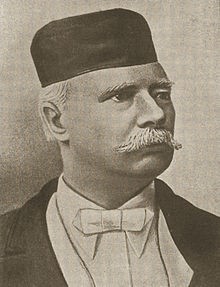
Author John Swinton (Wikipedia)


Mr. Marx is an observer of American action, and his remarks upon some of the formative and substantive forces of American life were full of suggestiveness. By the way, in referring to his Capital, he said that anyone who might desire to read it would find the French translation much superior in many ways to the German original. Mr. Marx referred to Henri Rochefort, the Frenchman, and in his talk of some of his dead disciples, the stormy Bakunin, the brilliant Lassalle, and others, I could see how his genius had taken hold of men who, under other circumstances, might have directed the course of history.

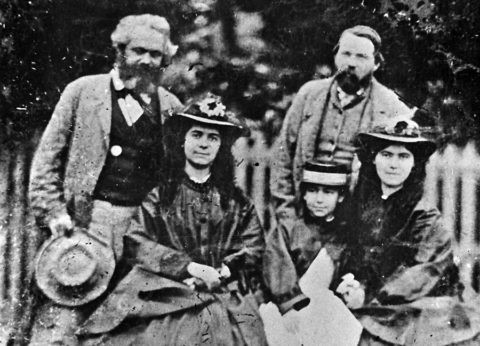
The afternoon is waning toward the twilight of an English summer evening as Mr. Marx discourses, and he proposes a walk through the seaside town and along the shore to the beach, upon which we see many thousand people, largely children, disporting themselves. Here we find on the sands his family party—the wife, who had already welcomed me, his two daughters with their children, and his two sons-in-law, one of whom is a Professor in King’s College, London, and the other, I believe, a man of letters.


A photograph from 1864 of (left to right) Karl Marx and Frederick Engels standing and Marx’s daughters Jenny, Eleanor, and Laura seated. | Public Domain


It was a delightful party—about ten in all—the father of the two young wives, who were happy with their children, and the grandmother of the children, rich in the joysomeness and serenity of her wifely nature. Not less finely than Victor Hugo himself does Karl Marx understand the art of being a grandfather; but, more fortunate than Hugo, the married children of Marx live to cheer his years.

Toward nightfall, he and his sons-in-law part from their families to pass an hour with their American guest. And the talk was of the world, and of man, and of time, and of ideas, as our glasses tinkled over the sea. The railway train waits for no man, and night is at hand.

Over the thought of the babblement and rack of the age and the ages, over the talk of the day and the scenes of the evening, arose in my mind one question touching upon the final law of being, for which I would seek answer from this sage. Going down to the depth of language, and rising to the height of emphasis, during an interspace of silence, I interrogated the revolutionist and philosopher in these fateful words, “What is [the final law of being]?” And it seemed as though his mind were inverted for a moment while he looked upon the roaring sea in front and the restless multitude upon the beach.

“What is?” I had inquired, to which, in deep and solemn tone, he replied: “Struggle!”

At first, it seemed as though I had heard the echo of despair; but, peradventure, it was the law of life.


[Author John Swinton (1829-1901) as a journalist was in a class of his own. An outstanding writer and defender of labor, he was among other things an editorialist for the then-prominent New York Sun who went on to edit his one-man pro-worker weekly John Swinton’s Paper. He is remembered among other things for writing in 1883, “The business of a New York journalist is to distort the truth, to lie outright, to pervert, to vilify, to fawn at the feet of Mammon, and to sell his country and his race for his daily bread, or for what is about the same — his salary. You know this, and I know it; and what foolery to be toasting an "Independent Press"! We are the tools and vassals of rich men behind the scenes. We are jumping-jacks. They pull the string and we dance. Our time, our talents, our lives, our possibilities, are all the property of other men. We are intellectual prostitutes."

He is not to be confused with the theologian John Swinton.]


Palestine Rejects U.S Brokered Deal Between Israel and UAE


https://www.youtube.com/watch?v=O9G5ykZsdjU


How Trump Politicized Schools Reopening, Regardless of Safety


If the Trump administration is willing to spend trillions to bail out corporations, banks, and airlines, why is it not willing to put up the $400-500 billion necessary to ensure the safety of our nation’s schools, children, and educators?

August 13, 2020 Diane Ravitch THE NEW YORK REVIEW OF BOOKS

https://portside.org/2020-08-13/how-trump-politicized-schools-reopening-regardless-safety

One of the most difficult issues of the pandemic is when and how schools should reopen. Parents and teachers are eager for them to reopen, but only if the schools are safe and protected from the disease that is ravaging so much of the nation. Parents want their children back in school. They are tired of pretending to be teachers, organizing their children’s time every day. Teachers are eager to resume in-person instruction, but not at risk of their lives. Even students are eager to return to school, to see their friends, to engage in class discussions, to participate in school activities.

School has resumed in other nations like Denmark, Finland, and South Korea. Those countries that have reopened their schools have added daily temperature checks, reduced class sizes, and provided whatever personnel and equipment was needed to protect the health of students and staff.

US states could follow suit, but for school to resume safely here, two necessities must be in place. First, the pandemic must be under control. Infection rates must be low and dropping. Nations that have successfully opened their schools tamed the coronavirus first. Second, the schools must be able to provide safe conditions, meaning small class sizes, extra nurses, disinfected and active ventilation systems, additional cleaning staff, and personal protective equipment for children and adults. Since every state’s tax revenues have been diminished by the economic effects of the pandemic, school budgets are being slashed at the very moment when they need more resources.

In the United States, the pandemic is surging in the South and in parts of the West. In the absence of federal leadership, each state has been free to write its own rules for behavior, and governors in Florida, Georgia, Tennessee, and several other states have followed the lead of President Trump by refusing to mandate the obvious requirements for public health and safety, such as wearing a mask and maintaining a safe distance from others to avoid the spread of the disease. Even states that have managed to contain the virus, like New York, New Jersey, and Connecticut, remain vulnerable to new outbreaks because of tourism and travel.

Amid this uncertainty and anxiety, President Trump has decided that the reopening of schools is essential to his prospects for reelection. He wants to bring back the strong economy for which he claims credit, but which collapsed as the pandemic spread. He wants stores to open, factories to resume production, and commerce to pick up again. He wants this economic revival to occur without following the guidelines laid out by his own administration’s scientists and medical experts. Until recent weeks, Trump has refused to wear a mask in public and has tried to maintain the pretense that all is well and, as he puts it, the virus will magically “disappear” one day. His supporters have followed his example and have demonstrated at state capitols in opposition to mask-wearing mandates and any other restrictions on their normal activity.

In mid-July, Trump demanded that schools across the nation reopen on time for in-person instruction, so that life and the economy could return to normal. He did this without regard to the upsurge in the coronavirus and without any assurance that federal money would be available to protect students and staff. Secretary of Education Betsy DeVos, notable for her belief that public schools are a “dead end,” reiterated Trump’s demands and threatened to cut the funding of schools that continued to use remote learning instead of in-person instruction. The federal funds over which she exercises a measure of control—only a small proportion of schools’ budgets, whose funding comes mainly from states—is dedicated to supporting poor children and students with disabilities. Vice President Mike Pence quickly added his support for the rapid reopening of schools, despite conditions that made them unsafe.

School leaders complained that they should not open schools that did not comply with the guidelines released by the Centers for Disease Control and Prevention (CDC), which specifically recommended social distancing, masks, testing, and other protocols. The initial CDC guidelines, released in May, said that a full reopening would pose the “highest risk” to students and staff unless all precautions were taken to protect them. The “lowest risk,” said the CDC at that time, was “virtual-only classes, activities, and events.”

Trump, DeVos, and Pence declared that the CDC guidelines were too rigorous and too expensive and that the agency would soon lower its standards. Kayleigh McEnany, the White House press secretary, said that “science should not stand in the way” of reopening schools fully, as the Trump administration wished.

By late July, the Trump administration was pressuring governors and mayors to reopen schools, claiming the social and psychological costs to children of staying home would be worse than the virus. And, as Trump had earlier predicted, the CDC bent to White House demands and revised its guidelines to reflect the views of the president and secretary of education. Its new guidelines, released July 23, were titled “The Importance of Reopening America’s Schools this Fall.” The newly revised guidance emphasized the social, emotional, and educational benefits of in-person instruction, as well as the low incidence of virus transmission among young children. The CDC’s shameful capitulation to political pressure not only compromised the health and safety of the nation’s children and educators but also eroded the agency’s scientific reputation.

While Trump was successful in pressuring the CDC to comply with his wishes, he could do nothing to dissuade the virus from spreading across California, Florida, Texas, Arizona, and other states. In California, where the rate of infections has soared, the two biggest school districts—Los Angeles and San Diego—announced on July 13 that they would continue with online instruction this fall. The largest teachers’ union in Florida filed a lawsuit on July 20 to block Governor Ron DeSantis’s order to open all schools for full-time instruction in the midst of the pandemic. Even districts like New York City where the pandemic has subsided are hesitant to reopen schools fully, both because they lack the resources to do it safely and because teachers and parents are fearful of unsafe conditions in the schools.

At no point have Trump or DeVos offered any plans or guidance or resources to school districts. The school leaders have been left on their own to figure out how to open safely without the funds to do so. Many are floundering, trying to cobble together distance learning; staggered schedules; some classes online, with others in-person; starting with young children or starting with older students. In the absence of definitive guidance from the CDC or any other authoritative agency, school leaders are trapped between parents who want schools to open, parents who don’t want schools to open, teachers who are fearful for their safety, and acute financial shortfalls.

The Pulitzer Prize–winning science writer Laurie Garrett recently reviewed the available studies and concluded that a nationwide reopening of schools, as Trump demands, should be out of the question. While it is accurate that children under ten are less likely to get or transmit the virus, they are nonetheless not immune to it. A large study of children in South Korea found that children over ten transmit the virus as often as adults. Closing the schools in the spring did limit the spread of the virus in the US; reopening them too soon may be harmful to families and to the adults who work in schools. A safe reopening requires small classes, clean air, and other changes that are costly.

“What’s clear,” Garrett writes, “is that smaller classes with better air filter systems cost money. Fairness quickly becomes an issue: wealthy districts are more likely to have the resources to make such changes—and to pay for additional staff to accommodate more classes of fewer students. Communities with lower property tax bases are far less likely to have the money to adapt in this way to Covid-19.”

When journalists point out that other nations have managed to reopen their schools, they don’t always mention that they reopened after coronavirus infections were brought down to negligible numbers, and that not all reopenings have been successful. South Korea reopened its schools in May when it appeared to be safe to do so; then closed hundreds of its 20,000 schools only a few days later after a resurgence of the virus. Israel reopened its schools after a two-month lockdown, when the numbers of infections were in decline, but then it spiraled out of control again, and epidemiologists concluded that the reopening of the schools had happened too soon.

Among the ironies of the situation is that parents who are sick of distance learning are now willing to bear it as long as necessary to keep their children out of harm’s way: they want their children in a real school with real teachers, but most are willing to wait until it is safe to do so. Second, Betsy DeVos herself was an evangelist for distance learning and even praised it at her confirmation hearings in 2017, but is now demanding a return to brick-and-mortar schools. Third, the Trump administration, which scorned public schools, now sees them as essential for the lives of children, as well as the economy. And the situation is made even more challenging because the Trump administration has politicized decision-making and even the CDC itself.

No one is certain of the right course of action. We do know that the best way to tame the pandemic is for everyone to wear masks and to practice social distancing, yet many of our national and state leaders refuse to follow the authoritative dictates of science. We also know that schools cannot open where it is unsafe. But one question persists: If the Trump administration is willing to spend trillions to bail out corporations, banks, and airlines, why is it not willing to put up the $400-500 billion necessary to ensure the safety of our nation’s schools, children, and educators and to achieve what it claims to want: the reopening of our schools?

Jim Clyburn Is Shamelessly Gaslighting Blacks On Biden Choosing Kamala Harris


https://www.youtube.com/watch?v=QcTo5Hngfqk


Want Progressive U.S. Politics? Continue to Reform the Democratic Party Rules


There would be far more elected officials like Jamaal Bowman and AOC, if New York complied with the new Party reforms. The Democratic National Convention’s Rules Committee voted unanimously to keep in place the small-d democratic reforms...

August 13, 2020 Larry Cohen IN THESE TIMES

https://portside.org/2020-08-13/want-progressive-us-politics-continue-reform-democratic-party-rules

On July 30, the Demo­c­ra­t­ic Nation­al Convention’s Rules Com­mit­tee vot­ed unan­i­mous­ly to keep in place the small‑d demo­c­ra­t­ic reforms that grew out of the 2016 Demo­c­ra­t­ic Nation­al Con­ven­tion in Philadel­phia. Those changes in the rules gov­ern this year’s con­ven­tion, and now, as a result of the unan­i­mous vote, they will gov­ern the 2024 con­ven­tion as well, once offi­cial­ly adopt­ed by the full con­ven­tion on August 17.The 39 state party chairs that supported the reform proposal recognize that democracy and change inside the party is just as important as democracy outside the party. Democrats can’t claim to be the voting rights party, and then restrict voting in primaries.

Those vital reforms were based on the work of the Uni­ty Reform Com­mis­sion, of which I was vice-chair, rep­re­sent­ing the Bernie Sanders wing of the Demo­c­ra­t­ic Party.

I was also one of the spon­sors on the Rules Com­mit­tee of the pro­pos­al to con­tin­ue the reforms through 2024, and yet, in late July, I feared it was a lost cause. But Sen. Sanders focused his own and his team’s efforts on pass­ing the pro­pos­al, and 39 state par­ty chairs endorsed it. Joe Biden’s cam­paign respond­ed well to those efforts and what became the ​“Uni­ty Res­o­lu­tion” was ulti­mate­ly adopt­ed by the Rules Com­mit­tee 173 – 0.

This is sig­nif­i­cant because if the pro­pos­al had not been adopt­ed, it would have been up to the Demo­c­ra­t­ic Nation­al Com­mit­tee (DNC) to decide whether or not to adopt these rules in 2024. Since mem­bers of the DNC are superdel­e­gates, this would have required them to again strip them­selves of the right to impact the Demo­c­ra­t­ic Par­ty nom­i­na­tion for pres­i­dent in four years. In 2016, most of those superdel­e­gates were lined up for Hillary Clin­ton long before the Iowa cau­cus, lead­ing many to believe Sanders’ cam­paign was hopeless.

The reforms, how­ev­er, go far beyond superdel­e­gates. Most cau­cus states switched over to hold­ing pri­maries, which dras­ti­cal­ly increased vot­er par­tic­i­pa­tion in Wash­ing­ton, Min­neso­ta, Col­orado and oth­er states. The remain­ing cau­cus states were required to adopt a method for vot­ers to par­tic­i­pate if they were work­ing, phys­i­cal­ly chal­lenged or oth­er­wise could not caucus.

Most impor­tant­ly, these rules require that unaf­fil­i­at­ed vot­ers can join the Demo­c­ra­t­ic Par­ty and vote on the same day as a pri­ma­ry. In New York alone, there are 3 mil­lion unaf­fil­i­at­ed vot­ers, many of them young peo­ple, who could be crit­i­cal to chang­ing the out­come not only for the party’s nom­i­na­tion for pres­i­dent, but also in the numer­ous ​“one par­ty dis­tricts” in the House of Rep­re­sen­ta­tives and state leg­is­la­ture where win­ning the par­ty nom­i­na­tion vir­tu­al­ly ensures election.

One par­ty dis­tricts are almost cer­tain to elect Democ­rats giv­en the district’s par­ty reg­is­tra­tion and vot­ing his­to­ry, so the pri­ma­ry is the elec­tion that counts. Cor­po­rate and oth­er big mon­ey inter­ests all focus on the Demo­c­ra­t­ic can­di­dates in these races, which often results in very mod­er­ate Democ­rats get­ting nom­i­nat­ed. This year, New York moved the cut off date to join the par­ty from six months to two months before the pri­ma­ry, which, while not in com­pli­ance with the reform rules from 2016 man­dat­ing same day par­ty reg­is­tra­tion, is still a step forward.

Imag­ine a cam­paign like the recent U.S. House pri­ma­ry elec­tion in New York’s 16th Dis­trict between Jamaal Bow­man and incum­bent Eliot Engel. With same day par­ty reg­is­tra­tion, thou­sands of new Democ­rats could have helped elect Bow­man, the pro­gres­sive chal­lenger. He won any­way, but there would be far more Bow­mans and AOCs if New York com­plied with par­ty rules. New Jer­sey, Penn­syl­va­nia, Mary­land and oth­er closed pri­ma­ry states have sim­i­lar bar­ri­ers and mul­ti­ple one par­ty dis­tricts. Chang­ing to same day reg­is­tra­tion could also help pro­gres­sives get elect­ed in those states.

Oth­er impor­tant reforms con­sid­ered at the Rules Com­mit­tee this year had mixed out­comes. Pri­mar­i­ly these were char­ter amend­ments, and faced a high­er bar since they are per­ma­nent pro­vi­sions. All were issues spon­sored by Sanders del­e­gates and viewed by the Biden cam­paign as items that could be deferred. (Eighty per­cent of the com­mit­tee mem­bers were Biden appointees.) These issues includ­ed man­dat­ing pri­maries instead of cau­cus­es and keep­ing cor­po­rate lob­by­ists out of the DNC. While they did not suc­ceed, reform­ers will con­tin­ue to pur­sue such issues at the DNC and in state parties.

In the Unit­ed States, unlike any oth­er democ­ra­cy, we define our pol­i­tics by our can­di­dates. Even on the Left, we talk about move­ment build­ing and orga­niz­ing yet often are addict­ed to can­di­dates and ignore the rules — espe­cial­ly when it comes to the rules inside the Demo­c­ra­t­ic Par­ty. Some on the Left have argued for build­ing a new par­ty with­out ever fig­ur­ing out what the rules are in the Demo­c­ra­t­ic Par­ty that stand as the real bar­ri­ers to change.

The unan­i­mous vote should be a wake-up call about what’s pos­si­ble in terms of build­ing and chang­ing the Demo­c­ra­t­ic Par­ty. The 39 state par­ty chairs that sup­port­ed the reform pro­pos­al rec­og­nize that democ­ra­cy and change inside the par­ty is just as impor­tant as democ­ra­cy out­side the par­ty. Democ­rats can’t claim to be the vot­ing rights par­ty, and then restrict vot­ing in pri­maries. State Par­ty chairs Ken Mar­tin (Minn.), Jane Kleeb (Neb.), Tina Pod­lodows­ki (Wash.) and Trav Robert­son (S.C.) led the effort to mobi­lize state chairs to sup­port the rules res­o­lu­tion that we ulti­mate­ly passed. They are com­mit­ted to par­ty build­ing at every level.

Par­ty build­ing starts with mea­sur­ing par­ty reg­is­tra­tion in every coun­ty and set­ting goals. It means mea­sur­ing turnout and vol­un­teers. It means open­ing up par­ty elec­tions at the precinct, coun­ty and state lev­els. It means orga­niz­ing around issues, and using the pri­ma­ry process to elect can­di­dates who are account­able on those issues to the par­ty orga­ni­za­tion, whether at the local, state or nation­al level.

The Demo­c­ra­t­ic Par­ty has oper­at­ed as a top-down sys­tem for decades, but slow­ly there is a grow­ing recog­ni­tion that the nation­al par­ty is most­ly the sum total of the 57 par­ties (includ­ing states, Wash­ing­ton, D.C., ter­ri­to­ries, Puer­to Rico and Democ­rats abroad) — and that those par­ties must be mem­ber based.

Until 2017, it was rare to have micro­phones on the floor at DNC meet­ings, let alone dis­cus­sion and roll call votes on motions. After the offi­cer elec­tions in 2017, that changed, and the inter­nal func­tions of the DNC are increas­ing­ly demo­c­ra­t­ic, in part because of the the Uni­ty Reform Pro­pos­als. DNC Chair Tom Perez has encour­aged par­tic­i­pa­tion even when it is con­tentious, such as last year’s dis­cus­sion on hold­ing pres­i­den­tial debates focused on top­ics like cli­mate, rather than the gen­er­al debate for­mat that prevailed.

Focus­ing on ​“the rules not just the rulers” is also crit­i­cal when it comes to Sen­ate gov­er­nance and the Demo­c­ra­t­ic cau­cus. Sen­ate Major­i­ty Leader Mitch McConnell (R‑Ky.) and the Repub­li­can cau­cus worked around the ​“clo­ture” rule that requires the sup­port of 60 sen­a­tors to end debate on a piece of leg­is­la­tion on the Sen­ate floor.

McConnell elim­i­nat­ed this clo­ture vote on Supreme Court nom­i­na­tions because a clo­ture vote would have blocked Jus­tices Neil Gor­such and Brett Kavanaugh from con­fir­ma­tion. Sim­i­lar­ly, McConnell passed his 2017 tax give­aways to cor­po­rate Amer­i­ca with a sim­ple major­i­ty. He also used a par­lia­men­tary motion to cut the floor time for judi­cial con­fir­ma­tion from 30 hours to two, and over 200 fed­er­al judges have been con­firmed in Pres­i­dent Trump’s first 3 years.

Hun­dreds of mil­lions of dol­lars in cam­paign con­tri­bu­tions will be spent on con­test­ed Sen­ate races this year. Yet at this moment, at least 10 Demo­c­ra­t­ic mem­bers of the Sen­ate have not com­mit­ted that they are will­ing to vote to get rid of the fil­i­buster if they are the major­i­ty in 2021. Here again, it is rules inside the Demo­c­ra­t­ic Par­ty, not those imposed from out­side, that hob­ble our democracy.

Our addic­tion to can­di­dates means that we raise huge con­tri­bu­tions and devote hours and hours of vol­un­teer time to win a Sen­ate Demo­c­ra­t­ic major­i­ty. But because we tend to ignore the rules, very lit­tle time has been spent dis­cussing how the Sen­ate should gov­ern with a Demo­c­ra­t­ic major­i­ty. For exam­ple, sen­a­tors like Joe Manchin (W.V.), Angus King (Maine), Kyrsten Sine­ma (Ariz.) and Dianne Fein­stein (Calif.) have all indi­cat­ed they would not move any leg­is­la­tion for­ward unless it had 60 votes, which in effect gives Repub­li­can sen­a­tors the right to veto Demo­c­ra­t­ic leg­isla­tive ini­tia­tives. Imag­ine, a Demo­c­ra­t­ic major­i­ty in the Sen­ate next year that is unable to act because the Democ­rats are unwill­ing to wield their major­i­ty pow­er the way that McConnell did repeatedly.

The hur­dles fac­ing us are not only Demo­c­ra­t­ic Par­ty rule­mak­ing and Sen­ate pro­ce­dures. From the cur­rent elec­toral col­lege sys­tem to the arcane U.S. vot­er reg­is­tra­tion process, the lim­its in all but five states on vote by mail, and, most impor­tant­ly, no lim­its on cam­paign spend­ing — the Unit­ed States stands as the most con­strained democ­ra­cy in the world. This is true even with­out deal­ing with fun­da­men­tal rules like the make up of the Sen­ate itself, the role of the fed­er­al judi­cia­ry in review­ing leg­isla­tive changes, or the abil­i­ty of the pres­i­dent to com­mit the nation to end­less wars.

But we can start with the rules that Democ­rats con­trol. As we saw in the Rules Com­mit­tee, we can orga­nize and make a dif­fer­ence. We can demand that the rules on unaf­fil­i­at­ed vot­ers join­ing the par­ty are enforced in New York and oth­er states. We can put lim­its on cor­po­rate and oth­er big mon­ey influ­ence in the par­ty struc­ture. We can bet­ter focus on one-par­ty dis­tricts, real­iz­ing that many of the rules are designed to pro­tect incum­bents who ben­e­fit great­ly from cor­po­rate con­tri­bu­tions. We can demand that Sen­ate Democ­rats gov­ern and not hide behind the fil­i­buster. We can build state par­ties from the bot­tom up, con­trolled by coun­ty orga­ni­za­tions that are tru­ly precinct-based, with fair inter­nal elec­tions. We can orga­nize for pro­gres­sive state par­ty plat­forms like those adopt­ed in many states that sup­port issues like Medicare for All and then build the pro­gres­sive cau­cus in that state to hold can­di­dates account­able on our issues.

What we can’t do is wait for the next Bernie Sanders and expect them to do it for us. We can’t ignore the rules and how we change them, and then say the par­ty sucks and look for anoth­er new one to solve the prob­lem. Run­ning inde­pen­dent and third par­ty can­di­dates is fine where it works, but it doesn’t work in most places.

Our Rev­o­lu­tion (where I chair the board) and oth­er orga­ni­za­tions are mobi­liz­ing not only on issues and for can­di­dates, but around par­ty build­ing and rules reforms with­in the par­ty. Vot­ing for Democ­rats can­not be like root­ing for a sports team and wear­ing their col­ors. We need to stay focused on issues, not just can­di­dates. But just as impor­tant­ly, we must focus on the rules that reg­u­late, and often con­trol, the outcome.