https://www.youtube.com/watch?v=3Fbi0dEYBLA
Friday, August 14, 2020

'It Means Nothing': Trump’s Pledge to Aid Tenants Won’t Halt Evictions
https://portside.org/2020-08-12/it-means-nothing-trumps-pledge-aid-tenants-wont-halt-evictions
Portside Date: August 12, 2020
Author: Katy O'Donnell
Date of source: August 11, 2020
Politico
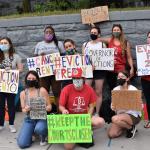
When President Donald Trump signed an executive order Saturday to shield tenants from the threat of eviction, he said it would “solve that problem largely, hopefully completely.”
Yet not only would his action fail to halt evictions, it wouldn't do much of anything to immediately help the 20 million or so Americans who face the loss of their homes in the next few months amid the coronavirus crisis.
Trump’s order does not extend the lapsed four-month eviction moratorium, which itself covered only about a quarter of the nation’s 44 million rental units. Instead, it merely directs the Department of Health and Human Services and the Centers for Disease Control to “consider whether any measures temporarily halting residential evictions” are necessary to halt the spread of Covid-19.
It also provides no direct money to aid tenants in distress, who will eventually have to pay months of back rent. The departments of the Treasury and Housing and Urban Development were instructed to identify sources of funding. Neither could provide details Tuesday on how they would do that.
“It’s nothing but a political ploy,” said House Financial Services Chair Maxine Waters (D-Calif.), who dismissed the “so-called executive order” as a stunt designed to deflect criticism from the president. “It means nothing."
But housing advocates argue that the measure may actually be worse than doing nothing at all, by easing the urgency to reach a deal with Congress and giving renters a false sense of security.
The order will “mislead renters into believing that they are protected when they are not,” National Low Income Housing Coalition President and CEO Diane Yentel said in a statement.
“This executive order is reckless and harmful, offering false hope and risking increased confusion and chaos at a time when renters need assurance that they will not be kicked out of their homes during a pandemic,” she added.
The four-month CARES Act moratorium ended July 25, and most states are letting their own temporary protections lapse. At the same time, the federal enhancement to unemployment benefits — a $600-a-week boost that has helped struggling tenants pay at least some of their rent — has also expired.
The expiration of those benefits means somewhere between 19 million and 23 million people — about one in five renters in the U.S. — will be at risk of eviction by the end of next month, according to an analysis by the Aspen Institute. Negotiations to renew both measures as part of the next relief package broke down late last week.
Trump, questioned at his Tuesday press conference about the prospect of mass evictions, said, "We are not allowing that to happen.”
“We are stopping evictions," he added, referring to the executive order.
Waters, speaking with housing advocates on Monday, called for the urgent “passage of a statutory extension of the eviction moratorium and the creation of an emergency rental assistance fund.”
The House has passed two bills that would provide $100 billion to help tenants pay their rent, but the Senate has not moved on either piece of legislation.
Saturday’s order hints at rental assistance without specifying an amount or where Treasury and HUD should draw the money from.
HUD twice declined to provide details on what the agency plans to do differently as a result of the order. Treasury said it had no comment.
“We are in close contact with the White House and other federal agencies on the Executive Order and its implementation,” HUD spokesperson Brad Bishop said Tuesday. “We will provide additional information as these discussions continue.”
The White House, meanwhile, is insisting the new order will prevent people from losing their homes.
“There will be no evictions,” economic adviser Larry Kudlow said in an interview with CNN on Sunday.
When the CNN anchor pressed him on whether the order actually stops evictions as some struggling tenants may believe, Kudlow said it will provide a “mechanism” to do that.
“We're setting up a process, a mechanism, OK? I can't predict the future altogether,” he said.
Katy O’Donnell is a financial services reporter for Politico.
Source URL: https://portside.org/2020-08-12/it-means-nothing-trumps-pledge-aid-tenants-wont-halt-evictions
Andrew Cuomo Wants to Protect His Wall Street Donors From Paying Taxes
https://portside.org/2020-08-12/andrew-cuomo-wants-protect-his-wall-street-donors-paying-taxes
Portside Date: August 12, 2020
Author: Matthew Cunningham-Cook
Date of source: August 11, 2020
Jacobin
In blocking his party’s push for new taxes on stock trades, capital gains, and carried interest, New York governor Andrew Cuomo is protecting the financial industry that has delivered millions to his campaign and political operation, according to state records reviewed by me. That includes the single-largest donor to the state Democratic Party during Cuomo’s 2018 reelection bid, who just delivered large donations to Cuomo as the governor has stymied the tax proposals.
Last month, billionaire James Simons and his wife gave Cuomo $90,000. Simons is the founder of the hedge fund Renaissance Technologies, which could be subject to the new levies being pushed by New York Democratic legislators. In total, Cuomo has received over $280,000 from Simons and his family. The Cuomo-controlled New York Democratic Party has received an additional $3.4 million from Simons.
Cuomo’s political machine has received big donations from other hedge fund moguls including Dan Loeb ($197,000) and Stanley Druckenmiller ($60,800), who could also be impacted by the Democratic tax initiatives aimed at the financial industry.
Democratic legislators have been pushing the tax measures to raise new revenues that they say could be used to prevent budget cuts to education, health care, and other state programs.
Disclosure records reviewed by me show that the financial industry has been actively lobbying on the tax proposals in Albany — and Cuomo has parroted their opposition to higher taxes on the rich.
“I literally talk to people all day long who are in their Hamptons house who also lived here or in their Hudson Valley house or in their Connecticut weekend house,” the governor said on August 3, suggesting that billionaires and multimillionaires will leave New York if higher taxes on the wealthy go through.
Michael Kink, the executive director of the labor-backed Strong Economy for All Coalition in New York, told me that Cuomo’s work to block progressive taxation is indicative of his warped priorities overall.
“A governor that’s connected to reality would be examining every single possible way of raising revenue in the time of crisis,” Kink said. “When you’re so close to someone like James Simons, that leads to you blocking the door to some of the biggest and most important sources of revenue. There’s a door called the billionaire’s tax — $5.5 billion a year. Cuomo strolls away from that door. Then there’s the stock transfer tax door which is $13 billion a year. The vast majority of people who would pay are the speculators who are diving in and out. James Simon, Dan Loeb, a lot of Cuomo’s major donors are the ones that would pay that tax.”
Democratic Bills Target Wall Street
Cuomo has received more than $10 million from the securities industry, according to data compiled by the National Institute on Money In Politics. In the current legislative session, the governor has refused to support three sets of Democratic tax plans aimed at Wall Street.
One bill would levy a 19 percent tax on investment income to eliminate the federal benefits of the carried interest tax deduction, which allows private equity and hedge fund managers to classify their income as capital gains, which is taxed at 15 percent instead of the top tax bracket of 37 percent. It is dependent on the legislation being passed in Massachusetts and Connecticut to go into effect. The compact carried interest legislation already passed in New Jersey in 2018.
Another bill would impose a state-based surcharge that would equalize taxation between capital gains and labor — in effect a more expansive piece of legislation than the carried interest bill.
Finally, Democratic legislators have pushed legislation to revive New York’s stock transfer tax. The stock transfer tax was in existence in New York from 1905 to 1981, and is technically still on the books, even though Cuomo previously tried to repeal it. The original tax’s revenue was split between the city and state of New York. The state began rebating the tax to the payers in 1981 during the Hugh Carey administration which also oversaw the restructuring of New York City by crushing austerity on the city’s working class. Cuomo has pushed for the full repeal of the tax.
Renaissance Technologies, led by Cuomo’s biggest donor Simons, is reportedly involved in “high-frequency trading” — a business that gained mass public recognition after the publication in 2014 of Michael Lewis’s Flash Boys. While secretive, the firm has been identified as a company that “has made high-frequency finance a huge success” by Richard Olsen, a Switzerland-based financial technologist. Efforts to reinstate New York’s tax on stock trades or financial transactions could threaten Renaissance’s profit margin.
Simons’s firm has also been fighting the IRS over a potential $6 billion tax bill.
Wall Street’s Furious Lobbying in Albany
In blocking the tax measures, Cuomo is aiding some of Wall Street’s most powerful companies and front groups that have been lobbying on those bills in Albany.
For instance, the American Investment Council (AIC) and the Securities Industry and Financial Markets Association (SIFMA) have been lobbying on the Democratic proposals, according to state lobbying records. The former represents major private equity firms and the latter represents broker-dealers, investment banks, and asset managers.
The two trade associations have spent over $400,000 lobbying in Albany during this legislative session. AIC began lobbying Albany for the first time in 2019, after Democrats gained total control of the legislature for the first time in decades.
AIC brought on lobbying firm Greenberg Traurig, which has funneled over $130,000 to Cuomo over the years. SIFMA has employed two firms — Reid, McNally & Savage and Brown & Weintraub, the latter of which was founded by two aides to former Gov. Mario Cuomo.
State records show that AIC has been lobbying against the carried interest proposal and an additional proposal that would tax mezzanine debt, which is used to finance private equity real estate transactions. SIFMA has also been lobbying against the carried interest proposal as well as the financial transaction tax, lobbying records show.
In a memo obtained by me, SIFMA told legislators in July that the financial transaction tax proposal would result in Wall Street firms “relocating personnel outside New York.”
The same week SIFMA’s letter was blasted out to legislators, Andrew Cuomo’s office parroted the same line, telling Bloomberg News: “In the digital age, it would be even easier for transactions to simply be moved out of state to avoid the tax.”
Private equity giant Blackstone has also been lobbying on the carried interest initiative, according to state records. Preserving lower tax rates for carried interest has been a personal priority of Blackstone CEO Steve Schwarzman, who once characterized an effort by the Obama administration to end the carried interest loophole as being “like when Hitler invaded Poland in 1939.”
The governor has said he supports closing the carried interest tax loophole, but it has never appeared in the final budget, despite the governor’s expansive powers over budgeting in New York.
Bill Mulrow, a top Blackstone executive, led Cuomo’s administration between 2015 and 2017, when he rejoined the firm. In March, Cuomo appointed Mulrow to help lead the state’s COVID-19 response.
Fox Business reported in April that Mulrow is spending little time at Blackstone, and that his boss, Schwarzman, “is said to be paying close attention to Mulrow’s efforts because of the implications it has for Wall Street.” Blackstone has spent $255,000 lobbying the legislature this cycle.
If the tax measures do not pass, the state will be forced to balance its budget with $8.2 billion worth of cuts to schools, hospitals, and local governments.
“We are demanding that the superrich pay up,” said Jonathan Westin, executive director of New York Communities for Change. “Many of them have increased their wealth by billions and we should be demanding that they pay so that the rest of us can live.”
Polls show that New Yorkers prefer higher taxes on the rich over devastating cuts to services.
Matthew Cunningham-Cook has written for Labor Notes, the Public Employee Press, Al Jazeera America, and the Nation.
Source URL: https://portside.org/2020-08-12/andrew-cuomo-wants-protect-his-wall-street-donors-paying-taxes
Strike wave grows in Belarus as regime trembles
http://www.marxist.com/strike-wave-grows-in-belarus-as-regime-trembles.htmOleg Bulaev - Marxist Tendency13 August 2020

Image: fair use
Share
Tweet
The wave of strikes in Belarus is growing. Today we can already talk about the beginning of the general strike. The entry of the working class in the arena is extremely significant and can lay the basis for an independent position of the workers. However, this means shedding any illusions in the liberal bourgeois politicians.
Grodno-Azot (chemical fertilisers), Belmedpreparaty (pharmaceutical), JSC “Grodnozhilstroy” (construction), Terrazit (PVC and aluminium), Minsk Electromechanical Plant (MEZ) and the Zhabinka sugar plant have joined the strike movement. Strikes and protests have also taken place at Agat Electromechanical Plant, and factories operated by the “Keramin” ceramics manufacturer. At the same time, the Philharmonic went on strike. And a number of small businesses too. Even employees of the Institute of Physics of the National Academy of Sciences are involved in the strikes.
As we are writing these lines, news arrives that taxi drivers at Uber and Yandex have also announced they are joining the general strike.
Most importantly, a strike started at the Belarusian Automobile Plant BelAZ. Today, thousands of BelAZ workers in the city of Zhodino were chanting: “[Lukasheno] Leave!"
Earlier, enterprises such as Belarussian Steel Works BMZ, VIPRIL Control (flight controllers) and many others went on an indefinite political strike.
At the entrance of the Terrazit plant, the striking workers posted a paper with their demands:
The paper reads:
“Fellow citizens! Grodno residents! Belarusians! The workers of Terrazit Plus LLC cannot stay away from the events taking place in the republic.
“Guided by Article 41 of the Constitution, we declare a strike and demand:
“1. Stop violence against civilians by the security forces.
“2. Release all detainees.
“3. Cancel the results of the 9 August elections and hold new transparent elections under the control of international observers.
“4. Provide the citizens of the republic and the world community with reliable information about the events taking place in the country. “
This appeal was signed by 135 workers of the company.
Thus, at present, industries such as auto construction, building construction, computer production, chemical, cement, fertilizer production, road construction, etc. have been affected by the strike wave.
In addition, the process of exodus of members from official state trade unions and the formation of independent militant trade unions has begun. Currently, metalworkers, doctors, chemical workers, etc. state trade unions are already massively leaving.
Against the background of large-scale strikes, many officers and rank-and-file policemen are leaving their posts or refusing to follow orders from their superiors.
What is happening now in Belarus is unprecedented precisely in terms of the participation of workers’ collectives, which for the first time since the early 1990s are beginning to realise their political power. Since the Russian strike wave of 2007 (which was still very limited in scope), when we saw the emergence of new free trade unions at the factories of Western companies, this is the first case of really significant workers’ demonstrations in the former USSR.
The workers are beginning to realise their strength and any future government in the republic will have to reckon with this.
At the same time, we will never cease warning the working people of the republic against the illusions of bourgeois politics, as we wrote earlier in our official statement. It is obvious that the liberal opposition, in its economic policy, is essentially anti-worker.
Unfortunately none of the large left forces (the BCP and Fair World) are offering an alternative. The first is not even an independent Stalinist party, but only a pitiful appendage of the regime. The leadership of the latter, despite the presence of honest and revolutionary-minded youth in its ranks, is thoroughly infected with reformist illusions and readily capitulates to the pressure of the liberals and EU-imperialism. Change in this party would require events sweeping away its current leadership.
The only way forward for workers in Belarus at present is to form their own government bodies (councils), form workers 'militias, take control of enterprises, and on this basis form their own independent workers' party. With these tools, the working people of the country will be able to hold open elections as they see fit, take control of the economy and open a new era in the history of the country and the entire former Soviet space.
Forward to an independent workers’ policy for Belarus!
Down with bourgeois illusions!
In the middle of a pandemic, the World Bank wants slum dwellers to lose their water supply
https://rwer.wordpress.com/2020/08/13/in-the-middle-of-a-pandemic-the-world-bank-wants-slum-dwellers-to-lose-their-water-supply/
from Norbert Häring
Developing countries are trying to contain the corona pandemic under the most adverse conditions. In the middle of this, the World Bank is proposing that the water supply of slum dwellers be cut off, if their landlords do not pay the water bill. It is an inhumane philosophy of development that is behind such monstrosities.
For about two decades, the World Bank’s philosophy has been “sustainable development”; “sustainable” in the sense of profitable in the long run. Wherever possible, development work should be carried out in partnership with private companies and their foundations, because only if some corporation can earn money sustainably from development policy will enough money flow in to make a lasting difference. The derivation from this is to privatize and commodify as much as possible, i.e. to make it a tradable commodity.
Thus, it is quite straightforward that in July 2020, in the middle of the corona pandemic, the World Bank would publish a scientific paper entitled “Enforcing Payment for Water and Sanitation Services in Nairobi’s Slums“.
The four authors, among them a World Bank economist, a former Argentinean Vice Minister of Finance, and the well-known experimental economist Paul Gertler from the University of California, ran one of the notorious Randomized Controlled Trials on poor Kenyan slum dwellers.
Strict enforcement through disconnections increases payment and the financial position of the utility without incurring political costs.
In the slums of Nairobi, most people live as tenants on plots of land with a common water supply for all. The landowners are responsible for the water bill. Through subsidies, the government has managed to connect most households at least to such collection points for running water. However, many landlords do not pay the bill and – partly because of this – the water is often strictly rationed.
In line with the World Bank philosophy focusing on commercial aspects, the four authors have tested, in cooperation with the water company, what happens when landowners are credibly threatened with water cut-offs. The direct victims of this are the tenants who are no longer getting water if the landlord still does not pay. Almost 30 percent of the plots in the “treated” group have had their water cut off. After nine months, in autumn 2019, shortly before the outbreak of the Corona crisis, “many” of the affected households had water again, the paper says, and further in the World Bank’s chilly jargon: “There is a balance between ensuring that the disconnection is credible and economically meaningful to the customer, while also being flexible enough to allow for reasonable opportunities for remedial action.”
The result of the experimental intervention was that the payment morale of the “treated” landlords was increased, while at the same time the dreaded revolt of the slum dwellers did not take place. The authors’ conclusion: “Strict enforcement through disconnections increases payment and the financial position of the utility without incurring political costs.”
Access to clean water as a nice-to-have luxury
In the paper, the economists implicitly justify the approach, which many people will regard as cynical, by arguing that financially better equipped water suppliers are able to supply more people with water using less rationing. This is correct if one strictly follows the World Bank philosophy that everything should be produced and allocated using market mechanisms.
A fundamental right of access to clean water and other basic services, or a political promise by the government to guarantee this, as is the case in Kenya, is not provided for in this philosophy. If one were to assume this, one would come up with different strategies.
One could, for example, take the land of those who are too far behind with their payments under public administration until the debt is paid. But that would be the opposite of the desired privatization. One could subsidize water suppliers, on the basis that it is a paramount political goal to provide all people, including the destitute, with clean water and the possibility of a healthy, hygienic life, especially during a pandemic. But that would not be “sustainable”.
Instead, the authors consider – and check it out through their anti-social field experiment on defenceless poor people – the political costs of cutting off the water that has been made available to people in recent years. And the World Bank finds nothing wrong with publishing the paper with its cynical, market-radical policy recommendation in the middle of the Corona pandemic. It is a very special kind of person who rules the world of the poor.
Twitter discussion prompts a letter of justification
On August 8, in response to the strong criticism of their paper on Twitter, the authors posted an explanation on the Internet, in which they address ethical concerns regarding their experiment.
There they write that the defaulting customers are predominantly well-off landowners. They forget to mention, and to justify, that it is their poor tin hut tenants who are cut off from the water. How little co-author Paul Gertler is interested in this aspect, he made clear with a Twitter comment. “I was threatened with electricity disconnection many years ago and just paid my bill”, he tweeted on August 9. A person who cannot even imagine how it is to be poor, doing experimental research on the destitute. What could possibly go wrong?
The economists stress that a government was involved in the experiment and that it had previously asked the World Bank for help in improving payment morale. That may be so. The World Bank and the International Monetary Fund always stress that everything they do is done at the request of the respective government. Often, however, this request is issued anything but voluntarily.
The authors also stress that they have diligently addressed possible negative effects of the water discontinuation, including on child health. There is a single paragraph in the paper on this subject in which it is briefly stated for a whole bouquet of possible effects, including child health, that no evidence has been found that they occur systematically.
Child health was measured by a single indicator, namely whether the oldest child in a family under five years of age suffered from diarrhea in the last two weeks. The authors apparently did not compare the incidence of diarrhea in the nearly one-third of families in the treated group who actually had their water turned off to those who continued to have water. Instead, all families in the group whose landlords were threatened with water discontinuation in principle were compared with the control group in which this was not the case.
The data of the third of the families in the treated group that was actually affected, was thus statistically diluted by the two-thirds in the same group who continued to have water, because their landlords paid up in time. Thus, it is not at all surprising that the negative effect on child health that was found was not statistically significant.
If it is already shocking that the pandemic is not mentioned in the working paper published in July 2020, it is even more difficult to comprehend how the current letter of defence can do without the words Corona, Covid or pandemic; a real-life pandemic that makes special demands on hygiene that cannot be met without sufficient clean water. What the World Bank and the authors have jointly delivered here is simply beyond justification. (See also postscriptum at bottom.)
Experiments on the poor under criticism
Only recently, there has been a fierce controversy in the international economic community over a paper on another field experiment on very poor people that was accepted for publication in one of the five most prestigious journals, the Quarterly Journal of Economics published by Harvard. It describes how the authors teamed up with an evangelical mission foundation to test whether evangelical missionary work among mostly Catholic poor Filipinos improves their work morale. Because the (controversial) result was supposedly positive, missionary work was seriously declared a possible strategy for poverty reduction.
Subscribe to:
Posts (Atom)