https://www.youtube.com/watch?v=eLqwL18C1nc
Monday, August 10, 2020

COVID-19: A blessing for Bezos and a nightmare for workers
https://www.wsws.org/en/articles/2020/08/10/amaz-a10.html
By Shuvu Batta
10 August 2020
Since the coronavirus was first detected in China in December 2019, nearly 20 million people worldwide have become infected and over 700,000 people have died, including 160,000 in the United States. Over 32 million people in the United States are now unemployed, exceeding records which have stood since the Great Depression.
Over that same time, Amazon’s value on the stock market has nearly doubled from $867 billion dollars to $1.61 trillion. Amazon CEO Jeff Bezos’ personal net worth has skyrocketed to $192 billion, including a $13 billion increase during a single day last month. This points to two interconnected processes: the devastating impact of the virus on human life on the one hand, and the engorging of the super-rich on a massive run-up in share values, driven by a massive government bailout on the other.
The first reported cases of COVID-19 at Amazon were two workers in Milan, Italy, March 1. Two days later workers in Seattle, Washington, tested positive for the virus. As time elapsed, the virus spread, infecting more and more Amazon workers, with confirmed cases in Germany, Spain, France, Poland, USA, etc.
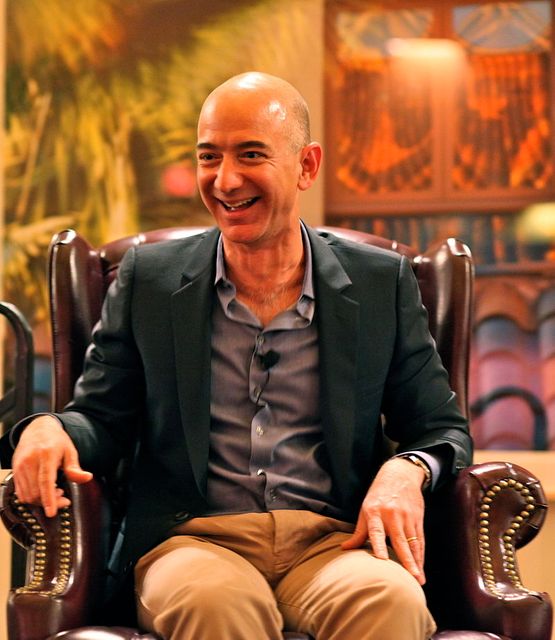 Jeff Bezos (Photo credit: Flickr.com/jurvetson)
Amazon, which utilizes state-of-the art warehouse robots and surveillance technology, gave its workers surgical masks and gloves which were often recycled as “protection” from COVID-19. Warehouses were not disinfected properly, non-essential items were being shipped, workers worked in cramped conditions; inevitably, many began to show up sick.
The anger bubbling up among Amazon workers could no longer be contained and a wave of strikes washed over warehouses and delivery stations around the world in late March and April. Here is an incomplete list:
• March 17: Workers begin strike at Amazon’s Castel San Giovanni Warehouse in Italy
• March 18: Workers begin walkout at Amazon Piacenza Warehouse in Milan, Italy
• March 18: 250-300 workers in Saran, France
• March 30: 300 workers near Florence, Italy
• March 30: Strike in JFK8 in New York City and delivery station in Chicago
• April 1: DTW1 warehouse in Romulus Michigan
• April 20 - April 26: 300 workers called out in facilities throughout the United States
In March and April there were also strikes by Amazon workers in Spain, but the exact dates are unable to be verified. Strike action was planned by Polish workers, but this was halted by the trade unions. Trade unions for German workers began closed negotiations with Amazon, as tensions began to boil within the rank and file, and in late June more than 2,000 Amazon workers in Germany launched a two-day strike in six facilities.
For all of the Amazon workers, from American workers to workers in Germany, the role of the unions has been to contain their fighting spirit, feed illusions of reform, and ultimately tire out workers into accepting Amazon’s terms and conditions of employment. This fact finds clear expression in the “ May Day Strike ,” a protest stunt manufactured by the Democratic Party, the trade unions and corporate news media like the Bezos-owned Business Insider.
The suppression of resistance by the trade unions has allowed Amazon to continue to gobble up smaller firms and expand its tentacles all over the world.
The virus has proven to be a great boon for the transnational corporation, accelerating the shift towards online shopping. Amazon dominates this market, accounting for over half of ecommerce sales in the US and 13 percent globally in 2019.
COVID-19 forced its competitors in physical retail to shut down, and sales for online shopping have sharply increased, with the company recording a 26 percent jump in first quarter revenue.
Amazon used the boost in revenue and demand to hire over 175,000 workers, and increase their investments on building capacity, tools, and services over the course of 2019 and 2020 to over $30 billion.
Even before the pandemic, the company’s logistics arm was set to surpass the combined delivery volume of the United Parcel Service and FedEx by 2022. COVID-19 has accelerated this process by allowing Amazon the opportunity to purchase logistics fleets at fire-sale prices. It acquired 2,300 trucks to launch a new fleet of larger carriers in order to expand its delivery operations, for a total of over 20,000 trucks servicing North America. The company announced the leasing of 12 Boeing 767-300 converted cargo aircraft, bringing its total fleet to 82. It has built dozens of new delivery stations throughout the United States, which are staffed by Amazon “Flex-Drivers,” independent contractors akin to Uber drivers, who are responsible for “last-mile delivery,” allowing the company to fulfill and expand its free two-day shipping for Amazon Prime members.
In addition, it will add 33 new fulfillment centers this year in the US, increasing storage capacity by more than 35 million cubic feet. An average fulfillment center occupies about 1 million cubic feet, which is the equivalent of the space physically occupied by 600,000 people. A similar expansion will take place worldwide, and the company is rapidly moving forward with the expansion of its grocery business.
As its business expands, Amazon is increasing investment in labor-cutting technologies. It’s planned fulfillment center in Sydney, Australia, will be its largest in the world and manned by 2,000 robots, requiring only 800 workers for maintenance. In an average warehouse in North America, about 1,600 workers are needed. Amazon has also acquired the self-driving technology company Zoox for more than $1.2 billion in June. This comes after the company’s investment in electric vehicle startup Rivian and investments in Aurora Innovation, a startup focused on the development of self-driving trucks.
Amazon’s immense technical expertise has led it to further integrate itself into the US military and domestic surveillance apparatus, which is offering lucrative contracts to tech firms as it prepares itself for large-scale war, primarily against China and Russia, and turns towards authoritarian forms of rule to control its domestic population.
According to a report published by the nonprofit Tech Inquiry, since 2016 Amazon has agreed to more than 350 subcontracts from the military and federal enforcement agencies like the FBI and ICE.
The company recently announced the establishment of a space unit called Aerospace and Satellite Solutions, led by former US Air Force Major General Clint Crosier. The unit is responsible for the development of rocket launches, human spaceflight support, robotic systems, mission control operations, space stations, satellite networks and more. Bezos’ Blue Origin also has a NASA contract worth $579 million.
After the 10-year Jedi Contract, which is aimed at overhauling and modernizing the US military’s internet infrastructure, was awarded to Microsoft over the frontrunner Amazon, a federal judge ordered the halting of this work in February, allowing Amazon time to present its case and potentially win the contract.
While tens of millions became unemployed due to COVID-19, with countless facing evictions and food insecurity, the US state has poured trillions of dollars into Wall Street through the Federal Reserve. Amazon’s growth has allowed Bezos’ wealth to skyrocket from about $120 billion in early February to $190 billion today.
The owners of Amazon have profited immensely during the pandemic on the exploitation of Amazon workers risking their lives. The company has been hiding infections, taking away workers’ temporary raises, and using the tens of millions of unemployed workers as justification for getting away with it all.
If you’re an Amazon worker and want to share your comments and get in touch with us, please contact the International Amazon Workers Voice today.
10 August 2020
Since the coronavirus was first detected in China in December 2019, nearly 20 million people worldwide have become infected and over 700,000 people have died, including 160,000 in the United States. Over 32 million people in the United States are now unemployed, exceeding records which have stood since the Great Depression.
Over that same time, Amazon’s value on the stock market has nearly doubled from $867 billion dollars to $1.61 trillion. Amazon CEO Jeff Bezos’ personal net worth has skyrocketed to $192 billion, including a $13 billion increase during a single day last month. This points to two interconnected processes: the devastating impact of the virus on human life on the one hand, and the engorging of the super-rich on a massive run-up in share values, driven by a massive government bailout on the other.
The first reported cases of COVID-19 at Amazon were two workers in Milan, Italy, March 1. Two days later workers in Seattle, Washington, tested positive for the virus. As time elapsed, the virus spread, infecting more and more Amazon workers, with confirmed cases in Germany, Spain, France, Poland, USA, etc.
Jeff Bezos (Photo credit: Flickr.com/jurvetson)Amazon, which utilizes state-of-the art warehouse robots and surveillance technology, gave its workers surgical masks and gloves which were often recycled as “protection” from COVID-19. Warehouses were not disinfected properly, non-essential items were being shipped, workers worked in cramped conditions; inevitably, many began to show up sick.
The anger bubbling up among Amazon workers could no longer be contained and a wave of strikes washed over warehouses and delivery stations around the world in late March and April. Here is an incomplete list:
• March 17: Workers begin strike at Amazon’s Castel San Giovanni Warehouse in Italy
• March 18: Workers begin walkout at Amazon Piacenza Warehouse in Milan, Italy
• March 18: 250-300 workers in Saran, France
• March 30: 300 workers near Florence, Italy
• March 30: Strike in JFK8 in New York City and delivery station in Chicago
• April 1: DTW1 warehouse in Romulus Michigan
• April 20 - April 26: 300 workers called out in facilities throughout the United States
In March and April there were also strikes by Amazon workers in Spain, but the exact dates are unable to be verified. Strike action was planned by Polish workers, but this was halted by the trade unions. Trade unions for German workers began closed negotiations with Amazon, as tensions began to boil within the rank and file, and in late June more than 2,000 Amazon workers in Germany launched a two-day strike in six facilities.
For all of the Amazon workers, from American workers to workers in Germany, the role of the unions has been to contain their fighting spirit, feed illusions of reform, and ultimately tire out workers into accepting Amazon’s terms and conditions of employment. This fact finds clear expression in the “ May Day Strike ,” a protest stunt manufactured by the Democratic Party, the trade unions and corporate news media like the Bezos-owned Business Insider.
The suppression of resistance by the trade unions has allowed Amazon to continue to gobble up smaller firms and expand its tentacles all over the world.
The virus has proven to be a great boon for the transnational corporation, accelerating the shift towards online shopping. Amazon dominates this market, accounting for over half of ecommerce sales in the US and 13 percent globally in 2019.
COVID-19 forced its competitors in physical retail to shut down, and sales for online shopping have sharply increased, with the company recording a 26 percent jump in first quarter revenue.
Amazon used the boost in revenue and demand to hire over 175,000 workers, and increase their investments on building capacity, tools, and services over the course of 2019 and 2020 to over $30 billion.
Even before the pandemic, the company’s logistics arm was set to surpass the combined delivery volume of the United Parcel Service and FedEx by 2022. COVID-19 has accelerated this process by allowing Amazon the opportunity to purchase logistics fleets at fire-sale prices. It acquired 2,300 trucks to launch a new fleet of larger carriers in order to expand its delivery operations, for a total of over 20,000 trucks servicing North America. The company announced the leasing of 12 Boeing 767-300 converted cargo aircraft, bringing its total fleet to 82. It has built dozens of new delivery stations throughout the United States, which are staffed by Amazon “Flex-Drivers,” independent contractors akin to Uber drivers, who are responsible for “last-mile delivery,” allowing the company to fulfill and expand its free two-day shipping for Amazon Prime members.
In addition, it will add 33 new fulfillment centers this year in the US, increasing storage capacity by more than 35 million cubic feet. An average fulfillment center occupies about 1 million cubic feet, which is the equivalent of the space physically occupied by 600,000 people. A similar expansion will take place worldwide, and the company is rapidly moving forward with the expansion of its grocery business.
As its business expands, Amazon is increasing investment in labor-cutting technologies. It’s planned fulfillment center in Sydney, Australia, will be its largest in the world and manned by 2,000 robots, requiring only 800 workers for maintenance. In an average warehouse in North America, about 1,600 workers are needed. Amazon has also acquired the self-driving technology company Zoox for more than $1.2 billion in June. This comes after the company’s investment in electric vehicle startup Rivian and investments in Aurora Innovation, a startup focused on the development of self-driving trucks.
Amazon’s immense technical expertise has led it to further integrate itself into the US military and domestic surveillance apparatus, which is offering lucrative contracts to tech firms as it prepares itself for large-scale war, primarily against China and Russia, and turns towards authoritarian forms of rule to control its domestic population.
According to a report published by the nonprofit Tech Inquiry, since 2016 Amazon has agreed to more than 350 subcontracts from the military and federal enforcement agencies like the FBI and ICE.
The company recently announced the establishment of a space unit called Aerospace and Satellite Solutions, led by former US Air Force Major General Clint Crosier. The unit is responsible for the development of rocket launches, human spaceflight support, robotic systems, mission control operations, space stations, satellite networks and more. Bezos’ Blue Origin also has a NASA contract worth $579 million.
After the 10-year Jedi Contract, which is aimed at overhauling and modernizing the US military’s internet infrastructure, was awarded to Microsoft over the frontrunner Amazon, a federal judge ordered the halting of this work in February, allowing Amazon time to present its case and potentially win the contract.
While tens of millions became unemployed due to COVID-19, with countless facing evictions and food insecurity, the US state has poured trillions of dollars into Wall Street through the Federal Reserve. Amazon’s growth has allowed Bezos’ wealth to skyrocket from about $120 billion in early February to $190 billion today.
The owners of Amazon have profited immensely during the pandemic on the exploitation of Amazon workers risking their lives. The company has been hiding infections, taking away workers’ temporary raises, and using the tens of millions of unemployed workers as justification for getting away with it all.
If you’re an Amazon worker and want to share your comments and get in touch with us, please contact the International Amazon Workers Voice today.
US Supreme Court defends deadly jail conditions in California
https://www.wsws.org/en/articles/2020/08/10/pris-a10.html
By Marc Wells
10 August 2020
In a 5–4 vote last week, the US Supreme Court stayed an injunction originally granted on May 26 on the basis of a class-action lawsuit brought by over 3,000 inmates to protect them against COVID-19 in the pandemic. The suit sought to force Sheriff Don Barnes and Orange County, California, to take urgent steps to remedy conditions in Orange County jails, a four-facility penitentiary complex. The Supreme Court ruling reflects the contempt of the ruling class for constitutional rights and its indifference for human life.
The Ahlman v. Barnes complaint granted injunction in May alleged various causes of action, such as unconstitutional conditions of confinement and unconstitutional punishment in violation of the Fourteenth Amendment and, where applicable, in violation of the Eighth Amendment to the US Constitution. It also alleged discrimination on the basis of disability in violation of Title II of the Americans with Disabilities Act and of Section 504 of the rehabilitation Act. The District Court concluded that the risk of harm in the jail was “undeniably high.”
The lawsuit sought the immediate release of vulnerable and disabled people in jail, plus the demand to expand social distancing, care, testing and personal protective equipment (PPE). It also sought additional releases to bring the jail population to a level that is compatible with public health experts’ recommendations.
At the time of this writing, the Orange County Sheriff’s Department alleges that all inmates and staff are tested for the coronavirus. This claim is contradicted by facts presented in the complaint, as well as inmates’ reports, taken into account by the District and Appeals’ courts, that the facility was not testing all suspected cases and that at least one symptomatic inmate was left in areas with inmates displaying no symptoms. The Orange County jails complex has run 3,133 tests, with 489 positive results.
In Ahlman v. Barnes, the plaintiff alleged that limits in the jail’s design and capacity preclude full social distancing, with beds less than six feet apart. Symptomatic inmates mingle in common areas. Cleaning supplies are insufficient to disinfect living areas, with several cases of supplies not received for days. Moreover, on many occasions, inmates were not tested after exposure to an infected individual.
Remarkably, the original injunction specifically focused on deliberate indifference on the part of the defendant, who was alleged to have made an intentional decision with respect to the conditions that put inmates at substantial risk of suffering serious harm, evinced by the high number of confirmed infections. The injunction agreed that the defendant was not even complying meaningfully with the meek Centers for Disease Control and Prevention (CDC) guidelines, which focus on prevention and management and don’t even contemplate a situation where hundreds within the inmate population have indeed been infected.
The accounts of several inmates depicted highly dangerous housing conditions and were a determining factor in the lower courts’ decision to grant injunction.
• Melissa Ahlman, 32, one of the plaintiffs in Ahlman v. Barnes, is a nursing mother, pumps milk for her baby several times a day and shares housing with other women nursing, some with diabetes, others with autoimmune disease. She has to wait in a crowded area among sick inmates who are seeking medical treatment. “I wonder what will happen if I get sick and it spreads to my baby through my milk,” Ahlman declared. “And I worry that I will get sick in here and not be able to come home to her.”
• Cynthia Campbell, 64, has rheumatoid arthritis, a painful autoimmune condition affecting joints and at times the liver, kidneys and heart. The jail conditions force her to come into closer than six feet contact with other inmates, even when she goes for her medical treatment: “Between myself and the three diabetic cellmates, I believe that we are constantly at risk to contract COVID because of our increased interaction with deputies and other inmates every time we go to medical.”
• Monique Castillo, 43, has type 1 diabetes and is insulin dependent. She’s picked up by guards four times a day and taken to the medical room. Because of that, she fears exposure: “When I travel to the waiting area of the medical office, there are many times that there are too many people in the waiting area to properly distance myself. When we wait to see a doctor, we sit on benches that are close together.”
• Don Wagner, 68, survived cancer and is dangerously exposed to COVID-19, especially when he visits the inmates’ medical station for regular monitoring of blood pressure and thyroid levels. He complained about lack of PPE: “We are not given gloves. We were not given masks either, instead we were given sheets to cut up and bandanas to use. We were not even given these materials until two weeks ago.” He is given a bar of soap a week and has no money to buy any additional cleaning supplies.
• Cecibel Caridad Ortiz, 31, has type 1 diabetes and shares her medical module with six other people: “There are two women who use canes, one who uses a walker, two who are nursing mothers, one who is not autoimmune, and three of us who are diabetic.” She’s been provided one single-use face mask that she had to use for three weeks.
• Enrique Hernandez, 42, explained it’s impossible to maintain social distancing: “The beds are very close together, only a couple of inches apart. If people sleep with their heads facing each other, their heads will touch. I sleep with my feet facing a cellmate’s feet, and our feet touch each other’s during the night.”
The conditions that prevail in the Orange County jails are widespread in California and throughout the US. There have been 8,726 confirmed COVID-19 cases among inmates in the California prison system, with 52 deaths. California’s oldest prison, San Quentin, has been the ground of numerous complaints, with nearly 2,200 infections. As of the end of July, the number of inmates’ deaths rose to 13. “Inhumane conditions” were widely reported by inmates as part of a petition sent to a local Fox television station.
California jails and prisons conditions are so dire that state prison employees represented by the Service Employees International Union (SEIU) filed a health and safety grievance on July 28 against the state corrections department and its health care system, alleging staffers’ exposure to “uncontrolled” coronavirus outbreaks inside state-run prisons. Additionally, hundreds of guards and prison staff have also contracted the virus.
The Supreme Court decision denies the right to safety during a deadly pandemic and at the same time shows contempt for the lives of the poor and destitute. This is an expression of the ideology of the ruling class, which is indifferent to the suffering of working people and loss of lives, as clearly evidenced by the back-to-work and back-to-school policies.
In her dissenting opinion, Justice Sonia Sotomayor, joined by Justice Ruth Bader Ginsburg, highlighted the jails’ awareness of the facts and knowledge that the pandemic was spreading rapidly.
As the dissenting opinion states, “[I]nmates described being transported back and forth to the jail in crammed buses, socializing in dayrooms with no space to distance physically, lining up next to each other to wait for the phone, sleeping in bunk beds two to three feet apart, and even being ordered to stand closer than six feet apart when inmates tried to socially distance.”
In a section of the dissenting opinion that speaks more to the crisis of bourgeois democracy than to its virtues, Justice Sotomayor wrote, “It has long been said that a society’s worth can be judged by taking stock of its prisons. That is all the truer in this pandemic, where inmates everywhere have been rendered vulnerable and often powerless to protect themselves from harm.”
Indeed, there remains no significant constituency within the ruling class for democratic rule. The most modest demand, such as the guarantee of survival, safe living and working conditions, is viewed with hostility. “Life, liberty and the pursuit of happiness” are no longer basic rights, they are privileges reserved only to the rich.
As social inequality accelerates, so does the reactionary response of the bourgeoisie through the agencies of its state in an attempt to defend its class privileges against the antagonist, the working class.
10 August 2020
In a 5–4 vote last week, the US Supreme Court stayed an injunction originally granted on May 26 on the basis of a class-action lawsuit brought by over 3,000 inmates to protect them against COVID-19 in the pandemic. The suit sought to force Sheriff Don Barnes and Orange County, California, to take urgent steps to remedy conditions in Orange County jails, a four-facility penitentiary complex. The Supreme Court ruling reflects the contempt of the ruling class for constitutional rights and its indifference for human life.
The Ahlman v. Barnes complaint granted injunction in May alleged various causes of action, such as unconstitutional conditions of confinement and unconstitutional punishment in violation of the Fourteenth Amendment and, where applicable, in violation of the Eighth Amendment to the US Constitution. It also alleged discrimination on the basis of disability in violation of Title II of the Americans with Disabilities Act and of Section 504 of the rehabilitation Act. The District Court concluded that the risk of harm in the jail was “undeniably high.”
The lawsuit sought the immediate release of vulnerable and disabled people in jail, plus the demand to expand social distancing, care, testing and personal protective equipment (PPE). It also sought additional releases to bring the jail population to a level that is compatible with public health experts’ recommendations.
At the time of this writing, the Orange County Sheriff’s Department alleges that all inmates and staff are tested for the coronavirus. This claim is contradicted by facts presented in the complaint, as well as inmates’ reports, taken into account by the District and Appeals’ courts, that the facility was not testing all suspected cases and that at least one symptomatic inmate was left in areas with inmates displaying no symptoms. The Orange County jails complex has run 3,133 tests, with 489 positive results.
In Ahlman v. Barnes, the plaintiff alleged that limits in the jail’s design and capacity preclude full social distancing, with beds less than six feet apart. Symptomatic inmates mingle in common areas. Cleaning supplies are insufficient to disinfect living areas, with several cases of supplies not received for days. Moreover, on many occasions, inmates were not tested after exposure to an infected individual.
Remarkably, the original injunction specifically focused on deliberate indifference on the part of the defendant, who was alleged to have made an intentional decision with respect to the conditions that put inmates at substantial risk of suffering serious harm, evinced by the high number of confirmed infections. The injunction agreed that the defendant was not even complying meaningfully with the meek Centers for Disease Control and Prevention (CDC) guidelines, which focus on prevention and management and don’t even contemplate a situation where hundreds within the inmate population have indeed been infected.
The accounts of several inmates depicted highly dangerous housing conditions and were a determining factor in the lower courts’ decision to grant injunction.
• Melissa Ahlman, 32, one of the plaintiffs in Ahlman v. Barnes, is a nursing mother, pumps milk for her baby several times a day and shares housing with other women nursing, some with diabetes, others with autoimmune disease. She has to wait in a crowded area among sick inmates who are seeking medical treatment. “I wonder what will happen if I get sick and it spreads to my baby through my milk,” Ahlman declared. “And I worry that I will get sick in here and not be able to come home to her.”
• Cynthia Campbell, 64, has rheumatoid arthritis, a painful autoimmune condition affecting joints and at times the liver, kidneys and heart. The jail conditions force her to come into closer than six feet contact with other inmates, even when she goes for her medical treatment: “Between myself and the three diabetic cellmates, I believe that we are constantly at risk to contract COVID because of our increased interaction with deputies and other inmates every time we go to medical.”
• Monique Castillo, 43, has type 1 diabetes and is insulin dependent. She’s picked up by guards four times a day and taken to the medical room. Because of that, she fears exposure: “When I travel to the waiting area of the medical office, there are many times that there are too many people in the waiting area to properly distance myself. When we wait to see a doctor, we sit on benches that are close together.”
• Don Wagner, 68, survived cancer and is dangerously exposed to COVID-19, especially when he visits the inmates’ medical station for regular monitoring of blood pressure and thyroid levels. He complained about lack of PPE: “We are not given gloves. We were not given masks either, instead we were given sheets to cut up and bandanas to use. We were not even given these materials until two weeks ago.” He is given a bar of soap a week and has no money to buy any additional cleaning supplies.
• Cecibel Caridad Ortiz, 31, has type 1 diabetes and shares her medical module with six other people: “There are two women who use canes, one who uses a walker, two who are nursing mothers, one who is not autoimmune, and three of us who are diabetic.” She’s been provided one single-use face mask that she had to use for three weeks.
• Enrique Hernandez, 42, explained it’s impossible to maintain social distancing: “The beds are very close together, only a couple of inches apart. If people sleep with their heads facing each other, their heads will touch. I sleep with my feet facing a cellmate’s feet, and our feet touch each other’s during the night.”
The conditions that prevail in the Orange County jails are widespread in California and throughout the US. There have been 8,726 confirmed COVID-19 cases among inmates in the California prison system, with 52 deaths. California’s oldest prison, San Quentin, has been the ground of numerous complaints, with nearly 2,200 infections. As of the end of July, the number of inmates’ deaths rose to 13. “Inhumane conditions” were widely reported by inmates as part of a petition sent to a local Fox television station.
California jails and prisons conditions are so dire that state prison employees represented by the Service Employees International Union (SEIU) filed a health and safety grievance on July 28 against the state corrections department and its health care system, alleging staffers’ exposure to “uncontrolled” coronavirus outbreaks inside state-run prisons. Additionally, hundreds of guards and prison staff have also contracted the virus.
The Supreme Court decision denies the right to safety during a deadly pandemic and at the same time shows contempt for the lives of the poor and destitute. This is an expression of the ideology of the ruling class, which is indifferent to the suffering of working people and loss of lives, as clearly evidenced by the back-to-work and back-to-school policies.
In her dissenting opinion, Justice Sonia Sotomayor, joined by Justice Ruth Bader Ginsburg, highlighted the jails’ awareness of the facts and knowledge that the pandemic was spreading rapidly.
As the dissenting opinion states, “[I]nmates described being transported back and forth to the jail in crammed buses, socializing in dayrooms with no space to distance physically, lining up next to each other to wait for the phone, sleeping in bunk beds two to three feet apart, and even being ordered to stand closer than six feet apart when inmates tried to socially distance.”
In a section of the dissenting opinion that speaks more to the crisis of bourgeois democracy than to its virtues, Justice Sotomayor wrote, “It has long been said that a society’s worth can be judged by taking stock of its prisons. That is all the truer in this pandemic, where inmates everywhere have been rendered vulnerable and often powerless to protect themselves from harm.”
Indeed, there remains no significant constituency within the ruling class for democratic rule. The most modest demand, such as the guarantee of survival, safe living and working conditions, is viewed with hostility. “Life, liberty and the pursuit of happiness” are no longer basic rights, they are privileges reserved only to the rich.
As social inequality accelerates, so does the reactionary response of the bourgeoisie through the agencies of its state in an attempt to defend its class privileges against the antagonist, the working class.
Trump executive orders set stage for tens of millions of evictions
https://www.wsws.org/en/articles/2020/08/10/unem-a10.html
By Jacob Crosse
10 August 2020
On Saturday, President Donald Trump announced a series of constitutionally dubious executive actions at his exclusive golf resort in New Jersey that would, among other things, slash federal unemployment benefits by at least $200 and fail to extend a partial federal moratorium on evictions.
The previous day, a comprehensive analysis by researchers at the Aspen Institute, based on data from the US Census Bureau and the National Low Income Housing Coalition, estimated that between 28,900,000 and 39,900,000 tenants in the US are at risk of eviction by the end of the year.
The authors warn that “if conditions do not change” and without “robust and swift intervention,” up to 43 percent of renter households will be at risk in the next several months. Since the start of the pandemic, 30 percent of renters have reported using government aid or other forms of assistance to pay rent, while another 30 percent expect to have to borrow cash or obtain a loan to pay September rent.
After two weeks of half-hearted negotiations and theatrics between Democratic congressional leaders and Trump administration officials, both sides adjourned Friday without reaching an agreement to extend the now-expired federal unemployment enhancement for the roughly 30 million Americans who had been receiving it. Nor did the two sides reach a deal to extend the federal partial moratorium on evictions, which, according to the Urban Institute, covered roughly 12.3 million people.
Speaking before wealthy supporters in a gilded ballroom at his private Westminster golf club, Trump claimed that his executive order on evictions “will solve that problem largely, hopefully completely.”
In fact, it will “largely” and “completely” do nothing to prevent the coming tsunami of evictions, nor those already in progress in cities such as Milwaukee, which saw 502 filings for the week of July 26, according to EvictionLab.org. The executive order is nothing but a directive to federal agencies instructing them to “consider” whether a temporary halt on evictions is necessary.
Prior to the pandemic, millions of US workers and their families were already besieged by skyrocketing rental costs coupled with a dwindling supply of affordable housing and stagnant wages. The pandemic has further exposed the terminal rot of American capitalism and left millions on the brink of homelessness.
Researchers at the Joint Center for Housing Studies at Harvard University found that between 2012 and 2017 the number of available units renting for $1,000 or more a month increased by five million, while the availability of low-cost units—that is, units renting for $600 a month or less—declined by 3.1 million. Units offering rents between $600 and $999 also decreased by 450,000 over that same period.
At the same time, roughly 53 million workers in the US, according to the Brookings Institution, are deemed “low-wage workers,” with a median hourly wage of $10.22. Nearly half of them, working in retail sales, food preparation, personal care, building cleaning, construction or driving, have been laid off during the pandemic or had their hours drastically reduced.
By July 2020, 50 million workers had applied for some sort of unemployment assistance, and 20 million renters reported living in households where someone had suffered a COVID-19-related job loss. Food pantry requests in some states have increased by as much as 2,000 percent (New Jersey), while 30 million have reported not having enough to eat.
Job losses have overwhelmed working class neighborhoods. The New York Times reported that unemployment rates in the South Side of Chicago, North Las Vegas, South Los Angeles, and certain New York City boroughs, which hovered around 10 percent prior to the pandemic, have ballooned to more than 30 percent in the last four months.
Rental prices have continued to increase. Data compiled by Zumper.com, an online rental platform, found that nationally rent is up 0.7 percent on a year-to-date basis for a one-bedroom apartment, meaning the median rent for a one-bedroom apartment stands at $1,233 a month. The rent for a two-bedroom apartment increased by exactly one percent, to $1,493 a month.
In New York City, the average rent for a one bedroom unit, at $2,840, remains unaffordable for the vast majority of human beings on the planet. The World Socialist Web Site spoke to Chad, a college student and part-time cook for a private dining club in Manhattan. “When the quarantine started, we all got laid off,” he said.
Chad explained that he attempted to apply for unemployment benefits the day after he was laid off in mid-March. “The application itself—it was very difficult because you couldn’t sign on to the website,” he said. “And then, when you tried to call, they would just send you on an endless loop till they finally kicked you out, as in hang up on you.
“Press five to talk to this person, and then press eight to talk to that person. And they just kept doing that until it just kicks you out. You just have to keep trying. For weeks I didn’t get anything.”
After a month, Chad started receiving his state benefits, “200-some-odd dollars,” he said. Shortly thereafter he began to receive his federal supplement, bringing the weekly total to “about $800, which is less than what I made, but being that there was nowhere to go I could just sit in the house and save money.
“When I had the stimulus plus the extra unemployment, I saved a lot of that money,” he continued. “I went to a real minimalist lifestyle. I didn’t spend anything extra. I just paid what I needed, and I stayed current on my bills.
“For the average New Yorker, [$800 a week] is a bare minimum. If I wasn’t married, with another income in my household, I would be decimated right now.”
Without the $600 federal enhancement, “my savings are going to dwindle,” said Chad. “For the last [two] weeks, I got $200, so now covering my bills, the money that I saved up is slowly going to be depleted. When it gets below a certain amount, then I’m going to worry.”
Asked what he thought about the Democratic Party’s recent negotiations, Chad said, “I don’t think anybody’s doing anything. What I will say is that I don’t see any sense of urgency on the Democratic Party’s part. They’re good. They have free health care for life. All of them make a good amount of money. So, they’re not hungry. They have nothing to worry about.”
He continued, “These lawmakers, they don’t know the struggles of an average person. And they’re sitting there arguing over giving people pennies. What did they give us, $1,200 in April? How long does $1,200 last an average person if you’ve got to worry about rent, food, and whatever? I think it’s laughable that they’re arguing about this.
“Another thing that I thought about: You’re forcing these kids to go back to school just so you can make the average working person go back to work. We live in a society where you have to gamble with your kid’s life just to make sure that they have a life.
“For example, I jog every morning. I pass by two or three daycare [centers] on my morning jog. I’m looking at these parents dropping their kids off at daycare just so they can go to work. That’s a shame that it has to be that way. You have an administration that’s so inept that they’re willing to gamble with the average working person’s life just to keep this economy going so rich people can still sit out in quarantine. That’s exactly what’s happening now.
“I consider myself one of the fortunate ones. I’m not rich by any means, but I’ve been able to get by. But ask me a month from now, ask me two months from now how that looks. I can guarantee you it’s going to look totally different. Once these costs start adding up, they will be more than the $200 a week that I’m bringing in.
“This government in general, whether Democrat or Republican, nobody came up with a clear, concise way to deal with COVID-19. The Democrats are the ones saying, ‘Hey, it’s not us saying it.’ But I didn’t hear them propose anything that would help.
“We live in a real interesting time. We have other countries that dealt with it better, but then we have other countries that opened up but had to shut right back down, which is what we’re going to go through here. But I don’t know if we’re going to shut down. I think they’re just going to sit there and keep doing what they have been doing, pretending that it’s not happening.”
Subscribe to:
Comments (Atom)