Saturday, August 8, 2020

Dark Money Floods in to State Elections, Revealing Cracks in Disclosure Laws


Political spending in state elections by LLC's and nonprofit groups has surged in the decade since Citizens United, but some states are leading the way in strengthening disclosure laws around who’s buying and funding campaign ads.

David Moore@ppolitics

https://readsludge.com/2020/07/17/dark-money-floods-in-to-state-elections-revealing-cracks-in-disclosure-laws/


Last month, the Republican primary runoff for a South Carolina Senate seat in the area around Myrtle Beach saw a rush of anonymous attack ads on issues ranging from guns and abortion to taxes and immigration.

One group that bought over half a million dollars of television ads attacking incumbent Luke Rankin, the South Carolina Conservatives Fund LLC, was created two days after the runoff started, the Charleston Post and Courier found. The LLC listed an address in Greensville, S.C. in its ads—but as reporters Andrew Brown and Jamie Lovegrove discovered, the owner of the building had never heard of the company, which is registered in Ohio. The LLC may well have picked a local address at random out of the phone book.

The experience of people in South Carolina who were deluged with ominous, anonymous ads is an example of how state disclosure laws are coming up short of ensuring transparency in election spending, Austin Graham, legal counsel with the nonpartisan Campaign Legal Center (CLC), tells Sludge.

“Where the action is in state campaign finance reform is with federal groups that don’t meet state requirements of PACs or 501(c)(4)s, so they’re not subject to the same disclosure rules as candidate committees and PACs that are registered with state authorities,” Graham said.

Untraceable spending to influence state elections has dramatically risen since the U.S. Supreme Court’s 2010 Citizen United ruling, which allowed groups that are technically independent of candidates and political parties to spend unlimited amounts of money on political contests. Groups buying TV ads attacking a candidate can do so through “dark money” 501(c)(4) nonprofits, which typically do not disclose their donors, or through a “gray money” PAC, which is required to disclose its donors, but may list groups whose funding sources are opaque.

Fully transparent outside spending on elections fell from 76% in 2006 to just 29% in 2014 in six states, according to a June 2016 report, “Secret Spending in the States,” by the nonpartisan policy institute Brennan Center for Justice. In those states analyzed—Alaska, Arizona, California, Colorado, Maine, and Massachusetts—dark money spending by outside groups surged by 38 times, on average, during that time.

Graham, with CLC’s State and Local Reform program, points to some bright spots in the national landscape where voters can access information about the funding behind fear-mongering ads they see on TV and election mail they receive close to Election Day. “There are states that have done a lot more than the federal level—for example, California, Rhode Island, and Minnesota—where disclosure requirements are much better. Then there’s South Carolina, which has atrocious disclosure requirements for groups that aren’t PACs.” (South Carolina Senator Rankin, who has held his seat since 1993, fended off his challenger last month and won his runoff by 1,792 votes, with 58% of the ballots cast.)

Looking at how states can ensure public knowledge about who’s ultimately paying for election ads after this November’s contests, Graham says, “The most important area in need of reform is in disclosures around independent expenditures by outside groups. Some states have a huge gap where PAC groups have to report their spending, but there’s nothing there for other groups that make expenditures.”

Other states that did not require disclosure of independent expenditures as of the 2018 election cycle—let alone details on who’s funding the groups making them—are Alabama, Indiana, and New Mexico. In April 2019, New Mexico moved to adopt greater disclosure of independent expenditures as part of a package of ethics reforms. Enhancing dark money disclosure was named as a priority by the newly-elected Colorado secretary of state, Democrat Jena Griswold, after the 2018 elections.

Aaron McKean, also legal counsel with CLC’s State and Local Reform program, points to the results of a bipartisan poll from November 2019 that found 83% of voters “support public disclosing contributions to organizations involved in elections,” with 56% “strongly in support.”

When it comes to being informed about the sources of state election spending, “The starting point is where voters and constituents are,” McKean told Sludge. “They’re most interested in transparency in elections. The 83% of voters in support speaks to the importance of disclosure in the electorate. The groundswell is there.”


The ability for states to set meaningful disclosure requirements scored a significant win in June, when the Supreme Court said it would not reconsider a strong Montana law requiring dark money groups to register with the state as PACs if they run campaign ads referring to a candidate or ballot issue.

On the less-sunlit side of the disclosure spectrum, in March of 2019, Mississippi’s Republican government trifecta passed a law that prohibits state agencies from requiring any disclosure by politically active nonprofits. On December 28, 2018, Michigan’s Republican Governor Rick Snyder vetoed a similar bill passed by the state’s lame-duck House of Representatives.

At the federal level, Democrats in Congress have since 2012 introduced the DISCLOSE Act, which would require organizations spending money in elections—including dark money nonprofits—to promptly disclose donors who have given $10,000 or more during an election cycle. The DISCLOSE Act’s provisions were updated and included in H.R. 1, the For the People Act of 2019, a sweeping ethics package passed by the Democratic House in March 2019.

Rhode Island is one state government that passed disclosure laws based on the DISCLOSE Act, requiring groups making independent expenditures of $1,000 or more to report their donors and expenditures to the state election board. The rules prompted a November 2019 lawsuit from two conservative groups that argued that revealing their donors’ identities would make donors less likely to give.

A Patchwork of State Contribution Limits and Disclosure Laws

States vary considerably in their laws for how different types of entities—individual donors, PACs, political parties, corporations, and others—are subject to campaign contribution limits, public disclosure rules, and other restrictions, like whether donations by lobbyists are prohibited. An interactive map with information about historical election rules in every state as of 2018 is available from the think tank Campaign Finance Institute (CFI), a division of the nonprofit National Institute on Money in Politics.

As of the last election cycle, 11 states had no contribution limits for an individual donating to a candidate: Alabama, Iowa, Indiana, Mississippi, North Dakota, Nebraska, Oregon, Pennsylvania, Texas, Utah, and Virginia. The national median for individual contribution limits in the other 39 states is $4,000 for governor, $2,000 for State Senate, and $1,600 for State House, according to the National Conference of State Legislatures.

Those 11 states correlate with CFI’s recent analysis of the states with the lowest percentage of campaign donations from small donations of $250 or less—that is, states where large donors, corporate contributors, and special interest PACs dominate campaign funding. Ten of the 11, excepting Nebraska, are in the bottom half of small-donor share among the 47 states that CFI recently analyzed. North Dakota (3%), Alabama (5%), Oregon (5%), and Utah (6%) are among the lowest nationwide by this metric.

Among the 22 state legislative chambers identified as 2020 battlegrounds by Ballotpedia, three are in states that have no individual contribution limits to candidates: the Iowa House, Nebraska Senate, and Pennsylvania House.

New Hampshire and South Dakota are unique in having contribution limits for individuals donating to state legislative candidates in 2018—$10,000 and $2,000, respectively—but no such limit for PAC donations. At least six more states have lower contribution limits for individuals than for PACs donating to state legislative candidates: Alaska ($1,000 vs. $2,000), Illinois ($5,600 vs. $55,400), New Jersey ($5,200 vs. $16,400), New Mexico ($5,000 vs. $11,000), Tennessee ($3,000 vs. $15,600), and Wyoming ($3,000 vs. $10,000).

Six states in 2018 had no contribution limits for corporations donating to candidates: Alabama, Illinois, Nebraska, Oregon, Utah, and Virginia. Similarly, over the past two decades, New York grappled with sky-high contribution limits through what was known as the “LLC Loophole,” where pass-through private companies were treated as individuals, enabling well-connected business interests to chain together multiple large donations—for example, up to $65,100 to statewide candidates. On January 24, 2019, New York Gov. Andrew Cuomo signed into law a significant overhaul of the state’s longstanding LLC loophole, prompted by new Democratic control of the State Senate after the 2018 primary elections ushered in several progressive reformers.

“Where contribution differences become a problem is when you have a prohibition on corporate contributions to candidates but it does not apply to contributions to a PAC or political party, so that opens up the possibility of donations going to a party, which then turns around and gives that same money to candidate, basically allowing them to be a conduit,” Graham said.

Graham highlights recent traction for public funding of campaigns as evidence that fair elections measures are catching on in state politics. “With broad support from Americans for transparency and accountability, we’ve seen support for public financing at the local level,” he said. In 2018, over 69% of voters in Denver passed a new public financing system, while a New York City ballot initiative voted 80% in favor of strengthening the city’s longstanding program last year, and Baltimore voters passed public financing with over 75% of the vote in 2018. “Public financing of elections offers more systemic change as to how campaigns operate and focus their fundraising efforts.”
Related coverage on Sludge:
Dark Money Pours Into West Virginia Ahead of State Supreme Court Election
Big Donors and PACs Dominate Campaign Funding in Nearly Every State, Report Finds
Grassroots NY Challengers Take on the Pandemic and the Big Money Machine
Bill Criminalizing Dark Money Disclosure is Passed by Michigan House
Campaign to Overturn Citizens United Keeps Racking Up Wins



CNBC Hosts Scramble For Argument Against Bernie's Billionaire Tax


https://www.youtube.com/watch?v=pcKskPUgC4o&feature


In Race for Open Kennedy Seat, Pharma and Private Equity Execs Cut Big Checks


While candidates in the race for Joe Kennedy's seat have sworn off super PAC backing and corporate PAC money, many are still accepting large donations from powerful health care CEOs, pharma lobbyists, and private equity firms.


Daniel Boguslaw@BogieStrkr


Daniel Boguslaw is a writer and researcher focusing on money in politics and corporate greed.See more
EDITED BY DONALD SHAW

Share this:

Twitter
Reddit
Facebook


https://readsludge.com/2020/07/20/in-race-for-open-kennedy-seat-pharma-and-private-equity-execs-cut-big-checks/

Massachusetts’ 4th Congressional District, which includes wealthy Boston suburbs as well as post-industrial legacy cities, has for decades elected representatives to the U.S. House who straddle a rift in the Democratic Party between its neoliberal base and its progressive left wing. Barney Frank, the district’s rabble-rousing former congressman, is well known in progressive circles for being one of the first member of Congress to come out as gay and for the eponymous Dodd-Frank Wall Street Reform and Consumer Protection Act. But Frank was also careful not to stray too far from the party line, railing against progressive policies set forth by Bernie Sanders and Elizabeth Warren and making sure never to cross his more moderate constituents. After Frank’s tenure, Joe Kennedy III furthered the outspoken representative’s legacy by trading on his family name while endorsing only the safest progressive issues and, until recently, maintaining substantial investments in the fossil fuel industry.

After four terms, Kennedy is leaving his post in MA-04 to challenge longtime progressive Senator Ed Markey, with one of his primary messages being that he is a younger candidate. But despite Kennedy’s departure, his distinctive brand of Janus-faced politicking is still well represented in the campaign finance disclosures of candidates in the nine-person scrum vying to replace him.

Couched in the language of “grassroots fundraising”, the financial front runners of the MA-04 race have lauded their progressive credentials by framing their millions in campaign cash as the result of independent donors instead of the corporate PACs and dark money groups that have come to dominate American campaign finance. The just-released fundraising numbers for the second quarter tell a different story, as high-dollar donations poured in from well-connected individuals who, taken together, belie an old-school style of money in politics, where political action committees are replaced with family connections and corporate donations pile up from dozens of top level employees at America’s largest and most predatory financial firms.


With nearly $1.4 million raised since he began his bid for the House, former Marine captain Jake Auchincloss is just a step away from the $1.6 million raised by nonprofit mogul Alan Khazei, a co-founder of CityYear and proud combatant of two failed senatorial bids. Auchincloss’s war chest, while almost entirely filled by individual donors, is rife with pharmaceutical CEOs, hospital executives, and healthcare industry lawyers who stand a vested interest in opposing Medicare for All, maintaining America’s broken healthcare industry, and ensuring massive kickbacks to the pharmaceutical and healthcare giants that call Boston home.

Some of the highest profile donors to the Auchincloss campaign include Albert Bourla, the chairman and CEO of Pfizer, who has donated $2,800; Giovanni Caforio, chairman of Bristol Myers Squibb, with $2,800; Keith Gottesdiener, CEO of Rhythm Pharmaceuticals, who chipped in $2,800; and Robert Bradway, chairman and CEO of Amgen.

While nothing on Auchincloss’s campaign site mentions lowering sky-high drug prices or holding Big Pharma accountable for their gouging of American consumers, an entire section is devoted to giving tax breaks and other legislative perks to pharmaceutical manufacturers in Massachusetts. When viewed by sector, Auchincloss has raised more than $80,000 from the health interests, and nearly $130,000 from FIRE (finance, insurance, realestate), according to the Center for Responsive Politics, with more money on the horizon as the race enters its final stretch.

The metro Boston area has long been a hospital and pharmaceutical hub, with industry giants like Partners HealthCare, Tufts, and Mass General, Novartis, Pfizer, and Sanofi holding outsized influence on local politics. Economic and social power are seated in the medical industry, with Boston’s elite “Brahmin” families sitting on hospital boards for over two hundred years, as detailed in Nelson Aldrich’s book, “Old Money”.

Auchincloss’s mother, Laurie Glimcher—the president and CEO of Boston based clinic the Dana Farber Cancer Institute—has spent time and energy whipping up funds for her son Jake from her vast rolodex of health professionals, according to a member of the Newton City Council and a source close to the Auchincloss campaign. Glimcher attended the elite Winsor prep school in Boston before earning degrees from Radcliffe and Harvard, going on to cement her ties to the Medical elite as a dean at Cornell, before turning down the position of dean of Harvard Medical School to join Dana Farber, where in 2018 she took in a whopping $1.6 million in executive compensation.

More than $15,000 has flooded into Auchincloss’s campaign from Dana Farber board members and doctors alone, Sludge found by reviewing Federal Election Commission records, and tens of thousands more was received from a coterie of medical school deans and doctors associations banking on the election of an industry-friendly candidate. In April, Auchincloss reaped cash from a Zoom fundraiser hosted by two prominent health industry lawyers with a suggested price tag of $2,800 a ticket.

High-ranking pharmaceutical lobbyists have also joined drug company CEOs in throwing their weight behind Auchincloss. Nicholas Shipley, vice president of Pharmaceutical Research and Manufacturers of America (PhRMA), donated $1,000 to the campaign, and FEC records show cash from two senior members of the Biotechnology Innovation Organization (BIO), the largest biotech lobby, contributing well over $1,000. Robert Coughlin, CEO of the Boston based MassBio healthcare lobby also threw $1,000 to the campaign.


With Big Pharma and the healthcare industry firmly secured by Auchincloss, Alan Khazei, the MA-04 fundraising leader, has turned to the robber barons of finance to secure his $1.6 million bag, running a campaign premised on his work as founder of CityYear, the AmeriCorps subsidiary routinely criticized for paying its young volunteers what often amounts to poverty wages.

Khazei has received over $100,000 in donations from executives and individuals affiliated with investment leviathan Bain Capital, over $50,000 combined from individuals affiliated with private equity companies Berkshire Partners and Advent International, and another $22,400 from affiliates of Fireman Capital Partners, a consumer focused private equity fund. One of Khazei’s biggest individual donors, who gave $5,600, is Charles Ledley—co-founder of Cornwall Capital and protagonist of “The Big Short,” who in 2008 turned a $110,000 dollar investment into $120 million by betting against the U.S. mortgage market and cashing out on the suffering of millions.

While Khazei has centered his platform on “fixing our democracy,” campaign finance reform is barely hinted at on his campaign site. His donors, taken together, represent private equity and investment firms that have lobbied against government oversight, failed to account for their role in destroying jobs through leveraged buyouts, and continue to post record profits as millions file for unemployment with no relief in sight.

Meanwhile, candidates like former Planned Parenthood vice president Jesse Mermell and president of the National Hispanic Bar Association Ben Sigel have posted significant sums in the hundreds of thousands from smaller dollar contributions. Becky Grossman, Ihssane Leckey, Dave Cavell, and Natalia Linos have hit a middle lane, combining high-dollar self funding with smaller individual donations. Grassroots fundraising from candidates like Mermell, who signed pledges rejecting fossil fuel and corporate PAC money, stands in sharp contrast to the top two frontrunners when it comes to campaign finance: it’s not only PACs and bundlers that hold tremendous sway over who is seen and who is left out, it also comes down to family networks and the industry elites who view a $2,800 campaign donation as a drop in the bucket.


Read more from Sludge:

Joe Kennedy, a Top Recipient of Hedge Fund Cash, Declined to Back Tax Fairness Act

Following Sludge Report, Kennedy’s Trust Fund Sells Its Fossil Fuel Stocks

Big Donors and PACs Dominate Campaign Funding in Nearly Every State, Report Finds


Another Act of Sabotage in Iran?


https://www.youtube.com/watch?v=KVNBae1QmKs


Dark Money Powers $60 Million Bribery Scheme in Ohio


David Moore@ppolitics


‘It’s a Secret, a (c)(4) Is a Secret’: Dark Money Powers $60 Million Bribery Scheme in Ohio

Last week, the FBI arrested Ohio House Speaker Larry Householder and four associates in a bribery investigation over a law that sends $1 billion from ratepayers to bail out two nuclear power plants.


https://readsludge.com/2020/07/29/dark-money-powers-60-million-bribery-scheme-in-ohio/


Any executive would jump at the opportunity to earn a return of 1667% on an investment, compared to the typical 10% returns from the stock market.

That impressive rate of return was what FirstEnergy Solutions, an Ohio coal and nuclear energy company, got when it paid out $60 million in dark money to secure a $1 billion bailout through the state government, according to information released from a federal bribery investigation.

Last week, the FBI arrested Ohio House Speaker Larry Householder, a Republican, and four associates on a racketeering conspiracy that made national headlines for both the scope of the dark money enterprise and the directness of the quid pro quo involved.

The scandal shows how effective dark money spending by “social welfare” nonprofit groups can be in securing legislative favors and breaking the existing safeguards on improper government actions. What’s more, the bribery charges illustrate how strengthening disclosure laws around the ultimate sources of election spending would have enabled Ohio voters and watchdog groups to uncover the corporate money sources earlier, while the bailout bill was being rushed through the state legislature by Republican leaders.

At issue was HB 6, a controversial bill signed by Republican Gov. Mike DeWine on July 23, 2019, which bailed out two nuclear power plants near Cleveland and Toledo owned by FirstEnergy. The Akron-based company, now known as Energy Harbor Corp., was undergoing bankruptcy proceedings at the time, brought on in part by the lower operating costs of natural gas energy. FirstEnergy claimed that without an infusion of cash the plants that employed 1,400 people would have to shut down within two years—even as, it was later revealed, it wired millions of dollars to dark money groups controlled by its statehouse allies.

Speaker Householder front-loaded the bailout, which he introduced three months into his term. FirstEnergy’s close relationship with the new speaker was no secret: Householder flew to President Donald Trump’s inauguration on the company’s plane. The rescue effort, opposed by consumer groups, added new fees to every electricity bill in the state to keep the two nuclear plants running, handing the company over $150 million a year through 2026—hence the billion dollar total. It also scaled back Ohio’s wind and solar energy goal from a maximum of 12.5% by 2027 to 8.5% by 2026, and would have eventually ended the requirements, even as renewable energy has become more widespread and affordable. John Finnigan, lead counsel for the Environmental Defense Fund, testified of HB 6 in April 2019, “This bill is nothing but a brazen boondoggle of a bailout for a bankrupt business.”

The FirstEnergy bailout bill passed the Ohio House by a vote of 51-38, with Speaker Householder calling back state representatives from their summer vacations to cinch it.

Last week, after FBI agents arrested Householder at his farm outside of Columbus on July 22, U.S. Attorney David DeVillers described the case as “likely the largest bribery scheme ever perpetrated against the state of Ohio.” Others arrested were former Ohio Republican Party Chairman Matthew Borges, prominent statehouse lobbyist Neil Clark, co-founder of a Columbus-based consulting firm Juan Cespedes, and Householder adviser Jeffrey Longstreth.

The full scope of FirstEnergy’s push to pass HB 6 was documented in a May 2019 report, “Connecting the Dots,” by the non-profit, non-partisan advocacy group Common Cause Ohio. The group’s analysis found that in the previous two election cycles, FirstEnergy’s PAC and employees contributed over $1.2 million to legislative and statewide candidates, and gave the maximum to Householder’s campaign committee, with over $25,000. Statehouse watchers noted that as Householder maneuvered to be elected speaker in 2018, FirstEnergy spent heavily on the primary campaigns of Republican candidates who backed his bid. Householder’s campaign committee contributed as well to over a dozen candidates, building his base of supportive representatives, and at least nine candidates backed by Householder ended up winning.
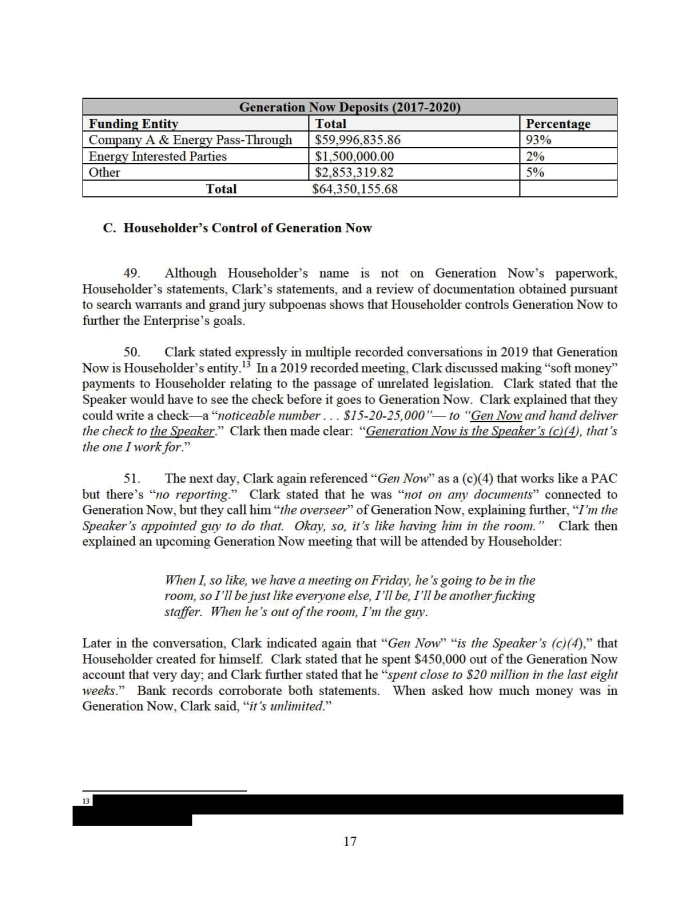
The key entity in the push to pass the nuclear plant bailout was Generation Now, a 501(c)(4) organization that was not required to disclose its donors. According to the federal investigation, over three years Generation Now received $60 million from what is officially called “Company A,” a reference to to FirstEnergy Solutions. In May 2019, Generation Now, which was formed with help from Householder’s adviser Jeff Longstreth, put $225,000 worth of ads on TV and radio in support of the bailout.

The Supreme Court’s 2010 ruling in Citizens United authorized corporations and outside groups to spend unlimited amounts on elections, as long as they weren’t in “coordination” with campaigns or political parties. What followed in Ohio, and was uncovered in the federal investigation, floored it into the territory of illegal coordination.

Before and during HB 6’s passage, millions of dollars in transfers—up to $8 million in May 2019 alone—flowed from Company A to Generation Now, an “entity secretly controlled by Householder” according to the criminal charges. The nonprofit’s funding went into mailers and political gifts, and Householder skimmed up to $400,000 to pay off credit card debt and for Florida home costs, according to the charging document.

Tape recordings of longtime Columbus lobbyist Neil Clark in federal possession establish the explicit coordination of Generation Now with Speaker Householder’s political operation:
Page 18 of Ohio House ComplaintDocumentCloud

Contributed to DocumentCloud by Donald Shaw of SludgeView document


Looking back at attempts by watchdog groups to raise flags, Catherine Turcer, executive director of Common Cause Ohio, told Sludge that Householder’s rush to pass the bill was out of the ordinary.

“One interesting thing about HB 6 was that it was like a zombie—we’d think it was dead, but it would come back to life,” Turcer said. “It looked like it never would have enough votes to get out of the House—we’re talking about corporate welfare, and FirstEnergy had enough money to make campaign contributions. We’ve bailed them out a number of times, so it was wildly unpopular to do another bailout.”

In 2013, FirstEnergy signed a 17-year, $102 million deal for naming rights to the stadium where the Cleveland Browns play and which can host international soccer games and concerts—a brand name which fans are now wondering about keeping.

Immediately after HB 6’s passage, a repeal campaign was launched by a group called Ohioans Against Corporate Bailouts, which was quickly undercut by more dark-money tactics. A new LLC called Ohioans for Energy Security popped up to spend $1 million on a campaign against the repeal effort, spending $644,000 on broadcast TV ads, $316,000 on cable, and $33,000 on radio.

“It was clear we had a dark money problem,” Turcer says. “There were these xenophobic ads that occurred during the referendum.”

One ad rumbled, “The Chinese government is quietly invading our American electrical grid” over images of the Chinese military, making it what a Cleveland Plain Dealer newspaper editorial called “the sleaziest scare ad in recent memory in Ohio.”

“It was also clear that we weren’t going to get good disclosure,” Turcer said. “The powers that be were happy with the system they had.”

The Ohio Elections Commission made a recommendation in 2010 that corporations spending money on political ads should report their activities, but there was no mechanism for disclosure. “We were able to make some estimates [of FirstEnergy-backed spending] based on the number of ads, but it’s not the same as knowing,” Turcer said.Beyond the misleading ads, the bailout’s supporters hired “blockers” to interfere with the referendum’s signature effort through illegal bribes and intimidation, even launching a parallel drive that paid workers double to gather signatures with no legal weight. In October 2019, a U.S. District Judge rejected a request by the repeal campaign for more time to gather at least 265,774 valid signatures from registered voters and place the question on the 2020 ballot, effectively ending the drive.

With last week’s arrests, Common Cause Ohio and other groups are calling on the Ohio General Assembly to repeal HB 6, and Gov. DeWine called on Householder to resign. But the systemic issue of strengthening the state’s disclosure laws, which allowed FirstEnergy to launder messages in favor of its bailout, remains to be addressed. Ohio’s disclosure laws for the names of entities making independent expenditures regarding candidates are relatively low, which aids transparency—$250 for General Assembly candidates, $500 for statewide candidates. But the dark money loophole is still intact if the big money originators behind political spending, like the kind that muddied the waters against the repeal effort, remain opaque.

The most pressing reform task coming out of the HB 6 scandal, Turcer says, is making sure there is disclosure of the funding sources of all political advertisements.

“HB 6, was created in the most corrupt process possible—through a misinformation campaign—so voters and constituents couldn’t understand what was happening. The General Assembly needs to reconsider regulating energy utilities, possibly. The next thing they need to do is pass a good disclosure bill.”

“We’re asking legislators who took advantage of dark money to repudiate it and shine a light on it,” Turcer said. “We also need better disclosure of lobbying activities, such as when lobbyists are acting as fundraisers.”


Common Cause Ohio and allies have been looking at sample disclosure language from states such as California, Montana, and Connecticut, which lead the way in requiring groups spending on elections to disclose their top donors, according to Turcer. Requiring dark money groups such as LLCs and 501(c)(4) organizations that buy election ads to disclose their funding sources to state agencies enables voters to know the source of the money behind potentially-misleading ads.

Jen Miller, the executive director of League of Women Voters of Ohio, which works alongside Common Cause Ohio, also hopes the General Assembly looks at the shadowy process by which HB 6 was passed along with its possible repeal. “The challenges we see in this scandal reflect Ohio’s lack of transparency in campaign finance, as well as our long history of gerrymandering, which makes it very difficult for voters to know who is paying for campaign ads,” Miller told Sludge. “When voters call for dark money loopholes to be closed, they’re often ignored by lawmakers who feel very secure in seats.

“We raised the flag about Generation Now’s ads in September of last year, as petition gatherers were being intimidated, and we think that if the funders had been public at that time, they would have behaved differently,” Miller said.

“Issue campaigns and candidate campaigns should have to share how they’re spending money and who’s funding their ads—and to have all that to be searchable, with systems that better allow voter groups and reporters to analyze campaign finance, and better requirements for disclosure of whether lobbying activities was for or against,” Miller said.


Trump-Epstein Ties EXPOSED In New Book


https://www.youtube.com/watch?v=HA9Fetnebdk


Here Are the Billionaires Funding Trump’s Voter Suppression Lawsuits


Dozens of billionaires have donated to the RNC's legal fund that is being used to fight against expanded access to mail voting.

Donald Shaw@donnydonny

https://readsludge.com/2020/07/31/here-are-the-billionaires-funding-trumps-voter-suppression-lawsuits/

With millions of people out of work and struggling to keep up with their bills because of the coronavirus shutdown, the federal government has passed new tax breaks for the rich and created trillions for bailing out large corporations. The 2020 election could give voters a chance to remove the politicians who enacted these policies, but if the Trump administration and Republican Party get their way, many voters will be forced to put their health at risk by voting in-person in November, almost certainly before a vaccine or a reliable treatment for the coronavirus is available.

For the past several months, national Republican have been at war in the courts over state policies—advanced mainly by Democrats, but also by Republicans in some states—designed to make it easier for people to safely vote. In more than a dozen states, including battlegrounds like Wisconsin and Michigan, the Republican National Committee (RNC) has initiated or joined lawsuits to block states from expanding vote-by-mail systems or to oppose Democratic lawsuits in states that have resisted putting universal vote-by-mail systems in place. The lawsuits are financed by a $20 million litigation budget that the Republicans have amassed for fighting Democrats on voting issues.

Trump and Republicans have repeatedly said that mail ballots are more susceptible to electoral fraud, though nonpartisan groups like Brennan Center for Justice say there is “no evidence” that voting by mail results in significant levels of fraud. Trump has said that he believes high levels of voting hurts Republicans.

“My biggest risk is that we don’t win lawsuits,” Trump told Politico in June. “We have many lawsuits going all over. And if we don’t win those lawsuits, I think—I think it puts the election at risk.”

In Pennsylvania, a key swing state, the RNC has sued to stop state officials from making remote drop boxes available for voters to submit their ballots and from counting ballots that are mailed without being sealed in internal secrecy envelopes. In Iowa, another swing state, the RNC joined a motion to dismiss a lawsuit brought by Democratic groups that seeks to overturn a law barring election officials from using voter rolls to look up information missing on mailed ballots. In California, the RNC filed a lawsuit in partnership with other Republican groups to prevent state election officials from following an executive order from Gov. Gavin Newsom to mail absentee ballots to all voters, but recently conceded after the legislature passed a legislative version of the order.


In a tweet on Thursday, now pinned to his profile, Trump said, “With Universal Mail-In Voting (not Absentee Voting, which is good), 2020 will be the most INACCURATE & FRAUDULENT Election in history,” adding, “Delay the Election until people can properly, securely and safely vote???” Election experts like Rick Hasen, Professor of Law and Political Science at UC Irvine, interpret Trump’s tweet as encouraging the continued slowdown of the U.S. Postal Service and withholding of needed funding from state boards of election to prepare vote-by-mail systems.

Trump recently selected former RNC convention finance chair Louis DeJoy to the position of postmaster general. Besides helping to raise money for the RNC, DeJoy has donated $114,500 to the RNC legal fund.

The RNC legal proceedings account has raised more than $23 million so far in the 2019-20 election cycle, including transfers from a Trump joint fundraising committee and large donations from more than two dozen billionaires, according to Sludge’s review of Federal Election Commission records.

While a Biden administration is unlikely to substantially roll back upwards wealth redistribution, the billionaires backing the lawsuits would almost certainly fare better under another four years of Trump. Biden, for example, has said he would try to end Trump’s signature 2017 tax law, which has disproportionately benefited the wealthy. According to research from University of California, Berkeley economists Emmanuel Saez and Gabriel Zucman, Trump’s tax bill reduced tax rates for the country’s 400 richest households below the level that any other income group pays.

Below is a table of the billionaires, per Forbes latest list, who have donated to the RNC legal proceedings account so far this election cycle, including donations from spouses of billionaires. The donations listed below comprise about 15% of the total amount that the RNC legal proceedings account has received from individuals this cycle.


At least 17 of the 24 billionaire donors to the RNC legal fund are among the top 400 wealthiest American households as ranked by Forbes magazine, including the following: Kelcy Warren, CEO of natural gas and propane pipeline giant Energy Transfer Partners, net worth $4.3 billion; Stephen Schwarzman, CEO of The Blackstone Group private equity firm, net worth $17.7 billion; and Charles Schwab, net worth $7.7 billion. Two more top donor families, those of Fertitta brothers Lorenzo and Frank III, fall just outside the top 400 richest Americans, with net worth around $1.6 billion apiece.
Dark Money Assistance

Also siding with the RNC on the lawsuits is a network of conservative “dark money” nonprofits tied through personnel and funding to groups that have worked to build support for the confirmation of Trump’s Supreme Court nominees and to elect conservtaive judges to state supreme courts.

One such group that recently emerged, the Honest Election Project, is a rebrand of the shadowy Judicial Education Project, according to OpenSecrets and The Guardian. The Judicial Education Project is established as a charity, allowing it to keep the sources of its millions of dollars in annual revenue hidden. In addition to its election lawsuit work as the Honest Elections Project, it makes grants to consevrative groups including SpeechNow, which helped establish the legal basis for super PACs through a 2010 case against the FEC. The Honest Election Project also funds Private Citizen, a First Amendment legal expense fund, and the George Mason University Foundation, a law school that established conservative ideological law centers and hired multiple Federalist Society-linked academics after receiving millions in donations from the Charles Koch Foundation.

The Honest Elections Project, which shares a law firm with the RNC, Viriginia-based Consovoy McCarthy PPLC, has filed multiple briefs in states and federal courts defending states against lawsuits from Democrat-aligned groups that seek to expand mail voting or ease requirements on ballot signatures. It also worked to force states to clean up voter registration rolls, a process that critics have labeled “purging.” The group recently spent $250,000 to run ads on cable news channels claiming that Democrats have sought to expand mail voting for partisan advantage and advocating for limited or no changes to voting laws to accommodate voters during the pandemic.

According to OpenSecrets and The Guardian, Judicial Education Project (the Honest Elections Project’s alias) has been funded almost entirely by DonorsTrust, a donor-advised fund sponsor that specializes in helping conservative donors anonymously fund “sensitive or controversial issues” while also securing special tax advantages. DonorsTrust has been a major funder of groups in the Koch network, including Americans for Prosperity, the American Legislative Exchange Council, and the State Policy Network, and in 2018 it provided 99% of Judicial Education Project’s funding.


CORRECTION: This article originally stated that Louis DeJoy donated $122,500 to the RNC legal proceedings account. The correct total of his donations to the account is $114,500.