Saturday, August 8, 2020

In Race for Open Kennedy Seat, Pharma and Private Equity Execs Cut Big Checks


While candidates in the race for Joe Kennedy's seat have sworn off super PAC backing and corporate PAC money, many are still accepting large donations from powerful health care CEOs, pharma lobbyists, and private equity firms.


Daniel Boguslaw@BogieStrkr


Daniel Boguslaw is a writer and researcher focusing on money in politics and corporate greed.See more
EDITED BY DONALD SHAW

Share this:

Twitter
Reddit
Facebook


https://readsludge.com/2020/07/20/in-race-for-open-kennedy-seat-pharma-and-private-equity-execs-cut-big-checks/

Massachusetts’ 4th Congressional District, which includes wealthy Boston suburbs as well as post-industrial legacy cities, has for decades elected representatives to the U.S. House who straddle a rift in the Democratic Party between its neoliberal base and its progressive left wing. Barney Frank, the district’s rabble-rousing former congressman, is well known in progressive circles for being one of the first member of Congress to come out as gay and for the eponymous Dodd-Frank Wall Street Reform and Consumer Protection Act. But Frank was also careful not to stray too far from the party line, railing against progressive policies set forth by Bernie Sanders and Elizabeth Warren and making sure never to cross his more moderate constituents. After Frank’s tenure, Joe Kennedy III furthered the outspoken representative’s legacy by trading on his family name while endorsing only the safest progressive issues and, until recently, maintaining substantial investments in the fossil fuel industry.

After four terms, Kennedy is leaving his post in MA-04 to challenge longtime progressive Senator Ed Markey, with one of his primary messages being that he is a younger candidate. But despite Kennedy’s departure, his distinctive brand of Janus-faced politicking is still well represented in the campaign finance disclosures of candidates in the nine-person scrum vying to replace him.

Couched in the language of “grassroots fundraising”, the financial front runners of the MA-04 race have lauded their progressive credentials by framing their millions in campaign cash as the result of independent donors instead of the corporate PACs and dark money groups that have come to dominate American campaign finance. The just-released fundraising numbers for the second quarter tell a different story, as high-dollar donations poured in from well-connected individuals who, taken together, belie an old-school style of money in politics, where political action committees are replaced with family connections and corporate donations pile up from dozens of top level employees at America’s largest and most predatory financial firms.


With nearly $1.4 million raised since he began his bid for the House, former Marine captain Jake Auchincloss is just a step away from the $1.6 million raised by nonprofit mogul Alan Khazei, a co-founder of CityYear and proud combatant of two failed senatorial bids. Auchincloss’s war chest, while almost entirely filled by individual donors, is rife with pharmaceutical CEOs, hospital executives, and healthcare industry lawyers who stand a vested interest in opposing Medicare for All, maintaining America’s broken healthcare industry, and ensuring massive kickbacks to the pharmaceutical and healthcare giants that call Boston home.

Some of the highest profile donors to the Auchincloss campaign include Albert Bourla, the chairman and CEO of Pfizer, who has donated $2,800; Giovanni Caforio, chairman of Bristol Myers Squibb, with $2,800; Keith Gottesdiener, CEO of Rhythm Pharmaceuticals, who chipped in $2,800; and Robert Bradway, chairman and CEO of Amgen.

While nothing on Auchincloss’s campaign site mentions lowering sky-high drug prices or holding Big Pharma accountable for their gouging of American consumers, an entire section is devoted to giving tax breaks and other legislative perks to pharmaceutical manufacturers in Massachusetts. When viewed by sector, Auchincloss has raised more than $80,000 from the health interests, and nearly $130,000 from FIRE (finance, insurance, realestate), according to the Center for Responsive Politics, with more money on the horizon as the race enters its final stretch.

The metro Boston area has long been a hospital and pharmaceutical hub, with industry giants like Partners HealthCare, Tufts, and Mass General, Novartis, Pfizer, and Sanofi holding outsized influence on local politics. Economic and social power are seated in the medical industry, with Boston’s elite “Brahmin” families sitting on hospital boards for over two hundred years, as detailed in Nelson Aldrich’s book, “Old Money”.

Auchincloss’s mother, Laurie Glimcher—the president and CEO of Boston based clinic the Dana Farber Cancer Institute—has spent time and energy whipping up funds for her son Jake from her vast rolodex of health professionals, according to a member of the Newton City Council and a source close to the Auchincloss campaign. Glimcher attended the elite Winsor prep school in Boston before earning degrees from Radcliffe and Harvard, going on to cement her ties to the Medical elite as a dean at Cornell, before turning down the position of dean of Harvard Medical School to join Dana Farber, where in 2018 she took in a whopping $1.6 million in executive compensation.

More than $15,000 has flooded into Auchincloss’s campaign from Dana Farber board members and doctors alone, Sludge found by reviewing Federal Election Commission records, and tens of thousands more was received from a coterie of medical school deans and doctors associations banking on the election of an industry-friendly candidate. In April, Auchincloss reaped cash from a Zoom fundraiser hosted by two prominent health industry lawyers with a suggested price tag of $2,800 a ticket.

High-ranking pharmaceutical lobbyists have also joined drug company CEOs in throwing their weight behind Auchincloss. Nicholas Shipley, vice president of Pharmaceutical Research and Manufacturers of America (PhRMA), donated $1,000 to the campaign, and FEC records show cash from two senior members of the Biotechnology Innovation Organization (BIO), the largest biotech lobby, contributing well over $1,000. Robert Coughlin, CEO of the Boston based MassBio healthcare lobby also threw $1,000 to the campaign.


With Big Pharma and the healthcare industry firmly secured by Auchincloss, Alan Khazei, the MA-04 fundraising leader, has turned to the robber barons of finance to secure his $1.6 million bag, running a campaign premised on his work as founder of CityYear, the AmeriCorps subsidiary routinely criticized for paying its young volunteers what often amounts to poverty wages.

Khazei has received over $100,000 in donations from executives and individuals affiliated with investment leviathan Bain Capital, over $50,000 combined from individuals affiliated with private equity companies Berkshire Partners and Advent International, and another $22,400 from affiliates of Fireman Capital Partners, a consumer focused private equity fund. One of Khazei’s biggest individual donors, who gave $5,600, is Charles Ledley—co-founder of Cornwall Capital and protagonist of “The Big Short,” who in 2008 turned a $110,000 dollar investment into $120 million by betting against the U.S. mortgage market and cashing out on the suffering of millions.

While Khazei has centered his platform on “fixing our democracy,” campaign finance reform is barely hinted at on his campaign site. His donors, taken together, represent private equity and investment firms that have lobbied against government oversight, failed to account for their role in destroying jobs through leveraged buyouts, and continue to post record profits as millions file for unemployment with no relief in sight.

Meanwhile, candidates like former Planned Parenthood vice president Jesse Mermell and president of the National Hispanic Bar Association Ben Sigel have posted significant sums in the hundreds of thousands from smaller dollar contributions. Becky Grossman, Ihssane Leckey, Dave Cavell, and Natalia Linos have hit a middle lane, combining high-dollar self funding with smaller individual donations. Grassroots fundraising from candidates like Mermell, who signed pledges rejecting fossil fuel and corporate PAC money, stands in sharp contrast to the top two frontrunners when it comes to campaign finance: it’s not only PACs and bundlers that hold tremendous sway over who is seen and who is left out, it also comes down to family networks and the industry elites who view a $2,800 campaign donation as a drop in the bucket.


Read more from Sludge:

Joe Kennedy, a Top Recipient of Hedge Fund Cash, Declined to Back Tax Fairness Act

Following Sludge Report, Kennedy’s Trust Fund Sells Its Fossil Fuel Stocks

Big Donors and PACs Dominate Campaign Funding in Nearly Every State, Report Finds


Another Act of Sabotage in Iran?


https://www.youtube.com/watch?v=KVNBae1QmKs


Dark Money Powers $60 Million Bribery Scheme in Ohio


David Moore@ppolitics


‘It’s a Secret, a (c)(4) Is a Secret’: Dark Money Powers $60 Million Bribery Scheme in Ohio

Last week, the FBI arrested Ohio House Speaker Larry Householder and four associates in a bribery investigation over a law that sends $1 billion from ratepayers to bail out two nuclear power plants.


https://readsludge.com/2020/07/29/dark-money-powers-60-million-bribery-scheme-in-ohio/


Any executive would jump at the opportunity to earn a return of 1667% on an investment, compared to the typical 10% returns from the stock market.

That impressive rate of return was what FirstEnergy Solutions, an Ohio coal and nuclear energy company, got when it paid out $60 million in dark money to secure a $1 billion bailout through the state government, according to information released from a federal bribery investigation.

Last week, the FBI arrested Ohio House Speaker Larry Householder, a Republican, and four associates on a racketeering conspiracy that made national headlines for both the scope of the dark money enterprise and the directness of the quid pro quo involved.

The scandal shows how effective dark money spending by “social welfare” nonprofit groups can be in securing legislative favors and breaking the existing safeguards on improper government actions. What’s more, the bribery charges illustrate how strengthening disclosure laws around the ultimate sources of election spending would have enabled Ohio voters and watchdog groups to uncover the corporate money sources earlier, while the bailout bill was being rushed through the state legislature by Republican leaders.

At issue was HB 6, a controversial bill signed by Republican Gov. Mike DeWine on July 23, 2019, which bailed out two nuclear power plants near Cleveland and Toledo owned by FirstEnergy. The Akron-based company, now known as Energy Harbor Corp., was undergoing bankruptcy proceedings at the time, brought on in part by the lower operating costs of natural gas energy. FirstEnergy claimed that without an infusion of cash the plants that employed 1,400 people would have to shut down within two years—even as, it was later revealed, it wired millions of dollars to dark money groups controlled by its statehouse allies.

Speaker Householder front-loaded the bailout, which he introduced three months into his term. FirstEnergy’s close relationship with the new speaker was no secret: Householder flew to President Donald Trump’s inauguration on the company’s plane. The rescue effort, opposed by consumer groups, added new fees to every electricity bill in the state to keep the two nuclear plants running, handing the company over $150 million a year through 2026—hence the billion dollar total. It also scaled back Ohio’s wind and solar energy goal from a maximum of 12.5% by 2027 to 8.5% by 2026, and would have eventually ended the requirements, even as renewable energy has become more widespread and affordable. John Finnigan, lead counsel for the Environmental Defense Fund, testified of HB 6 in April 2019, “This bill is nothing but a brazen boondoggle of a bailout for a bankrupt business.”

The FirstEnergy bailout bill passed the Ohio House by a vote of 51-38, with Speaker Householder calling back state representatives from their summer vacations to cinch it.

Last week, after FBI agents arrested Householder at his farm outside of Columbus on July 22, U.S. Attorney David DeVillers described the case as “likely the largest bribery scheme ever perpetrated against the state of Ohio.” Others arrested were former Ohio Republican Party Chairman Matthew Borges, prominent statehouse lobbyist Neil Clark, co-founder of a Columbus-based consulting firm Juan Cespedes, and Householder adviser Jeffrey Longstreth.

The full scope of FirstEnergy’s push to pass HB 6 was documented in a May 2019 report, “Connecting the Dots,” by the non-profit, non-partisan advocacy group Common Cause Ohio. The group’s analysis found that in the previous two election cycles, FirstEnergy’s PAC and employees contributed over $1.2 million to legislative and statewide candidates, and gave the maximum to Householder’s campaign committee, with over $25,000. Statehouse watchers noted that as Householder maneuvered to be elected speaker in 2018, FirstEnergy spent heavily on the primary campaigns of Republican candidates who backed his bid. Householder’s campaign committee contributed as well to over a dozen candidates, building his base of supportive representatives, and at least nine candidates backed by Householder ended up winning.
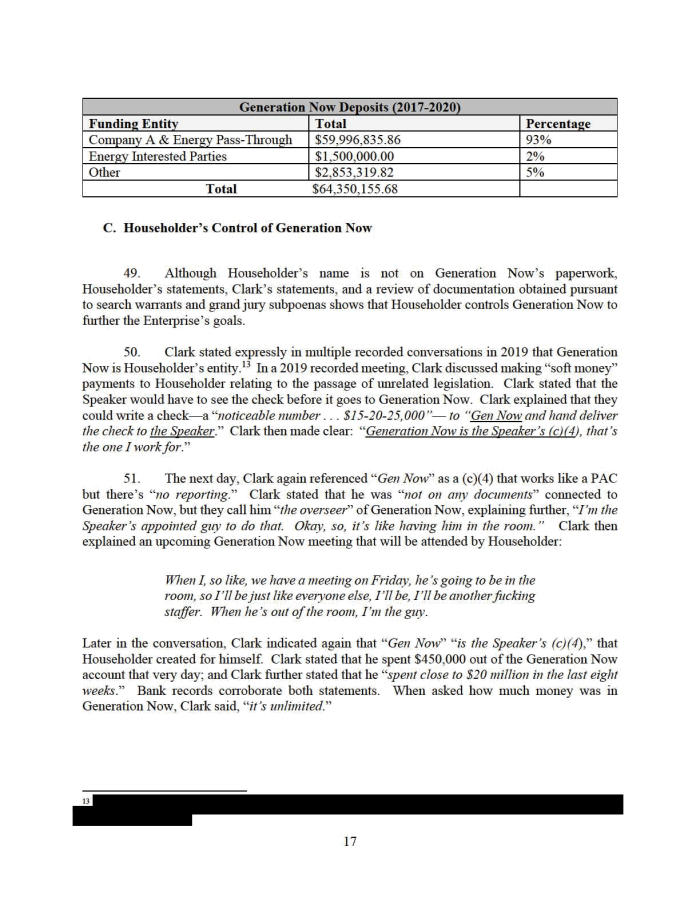
The key entity in the push to pass the nuclear plant bailout was Generation Now, a 501(c)(4) organization that was not required to disclose its donors. According to the federal investigation, over three years Generation Now received $60 million from what is officially called “Company A,” a reference to to FirstEnergy Solutions. In May 2019, Generation Now, which was formed with help from Householder’s adviser Jeff Longstreth, put $225,000 worth of ads on TV and radio in support of the bailout.

The Supreme Court’s 2010 ruling in Citizens United authorized corporations and outside groups to spend unlimited amounts on elections, as long as they weren’t in “coordination” with campaigns or political parties. What followed in Ohio, and was uncovered in the federal investigation, floored it into the territory of illegal coordination.

Before and during HB 6’s passage, millions of dollars in transfers—up to $8 million in May 2019 alone—flowed from Company A to Generation Now, an “entity secretly controlled by Householder” according to the criminal charges. The nonprofit’s funding went into mailers and political gifts, and Householder skimmed up to $400,000 to pay off credit card debt and for Florida home costs, according to the charging document.

Tape recordings of longtime Columbus lobbyist Neil Clark in federal possession establish the explicit coordination of Generation Now with Speaker Householder’s political operation:
Page 18 of Ohio House ComplaintDocumentCloud

Contributed to DocumentCloud by Donald Shaw of SludgeView document


Looking back at attempts by watchdog groups to raise flags, Catherine Turcer, executive director of Common Cause Ohio, told Sludge that Householder’s rush to pass the bill was out of the ordinary.

“One interesting thing about HB 6 was that it was like a zombie—we’d think it was dead, but it would come back to life,” Turcer said. “It looked like it never would have enough votes to get out of the House—we’re talking about corporate welfare, and FirstEnergy had enough money to make campaign contributions. We’ve bailed them out a number of times, so it was wildly unpopular to do another bailout.”

In 2013, FirstEnergy signed a 17-year, $102 million deal for naming rights to the stadium where the Cleveland Browns play and which can host international soccer games and concerts—a brand name which fans are now wondering about keeping.

Immediately after HB 6’s passage, a repeal campaign was launched by a group called Ohioans Against Corporate Bailouts, which was quickly undercut by more dark-money tactics. A new LLC called Ohioans for Energy Security popped up to spend $1 million on a campaign against the repeal effort, spending $644,000 on broadcast TV ads, $316,000 on cable, and $33,000 on radio.

“It was clear we had a dark money problem,” Turcer says. “There were these xenophobic ads that occurred during the referendum.”

One ad rumbled, “The Chinese government is quietly invading our American electrical grid” over images of the Chinese military, making it what a Cleveland Plain Dealer newspaper editorial called “the sleaziest scare ad in recent memory in Ohio.”

“It was also clear that we weren’t going to get good disclosure,” Turcer said. “The powers that be were happy with the system they had.”

The Ohio Elections Commission made a recommendation in 2010 that corporations spending money on political ads should report their activities, but there was no mechanism for disclosure. “We were able to make some estimates [of FirstEnergy-backed spending] based on the number of ads, but it’s not the same as knowing,” Turcer said.Beyond the misleading ads, the bailout’s supporters hired “blockers” to interfere with the referendum’s signature effort through illegal bribes and intimidation, even launching a parallel drive that paid workers double to gather signatures with no legal weight. In October 2019, a U.S. District Judge rejected a request by the repeal campaign for more time to gather at least 265,774 valid signatures from registered voters and place the question on the 2020 ballot, effectively ending the drive.

With last week’s arrests, Common Cause Ohio and other groups are calling on the Ohio General Assembly to repeal HB 6, and Gov. DeWine called on Householder to resign. But the systemic issue of strengthening the state’s disclosure laws, which allowed FirstEnergy to launder messages in favor of its bailout, remains to be addressed. Ohio’s disclosure laws for the names of entities making independent expenditures regarding candidates are relatively low, which aids transparency—$250 for General Assembly candidates, $500 for statewide candidates. But the dark money loophole is still intact if the big money originators behind political spending, like the kind that muddied the waters against the repeal effort, remain opaque.

The most pressing reform task coming out of the HB 6 scandal, Turcer says, is making sure there is disclosure of the funding sources of all political advertisements.

“HB 6, was created in the most corrupt process possible—through a misinformation campaign—so voters and constituents couldn’t understand what was happening. The General Assembly needs to reconsider regulating energy utilities, possibly. The next thing they need to do is pass a good disclosure bill.”

“We’re asking legislators who took advantage of dark money to repudiate it and shine a light on it,” Turcer said. “We also need better disclosure of lobbying activities, such as when lobbyists are acting as fundraisers.”


Common Cause Ohio and allies have been looking at sample disclosure language from states such as California, Montana, and Connecticut, which lead the way in requiring groups spending on elections to disclose their top donors, according to Turcer. Requiring dark money groups such as LLCs and 501(c)(4) organizations that buy election ads to disclose their funding sources to state agencies enables voters to know the source of the money behind potentially-misleading ads.

Jen Miller, the executive director of League of Women Voters of Ohio, which works alongside Common Cause Ohio, also hopes the General Assembly looks at the shadowy process by which HB 6 was passed along with its possible repeal. “The challenges we see in this scandal reflect Ohio’s lack of transparency in campaign finance, as well as our long history of gerrymandering, which makes it very difficult for voters to know who is paying for campaign ads,” Miller told Sludge. “When voters call for dark money loopholes to be closed, they’re often ignored by lawmakers who feel very secure in seats.

“We raised the flag about Generation Now’s ads in September of last year, as petition gatherers were being intimidated, and we think that if the funders had been public at that time, they would have behaved differently,” Miller said.

“Issue campaigns and candidate campaigns should have to share how they’re spending money and who’s funding their ads—and to have all that to be searchable, with systems that better allow voter groups and reporters to analyze campaign finance, and better requirements for disclosure of whether lobbying activities was for or against,” Miller said.


Trump-Epstein Ties EXPOSED In New Book


https://www.youtube.com/watch?v=HA9Fetnebdk


Here Are the Billionaires Funding Trump’s Voter Suppression Lawsuits


Dozens of billionaires have donated to the RNC's legal fund that is being used to fight against expanded access to mail voting.

Donald Shaw@donnydonny

https://readsludge.com/2020/07/31/here-are-the-billionaires-funding-trumps-voter-suppression-lawsuits/

With millions of people out of work and struggling to keep up with their bills because of the coronavirus shutdown, the federal government has passed new tax breaks for the rich and created trillions for bailing out large corporations. The 2020 election could give voters a chance to remove the politicians who enacted these policies, but if the Trump administration and Republican Party get their way, many voters will be forced to put their health at risk by voting in-person in November, almost certainly before a vaccine or a reliable treatment for the coronavirus is available.

For the past several months, national Republican have been at war in the courts over state policies—advanced mainly by Democrats, but also by Republicans in some states—designed to make it easier for people to safely vote. In more than a dozen states, including battlegrounds like Wisconsin and Michigan, the Republican National Committee (RNC) has initiated or joined lawsuits to block states from expanding vote-by-mail systems or to oppose Democratic lawsuits in states that have resisted putting universal vote-by-mail systems in place. The lawsuits are financed by a $20 million litigation budget that the Republicans have amassed for fighting Democrats on voting issues.

Trump and Republicans have repeatedly said that mail ballots are more susceptible to electoral fraud, though nonpartisan groups like Brennan Center for Justice say there is “no evidence” that voting by mail results in significant levels of fraud. Trump has said that he believes high levels of voting hurts Republicans.

“My biggest risk is that we don’t win lawsuits,” Trump told Politico in June. “We have many lawsuits going all over. And if we don’t win those lawsuits, I think—I think it puts the election at risk.”

In Pennsylvania, a key swing state, the RNC has sued to stop state officials from making remote drop boxes available for voters to submit their ballots and from counting ballots that are mailed without being sealed in internal secrecy envelopes. In Iowa, another swing state, the RNC joined a motion to dismiss a lawsuit brought by Democratic groups that seeks to overturn a law barring election officials from using voter rolls to look up information missing on mailed ballots. In California, the RNC filed a lawsuit in partnership with other Republican groups to prevent state election officials from following an executive order from Gov. Gavin Newsom to mail absentee ballots to all voters, but recently conceded after the legislature passed a legislative version of the order.


In a tweet on Thursday, now pinned to his profile, Trump said, “With Universal Mail-In Voting (not Absentee Voting, which is good), 2020 will be the most INACCURATE & FRAUDULENT Election in history,” adding, “Delay the Election until people can properly, securely and safely vote???” Election experts like Rick Hasen, Professor of Law and Political Science at UC Irvine, interpret Trump’s tweet as encouraging the continued slowdown of the U.S. Postal Service and withholding of needed funding from state boards of election to prepare vote-by-mail systems.

Trump recently selected former RNC convention finance chair Louis DeJoy to the position of postmaster general. Besides helping to raise money for the RNC, DeJoy has donated $114,500 to the RNC legal fund.

The RNC legal proceedings account has raised more than $23 million so far in the 2019-20 election cycle, including transfers from a Trump joint fundraising committee and large donations from more than two dozen billionaires, according to Sludge’s review of Federal Election Commission records.

While a Biden administration is unlikely to substantially roll back upwards wealth redistribution, the billionaires backing the lawsuits would almost certainly fare better under another four years of Trump. Biden, for example, has said he would try to end Trump’s signature 2017 tax law, which has disproportionately benefited the wealthy. According to research from University of California, Berkeley economists Emmanuel Saez and Gabriel Zucman, Trump’s tax bill reduced tax rates for the country’s 400 richest households below the level that any other income group pays.

Below is a table of the billionaires, per Forbes latest list, who have donated to the RNC legal proceedings account so far this election cycle, including donations from spouses of billionaires. The donations listed below comprise about 15% of the total amount that the RNC legal proceedings account has received from individuals this cycle.


At least 17 of the 24 billionaire donors to the RNC legal fund are among the top 400 wealthiest American households as ranked by Forbes magazine, including the following: Kelcy Warren, CEO of natural gas and propane pipeline giant Energy Transfer Partners, net worth $4.3 billion; Stephen Schwarzman, CEO of The Blackstone Group private equity firm, net worth $17.7 billion; and Charles Schwab, net worth $7.7 billion. Two more top donor families, those of Fertitta brothers Lorenzo and Frank III, fall just outside the top 400 richest Americans, with net worth around $1.6 billion apiece.
Dark Money Assistance

Also siding with the RNC on the lawsuits is a network of conservative “dark money” nonprofits tied through personnel and funding to groups that have worked to build support for the confirmation of Trump’s Supreme Court nominees and to elect conservtaive judges to state supreme courts.

One such group that recently emerged, the Honest Election Project, is a rebrand of the shadowy Judicial Education Project, according to OpenSecrets and The Guardian. The Judicial Education Project is established as a charity, allowing it to keep the sources of its millions of dollars in annual revenue hidden. In addition to its election lawsuit work as the Honest Elections Project, it makes grants to consevrative groups including SpeechNow, which helped establish the legal basis for super PACs through a 2010 case against the FEC. The Honest Election Project also funds Private Citizen, a First Amendment legal expense fund, and the George Mason University Foundation, a law school that established conservative ideological law centers and hired multiple Federalist Society-linked academics after receiving millions in donations from the Charles Koch Foundation.

The Honest Elections Project, which shares a law firm with the RNC, Viriginia-based Consovoy McCarthy PPLC, has filed multiple briefs in states and federal courts defending states against lawsuits from Democrat-aligned groups that seek to expand mail voting or ease requirements on ballot signatures. It also worked to force states to clean up voter registration rolls, a process that critics have labeled “purging.” The group recently spent $250,000 to run ads on cable news channels claiming that Democrats have sought to expand mail voting for partisan advantage and advocating for limited or no changes to voting laws to accommodate voters during the pandemic.

According to OpenSecrets and The Guardian, Judicial Education Project (the Honest Elections Project’s alias) has been funded almost entirely by DonorsTrust, a donor-advised fund sponsor that specializes in helping conservative donors anonymously fund “sensitive or controversial issues” while also securing special tax advantages. DonorsTrust has been a major funder of groups in the Koch network, including Americans for Prosperity, the American Legislative Exchange Council, and the State Policy Network, and in 2018 it provided 99% of Judicial Education Project’s funding.


CORRECTION: This article originally stated that Louis DeJoy donated $122,500 to the RNC legal proceedings account. The correct total of his donations to the account is $114,500.

Corporate Lobbyists Vote To Keep Corporate Lobbyists In the DNC


A measure to bar corporate lobbyists from serving on the DNC was rejected with several corporate lobbyists on the DNC Rules Committee voting against it.


David Moore@ppolitics

https://readsludge.com/2020/08/05/corporate-lobbyists-vote-to-keep-corporate-lobbyists-in-the-dnc/

Last week, a proposal to reduce corporate influence over the Democratic Party was hastily rejected during a virtual meeting of the Democratic National Convention Rules Committee by a vote of 105 to 45, with eight abstentions. The resolution, which would have changed the DNC Charter to permanently bar corporate PAC donations and ban corporate lobbyists from serving on the party organization, was introduced by Brent Welder, a Kansas City area attorney and delegate appointed by the Bernie Sanders campaign.

Several of the Rules Committee appointees who voted against Welder’s resolution have backgrounds in corporate lobbying. Sludge found at least ten current corporate lobbyists and one major former lobbyist—as well as three corporate consultants, four corporate lawyers, and five corporate executives—among the members who voted against the proposal.

“If you are a lobbyist for a for-profit corporation, you shouldn’t serve on the DNC,” Welder told Sludge. “I guarantee you that 99.9% of Democrats in America agree with that, and only the place you find people who disagree with it are in the leadership of DNC.”

The Convention Rules Committee’s virtual meeting was co-chaired by former Rep. Barney Frank, who serves on the board of directors of New York commercial bank Signature Bank, and Maria Cardona, a principal at Dewey Square Group, a lobbying and public relations firm that worked for the insurance industry during the debate over health care reform early in the Obama presidency.

Welder, who also proposed a resolution on ranked-choice voting, said that he was approached by the Biden campaign through an intermediary and pressured to withdraw his measures.

“I was informed before the meeting that of all the amendments put forth, the Biden campaign was most upset about those two amendments, and urged me to withdraw them, which I politely declined to do,” Welder said. “There had been about 30 amendments originally proposed, the deadline was a few days before. By time the meeting happened, it was down to eight, as people had been pressured to withdraw amendment through various means. Of all the amendments, they tried to kill them without anyone knowing who voted for or against them.”

About two hours into the virtual meeting, which is viewable on YouTube, Welder was recognized for several minutes in the main room to speak on behalf of his resolution. “We need to neutralize the corporate influence, first within our party, that is preventing us from living up to the platform, our ideals, and being a true party of the people,” Welder said.

After Welder’s remarks, co-chair Maria Cardona opened the debate and said that members could begin voting on the proposal immediately through the portal. Cardona then turned the floor over to Illinois lobbyist Mike Kreloff, who read prepared remarks explaining that as a lobbyist who sometimes worked for corporations he thought a separate DNC commission, which he said has been running for 18 months, should be the venue for evaluating the resolutions. Jerry Goldfeder, a Biden appointee and a New York election lawyer, echoed Kreloff’s remarks and succinctly moved to table the resolution. Andrew Tuozzolo, chief of staff to New Orleans City Councilwoman Helena Moreno, immediately seconded the motion in the main speaking room, and Cardona initiated a new vote to table Welders’ resolution.

Welder then asked Frank for how long the resolution would be tabled and Frank replied that it would be tabled “until someone makes a successful motion to take it off the table,” adding that “with the expiration of the committee that wouldn’t be possible.” Welder replied, “Gotcha, that doesn’t make any sense at all.” The vote to table Welder’s resolution was then announced as 122-46.At that point, Wedler told Sludge, “The co-chairs shoved [my video call] back into the side room, where I couldn’t be heard.” Welder said that he believes his microphone had initially been left on inadvertently by the meeting co-chairs. “With other members there, protests sustained for 10-15 minutes, until the chairs first said the meeting was adjourned, but then said there would be an up or down vote on the proposal. Bernie campaign leadership had convinced them to untable it,” through an off-camera process, Welder said. Minutes before the long meeting ended, the final vote against Welder’s resolution among the committee of mostly Biden campaign appointees came in at almost two-to-one against.

While he decried the process for considering the resolution as flawed by design, Welder describes being able to raise his amendment as a “big step forward in transparency, to hold the DNC accountable for corruption that’s occurring.”

“Getting Big Money out of politics makes everything else possible,” Welder said. “A lot of people don’t realize the corruption that happens at the top ranks of the DNC, that rank and file Democrats have lots of good ideas that get railroaded by leadership.”

Sludge sought to confirm Welder’s account with DNC Communications Director Xochitl Hinojosa, a top Perez adviser going back to his stint as secretary of Labor, and DNC Secretary Jason Rae, but did not receive a response.

Below are some of the committee members with backgrounds in advancing corporate interests who voted against Welder’s resolution.
Corporate Lobbyists on Convention Rules

Maria Cardona, an at-large DNC member, is a principal at lobbying firm Dewey Square Group, whose past lobbying clients include AT&T (on “telecom liability issues”), multiple medical companies, and Countrywide financial corporation, the implosion of which triggered the subprime mortgage crisis. In 2016, The Intercept reported that consultants with Dewey Square Group lobbied against Obamacare and the Dodd-Frank financial reform package. In advocacy efforts for insurance industry clients such as the Massachusetts Association of Health Plans, Dewey Square Group placed letters to the editor in newspapers “under names of elderly Massachusetts residents without their knowledge or consent.”

Committee co-chair Barney Frank, who had received over $1 million in payments from Signature Bank as of May 2018 when he agreed that the Trump administration’s deregulation of banks did not pose a major threat, did not appear to vote on Welder’s resolution, as no roll call vote was recorded for him.

Harold Ickes, an at-large DNC member, is a powerful lobbyist and party insider whose past clients have included Deloitte Consulting, Verizon, Northwell Health, JP Morgan Chase, Mastercard, and United Airlines. Ickes was appointed to the regular rules committee by Chair Tom Perez in an October 2017 “purge” of DNC leaders who had favored greater reforms for party transparency or backed Perez’s rival Rep. Keith Ellison for chair.

Joe Donnelly, a former U.S. senator from Indiana, is a partner at prominent lobbying firm Akin Gump, joining last April to “advise clients in the financial services, defense and health care industries, among others, on a host of policy matters.” Donnelly is not allowed to register as a lobbyist under Senate “cooling off” rules until January 2021.

Steve Dettelbach, an attorney, is a partner at lobbying firm Baker & Hostetler, where he is co-leader of the White Collar, Investigations and Securities Enforcement and Litigation team.

Mark Siegel is a partner at lobbying firm Locke Lord Strategies, where he has represented Pakistan in the United States. Siegel’s previous lobbying clients with the firm include America’s Mutual Banks (2014 and before), ​America’s Mutual Holding Companies (2014 and before), the Financial Planning Coalition (2013 and before), and the ​Embassy of the Islamic Republic of Pakistan.

Dennis Speight, a DNC member from Texas, is registered in Texas as a lobbyist, as director of political affairs for the Texas Trial Lawyers Association and its PAC.

Charlie Baker, president and co-founder of lobbying firm Dewey Square Group, was among Tom Perez’s 25 party leaders nominated to the Convention Rules Committee. In 2015, Baker was named chief administrative officer of Hillary for America. In 2016, journalist Lee Fang reported in The Intercept that Baker had been registered in 2009 to lobby for the Medicines Company, a drug firm, and for Citizen Financial Group to help the bank lobby on Dodd-Frank in 2010.

John Podesta, a party insider and former chief of staff to President Bill Clinton, founded the Podesta Group lobbying firm, which through 2017 lobbied for hundreds of major corporations, including a coalition of major American coal companies that from 2009 to 2012 fought against President Obama’s Clean Power plan. Podesta founded the Center for American Progress (CAP) in October 2003, a think tank whose corporate donors have included Comcast, Walmart, General Motors, Pacific Gas and Electric, General Electric, Boeing and Lockheed. Over the past several years, CAP has advanced increasingly neoliberal policies and rejected a single-payer health care system in favor of a public option plan, with senior staffers leading attacks on Bernie Sanders’ Medicare for All plan during last year’s Democraic presidential primary.

Leticia Van de Putte, a former Texas state senator, is a lobbyist who co-founded the bipartisan external relations firm Andrade-Van de Putte & Associates, which a San Antonio Express News column last year described as “connecting business clients with government officials.” One set of photos in the company’s website gallery is labeled at an event with the South San Antonio Chamber of Commerce and Councilmember Rebecca Viagran.

Michael Stratton is the senior policy director at Denver, Colorado-based law firm Brownstein Hyatt Farber and Schreck, whose hundreds of corporate lobbying clients include dozens of oil, gas, and natural resources companies. Brownstein Hyatt Farber and Schreck is the second largest lobbying firm at the federal level.

Mike Kreloff, who delivered the first prepared statement against Welder’s resolution, is a Springfield, Illinois lobbyist whose recent clients include the Chicago-based clean energy company Elevate Energy and the Illinois Chapter of the American Academy of Pediatrics.

Corporate Lawyers on the Convention Rules Committee

Kate Cook is a partner at Boston-based litigation firm Sugarman Roberts and former chief legal counsel to Gov. Deval Patrick. The firm’s services include environmental and energy law and business disputes.

Marcel Groen, former chair of the Pennsylvania Democratic Party, is a partner at Fox Rothschild LLP, a politically-connected Philadelphia law firm whose corporate clients include Oaktree Capital, Biomed America, life sciences company Novasep Holding SAS, and PuraCap Pharmaceutical, LLC.

James Morphew appears to be a partner at Sorling Northrup, a Springfield, IL law firm with corporate practices in banking, insurance, and real estate.

Joseph Smallhoover, one of eight DNC members elected by Democrats Abroad, is an attorney whose boutique firm serves U.S. business clients in industries including mining, health products, speciality plastics, and “Counsel to a major US based pharmaceutical company in connection with its acquisition of rights to various molecules and their marketing in Europe.”
Corporate Executives and Consultants on the Convention Rules Committee

Daniel Halpern, a restaurant executive and co-chair of the DNC Budget and Finance Committee, voted no. Earlier this year, multiple DNC members told Sludge that the committee was not meeting its responsibility to distribute regular written reports to DNC members on the efficacy of the chair’s expenditures. Halpern is a past chairman of the Georgia Restaurant Association, a business group that in 2014 opposed a minimum wage increase to $10.10 in Georgia.

Erskine Bowles, a former chief of staff to President Bill Clinton from 1996-1998 and a co-chair with Alan Simpson of President Obama’s deficit-reduction commission in 2010, co-founded the investment banking firm Bowles Hollowell Conner, which was active in private equity before its acquisition in 1998 by a bank holding company that later became part of Wachovia. A board member of the bipartisan policy organization Committee For a Responsible Federal Budget, Bowles went on to found Campaign to Fix the Debt, funded by Wall Street billionaire Pete Peterson, which has been criticized as an advocacy group that advances corporate tax cuts and for slashing spending on social services. Fix The Debt “are spending millions, but they are protecting billions in defense contracts and tax giveaways that would otherwise be on the chopping block,” said Kevin Connor of the watchdog group Public Accountability Initiative in The New York Times.

Chris Tapio is the president of Townsend Calkin Tapio Public Affairs, a Sacramento-based firm whose “Successes” page lists ExxonMobil, California Association of Health Plans, Kaiser Permanente, California Hospital Association, Chevron, Visa, PG&E, and California Association of Health Facilities (CAHF). In 2016, he was described by California’s Capitol Weekly: “A 20-year veteran of capitol politics, strategist Chris Tapio is best known as a consultant and adviser to the moderate Democrats in the Legislature… busy working to connect newly-elected legislators with like-minded supporters in the business community…”.
Rules of Order, Unfollowed

A similar experience was reported by Jennifer Ann Leister, a Bernie Sanders campaign delegate and member of the Virginia Democratic Central Committee, who was nominated in June to the Convention Credentials Committee. The Credentials committee voted last week on several measures regarding the seating of convention delegates, such as those from states including Iowa, and delegates elected from Puerto Rico, after Mayor Mike Bloomberg discontinued his campaign.

Regarding the virtual meeting’s main room proceedings (viewable on YouTube), Leister told Sludge, “We were in a separate room where we couldn’t interact with speakers, the chat feature was turned off, and Robert’s Rules of Order were not being followed,” even though the committee’s Rules of Procedure documented stated, “Chairs of the Credentials Committee shall rely on Robert’s Rules of Order.”

“People were shouting but speakers couldn’t hear us,” Leister said. “It was interesting to see the difference between 2016 and 2020, because in 2016 everything was very public regarding who are the delegates and who’s on the committees. The Biden and Sanders campaigns were doing their best to arrange things so that it would be non-confrontational and I respect that—I do not understand why we weren’t allowed to ask questions about what we were voting on and have them answered.”

DNC-approved portions of the Convention Committee meetings are available to view on YouTube, but not the entire meeting proceedings with all 150+ committee members. What was video-captured and is shown on the DNC’s YouTube channel is just the “closed door” room of chosen speakers, not the separate side room of the majority of delegates on the 2020 committees. Under the opaque process of the virtual meetings, which was not detailed to all committee members ahead of time, the side rooms with the hundred-plus delegates—including those appointed by Bernie Sanders’ former presidential campaign, present under an April 30 deal negotiated with the Biden campaign—were not permitted to speak directly to main room presenters or raise issues during proceedings.

In October 2017, the DNC approved a resolution banning corporate PAC donations from contributors whose work conflicts with the party’s platform, but in the years since, party leadership refused efforts by reform-minded national DNC members to strengthen the ban to encompass all corporate PAC money and formalize the rule in the party charter. Tom Perez’s narrow win over then-Rep. Keith Ellison for DNC chair in February 2017 was widely seen as a victory for establishment party figures comfortable with the revolving door and a reliance on big money corporate fundraising.

The Convention Rules Committee is one of three DNC “standing committees” that form in the run-up to the national convention every four years, along with a Credentials Committee and Platform Committee, and which are composed primarily of delegates appointed by the presidential nominee—this year, the campaign of former Vice President Joe Biden. These temporary bodies are different from the DNC’s Charter call for standing committees on Credentials, Resolutions, Rules and Bylaws, and Budget and Finance, which are smaller in size, and some of which meet annually.

The convention committees that met last week, including the Platform Committee that voted against endorsing a single-payer health care system by 125 to 36 (with three abstentions), are now dissolved after their one virtual meeting. DNC officials emailed by Sludge did not respond to a request for updated lists of members of DNC committees, which are not posted publicly on the DNC’s website or any official social media accounts.


Melbourne’s ‘State of Disaster’ Is Covid as Usual in the US


NEIL DEMAUSE

https://fair.org/home/melbournes-state-of-disaster-is-covid-as-usual-in-the-us/


The Australian state of Victoria declared a “state of disaster” over Covid-19 on Sunday, August 2, sending the nation’s second-most-populous region, which includes the city of Melbourne, back into a strict lockdown. Nonessential businesses will be closed for the next six weeks, the government has imposed a nightly 8 pm curfew, and during daylight hours, trips outside the house are strictly limited: In metropolitan Melbourne, only one person per household will be allowed to leave their homes at any time to pick up essential goods, and no one can travel more than five kilometers from their home. “Where you slept last night is where you’ll need to stay for the next six weeks,” declared Victoria premier Daniel Andrews (CNN, 8/2/20).

These extreme measures — reminiscent of lockdowns put in place in the spring in Italy and Spain as those nations battled virus surges — were necessary to stem a massive outbreak in and around Australia’s second-largest city, reported US and international news outlets. “Australia’s Melbourne Clamps Down in Frantic Race to Curb Virus,” declared the New York Times headline on a Reuters wire story (8/3/20) discussing how “the surge in community transmissions in Victoria raised fears that the infection rate could blow out of control”; the renewed lockdown after a two-month-plus stretch of low infection rates in Australia “underscores how quickly early success in containing the virus can unravel,” noted CNN (8/3/20). The Wall Street Journal (8/3/20) reported that infections had soared since mid-June following


failures to adhere to infection-control procedures at hotels in Melbourne housing travelers returning from overseas spawned infection clusters in schools, public-housing towers and aged-care homes, and spread to other Australian states.

All of this is true, but it also elides one important piece of information: If Victoria were a US state, its infection rate would be one of the lowest in the nation.