Thursday, August 6, 2020

MEDIA COVER FOR US CLIENTS’ COVID-19 CATASTROPHES
By Lucas Koerner, Fairness and Accuracy in Reporting.
August 5, 2020
https://popularresistance.org/media-cover-for-us-clients-covid-19-catastrophes/
Back in March, when coronavirus cases were beginning to surge in the US and in South American allies such as Brazil and Ecuador, Washington was busy raising the alarm about the “expansion of Covid-19 pandemic in the region, if not globally, if Venezuela… fails to address it.” Venezuela was reporting under 150 cases at the time.
This scaremongering propaganda has been repeated ad nauseam by the Western media ever since.
Despite Venezuela’s comparatively low figures for deaths and infections, corporate journalists regularly smear the Maduro government’s “authoritarian” handling of the pandemic, and actively hide the impact of the criminal US sanctions against the Caribbean country.
https://popularresistance.org/media-cover-for-us-clients-covid-19-catastrophes/
Back in March, when coronavirus cases were beginning to surge in the US and in South American allies such as Brazil and Ecuador, Washington was busy raising the alarm about the “expansion of Covid-19 pandemic in the region, if not globally, if Venezuela… fails to address it.” Venezuela was reporting under 150 cases at the time.
This scaremongering propaganda has been repeated ad nauseam by the Western media ever since.
Despite Venezuela’s comparatively low figures for deaths and infections, corporate journalists regularly smear the Maduro government’s “authoritarian” handling of the pandemic, and actively hide the impact of the criminal US sanctions against the Caribbean country.

CNN (6/19/20) accuses Venezuelan President Nicolas Maduro of having “made the most of the coronavirus lockdown to stamp his authority over the country’s key political institutions.”
Maduro is said to be “tighten[ing his] grip on power, helped by coronavirus lockdown” (CNN, 6/19/20), “using Covid-19 to silence his opponents even further” (Americas Quarterly, 7/21/20) and causing “hunger, infection, repression” (New Yorker, 5/29/20). The country’s healthcare system is “crippled by a broken economy overseen by an increasingly authoritarian government” (New York Times, 4/10/20; FAIR.org, 4/16/20), rendering the Covid-19 outbreak in Venezuela a “frightening prospect” (Washington Post, 3/20/20) that “poses global threat,” as Human Rights Watch’s Tamara Taraciuk Broner and John Hopkins University’s Kathleen Page (Foreign Policy, 3/12/20) put it.
Most recently, Broner and Page (Washington Post, 7/2/20) blamed the collapse of Venezuela’s healthcare sector squarely on the “irresponsible and repressive measures by the government of Nicolás Maduro,” though they speculated that “US financial and oil sanctions could indeed be exacerbating the crisis.” They declined, however, to call for lifting the illegal US embargo, which leading Venezuelan economist Francisco Rodriguez estimates is costing the country almost $17 billion a year in lost oil revenues, insisting that “pressure needs to continue.” For reference, Venezuela imported just $2.6 billion in food and medicine in 2018.
Just as the media’s recitation of evidence-free US attacks against China’s Covid-19 response has helped distract from the Trump administration’s criminal incompetence (FAIR.org, 6/21/20, 4/9/20, 3/24/20), the vilification of Venezuela dovetails with the whitewashing of right-wing US client states in the region.
Alongside Brazil, Peru, Ecuador and Chile currently lead South America in total Covid deaths per capita. However, unlike Brazil—whose far-right President Jair Bolsonaro has been exceptionalized as the posterboy of Covid-19 denialism by the same Western media that helped put him in power (FAIR.org, 4/12/20)—neighboring pro-US regimes have largely been given a pass.
While Peru, Ecuador, and Chile are, like Brazil, members of the anti-Venezuela regime-change coalition known as the Lima Group, their right-wing neoliberal leaders are celebrated in the Western press as reliable, “pro-business” technocrats, in contrast to Trump and Bolsonaro–style “authoritarian populists” and what are viewed as their left-wing Chavista counterparts (FAIR.org, 5/7/20).

Chart: COVID-19
Peru
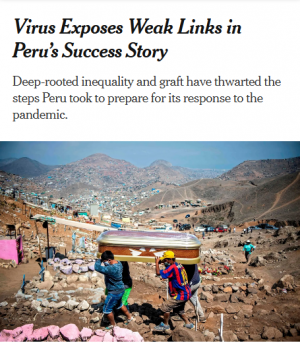
The New York Times (6/12/20) reported that Peruvian President Martín “Vizcarra’s centrist government appeared well-prepared to face the pandemic,” but the “crisis has marred Peru’s veneer of economic progress.”
Despite presiding over the second-highest excess death toll per capita in the world, Peru’s right-wing Vizcarra government has received broadly sympathetic coverage from the international media. The New York Times (6/12/20) hailed President Martín Vizcarra as a model “centrist” technocrat who “followed the best advice when the coronavirus arrived in Peru”:
He ordered one of Latin America’s first and strictest lockdowns, and rolled out one of the region’s biggest economic aid packages to help citizens stay home.
The Times attributed Peru’s failed pandemic response to “deep-rooted inequality and graft,” but largely avoided faulting Vizcarra’s neoliberal administration.
Peruvian sociologist Anahi Durand told FAIR that the government rejected calls from the left to implement a universal basic income “that would have allowed the population to stay at home.” It opted instead for a policy of targeted aid to the poor, which has “not reached many people who need” it, the Times reported, refraining, however, from criticizing Vizcarra for the debacle.
At the same time, a small group of major firms—ranging from logging companies accused of tax evasion and fined for environmental infractions, like Maderera Bozovich, to transnational consulting giants such as Deloitte and Ernst & Young—received $2.5 billion in loans out of the government’s $7.5 billion credit package, which was funneled almost exclusively through top private banks. Neither the New York Times, nor other Western outlets like the BBC (7/9/20), Wall Street Journal (6/14/20) and Time (5/29/20), mentioned this rather crucial fact in their account of Peru’s disaster.
“The policy of the government has been to put the economy ahead of public health,” Durand concluded.
While corporate journalists are right to point the finger at Peru’s precarious informal economy and severely underfunded health system, they refuse to place any significant blame at the door of Vizcarra and the country’s “string of pro-business presidents,” whom they praise for reducing poverty (New York Times, 6/12/20).
The fact that the Andean country of nearly 33 million spends just $700 on healthcare per person, and has only two ICU beds for every 1,000 people is widely reported (Washington Post, 6/18/20; Time, 5/29/20). But this isn’t presented as evidence of neoliberal Peruvian elites’ “reckless disregard…for the life and health of…[their own] people,” which the Washington Post (7/2/20) and other newspapers regularly cite as the cause of blockaded Venezuela’s healthcare crisis. Other standards seem to apply to loyal US client states.
Ecuador

The Wall Street Journal (6/30/20) reported that after making “gruesome headlines around the world,” Ecuador’s “Guayaquil is now a success story.”
While acknowledging that the country’s business capital suffered 16,700 excess deaths—0.7% of the population, or almost three times the Covid death rate endured by New York City—the Journal carefully avoided any critical evaluation of the neoliberal Lenín Moreno administration’s role in the catastrophe, which it chalks up to a “deadly quirk in the calendar,” “slow reaction” and “political fights.”Ecuador has received relatively scant coverage in past months, despite the South American country leading the world in excess deaths per capita. In one of the few recent pieces of in-depth reporting, the Wall Street Journal (6/30/20) narrated the “success story” of how Ecuador’s devastated city of Guayaquil “largely vanquished the new coronavirus,” in which the former and current right-wing mayors collectively in power since 2000, Jaime Nebot and Cynthia Viteri, bizarrely figure among the heroes.
The New York Times (4/23/20), for its part, appeared to renounce any pretense of journalistic inquiry, dismissing the disproportionate death toll as a “mystery” that is “impossible to explain”: “There is no obvious reason for Ecuador to be devastated far more than other countries.” What about the Moreno government’s obsession with pleasing bankers and persecuting political opponents?
Last October’s nationwide uprising (FAIR.org, 10/23/19; CounterSpin, 10/29/19) has all but vanished from Western media coverage, invoked only to smear the popular rebellion as “violent protests” where “eight people died and thousands were injured in two weeks of chaos that left Quito’s historic center looking like a war zone” (Financial Times, 6/15/20). Readers will find scarce mention in the press of Moreno’s brutal, militarized crackdown, nor of the continued imprisonment and persecution of supporters of ex-President Rafael Correa. Most recently, as Covid-19 cases spike in Quito, Moreno and his corrupt auditor general have been busy banning Correa’s political party ahead of next year’s presidential elections.
Also absent from the media narrative is any mention of the fact that the Moreno government, together with the International Monetary Fund (IMF), has pushed through savage cuts to public spending, including slashing investment in public health by 64% over the last two years. In 2019, 3,680 public health workers were laid off, equivalent to 4.5% of total Health Ministry staff. A further 2,279 of the ministry’s administrative staff, or 2.8% of total personnel, were laid off in May, following the signing of a new IMF loan, which mandated that the state reduce public spending by 6.2% of GDP through 2025.
It was this neoliberal austerity program—not vague accusations of federal government “indifference,” as reported by the Journal (6/30/20)—that back in March prompted the resignation of the Health minister, who stated that “no budget allocation has been received from the competent authority to emergency management.”
Economist Andrés Arauz, who previously served as Ecuador’s minister of Knowledge and director general of the Central Bank, commented to FAIR:
The minister complained that the Finance Ministry did not transfer a single cent for the emergency, while billions of dollars were being paid out in margin calls and speculative operations on the stock market.
Between February and April, Ecuador shelled out nearly $2.5 billion in debt payments, including hundreds of millions in margin calls on risky Wall Street loans.
Corporate outlets have all but ignored the payouts, but more egregiously, they gloss over the fact that it was Moreno’s voluntary decision to surrender national sovereignty to the IMF and Western banks, presenting him as the hapless victim of “dire economic straits” (Financial Times, 6/15/20).
Moreno had numerous available avenues for raising state revenue that he proceeded to close off. His government eliminated a pair of laws requiring windfall oil and mining revenues to be shared 50/50 between the Ecuadorian state and transnational companies, declined to renew import tariffs, and even passed a law removing a tax on the exit of dollars, as well as blocking the state from financing itself internally by borrowing within the country (Counterpunch, 11/13/18). All of these measures were aimed at enriching Moreno’s major local and foreign capitalist backers, who continue to engage in massive capital flight, to the tune of $900 million in April alone.
But this media narrative of Moreno shackled by a huge foreign debt, for which he supposedly has zero responsibility (FAIR.org, 10/23/19), is useful in justifying the kind of class warfare that the editors of the Financial Times (6/15/20) salivate for:
The president said the budget deficit would be at least $12 billion this year, about 11% of gross domestic product. To help fill the gap, his government has announced $4 billion of spending cuts, including scrapping state-owned companies, liquidating the national airline, and asking government employees and teachers to reduce their hours and pay.
Eight public firms are on the chopping block, with 3,604 workers set to lose their jobs, joining the 180,000 workers who have been laid off during the pandemic, according to official figures.
Meanwhile, facing zero international media scrutiny, Moreno has taken advantage of the current state of exception to ram through even more sweeping neoliberal measures, which had been halted by massive street protests last fall, including a labor reform undermining workers’ rights, the elimination of fuel subsidies, and modifications to the tax code previously rejected by the legislature.
Indeed, despite his bleeding of the country to the benefit of capital, Moreno’s corporate media admirers (FAIR.org, 2/4/18) will never refer to the right-wing US-friendly leader as an “authoritarian” whose “irresponsible and repressive measures” have cost thousands of lives, as Venezuela is described.
The New York Times (6/12/20) reported that Peruvian President Martín “Vizcarra’s centrist government appeared well-prepared to face the pandemic,” but the “crisis has marred Peru’s veneer of economic progress.”
Despite presiding over the second-highest excess death toll per capita in the world, Peru’s right-wing Vizcarra government has received broadly sympathetic coverage from the international media. The New York Times (6/12/20) hailed President Martín Vizcarra as a model “centrist” technocrat who “followed the best advice when the coronavirus arrived in Peru”:
He ordered one of Latin America’s first and strictest lockdowns, and rolled out one of the region’s biggest economic aid packages to help citizens stay home.
The Times attributed Peru’s failed pandemic response to “deep-rooted inequality and graft,” but largely avoided faulting Vizcarra’s neoliberal administration.
Peruvian sociologist Anahi Durand told FAIR that the government rejected calls from the left to implement a universal basic income “that would have allowed the population to stay at home.” It opted instead for a policy of targeted aid to the poor, which has “not reached many people who need” it, the Times reported, refraining, however, from criticizing Vizcarra for the debacle.
At the same time, a small group of major firms—ranging from logging companies accused of tax evasion and fined for environmental infractions, like Maderera Bozovich, to transnational consulting giants such as Deloitte and Ernst & Young—received $2.5 billion in loans out of the government’s $7.5 billion credit package, which was funneled almost exclusively through top private banks. Neither the New York Times, nor other Western outlets like the BBC (7/9/20), Wall Street Journal (6/14/20) and Time (5/29/20), mentioned this rather crucial fact in their account of Peru’s disaster.
“The policy of the government has been to put the economy ahead of public health,” Durand concluded.
While corporate journalists are right to point the finger at Peru’s precarious informal economy and severely underfunded health system, they refuse to place any significant blame at the door of Vizcarra and the country’s “string of pro-business presidents,” whom they praise for reducing poverty (New York Times, 6/12/20).
The fact that the Andean country of nearly 33 million spends just $700 on healthcare per person, and has only two ICU beds for every 1,000 people is widely reported (Washington Post, 6/18/20; Time, 5/29/20). But this isn’t presented as evidence of neoliberal Peruvian elites’ “reckless disregard…for the life and health of…[their own] people,” which the Washington Post (7/2/20) and other newspapers regularly cite as the cause of blockaded Venezuela’s healthcare crisis. Other standards seem to apply to loyal US client states.
Ecuador
The Wall Street Journal (6/30/20) reported that after making “gruesome headlines around the world,” Ecuador’s “Guayaquil is now a success story.”
While acknowledging that the country’s business capital suffered 16,700 excess deaths—0.7% of the population, or almost three times the Covid death rate endured by New York City—the Journal carefully avoided any critical evaluation of the neoliberal Lenín Moreno administration’s role in the catastrophe, which it chalks up to a “deadly quirk in the calendar,” “slow reaction” and “political fights.”Ecuador has received relatively scant coverage in past months, despite the South American country leading the world in excess deaths per capita. In one of the few recent pieces of in-depth reporting, the Wall Street Journal (6/30/20) narrated the “success story” of how Ecuador’s devastated city of Guayaquil “largely vanquished the new coronavirus,” in which the former and current right-wing mayors collectively in power since 2000, Jaime Nebot and Cynthia Viteri, bizarrely figure among the heroes.
The New York Times (4/23/20), for its part, appeared to renounce any pretense of journalistic inquiry, dismissing the disproportionate death toll as a “mystery” that is “impossible to explain”: “There is no obvious reason for Ecuador to be devastated far more than other countries.” What about the Moreno government’s obsession with pleasing bankers and persecuting political opponents?
Last October’s nationwide uprising (FAIR.org, 10/23/19; CounterSpin, 10/29/19) has all but vanished from Western media coverage, invoked only to smear the popular rebellion as “violent protests” where “eight people died and thousands were injured in two weeks of chaos that left Quito’s historic center looking like a war zone” (Financial Times, 6/15/20). Readers will find scarce mention in the press of Moreno’s brutal, militarized crackdown, nor of the continued imprisonment and persecution of supporters of ex-President Rafael Correa. Most recently, as Covid-19 cases spike in Quito, Moreno and his corrupt auditor general have been busy banning Correa’s political party ahead of next year’s presidential elections.
Also absent from the media narrative is any mention of the fact that the Moreno government, together with the International Monetary Fund (IMF), has pushed through savage cuts to public spending, including slashing investment in public health by 64% over the last two years. In 2019, 3,680 public health workers were laid off, equivalent to 4.5% of total Health Ministry staff. A further 2,279 of the ministry’s administrative staff, or 2.8% of total personnel, were laid off in May, following the signing of a new IMF loan, which mandated that the state reduce public spending by 6.2% of GDP through 2025.
It was this neoliberal austerity program—not vague accusations of federal government “indifference,” as reported by the Journal (6/30/20)—that back in March prompted the resignation of the Health minister, who stated that “no budget allocation has been received from the competent authority to emergency management.”
Economist Andrés Arauz, who previously served as Ecuador’s minister of Knowledge and director general of the Central Bank, commented to FAIR:
The minister complained that the Finance Ministry did not transfer a single cent for the emergency, while billions of dollars were being paid out in margin calls and speculative operations on the stock market.
Between February and April, Ecuador shelled out nearly $2.5 billion in debt payments, including hundreds of millions in margin calls on risky Wall Street loans.
Corporate outlets have all but ignored the payouts, but more egregiously, they gloss over the fact that it was Moreno’s voluntary decision to surrender national sovereignty to the IMF and Western banks, presenting him as the hapless victim of “dire economic straits” (Financial Times, 6/15/20).
Moreno had numerous available avenues for raising state revenue that he proceeded to close off. His government eliminated a pair of laws requiring windfall oil and mining revenues to be shared 50/50 between the Ecuadorian state and transnational companies, declined to renew import tariffs, and even passed a law removing a tax on the exit of dollars, as well as blocking the state from financing itself internally by borrowing within the country (Counterpunch, 11/13/18). All of these measures were aimed at enriching Moreno’s major local and foreign capitalist backers, who continue to engage in massive capital flight, to the tune of $900 million in April alone.
But this media narrative of Moreno shackled by a huge foreign debt, for which he supposedly has zero responsibility (FAIR.org, 10/23/19), is useful in justifying the kind of class warfare that the editors of the Financial Times (6/15/20) salivate for:
The president said the budget deficit would be at least $12 billion this year, about 11% of gross domestic product. To help fill the gap, his government has announced $4 billion of spending cuts, including scrapping state-owned companies, liquidating the national airline, and asking government employees and teachers to reduce their hours and pay.
Eight public firms are on the chopping block, with 3,604 workers set to lose their jobs, joining the 180,000 workers who have been laid off during the pandemic, according to official figures.
Meanwhile, facing zero international media scrutiny, Moreno has taken advantage of the current state of exception to ram through even more sweeping neoliberal measures, which had been halted by massive street protests last fall, including a labor reform undermining workers’ rights, the elimination of fuel subsidies, and modifications to the tax code previously rejected by the legislature.
Indeed, despite his bleeding of the country to the benefit of capital, Moreno’s corporate media admirers (FAIR.org, 2/4/18) will never refer to the right-wing US-friendly leader as an “authoritarian” whose “irresponsible and repressive measures” have cost thousands of lives, as Venezuela is described.
Chile

After average daily Covid cases in Chile jumped from 629 per day to 6,277 per day, the Washington Post (6/23/20) reported that Chilean officials “appear to have been overconfident.”
Media particularly faulted President Sebastián Piñera for not repairing the “disconnect between government and nation” exposed by last year’s nationwide anti-neoliberal uprising, which Bloomberg (6/16/20) vilified as “massive riots…[that] turned the city center into a war zone of smashed lights, debris, burnt-out buildings and graffiti.” At the time, corporate journalists by and large looked the other way while the Chilean state arrested 11,412 people, imprisoned 2,500, tortured 1,516 and injured 3,756, including 460 shot in the eye by police, according to Chile’s National Human Rights Institute (FAIR.org, 10/23/19, 10/26/19, 11/5/19, 12/6/19).Since its emergence as a global leader in per capita Covid-19 deaths last month, Chile has received mildly critical coverage from across the media spectrum. Western outlets reproached the right-wing Piñera government for being “overconfident” (Washington Post, 6/23/20) and “out of touch” (Bloomberg, 6/16/20), based on its controversial policy of rolling quarantines and rapid reopening. Chile “failed to recognize that the affluent have maids, gardeners and cooks who might also get infected,” NPR (7/2/20) reported.
Frontline health workers reject the media’s gentle criticism of Chile’s Covid-19 response as understatements, accusing the government of Trump-style criminal negligence.
According to Dr. Roberto Bermudez, who attends Covid patients at two public hospitals in Santiago, the Piñera government has “followed the lead of the Trump administration” in manipulating statistics, refusing to implement a national quarantine and privileging corporate profits over public health.
“The strategy is very macabre. Chile allowed many people to die while trying to pursue herd immunity,” he told FAIR, referring to disgraced former Health Minister Jaime Mañalich’s comment in April that “the only way to protect ourselves is that the majority of people are infected.”
For months, Mañalich—a close friend and confidant of Piñera—doctored the country’s death figures, making public only the test-confirmed deaths, and not the considerable number of Covid-19 deaths diagnosed by doctors but with no test administered. United Nations Development Program Regional Director Luis Felipe López-Calva estimates that Chile could be under-reporting coronavirus fatalities by as much as 61%, based on excess death data compiled by the Economist.
Corporate journalists euphemistically described the government’s brazen lying to the public as “discrepancies” (NPR, 7/2/20) that caused “divisions [with] sectors of the medical community” (Guardian, 6/14/20).
They also ignored the fact that mayors and health experts across the country have been urging Piñera to declare a nationwide quarantine since the pandemic arrived in March, which was reported at the time (Reuters, 3/20/20; Newsweek, 3/23/20) but has since been erased from the media narrative. In response to the government’s stonewalling, multiple criminal lawsuits have been filed accusing Piñera and Mañalich of homicide, which has similarly gone unreported.
As in Peru and Ecuador, the press has turned a blind eye to the Piñera government’s systematic prioritization of private capital over human life. In April, the Chilean president promulgated a law authorizing employers to temporarily suspend workers’ contracts under the pretext of avoiding mass layoffs resulting from insolvency.
Over 677,000 workers have been left to scrape by on fractions of their already-meager earnings drawn from unemployment funds, while transnational conglomerates—now freed from wage obligations—pay multimillion dollar dividends to their shareholders. For instance, Latin American retail giant CENCOSUD paid investors more than $234 million between two of its subsidiaries after suspending the contracts of 7,731 workers. LATAM Airlines paid out $57 million while slashing wages in half through June, firing 4,400 workers and filing for bankruptcy in the US. Meanwhile, soup kitchens now blanket the landscape of metropolitan Santiago, configuring a new geography of hunger.

Reuters (6/12/20) romanticizes the “carefully gloved fist” of an armed force that in the past year has tortured and blinded hundreds of Chileans.
Reuters (6/12/20) could scarcely hide its infatuation with the armed forces “safeguarding the coronavirus lockdowns and curfews Chilean-style, with soldiers and police working in tandem, wielding weaponry but with a carefully gloved fist.” The wire service did not mention that these are the same soldiers and police who, however “mindful of the growing poverty and hunger…caused by the pandemic,” have maimed, murdered and tortured, not only under the state of emergency, but during last year’s uprising as well.Also missing from the headlines is any criticism of Piñera’s crusade to normalize militarized state repression, including the deployment of active-duty troops to enforce sanitary restrictions and nightly curfews decreed under a “state of catastrophe” order issued in March.
Notwithstanding Piñera’s illegal militarization of Indigenous Mapuche territory and effort to ram through parliament a new intelligence bill targeting popular movements as “internal enemies,” the pro-US leader is not accused in the Western media of “tighten[ing his] grip on power, helped by coronavirus lockdown,” or “using Covid-19 to silence his opponents even further.”
It is clear that such indictments are reserved for Official Enemies like Venezuela, China (FAIR.org, 3/6/20) and Cuba (FAIR.org, 5/31/20, 4/14/20), but never loyal US vassals.
MASS VIOLATIONS BY US POLICE OF PROTESTER’S RIGHTS
By Amnesty International.
August 5, 2020
https://popularresistance.org/mass-violations-by-us-police-of-protesters-rights/
The World Is Watching.
Download the full report here.
On 25 May 2020, George Floyd was detained, tortured and extrajudicially executed by Minneapolis Police Department officers who restrained and suffocated him by holding him on the ground and kneeling on his neck for almost nine minutes. His death sparked widespread protests across the USA and the world and a long-overdue conversation about systemic racism and policing. Recent events have also raised longstanding concerns about violations of human rights, including the rights to life, to security of the person, to equal protection of the law, to freedom from discrimination and to freedom of expression and peaceful assembly. 1
More than 1,000 people are killed each year by police in the USA; because the US government does not collect data on these deaths, the exact number of people killed by police annually is unknown. The data that does exist shows that Black people are disproportionately impacted by police killings. While Black people represent 13.2% of the US population, they represent 24.2% of deaths from police use of firearms. The use of lethal force against people of colour in the USA should be understood as part of the wider pattern of racially discriminatory treatment by law enforcement officers, including unjustified stops and searches, excessive use of force and racial profiling. Such treatment violates international human rights law which strictly prohibits all forms of discrimination.
One of a state’s most fundamental duties is to protect life and police officers, as agents of the state, have a responsibility to uphold this in carrying out their law enforcement duties. International law allows police officers to use lethal force only as a last resort to protect themselves or others from death or serious injury.
Furthermore, international law enforcement standards require that force of any kind be used only when no other means are available that are likely to achieve the legitimate objective. If the use of force is unavoidable it must be no more than is necessary and proportionate to achieve the objective and law enforcement must use it in a manner designed to minimize damage or injury and must respect and preserve human life. 2
Amnesty International has previously documented serious and egregious violations of human rights in the use of lethal force by law enforcement in the USA. Following the killing of Michael Brown, an 18-year-old Black teenager, by a police officer in Ferguson, Missouri, on 9 August 2014, Amnesty International issued a report on the laws governing use of lethal force by police, Deadly force: Police use of lethal force in the United States. This research found that:
• All 50 states and Washington, D.C. fail to comply with international law and standards on the use of lethal force by law enforcement officers.
• None of the state statutes require that the use of lethal force be used only as a last resort and that non-violent and less harmful means be tried first.
• No state limits the use of lethal force to only those situations where there is an imminent threat to life or serious injury to the officer or to others.
This report shows that there has been a disturbing lack of progress over the past five years in ensuring that police officers use lethal force only when there is an imminent risk of death or serious injury to themselves or others. Just three states – California, Washington and Missouri – have taken important but incremental steps, such as by bringing their state laws on lethal force into compliance with US constitutional standards.
In the context of the policing of the protests sparked by the killing of George Floyd, Amnesty International has documented serious human rights concerns in relation to the use of excessive force. On 23 June 2020, Amnesty International launched an interactive digital project, “Black Lives Matter Protests: Mapping Police Violence Across the USA”. This found that police forces across the USA committed widespread and egregious human rights violations in response to largely peaceful assemblies protesting systemic racism and police violence.
Amnesty International documented 125 separate incidents of police violence against protesters in 40 states and the District of Columbia between 26 May and 5 June 2020. These acts of excessive force were committed by members of state and local police departments, as well as by National Guard troops and security force personnel from several federal agencies.
Among the abuses documented were beatings, the misuse of tear gas and pepper spray, and the inappropriate and at times indiscriminate firing of “less lethal” projectiles, such as sponge rounds and rubber bullets.
In city after city, Amnesty International documented incidents of unnecessary and excessive use of force by law enforcement agencies while policing Black Lives Matter protests. The unnecessary and excessive use of specific weapons, such as chemical irritants and kinetic impact projectiles, is ultimately a symptom of the very issue that started these protests: unaccountable police violence.
In many cities law enforcement confronted protesters while wearing riot gear as a first level of response, rather than in response to any particular acts of violence. Again, and again, law enforcement used physical force, chemical irritants, kinetic impact projectiles, and arbitrary arrest and detention as a first resort against largely peaceful demonstrations.
In several cities, law enforcement resorted to physical force against largely peaceful protesters to enforce hastily rolled out curfews. Between 26 May and 5 June 2020, Amnesty International documented at least six incidents of police using batons and 13 instances of the unnecessary use of kinetic impact projectiles in 13 cities across the country.
Amnesty International documented the use of tear gas and pepper spray in dozens of incidents across the country. In many cases, these were used against people non-violently protesting, rather than as a necessary and proportionate response to widespread violence or a perceived threat. Between 25 May and 5 June, Amnesty International documented 89 specific instances of the unnecessary use of tear gas in cities in 34 states and 21 incidents of the unlawful use of pepper spray in 15 states and Washington, DC. In many of the documented incidents, chemical irritants were used as a first resort to disperse a peacefully assembled crowd or in response to non-compliance with some specific order.
In some instances, the use of chemical irritants can constitute torture or other ill-treatment. Furthermore, their widespread, unnecessary and excessive use against largely peaceful protesters raises additional concerns during a pandemic involving a respiratory illness such as COVID-19. The natural response by people when exposed to these chemicals is to remove their masks in order to flush their eyes, noses and mouths and expectorate the chemicals from their mouths and lungs, potentially spreading the virus.
In numerous incidents across the USA, law enforcement personnel targeted media representatives with chemical irritants, kinetic impact projectiles and arrest and detention. Amnesty International has documented cases in several states where journalists sustained serious injuries resulting from kinetic impact projectiles and/or were detained and arrested without proper access to medical care. Amnesty International has also documented the use of excessive force against and arbitrary arrests of legal observers as they monitored protests.
Street medics were also targeted. In some cases, law enforcement destroyed clearly identified medic stations and subjected clearly identified street medics to excessive force, such as physical assault, pepper spray and rubber projectiles, and arrest.
This report draws on more than 50 interviews conducted by Amnesty International over several weeks in June 2020 about people’s experiences in the context of the protests sparked by the killing of George Floyd. It highlights the shocking failure to limit the use of force by law enforcement to situations where it is necessary and proportionate to an actual threat and details how protesters, journalists, legal observers and street medics were met with police violence. The report ends with a series of recommendations to federal, state and local authorities to ensure accountability for these violations and to address the urgent need for police reform, including the policing of protests, in the USA.
Key Recommendations
Amnesty International is calling on federal, state and local officials to enact systemic reform that protect and respect Black lives, the development of national guidelines on respecting and facilitating the right to peaceful protest and for all law enforcement agencies to review their policies and the equipment used in the policing of demonstrations.
Limit the use of deadly force by law enforcement
• Federal, state and local authorities must urgently take decisive action to address systemic racism and systemic misuse of force in the US policing and criminal justice system, including by launching independent investigations and ensuring accountability in all cases of unlawful lethal use of force by police.
• All state legislatures should introduce or amend statutes that authorize the use of lethal force to ensure that they are in line with international law and standards by limiting the use of lethal force by law enforcement officials to those instances in which it is necessary and proportional to protect against an imminent threat of death or serious injury.
• The US Congress should pass the George Floyd Justice in Policing Act of 2020 (HR 7120), including the Police Exercising Absolute Care with Everyone (“PEACE Act”) which would bar federal law enforcement from using deadly force unless necessary as a last resort to prevent imminent death or serious bodily injury and prevent states from receiving federal funding unless they enact a similarly restrictive state use of force law.
Policing of protests
• Federal, state and local authorities must ensure that everyone under their jurisdiction can enjoy their human rights to peaceful assembly and freedom of expression.
• All law enforcements agencies must revise their policies and practices for the policing of protests. Law enforcement agencies must comply at all times with international human rights standards, including the UN Code of Conduct for Law Enforcement Officials and the UN Basic Principles on the Use of Force and Firearms by Law Enforcement Officials which must be the guiding principles underpinning all operations before, during and after demonstrations.
• The Department of Justice and all state Attorney Generals should investigate, effectively, impartially and promptly, all allegations of human rights violations by police officials during public assemblies, including unlawful use of force, and bring all those found responsible, including commanding officers, to account through criminal or disciplinary proceedings as appropriate, and provide full redress to victims.
End Notes:
1 The USA signed and ratified the International Covenant on Civil and Political Rights in 1992 and the International Convention on the Elimination of All Forms of Racial Discrimination in 1994.
2 UN Basic Principles on the Use of Force and Firearms by Law Enforcement Officials
https://popularresistance.org/mass-violations-by-us-police-of-protesters-rights/
The World Is Watching.
Download the full report here.
On 25 May 2020, George Floyd was detained, tortured and extrajudicially executed by Minneapolis Police Department officers who restrained and suffocated him by holding him on the ground and kneeling on his neck for almost nine minutes. His death sparked widespread protests across the USA and the world and a long-overdue conversation about systemic racism and policing. Recent events have also raised longstanding concerns about violations of human rights, including the rights to life, to security of the person, to equal protection of the law, to freedom from discrimination and to freedom of expression and peaceful assembly. 1
More than 1,000 people are killed each year by police in the USA; because the US government does not collect data on these deaths, the exact number of people killed by police annually is unknown. The data that does exist shows that Black people are disproportionately impacted by police killings. While Black people represent 13.2% of the US population, they represent 24.2% of deaths from police use of firearms. The use of lethal force against people of colour in the USA should be understood as part of the wider pattern of racially discriminatory treatment by law enforcement officers, including unjustified stops and searches, excessive use of force and racial profiling. Such treatment violates international human rights law which strictly prohibits all forms of discrimination.
One of a state’s most fundamental duties is to protect life and police officers, as agents of the state, have a responsibility to uphold this in carrying out their law enforcement duties. International law allows police officers to use lethal force only as a last resort to protect themselves or others from death or serious injury.
Furthermore, international law enforcement standards require that force of any kind be used only when no other means are available that are likely to achieve the legitimate objective. If the use of force is unavoidable it must be no more than is necessary and proportionate to achieve the objective and law enforcement must use it in a manner designed to minimize damage or injury and must respect and preserve human life. 2
Amnesty International has previously documented serious and egregious violations of human rights in the use of lethal force by law enforcement in the USA. Following the killing of Michael Brown, an 18-year-old Black teenager, by a police officer in Ferguson, Missouri, on 9 August 2014, Amnesty International issued a report on the laws governing use of lethal force by police, Deadly force: Police use of lethal force in the United States. This research found that:
• All 50 states and Washington, D.C. fail to comply with international law and standards on the use of lethal force by law enforcement officers.
• None of the state statutes require that the use of lethal force be used only as a last resort and that non-violent and less harmful means be tried first.
• No state limits the use of lethal force to only those situations where there is an imminent threat to life or serious injury to the officer or to others.
This report shows that there has been a disturbing lack of progress over the past five years in ensuring that police officers use lethal force only when there is an imminent risk of death or serious injury to themselves or others. Just three states – California, Washington and Missouri – have taken important but incremental steps, such as by bringing their state laws on lethal force into compliance with US constitutional standards.
In the context of the policing of the protests sparked by the killing of George Floyd, Amnesty International has documented serious human rights concerns in relation to the use of excessive force. On 23 June 2020, Amnesty International launched an interactive digital project, “Black Lives Matter Protests: Mapping Police Violence Across the USA”. This found that police forces across the USA committed widespread and egregious human rights violations in response to largely peaceful assemblies protesting systemic racism and police violence.
Amnesty International documented 125 separate incidents of police violence against protesters in 40 states and the District of Columbia between 26 May and 5 June 2020. These acts of excessive force were committed by members of state and local police departments, as well as by National Guard troops and security force personnel from several federal agencies.
Among the abuses documented were beatings, the misuse of tear gas and pepper spray, and the inappropriate and at times indiscriminate firing of “less lethal” projectiles, such as sponge rounds and rubber bullets.
In city after city, Amnesty International documented incidents of unnecessary and excessive use of force by law enforcement agencies while policing Black Lives Matter protests. The unnecessary and excessive use of specific weapons, such as chemical irritants and kinetic impact projectiles, is ultimately a symptom of the very issue that started these protests: unaccountable police violence.
In many cities law enforcement confronted protesters while wearing riot gear as a first level of response, rather than in response to any particular acts of violence. Again, and again, law enforcement used physical force, chemical irritants, kinetic impact projectiles, and arbitrary arrest and detention as a first resort against largely peaceful demonstrations.
In several cities, law enforcement resorted to physical force against largely peaceful protesters to enforce hastily rolled out curfews. Between 26 May and 5 June 2020, Amnesty International documented at least six incidents of police using batons and 13 instances of the unnecessary use of kinetic impact projectiles in 13 cities across the country.
Amnesty International documented the use of tear gas and pepper spray in dozens of incidents across the country. In many cases, these were used against people non-violently protesting, rather than as a necessary and proportionate response to widespread violence or a perceived threat. Between 25 May and 5 June, Amnesty International documented 89 specific instances of the unnecessary use of tear gas in cities in 34 states and 21 incidents of the unlawful use of pepper spray in 15 states and Washington, DC. In many of the documented incidents, chemical irritants were used as a first resort to disperse a peacefully assembled crowd or in response to non-compliance with some specific order.
In some instances, the use of chemical irritants can constitute torture or other ill-treatment. Furthermore, their widespread, unnecessary and excessive use against largely peaceful protesters raises additional concerns during a pandemic involving a respiratory illness such as COVID-19. The natural response by people when exposed to these chemicals is to remove their masks in order to flush their eyes, noses and mouths and expectorate the chemicals from their mouths and lungs, potentially spreading the virus.
In numerous incidents across the USA, law enforcement personnel targeted media representatives with chemical irritants, kinetic impact projectiles and arrest and detention. Amnesty International has documented cases in several states where journalists sustained serious injuries resulting from kinetic impact projectiles and/or were detained and arrested without proper access to medical care. Amnesty International has also documented the use of excessive force against and arbitrary arrests of legal observers as they monitored protests.
Street medics were also targeted. In some cases, law enforcement destroyed clearly identified medic stations and subjected clearly identified street medics to excessive force, such as physical assault, pepper spray and rubber projectiles, and arrest.
This report draws on more than 50 interviews conducted by Amnesty International over several weeks in June 2020 about people’s experiences in the context of the protests sparked by the killing of George Floyd. It highlights the shocking failure to limit the use of force by law enforcement to situations where it is necessary and proportionate to an actual threat and details how protesters, journalists, legal observers and street medics were met with police violence. The report ends with a series of recommendations to federal, state and local authorities to ensure accountability for these violations and to address the urgent need for police reform, including the policing of protests, in the USA.
Key Recommendations
Amnesty International is calling on federal, state and local officials to enact systemic reform that protect and respect Black lives, the development of national guidelines on respecting and facilitating the right to peaceful protest and for all law enforcement agencies to review their policies and the equipment used in the policing of demonstrations.
Limit the use of deadly force by law enforcement
• Federal, state and local authorities must urgently take decisive action to address systemic racism and systemic misuse of force in the US policing and criminal justice system, including by launching independent investigations and ensuring accountability in all cases of unlawful lethal use of force by police.
• All state legislatures should introduce or amend statutes that authorize the use of lethal force to ensure that they are in line with international law and standards by limiting the use of lethal force by law enforcement officials to those instances in which it is necessary and proportional to protect against an imminent threat of death or serious injury.
• The US Congress should pass the George Floyd Justice in Policing Act of 2020 (HR 7120), including the Police Exercising Absolute Care with Everyone (“PEACE Act”) which would bar federal law enforcement from using deadly force unless necessary as a last resort to prevent imminent death or serious bodily injury and prevent states from receiving federal funding unless they enact a similarly restrictive state use of force law.
Policing of protests
• Federal, state and local authorities must ensure that everyone under their jurisdiction can enjoy their human rights to peaceful assembly and freedom of expression.
• All law enforcements agencies must revise their policies and practices for the policing of protests. Law enforcement agencies must comply at all times with international human rights standards, including the UN Code of Conduct for Law Enforcement Officials and the UN Basic Principles on the Use of Force and Firearms by Law Enforcement Officials which must be the guiding principles underpinning all operations before, during and after demonstrations.
• The Department of Justice and all state Attorney Generals should investigate, effectively, impartially and promptly, all allegations of human rights violations by police officials during public assemblies, including unlawful use of force, and bring all those found responsible, including commanding officers, to account through criminal or disciplinary proceedings as appropriate, and provide full redress to victims.
End Notes:
1 The USA signed and ratified the International Covenant on Civil and Political Rights in 1992 and the International Convention on the Elimination of All Forms of Racial Discrimination in 1994.
2 UN Basic Principles on the Use of Force and Firearms by Law Enforcement Officials
PARENTS STAND WITH EDUCATORS ON SAFETY BEFORE REOPENING SCHOOLS
By Brenda Álvarez, NEA Today.
August 5, 2020
https://popularresistance.org/parents-stand-with-educators-on-safety-before-reopening-schools/
Many parents nationwide are questioning whether it’s safe to send their kids back to a brick and mortar school this fall. With varied life circumstances, and different districts and schools choosing different options, it’s a daunting decision to make.
For Florida’s Raquel Pantoja Lias, a mom of a rising fourth grader in Broward County, it’s a hard “no.”
Under an emergency order from the state education commissioner, most schools are scheduled to reopen on August 19 for in-person learning, five days a week, a plan supported by Gov. Ron DeSantis. Along with educators and parents, the Florida Education Association filed suit against state officials to safeguard the health and welfare of public school students, educators, and the community at large. The lawsuit intends to stop the reckless and unsafe reopening of public school campuses as coronavirus infections surge statewide.
The Florida governor has latched on to the claim that students have a lower likelihood of catching the virus and therefore schoolteachers must return to work. President Donald Trump and Education Secretary Betsy DeVos have made similar statements and have threatened to withhold federal funds from K-12 schools that don’t open for in-person learning.
“I don’t care what they say,” says Lias. “Is Donald Trump’s son going to school? No, but he wants to send everybody else’s kid back and risk their lives. Our kids are not experiments to see if reopening is going to work. So no, my daughter is not going into a school building to potentially die.”
This sentiment is a real concern for many Floridians. The state is now the new hot spot, given a surge of new coronavirus cases and hospitalizations. Between July 16 and 24, the number of new cases increased by 34 percent, from 23,170 to 31,150. Within the same eight-day period, the number of children hospitalized with coronavirus went from 246 to 303, a 23 percent increase.
And…kids are dying. As reported by several news outlets, on July 17, Kimora “Kimmie” Lynum, 9, died from Covid-19 complications. Kimmie became the fifth minor and the youngest in the state to die from the virus. Her family has said she had no underlying health conditions.
Lias wants to keep her daughter safe through distance learning, and recent national polls from The Navigator, Axios and Quinnipiac show other parents want the same. According to The Navigator, “a majority of Americans, and parents, oppose reopening schools in the fall because of the risks, and nearly two in three parents say schools should be among the last things to reopen.”
How best to reopen schools—whether it’s in-person, hybrid, or virtual—is a much more complicated issue that’s going to require leaving behind the idea of going back to the “old normal.”
“We’re in the midst of a paradigm shift,” says Courtney Fox, a mom of a rising tenth grader in Arlington, Va. “It’s not one anybody chose. Covid chose it for us, and instead of fighting over trying to retain as much of the old normal as possible, we need to embrace this opportunity to reinvent schools and create a better future.”

‘Disrupt The Thinking’
The coronavirus has magnified inequities that have existed in schools across the country for decades, hurting students along the way: lack of devices or no home internet, inadequate access to specialized support services (special education and mental health), food deficits, housing instability, and more.
Courtney Fox saw some of these inequities within Arlington Public Schools (APS) when her youngest daughter couldn’t adequately access special education services, resulting in her transfer to a private school. When it came to exploring reopening options for her eldest daughter today, Fox realized now is the time to reimagine public schools so it’s better for every student.
“If we do online learning right, our kids will be learning,” Fox says, “and I’m not just talking about teaching them history and math. This is about community building , social-emotional [development], and equity.”
Many school districts around the nation have taken a slow approach to reopening school buildings, starting with distance learning first, while allowing only some students with special needs to enter school buildings, and then reevaluating later in the year.
In Arlington, Va., the approach is a yearlong, two-tiered system, with each tier starting the year online. This bifurcated system, Fox worries, would be separate, unequal, and inequitable.
In mid-July, APS announced its two-model approach: 1) full-time distance learning or 2) a hybrid model in which two groups of students would each attend school two days per week, wear masks, and practice social distancing.
Fox found this split would create two master schedules and run two separate school systems, carrying the potential to fracture the Arlington school community. “Imagine the kids who are virtual who come back to their home schools a year from now and feel like outsiders, [and] the hybrid kids who are going to get less instruction,” she told WUSA-TV. “To me, it just didn’t make sense.”
So, she started an online petition, called “#OneAPS.”
“If we were all online as one—retaining original master schedules for each school and keeping collaborative learning teams together—it would be a game changer and would include a greater chance of succeeding with online learning,” she explains.
Fox says she’s “pro-reality,” and by no means thinks the petition carries all the answers. Part of her goal was to help “disrupt the thinking…to refocus on the values of unity, science, and equity,” as well as gather support for the “#OneAPS” plan that encourages the district to start the school year with distance learning for all students so they could be educated under one model: together and equally.
Additionally, according to the petition, the district’s split model comes with other glitches. Students who choose the hybrid model would not be guaranteed their own teachers; and teachers would not necessarily return to their own schools and may be required to teach classes they’ve never taught before. More so, the plan mandates educators return to school under the hybrid model, or they may be forced to take leave without pay, retire, or quit.
Under the virtual model, students would have fewer guarantees, including being enrolled in classes operated by third party vendors instead of APS educators.
“This is not stick your finger in the leak and try to hold the dam. This is about protecting this system so it’s here for us when we get through this and using this as an opportunity to do what’s right to make things more equitable for everyone.”
The “#OneAPS” plan would keep the district as one united school system; would protect the health and safety of students, teachers and staff; would not force teachers into school buildings; and would support the most vulnerable learners, such as special education students and English language learners.
Fox is one of thousands of parents nationwide that has taken to online platforms to weigh in on the reopening debate. In Pennsylvania, for example, a Facebook group with nearly seven thousand members of parents, educators, students, and supporters are refusing to return to schools until counties report no new cases of COVID-19 for at least 14 days.
A group of parents, educators, school staff, concerned community members, and health officials in Hawaii have expressed strong opposition to the state’s reopening plan: “The current plan is unacceptable; it does not follow CDC guidelines on safe school reopenings, was designed and promulgated without adequate public input or transparency, and needlessly puts the lives of our community at great risk. It is nothing less than a recipe for a public health disaster.”
Parents are welcome and needed in these conversations, said NEA President Lily Eskelsen Garcia.
“The partnership between parents and educators is so important, especially in this time of crisis. Educators’ number-one concern is the safety, well-being and success of our students,” she said. “Parents and educators are standing together because we cannot wait. Our nation’s students cannot pay the price in this crisis.”
NEA Guidance And Action
The NEA believes that any reopening model has to not only ensure the health and safety of students and staff, but also prioritize long term strategies on student learning and educational equity.
To assist states and school districts in this effort, this week NEA released “All Hands on Deck: Initial Guidance Regarding Reopening School Buildings.” Built around four basic principles—health expertise, educator voice, access to protection, and leading with equity—the document lays out what schools need to do to prepare for reopening, and how they can make their reopening succeed far beyond the first few weeks of the new school year.
On May 15, the House passed the HEROES Act to help schools and campuses reopen safely and save educators’ jobs. Now, it’s up to the Senate. Budget cuts loom even as schools struggle to make the costly changes necessary to reopen safely.
Unless the Senate acts soon, those budget cuts could lead to the loss of nearly 2 million education jobs at every level from kindergarten to postsecondary, adding to the complications of reopening school buildings.
Everyone agrees the road to recovery runs through our schools. But they cannot reopen safely if school budgets are slashed and students do not have what they need to be safe, learn, and succeed—especially the students of color, students with disabilities, and students living in poverty who have suffered most during this crisis.
https://popularresistance.org/parents-stand-with-educators-on-safety-before-reopening-schools/
Many parents nationwide are questioning whether it’s safe to send their kids back to a brick and mortar school this fall. With varied life circumstances, and different districts and schools choosing different options, it’s a daunting decision to make.
For Florida’s Raquel Pantoja Lias, a mom of a rising fourth grader in Broward County, it’s a hard “no.”
Under an emergency order from the state education commissioner, most schools are scheduled to reopen on August 19 for in-person learning, five days a week, a plan supported by Gov. Ron DeSantis. Along with educators and parents, the Florida Education Association filed suit against state officials to safeguard the health and welfare of public school students, educators, and the community at large. The lawsuit intends to stop the reckless and unsafe reopening of public school campuses as coronavirus infections surge statewide.
The Florida governor has latched on to the claim that students have a lower likelihood of catching the virus and therefore schoolteachers must return to work. President Donald Trump and Education Secretary Betsy DeVos have made similar statements and have threatened to withhold federal funds from K-12 schools that don’t open for in-person learning.
“I don’t care what they say,” says Lias. “Is Donald Trump’s son going to school? No, but he wants to send everybody else’s kid back and risk their lives. Our kids are not experiments to see if reopening is going to work. So no, my daughter is not going into a school building to potentially die.”
This sentiment is a real concern for many Floridians. The state is now the new hot spot, given a surge of new coronavirus cases and hospitalizations. Between July 16 and 24, the number of new cases increased by 34 percent, from 23,170 to 31,150. Within the same eight-day period, the number of children hospitalized with coronavirus went from 246 to 303, a 23 percent increase.
And…kids are dying. As reported by several news outlets, on July 17, Kimora “Kimmie” Lynum, 9, died from Covid-19 complications. Kimmie became the fifth minor and the youngest in the state to die from the virus. Her family has said she had no underlying health conditions.
Lias wants to keep her daughter safe through distance learning, and recent national polls from The Navigator, Axios and Quinnipiac show other parents want the same. According to The Navigator, “a majority of Americans, and parents, oppose reopening schools in the fall because of the risks, and nearly two in three parents say schools should be among the last things to reopen.”
How best to reopen schools—whether it’s in-person, hybrid, or virtual—is a much more complicated issue that’s going to require leaving behind the idea of going back to the “old normal.”
“We’re in the midst of a paradigm shift,” says Courtney Fox, a mom of a rising tenth grader in Arlington, Va. “It’s not one anybody chose. Covid chose it for us, and instead of fighting over trying to retain as much of the old normal as possible, we need to embrace this opportunity to reinvent schools and create a better future.”
‘Disrupt The Thinking’
The coronavirus has magnified inequities that have existed in schools across the country for decades, hurting students along the way: lack of devices or no home internet, inadequate access to specialized support services (special education and mental health), food deficits, housing instability, and more.
Courtney Fox saw some of these inequities within Arlington Public Schools (APS) when her youngest daughter couldn’t adequately access special education services, resulting in her transfer to a private school. When it came to exploring reopening options for her eldest daughter today, Fox realized now is the time to reimagine public schools so it’s better for every student.
“If we do online learning right, our kids will be learning,” Fox says, “and I’m not just talking about teaching them history and math. This is about community building , social-emotional [development], and equity.”
Many school districts around the nation have taken a slow approach to reopening school buildings, starting with distance learning first, while allowing only some students with special needs to enter school buildings, and then reevaluating later in the year.
In Arlington, Va., the approach is a yearlong, two-tiered system, with each tier starting the year online. This bifurcated system, Fox worries, would be separate, unequal, and inequitable.
In mid-July, APS announced its two-model approach: 1) full-time distance learning or 2) a hybrid model in which two groups of students would each attend school two days per week, wear masks, and practice social distancing.
Fox found this split would create two master schedules and run two separate school systems, carrying the potential to fracture the Arlington school community. “Imagine the kids who are virtual who come back to their home schools a year from now and feel like outsiders, [and] the hybrid kids who are going to get less instruction,” she told WUSA-TV. “To me, it just didn’t make sense.”
So, she started an online petition, called “#OneAPS.”
“If we were all online as one—retaining original master schedules for each school and keeping collaborative learning teams together—it would be a game changer and would include a greater chance of succeeding with online learning,” she explains.
Fox says she’s “pro-reality,” and by no means thinks the petition carries all the answers. Part of her goal was to help “disrupt the thinking…to refocus on the values of unity, science, and equity,” as well as gather support for the “#OneAPS” plan that encourages the district to start the school year with distance learning for all students so they could be educated under one model: together and equally.
Additionally, according to the petition, the district’s split model comes with other glitches. Students who choose the hybrid model would not be guaranteed their own teachers; and teachers would not necessarily return to their own schools and may be required to teach classes they’ve never taught before. More so, the plan mandates educators return to school under the hybrid model, or they may be forced to take leave without pay, retire, or quit.
Under the virtual model, students would have fewer guarantees, including being enrolled in classes operated by third party vendors instead of APS educators.
“This is not stick your finger in the leak and try to hold the dam. This is about protecting this system so it’s here for us when we get through this and using this as an opportunity to do what’s right to make things more equitable for everyone.”
The “#OneAPS” plan would keep the district as one united school system; would protect the health and safety of students, teachers and staff; would not force teachers into school buildings; and would support the most vulnerable learners, such as special education students and English language learners.
Fox is one of thousands of parents nationwide that has taken to online platforms to weigh in on the reopening debate. In Pennsylvania, for example, a Facebook group with nearly seven thousand members of parents, educators, students, and supporters are refusing to return to schools until counties report no new cases of COVID-19 for at least 14 days.
A group of parents, educators, school staff, concerned community members, and health officials in Hawaii have expressed strong opposition to the state’s reopening plan: “The current plan is unacceptable; it does not follow CDC guidelines on safe school reopenings, was designed and promulgated without adequate public input or transparency, and needlessly puts the lives of our community at great risk. It is nothing less than a recipe for a public health disaster.”
Parents are welcome and needed in these conversations, said NEA President Lily Eskelsen Garcia.
“The partnership between parents and educators is so important, especially in this time of crisis. Educators’ number-one concern is the safety, well-being and success of our students,” she said. “Parents and educators are standing together because we cannot wait. Our nation’s students cannot pay the price in this crisis.”
NEA Guidance And Action
The NEA believes that any reopening model has to not only ensure the health and safety of students and staff, but also prioritize long term strategies on student learning and educational equity.
To assist states and school districts in this effort, this week NEA released “All Hands on Deck: Initial Guidance Regarding Reopening School Buildings.” Built around four basic principles—health expertise, educator voice, access to protection, and leading with equity—the document lays out what schools need to do to prepare for reopening, and how they can make their reopening succeed far beyond the first few weeks of the new school year.
On May 15, the House passed the HEROES Act to help schools and campuses reopen safely and save educators’ jobs. Now, it’s up to the Senate. Budget cuts loom even as schools struggle to make the costly changes necessary to reopen safely.
Unless the Senate acts soon, those budget cuts could lead to the loss of nearly 2 million education jobs at every level from kindergarten to postsecondary, adding to the complications of reopening school buildings.
Everyone agrees the road to recovery runs through our schools. But they cannot reopen safely if school budgets are slashed and students do not have what they need to be safe, learn, and succeed—especially the students of color, students with disabilities, and students living in poverty who have suffered most during this crisis.
Subscribe to:
Comments (Atom)