Tuesday, August 4, 2020

Drive to reopen US schools continues despite mounting evidence of deadly consequences
https://www.wsws.org/en/articles/2020/08/03/scho-a03.html
By Evan Blake
3 August 2020
The drive to reopen the schools continues across the US despite mounting evidence of the disastrous public health implications of doing so even as the coronavirus pandemic rages out of control.
New cases of COVID-19 and deaths from the disease continue to rise and no plan is in place to contain the spread of the virus. Under these conditions, it is impossible to reopen schools safely even with the most advanced measures to protect teachers and students, let alone the half-measures underfunded school districts are implementing.
Opposition to the reopening of the schools is growing in every part of the country, with social media exploding over the past month since President Trump tweeted that “SCHOOLS MUST OPEN IN THE FALL!!!” There are now over 55 Facebook groups in at least 30 states, with a combined membership of over 300,000 educators, parents and students. These social media groups have served as centers for the organization of car caravans and other forms of protest.
At least four schools in Indiana and Mississippi that resumed in-person instruction over the past week have already had a student test positive for COVID-19. Within hours of the start of the first school day at Greenfield Central Junior High School in Indiana, officials were notified that a student had tested positive, prompting them to isolate the student and order all those with whom the student had come into contact to self-quarantine.
There is an expanding body of scientific research showing the centrality of keeping schools closed as part of any plan to contain the pandemic. Last week, a study published in the Journal of the American Medical Association ( JAMA) concluded that the widespread closure of schools in mid-March saved at least 40,600 lives over a 16-day period and resulted in an estimated 1.37 million fewer infections over a 26-day period in the spring. Those states that closed earliest saw the largest relative reductions in infections and deaths.
Another JAMA study released last week found that babies and young children infected with COVID-19 can carry high viral loads in their throats and airways—up to 100 times the amount of adults. The study noted, “Behavioral habits of young children and close quarters in school and day care settings raise concern for SARS-CoV-2 amplification in this population as public health restrictions are eased.”
These findings were corroborated in a separate study from Trento, Italy, which found that children 14 years old and younger transmit the virus at over twice the rate of adults aged 30–49.
Researchers at the University of Texas at Austin recently released estimates on the number of children or staff likely to enter US schools already infected, based on current infection rates. Their research found that more than 80 percent of Americans live in a county where at least one person in a school of 500 students and staff would likely arrive infected.
The Centers for Disease Control and Prevention (CDC) has released a report on a major outbreak at a YMCA overnight summer camp in Georgia in late June, where 260 campers and staff members tested positive for COVID-19, or over 75 percent of those tested. Notably, the camp required all attendees to provide documentation that they had tested negative for the virus before arriving.
The demand that schools reopen is central to the ruling class campaign to force workers back to work in order to pump out profits for the corporate-financial elite. While the Trump administration has spearheaded this campaign, flouting medical science, the Democrats bear equal responsibility for prematurely reopening businesses and demanding the reopening of schools in states they control, such as Rhode Island, Hawaii and Colorado.
Plans to reopen schools are left at the local level, with each of the country’s over 13,000 school districts choosing independently and without statewide or regional coordination whether to fully resume in-person instruction, remain fully online, or adopt a hybrid model where students attend in person part of the week.
Of the 15 largest school districts in the US, 10 have announced that they will at least begin their school years fully online, largely as a result of pressure from parents and educators resisting plans to resume in-person instruction.
In Orange County, Florida, the ninth-largest school district in the US, with over 212,000 students, parents must choose either fully in-person or fully online instruction. For working class parents, many of whom have just seen their federal unemployment benefits eliminated, this “choice” amounts to economic blackmail. They are being compelled to return to work and send their children to school, regardless of their justified concern over the potential for both themselves and their children becoming infected.
According to a University of Texas at Austin study, a school of 1,000 students in Orange County can expect to have 14 students or staff arrive at school infected.
The largest and third-largest districts in the country—New York City and Chicago, both of which are run by the Democratic Party—have announced that they plan to partially reopen schools under the hybrid model. This will affect a combined 1.5 million students and nearly 100,000 teachers.
Given the overcrowded and dilapidated classrooms that exist in these districts, such plans spell disaster for the working class in both cities. Similar plans are proposed by the Hawaii Department of Education, the 13th largest school district, where classes are scheduled to resume on August 17 for over 185,000 students.
The Socialist Equality Party and the WSWS Educators Newsletter have issued the call for educators, parents and students to form independent rank-and-file safety committees to unite across district and state lines and prepare for a nationwide strike to halt the drive to reopen the schools.
We propose that these committees fight for a vast expansion in public education funding, as states face combined budget shortfalls of at least $300 billion. They must establish deep connections with all sections of the working class, including autoworkers, who are forming their own rank-and-file safety committees across the Midwest.
This network of rank-and-file committees must be completely independent of the unions and both the Republican and Democratic parties. The American Federation of Teachers (AFT) and the National Education Association (NEA) are subservient to the Democratic Party and have ruled out mobilizing their millions of members in a nationwide strike to oppose the reopening of the schools. Instead, they will work to isolate any struggles that break out, as they have with every teachers’ strike since 2018.
The ruling elites internationally, from Brazil to Germany, to Scotland and Australia, are demanding that the schools reopen under unsafe conditions because they are all seeking to force workers back onto the job in order to drive up corporate profits and make workers pay for the trillions being squandered to bail out the banks.
The response of educators, parents and students must therefore be international, fighting to link their struggles across borders in a global counteroffensive against the capitalist system.
The establishment of a network of independent rank-and-file committees in schools and neighborhoods will become a powerful means through which the working class can prosecute its struggle in defense of public health, public education, democratic rights and the social needs of the people in opposition to the limitless greed of the financial oligarchy. We urge all those who wish to form such committees and advance this struggle to contact us today.
The author also recommends:
Hundreds of thousands mobilize on social media to oppose US school reopenings
[31 July 2020]
As opposition mounts to reopening of schools, US teacher union opposes national strike
[30 July 2020]
Teachers face battle as Trump pushes school reopenings
[28 July 2020]
Scottish government prepares to reopen schools as new COVID-19 spikes emerge
https://www.wsws.org/en/articles/2020/08/03/scot-a03.html
By Steve James
3 August 2020
The Scottish government led by Scottish National Party (SNP) leader and First Minister Nicola Sturgeon announced its intention to reopen all schools in Scotland on August 11.
The decision, announced by Sturgeon July 30, once again underscores the point that, presentational differences notwithstanding, SNP policy on the coronavirus pandemic is indistinguishable from that of Boris Johnson’s hated Conservative government in Westminster.
From August 11, primary and secondary schools will begin to reopen. All schools are expected to be fully operational by August 18. Only the most minimal measures will be taken to prevent coronavirus infection rapidly taking hold in schools, endangering the health and lives of large numbers of children, and placing their families, particularly elderly and vulnerable relatives, in danger.
Government advice does not require physical distancing between children and young people of any age, although adults are expected to maintain two-metre distancing. Personal protective equipment (PPE) will not be required unless specified by a risk assessment. Pupils will not be required to wear face masks, nor will they be required to physically distance on school buses. “Enhanced hygiene” measures are required, meaning only more time for hand washing and sanitiser use. Windows and doors are to be left open.
Sturgeon sanctimoniously claimed she was acting on the “moral and educational imperative that we get children back to school as soon as is safely possible.” Her deputy, Education Secretary John Swinney, claimed he was responding to concerns from teachers.
“That’s why we’ve taken such care to gather the evidence, we established a specific expert group to look at all of these questions and to provide us with clinical advice” said Swinney.
A measure of the Scottish government’s “care to gather evidence” was the rebuke issued to Sturgeon by director of the UK’s Office for Statistical Regulation, Ed Humpherson. Writing to the Scottish government’s chief statistician, Roger Halliday, Humpherson noted Sturgeon’s July 3 claim repeated on several occasions that the “the prevalence of the virus in Scotland, right now, is five times lower than it is in England.”
Humpherson complained that “sources used to underpin this claim have been difficult to identify… it is important to recognise that a comparison of COVID-19 prevalence rates is not straightforward. If it is to be undertaken, the results and the uncertainties should be communicated transparently.”
Humpherson noted the comparison was based on groups of statistics that were not directly comparable and with unclear timeframes. He concluded, “We do not think that the sources above allow for a quantified and uncaveated comparison of the kind that was made.”
In other words, the Scottish government chose its statistics to justify the impression that its response to the pandemic was qualitatively better than in England.
Comparing similar statistics, however, the UK’s Office for National Statistics reported that Scotland suffered the third worse rate of excess deaths in Europe over the first half of 2020. Only Spain and England fared worse. Of the 25 major European cities with the highest rates of excess deaths, Edinburgh and Glasgow were both in the top 10, along with London, Birmingham, Amsterdam, and Madrid.
The ONS conceded that the fact that Scotland retained its lockdown a few weeks beyond May 10 meant that death rates continued to fall in Scotland. On the week beginning May 23, for example, Scotland had an age-standardised mortality rate 5.11 percent above average for the last 5 years. England’s rate was 7.55 percent, against Spain’s 6.65 percent. The downward trend has continued. In the week to July 26, COVID-19 accounted for less than 1 percent of all deaths in Scotland, compared with 36 percent at the pandemic peak.
But whatever gains may have been made by extending the lockdown in Scotland, they are rapidly being squandered in the rush to make up lost time. Many workplaces are already working normally, but fully returning the schools August 11 is the key to restoring the generation of profit. This will inevitably be accompanied by tragedies reminiscent of the pandemic’s early days.
New infection spikes have already emerged in advance of schools re-opening. Among the most concerning was that reported in Inverclyde, which includes the former industrial towns of Greenock and Port Glasgow. Inverclyde, which has some of the poorest areas in Scotland, has consistently recorded by far the highest infection and death rates.
In May, the region reported a COVID-19 death rate of 12.7 deaths per 10,000 people, more than double Scotland’s rate at the time of 5.1 deaths.
A June report from NHS Greater Glasgow and Clyde suggested that the coronavirus was circulating extensively in the area long before the lockdown. Talking to Scottish Television of her experiences early during the pandemic, Dr Abby Gunn, a consultant to the Inverclyde Royal Hospital in Greenock, made the same point. She explained, “Every ward and every room that you went to had Covid-19 in the hospital. We saw this coming months in advance, yet we were still doing some of the real-time planning after we had the first positive case.”
Last week, NHS Greater Glasgow and Clyde confirmed a cluster of cases had again emerged in Inverclyde. Eleven new cases have been reported including a worker at Amazon’s 300,000-square-foot Faulds Park distribution centre outside Gourock, which employs 400. Although some workers were sent home, the entire facility remains operational.
An Amazon worker told the Greenock Telegraph, “The problem is that the person who tested roamed about putting items onto steel shelving, so workers feel the whole plant should have been closed down for a deep clean. Who knows where this person or others who are now isolating touched? People are concerned that management haven’t gone far enough to make sure the whole site is safe.”
Distribution played a role in other cases associated with the Inverclyde cluster. Deliveries by an infected driver to a Port Glasgow pharmacy appear to have resulted in several cases linked to the pharmacy.
Another spike associated with an outbreak at a privately contracted NHS contact tracing centre, run by Sitel near Motherwell, has now been linked to 27 COVID-19 cases. These include workers at the site and cases associated with reopened pubs and cafes across central Scotland.
Five people tested positive last week at the Fullarton Care Home in Irvine, where 22 elderly people died during the peak of the infection crisis. Run by HC-One, which operates 300 care home across the UK, the Irvine care home was criticised by the Care Inspectorate for poor hygiene and infection control, with staff untrained in the safe use of PPE.
Of a total of 4,201 COVID-19 deaths in Scotland, 46 percent, 1,932, have been in care homes. Many were caused by hasty releases of 1,300 untested elderly hospital patients, some of whom later showed COVID-19 symptoms. Most died in extremely difficult circumstances—isolated, frightened, written off by an over stressed hospital system, and left in care homes suffering extreme staff shortages because of the pandemic.
No confidence should be placed in the Scottish government, or its allies and apologists in the trade union bureaucracy and the pseudo-left groups, to do anything but defend the interests of capitalism. To combat the pandemic, and the attacks on living standards being pushed through, workers in Scotland, as in England and internationally, must mobilise independently through the formation of rank and file organisations in every workplace, school, and neighbourhood. They must take up the struggle for the socialist reorganisation of society.
The July days of the COVID-19 pandemic wreak havoc on the US
https://www.wsws.org/en/articles/2020/08/03/pand-a03.html
By Benjamin Mateus
3 August 2020
The first confirmed case of a person infected with COVID-19 was traced back to November 17, 2019 (260 days ago), in a 55-year-old man from Hubei province in China. Since then, 18.1 million people have been infected globally, and more than 691,000 have perished.
It has been 195 days since the first person with COVID-19 was identified in the US, in Washington state. Since then, the US has become the epicenter of the global pandemic, with over 4.8 million cases and over 158,000 deaths, outpacing every other nation without a seeming end to the daily gruesome figures. Two million cases were recorded just in July. The previous high in April had seen close to 900,000 cases.
At the end of May, when the initiative to reopen the country’s economy was in full throttle, the nation had barely brought the pandemic under any semblance of control. The daily cases coming off the spring surge, when the seven-day moving average had reached a peak of 32,471, had barely seen a 30 percent decline when the Trump administration and states were clamoring to loosen restrictions and allow commerce to resume.
As predicted, the number of cases started to rise again in mid-June, especially in the Sun Belt states that were keen on opening up as soon as possible. The decline in fatality rates served to assure governors and state officials that the rise in cases was a byproduct of more testing as well as younger people becoming infected. Again, public health experts cautioned that fatality rates would begin climbing soon. But these concerns were dismissed by the media, touting the declines in death rates as assurance that young people were somehow impervious to the effects of the virus.
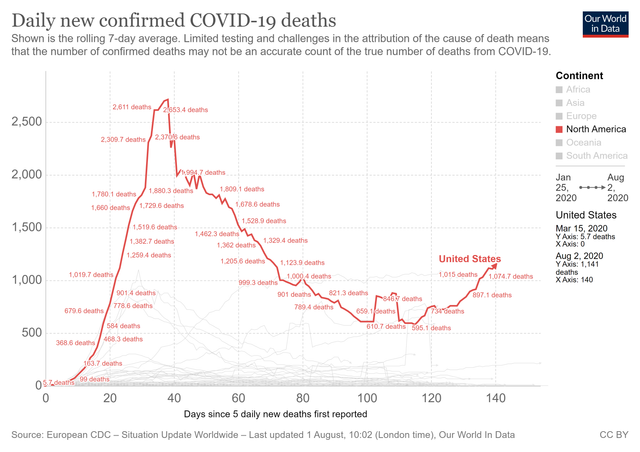
The physics of the pandemic has proven that such optimistic sentiments were misplaced. In the first week of July, the seven-day moving average of daily fatalities reached its lowest point, with 521, and began climbing steadily, having now reached a seven-day moving average of 1,129. The curve for new cases peaked nearly 10 days ago, reaching a seven-day moving average of over 68,000, and has been on a slow decline. There have been at least 27,585 people who have succumbed in July. By all accounts, it is expected that daily deaths will continue to increase over the next two to three weeks before reaching their peak.
Three states have surpassed New York with total cases—California (513,763), Florida (487,132) and Texas (449,736). Georgia, New Jersey, Illinois, Arizona, North Carolina, Louisiana, Massachusetts, Pennsylvania and Tennessee have all passed 100,000 cases. California has the distinction of third place in the number of deaths, with 9,370, behind New Jersey and New York. For July, this represents a 51.6 percent increase, just for fatalities. Texas, with 7,266 fatalities, saw a 155 percent increase in deaths. Florida, with 7,022 deaths, has seen a 97.6 percent increase.
Despite the downturn in new daily cases, previously staunch supporters of rapid reopening are now raising the alarm and acknowledging that the pandemic in the US is deeply entrenched in communities throughout the Midwest. Dr. Deborah L. Birx, the White House’s coronavirus coordinator, speaking on CNN, said, “What we are seeing today is different from March and April. It is extraordinarily widespread. It’s into the rural as equal to urban areas. To everybody who lives in a rural area, you are not immune or protected from this virus.”
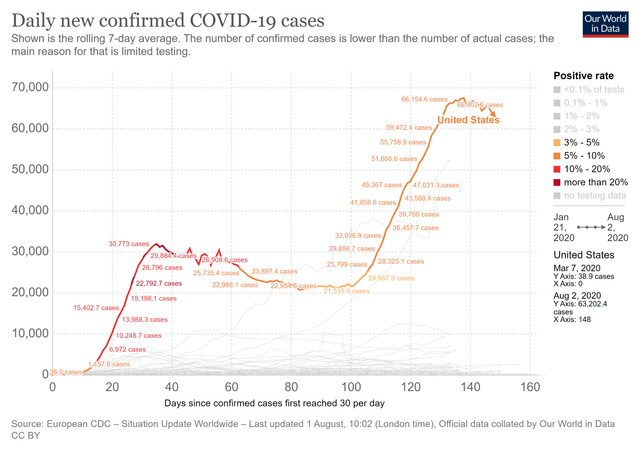
COVID-19 daily cases seven-day average in the US
Dana Bash, CNN’s chief political correspondent, followed with the question, “People are panicked, people are worried, people don’t understand why this is seemingly completely out of control. Is it time to reset?” Dr. Birx, uneasy, barely managed to defend the administration’s response to the pandemic and essentially deflected the question.
On July 29, a coalition of health experts urged the federal government to step back from their push to reopen the economy and move to close nonessential businesses. A letter drafted by Matthew Wellington, public health campaigns director, US PIRG, and signed by more than 1,000 health professionals, reads, “Hit the Reset Button—of all the nations in the world, we’ve had the most deaths from COVID-19. At the same time, we’re in the midst of ‘reopening our economy,’ exposing more and more people to coronavirus and watching the number of cases, and deaths, skyrocket.”
Johns Hopkins Center for Health Security published a report over the weekend titled “Resetting Our Response: Changes Needed in the US Approach to COVID-19.” They, too, are advocating a shutdown of nonessential businesses, explicitly calling for the closure of high-risk activities and settings “in jurisdictions where the epidemic is worsening” and to “reinstitute stay-at-home orders where health care systems are in crisis.” Additionally, they are demanding bolstering supply chains for personal protective equipment (PPE) and testing equipment, as well as establishing a robust ramping up of contact tracing.
Dana Bash, CNN’s chief political correspondent, followed with the question, “People are panicked, people are worried, people don’t understand why this is seemingly completely out of control. Is it time to reset?” Dr. Birx, uneasy, barely managed to defend the administration’s response to the pandemic and essentially deflected the question.
On July 29, a coalition of health experts urged the federal government to step back from their push to reopen the economy and move to close nonessential businesses. A letter drafted by Matthew Wellington, public health campaigns director, US PIRG, and signed by more than 1,000 health professionals, reads, “Hit the Reset Button—of all the nations in the world, we’ve had the most deaths from COVID-19. At the same time, we’re in the midst of ‘reopening our economy,’ exposing more and more people to coronavirus and watching the number of cases, and deaths, skyrocket.”
Johns Hopkins Center for Health Security published a report over the weekend titled “Resetting Our Response: Changes Needed in the US Approach to COVID-19.” They, too, are advocating a shutdown of nonessential businesses, explicitly calling for the closure of high-risk activities and settings “in jurisdictions where the epidemic is worsening” and to “reinstitute stay-at-home orders where health care systems are in crisis.” Additionally, they are demanding bolstering supply chains for personal protective equipment (PPE) and testing equipment, as well as establishing a robust ramping up of contact tracing.
COVID-19 daily deaths seven-day average in the US
The US economy’s contraction in the second quarter of 2020 was the worst ever recorded. Gross domestic product fell nearly 10 percent, shrinking by $1.8 trillion. The only comparison to such a collapse in historical reference is to the Great Depression and the demobilization after World War II. Every week in July, the number of unemployment claims exceeded 1 million.
Jerome H. Powell, the Federal Reserve chair, told reports last week, “The path forward for the economy is extraordinarily uncertain and will depend in large part on our success in keeping the virus in check.” Neel Kashkari, president of the Federal Reserve Bank of Minneapolis, has expressed concern over the toll the pandemic has taken and suggested a short-term lockdown to get control of the health crisis. The end of July saw US unemployment supplements expire for tens of millions of people. And still, like their response to the pandemic, Washington continues to bicker over the relief package.
The pandemic is shifting to new locations, rapidly moving into Midwest states like Ohio, Indiana, Kentucky, Tennessee, Missouri, Kansas and Nebraska, predominately due to summer travels. Government officials in some of these states are attempting to reimpose restrictions again, warning residents that a surge could overwhelm their limited hospital capacities. Yet a lack of a real coordinated effort and comprehensive strategy by the Trump administration has led to widespread social resentment and frustration.
The US economy’s contraction in the second quarter of 2020 was the worst ever recorded. Gross domestic product fell nearly 10 percent, shrinking by $1.8 trillion. The only comparison to such a collapse in historical reference is to the Great Depression and the demobilization after World War II. Every week in July, the number of unemployment claims exceeded 1 million.
Jerome H. Powell, the Federal Reserve chair, told reports last week, “The path forward for the economy is extraordinarily uncertain and will depend in large part on our success in keeping the virus in check.” Neel Kashkari, president of the Federal Reserve Bank of Minneapolis, has expressed concern over the toll the pandemic has taken and suggested a short-term lockdown to get control of the health crisis. The end of July saw US unemployment supplements expire for tens of millions of people. And still, like their response to the pandemic, Washington continues to bicker over the relief package.
The pandemic is shifting to new locations, rapidly moving into Midwest states like Ohio, Indiana, Kentucky, Tennessee, Missouri, Kansas and Nebraska, predominately due to summer travels. Government officials in some of these states are attempting to reimpose restrictions again, warning residents that a surge could overwhelm their limited hospital capacities. Yet a lack of a real coordinated effort and comprehensive strategy by the Trump administration has led to widespread social resentment and frustration.
Subscribe to:
Posts (Atom)