Saturday, July 11, 2020
In Wake of Supreme Court Ruling, Powerful House Democrat Richard Neal Faulted as 'Biggest Obstacle' to Getting Trump Tax Returns
"We had a window of opportunity, and Neal blew it."
by
Eoin Higgins, staff writer
https://www.commondreams.org/news/2020/07/09/wake-supreme-court-ruling-powerful-house-democrat-richard-neal-faulted-biggest
Democratic Congressman Richard Neal, powerful chair of the House Ways and Means Committee, came in for renewed criticism Thursday from a chorus of critics including his challenger in an upcoming primary for failing to move more swiftly to obtain access to President Donald Trump's financial records when given the chance last year.
Alex Morse, the progressive mayor of Holyoke, Massachusetts vying to oust Neal in the state's Democratic primary for the 1st District on September 1, was among the first to note Neal's role after a pair decisive Supreme Court rulings on Trump's taxes and other financial disclosures.
"As chair of Ways and Means, Richard Neal should have been leading the fight to get Trump's tax returns," Morse said in a statement. "Instead, he's been the biggest obstacle."
Neal's failure to move aggressively on the matter has long drawn the ire of progressives who believe the congressman should have acted faster to obtain the documents since taking control of the committee in January 2019. That frustration was compounded Thursday after the Supreme Court ruled in Trump vs. Mazars USA that while the president is not above the law with respect to the documents, the return of the case to a lower court will likely drag out possible disclosure beyond the upcoming election.
"What good is Richie Neal's power in Congress if even Brett Kavanaugh and Neil Gorsuch are doing more work to hold Trump accountable than he is," said Morse. "A real Democrat would have subpoenaed Trump's taxes on Day 1, instead of delaying because he was more focused on cozying up to his Republican colleagues for votes on a bill to help his corporate donors."
The congressman's inaction was noted by constituent Alexander Davis, who tweeted that an attempt in the summer of 2019 to move Neal on the issue did not seem to have had much effect.
"I met Neal in his office with several other constituents in August of 2019," said Davis. "He said he was proceeding as quickly as possible, and that he didn't want the case to get remanded because of a lack of process. But here we are, after he dragged his feet for months, and it's remanded."
The high court's rulings in Trump v. Mazars USA and Trump v. Vance both asserted that the president could not refuse a subpoena to his financial records but the former, which dealt specifically with Congressional access to the records, was sent back to a lower court.
In a statement on the decision, the Revolving Door Project said that while the lower courts are almost certain to rule in Congress' favor, the release of the documents are likely to come after the election—an outcome which could have been avoided.
"That this decision would come at such a late hour was not inevitable," the group said. "Had Rep. Richard Neal moved expeditiously to request Trump's tax returns on his first day in office as many, including ourselves, pushed him to do, even delays of the kind the Supreme Court has just imposed would have been unlikely to push disclosure until after the election."
The group added that voters should hold the longtime incumbent personally responsible for the delay.
"Those who are saddened that Trump's strategy of total intransigence has ultimately borne fruit should not forget the central role that Rep. Richard Neal played in assuring its success," the group said.
Morse called Neal's inaction "the biggest obstacle" to the American people getting a look at the president's finances and minced no words in his assessment of his opponent.
"We had a window of opportunity, and Neal blew it," said Morse. "Now, because of Neal's inaction, we are not going to see Donald Trump’s tax returns before the 2020 election."

Fossil Fuels’ ‘Net-Zero’ Carbon Emissions Scam Is Something Humanity Doesn’t Have Time For
Patti Lynn July 9, 2020
https://citizentruth.org/fossil-fuels-net-zero-carbon-emissions-scam-is-something-humanity-doesnt-have-time-for/
Why vague commitments by fossil fuel corporations to “zero out” carbon emissions don’t add up.
Fossil fuel giant Shell took time in the middle of the COVID-19 pandemic to announce on April 16 that it was going to work toward reducing its emissions to “net-zero” by 2050. The announcement comes on the heels of BP’s pledge in February to do the same. Both plans have been met with healthy amounts of skepticism. Many people pointed out the vague language of BP’s commitment to “zero out” its carbon emissions. And there are serious doubts as to whether any of this will actually result in action by the corporations to reduce emissions. Remember BP’s “Beyond Petroleum” slogan in the early 2000s, which was all PR and no action? And then there’s the fact that Shell openly admitted to influencing the U.N. climate treaty’s Paris Agreement, including by advancing measures that promote “net-zero” approaches.
But the problem with these corporations’ pledge is even more basic. It assumes that net-zero is the ultimate goal—that achieving net-zero will solve the climate crisis. This assumption has been thoroughly perpetuated by companies (like BP and Shell) that are deeply invested in the status quo—so much so that it has been adopted even by those who care deeply about the climate crisis. But there are significant flaws in the logic of net-zero, and if that’s what we aim for as we tackle the climate crisis, we will fail to make the changes we need to.
The first thing we need to get clear on is what “net-zero” actually means. So let’s break it down.
In the simplest terms, it’s basic arithmetic on a balance sheet: You earn $100 and you spend $100—now you’re at net-zero. As a term applied to carbon emissions, it means that you release 100 tons of carbon in the air, and someone else does something to take away 100 tons of carbon from the atmosphere.
Sure, it sounds good. But here are three significant ways that aiming for net-zero will not get us to where we need to be, climate-wise.
The Concept Behind Net-Zero Relies Heavily on Risky and Untested Technologies.
You’ve seen those Exxon ads where a tree transforms into a storage plant for carbon. Or you might have heard about spraying particles into the atmosphere to cool global temperatures. BP, Exxon and other big polluters want to continue to send a whole lot of greenhouse gases up into the atmosphere—and they’re banking on new, untested technologies to capture or somehow offset the effect of these gases on the environment. But by now, we should know that our society’s infatuation with creating new technologies as fixes only leads to more and bigger problems. (Like GMO seeds and the profound implications they have for the future of small-scale farming—or farming at all.) There are a host of ways these technologies could fail or result in unintended consequences—like accidentally causing irreversible temperature rise—that we need to be talking about.
These Technologies and Other Net-Zero Schemes are Inherently Unjust.
Thanks in part to Donald Trump, the idea of planting lots of trees to absorb carbon is now part of the popular imagination. But dig a little deeper and you’ll see that this and other similar schemes rely on having vast tracts of land, which will result in land grabs by corporations and other powerful forces, with little regard for the farmers, Indigenous people, and others who live on and take care of the land. And that idea about spraying aerosols into the air? There’s a whole host of possible negative effects, including possible decreased rainfall and increased drought over India and the African Sahel region. Net-zero schemes are being created by and for corporations and governments in Global North countries who have long seen people in the Global South—especially people of color, Indigenous people, women and low-income communities—as expendable, exploitable and inconsequential. Everything we know about net-zero schemes points to the same attitude toward these communities, with similar negative impacts there.
Extracting and Burning Fossil Fuels Gets a Green Light with Net-Zero.
Getting to net-zero doesn’t require us to stop looking for, extracting and burning fossil fuels—a major driver of the climate crisis. It might require some reduction, but it would definitely not keep fossil fuels in the ground where they belong. Overwhelming scientific evidence makes it clear we don’t have much time to make significant changes—and continuing to rely on fossil fuels to power our lives just doesn’t add up.
In short, aiming for net-zero is a far cry from getting to the roots of the climate crisis. It certainly does nothing to shift an unjust economy that relies on unlimited extraction and burning of fossil fuels for the benefit of the few at the expense of the many. Without getting to the root of the problem, we will never truly solve it.
Instead, we need to be taking all of the resources and political will currently trained at net-zero schemes, and pour them into the implementation of real solutions. We only need to look at the responses to the COVID-19 pandemic around the world to see that, when pushed by circumstance and popular demand, governments can take rapid, previously unimaginable changes. For example, some governments moved quickly to put policies to protect people’s lives and well beings: from moratoriums on evictions and water and other utility shutoffs, to housing people without homes in available housing, to providing steps toward universal basic income.
But the pandemic, as well as the global uprisings in defense of Black lives, has also made clear that half-measures are not enough. Systemic racism and the deep economic disparities that are resulting in Black people dying in disproportionate numbers from the disease in the U.S., the conditions that force low-wage workers to the front lines of the pandemic, and more require an entire re-imagining of our economic and social structures.
Similarly, half measures are not enough for the climate crisis. We need systemic change, and it’s absolutely possible to achieve it. There are real solutions out there. They have been developed and led by communities who have been dealing with the climate crisis for decades—and who have done the least to cause it.
Such solutions are rooted in a balanced, respectful relationship with nature, rather than a domineering and exploitative one. They respect the knowledge and expertise of Indigenous people. They put women at the forefront of change. They improve the quality of life. They are more practical and better-rooted in how humans can actually keep living and working toward ensuring a healthy planet. And they drastically reduce greenhouse gas emissions. A few of these solutions include:
Keeping fossil fuels in the ground while enabling a just transition to 100 percent renewable energy sources (ensuring workers are able to move to new, secure green jobs).
Curbing destructive industrial agriculture and promoting “agro-ecological” practices—agricultural practices that take into account the entire ecosystem, which is proven to capture carbon, provide stable livelihoods and promote ecological diversity.
Preserving natural forests, which naturally absorb carbon.
The conversation we should be having is not whether BP, Shell, or any corporation or government pledging to become net-zero is serious about it. The conversation we should be having is how quickly and justly we can move to an economy that does not rely at all on the extraction and burning of fossil fuels and is rooted in racial, gender, and economic justice. Some call that “real zero.” Some call it impossible. I call it the only real future we have.
COVID-19 Exposes the Weakness of a Major Theory Used to Justify Capitalism
Richard Wolff July 9, 2020
https://citizentruth.org/covid-19-exposes-the-weakness-of-a-major-theory-used-to-justify-capitalism/
A cornerstone of orthodox economics is the idea that capitalists’ decisions about investing and producing are inherently “efficient.” This means that capitalists select among all alternative courses of action those whose costs are minimal and whose benefits are maximal. Keeping costs to the lowest possible level while producing goods and services that yield the most possible revenue is what maximizes profit, the difference between costs and revenues. Capitalism, we are told, is the best system because it drives all those in charge of production (the owners and top executives of enterprises) to maximize profits and thus economic efficiency. Capitalists get profits, and the rest of us benefit from the efficiency of production within a capitalist system.
COVID-19 exposes the sham of orthodox economics. It was not profitable for capitalists to produce and stockpile adequate quantities of tests, masks, gloves, beds, etc., to be prepared for the virus. Given the costs to produce these commodities, there was no way of knowing how long they would need to be stockpiled before there would be a demand for and purchase of them. Stockpiling costs. So do monitoring stockpiles for deterioration and replacing deteriorated stocks or insuring against deterioration. There was, in short, no way to know (and thus be able to calculate) the costs in the manner fantasized by orthodox economics.
Likewise, there was no way for capitalists to know or calculate the prices they might receive for selling the commodities they might stockpile. If no major disease arrived, revenues might be very small and take a long time to materialize. If a pandemic arrived, high prices might be charged, but when? If a national emergency brought in the government as the single buyer of such commodities (then delivered freely to the people in need), the prices would likely be much lower. If the United States cooperated with other countries on producing and distributing these commodities, and if such cooperation included pricing, that too would impact revenues from selling them. In short, capitalists cannot know or calculate revenues in the manner fantasized by orthodox economics.
Capitalists in general—and U.S. capitalists in particular—calculated that profits would be greater in other investments than those that could have produced the items needed to prepare for and contain COVID-19. The results (negative revenues) of having inadequately prepared and inadequately contained COVID-19 far outdistance whatever it might have cost to make adequate preparations. Efficiency in dealing with the pandemic was not what capitalism achieved: quite the opposite.
Most orthodox economics textbooks—those actually used now in most college and university economics courses—teach the simple-minded cost-benefit or cost-revenue “model” as if it captured capitalists’ decision-making. Profit-maximizing capitalism is thus justified, as “efficient” society gets the most return for the least effort. The magical sleight of hand here requires that students be told that the model captures the essence of what capitalists actually do.
But that is false. The model captures nothing of the irreducibly unknown and unknowable in both costs and revenues. Instead, the model blithely assumes the opposite, that costs and revenues are in general knowable and known. Only then can the textbook claim that capitalism is efficient. And that is the point of the model and of the textbook: to justify and rationalize a capitalism that would otherwise risk the exposure that COVID-19 now performs.
Actual capitalists know perfectly well how they must constantly guess about costs and revenues, how their guesses are often wrong, and how the fortunes of their enterprises rise and fall as their guesses encounter realities. The difference between economics textbooks and capitalist reality explains the difference between academic departments of economics and “business schools.” Most U.S. universities include both. They don’t have two history or anthropology or English departments. There is a reason for two separate faculties: In economics departments, capitalism is justified and rationalized by “models” such as those based on calculating costs and benefits. In business schools, the models are mostly ignored in favor of examining how to run actual businesses confronting irreducible unknowns (not only in costs and revenues but also in personnel management, enterprise organization, and financing).
One desperate effort of orthodox economics to banish the unknown from their models is worth considering because it seems to have persuaded some. They can admit that the costs and revenues they refer to are not known for certain, but that the “probability” of specific costs and revenues occurring can be known. We can then speak, they tell us, of costs and revenues that are 50, 30, or 1 percent certain, and that can then allow for efficient capitalist decisions based on the known probability of outcomes.
This is yet more magical sleight of hand. Simply put, to know the probability of any specific cost or revenue requires that we know the full range of possible costs or revenues and how frequently each specific cost occurs (how costs are “distributed” across all possibilities). But that is precisely what is not known or knowable. Poor capitalists: in fact, they can know neither what their costs and revenues are nor what all the possible costs and revenues might be nor what probability attaches to each of them. Uncertainty and unknowability are irreducible; they always were.
Thus capitalism does not generate, let alone guarantee efficiency. It’s all a mirage of ideological justification. Capitalism serves capitalists first and foremost. That minority occupies or selects the occupants of most of the dominant positions in society. In this they are like the masters and lords in slave and feudal societies. In those societies, the self-justification of their dominant minorities concerned their physical, mental, or moral superiority and/or their special relationship to God or Gods. Capitalist societies that broke from slave and feudal predecessors also rejected those systems’ self-justifications. Capitalism had to find a different kind of self-justification.
It found one: the fantasy of “efficiency” as guaranteed by capitalists’ profit maximization. We are all supposed to bow down to capitalism the way our ancestors bowed down to slave masters, feudal lords, and kings. COVID-19 exposes what is at stake in continuing to believe in this fantasy.
For centuries, capitalists undertook investments that were “profitable” only because they did not know (and thus miscounted or ignored) all the ecological costs entailed. It was capitalists who moved enterprises from one part of the world to another for higher profits who did not know (and thus did not take into account) the social and human costs involved. It was capitalists who found more profitable investments than to prepare for and stockpile the needed protective equipment to defend public health against COVID-19. They did not know either.
Moreover, it was partly belief in the fantasy—that private profit-driven enterprise is the “most efficient” economic system—that hobbled governments around the world. They did far less than they could and should have done to compensate for capitalism’s failures adequately to prepare for or contain the virus. Across the globe, the more entrapped in that fantasy (as in the U.S., the UK, and Brazil), the worse the death and destruction of COVID-19. Where entrapment was less (as in New Zealand, Vietnam, and Japan)—sometimes because of competing traditional values not or not yet displaced by the capitalist fantasy—death and destruction were minimized.
A positive outcome of the coronavirus disaster would be a wider appreciation that liberating ourselves from capitalism requires rejecting its self-justifying ideology of efficiency.
'Historic Victory for Working People': Seattle City Council Passes Progressive Tax on Big Business to Fund Relief
"Working people and our movement have to unapologetically claim victory for what we've won, because we want to spread these victories to other cities."
July 8, 2020 Andrea Germanos COMMON DREAMS
https://portside.org/2020-07-08/historic-victory-working-people-seattle-city-council-passes-progressive-tax-big-business
The Tax Amazon movement claimed "a historic victory for working people" on Monday when Seattle's city council passed a new tax on big businesses to fund local economic relief.
The vote on the JumpStart Seattle plan, proposed last month by Councilmember Teresa Mosqueda, was a veto-proof 7-2. The plan targets corporations with payrolls of $7 million or more and employees with salaries above $150,000, with the measure expected to generate at least $200 million a year. The tax rate corporations would pay ranges from 0.7% to 2.4%. The highest rate—which would affect Seattle-based Amazon—would hit businesses with payrolls of at least $1 billion with salaries of $500,000 per year.
Mosqueda has framed the progressive tax plan as "part of the medicine to address both" the public health crisis and economic crisis, referring to the cornavirus pandemic and resulting damage to the local economy. The revenue generated would fund homelessness prevention programs and rental assistance, immigrant and refugee supports, food security programs, and assistance for small businesses.
"Seattle residents have made it clear—now is not the time for government austerity or divisiveness," Mosqueda said in a statement following the vote.
"We are in the midst of a health and economic crisis that even a strong economy like Seattle may not be able to recover from quickly," said Mosqueda, pointing to the fact that "over a million people statewide... have filed for unemployment this year; countless businesses shuttered temporarily and some potentially forever; our immigrant and refugee families have been left out of federal aid, and our homeless neighbors continue to suffer in our streets in the midst of a global pandemic."
Mosqueda said the proposal would live up to its name because it would "jump start our recovery with a relief plan that centers workers, small businesses, and our most vulnerable community members."
In 2018, the city council passed a so-called "head tax" on large companies—including Amazon—to generate $47 million a year only to see the measure repealed weeks later following a well-funded opposition effort, of which Amazon was at the forefront. Councilmember Kshama Sawant at the time dubbed the repeal a "cowardly betrayal of the needs of the working people."
Following the new progressive tax proposal's passage Monday, Sawant thanked the movement that made it possible, giving props to "the thousands of working people, unions, socialists!" Sawant also expressed hope that Seattle's action could be a model for other cities to follow.
Councilmember Tammy Morales also said JumpStart could be a model, tweeting: "The Seattle City Council is boldly leading to create a more equitable way to finance public services. And we challenge elected officials at the state level to join us in choosing investment over austerity."
Rep. Pramila Jayapal (D-Wash.) welcomed the vote as well. "In a city with so much wealth and yet one of the most regressive tax systems, progressive taxation is desperately needed," she tweeted.
"To the big businesses that oppose this: understand that the economic injustice disproportionately hurting Black and brown communities is systemic," Jayapal added. "If you truly believe #BlackLivesMatter, these are the kinds of structural changes that must be adopted to combat racism and inequality."
Teachers Union President Dares Trump to Sit in Classroom Amid Coronavirus 'and Breathe That Air'
The president of the nation’s largest teachers’ union hit back at President Trump over his demand that schools resume in-person classes this fall, saying reopening cannot take place without guaranteeing the safety of students and staff.
July 8, 2020 Zack Budryx THE HILL
https://portside.org/2020-07-08/teachers-union-president-dares-trump-sit-classroom-amid-coronavirus-and-breathe-air
The president of the nation’s largest teachers’ union hit back at President Trump over his demand that schools resume in-person classes this fall, saying reopening cannot take place without guaranteeing the safety of students and staff.
“Did you hear the word he didn’t use? ‘Safely,'” National Education Association (NEA) President Lily Eskelsen Garcia said Wednesday in reference to Trump’s event the previous day on reopening schools.
“There’s no one that wants our kids back more than teachers ... but we want to open it safely,” she said on CNN’s “New Day.”
“We see what happens when they let bars open prematurely,” she added, noting spikes in coronavirus community spread in states that were quick to reopen. “This isn’t a bar. We’re talking about second graders. I had 39 sixth graders one year in my class. I double dog dare Donald Trump to sit in a class of 39 sixth graders and breathe that air without any preparation for how we’re going to bring our kids back safely.”
The NEA has said any return to in-person classes must be accompanied by districts receiving personal protective equipment, deep-cleaning procedures that meet Centers for Disease Control and Prevention standards, classroom layouts that accommodate six feet of distancing and hand-washing and sanitizing stations installed.
Asked how the cost of those upgrades would be covered, Garcia said Congress had already readily “[thrown] money at businesses so that they wouldn’t have to lay people off,” but noted that Trump has called the HEROES Act, which would pump money into schools for virus preparation, “dead on arrival.”
House Democrats passed the $3 trillion HEROES Act in May. The measure has not been taken up in the GOP-controlled Senate.
Trump on Wednesday morning threatened to cut funding to schools that fail to reopen, claiming without evidence that reluctance to open was an attempt to sabotage him politically.
The 1 Percent's Quarter-Trillion Dollar Tax Cheat
As the social safety net is shredded, new data show that billionaires and corporations are refusing to pay hundreds of billions of dollars of owed taxes every single year.

David Sirota
Jul 9


The next time you hear conservative politicians insist they want “law and order,” hate “looting” and believe America can’t afford new government programs, show them two landmark reports that emerged in the last 24 hours. The data in those analyses tell the story of conservative politicians letting billionaires and corporations brazenly evade laws and effectively loot hundreds of billions of dollars from the public treasury — all while those same politicians plead poverty to justify cutting the social safety net during a lethal pandemic.
The first report came from the nonpartisan Congressional Budget Office, which found that between 2011 and 2013, $381 billion of taxes went unpaid every single year. Couple that data with recent Harvard University research showing that the top 1 percent of income earners are responsible for 70 percent of the tax gap, and you see the full picture: The wealthiest sliver of the population is depriving the American public of about $266 billion of owed tax revenue every year.
That tax gap didn’t just magically happen — it is the result of conservatives’ huge cuts to the Internal Revenue Service’s enforcement budget, which resulted in a particularly precipitous decline in audit rates for the super rich. In fact, the $266 billion figure could be an understatement, because the congressional budget analysts were estimating the tax gap that existed before those IRS budget cuts.

“With the money that these tax cheats owe, this year alone, we could fund tuition-free college for all, eliminate child hunger, ensure clean drinking water for every American household, build half a million affordable housing units, provide masks to all, produce the protective gear and medical supplies our health workers need to combat this pandemic, and fully fund the U.S. Postal Service,” said Sen. Bernie Sanders, who requested the CBO study. “That is an absolute outrage, and this report should make us take a long, hard look at what our national priorities are all about."
“Shifting Over $1 Trillion In Profits Every Year To Corporate Tax Havens”
Just after the congressional report was released, the Tax Justice Network released a separate study showing that newly released international data prove “that instead of declaring profits in the countries where they were generated, multinational firms operating around the world are shifting over $1 trillion in profits every year to corporate tax havens” — moves that deprive governments of $330 billion of tax revenue that is owed but that is not being paid.
The study noted that just four small countries — the UK, Netherlands, Switzerland and Luxembourg — “are together responsible for half of the world’s corporate tax avoidance.”
The United States alone is losing about $60 billion of revenue a year because of these corporate tax evasion schemes, according to Reed College economist Kimberly Clausing.

In case you thought the tax haven shenanigans were just limited to corporations, jog your memory and recall the Panama Papers and Credit Suisse scandals that spotlighted how wealthy individuals have gotten in on the offshore schemes.
We Know How To Fix Things, But Our Political System Is Rigged
At a time when the social safety net is being shredded in the name of budget austerity, the ruling class refusing to pay owed taxes is a grotesque form of looting. So what is Washington doing in response to all this?
On the domestic front, Donald Trump began his presidency proposing more IRS budget cuts, but this year the White House is pushing for an increase. At the same time, though, Trump’s Justice Department is prosecuting far fewer criminal cases referred by the IRS: Over the last 5 years, such prosecutions have dropped by more than 66 percent, according to data compiled by Syracuse University researchers.
On the international front, Trump’s 2017 tax cut bill included several provisions that “encourage American-based corporations to shift profits offshore,” according to the Institute for Taxation and Economic Policy. The administration has also recently moved to roll back rules designed to crack down on so-called corporate inversions, whereby companies incorporate offshore in order to avoid tax liabilities. And thanks to Trump’s coronavirus legislation, firms that already pulled the inversion maneuver could now be rewarded with Federal Reserve bailouts, according to Bloomberg News.
The problem here isn’t that we lack the knowledge to fix things — the problem is our political system.
The lawmakers with the power to truly beef up enforcement and crack down on profit shifting operate inside a machine that runs on legalized bribery. Some of them are trying to do the right thing, but most of them are bankrolled, in part, by big donors and corporate interests that are enriched by lax tax enforcement and offshore tax evasion. Those bought-and-paid-for lawmakers will publicly insist they want “law and order” and oppose looting, but they’ll allow widespread looting and tax lawlessness to continue, while they pretend there’s no money to pay for anything.
Meanwhile, because advocacy groups, voting blocs and political leaders tend to be organized around specific programs and issues (say, Medicare or public education) there remains no large mobilized constituency organized around the general goal of cracking down on tax cheating -- even though such a crackdown could provide new resources for key programs and issues.
Maybe all of this can change. Maybe the rise of grassroots-funded elected officials can break the link between corruption and policies that encourage tax theft. And maybe one day we will see more explicit organizing, movement building and public education around the tax issue — it has started to happen in the UK, where some celebrities have made tax fairness their cause, so maybe it can happen here.
But if it doesn’t happen, millions will continue fighting over a few budget crumbs while the 1 percent keeps taking bigger and bigger bites of the revenue pie.
Michigan court rules that SEP must gather signatures despite pandemic
https://www.wsws.org/en/articles/2020/07/10/pers-j10.html
10 July 2020
On Wednesday, a federal judge in the Eastern District of Michigan denied the Socialist Equality Party’s challenge to the state’s 12,000 physical signature ballot access requirement during the coronavirus pandemic.
The judge, Sean F. Cox, a Republican, sided with the Democratic administration of Governor Gretchen Whitmer in ruling that the coronavirus pandemic did not seriously “burden” our constitutional rights or the rights of those Michiganders who want to vote for our campaign.
Cox issued his ruling as the deadly coronavirus pandemic is spiraling out of control. Yesterday, the official global death toll surpassed 550,000, and the number of infections increased to more than 12.3 million.
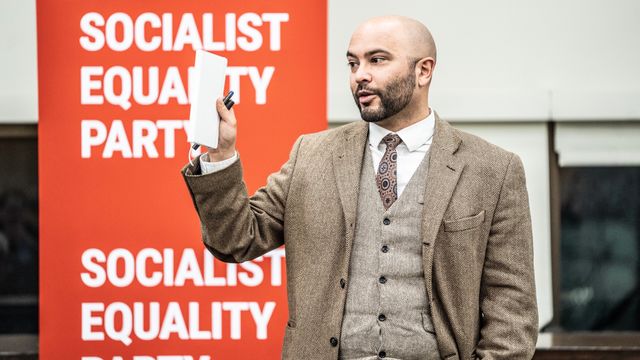
Socialist Equality Party presidential candidate Joseph Kishore
The United States is the epicenter of the virus, which is now spreading without restraint. Already, COVID-19 has claimed more than 135,000 lives in the United States. More than 61,000 people tested positive yesterday, a new record, and the daily death toll is approaching 1,000.
Hospitals in Texas, Florida and Arizona are overwhelmed, and nurses are again facing critical shortages of personal protective equipment and ventilators. Cases are increasing in most states, including in Michigan, where they are at levels not seen since the end of May.
The surge in cases and deaths is the direct and predictable outcome of the criminal policies of Trump and the entire political establishment, including the Whitmer administration. Even as the pandemic exacts its horrific toll, the White House is demanding that schools reopen in the fall, threatening the lives of hundreds of thousands of teachers and students, as part of the overall back-to-work campaign.
It is under these conditions that Judge Cox declared his full support for the argument of the state of Michigan that SEP should have been gathering signatures and that it still should be doing so.
Cox’s decision is not a serious legal ruling grounded in jurisprudence or reasoned analysis. It is a political decision aimed at barring socialists from the ballot, with the legal rationalization serving to justify a conclusion determined in advance.
Cox asserts that it is not the coronavirus pandemic or the governor’s stay-at-home orders that have prevented signature gathering, but the candidates’ own lack of “diligence.”
In fact, it is the “diligence” of the SEP that required that it not attempt to gather signatures. If we did make this attempt, we would have been violating our own political principles and our warnings of the dangerous consequences of the reckless policies of the ruling class—warnings that have now been completely confirmed.
If our campaign did not want to interact face-to-face with hundreds of thousands of people in the midst of the worst health crisis in the state’s history, exchanging pens, clipboards and papers with voters, and talking with them to explain our program, Cox concluded, “that is their own choice.” It is our fault, Cox writes, that we did not foresee the coronavirus crisis and did not gather signatures in January, or, as the Democrats’ lawyers argued, in 2019.
Cox unquestioningly accepted the Democrats’ argument that our campaign should have gathered signatures during the period when there existed state-enforced social distancing measures, even though doing so would have violated the stay-at-home orders and subjected our volunteers to arrest.
Meanwhile, the Democratic and Republican candidates do not need to gather any signatures and are automatically on the ballot. Such is American democracy that Joe Biden can campaign from the safety of his basement and the Democratic National Committee can nominate its candidate at a virtual convention, but socialists must sacrifice their lives and the lives of the public at large just to gain access to the ballot.
The judge’s aim was to ensure that voters cannot cast votes that pose a threat to the capitalist system. The unelected ex-corporate attorney, appointed for life by war criminal George W. Bush, has decided who Michigan’s 7.6 million registered voters can and cannot vote for. His ruling means voters must choose between the state-sanctioned official candidates of the Democratic-Republican duopoly to which he himself belongs.
The United States has the most restrictive election laws of any major capitalist country in the world. It has a population of 328 million people but a political system that has been dominated by the same two parties for 150 years. The entire electoral process is rigged with massive sums spent by the ruling class to ensure that it gets the best candidates that money can buy.
To get on the ballot, independent candidates and third parties must gather thousands, tens of thousands or even hundreds of thousands of signatures, depending on the state. These requirements have been a principal mechanism for excluding left-wing and particularly socialist opposition to the capitalist parties.
Now there is the pandemic, which makes petitioning impossible if one does not want to risk the lives of petitioners and countless thousands of people.
If such a ruling had been made in a country targeted by the American ruling class, it would be seized on by the media as a justification for “regime change.”
Indeed, in a January 9, 2020 statement titled “Free and Fair Presidential and Parliamentary Elections in Venezuela,” the State Department demanded that “elections must be open to all parties and candidates.” It called on the Venezuelan government to “remove all restrictions on individuals and political parties to allow their free participation in presidential and parliamentary elections.”
On February 20, 2020, Secretary of State Mike Pompeo issued a statement titled “The Iranian People Deserve Free and Fair Elections.” The announcement explained, “In advance of Iran’s upcoming parliamentary elections on February 21, the Guardian Council blocked more than 7,000 candidates from even running. Many of them were Iranians who questioned the Supreme Leader’s policies. This process is a sham. It is not free or fair.”
The ruling in Michigan is only further confirmation that the American elections are “not free or fair.”
Cox’s decision expresses the fear within the ruling class of the growing social anger among masses of workers and young people. There are 40 million unemployed and tens of millions more facing poverty, hunger, foreclosure, eviction and permanent job loss. The two parties provided trillions of dollars to corporations through the CARES Act. Meanwhile, unemployment benefits and eviction protection expire at the end of this month.
Workers and young people have begun to fight back. The eruption of mass, multi-racial and multi-ethnic protests against police violence were an initial expression of deep popular anger. Autoworkers in Michigan staged a series of walkouts late last month and, influenced by the calls of the SEP and the WSWS, formed rank-and-file safety committees to organize opposition.
This is only the beginning. The policy of the ruling class will lead to massive social explosions in the United States and throughout the world.
Our campaign will continue to aggressively defend our rights and the rights of voters through the courts. But Wednesday’s ruling further exposes the fact that real change will not take place through the existing sclerotic and undemocratic political system. It must and will take place through the mobilization of the working class in the fight for socialism.
The Socialist Equality Party and our election campaign are oriented to the building of a revolutionary socialist leadership in the working class. We call on all those who support the fight for socialism to join the SEP and support this campaign.
Joseph Kishore—SEP candidate for US president
The United States is the epicenter of the virus, which is now spreading without restraint. Already, COVID-19 has claimed more than 135,000 lives in the United States. More than 61,000 people tested positive yesterday, a new record, and the daily death toll is approaching 1,000.
Hospitals in Texas, Florida and Arizona are overwhelmed, and nurses are again facing critical shortages of personal protective equipment and ventilators. Cases are increasing in most states, including in Michigan, where they are at levels not seen since the end of May.
The surge in cases and deaths is the direct and predictable outcome of the criminal policies of Trump and the entire political establishment, including the Whitmer administration. Even as the pandemic exacts its horrific toll, the White House is demanding that schools reopen in the fall, threatening the lives of hundreds of thousands of teachers and students, as part of the overall back-to-work campaign.
It is under these conditions that Judge Cox declared his full support for the argument of the state of Michigan that SEP should have been gathering signatures and that it still should be doing so.
Cox’s decision is not a serious legal ruling grounded in jurisprudence or reasoned analysis. It is a political decision aimed at barring socialists from the ballot, with the legal rationalization serving to justify a conclusion determined in advance.
Cox asserts that it is not the coronavirus pandemic or the governor’s stay-at-home orders that have prevented signature gathering, but the candidates’ own lack of “diligence.”
In fact, it is the “diligence” of the SEP that required that it not attempt to gather signatures. If we did make this attempt, we would have been violating our own political principles and our warnings of the dangerous consequences of the reckless policies of the ruling class—warnings that have now been completely confirmed.
If our campaign did not want to interact face-to-face with hundreds of thousands of people in the midst of the worst health crisis in the state’s history, exchanging pens, clipboards and papers with voters, and talking with them to explain our program, Cox concluded, “that is their own choice.” It is our fault, Cox writes, that we did not foresee the coronavirus crisis and did not gather signatures in January, or, as the Democrats’ lawyers argued, in 2019.
Cox unquestioningly accepted the Democrats’ argument that our campaign should have gathered signatures during the period when there existed state-enforced social distancing measures, even though doing so would have violated the stay-at-home orders and subjected our volunteers to arrest.
Meanwhile, the Democratic and Republican candidates do not need to gather any signatures and are automatically on the ballot. Such is American democracy that Joe Biden can campaign from the safety of his basement and the Democratic National Committee can nominate its candidate at a virtual convention, but socialists must sacrifice their lives and the lives of the public at large just to gain access to the ballot.
The judge’s aim was to ensure that voters cannot cast votes that pose a threat to the capitalist system. The unelected ex-corporate attorney, appointed for life by war criminal George W. Bush, has decided who Michigan’s 7.6 million registered voters can and cannot vote for. His ruling means voters must choose between the state-sanctioned official candidates of the Democratic-Republican duopoly to which he himself belongs.
The United States has the most restrictive election laws of any major capitalist country in the world. It has a population of 328 million people but a political system that has been dominated by the same two parties for 150 years. The entire electoral process is rigged with massive sums spent by the ruling class to ensure that it gets the best candidates that money can buy.
To get on the ballot, independent candidates and third parties must gather thousands, tens of thousands or even hundreds of thousands of signatures, depending on the state. These requirements have been a principal mechanism for excluding left-wing and particularly socialist opposition to the capitalist parties.
Now there is the pandemic, which makes petitioning impossible if one does not want to risk the lives of petitioners and countless thousands of people.
If such a ruling had been made in a country targeted by the American ruling class, it would be seized on by the media as a justification for “regime change.”
Indeed, in a January 9, 2020 statement titled “Free and Fair Presidential and Parliamentary Elections in Venezuela,” the State Department demanded that “elections must be open to all parties and candidates.” It called on the Venezuelan government to “remove all restrictions on individuals and political parties to allow their free participation in presidential and parliamentary elections.”
On February 20, 2020, Secretary of State Mike Pompeo issued a statement titled “The Iranian People Deserve Free and Fair Elections.” The announcement explained, “In advance of Iran’s upcoming parliamentary elections on February 21, the Guardian Council blocked more than 7,000 candidates from even running. Many of them were Iranians who questioned the Supreme Leader’s policies. This process is a sham. It is not free or fair.”
The ruling in Michigan is only further confirmation that the American elections are “not free or fair.”
Cox’s decision expresses the fear within the ruling class of the growing social anger among masses of workers and young people. There are 40 million unemployed and tens of millions more facing poverty, hunger, foreclosure, eviction and permanent job loss. The two parties provided trillions of dollars to corporations through the CARES Act. Meanwhile, unemployment benefits and eviction protection expire at the end of this month.
Workers and young people have begun to fight back. The eruption of mass, multi-racial and multi-ethnic protests against police violence were an initial expression of deep popular anger. Autoworkers in Michigan staged a series of walkouts late last month and, influenced by the calls of the SEP and the WSWS, formed rank-and-file safety committees to organize opposition.
This is only the beginning. The policy of the ruling class will lead to massive social explosions in the United States and throughout the world.
Our campaign will continue to aggressively defend our rights and the rights of voters through the courts. But Wednesday’s ruling further exposes the fact that real change will not take place through the existing sclerotic and undemocratic political system. It must and will take place through the mobilization of the working class in the fight for socialism.
The Socialist Equality Party and our election campaign are oriented to the building of a revolutionary socialist leadership in the working class. We call on all those who support the fight for socialism to join the SEP and support this campaign.
Joseph Kishore—SEP candidate for US president
Subscribe to:
Posts (Atom)