Thursday, July 2, 2020

60+ Groups Demand Senate Pass Sanders Amendment to Slash 'Out of Control' Pentagon Budget by $74 Billion
"The current moment should force us to confront the reality that, for too long, we have invested in the wrong priorities, the wrong tools, and the wrong solutions."
June 30, 2020 Jake Johnson COMMON DREAMS
https://portside.org/2020-06-30/60-groups-demand-senate-pass-sanders-amendment-slash-out-control-pentagon-budget-74
More than 60 progressive advocacy groups representing millions of members across the U.S. are pressuring senators to pass an amendment led by Sen. Bernie Sanders that would cut the proposed Pentagon budget by 10% and redirect the $74 billion in savings toward funding healthcare, education, jobs, and housing in impoverished and neglected communities.
"Our militarism budget is out of control," a coalition of 61 advocacy groups wrote in a letter (pdf) to senators on Monday. "In 2019, the United States spent more money on our military than the next nine countries combined. The Department of Defense's budget eclipses that of federal courts, education, the State Department, local economic development, public health, and environmental protection combined, yet the Pentagon is incapable of passing a basic audit."
The National Defense Authorization Act (NDAA) currently under consideration in the Senate calls for a $740.5 billion military budget for fiscal year 2021. Last week, Sanders and Sen. Ed Markey (D-Mass.) unveiled an amendment that would reduce the proposed outlay by 10% and use the savings to "create a federal grant program to fund healthcare, housing, childcare, and educational opportunities for cities and towns experiencing a poverty rate of 25% or more."
Reps. Barbara Lee (D-Calif.) and Mark Pocan (D-Wis.) have introduced a companion amendment in the House. Lee has also introduced a resolution proposing up to $350 billion in cuts to the Pentagon budget by closing U.S. military bases overseas, ending funding for ongoing wars, and slashing private service contracting.
The coalition of progressive advocacy groups—which includes Public Citizen, RootsAction, CodePink, and Win Without War—wrote Monday that "common-sense steps" like "eliminating redundant and unusable weapons systems, ending wars, ceasing reliance on expensive contractors, and rejecting new nuclear weapons development" would "allow us to properly focus our investments on our most urgent and pressing human needs."
"The jarring recent images of police with weapons of war in our streets is a stark reminder of how militarism and white supremacy drive misplaced spending priorities both at home and abroad," the groups wrote. "Meanwhile, all over the country, millions have lost their jobs and access to healthcare as the novel coronavirus pandemic rages on. The current moment should force us to confront the reality that, for too long, we have invested in the wrong priorities, the wrong tools, and the wrong solutions."
In a virtual "Putting People Over Pentagon" town hall Monday night, some of the organizations behind the letter joined progressive lawmakers to discuss the urgent need to reduce America's bloated military budget and invest in key domestic priorities.
"This 10% cut is eminently doable and reasonable," Rep. Pramila Jayapal (D-Wash.), co-chair of the Congressional Progressive Caucus, said during the event. "But it's not going to be easy... As progressives, it is our job to redefine and reimagine what it is to be strong. Strong means an end to endless wars and a return to robust diplomacy and international coalition building."
Read the full letter:
The undersigned organizations, representing our millions of members across the country, write to you in strong support of the proposed amendment to the National Defense Authorization Act for Fiscal Year 2021 that would reallocate 10 percent of the bloated Pentagon budget toward severely underfunded human needs priorities—many of which are more critical than ever as our country continues to confront the Covid-19 pandemic. We urge you to co-sponsor Amendment 1788 introduced by Senators Sanders and Markey, and vote in support should it reach the Senate floor.
Our militarism budget is out of control. In 2019, the United States spent more money on our military than the next nine countries combined. The Department of Defense's budget eclipses that of federal courts, education, the State Department, local economic development, public health, and environmental protection combined, yet the Pentagon is incapable of passing a basic audit.
Multiple analyses have determined that U.S. and collective security would not suffer, and in fact would improve by, cutting hundreds of billions of dollars from the runaway Pentagon budget through common-sense steps, like eliminating redundant and unusable weapons systems, ending wars, ceasing reliance on expensive contractors, and rejecting new nuclear weapons development. These overdue steps would instead allow us to properly focus our investments on our most urgent and pressing human needs. Polling demonstrates that this is a popular idea, and most American voters want to see money redirected from the Pentagon to invest in human security.
The jarring recent images of police with weapons of war in our streets is a stark reminder of how militarism and white supremacy drive misplaced spending priorities both at home and abroad. Meanwhile, all over the country, millions have lost their jobs and access to healthcare as the novel coronavirus pandemic rages on. The current moment should force us to confront the reality that, for too long, we have invested in the wrong priorities, the wrong tools, and the wrong solutions.
As a point of comparison: last year, the Centers for Disease Control budget was $7 billion, just 7 percent of the national policing budget, and less than 1 percent of the Pentagon budget. Those three figures alone tell a tragic story about what and who this country prioritizes and values.
We should no longer tolerate unchecked spending on systems that fuel violence and corporate greed at the expense of the basic needs of our people. This amendment is a crucial step toward a federal budget that actually aligns with our values. We strongly urge you to support it.
“HARD ROAD OF HOPE” SHOWS WEST VIRGINIA IS A MIRROR OF THE UNITED STATES
By Margaret Flowers, Popular Resistance.
June 30, 2020
https://popularresistance.org/hard-road-of-hope-shows-west-virginia-is-a-mirror-of-the-united-states/
Eleanor Goldfield is a remarkable person. She is an artist, writer, poet, composer, performer, podcaster, educator, photographer, organizer, activist, and now a documentarian. She publishes her work at ArtKillingApathy.com. She has had a regular program, “Act Out!” on Free Speech TV for almost five years that is one of their most popular shows. And she does a podcast with political comedian Lee Camp called “Common Censored.” When she is not working on all of that, she can be found teaching self-defense, running an art build or biking around Washington DC to provide mutual aid in her neighborhood.
For years now Eleanor has been participating in climate justice camps and actions providing support to those on the front lines of the climate and environmental crises however it was needed from producing media to locking down. It was through this work that she became aware of the major shift from mountain top removal for coal to fracking for gas, both very exploitative and extractive industries, in West Virginia. As she went there to cover what was happening, it became clear that the story was too big for anything but a documentary.
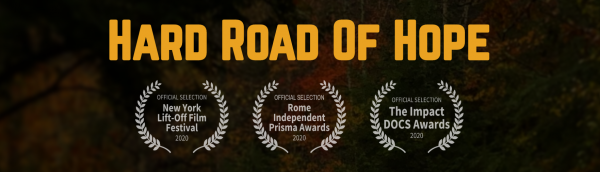
In “Hard Road of Hope,” Eleanor teaches the untold history of how immigrants were brought to West Virginia to work in the coal mines and how they worked together against dangerous and oppressive working conditions. You will likely be surprised by this history. I was. As West Virginians tell the story of this struggle, Eleanor weaves in the roots of capitalism, colonization and cultural genocide that created and made it possible to maintain such oppression.
The story of what happened in West Virginia and what continues to happen to this day is one that plays out across the United States. If it hasn’t happened yet in your community, it will one day if we stay on the current path. We have much to learn from folks in West Virginia and Hard Road of Hope gives us a valuable peek into their long history of strength and resistance.
Eleanor took some time out of her busy schedule to speak with me about her new documentary:
How did you become involved in climate and environmental justice activism?
Climate justice/environmentalism was really my first entry point into activism. It started when I was about 14 just picking up trash in my neighborhood. From there, the circles just grew larger as I noticed more problems – for instance, that my school didn’t recycle. So, I started a recycling program there and facilitated workshops on how and what to recycle and why. I started an environmental club that brought up issues at assemblies and tabled at events, eventually fundraising to buy a plot of rainforest (back then I thought that would save the day).
Before the second Iraq war in 2003, I shifted to antiwar activism. At the time I didn’t recognize or understand the connections between these two issues. By the time I came back to climate justice work, I was in my mid-20s and understood the capitalist and imperialist link between all the issues I’d covered/organized around. More recently, my more climate-focused work has been around frontline coverage and organizing – be it in Pennsylvania against fracking projects, down in the bayous of Louisiana against the Bayou Bridge Pipeline, in West Virginia against Mountain Top Removal or in northern California against logging.
What inspired you to produce this movie?
Myself and two other journalists had planned to go down to West Virginia to cover the power shift between coal and fracking. One of the journalists, Jen Deerinwater (who is also in the film) is Cherokee and was interested in going to see her ancestral lands and report from an indigenous perspective. With my background in environmental reporting, I wanted to bring my camera and questions to a place often perceived as “not worth it.” As someone who grew up in North Carolina hearing about West Virginia like it was just some throwaway hovel filled with hillbillies and coal ash, I wanted to prove myself (and others) wrong. After all, if a place is to be cast aside because it’s been destroyed by industry, and people are to be cast aside because they’re downtrodden and isolated, what part of this country would be left?
Still, I didn’t shift my goal to making a movie until we’d gotten down there and really spent time with folks. I realized that West Virginia wasn’t just about West Virginia – this was a story about this country. And I realized that I had far more than could be shared on a weekly show. I needed to do a deeper dive. So, I decided now would be a good time to become a filmmaker.
How much time did you spend there and how were you received by the folks in West Virginia?
All told a little over two weeks. Folks were incredibly welcoming – eager and proud to share their stories.
Why is the long history of struggle in West Virginia important to understand in light of the bigger picture of current struggles in the United States?
Since the release of the film, I’ve gotten emails from folks in Colorado, Indiana, Ohio, Illinois, Pennsylvania and elsewhere basically saying, “this is my story!” West Virginia is a mirror to much of this country: a resource colony from its founding, it exemplifies the power of industry, the destruction and oppression meted out for the sake of corporate profits and the deep propagandization that teaches folks to take pride in that oppression. At the same time, it’s a mirror to our labor rights history – the incredible resilience, resolve and resistance of people on the front lines demanding basic human rights. Therefore, it speaks to the power of teaching this history – of understanding our radical roots so that we may contextualize our present and build a more just and equitable future.
Who do you want to see the movie and what impact do you hope it will have?
Well, just like with my music, I want everyone to experience it! But I’d particularly like folks to see it who don’t think of themselves as radicals – who think of themselves as good Americans, hard workers and frustrated with the status quo but unsure how to address it. So many people I know from back home in North Carolina, for instance, fall into apathy because they feel there is no way to address their frustrations with the system: both parties seem untrustworthy, voting doesn’t seem to change anything and activism at once sounds scary and just for kids. Reconnecting folks with the radical history and the work being done by proud rednecks broadens the scope and understanding of activism – of what it means to dissent and stand up for justice and freedom.
Ultimately, I hope to get it out to a lot of schools – I’m in talks with some folks about that. I’d like for it to reshape the teaching of history from that area, to partner with those organizations and folks in West Virginia doing this work. I hope the film can be used as a tool to showcase not just corporate malfeasance but hope in and for the power of the people.
Watch the trailer below:
Hard Road of Hope Trailer from Eleanor Goldfield on Vimeo.
Find out how you can watch the full film here.
Subscribe to:
Posts (Atom)