Monday, June 8, 2020
Trump’s Use of Religion Follows Playbook of Authoritarian-leaning Leaders the World Over
Laura R. Olson
June 6, 2020
https://citizentruth.org/trumps-use-of-religion-follows-playbook-of-authoritarian-leaning-leaders-the-world-over/
Where Trump succeeds is in presenting himself as a Christian nationalist, much as Putin and Modi style themselves as the stout defenders of their countries’ dominant religions.
(Common Dreams) It was a striking moment: Donald Trump, Bible in hand, posing for photos in an apparent moment of political theater made possible by the dispersal of protesters through the use of tear gas.
The president’s visit to St. John’s Episcopal Church, known as “the Church of the Presidents,” came immediately after giving a Rose Garden speech framing himself as “your president of law and order” and threatening to send federal troops to “restore security and safety in America.” The next day, Trump made another high-profile visit to a place of worship, this time Washington’s St. John Paul II National Shrine.
Coming at a time of social turbulence, critics accused Trump of following authoritarian-leaning world leaders by sidling up to religion to reinforce an image as a strongman defending a particular brand of tradition. Bishop of the Episcopal Diocese of Washington Mariann Budde said as much, commenting that Trump used the Bible at St. John’s “as if it were a prop or an extension of his military and authoritarian position.”
As a scholar who has researched the interaction of politics and faith for decades, I know how potent religion can be as a political tool.
A powerful tool
Religion creates meaning in our lives by articulating values about how we relate to one another. But just as it can unite us, religion can also be a source of division – used to “other” people who are not of the faith and don’t share the same traditions and rituals.
When enough people perceive – or can be convinced – that traditional elements of the social fabric are at risk, religious signaling through the use of symbols and images can help would-be authoritarians cement their power. They present themselves as protectors of the faith and foes of any outsider who threatens tradition.
In Russia, this phenomenon is seen in President Vladimir Putin’s forging of a strategic alliance with the Russian Orthodox Church. For his part, Putin presents himself not just as a commanding leader, but also as a devoutly religious Russian.
When he appears shirtless, for example, the large cross he wears around his neck is always visible. Meanwhile, the Church promotes traditional moral values and maintains a distance from the rest of the worldwide Orthodox Christian community, thereby separating the “truly Russian” from the outsider. In their most recent collaboration, Putin and the Church proposed amendments to the Russian constitution that would enshrine Russians’ faith in God, define marriage as the union of a man and a woman and, tellingly, proclaim “the great achievement of the [Russian] people in defense of the Fatherland.” These changes, all of which are intended to reinforce Putin’s base of support, would be jarringly nationalistic additions to the constitution.
Putin benefits from this insider-outsider dynamic in advancing his goal of restoring Russia to his vision of its past territorial glory. In justifying the Russian incursion into Crimea, Putin argued that the region had “sacral importance for Russia, like the Temple Mount in Jerusalem for the followers of Islam and Judaism.” Defending and expanding Russian territory is a much easier sell if it is framed as the defense of the holy.
Religious imagery
We see a similar dynamic in India, where Prime Minister Narendra Modi’s grip on power relies in large part on his embrace of a version of Hindu nationalism that elevates Hindus as “truly Indian” insiders and singles out Muslims as outsiders.
Like Putin, Modi wraps himself in religious imagery. He makes high-profile visits to remote Hindu temples while electioneering and never wears green because of its association with Islam.
Modi’s Hindu nationalism cements his popularity among devout Hindus and builds public support for anti-Muslim policies, such as stripping the only majority-Muslim state in India of its autonomy and enacting a controversial new law preventing Muslim migrants from attaining Indian citizenship.
Trump as savior
Trump has stumbled in attempts to portray himself as personally devout, declining to name a favorite passage from the Bible and stating that he has never sought forgiveness from God for his sins.
Nevertheless, public opinion polls have consistently shown that white Christians comprise the core of Trump’s base, although there are recent signs of a dip even among this key group.
And while it is important to note that many white Christians do not support Trump, 29% of evangelicals go so far as to say they believe he is anointed by God.
Where Trump succeeds is in presenting himself as a Christian nationalist, much as Putin and Modi style themselves as the stout defenders of their countries’ dominant religions.
One way Trump achieves this end is by making statements such as this one on the campaign trail earlier this year: “We’re going to win another monumental victory for faith and family, God and country, flag and freedom.”
In their new book “Taking America Back for God,” sociologists Andrew Whitehead and Samuel Perry contend that many of Trump’s white Christian supporters see him as their long-awaited savior – not just the protector of traditional religion, but also the defender of a bygone way of life.
In that imagined past, white men ruled the roost, families went to church every Sunday and outsiders knew their place. A deep-rooted desire for a return to that past may have been why Trump’s Make America Great Again slogan has proved so potent. As Yale scholar Philip Gorski has argued, that phrase can be interpreted to mean “making white Christianity culturally dominant again.”
As such, we should not be surprised that in the current moment of crisis Trump is attempting to use religion to reinforce differences between his supporters and his opponents. Like Putin, he is posing as the defender of a particular version of a glorious past. And echoing Modi, he is doing this by building support through the denigration of the outsider.

Police Violence Amid George Floyd Protests Causing Deaths And Serious Injuries
Alec Pronk
https://citizentruth.org/police-violence-amid-george-floyd-protests-causing-deaths-and-serious-injuries/
The long list of names killed due to police violence is growing.
David McAtee, Sean Monterrosa, Jamel Floyd. These are just some of the names of the people killed by law enforcement as anti-racist protests enter their second week across America.
When protestors took to the streets seeking justice for George Floyd, the police action was swift with mounting evidence of violent cops overreaching their powers. Stories slowly trickled in of killings and murders, some perpetrated by the cops and others amidst general unrest.
The general observation has been that protesting police brutality is often met with more police brutality, and it can be life-threatening.
Louisville has been a particular flashpoint as animus to the police has grown after 26-year old EMT Breonna Taylor, a black woman, was killed in her apartment after police performed a no-knock warrant despite Taylor’s apartment being the wrong address.
While the National Guard and Louisville police were enforcing a curfew, barbecue owner David McAtee allowed fleeing protestors into his business. From released footage, it appears law enforcement shot pepper bullets at the door of McAtee’s restaurant, and in the commotion McAtee returned fire before law enforcement shot him dead, firing 18 shots in his direction.
The aggressive police tactics are documented on video, and the actions of the Louisville police contravened their policy on dispersing nonviolent protests. These same tactics have been on display across the nation, and it’s called into question the role of police in America.
Sean Monterrosa: Killed Kneeling
Sean Monterrosa was working for a better America, and the San Francisco Chronicle reported he sent his sister a petition to sign to demand justice for George Floyd, an hour before the police gunned him down.
The 22-year-old was in Vallejo, a Bay area suburb, when cops responded to a looting of a Walgreens pharmacy. Monterrosa was kneeling and surrounding to the cops when a police officer shot from his vehicle and killed Monterrosa.
After widespread unrest broke out across the country, President Donald Trump tweeted, “when the looting starts, the shooting starts.” The comments have been part of a pattern from Republicans to ramp up pressure on local authorities to “dominate the streets” as the President put it.The aggressive tactics have been widespread and include trigger-happy police, tactics that contravene their own guidelines, and a general disregard for the public.
Monterrosa’s killing has added to tensions in the Bay Area, but authorities across the region have lifted curfews after protests remained peaceful. In ominous words, San Jose Police Chief Eddie Garcia said he was worried about an increase in violence once the curfews would be lifted.
Non-lethal?
While police have deployed lethal methods in some instances, the most notable form of violence from police has been their use of so-called non-lethal force. But multiple incidences have called into question just how non-lethal pepper spray, pepper balls, and flashbangs are.
Austin police hit Justin Howell, a 20-year-old college student, with a supposedly non-lethal beanbag round, but now he in critical condition with a fractured skull. Shocking video shows protestors carrying Howell’s limp body in the direction of the police in seek of medical attention, only to be fired at with more rounds.
A medic helping Howell shared a picture of her hand which suffered fractures and torn tendons to a bean bag shot as she raised her hands, seeking medical help for Howell.
Police officers have also deployed pepper spray across the nation to quell protests, and a particularly grim story involving pepper spray emerged from the New York City jail system.
Jamel Floyd had been in custody since October 2019 and barricaded himself in his cell. The Justice Department said he was being disruptive and a potential harm to himself and others. Guards subsequently sprayed him with pepper spray in a closed environment, and medical staff found him unresponsive and proclaimed him dead.
Speaking on the detention center where Floyd was being held, Representative Nydia Velazquez said, “whether it is a loss of heat in the dead of winter, inadequate protections against the spread of COVID-19 or this most recent incident, it has become evident this institution is too often unsafe.”
The Best Way to “Reform” the Police Is to Defund the Police
AN INTERVIEW WITH
ALEX S. VITALE
https://jacobinmag.com/2020/06/defund-police-reform-alex-vitale
Last Monday, a Minneapolis police officer killed George Floyd by kneeling on his neck for nearly nine minutes. Protests that began early last week in Minneapolis spread to city after city, and by the weekend they had snowballed into nationwide mass civil unrest, which continues into this week.
Jacobin’s Meagan Day spoke to Alex Vitale, professor of sociology and coordinator of the Policing and Social Justice Project at Brooklyn College and author of The End of Policing, about the mass demonstrations underway and the political experiences and ideas that are animating it.
MD
It’s so strange and unexpected to see a resurgence of protests against police brutality in this moment, of all moments, with the COVID-19 pandemic in full swing and much of the nation still theoretically in coronavirus-related lockdown. I didn’t even expect to see people protesting the inadequate coronavirus response en masse, much less protesting racist police violence. How can we make sense of this?
AV
It is kind of shocking. I also assumed that the social distancing imperatives would dramatically curtail street protest. But I think we’re in a moment of profound crisis that goes far beyond policing, and that the coronavirus crisis and the coming economic depression are part of what’s driving this. It’s the convergence of a bunch of different factors. Completely unreformed brutal policing is just the catalyst that has unleashed a kind of generational activism that’s responding to a deeper crisis, which policing is part of and emblematic of.
MD
I see many different kinds of people at the protests. There are poor and working-class black people, but there are also young white people, many presumably from middle-class backgrounds. That seems to support what you’re saying, that the protests are driven by anger both at police violence against black people in particular, and at a wider variety of social phenomena.
AV
I think what we’re seeing is the residuum of Occupy Wall Street, Black Lives Matter, and the Sanders campaign, movements united by a sense that our basic economic system is not working. Even people who don’t personally experience police violence see a future of economic and environmental collapse and are terrified and angry. If we had a booming economy, it would mute this. If we had credible leadership in Washington, it would mute this. But not only is Trump in the White House, I don’t think that anyone believes Biden is going to fix it.
When we think about the urban uprisings of the 1960s, we don’t think of them as being solely about policing. We understand that policing incidents were a trigger, but that they were a response to a deep problem of racial and economic inequality in America. That’s how we have to understand what’s happening today. Police are the public face of the failure of the state to provide for people’s basic needs, and to paper over that failure with solutions that just harm people further.
MD
It’s surprising to say, but these protests seem to have a greater intensity than the earlier Black Lives Matter protests did. It’s like Ferguson and Baltimore, but in dozens upon dozens of cities. Why might this be?
AV
One of the reasons of protests are more intense today than they were five years ago is that five years ago people were told, “Don’t worry, we’re going to take care of it. We’re going to give the police some implicit bias training. We’re going to have some community meetings. We’re going to give them some body cameras and it’s all going to get better.” And five years later, it’s not better. Nothing has changed. People are not going to listen to any more pablum about community meetings.
Minneapolis is a liberal city in both the best and the worst senses of the word. Five years ago, they fully embraced the idea that they could get out of their policing problem by having people sit around and talk about racism. They tried all these tactics to restore community trust in the police while at the same time the police were permitted to on waging a war on drugs, a war on gangs, a war on crime, and criminalizing poverty and mental illness and homelessness.
It’s not just Minneapolis. One of the things you heard a lot was this idea that we needed to jail killer cops. This is a dead-end strategy. First of all, the legal system is designed to protect police. It’s not an accident. It’s not a bug. It’s a feature. Secondly, when police are prosecuted, the system tosses them out and says, “Oh they were a bad apple. We got rid of them. See, the system works.”
So people are realizing this type of procedural reform will do nothing to change policing. Where’s the evidence? Well, we jailed a killer cop in Chicago last year. Nobody in Chicago is dancing in the streets about how great policing is right now.
MD
I perceive a growing popular awareness that the police are what society has in lieu of a decent welfare state. Do you agree that people are increasingly connecting their negative feelings about policing to a positive desire for a transformational economic reform agenda?
AV
Absolutely. I mean, we’ve seen the signs on the street this past week that say, “Defund the police.” That slogan really embodies this idea that we’re not going to fix the police, but instead we have to reduce them in every way we possibly can and replace them with democratic, public, non-police solutions. This idea has been building for the last five years, because the longer people have stayed engaged with the problems of policing and criminalization, the more they learn firsthand how pointless these reforms are. More people are recognizing that shrinking the police apparatus and replacing it with publicly-financed alternatives is the way forward.
And by the same token, any effort to produce a multiracial working-class movement has to have dialing back the carceral apparatus of the state as part of its platform. Mass incarceration and mass criminalization are a direct threat to all our political projects. They foment racial division, undermine solidarity, instill fear, reduce the resources at our disposal, put activists in precarious positions, and will always directly subvert our movements.
The procedural reformers are caught in this mythic understanding of American society. They believe that the neutral professional enforcement of the law is automatically beneficial for everyone, that the rule of law sets us all free. But this is a gross misunderstanding of the nature of the legal frameworks within which we live. These frameworks do not benefit everyone equally. There’s a famous nineteenth-century saying that the law forbids both the rich and the poor from sleeping under bridges, begging in the streets, and stealing bread. But of course the rich don’t do those things. Only the poor do.
Ultimately policing is about maintaining a system of private property that allows exploitation to continue. It has been a tool for facilitating regimes of exploitation since the late eighteenth and early nineteenth century. When most modern police forces were formed, those regimes were colonialism, slavery, and industrialization. Policing emerged to manage their consequences — to suppress slave revolts, to put down colonial uprisings, to force the working class to behave as a stable workforce that doesn’t act out.
And that is the fundamental nature of policing. It’s a force that has never been interested in producing equality, just the opposite. It’s existed to suppress our movements and to allow exploitation to proceed.
MD
What does defunding the police look like in practice?
AV
Practically, on a local level, it means trying to build a majoritarian politics on the ground to compel a city council to vote to cut the budget for the police and reinvest as much of that money as possible in community needs.
For example, in New York City the Democratic Socialists of America have been doing issue advocacy around issues of criminalization for some time. Now they’re planning for next year’s city council races to make one of their key litmus tests whether or not the candidates seeking endorsement will support a program of reducing the budget for policing by a billion dollars. They’re helping to put this on the radar in a practical way. And just this week, forty candidates for next year’s city council races signed a pledge to defund the NYPD. That’s incredible.
I’m the coordinator for the Policing and Social Justice Project, which is part of a movement in New York for budget justice. We put out the target of one billion. Other groups like Communities United for Police Reform and Close Rikers have called for substantial reductions to policing and reinvesting that money in community needs. So we’re all participating in budget hearings, writing op-eds, we released a video that’s circulating on social media, including paid advertising, that calls for this billion cut. We’re making a real push to defund the police not in theory but in practice.
And then it’s important to lobby to divert or reallocate that money in ways that actually directly replace the function of policing. So for example, in New York City the Public Safety Committee makes its recommendation about the police budget, other committees make their recommendations to other departments, but there’s a Budget Committee chair who can send signals to those different subcommittees. So the Budget Committee chair who we’re targeting in New York could say to the Public Safety Committee, “Hey we want you to take two hundred million out of the police budget,” and then he could say to the Education Committee, “You’ve got an extra hundred million to put in, but I want you to put it into counselors and restorative justice.”
MD
Polls consistently show that even though many people, especially people of color and in particular black people, distrust the police, they don’t actively want the number of officers in their neighborhood reduced. I suspect that disconnect owes to people’s automatic equation of police with safety: people want to feel safer, and policing is the only solution to public safety on offer. Why do you think this gap exists, and how do we bridge it?
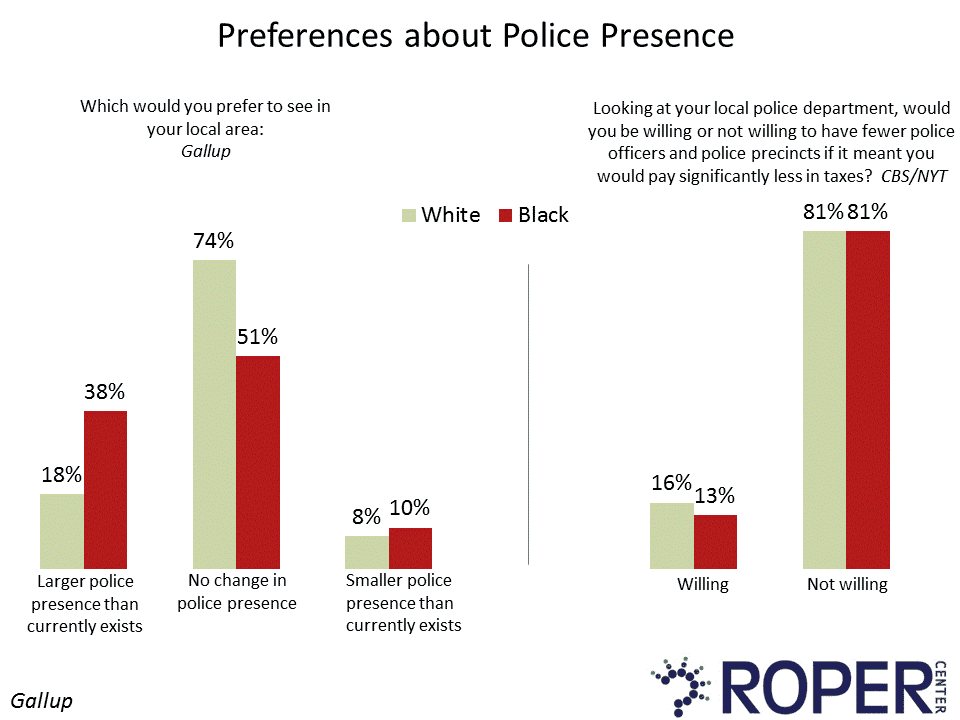
AV
I think it’s analogous to the situation with Bernie Sanders. You saw the exit polls showing that people liked Sanders’s ideas but voted for Biden. They’re afraid. They’re not ready. They have a stake in conformity and they don’t trust this new thing, even though on some level they understand and believe in it.
When it comes to police, we’re dealing with a forty-year legacy of people being told that the only thing they can have to fix any problem in their neighborhood — loose dogs, noise complaints, rowdy teenagers — is more police. That’s the only option. So people have been conditioned to think, “Oh, if I have a problem, it’s a problem for the police to solve.” When people say they want police, they’re saying they want fewer problems.
We really have to break out of this thinking. We have to empower people to actually ask for what they want, and we also have to equip people with more examples of things that they could demand that would actually make their communities healthier and safer. A lot of people would agree that it would be better if they had a new community center, for example. They just don’t believe it’s possible. They think, “There’s no point asking for that, cause they’re never going to give us that.”
We need to be putting concrete alternatives out there. For example, mental health crisis calls have become major part of what police to every day in New York City. There are seven hundred of them a day. We don’t need police to do that work, and in fact we don’t want armed police doing that work, because it’s dangerous for people having mental health crises. We need to create a twenty-four-hour non-police mental health crisis response system. Jumaane Williams in New York City has called for exactly that in an excellent detailed report. The proposal is to take the money that’s spent on police crisis calls and shift it over to delivering mental health services.
It’s a concrete idea for an alternative to policing. We need more of those to instill a sense of possibility and optimism, and broaden people’s imaginations.
Constitutional crisis coming in November?
Will He Go?
Will Trump leave office if defeated? A law professor fears a meltdown this November.
Sean Illing, Lawrence Douglas
https://portside.org/2020-06-07/will-he-go
Imagine that it’s November 3, 2020, and Joe Biden has just been declared the winner of the presidential election by all the major networks except for Fox News. It was a close, bitter race, but Biden appears to have won with just over 280 electoral votes.
Because Election Day took place in the middle of a second wave of coronavirus infections, turnout was historically low and a huge number of votes were cast via absentee ballot. While Biden is the presumptive winner, the electoral process was bumpy, with thousands of mail-in votes in closely fought states still waiting to be counted. Trump, naturally, refuses to concede and spends election night tweeting about how “fraudulent” the vote was.
We knew this would be coming; he’s been previewing this kind of response for a while now.

Donald J. Trump
✔@realDonaldTrump
There is NO WAY (ZERO!) that Mail-In Ballots will be anything less than substantially fraudulent. Mail boxes will be robbed, ballots will be forged & even illegally printed out & fraudulently signed. The Governor of California is sending Ballots to millions of people, anyone.....
133K
7:17 AM - May 26, 2020
Twitter Ads info and privacy
83.4K people are talking about this
One day goes by, then a few more, and a month later Trump is still contesting the outcome, calling it “rigged” or a “Deep State plot” or whatever. Republicans, for the most part, are falling in line behind Trump. From that point forward, we’re officially in a constitutional crisis.
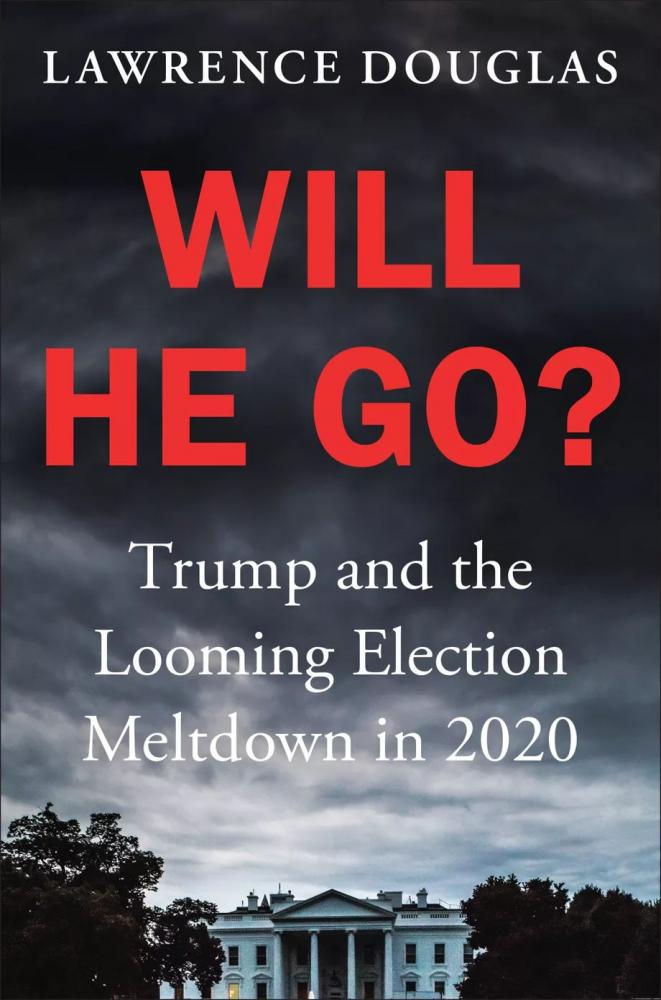
This is the starting point of a new book by Amherst College law professor Lawrence Douglas called Will He Go? Trump and the Looming Election Meltdown in 2020. According to Douglas, a scenario like the one above is entirely possible, maybe even probable. And if nothing else, we’ve learned in the Trump era that we have to take the tail risks seriously. Douglas’s book is an attempt to think through how we might deal with the constitutional chaos of an undecided — and perhaps undecidable — presidential election.
I spoke to Douglas by phone about why he thinks our constitutional system isn’t prepared for what might happen in November, and why he’s not worried about a stolen election so much as an election without an accepted result. “If things go a certain way,” he told me, “there’s a Chernobyl-like defect built into our system of presidential elections that really could lead to a meltdown.”
A lightly edited transcript of our conversation follows.
Sean Illing
What worries you most about the November election?
Lawrence Douglas
To say that we’re facing a perfect storm is clichéd, but it does strike me that there are a lot of things coming together that could spell a chaotic election.
Foremost among them is the fact that we have a president of the United States who has pretty consistently and aggressively telegraphed his intention not to concede in the face of an electoral defeat, especially if that electoral defeat is of a very narrow margin. And it looks like it probably will be a narrow margin. In all likelihood, the 2020 election is going to turn on the results in probably the three swing states that determined the results in 2016: Michigan, Pennsylvania, and Wisconsin.
The other concern is that if we do fall into an electoral crisis and we start seeing the kinds of challenges to the results that we saw back in year 2000, during Bush v. Gore, then we could really see a meltdown because our contemporary political climate is so polarized. That’s what led me to start asking, what types of federal laws do we have in place? What kind of constitutional procedures do we have in place to right the ship?
And what I found is that they just don’t exist.
Sean Illing
What does that mean, exactly? Are we racing toward a constitutional crisis?
Lawrence Douglas
In a word, yes.
What makes our situation particularly dangerous is it’s not simply the statements that come out of Trump. We’re pretty used to Trump making statements that leave us all gobsmacked at this point. What worries me is that if there are going to be any guardrails protecting us from his attacks on the electoral process, it would have to come from the Republican Party. And we’ve seen that Republican lawmakers simply are not prepared to hold this guy to account.
We saw that in the impeachment proceeding, where it was really astonishing that you have Mitt Romney as the only Republican voting in the Senate to remove the president. And it was only, what, eight years ago that Mitt Romney was the standard-bearer of the party in the national election.
It’s a pretty disturbing erosion of democratic norms.
Sean Illing
If you’re right that the Republican Party isn’t going to stand up for the rule of law, where does that leave us legally and politically?
Lawrence Douglas
If you have a president who is really pushing the argument that fraud cost him the election, he really does have the opportunity to push things to Congress. And what I mean by that is that Congress is the body that ultimately tallies Electoral College votes.
It’s not inconceivable that you have states that submit competing electoral certificates. And I won’t go into the nitty-gritty about how that happens, but it can happen. And if that happens and you have a split Congress between the Senate Republicans and the House Democrats, there is basically no way to resolve the dispute.
Sean Illing
Let’s say that happens and we enter January 2021 without a political consensus on who won the election. What then?
Lawrence Douglas
I’m not trying to be an alarmist here, but it’s possible to imagine, come January 20, that we don’t have a president. By the terms of the 20th Amendment, Trump ceases to be president at noon on January 20 and [Mike] Pence likewise ceases to be vice president.
At this point, by the terms of the Presidential Succession Act of 1947, the speaker of the House, Nancy Pelosi, could become acting president, but only if she resigns her House seat. But what if Trump continues to insist that he has been reelected and is the rightful president? Imagine if, come January 20, Trump stages his own inauguration ceremony with Clarence Thomas issuing the oath of office.
Then we might have Nancy Pelosi and Trump both claiming to be the commander in chief. This is a world of hurt.
Sean Illing
What about the Supreme Court?
Lawrence Douglas
I think a lot of people assume the Supreme Court would step in and end things before they got too chaotic. This is more or less what happened in 2000.
But it’s very misleading to think that it was the Supreme Court that settled the 2000 election. It really wasn’t the Supreme Court in the decision Bush v. Gore that ended things — it was Al Gore. Al Gore, for the good of the country, decided to accept the Supreme Court’s ruling. I’d say it’s impossible to imagine Trump doing anything like that.
Besides, if it did intervene, I’m not sure that Congress would abide by a court ruling. Because so many experts [here and here] say the Court really doesn’t have jurisdiction to resolve an electoral dispute once it hits Congress.
Sean Illing
Let’s imagine that the election happens and Biden wins convincingly enough that the vast majority of the country, even most Republicans, accept the outcome. In that case, Trump — and a small wing of hardliners — may refuse to concede, but both parties basically accept the results.
What happens then? Would federal marshals have to go in and drag Trump out of the White House?
Lawrence Douglas
Here’s the thing: That’s not the scenario I’m worried about. If Trump loses decisively, I think his opportunities for creating mayhem will be dramatically curtailed.
What worries me is that I don’t see him losing in that fashion. I could certainly imagine him losing decisively in the popular vote, as he did in 2016, but I can’t imagine him losing that decisively in the Electoral College. And everything will turn on what happens in these swing states.
This is going to be an election that is conducted under very unusual circumstances. There are going to be potentially chaotic scenes at polling stations, and god forbid there’s a fresh outbreak of Covid-19 in the fall. Then you’re also going to have millions of people voting by mail-in.
Sean Illing
Why is that a problem?
Lawrence Douglas
Well, these mail-in ballots are not going to get counted by November 3. That gives someone like Trump space to create incredible chaos.
Imagine a swing state like Michigan. Imagine the November 3 popular vote appears to go to Trump by a small margin. So he declares that he’s won Michigan. And Michigan defines the margin of victory in the Electoral College, so he declares that he’s been reelected.
Well, as these write-in ballots and these mail-in ballots are counted in the next days, there’s this phenomenon that we’ve seen in the last several elections called the “blue shift.” It tends to be the case that mail-in ballots break Democratic. It’s typically the case that mail-in ballots come from urban areas, which are predominantly Democratic in their voting patterns.
And so in this case, it’s entirely possible that Trump is trailing once all the votes are counted. But then he says, “Those votes are bogus. They shouldn’t be counted.” And if you look at the political profile of Michigan, again, you find this kind of perfect storm brewing, because the Republicans control the statehouse in Lansing. So let’s say they all support Trump, and they all say, “Yeah, we’re going to go with the Election Day results. We’re going to give our electoral votes all to Trump.”
Then we’ve got total chaos.
Sean Illing
But the governor of Michigan is a Democrat, and my understanding is that it’s the governor, along with the secretary of state and the board of electors, who sends the electoral certificate to Congress.
Is that right?
Lawrence Douglas
That’s correct. It’s the governor who is responsible under federal law to send the electoral certificate of the state to Congress. But that is not to say that the state legislature is barred from sending its own certificate to Congress. You might say, “Well, then, isn’t the governor’s certificate the proper certificate?” and the answer is that it’s up to Congress to make that determination. And if one House accepts the governor’s certificate and the other accepts the legislature’s certificate, then we’re in a stalemate.“I’M NOT TRYING TO BE AN ALARMIST HERE, BUT IT’S POSSIBLE TO IMAGINE, COME JANUARY 20, THAT WE DON’T HAVE A PRESIDENT”
Sean Illing
So your main worry is not that the election will be stolen so much as we’ll be left without a result?
Lawrence Douglas
Exactly.
Sean Illing
The situation you’re describing is almost unthinkable: We have an election and there’s simply no binding result.
Lawrence Douglas
Again, I’m not trying to be an alarmist.
Sean Illing
This is pretty damn alarming, Lawrence.
Lawrence Douglas
Look, one of the main points of my book was to say, “Hello, people. If things go a certain way, there’s a Chernobyl-like defect built into our system of presidential elections that really could lead to a meltdown.”
Sean Illing
Are there any precedents for this?
Lawrence Douglas
We came very close to having something like this happen back in 1876. There was this Hayes-Tilden election, in which three separate states submitted competing electoral certificates to Congress. Congress was likewise divided between House Democrats and Senate Republicans, and they couldn’t figure anything out. It was a total stalemate. They eventually jerry-rigged a solution, but that solution only worked because Samuel Tilden, the Democratic candidate, agreed to concede.
Again, I don’t see Trump doing that.
Sean Illing
This is an astonishing hole in our Constitution. It’s another example of our reliance on norms, not laws or institutions, to keep things humming along.
Lawrence Douglas
It’s such a great point. When I was researching the book, I was asking myself, well, what does the Constitution and the federal law do in order to secure the peaceful transition of power? And one of the things that I realized is they don’t secure the peaceful succession of power. They presuppose it. They assume that it’s going to happen. So if it doesn’t happen, well, no one knows ...
Sean Illing
Now, on to another worry: Could the election be postponed?
Lawrence Douglas
No, I don’t think so. The president can’t do that, because Election Day is set by federal law. You could have Congress change the election, but that would require bicameral support and bipartisan support, and that seems highly unlikely.
Sean Illing
It feels almost pointless to ask this question, but I’ll do it anyway: Are you confident that our constitutional system can handle what’s potentially coming in November?
Lawrence Douglas
No. I have incredible respect and admiration for our constitutional system, but I’ll go back to one of the points you made, which is that the system really assumes that political actors have absorbed the norms that make the system work. But if you have a president who ignores those norms; if you have a party that ignores those norms, that continues to facilitate the rejection of those norms; and if you have a fractured media universe that rewards the president for rejecting those norms, then we’re in a very dangerous situation.
The only real way to avoid this is to make sure we don’t enter into this scenario, and the best way to do that is to ensure that he loses decisively in November. That’s the best guarantee. That’s the best way that we can secure the future of a healthy constitutional democracy.
Subscribe to:
Comments (Atom)