Monday, June 8, 2020

2020 Uprisings, Unprecedented in Scope, Join a Long River of Struggle in America
To achieve . . . structural change will require the rapid development of new forms of leadership and new organizational structures for the protest movement.
Matthew Countryman
https://portside.org/2020-06-07/2020-uprisings-unprecedented-scope-join-long-river-struggle-america
The river was the metaphor that best captured “the long, continuous movement” of the black freedom struggle for theologian, historian and civil rights activist Vincent Harding. Harding, who had served as a speechwriter for Rev. Martin Luther King Jr., wrote in his groundbreaking 1981 study of African-American history, “There is a River: The Black Struggle for Freedom in America” that the freedom struggle was “sometimes powerful, tumultuous, roiling with life; at other times meandering and turgid.”
When I think of the sudden, explosion of anti-racist protest that has overwhelmed the nation’s cities over the past two weeks, it is Harding’s metaphor of the river that comes to mind.
It is as if the dam has broken, and the many currents of the American protest tradition — not just the anti-racist tradition, but the anti-corporate and anti-war protest traditions; women’s, LGBTQ and student movements; movements for workers’ rights and economic justice — have all come together in a massive river of outrage and sorrow, exhilaration and hope.
This weekend, tens of thousands of protesters joined the river in massive demonstrations in hundreds of cities across the country, from New York City to Jackson, Michigan, from Washington D.C. to Louisville, from Philadelphia to Seattle.
The River of Protest
Numerous commentators have compared the events of the past few days to the urban uprisings that shook 125 cities in the aftermath of the April 4, 1968, assassination of Martin Luther King, Jr.
But as an historian of black social movements, my view is that as widespread and destructive as the 1968 rebellions were, neither their size nor the challenge they posed to the American political system approached what the U.S. has seen over the past two weeks. According to USA Today, as of June 4 there have been protests in 700 cities and towns since the death of George Floyd in police custody.
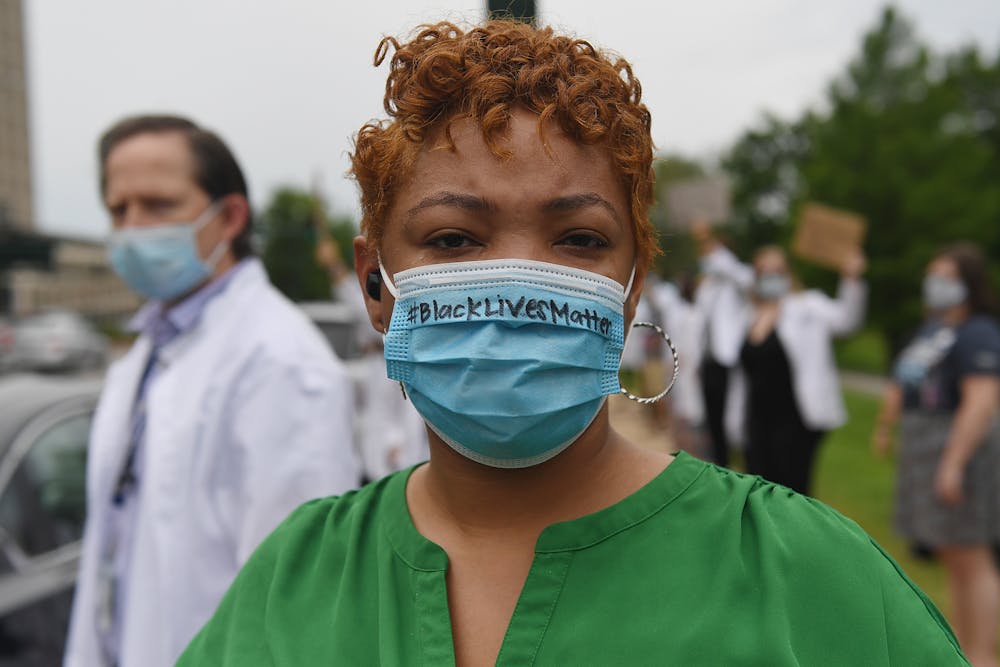
Protests have spread across the nation, including to St. Louis, where several hundred doctors, nurses and medical professionals demonstrated against police brutality and the death of George Floyd on June 5, 2020. Michael B. Thomas/Getty Images
This remains true even if we consider the protests and police violence that shook the Chicago Democratic Convention in August 1968. Similarly, the scope and scale of the 2020 protests dwarf the student strikes that shut down hundreds of college campuses in the aftermath of the shootings of student protesters at Kent State and Jackson State in May 1970; the six days of protest and looting that shook Los Angeles in the aftermath of the 1992 Rodney King trial; the 1999 “Battle of Seattle,” during which protesters used a mix of nonviolent and more militant tactics to disrupt a World Trade Organization conference and the 650 cities that hosted Women’s Marches in January, 2017.
More than the number and size of the protests, though, what makes the 2020 uprisings unprecedented are the ways that they have pulled together multiple currents within the U.S. protest tradition into a mighty river of demand for fundamental change in American society.
Wanton disregard for black life
The spark, of course, was the horrifying video of yet another police killing of an unarmed African-American, George Floyd.
The nation was confronted with incontrovertible evidence, played out over 8 minutes and 46 seconds of video, not only of wanton disregard for black life but also of the ongoing failure of political institutions to solve the problem of racist police violence.
On top of the disproportionate death rates and economic devastation that COVID-19 has wrought on communities of color, a harsh light has been shone on the structural racism rampant in American society.
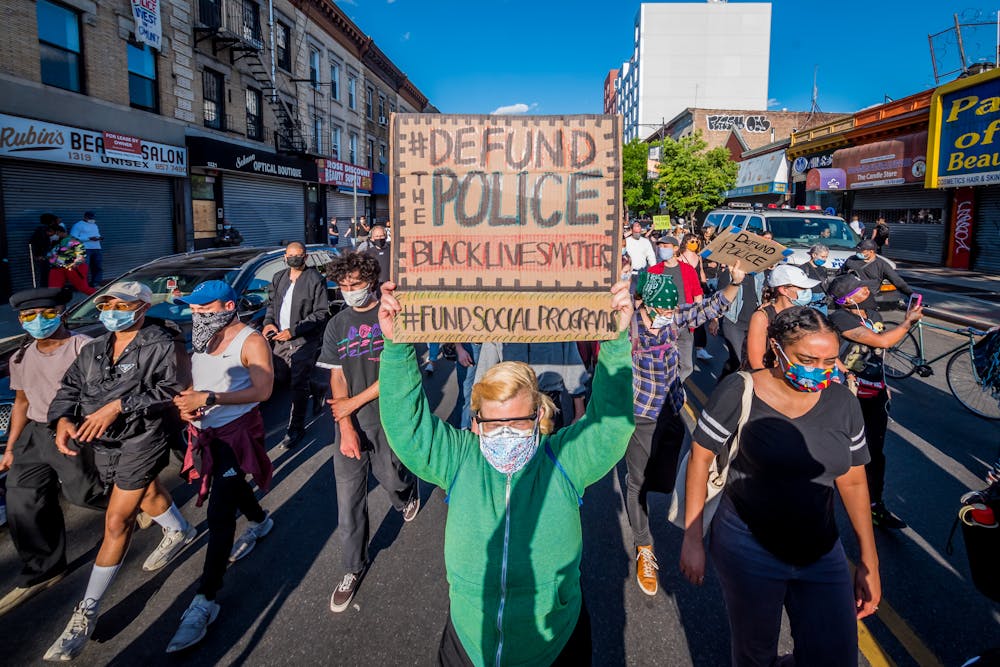
Among the comprehensive range of demands by protesters is this one: Defund the police. Erik McGregor/LightRocket via Getty Images
But while the murder of George Floyd was the spark, the fuel for the uprisings comes from many sources: the worst public health and economic crisis in generations, three and a half years of a divisive and chaotic presidential administration, a burgeoning white nationalist movement and decades upon decades of growing economic inequality amid an increasingly threadbare social safety net.
The focus of the protests has been on police violence and the nation’s unfinished racial justice agenda. But the diversity of protesters and the use of protest tactics —- from nonviolent marches and rallies to civil disobedience, rock throwing and looting —- drawn from the traditions of youth, labor and anti-corporate protest make it clear that even more is at play in the uprising.
The point is not, as others have argued, that it is the level of involvement of whites in the protests that distinguishes them from previous high points of anti-racist protest. There is in fact a long history of white support for, and participation in, black protest movements.
What is unprecedented is the way that protesters of all races and ethnicities have focused their ire on upscale business districts and national retail chains (as opposed to neighborhood businesses), while others have called for the redirecting of public spending from the police, prisons and other elements of the criminal justice system to health and social welfare programs.
Despite, or perhaps because of the protests’ decentralized and leaderless nature, they have managed to put on the table the broadest and most comprehensive set of social and economic reforms since the Poor People’s campaign that followed on the heels of Martin Luther King’s assassination in 1968.
From calls to shift funding from police budgets to programs for the poor to proposals for renewed public investment in minority businesses and urban neighborhoods, the uprisings are likely to reshape public policy debates for months and even years to come.
It is impossible to know whether the protests can or will be transformed into sustained campaigns to reform the criminal justice system or reinvigorate government programs for the poor and economically downtrodden. To achieve that level of structural change will require the rapid development of new forms of leadership and new organizational structures for the protest movement.
But as unlikely as that may seem, remember that no one could have predicted that the U.S. was on the verge of this level of mass mobilization of anti-racist protest two short weeks ago.
As Protests grow, Big Labor Sides with Police Unions
The latest in an historically fraught relationship among police, labor and civil rights movement
Alexia Fernández Campbell
https://portside.org/2020-06-07/protests-grow-big-labor-sides-police-unions
Labor unions exist to protect workers, but most workers aren’t authorized to use deadly force as part of their jobs.
Police unions have written labor contracts that bar law enforcement agencies across the country from immediately interrogating or firing officers after egregious acts of misconduct.
Leaders of the country’s other labor unions are tiptoeing around the subject as their members join protests in hundreds of U.S. cities this week over the killing of George Floyd. Labor leaders have strongly denounced police officers’ actions in that case and called on lawmakers to address systemic racism. But they’re suggesting that collective bargaining agreements shouldn’t be on the table. They’ve been careful not to blame police unions for the problem, choosing to embrace them instead.
Police union contracts are not normal collective bargaining agreements. Police unions have crafted a complex web of disciplinary rules that critics say makes it impossible to hold police accountable for killing unarmed Black citizens. After a Minneapolis police officer pinned Floyd’s neck to the ground for more than 8 minutes while fellow officers stood by and watched, many want to see these union contract rules reformed or dismantled.
“The short answer is not to disengage and just condemn,” Richard Trumka, head of the AFL-CIO labor federation, said Wednesday on a press call about racial justice. “The answer is to totally re-engage and educate.”
(Editor’s note: The author of this article is a member of the Washington-Baltimore News Guild, which is affiliated with the Communication Workers of America, a member union of the AFL-CIO.)
Public Integrity reached out to leaders of 10 major unions and labor groups. None were willing to talk about police unions. Trumka, of the AFL-CIO, was too busy to chat. The president of the United Food and Commercial Workers Union couldn’t fit a call into his schedule. Teamsters President James Hoffa declined to comment.
Silence from the Service Employees International Union, the American Federation of State, County and Municipal Employees, United Auto Workers, Communication Workers of America, Unite Here and the American Federation of Teachers.
Labor leaders briefly talked about police unions in response to a reporter’s question Wednesday. They seemed uncomfortable.
Randi Weingarten, president of the American Federation of Teachers, said no union contracts should shield employee misconduct, but that focusing on collective bargaining is a “false choice.”
“I think we have to do something nationally about the demilitarization of policing,” she said.
Joshua Freeman, a labor historian at City University of New York, said he’s not surprised that the labor movement doesn’t want to focus on police unions. It wasn’t until the police killed Michael Brown and Eric Garner in 2014 that the labor movement began to acknowledge racism in policing, he said. But more existential questions about reforming police unions are still taboo.
“It’s a very delicate subject, it’s rarely discussed openly and out loud,” Freeman said.
The labor movement’s quiet support for police unions comes at a critical moment. News outlets have described how Derek Chauvin, the officer who tackled Floyd, had at least 17 complaints filed against him but never got more than a written reprimand. That has led some criminal justice reform advocates to call for changes that would curtail — or outright abolish — the power of police unions. The labor movement’s silence on the subject so far suggests that it won’t be an ally in that fight.
POLICE UNION TENSION WITH LABOR MOVEMENT
Police unions have a fraught relationship with the wider U.S. labor movement.
Labor historians trace the tension back to the late 1800s, before police unions even existed. City officials would dispatch cops to break up frequent labor strikes, and they often arrested union leaders and beat workers with batons.
“Police were seen as tools for repressing unions,” Freeman said.
The most infamous example is the Haymarket massacre of 1886. Chicago police officers killed a worker, and injured seven others, who were on strike to demand an eight-hour work day.
At the time, only workers in the private sector would organize. It wasn’t until the 1920s when that started to change. Government employees, such as schoolteachers and sanitation workers, began organizing to demand better pay and benefits. Police officers wanted that, too.
The American Federation of Labor, which later would become the AFL-CIO, started letting police into its ranks in 1919. By the 1950s and 60s, police unions were common.
While the power of public-sector unions was growing, so was the civil rights movement, and racial tensions ended up driving a wedge between police unions and organized labor.
Newspapers across the U.S. shocked readers with images of police violence against Black protestors in the South during the 1960s. Instead of siding with police, the labor movement aligned itself with the civil rights movement (though Martin Luther King Jr. would describe that support as “conditional”). For example, the Los Angeles labor council fought for justice for the family of 17-year-old Augustín Salcido, who was shot and killed when a LAPD officer was trying to arrest him for allegedly selling stolen watches. The council immediately put out a statement, according to Jacobin magazine.
“Mexican-American members of our union in the thousands can testify to the beatings, intimidations, shake-downs, uncalled for arrests and terrorism carried on by the police in the Mexican-American community in Los Angeles,” they wrote. The police officer was charged with murder and later acquitted.
That was a rare rebuke of police by labor unions. To this day, the national labor movement works hard to avoid angering police unions.
POST-FERGUSON SHIFT
The police shooting in Ferguson, Missouri., in 2014 of an unarmed Black teenager, Michael Brown, shifted the conversation. Street riots highlighted the strain between Black communities and militarized police.
The AFL-CIO began to talk more openly about racism in the police force. But Trumka, head of the powerful labor federation, still took care not to alienate the police union that represented the police officer, Darren Wilson.
“Lesley McSpadden, Michael Brown’s mother who works in a grocery store, is our sister, an AFL-CIO union member, and Darren Wilson, the officer who killed Michael Brown, is a union member, too, and he is our brother,” Trumka said at the time. “Our brother killed our sister’s son and we do not have to wait for the judgment of prosecutors or courts to tell us how terrible this is.”
The AFL-CIO was fielding calls and emails from local union leaders about how to support Black members and take part in the fight for racial justice. So that same year, the AFL-CIO created the Commission on Racial and Economic Justice, to address what the federation called “police-on-black crime,” among other problems facing Black communities.
In 2017, the commission published a report with a long list of recommendations for unions, such as urging lawmakers to mandate racial bias training for cops and to abolish the for-profit prison system. Yet the report barely mentioned the role of police unions in the racial justice movement, merely noting that “police unions resent when outsiders question their judgment or actions in the line of duty.” The report suggested that local unions and labor councils should host forums between police unions and community members.
Nowhere did the report mention how police union contracts typically include language to hide complaints against police officers from the public. It didn’t describe the arbitration clauses that often force police departments to rehire fire, misbehaving cops. Or how police unions have successfully lobbied for state laws granting police officers far more job security than the average U.S. worker.
“These are armed, trained people who are totally not accountable to the community they are policing,” said Sam Mitrani, a labor historian at College of DuPage in Ilinois.
Labor leaders are probably hesitant to take on police unions because many of them represent law enforcement officers through their local affiliates. SEIU, CWA and AFSCME all do. The AFL-CIO also represents one of the largest police unions, the International Union of Police Associations, which has more than 15,000 members.
Tensions between the IUPA and the broader labor movement spilled into the public after the police choking of an unarmed Black man named Eric Garner in New York City.
Trumka and other national union leaders co-signed an open letter to then President Barack Obama regarding police reform and the “long list of black men and boys who have died under eerily similar circumstances.”
Sam Cabral, president of the IUPA (which is affiliated with the AFL-CIO), was not happy about it.
“In the aftermath of the shooting of Michael Brown in Ferguson and the death of Eric Garner in New York, the International Union of Police Associations withheld comment until facts were known,” wrote its president, Sam Cabral, according to Al Jazeera. “We wish the administration as well as the president of the AFL-CIO had been as thoughtful. I believe that anyone making pronouncements before knowing the facts has an agenda, not a position.”
Two local union affiliates in California urged the AFL-CIO to kick the IUPA out of the federation. That didn’t happen.
In December, Public Integrity reported that IUPA’s charitable arm, which says it raises money to help the families of police officers killed or injured in the line of duty, spends most of its money on telemarketing services. IUPA’s charitable arm also claimed to be supported by several high-profile corporations — claims that Public Integrity in January revealed to be untrue.
Now, after Floyd’s death, Trumka is careful not to rile up the IUPA, even as he calls for the president of the local police union in Minneapolis to step down. (That union is not affiliated with the AFL-CIO.) And so far, the IUPA has said nothing about Floyd’s death or the officer who killed him.
Public Integrity reached out to the IUPA and other major police unions, such as the Fraternal Order of Police and the Police Benevolent Association. None of them responded.
Our mission is to protect democracy and inspire change using investigative reporting that exposes betrayals of the public trust by powerful interests.
‘Live PD,’ ‘Cops’ Pulled from TV Schedules in Light of George Floyd Protests (EXCLUSIVE)
The decision to hold “Live PD” and “Cops” comes as protests over police brutality continue across the nation following the killing of George Floyd by Minnesota police officers
Michael Schneider
https://portside.org/2020-06-07/live-pd-cops-pulled-tv-schedules-light-george-floyd-protests-exclusive
A&E has decided not to run new episodes of “Live PD” this Friday and Saturday, while Paramount Network has delayed the Season 33 launch of “Cops,” the long-running reality series that was scheduled to return on Monday.
The decision to hold “Live PD” and “Cops” comes as protests over police brutality continue across the nation following the killing of George Floyd by Minnesota police officers, shining a spotlight on the widespread abuse by law enforcement against African Americans. This weekend A&E will air episodes of “Live Rescue” in its place.
“Out of respect for the families of George Floyd and others who have lost their lives, in consultation with the departments we follow, and in consideration for the safety of all involved, we have made the decision not to broadcast ‘Live PD’ this weekend,” A&E said in a statement.
Paramount Network hasn’t yet commented on the fate of Monday’s “Cops” episode, but its program schedule no longer shows it airing as planned at 10 p.m. ET; “Ghostbusters” is now scheduled there instead. Paramount made the shift over a week ago, as “Cops” also didn’t air this past Monday in its normal spot. And Paramount appears to not have future plans for “Cops” on the network. Already, the show is no longer mentioned anywhere on the channel’s website.
Paramount Network owner ViacomCBS made headlines earlier this week when on Monday the company’s cable networks went dark for eight minutes and 46 seconds — the amount of time that the Minneapolis police officer kept his knee on Floyd’s neck, killing him in the process.
“Cops” launched on Fox in 1989, and is considered one of the originators of the modern reality TV movement. But in recent years, it has also come under fire for how it depicts law enforcement, and for questionable behind the scenes practices.
Reality Blurred’s Andy Dehnart, who wrote a recent piece about police-based reality TV on his website, was the first to report Paramount’s decision to pull Monday’s “Cops” premiere.
“Cops” was the subject of a recent podcast hosted by Dan Taberski, “Running from Cops,” which chronicled hundreds of episodes of the show. Taberski and his team detailed instances where people were coerced into signing waivers and how production allows police to edit and remove anything that might paint them in a negative light.
“Cops” aired for 25 seasons on Fox, which was still in its infancy when the show first premiered. The network aired “Cops” together with “America’s Most Wanted” on Saturday nights for 14 years; “Most Wanted” moved to Lifetime in 2011 and was eventually canceled.
“Cops,” meanwhile, got a new lease on life in 2013 when Spike TV ordered new episodes and paired them with repeats. (Spike was rebranded as Paramount Network in 2018.)
Meanwhile, “Live PD” has been a tremendous hit for A&E since its premiere in October 2016. The show follows cops and sheriffs — live, in real time, as they patrol various cities and counties across the country. As it turned into a sensation, A&E kept expanding the show’s footprint; it’s now the No. 1 series on cable on Friday and Saturday nights. After taking a break in the early spring due to a COVID-19 production shutdown, it returned in April.
Subscribe to:
Comments (Atom)