Sunday, June 7, 2020
'These Unions Dishonor the Labor Movement': Nearly 200 Academics, Lawmakers, and Activists Demand AFL-CIO Expel Police Unions
"The AFL-CIO cannot stand for criminal justice reform, while at the same time allowing police unions to use your power to impede reform."
by
Jake Johnson, staff writer
https://www.commondreams.org/news/2020/06/06/these-unions-dishonor-labor-movement-nearly-200-academics-lawmakers-and-activists
A coalition of nearly 200 civil rights activists, academics, and state and city lawmakers is calling on the AFL-CIO—the largest federation of unions in the United States—to permanently expel police unions from its ranks, arguing that organized labor's "proud history" of fighting for the most vulnerable "is being destroyed by the legacy that police unions are leaving behind."
"As long as police unions can hide behind the shield that the AFL-CIO provides, no real action can be taken that will move our country forward."
Pressure on the AFL-CIO to expel police unions is far from new, but the push has gained urgency in the wake of the May 25 police killing of George Floyd, which catalyzed a nationwide uprising against police brutality and drove lawmakers to look more closely at systemic reforms.
In a letter (pdf) to the leadership of the AFL-CIO on Friday, the coalition urged the labor federation to "stop allowing the International Union of Police Associations (IUPA) and other law enforcement affiliates including prison guard unions to use the protections the AFL-CIO provides under your power and leadership."
"We ask you to disassociate the IUPA from the AFL-CIO," the letter states. "We further ask that all other AFL-CIO unions establish a policy to not include police or other law enforcement, including immigration-related officers, in their membership."
"The AFL-CIO cannot stand for criminal justice reform, while at the same time allowing police unions to use your power to impede reform," the letter continues. "In contract negotiations across the country, unions have fought again and again to prevent accountability measures from being put in place such as civilian review boards and making discipline records transparent."
New York State Sen. Julia Salazar, one of the letter's signatories, tweeted that she is supporting the call for expulsion of police unions from the AFL-CIO "first as a labor union member and second as a legislator."
As Alexia Fernández Campbell of the Center for Public Integrity (CPI) reported Friday, leaders of America's most prominent labor unions "are tiptoeing around the subject" of police unions following the killing of Floyd at the hands of Minneapolis officers last week.
In a press call Wednesday, AFL-CIO president Richard Trumka—who has in the past characterized criminal justice reform as a labor issue—said "the short answer is not to disengage and just condemn."
"The answer is to totally re-engage and educate," said Trumka.
Joshua Freeman, a labor historian at City University of New York, told CPI that he isn't surprised labor leaders are largely trying to avoid the subject of police unions after Floyd's killing, which was widely condemned by unions—with the notable exception of IUPA, which has yet to comment on the matter.
"It's a very delicate subject, it's rarely discussed openly and out loud," Freeman said of police unions.
Writing for the New Republic last week, labor reporter and union member Kim Kelly echoed the demand of the coalition of academics, activists, and lawmakers.
"If the federation wants to prove that it's seriously committed to racial justice and true worker solidarity," Kelly wrote, "the AFL-CIO must permanently disaffiliate from the IUPA and sever its ties with any and all other police associations."
Read the full letter:
We are a group of civil rights organizations, elected officials, faith leaders, academics, public defenders, and community-based organizers who believe in the power of unions, and who recognize the history that unions have given power to people in our communities who are often powerless. However, that proud history is being destroyed by the legacy that police unions are leaving behind, and we ask you to stop allowing the International Union of Police Associations (IUPA) and other law enforcement affiliates including prison guard unions to use the protections the AFL-CIO provides under your power and leadership.
We ask you to disassociate the IUPA from the AFL-CIO.
We further ask that all other AFL-CIO unions establish a policy to not include police or other law enforcement, including immigration-related officers, in their membership.
For too long, police unions have used the contract negotiation process to enact measures that shield police from accountability at the expense of public safety, to grow their budget for their self-interest rather than the interest of the community, and to impede necessary change by attacking progressives—including the broader labor movement—who have been at the forefront of criminal justice reform.
The killings of George Floyd and Breonna Taylor and Tony McDade are just the latest signs of the all-too-apparent crisis in policing in America. But it would be a continued mistake to question the structure of policing—as we are now—but then to say that the profession as it exists now may be reformed. We’ve made that mistake before. We can no longer tinker around the edges of this issue.
Eric Garner. Michael Brown. Laquan McDonald. Sandra Bland. Jessica Williams. These police killings six years ago sparked protests across the country and birthed the Black Lives Matter movement and a flood of reform efforts. Six years later, though, we see that nothing has changed.
The solutions we need right now both to protect our safety and to rescue our democracy are ones that meet the scale of the problem. To respond to George Floyd's death, or Breonna Taylor's death, we must replace the questions about how to reform policing with questions about what a broader vision for safety and justice in America should look like and what role policing should play in it. However, as long as police unions can hide behind the shield that the AFL-CIO provides, no real action can be taken that will move our country forward.
In the past few years, we have seen a wave of criminal justice reforms sweeping the country. There is a growing recognition that mass incarceration hurts the powerless the most- whether it's holding someone in jail because they can’t afford to pay their bail, demanding a high fine or fee to pay for a diversion program, or violating someone on probation because they missed an appointment due to childcare. And this growing recognition includes Richard Trumka, the president of AFL-CIO, who acknowledged during a speech on criminal justice reform that this nation, under the guise of public safety, spends billions making our country less safe by selectively locking people up and sealing people out and shut entire communities down by creating a permanent criminal class. He also committed: "I made a promise to myself that I would do everything in my power to help change this tragic reality."
But as advocates in cities and counties across the country—including your leader—have fought to equalize the playing field, the one voice that obstructed reform—through vicious attacks and fear mongering tactics— has been the police unions. The AFL-CIO cannot stand for criminal justice reform, while at the same time allowing police unions to use your power to impede reform. In contract negotiations across the country, unions have fought again and again to prevent accountability measures from being put in place such as civilian review boards and making discipline records transparent. The unions impede this needed reform by claiming that accountability will interfere with policing, and making the false claim that somehow accountability is at odds with public safety when, in fact, the opposite is true. Derek Chauvin, the officer charged with murdering George Floyd, had 18 prior complaints filed with Minneapolis Police Department’s Internal Affairs, while his accomplice Tou Thao was the subject of six complaints. It was union protection that allowed them to remain armed, dangerous, and a threat to public safety. The AFL-CIO should not be complicit in shielding their members from accountability. These unions dishonor the labor movement.
Police unions have a long history of maintaining their power by exploiting fears and promoting the myth that more police equals less crime. This is the rhetoric used to push back from budget cuts that could mean more money to spend on housing, education, mental health treatment, or other services that can make communities safer while improving life outcomes for all. This is funding that is either taken from, or not available to, other union members who work for the government.
Across the country, people are working to change the landscape of law enforcement by common sense reforms that increase public safety such as sending experts in mental health and substance abuse to treat people instead of police and using community based violence interrupters to prevent gun violence. However, when the police union uses the AFL-CIO to stand in the way of reform by unnecessarily advocating for increased police spending, we all lose.
We respect the need for unions to protect people's rights in the workplace, but we also agree with President Trumka that criminal justice reform is a labor issue. If AFL-CIO wants to prove its commitment to racial justice, worker solidarity, and meaningful reform, then AFL-CIO must permanently disaffiliate from the IUPA and sever its ties with any and all other police associations. It must also ask all unions affiliated with the AFL-CIO to establish a policy preventing police officers from joining other affiliate unions.

Governor Cuomo: Avoid Budget Cuts by Not Rebating Stock Sales Tax to Wall Street
"This stock transfer sales tax, bringing in an estimated 13 to 16 billion dollars a year, would reduce forthcoming budget cuts in health, education, transportation, and other safety nets."
by
Ralph Nader
https://www.commondreams.org/views/2020/06/06/governor-cuomo-avoid-budget-cuts-not-rebating-stock-sales-tax-wall-street
New York Governor Andrew Cuomo is basking in the popularity of his meticulous Covid-19 news briefings and simultaneously predicting a pandemic-driven $61 billion state deficit over four years. Astonishingly, the Governor electronically rebates an existing tiny stock transfer sales tax back to Wall Street. This stock transfer sales tax, bringing in an estimated 13 to 16 billion dollars a year, would reduce forthcoming budget cuts in health, education, transportation, and other safety nets.
No Governor in the country has the luxury of simply keeping very significant tax revenues that are already collected to avoid cutting necessities of life. Yet Governor Cuomo has supported these rebates for the past ten years, as have previous New York state Governors all the way back to 1981 when this early 20th-century tax stopped being retained in the state’s treasury. As much as a staggering $250 billion dollars has been immediately returned to the stockbrokers over that time period.
Bear in mind, a fraction of one percent of this tiny sales tax is paid by the investors buying stocks, bonds, and engaging in massive volumes of derivative speculation. Since the great bulk of trading is conducted by upper-income people and large companies, this sales tax, unlike the regressive 8 percent sales tax ordinary New Yorkers pay when they buy from stores, is progressive in its impact.
So why hasn’t the media taken this eminently timely and newsworthy story to the people? I’ve been explaining this surrender to Wall Street for years. Most recently, given its timeliness, calling up reporters and columnists of major press outlets, but to no avail; with the exception of the Buffalo News. This indifference is inexplicable. After all, Governor Cuomo regularly talks about drastic budget cuts.
Well, a new factor may change this equation. Blair Horner, a longtime, prominent director of the New York Public Interest Research Group (NYPIRG), an influential university college student-funded civic advocacy group is now on the case.
On May 28, 2020, Mr. Horner held a virtual news conference in Albany, presented a letter signed by over fifty labor, consumer, women’s, educational, minority, health, taxpayer, elderly, and justice organizations – all calling on the Governor to keep the many billions of dollars from the stock transfer tax. The number of New York groups supporting this proposal will only grow. Attentively advanced by the seasoned Horner and his team, a detailed news release was distributed and several speakers, including me, briefly spoke. At question time, only a Newsday reporter asked about Wall Street’s reaction.
A half-hour later, no reporter asked Governor Cuomo during his long daily briefings about keeping the collected revenues. The next day there was no media coverage of this event and the benefits the revenue could have for communities whose members will be bearing the brunt of avoidable service cuts and job losses.
Everyday New York state rebates about $40 million to an upper-economic class, already further enriched by Trump’s 2017 tax bonanza. Nor have these privileged plutocrats shared, via a wealth tax, a fraction of the sacrifice of New York’s 2.2 million front-line Covid-19 workers. Shameful!
Bills mandating the retention of this stock sales tax are already in the state legislature. A prime sponsor, Assemblyman Phil Steck believes that there will be overwhelming left/right support in the polls.
However, the legislature’s leaders await the signal from a thus far reluctant Governor Cuomo. But not, I suspect for long.
With Wall Street’s Robert Rubin and Michael Bloomberg coming out for a financial transaction tax (thanks probably to the Bernie Sanders movement), can the son of Mario Cuomo be much far behind?
See the Coalition release, letter to Governor Cuomo, and the New York State Assembly and Senate bills to stop the rebate of the stock transfer tax at https://nader.org/ny-stock-tax/
Labor Bureau Says 'Misclassification Error' Is Making Unemployment Rate Look Lower Than It Really Is
"Long story short, BLS is telling us that we're at 16 percent unemployment."
by
Jake Johnson, staff writer
https://www.commondreams.org/news/2020/06/06/labor-bureau-says-misclassification-error-making-unemployment-rate-look-lower-it
Buried at the bottom of the Bureau of Labor Statistics' May jobs report—which President Donald Trump and Republican lawmakers touted Friday as evidence that the U.S. economy is rebounding from the Covid-19 crisis at an extraordinary clip—is a note conceding that a "misclassification error" during the agency's data-collection process made the unemployment rate look significantly lower than it really is.
BLS, a Labor Department agency staffed with more than 2,000 career officials, admitted at the end of its report that "a large number of workers... were classified as employed but absent from work." Those workers, the agency explained, should have been classified as "unemployed on temporary layoff" by household survey interviewers but were not.
If those workers had been categorized correctly, the agency said, the "overall [May] unemployment rate would have been about 3 percentage points higher than reported."
"However, according to usual practice, the data from the household survey are accepted as recorded," the agency said, explaining its decision to report that the unemployment rate fell to 13.3% in May, down from 14.7% in April. "To maintain data integrity, no ad hoc actions are taken to reclassify survey responses."
Because the classification error also affected the March and April jobs reports—the actual unemployment rate in April, according to BLS, was likely 19.7% rather than the reported 14.7%—it remains the case that the U.S. unemployment rate likely fell in May, just not to 13.3%.
"Unemployment fell no matter how you cut it," tweeted economist Martha Gimbel, "but double-digit unemployment is unacceptable and should not be our standard for victory."
Many U.S. media outlets on Friday—including, regrettably, this website—reported the top-line BLS unemployment number for May without emphasizing the agency's "misclassification error." (Common Dreams' Friday article on the unemployment numbers has been adjusted to highlight the agency's error.)
Analysts quickly dismissed speculation that the BLS numbers were improperly tampered with by the Trump administration, a possibility that New York Times columnist Paul Krugman hinted at in a series of tweets Friday.
Late Friday, the Washington Post's Heather Long explained the process behind BLS' calculation of the unemployment rate:
The unemployment rate comes from a survey where Census workers ask about 60,000 households questions about whether they are working or looking for a job the week of May 10 to 16.
One of the first questions that gets asked is did the person do any work "for pay or profit?" There are then 45 pages of follow up questions that come after that. One of those questions asks if someone was "temporarily absent" from the job and why that absence occurred. One of the responses is "other."
The BLS instructed surveyors to try to figure out if someone was absent because of the pandemic and, if so, to classify them as on "temporary layoff," meaning they would count in the unemployment data. But some people continued to insist they were just "absent" from work during the pandemic, and the BLS has a policy of not changing people's answers once they are recorded. It's how the BLS protects again bias or data manipulation.
"Long story short, BLS is telling us that we're at 16 percent unemployment," David Dayen, executive editor at The American Prospect, wrote in a summary of the jobs report Friday. "And while that's better than the nearly 20 percent (if you include the misclassified) in the April jobs report, it means we've only brought a small sample of those workers back. The level of employment remains sharply reduced from the pre-pandemic months; we've maybe brought back a little over 10 percent of the jobs."
Movement to Defund Police Gains 'Unprecedented' Support Across US
https://portside.org/2020-06-05/movement-defund-police-gains-unprecedented-support-across-us
Portside Date: June 5, 2020
Author: Sam Levin
Date of source: June 4, 2020
The Guardian

The movement to defund the police is gaining significant support across America, including from elected leaders, as protests over the killing of George Floyd sweep the nation.
For years, activists have pushed US cities and states to cut law enforcement budgets amid a dramatic rise in spending on police and prisons while funding for vital social services has shrunk or disappeared altogether.
George Floyd protests: more than 3,000 arrested in Los Angeles county
Government officials have long dismissed the idea as a leftist fantasy, but the recent unrest and massive budget shortfalls from the Covid-19 crisis appear to have inspired more mainstream recognition of the central arguments behind defunding.
“To see legislators who aren’t even necessarily on the left supporting at least a significant decrease in New York police department [NYPD] funding is really very encouraging,” Julia Salazar, a New York state senator and Democratic socialist, told the Guardian on Tuesday. “It feels a little bit surreal.”
Floyd’s death on camera in Minneapolis, advocates say, was a powerful demonstration that police reform efforts of the last half-decade have failed to stop racist policing and killings. Meanwhile, the striking visuals of enormous, militarized and at times violent police forces responding to peaceful protests have led some politicians to question whether police really need this much money and firepower.
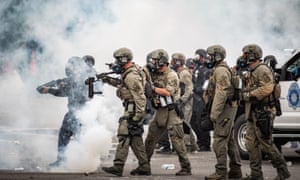
Riot police points weapons as they move through a cloud of teargas at a Black Lives Matter protest in Denver. Photograph: Paul Winner/Rex/Shutterstock
Meanwhile, unemployment is surging amid the economic fallout of the coronavirus pandemic, with housing and healthcare crises worsening. Many governments have been making painful cuts to services and expect to see tax revenue fall even further in the coming year. But police budgets have not been affected, and some mayors are even seeking to expand law enforcement funding.
A snapshot of some of city budget debates that have escalated this week:
Los Angeles: the police budget is $1.8bn, and the mayor has for weeks been pushing for raises and bonuses for officers and an overall 7% increase that would make the budget more than half of the general fund. But on Wednesday, he said he was now looking to make cuts to the police budget.
New York: The mayor is pushing to leave the NYPD’s nearly $6bn budget intact while slashing education and youth programs and cutting other agencies by as much as 80%.
Philadelphia: The mayor has proposed spending $977m on police and prisons, which is 20% of the general fund. A $14m increase for police comes as the city is cutting funding for youth violence prevention, arts and culture, workforce development, and laying off staff at recreation centers and libraries.
Defunding, said activist Jeralynn Blueford, is the logical response from leaders in this moment of unprecedented unrest. “If police had been serious about reform and policy change, then guess what? People would not be this angry.”
Blueford’s son was killed by Oakland police in 2012 and she’s been fighting for reforms since. “We allowed you to kill our children, and you said this was going to change, and you reneged on it. If we keep funding them, it gives them the green light to continue ”.
If police had been serious about reform and policy change, then guess what? People would not be this angry | Jeralynn Blueford
Community groups advocating for defunding have put forward differing strategies, some merely opposing police budget increases, others advocating mass reductions, and some fighting for full defunding as a step toward abolishing police forces. Some initiatives are tied to the fight to close prisons. All are pushing for a reinvestment of those dollars in services.
“People have been fighting for years to get cops out of schools, and now it’s happening overnight,” said Tony Williams, a member of MPD150, an abolition group whose literature on building a “police-free future” has spread on social media in recent days. One elected Minneapolis ward member said this week that the city’s police department was “irredeemably beyond reform”, the kind of remark that would until recently have been unthinkable to organizers.
“This is unprecedented in our movement, but it is a natural consequence of where we’ve been over the last five years,” Williams said, rattling off high-profile killings by police that have failed to lead to substantive reforms.
Eric Garcetti, the Los Angeles mayor, addressed the broader protests in a speech late Wednesday night and said he was now working to make cuts of up to $150m to the police budget and reinvest funds in black communities, though specifics of his plans were unclear.
His move comes after a coalition convened by Black Lives Matter LA pushed for what it called a “people’s budget”, which encouraged the city to spend only 5.7% of its general fund on law enforcement, and 44% on universal aid and crisis management.
“In moments of crisis, people want services and resources that go directly to help people rather than police that surveil, brutalize and kill us,” said Melina Abdullah, the BLM LA co-founder, adding that Garcetti’s proposed cut was “minimal” and that officials “need to go much further”.
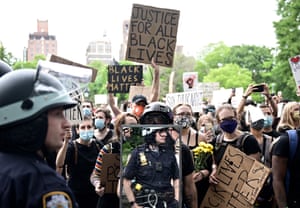
Protesters demonstrate on 2 June 2020, during a Black Lives Matter protest at Washington Square in New York City. Photograph: Johannes Eisele/AFP/Getty Images
Even though many US police departments’ duties are responding to non-violent, non-emergency calls, departments have expanded their military-style arsenal in recent years. US police kill more people in days than many other countries do in years.
Senator Salazar in New York said the Covid-19 devastation is motivating lawmakers normally sympathetic to the NYPD to rethink the budget: “Every senate office … has been fielding an unfathomable number of unemployment claims. We’ve been thinking every day about how social services and the public safety net are failing people. Having come out of a bleak state budget process, it’s very frustrating to hear that $6bn figure for the NYPD.”
We’ve been thinking every day about how social services and the public safety net are failing people |Julia Salazar
The city councilmember who chairs the committee that oversees the budget called for significant NYPD cuts this week. Although she doesn’t control NYPD financing as a state lawmaker, Salazar said she could envision police immediately losing $1bn from its budget just for current police functions that have nothing to do with law enforcement and crime, such as responding to mental health calls and other social services.
Kamau Walton, a Philadelphia-based member of Critical Resistance, a long-running US abolition group, said the absurdity of increased police spending in this moment was visible to many. Walton lives across from a recreation center and library that has been closed due to Covid, and said houseless people now gather outside, because they have nowhere else to go.
The city, however, is further cutting housing and homelessness services and seems to lack a summer plan for these communities who have lost programs, resources and jobs, they said. “At a drop of a dime, they can find money for uber-militarized tanks and fly helicopters all over the city and shoot rubber bullets, but we can’t put people in houses?”
Kelly Lytle Hernández, a UCLA historian and recent MacArthur recipient, said this could be a pivotal moment for the US: “We’ve created over the last 30 to 40 years a sense that our safety and wellbeing always comes from investing more and more in police.”
This week, it seems there is increasing recognition of this failure, she said, adding, “Defunding the police is the first step in a much broader historical transformation that I’m hoping you’re seeing broad-based support for on the streets today.”
The Guardian
The movement to defund the police is gaining significant support across America, including from elected leaders, as protests over the killing of George Floyd sweep the nation.
For years, activists have pushed US cities and states to cut law enforcement budgets amid a dramatic rise in spending on police and prisons while funding for vital social services has shrunk or disappeared altogether.
George Floyd protests: more than 3,000 arrested in Los Angeles county
Government officials have long dismissed the idea as a leftist fantasy, but the recent unrest and massive budget shortfalls from the Covid-19 crisis appear to have inspired more mainstream recognition of the central arguments behind defunding.
“To see legislators who aren’t even necessarily on the left supporting at least a significant decrease in New York police department [NYPD] funding is really very encouraging,” Julia Salazar, a New York state senator and Democratic socialist, told the Guardian on Tuesday. “It feels a little bit surreal.”
Floyd’s death on camera in Minneapolis, advocates say, was a powerful demonstration that police reform efforts of the last half-decade have failed to stop racist policing and killings. Meanwhile, the striking visuals of enormous, militarized and at times violent police forces responding to peaceful protests have led some politicians to question whether police really need this much money and firepower.
Riot police points weapons as they move through a cloud of teargas at a Black Lives Matter protest in Denver. Photograph: Paul Winner/Rex/Shutterstock
Meanwhile, unemployment is surging amid the economic fallout of the coronavirus pandemic, with housing and healthcare crises worsening. Many governments have been making painful cuts to services and expect to see tax revenue fall even further in the coming year. But police budgets have not been affected, and some mayors are even seeking to expand law enforcement funding.
A snapshot of some of city budget debates that have escalated this week:
Los Angeles: the police budget is $1.8bn, and the mayor has for weeks been pushing for raises and bonuses for officers and an overall 7% increase that would make the budget more than half of the general fund. But on Wednesday, he said he was now looking to make cuts to the police budget.
New York: The mayor is pushing to leave the NYPD’s nearly $6bn budget intact while slashing education and youth programs and cutting other agencies by as much as 80%.
Philadelphia: The mayor has proposed spending $977m on police and prisons, which is 20% of the general fund. A $14m increase for police comes as the city is cutting funding for youth violence prevention, arts and culture, workforce development, and laying off staff at recreation centers and libraries.
Defunding, said activist Jeralynn Blueford, is the logical response from leaders in this moment of unprecedented unrest. “If police had been serious about reform and policy change, then guess what? People would not be this angry.”
Blueford’s son was killed by Oakland police in 2012 and she’s been fighting for reforms since. “We allowed you to kill our children, and you said this was going to change, and you reneged on it. If we keep funding them, it gives them the green light to continue ”.
If police had been serious about reform and policy change, then guess what? People would not be this angry | Jeralynn Blueford
Community groups advocating for defunding have put forward differing strategies, some merely opposing police budget increases, others advocating mass reductions, and some fighting for full defunding as a step toward abolishing police forces. Some initiatives are tied to the fight to close prisons. All are pushing for a reinvestment of those dollars in services.
“People have been fighting for years to get cops out of schools, and now it’s happening overnight,” said Tony Williams, a member of MPD150, an abolition group whose literature on building a “police-free future” has spread on social media in recent days. One elected Minneapolis ward member said this week that the city’s police department was “irredeemably beyond reform”, the kind of remark that would until recently have been unthinkable to organizers.
“This is unprecedented in our movement, but it is a natural consequence of where we’ve been over the last five years,” Williams said, rattling off high-profile killings by police that have failed to lead to substantive reforms.
Eric Garcetti, the Los Angeles mayor, addressed the broader protests in a speech late Wednesday night and said he was now working to make cuts of up to $150m to the police budget and reinvest funds in black communities, though specifics of his plans were unclear.
His move comes after a coalition convened by Black Lives Matter LA pushed for what it called a “people’s budget”, which encouraged the city to spend only 5.7% of its general fund on law enforcement, and 44% on universal aid and crisis management.
“In moments of crisis, people want services and resources that go directly to help people rather than police that surveil, brutalize and kill us,” said Melina Abdullah, the BLM LA co-founder, adding that Garcetti’s proposed cut was “minimal” and that officials “need to go much further”.
Protesters demonstrate on 2 June 2020, during a Black Lives Matter protest at Washington Square in New York City. Photograph: Johannes Eisele/AFP/Getty Images
Even though many US police departments’ duties are responding to non-violent, non-emergency calls, departments have expanded their military-style arsenal in recent years. US police kill more people in days than many other countries do in years.
Senator Salazar in New York said the Covid-19 devastation is motivating lawmakers normally sympathetic to the NYPD to rethink the budget: “Every senate office … has been fielding an unfathomable number of unemployment claims. We’ve been thinking every day about how social services and the public safety net are failing people. Having come out of a bleak state budget process, it’s very frustrating to hear that $6bn figure for the NYPD.”
We’ve been thinking every day about how social services and the public safety net are failing people |Julia Salazar
The city councilmember who chairs the committee that oversees the budget called for significant NYPD cuts this week. Although she doesn’t control NYPD financing as a state lawmaker, Salazar said she could envision police immediately losing $1bn from its budget just for current police functions that have nothing to do with law enforcement and crime, such as responding to mental health calls and other social services.
Kamau Walton, a Philadelphia-based member of Critical Resistance, a long-running US abolition group, said the absurdity of increased police spending in this moment was visible to many. Walton lives across from a recreation center and library that has been closed due to Covid, and said houseless people now gather outside, because they have nowhere else to go.
The city, however, is further cutting housing and homelessness services and seems to lack a summer plan for these communities who have lost programs, resources and jobs, they said. “At a drop of a dime, they can find money for uber-militarized tanks and fly helicopters all over the city and shoot rubber bullets, but we can’t put people in houses?”
Kelly Lytle Hernández, a UCLA historian and recent MacArthur recipient, said this could be a pivotal moment for the US: “We’ve created over the last 30 to 40 years a sense that our safety and wellbeing always comes from investing more and more in police.”
This week, it seems there is increasing recognition of this failure, she said, adding, “Defunding the police is the first step in a much broader historical transformation that I’m hoping you’re seeing broad-based support for on the streets today.”
Killing Workers (and Customers) – With No Liability
by EVE OTTENBERG
https://www.counterpunch.org/2020/06/05/killing-workers-and-customers-with-no-liability/
Republicans want to help businesses kill workers. They want to force employees to return to Covid-19 hotspots, like slaughterhouses, by depriving them of unemployment checks if they don’t clock in. In addition, Senate Majority leader Mitch McConnell wants to give these businesses and others, like nursing homes, legal immunity for deliberately exposing workers to a deadly plague. On May 26, he announced such legislation. Make no mistake: McConnell’s liability protection is a license to kill. He’s gone from being the gravedigger of democracy to just being a gravedigger.
This problem has also arisen with hospitals. From the pandemic’s start, many nurses and support staff lacked proper Covid-19 protective gear. When they brought their own, some were fired. This opened the hospitals to lawsuits – for instance, wrongful death suits from the families of medical workers inadequately protected and consequently killed by the disease. Indeed some medical workers, fired for protesting the lack of gear, are suing their hospitals. As National Nurses United executive director Bonnie Castillo explained. “Nurses signed on to take care of their patients. They did not sign up to sacrifice their lives on the front lines of the Covid-19 pandemic.” But that’s exactly what inadequate gear has made them do.
As the New York Times observed in a mid-May editorial on McConnell’s liability protection push, for McConnell the biggest obstacle to re-opening the economy “is not a deadly disease but rapacious trial lawyers” and a tsunami of wrongful death cases, which the Times observes has not and probably will not materialize. But that doesn’t matter for McConnell. He has doubtless heard from corporate donors and supporters chary of their legal exposure and who therefore may hesitate to really put the screws to their employees. McConnell’s bill will make them feel comfortable doing that. Risk-free killing on the job – that’s the senate majority leader’s goal.
This liability bill – which may encounter constitutional problems – would also protect businesses from injured customers. But what do business and its congressional shills think those customers will do when they learn that their baristas, say, work in Covid-19 hotspots? They’ll stay away, and business’ insistence that it be protected from their lawsuits is just the kind of lousy advertising that will continue to keep customers away.
Currently employers have an incentive to notify workers if someone on the job tests positive for Covid-19. That motivation will disappear entirely if McConnell guts liability. In fact, anecdotal evidence shows that employers are not even doing such a good job now, even with this incentive. News reports abound of hospitals that failed to notify staff when a co-worker had the virus. Meanwhile, for those employers who do take their responsibility seriously, McConnell’s bill undercuts them. Its message is: don’t be a chump and worry about Covid-19; you’re in the clear. It can rampage through your business, but there’s nothing your employees or customers can do about it. They can’t touch you.
But, some say, adopt new standards and regulations which, if a business complies, could serve to eliminate its liability. A win/win – no? No. Business hates regulations. How long after enactment until a right-wing president eviscerates the regs? Then corporations will have the liability shield and none of the pesky regulations that justified it. If you think this outcome unlikely – you haven’t been paying attention to what business has done to regulatory oversight, consistently, since the Reagan regime.
Texas, Alabama, Wisconsin, South Dakota and other states all registered jumps in Covid-19 cases after they reopened. Will some of these people sue the businesses they patronized? Maybe. Will some of those suits be justified? Could be. But so far, this tidal wave of suits has not surged; instead a second wave of infections has begun to swell. The vast majority of those who sicken and die will never sue anybody, which is why these feckless governors felt so comfortable re-opening their states without even reducing the numbers of new cases first. Incidentally and unfortunately, infections from crowded protests will enlarge this second wave, but that doesn’t affect business, so you won’t see McConnell currying anybody’s favor regarding it.
When McConnell first announced his liability ban, House leader Nancy Peolsi came out against it. Since then, the house completed a new $3 trillion stimulus package, which now lingers in the senate and regarding which Pelosi said she has no red lines, possibly meaning that she is willing to negotiate on liability. Let’s hope not. Her argument that the best protection for business is to follow OSHA regs may not be welcome to senate Republicans, many of whom doubtless regard that agency as a font of unwanted regulation, but this argument should not be horse-traded away. Liability protection rewards bad, irresponsible behavior and will increase Covid-19 deaths. A day in court is one of the few ways ordinary citizens – workers and customers – can exercise their right not to be harmed. Hopefully the House will not forget that.
MORE THAN 17,000 TROOPS IN 23 STATES AND DC ACTIVATED
By Howard Altman, Military Times.
June 6, 2020
https://popularresistance.org/more-than-17000-troops-in-23-states-and-dc-activated/
NOTE: We post this article so readers are aware of the major deployment of the national guard in the United States and how the military views their role and the rebellion. We do not condone the use of the national guard. These people are armed and dangerous. They are not trained to deal with First Amendment activity. They are aiding the violent and repressive police.

Tanya Kerssen@tkerssen
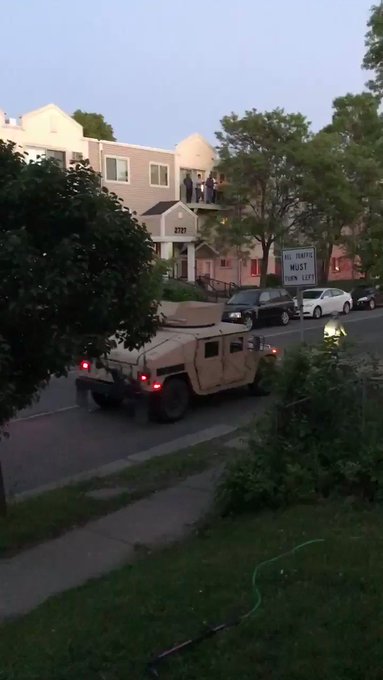
Share widely: National guard and MPD sweeping our residential street. Shooting paint canisters at us on our own front porch. Yelling “light em up” #JusticeForGeorgeFloyd #JusticeForGeorge #BlackLivesMatter
275K
9:37 PM - May 30, 2020
Twitter Ads info and privacy
203K people are talking about this
We encourage members of the national guard to refuse to take these illegal orders. Reach out to About Face: Veterans Against the War and Courage to Resist for support if you are with the national guard and want to be in solidarity with your sisters and brothers fighting for their rights and their lives. – MF
The National Guard has drastically increased its response to unrest sweeping America over what prosecutors say was the murder of a handcuffed black man by Minneapolis police. There are now more than 17,000 National Guard troops in 23 states and the District of Columbia have been activated to help quell the unrest.
That’s more than a three-fold increase in just over a day.
“The hardest mission we do is responding in times of civil unrest,” Air Force Gen. Joseph Lengyel, chief of the National Guard Bureau, said in a statement posted on the NGB homepage .”The activation of Guard members in response to civil unrest has unfolded in multiple cities in the wake of the death of George Floyd in Minneapolis.”
Protests first erupted May 26, a day after Floyd’s death in a confrontation with police captured on widely seen citizen video. On the video, Floyd can be seen pleading as Officer Derek Chauvin presses his knee against him. As minutes pass, Floyd slowly stops talking and moving. The 3rd Precinct covers the portion of south Minneapolis where Floyd was arrested. Chauvin, one of four officers fired from the force after Floyd’s death, was arrested Friday and charged with murder.
Guard troops have now been activated in Arizona, Arkansas, California, Colorado, Florida, Georgia, Illinois, Indiana, Kentucky, Michigan, Minnesota, Nevada, North Carolina, Ohio, Pennsylvania, South Carolina, South Dakota, Tennessee, Texas, Utah, Virginia, Washington, Wisconsin and D.C., according to Army Master Sgt. Michael Houk, a National Guard Bureau spokesman.
“Guard personnel assigned to these missions are trained, equipped and prepared to assist law enforcement authorities and first responders, said Lengyel. “We plan, train, and prepare for emergency response missions with our local, state, and federal partners.
“We’re part of the communities we serve,” said Lengyel. “We know the police, fire departments and hospital workers. We know their capabilities because we live with their capabilities.”
Guard members are slated to perform a variety of mission sets including traffic control, support to law enforcement, transportation and communication support. They’ve also been called up on to assist with extinguishing fires burning as a result of the unrest.
“Aircrews were using forest fire equipment, including helicopter water buckets, to put out building fires at protests last night,” said Lengyel.

General Joseph Lengyel
✔@ChiefNGB
· May 31, 2020
Today, about 5,000 National Guard Soldiers & Airmen are supporting our local & state partners responding to civil unrest in 15 states & D.C. Thousands more stand ready if needed. (1/2)
General Joseph Lengyel
✔@ChiefNGB
Responding to civil unrest is the hardest mission your National Guard does. Our unique, longstanding partnerships with local civilian first responders mean we are Always Ready, Always There to help, when needed, where it's needed. (2/2)
351
12:25 PM - May 31, 2020
Twitter Ads info and privacy
155 people are talking about this
The overall mission of Guard members is to assist local authorities and ensure safety.
“We’re here to help and assist local authorities,” said Lengyel. “Our troops are trained to protect life, preserve property and ensure people’s right to peacefully demonstrate.”
Those Guard members called up are in a state active duty status and remain under the command and control of their respective governors, said Lengyel, adding those responding will continue to adhere to COVID-19 prevention measures.
“Governors have used Guard members many times during response efforts to support local and state law enforcement in a wide range of capacities, to include assisting in upholding the rule of law.” said Lengyel. “While conditions may change, the National Guard’s ability to respond is constant.”
The activation of National Guard troops for civil unrest response brings the total number of Guard members on duty in support of their governors to nearly 62,000, according to the National Guard Bureau.
The National Guard troops are responding under the direction of their governor are traditional part time guardsmen operating under State Active Duty orders with state and local law enforcement as the lead agency, said Houk.
When it comes to rules on use of force and how Guard troops are armed, officials say each state has its own playbook.
During a press conference Sunday evening, D.C. Mayor Muriel Bowser said she requested assistance from the D.C. National Guard for up to 500 troops.
As of Monday morning, the entire DCNG has now been activated and are not armed, Air Force Senior Master Sgt. Craig Clapper, a D.C. National Guard spokesman, told Military Times. They do have protective equipment like shields and batons, he said.
“They don’t do law enforcement,” said Clapper. “They are not to engage. They are in a support role.”
Clapper said the DCNG troops are “there to keep the crowd back. If someone tries to break the line, they will push them back.”
As a precaution, Army Secretary Ryan McCarthy, in coordination with Bowser, has activated the D.C. National Guard, according to an Army official.
“The authority to activate the D.C. National Guard has been delegated by the President to the Secretary of Defense and further delegated to the Secretary of the Army,” according to the Army official. “The D.C. National Guard is the only National Guard unit, out of all of the 54 states and territories, which reports only to the President. In this status they operate similar to a state National Guard unit in Title 32 status with the same legal authorities.”
During a Sunday afternoon media call, the heads of the Colorado, Georgia and Minnesota National Guards described their rules.
Colorado National Guard troops are unarmed, said Air Force Maj. Gen. Michael A. Loh, the Colorado National Guard’s adjutant general. That was a decision made Saturday in conjunction with the Colorado governor and mayor and police chief of Denver, Loh said.
“The Denver police chief said that ‘if we have to use deadly force, I want my police officers to do it and I want you to be in support.’”
Colorado Guard troops do carry defensive weapons, like batons, tasers and pepper spray, Loh said.
For the Georgia National Guard, the standard practice is for troops to protect themselves by carrying pistols, particularly in urban environments, said Army Maj. Gen. Thomas Carden Jr., the adjutant general of the Georgia National Guard.
“We can’t envision a situation, especially here in Atlanta, where we would need a rifle, if you will,” said Carden. “We don’t engage a threat from that far out.”
In Minnesota, National Guard troops are armed, but carry their ammunition in pouches, said Army Maj. Gen. Jon Jensen, the state’s adjutant general.
The troops are armed, said Jensen, because the FBI contacted Minnesota Guard officials saying they had received “a credible, lethal threat directed against the Minnesota National Guard.” Jensen declined to elaborate.
Jensen said Minnesota Guard troops are authorized to use proportional force in response to threats.
“I cannot exceed greatly the force upon which I am threatened with,” he explained. “I always maintain the inherent right of self defense.”
Minnesota Guardsman are not armed with rubber bullets or tasers, Jensen said.
All three National Guard leaders said their troops have not yet had to use force or defensive weapons.
The generals said their troops are largely guarding critical infrastructure like hospitals and government buildings, allowing local law enforcement to provide front-line services.
Jensen said despite the ongoing tensions in Minneapolis, where the unrest began, and neighboring St. Paul, he has not yet reached out to the Pentagon to provide troops for active duty.
He said his biggest need is for military police, but that can be provided by neighboring states under a nationwide Guard compact. He would not name the two states that have agreed to provide those troops.
Houk told Military Times that the duration of the activations is unknown at this time.
“The National Guard will remain on mission as long as they’re needed,” he said.
The Associated Press has written about activations in several states.
California
A fourth day of violence in Los Angeles prompted the mayor to impose a rare citywide curfew and call in the National Guard after demonstrators clashed repeatedly with officers, torched police vehicles and pillaged businesses in a popular shopping district.

Kara Finnstrom@KaraFinnstrom
The National Guard has arrived in Los Angeles. Some members keep watch along Beverly Blvd. in Fairfax District @CBSLA

119
7:20 AM - May 31, 2020
Twitter Ads info and privacy
55 people are talking about this
Mayor Eric Garcetti said Saturday he asked Gov. Gavin Newsom for 500 to 700 members of the Guard to assist the 10,000 Los Angeles Police Department officers. The Guard members were expected to arrive early Sunday.
Garcetti said the soldiers would be deployed “to support our local response to maintain peace and safety on the streets of our city.”
Firefighters responded to dozens of fires, and scores of businesses were damaged. One of the hardest-hit areas was the area around the Grove, a popular high-end outdoor mall west of downtown where hundreds of protesters swarmed the area, showering police with rocks and other objects and vandalizing shops. One officer suffered a fractured skull, Los Angeles Police Chief Michel Moore said.
When the curfew took effect at 8 p.m., police moved aggressively to get people off the streets and there was no repeat of the late-night rampage that occurred downtown Friday night and led to more than 500 arrests.
Community leaders denounced the violence that has accompanied protests over Floyd’s death.
There were protests in cities throughout California, from San Diego to San Francisco.
San Francisco’s iconic Union Square saw people stealing leather bags from the Coach store and shoes from the Salvatore Ferragamo location, The Mercury News reported. Streets were littered with bras from Victoria’s Secret and cushioned jewelry boxes from Swarovski. Police fired tear gas to disperse protesters.
San Francisco Mayor London Breed said a citywide curfew would go into effect from 8 p.m. Sunday to 5 a.m. Monday. She also asked the governor to put the National Guard on standby.
“People are hurting right now. They’re angry. I’m angry,” Breed tweeted, “We can’t tolerate violence and vandalism.”
San Francisco Police Chief Bill Scott said he understood why protesters are angry at police. But he warned that if anyone assaulted officers, “we will not tolerate that.”
Washington, D.C.

BNO News
✔@BNONews
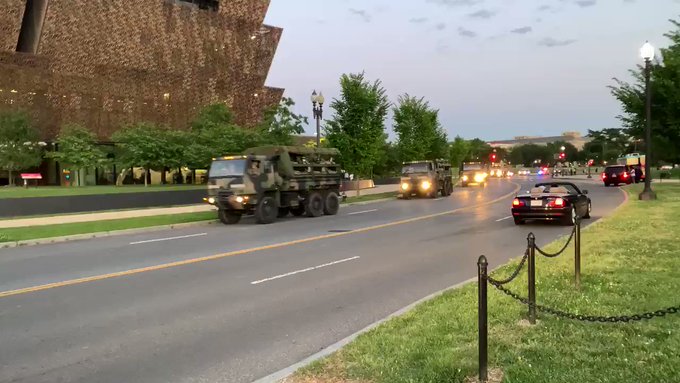
BREAKING: U.S. Army Secretary Ryan McCarthy activates D.C. National Guard to help maintain order near the White House
2,930
8:59 PM - May 30, 2020
Twitter Ads info and privacy
1,784 people are talking about this
In Washington, the National Guard was deployed outside the White House, where chanting crowds taunted law enforcement officers. Dressed in camouflage and holding shields, the troops stood in a tight line a few yards from the crowd, preventing them from pushing forward. President Donald Trump, who spent much of Saturday in Florida for the SpaceX rocket launch, landed on the lawn in the presidential helicopter at dusk and went inside without speaking to journalists.
Georgia
Atlanta’s mayor announced a curfew Saturday night and Georgia’s governor authorized up to 1,500 National Guard troops to deploy throughout the city after a Friday night protest over the death in Minnesota of George Floyd turned violent.
Atlanta Mayor Keisha Lance Bottoms urged unity and nonviolence during a news conference Saturday evening. She said the curfew would be in effect from 9 p.m. Saturday to sunrise on Sunday, calling it a “very unusual and extreme step.”
Bottoms, who made a passionate and personal plea to protesters the night before, also noted that Friday’s demonstration, which began peacefully, took place amid a pandemic.
“If you were out protesting last night, you probably need to go get a COVID test this week,” she said. “There is still a pandemic in America that’s killing black and brown people at higher numbers.”
Officials were also bracing for the possibility of new outbreaks of violence.
Atlanta Police Chief Erika Shields said at a news conference that they would have a zero tolerance policy Saturday night.
“Yes, you caught us off balance once. It’s not going to happen twice,” she said, later adding, “Quite frankly, I’m ready to just lock people up.”
Missouri
Gov. Mike Parson on Saturday evening activated the Missouri National Guard to help respond to protests around the state that he described as creating hazards to safety, welfare and property that are beyond the abilities of local authorities to manage.
But St. Louis County Executive Sam Page and state Rep. Raychel Proudie, a Democrat from Ferguson, urged Parson not to send the Guard members to the St. Louis area. They said nothing in the community is being destroyed, the St. Louis Post-Dispatch reported. Page said he’s spoken to the county’s police chief, who assured him that local law enforcement would be able to maintain safety.
Protests continued Saturday in the St. Louis area, in Kansas City and elsewhere in the state in response to the death of Floyd.
In Kansas City, five people were arrested in Saturday evening protests in and near the Country Club Plaza shopping and entertainment district, the Kansas City Star reported. Mayor Quinton Lucas had earlier told reporters that he knew there was a lot of pain in the community and nation and called on the hundreds gathered near the plaza to think about change and to protest peacefully.
Local media reported that police used tear gas to force protesters out of streets and onto sidewalks in the plaza area. The plaza managers announced earlier in the day that the shops and restaurants in the district would close Saturday afternoon and remain closed Sunday because of planned protests.
On the other side of the state, the Post-Dispatch reported about 500 people were protesting peacefully Saturday evening in Ferguson, where 18-year-old Michael Brown was fatally shot by Ferguson police officer Darren Wilson in 2014. The resulting protests strengthened the fledgling Black Lives Matter movement. Protesters marched in other St. Louis-area communities earlier in the day.
Minnesota
In Minneapolis, the city where the protests began, police, state troopers and National Guard members moved in soon after an 8 p.m. curfew took effect Saturday to break up protests, firing tear gas and rubber bullets to clear streets outside a police precinct and elsewhere.

Donald J. Trump
✔@realDonaldTrump
The National Guard has been released in Minneapolis to do the job that the Democrat Mayor couldn’t do. Should have been used 2 days ago & there would not have been damage & Police Headquarters would not have been taken over & ruined. Great job by the National Guard. No games!
294K
9:08 PM - May 30, 2020
Twitter Ads info and privacy
141K people are talking about this
The show of force came after three days when police largely avoided engaging protesters, and after the state poured in more than 4,000 National Guard troops to Minneapolis and said the number would soon rise to nearly 11,000.
“The situation in Minneapolis is no longer in any way about the murder of George Floyd,” said Gov. Tim Walz, who also said local forces had been overmatched the previous day. “It is about attacking civil society, instilling fear and disrupting our great cities.”
Minneapolis’ streets steadily grew calmer as the night went on, and Corrections Commissioner Paul Schnell said the tough response would remain as long as it takes to “quell this situation.”
Ohio
The governor of Ohio said he was calling out the Ohio National Guard and also asking the highway patrol to help enforce laws in Columbus as the mayor of that city and Cleveland both announced 10 p.m. curfews following damage to businesses amid protests over the death in Minneapolis of George Floyd.
Gov. Mike DeWine said the vast majority of protesters wanted “simply to be heard” and focus attention on the death of Floyd and other injustices.
“But the voices calling for justice, the voices calling for change, are sadly being drowned out by a smaller group of violent individuals … (who) threaten the safety of our citizens, of the community,” the Republican governor said. “Acts of violence cannot, and will not, be tolerated. This violence must stop.”
Columbus Mayor Andrew Ginther said he believed racism “is a public health and safety crisis” and he wanted to see a more equitable city, but “we are now at a point that we can no longer tell who is protesting for change and an end to racism and who has only chaos and destruction in mind.”
Ginther said more than 100 public and private properties had been damaged and at least 10 robbed of goods, five police officers were injured by thrown bricks or rocks and police vehicles had been set afire.
The Columbus Dispatch reported that U.S. Rep Joyce Beatty, Franklin County Commissioner Kevin Boyce and Shannon Hardin, president of the Columbus City Council, were among those pepper-sprayed at a protest Saturday morning.
South Dakota
South Dakota Gov. Governor Kristi Noem activated the National Guard after protests in Sioux Fall turned violent over the death of George Floyd in Minneapolis last week.
The Argus Leader reports the protest in South Dakota’s largest city started Sunday afternoon with a march downtown. Police said dozens of protesters later congregated at the Empire Mall and began throwing rocks at officers.
Several businesses in the area of the Empire Mall had windows damaged.
Police said protesters had dispersed by 11 p.m.
Noem said about 70 Guard members are in Sioux Falls and will remain until they are no longer needed.
“Rioting and looting will not be tolerated in South Dakota,” Noem said.
Utah
In Salt Lake City, protesters defied a curfew and National Guard troops were deployed by Utah’s governor. Demonstrators flipped a police car and lit it on fire, and another vehicle was later set ablaze. Police said six people were arrested and a police officer was injured after being struck in the head with a baseball bat.
Washington
Washington Gov. Jay Inslee late Sunday ordered a statewide activation of the National Guard following vandalism and thefts in stores and shopping malls in multiple cities following protests over the killing of George Floyd.
And police in Portland, Oregon, deployed incendiary devices to disperse a large crowd in downtown late Sunday night after authorities said projectiles – including aerial mortars – were thrown at officers.
Inslee had previously authorized 400 troops for Seattle and 200 troops for Bellevue. On Saturday night, people smashed downtown Seattle storefronts and stole items from many businesses, tossing mannequins into the street. On Sunday, there were thefts in stores and shopping malls in Bellevue, Spokane, Tukwila and Renton.
Inslee’s activation means more troops will be used to help control unrest.
“We must not let these illegal and dangerous actions detract from the anger so many feel at the deep injustice laid so ugly and bare by the death of George Floyd,” Inslee said in a statement. “But we also will not turn away from our responsibility to protect the residents of our state.”
This story has been corrected. The National Guard provided the wrong information about which states have activated Guard troops in this response.
MORE THAN 10,000 PEOPLE REPORTEDLY ARRESTED AT US PROTESTS
By AP News.
June 6, 2020
https://popularresistance.org/more-than-10000-people-reportedly-arrested-at-us-protests/
Los Angeles Has Had More Than A Quarter Of The National Arrests, Followed By New York, Dallas And Philadelphia, According To An Associated Press Tally.
More than 10,000 people have been arrested in protests decrying racism and police brutality in the wake of George Floyd’s death, according to an Associated Press tally of known arrests across the U.S.
The count has grown by the hundreds each day as protesters spilled into the streets and encountered a heavy police presence and curfews that give law enforcement stepped-up arrest powers.
Los Angeles has had more than a quarter of the national arrests, followed by New York, Dallas and Philadelphia. Many of the arrests have been for low-level offenses such as curfew violations and failure to disperse. Hundreds were arrested on burglary and looting charges.
As cities were engulfed in unrest last week, politicians claimed that the majority of the protesters were outside agitators, including a contention by Minnesota’s governor that 80 percent of the participants in the demonstrations were from out of state.
The arrests in Minneapolis during a frenzied weekend tell a different story. In a nearly 24-hour period from Saturday night to Sunday afternoon, 41 of the 52 people cited with protest-related arrests had Minnesota driver’s licenses, according to the Hennepin County sheriff.
In the nation’s capital, 86 percent of the more than 400 people arrested as of Wednesday afternoon were from Washington, D.C., Maryland and Virginia.
It is not known how many of the people arrested were locked up — an issue at a time when many of the nation’s jails are dealing with coronavirus outbreaks. The protesters are often placed in zip-ties and hauled away from the scene in buses.
In Los Angeles, an online fundraising campaign has gathered $2 million so far to help more than 3,000 people arrested in demonstrations since Floyd died on May 25 in Minneapolis.
Kath Rogers, executive director of the Los Angeles office of the National Lawyers Guild, said she was surprised by the huge number of arrests in that city. The office is calling on those arrested to be in contact so they can be part of the group’s mass defense. So far, they have heard from about 400 people, she said.
She said some people had been swept up in the arrests because they were in the wrong place at the wrong time, like a woman who was simply going for an evening walk and wasn’t part of the protest. Or a young man who was taking pictures of the looting with his phone and then was arrested for looting.
“I’ve been here for two years and we go to hundreds of demonstrations, but I’ve never seen rubber bullets flying like this, tear gas used this way,” she said.
Los Angeles Chief Michel Moore told the city’s Police Commission Tuesday the bulk of the arrests, about 2,500, were for failure to disperse or curfew violations.
The rest were for crimes including burglary, looting, assaults on police officers and other violence, Moore told the panel, which functions as the police department’s civilian oversight board.
The only other U.S. city with an arrest toll that comes close to Los Angeles’ is New York, with about 2,000, according to AP’s tally.
A Los Angeles group called the Peoples City Council Fund as of Wednesday night had gathered more than $2 million for arrested protesters there through the online fundraising platform gofundme. More than 46,000 people donated mostly small amounts, some just $10 or $20.
Fundraiser organizers said hundreds of thousands of the dollars raised will go to Black Lives Matter LA as well as the National Lawyers Guild, a progressive group that has been defending civil rights activists since the 1930s.
The AP tally didn’t take into account any additional arrests still unreported from Wednesday evening.
Subscribe to:
Comments (Atom)