Sunday, June 7, 2020

NEW YORK POLICE ARE ATTACKING PROTESTERS — THEY KNOW THEY WON’T FACE CONSEQUENCES
Alice Speri, Ryan Devereaux, Sam Biddle
https://theintercept.com/2020/06/02/new-york-police-protesters-george-floyd/
AS THOUSANDS OF PROTESTERS converged in Brooklyn on Monday evening, NYPD scanners picked up a bit of radio chatter that stood out even in the atmosphere of boiled-over police violence. After a police dispatcher noted protester movement near the 77th Precinct, a voice on the same channel replies clearly: “Shoot those motherfuckers.” Just as clear was the immediate response: “Don’t put that over the air.”
The exchange, at 6:20 p.m., was captured via Broadcastify, one of many publicly accessible websites that allow users to listen in on police and other emergency radio channels nationwide. These sites have “skyrocketed to the top of the App Store” in the wake of George Floyd’s killing by police in Minneapolis, Vice reported this week. An NYPD spokesperson confirmed the radio exchange and told The Intercept that it is under internal review.
After days of increasingly violent repression of protests across the country, and after President Donald Trump called for protesters looting stores to be shot and Defense Secretary Mark Esper called U.S. cities a “battlespace” — the radio message was yet another indicator that police see protesters as enemies to combat rather than the citizens they are sworn to protect. But the chatter was also a sign of how emboldened police have become in calling for violence, and how little they seem to fear repercussions for violent attacks on civilians.
In New York City, as across the country, officers have responded to protests prompted by anger at police violence and lack of accountability with yet more violence and, mostly, no consequence. Over the last several days, NYPD officers have beaten protesters with nightsticks, ripped off masks to pepper-spray them at close range, driven their vehicles into crowds, and in at least one occasion pointed a gun at a group of demonstrators. These incidents, police critics say, represent a significant escalation while also being consistent with a long pattern of violence and lack of accountability by the country’s largest police department. The abuse has been enabled by laws that shield officers from accountability and by barriers to police oversight — as well as by city leaders who have long allowed police to operate with impunity.
“The disturbing videos and reports of the violent attacks by NYPD on protestors and the media, while traumatizing to watch, are all too familiar to us,” a group of New York City public defenders wrote in a statement on Tuesday. “They mirror the stories we hear every day of police acting with impunity, targeting, attacking, beating, lying, abusing, and disrespecting Black and brown people in the communities we serve in all five boroughs.”
In response to the police crackdown, NYPD Commissioner Dermot Shea expressed his pride as he congratulated his officers for their actions — days after condemning the officers who killed George Floyd in Minneapolis, calling their actions “deeply disturbing” and “not acceptable ANYWHERE.” Mayor Bill de Blasio, for his part, who also condemned Floyd’s killing in Minneapolis, continued his long-held practice of defending police misconduct in the face of indisputable evidence and attempted to shift the blame to protesters.
“I’ve seen that video and I’ve obviously heard about a number of other instances. It’s inappropriate for protesters to surround a police vehicle and threaten police officers,” de Blasio said earlier this week, in reference to one of those incidents. “If a police officer is in that situation, they have to get out of that situation.”
The Civilian Complaint Review Board, New York’s independent office for investigating police abuses, has received 467 complaints since Friday, when the protests started, “and is committed to fully investigating them,” a board spokesperson told The Intercept. But the police department is investigating only six, according to Shea. The NYPD spokesperson did not answer questions about several instances of police violence and misconduct that were caught on video. A spokesperson for the Attorney General’s office told The Intercept they are aware of the NYPD radio exchange, but declined to comment further or provide detail on any other ongoing investigation into police actions.
Despite the videos, advocates and victims of police violence fear that the officers involved in these incidents will escape accountability, as a number of officers assigned to protests have begun covering the badge numbers necessary to identify them. The NYPD did not comment on officers covering their badges.
Covering one’s badge number is in direct violation of the NYPD’s patrol guide, which allows officers to wear “mourning bands” covering the seal of the city upon the death of an officer but mandates that the seal number and rank remain visible. In April, Shea wrote on Twitter that some officers would be wearing mourning bands in commemoration of NYPD officers who died of Covid-19.
But covering one’s badge number also violates New York’s Right to Know Act, which mandates officers identify themselves by name, rank, and shield number when they interact with people. The act, which went into effect in 2018, also requires officers to inform those they stop that they have a right to refuse consent for a search, and to document those requests.
“It’s basically protecting NYPD officers from being held accountable in these mass protests, where they’re not actually following the law themselves,” said Jennvine Wong, a staff attorney at the Legal Aid Society’s Cop Accountability Project, in reference to growing reports of cops covering their badges. “Not only are they not following the law when it comes to the way that they’re interacting with individuals, but they’re also not providing the information that they should be providing when they’re interacting with the public.”
Officers had ignored their obligations under the Right to Know Act long before this week’s protest, Wong noted. She called it a “long-standing pattern with the NYPD.”
“It’s really problematic, because it makes it very difficult for advocates for individuals who are the victims of police brutality to hold these officers accountable if we’re not able to identify them,” she added. “And so not only are they acting with impunity, but they are actively trying to hide their identities from people who would hold them accountable. … They’re attacking protesters, and they’re covering their badge numbers. And so, even if we captured them on camera, how are we supposed to hold them accountable?”
For the most part, New York law protects officers from meaningful accountability. For years, before this week’s protests, advocates have lobbied legislators to repeal a decades-old state law known as “50-a,” which makes the personnel records of law enforcement officers “confidential and not subject to inspection or review.” As The Intercept has reported, officials have responded to pressure for greater police transparency with even stricter interpretations of 50-a, making everything from complaints of misconduct to the findings of internal reviews, to body camera footage largely inaccessible to the public. Efforts to repeal 50-a in court have failed, but the legislation was back in the spotlight this week after Floyd was killed in Minneapolis. Derek Chauvin, the officer accused of killing Floyd, had 18 previous complaints of misconduct filed against him.
In New York, which has one of the strictest laws in the country protecting the privacy of law enforcement officers, Gov. Andrew Cuomo surprised advocates this week when he expressed support for repealing 50-a, despite the fact that the legislation has been hotly debated during the nine years he has been in office. “I would sign a bill today that reforms 50-a,” Cuomo said. “I would sign it today.” De Blasio has defended 50-a, and under his administration the city has stopped making the outcomes of internal disciplinary reviews available to the public.
A spokesperson for Gov. Cuomo told The Intercept that “the Governor supports reforming 50-A, and has said he will sign a bill that does that,” adding that Cuomo “has asked the Attorney General to review all actions and procedures used during the protests.”
But advocates were skeptical of the governor’s promise — and insisted that the legislation should be repealed rather than simply amended. “He’s been silent on it previously,” said Wong, of Legal Aid. “This is a movement that advocates have been working on for years and years and years — they’ve been pushing for a repeal of 50-a forever.”
“New Yorkers have been demanding change for years,” Council Member Antonio Reynoso echoed in a statement condemning the NYPD and the mayor’s handling of the protests. “The NYPD needs to immediately release the disciplinary records of all officers, and where patterns of misconduct by individual officers are discovered, those officers must be terminated immediately and prosecuted where appropriate.”
Even before the recent wave of protests, the coronavirus emergency had offered police a new opportunity to escape scrutiny. A city official, speaking to The Intercept on the condition of anonymity, said that the CCRB was already in a tough position before the protests began. With New York City the epicenter of Covid-19, CCRB investigators, like other city employees, have been working remotely for weeks. Although investigations into police misconduct can be done remotely, the official said — much of it involves pushing through cases that came in long before the pandemic — the novel coronavirus has presented unique problems.
First, the official said, the CCRB frequently fields complaints from populations for whom physical visits to the board’s office is a necessity: individuals who lack access to phones or the internet and, in particular, New York City’s unhoused. “The other side of it is the PBA,” the official said — the Patrolmen’s Benevolent Association, the hard-right union representing New York City’s cops. “There have been no officer interviews since the beginning of Covid,” the official said, adding that without cooperation from the PBA, oversight investigators can only go so far. All of this, of course, comes after weeks of controversy surrounding the NYPD’s hard-line enforcement of local social distancing guidelines — and, now, its hammer-fist approach to policing protests. The PBA could not be reached for comment prior to publication.
While few expect the police department itself to conduct fair investigations of officer abuse during the protests, advocates warned that the questionable arrests and excessive force displayed in recent days would likely lead to scores of civil lawsuits against the city. Last year, the city paid $69 million to settle lawsuits over police misconduct, an increase of nearly $30 million over the previous year. And litigating misconduct lawsuits cost the city some $230 million in 2018 and $335.5 million in 2017.
Massive taxpayer-funded payouts over police misconduct are likely to come under increased scrutiny this year, since the economic impact of the Covid-19 crisis is forcing the city to slash its budget for next year by $6 billion. But, as The Intercept has reported, there is one city agency that has been largely spared the across-the-board cuts: the NYPD.
A SHORT HISTORY OF U.S. LAW ENFORCEMENT INFILTRATING PROTESTS
Ryan Grim, Jon Schwarz
https://theintercept.com/2020/06/02/history-united-states-government-infiltration-protests/
WHEN Harry, George, Tom, and Joe showed up at a warehouse outside Philadelphia rented by protesters, organizers were immediately suspicious. The men claimed to be “union carpenters” from the Scranton, Pennsylvania, area who built stages — just the kind of help the protesters needed. They were preparing for the Republican National Convention in 2000, where the party would be nominating George W. Bush. Across the country, allied organizers were planning similar protests for the Democratic National Convention in Los Angeles.
One of the hallmarks of the social justice movement at the time was its puppets. Organizers were coming off successful protests in Seattle in November 1999 against the World Trade Organization, and in Washington, D.C., in April 2000, against the International Monetary Fund and World Bank, and had managed to reshape the politics of globalization. Soaring papier-mache puppets, rolled through the streets on individually constructed floats, projected a festive air, capturing sympathetic media coverage and countering the authorities’ narrative that the protesters were nihilists simply relishing in property destruction.
The four carpenters were good with a hammer, but much about them had protesters wary they were in fact infiltrators. In conversation, “they were not very political or well informed,” recalled Kris Hermes, an organizer, in “Crashing the Party,” his memoir of the affair. They were older and more muscular than most protesters, he wrote, and they insisted on drinking beer while working, despite the organizers’ ban on drinking in the warehouse. In discussions and meetings, they asserted the right of protesters to destroy property and to physically resist arrest. The movement’s intentional lack of hierarchy left organizers with little ability to act on their suspicions of infiltration, even as they were becoming more deft at sussing out such provocateurs.
On August 1, the first full day of the Republican convention, police surrounded the warehouse, known as the “Ministry of Puppetganda,” executed mass arrests, and confiscated the puppets, floats, signs, and other materials to be used in upcoming marches. The police lied, publicly saying that organizers had been planning violent demonstrations and hinting darkly at bomb-making materials being hidden in the warehouse. That roundup presaged other mass arrests of protest leaders throughout the week, followed by beatings inside the jail and even a $1 million bond.
When the warrant for the warehouse raid was unsealed, it finally confirmed that Harry, George, Tom, and Joe had been state troopers assigned to infiltrate the group and produce a pretext for a raid. All of the charges against the puppeteers were eventually dropped, and the saga would eventually cost the city millions in lawsuit settlements (with much of the legal work led by radical attorney Larry Krasner, who is now Philadelphia district attorney).
It is a historical fact, as this episode illustrates, that law enforcement frequently infiltrates progressive political movements using agent provocateurs who urge others to engage in violence. It is also a historical fact that, more rarely, such provocateurs commit acts of violence themselves.
The media pays little attention to such infiltrators, for a variety of reasons. On the one hand, corporate media has never taken much enthusiasm in questioning government action in the midst of riots or major demonstrations, unless that action goes wildly over the line or targets members of the media. The subject of provocateurs is also fraught from the perspective of protesters and movement organizers, as it can lead to paranoia that undermines solidarity and movement building. It is often conflated with the trope of “outside agitators” and used by authorities or other opponents of the protesters to delegitimize the anger on display, giving some protesters or their supporters an incentive to downplay the reality of the provocations.
The intensity of the conversation around protests that turn violent, and the life-or-death consequences of winding up on the wrong side of public opinion, leaves little room for a nuanced discussion. Were such a conversation possible, it would be easy to talk about the difference between the anger of a crowd and the actions it ultimately takes. An angry crowd that remains nonviolent and engages in zero property destruction is no less legitimately angry than one that does. Often the only difference is in whether and how the anger is triggered and escalated.
In protests across the country over the past week, the clear actor escalating the violence generally hasn’t been a protester or even a right-wing infiltrator, but the police themselves. In rally after rally, people have observed that looting and destruction only began after police charged and beat a crowd, or fired tear gas or rubber bullets into it. In other cases, it can take just one act by a protester to light the spark. Given the chaotic nature of the protests, it’s probable that everyone being blamed for property damage has played some role. But as the protests continue, and President Donald Trump calls for ever more violent methods of repression, the possible role of police provocateurs in protests is worth bearing in mind.
IN 2008, Francesco Cossiga, one of the most important political figures in post-World War II Italy, provided a rare glimpse behind the curtain at how the world looks to people at the top of governments facing large-scale protests.
Cossiga had served as prime minister and then president of Italy. Before that, in the late ’70s, he led the Ministry of the Interior. During that period, he was notorious for the brutality with which he put down left-wing demonstrations led by students. This is how the New York Times reported the situation in 1977: “Extremists among the students have created chaos in a number of Italian cities with a wave of shooting and destruction.”
As Silvio Berlusconi’s administration faced similarly threatening protests, Cossiga urged them to rerun his playbook:
[They] should do what I did when I was interior minister. … Pull back police from streets and colleges, infiltrate the movement with provocateurs ready for anything [emphasis added], and for ten days let protesters devastate shops, burn down cars, and set cities aflame. Then, emboldened by popular support … police should have no mercy and send them all to the hospital. Not arrest them, because prosecutors would just free them right away, but beat them all and beat the professors that encourage them.
The Times appears to have mentioned the possibility that government provocateurs were behind some of the violence once — and then not as fact, but as an accusation of “leftwing parties and newspapers.”
Cossiga had been a professor of constitutional law and was a centrist Christian Democrat. When he became prime minister in 1979, Jimmy Carter’s ambassador to Italy saw this as an “excellent development,” and Cossiga maintained a strong relationship with America. There is no direct line between Cossiga and today’s protests in the U.S. But his example indicates that it’s no fevered conspiracy theory to believe reasonable, reputable figures see provocateur tactics as legitimate — even if most of them are more circumspect in public.
THE BEST documented use of provocateurs by the U.S. government occurred during the Federal Bureau of Investigation’s Counter-Intelligence Program, or COINTELPRO, from 1956 to 1971. The reason the documentation is available is because a group of citizens broke into an FBI office in Pennsylvania — coincidentally, just a short drive from the warehouse targeted by police in 2000 — and stole files that they then passed to the media. This, in turn, led to congressional investigations, which pried loose more information.
In one notorious example in May 1970, an informant working for both the Tuscaloosa police and the FBI burned down a building at the University of Alabama during protests over the recent Kent State University shootings. The police then declared that demonstrators were engaging in an unlawful assembly and arrested 150 of them.
In another well-known case, a man nicknamed “Tommy the Traveler” visited numerous New York State colleges, posing as a radical member of Students for a Democratic Society. He encouraged acolytes to kidnap a congressman and offered training in Molotov cocktails. Two students at Hobart College acted on his suggestions and firebombed the campus ROTC building. Eventually it came out that his full name was Tommy Tongyai, and he had worked both for local police and the FBI.
The list goes on and on from there. A John Birch Society member turned FBI informant helped assemble time bombs and placed them on an Army truck. An FBI informant in the radical political organization Weather Underground took part in the bombing of a Cincinnati public school. A prominent member of Vietnam Veterans Against the War — and FBI informant — pushed for “shooting and bombing,” and his advocacy apparently did indeed lead to a bombing and a bomb threat. An FBI informant in Seattle drove a young black man named Larry Ward to a real estate office that engaged in housing discrimination and encouraged him to place a bomb there; the police were waiting and killed Ward. Thirteen Black Panthers were accused of a plot to blow up the Statue of Liberty after receiving 60 sticks of dynamite from an FBI informant. After 28 people broke into a federal building to destroy draft files in 1971, an FBI informant bragged, “I taught them everything they knew.” All 28 were acquitted when his role was revealed.
The FBI also allowed informants within right-wing organizations to participate in violence against progressive activists. Gary Thomas Rowe, who infiltrated the Ku Klux Klan in 1960, provided the FBI with three weeks warning that the Klan was planning attacks on Freedom Riders arriving in Alabama from the north. The FBI stood by and allowed the attacks to occur. Local police gave the Klan 15 minutes to assault the activists. In those 15 minutes, the white supremacists — including Rowe — set the Freedom Rider bus on fire in an attempt to burn them alive.
Rowe may also have played a role in the infamous 1963 bombing of the 16th Street Baptist Church in Birmingham, Alabama, which killed four young girls. He was in the car with three other Klansmen in 1965 when they chased down and murdered Viola Liuzzo, a mother of five from Detroit who’d traveled to Selma. Rowe received immunity for testifying against his compatriots, and was given a job as a U.S. Marshall by Lyndon Johnson’s attorney general.
Local police informants without apparent connections to the FBI got into the act too. A deputy sheriff enrolled as a student at SUNY Buffalo and helped students build and test bombs. Another informant posed as a student at Northeastern Illinois State College, led sit-ins for Students for a Democratic Society, and encouraged compatriots to sabotage military vehicles.
Soon after COINTELPRO was uncovered in 1971, the FBI announced that it was halting all such activities. Mark Felt, the assistant FBI director now also known to be the infamous “Deep Throat” source for Bob Woodward and Carl Bernstein, later said that the bureau had made no effort to see that “constitutional values are being protected.”
When and whether the FBI ever stopped, however, is an open question. In 1975 an informant told the New York Times that he had engaged in COINTELPRO-like activities until he’d left the previous year. This included encouraging a Maoist group to blow up a bus at the 1972 GOP convention in Miami.
In any case, police forces in the U.S. continued the same tactics. In 1978, an undercover officer encouraged two hapless young activists to seize control of a television tower in Puerto Rico. When they arrived, they were gunned down by 10 policemen. Tellingly, when Puerto Rican government asked the FBI to investigate what happened, the FBI gave the government a clean bill of health. A top FBI official later called this a “coverup.”
After 9/11, the FBI got back in the business of encouraging violent acts in a big way — although they were generally much more careful to step in before the violence actually occurred. When journalist (and Intercept contributor) Trevor Aaronson examined U.S. prosecutions for international terrorism in the decade after the attacks, he found five examples of actual plots. By contrast, 150 people were indicted in sting operations that existed only thanks to the encouragement of the FBI and its informants. According to Aaronson, “the FBI is much better at creating terrorists than it is at catching terrorists.”
The same tactics have been used to generate purported domestic terrorism plots. In 2008 environmental activist Eric McDavid was sentenced to 20 years in prison for plotting to damage the Nimbus Dam in California. Eight years later, a judge ordered him released because the FBI had withheld evidence regarding a government informant. In 2012, the FBI and its informant essentially created a plot to blow up a bridge in Cleveland out of whole cloth, and dragged five Occupy activists into it.
Most recently, the FBI’s Counterterrorism Division invented something called the “Black Identity Extremism” movement. As portrayed by an FBI report, the threat from the imaginary movement reads as strikingly similar to that allegedly posed by black organizations during the days of COINTELPRO. The National Organization of Black Law Enforcement Executives said this “resurrects the historically negative legacy of African American civil rights leaders who were unconstitutionally targeted and attacked by federal, state, and local law enforcement agencies.”
That brings us to the present day. On the one hand, this history doesn’t mean that the FBI or local police are currently acting as provocateurs during the current unrest. But it does mean that such activity is clearly one avenue that is open to U.S. police forces looking to undermine protests and escalate violence.
MINNEAPOLIS POLICE UNION PRESIDENT: “I’VE BEEN INVOLVED IN THREE SHOOTINGS MYSELF, AND NOT A ONE OF THEM HAS BOTHERED ME”
[PSYCHOPATH]
https://theintercept.com/2020/06/02/minneapolis-police-union-bob-kroll-shootings/
Ryan Grim, Aída Chávez
IN AN INTERVIEW in April, Lt. Bob Kroll, head of Minneapolis’s police union, said that he and a majority of the Minneapolis Police Officers’ Federation’s board have been involved in police shootings. Kroll said that he and the officers on the union’s board were not bothered by the shootings, comparing themselves favorably to other officers.
“There’s been a big influx of PTSD,” Kroll said. “But I’ve been involved in three shootings myself, and not one of them has bothered me. Maybe I’m different.”
His comments underscore the rampant nature of police violence in the United States. The number of times police officers fire their weapons swamps the level of violence in most other countries, where authorities rely on nonlethal methods of coercion, persuasion, or control. Many police officers live with post-traumatic stress disorder induced by the violence associated with policing.
But not Kroll’s crew, he said. “Out of the 10 board members, over half of them have been involved in armed encounters, and several of us multiple. We don’t seem to have problems,” he said. “Certainly getting shot at and shooting people takes a different toll, but if you’re in this job and you’ve seen too much blood and gore and dead people then you’ve signed up for the wrong job.”
Kroll has been a central figure in the unfolding protests and riots following the killing of George Floyd by Minnesota police officer Derek Chauvin. In a letter to union members on Monday, Kroll called Floyd a “violent criminal” and described the ongoing protests as a “terrorist movement” that was years in the making, starting with a minimized police force. He railed against the city’s politicians, namely Minneapolis Mayor Jacob Frey and state Gov. Tim Walz, for not authorizing greater force to stop the uprising. “The politicians are to blame and you are the scapegoats,” he wrote.
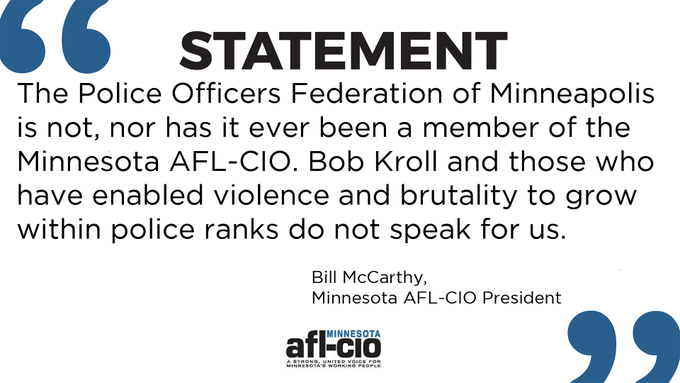
On Tuesday afternoon, the Minnesota AFL-CIO called for Kroll’s resignation, blaming him for his role in “[enabling] violence and brutality to grow within police ranks.” Police forces across the country have been escalating violence against demonstrators; driving vehicles into crowds; firing rubber bullets, tear gas, and flash grenades at largely peaceful gatherings; and even killing a man in Louisville, Kentucky.

Minnesota AFL-CIO@MNAFLCIO
Minnesota AFL-CIO Calls for Minneapolis Police Union President Bob Kroll’s Immediate Resignation https://aflcio.mn/3013vwN #BlackLivesMatter #GeorgeFloyd #1u #mnleg
5,083
1:26 PM - Jun 2, 2020
Twitter Ads info and privacy
2,316 people are talking about this
THE CONVERSATION, “The Nothing Sacred Interview Lieutenant Bob Kroll,” was posted to YouTube and Facebook on April 29, but has gone largely overlooked. Kroll, in the interview with STIM Radio host Maxwell Thomas Silverhammer, also discusses efforts by the mayor and city council to pressure the police and other unionized workers to forgo raises in order to help the city mitigate the budgetary crisis brought about the coronavirus pandemic.
“The first thing we said was OK, let’s see the budget, let’s see the city budget. And guys they’re pissing away, millions and millions of dollars to projects,” he said. “Like, you know, they’re giving $15,000 a year to the transgender coordinator of the city.”
Kroll said that he asked for an assessment of how much the city would save by postponing raises for the officers and said he was told that it would come to $410,000. That was an unacceptable sum, he said, because the city had been spending similar amounts settling claims of wrongful death by police officers. Kroll’s curious logic argued that the police should be held blameless for the costly settlements because the true blame rested with city attorneys, who didn’t properly defend police officers when they were sued after fatal shootings.
“They just paid a former Minnesota Viking $385,000 in an out-of-court settlement because he was tased when he wouldn’t leave a bar,” Kroll said, apparently not considering the possibility that the police could have declined to tase him. “The cops tased him,” Kroll said.
“You’re giving away money left and right in lawsuits, and you want us to take a bath? So forget it,” Kroll said, adding that the settlement with the family of Terrance Franklin particularly bothered him. Franklin, a burglary suspect, unarmed and 173 pounds, was found hiding in a basement by five officers who unleashed a dog on him. His family’s attorneys say an officer’s semiautomatic weapon accidentally went off, hitting two officers in the legs, and police responded by shooting and killing Franklin in anger. Police claimed that Franklin attacked an officer and took control of the gun, a charge the family’s attorneys said was absurd and contradicted by evidence. The city eventually agreed to a $795,000 settlement. Kroll said that a good friend of his had killed Franklin: “stepped up and shot him in the head at close range.”
“The Franklin one was near and dear to my heart because he shot two friends of mine, and a very good friend of mine was the one who shot and killed him in the confrontation,” Kroll said.
Kroll’s politics are not incidental to what is effectively a police riot underway in Minnesota and across the country. He’s one of Minnesota’s more outspoken supporters of President Donald Trump and took the stage with him at a 2019 campaign rally to praise the administration for “letting the cops do their jobs.”
According to a 2015 Star Tribune report, Kroll clocked at least 20 internal affairs complaints during his three decades in the Minneapolis Police Department, “all but three of which were closed without discipline.” There have also been several lawsuits against Kroll, detailing a long history of allegations of bigoted comments, including one that accused him of using excessive force against an elderly couple during a no-knock raid and another that accused him of “beating, choking, and kicking” a biracial 15-year-old boy while “spewing racial slurs.”
“The big buzzword they had was deescalation,” Kroll said of police reform efforts. “You’re supposed to, you know, even if you’re lawful in using force, it could look bad and give a bad public perception.”
Being trained not to use force is what’s causing officers stress, Kroll said. “Certainly cops, it’s not in their nature. So you’re training them to back away,” he said. “And it’s just not a natural — that’s where a lot of the stress does come from with the cops is not [having] the ability to grab somebody and say, no, step back or you’re going to jail and if need be, by force.”
Kroll also mocked the concept of procedural justice, an institutional reform meant to reduce police use of force through diversity and anti-bias training, saying that it’s an opportunity for people of color to get back at white men. He said that in his early days of training, the rule was to “ask them nicely to do something the first time,” then give them a “direct, lawful order” to do so, and if they refuse — “you make them with force, that’s how you get compliance.”
“Those days are over,” he said. “Now, it is ask them, love them, call, you know, give them their space and give them their voice. And this is what they’re training new officers. … Our cops went through that and they’re going, ‘Oh my God.’ Yeah, procedural justice. And the theory behind it being that, you know, the white men have oppressed everyone else for 200 years. So it’s their opportunity to get back.”
Minneapolis Police Officers Federation did not respond to a request for comment.
Subscribe to:
Comments (Atom)