Sunday, June 7, 2020

Saturday, June 6, 2020
We Crunched the Numbers: Police — Not Protesters — Are Overwhelmingly Responsible for Attacking Journalists
Trevor Timm
https://theintercept.com/2020/06/04/journalists-attacked-police-george-floyd-protests/
WE ARE WITNESSING a truly unprecedented attack on press freedom in the United States, with journalists are being systematically targeted while covering the nationwide protests over the killing of George Floyd by Minneapolis police.
The scale of the attacks is so large, it can be hard to fathom. At the U.S. Press Freedom Tracker, a project of Freedom of the Press Foundation and the Committee to Protect Journalists, we catalogued 150 press freedom violations in the United States in all of 2019. We are currently investigating 280 from just the last week.
The crisis has rightly generated international outrage. Some have pushed a narrative — fueled by commonly used phrases like “journalists are being attacked by police and protesters alike” — that police and protesters are attacking journalists at relatively equal rates.
Our data shows this is incorrect. Police are responsible for the vast majority of assaults on journalists: over 80 percent.
At the Tracker, we document violence against journalists from all perpetrators, whether it comes from the police, protesters, or bat-wielding racist vigilantes (yes, that really happened). And the data could not be more clear.
Here is a breakdown of our preliminary numbers, as of the morning of June 4:

U.S. Press Freedom Tracker
✔@uspresstracker
LATEST DATA, MAY 26-JUNE 3:
*279+ total press freedom incidents*
—45+ arrests
—180 assaults (149 by police)
—40 equipment/newsroom damage
Assault category breakdown:
—67 physical attacks (42 by police)
—40 tear gassings
—23 pepper sprayings
—69 rubber bullets/projectiles
590
8:48 AM - Jun 4, 2020
Twitter Ads info and privacy
610 people are talking about this
As you can see, out of the 180 assaults we are investigating, 149 of them have been by police. That’s almost 83 percent. (This number also does not include police arresting journalists, which have occurred at least another 45 times.)
We further break down the Tracker’s “assaults” category into several subcategories. For our tracking purposes, “assaults” can mean physical attacks, but also tear-gassing, pepper-spraying, or being fired upon with rubber bullets and other projectiles.
Even if you remove all the times police have purposefully fired on and seriously injured journalists with their extremely dangerous “crowd control” weapons, the police have physically assaulted journalists at a greater rate as well. Out of the 67 physical assaults, 42 have been by police. Further, some of the assaults from private citizens have not come from protesters either. For example, WHYY reporter Jon Ehrens was beaten up by what appears to be police-aligned white nationalists in Philadelphia.
MANY OF THE ATTACKS by police have been targeted. There are now literally dozens of videos showing journalists — sometimes live on national television — with cameras, microphones, and press badges, clearly indicating to police they are with the media, only to find officers purposefully firing dangerous projectiles at them anyway.
Listen to this harrowing NPR segment in which multiple journalists — one of them even in tears — describe the terrifying scenarios they have found themselves in as police have turned on them. As Los Angeles Times reporter Molly Hennessy-Fiske puts it, “We were not caught in the crossfire. They pursued us. And they knew that we were reporters and photographers.”
Just last night, journalist Amin Rosen described riding his bicycle and being assaulted by a New York Police Department officer with a baton. The police then stole his bike, refused to identify themselves, and, when Rosen asked how he could get it back, they reportedly responded, “It’s not your bike anymore.” Rosen was wearing a helmet with a large “PRESS” sign on it the whole time.

Armin Rosen@ArminRosen
· Jun 3, 2020
Replying to @ArminRosen
Btw the clubbing was extremely professional—one swift strike right on the upper deltoid, didn’t hit bone. I can feel about a 3-inch welt forming. Realizing possible second, weaker strike to the left buttock, now that I’m climbing off some stairs...
Armin Rosen@ArminRosen
Still got my helmet though! (Tape etc applied by @BenFeibleman last night)

1,270
8:53 PM - Jun 3, 2020
Twitter Ads info and privacy
159 people are talking about this
There’s no doubt there have been several serious physical assaults directed at journalists from a small subset of people attending protests. And private citizens have broken cameras and damaged newsroom facilities as well (14 incidents at the police’s hands, and 26 by others).
At Freedom of the Press Foundation, we forcefully condemn all acts of violence on journalists and urge anyone on the streets to respect their rights. (It should also be noted many protesters have helped journalists to safety as well).
However, when reporting on violence against journalists this fact bears repeating: The police are violently attacking journalists at a rate greater than 4 to 1 when compared with private citizens. Given the out-of-control militarization of police we have seen over the past two decades, and government’s threats to increase its crackdown, that is especially terrifying. And if police departments are not held quickly accountable by state governments, it will only get worse.
LEFT FOR DEAD, INSURGENT CANDIDATES SCORED BIG VICTORIES IN DOWN-BALLOT ELECTIONS
Ryan Grim, Aída Chávez, Akela Lacy
https://theintercept.com/2020/06/03/june-primary-elections-corporate-democrats-progressives/
FROM NEW MEXICO to Pennsylvania and Washington, D.C., progressive challengers to Democratic incumbents scored a series of victories on Tuesday night, continuing to grind out an insurgency that in just a few years has dramatically reshaped the politics of the Democratic Party.
In the wake of Bernie Sanders’s surge and then rapid collapse in the Democratic presidential primary, speculation about the demise of the progressive wing of the party, and a dismissal of the entire idea of organizing as a means toward power has been rampant, but leftist candidates at the local level continue to notch the kind of victories that force incumbents to pay attention.
In Pennsylvania, a progressive force has been coalescing since the election of President Donald Trump in November 2016, with radical activists allying with what’s become known as “the resistance” in a way that has gone smoother than elsewhere in the country. That alliance has meant that many of the same forces have organized both victories at the ballot box and street demonstrations, in both major cities and small towns.
Organizers in Lancaster County, Pennsylvania, launched Lancaster Stands Up in the days after Trump’s victory and have gone on to block the privatization of local prison services, elect allies to council and school board seats, win a Democratic congressional nomination and, in recent days, put together the largest street protests in the city’s modern memory. The model has gone statewide, with an umbrella organization, Pennsylvania Stand Up, of nine chapters, including Eerie Stands Up, Lehigh Valley Stands Up, and others. Another of its chapters, Reclaim Philadelphia, is an effort by local activists, with help from the Working Families Party, to take back control of the city from establishment Democrats with ties to real estate developers and major corporate players.
That effort got a major boost Tuesday night, when insurgent Nikil Saval, a co-founder of Reclaim Philadelphia, knocked off longtime incumbent state Sen. Larry Farnese, who had held the seat since 2008. For the previous 30 years, it had been held by a legendary South Philly politician, Vincent Fumo, who took over the seat when the incumbent went to prison for corruption. Fumo, likewise, left the seat for prison. For the left to claim Fumo’s seat is a major symbolic victory in a closely watched contest.
Rick Krajewski, another Reclaim organizer running in a competitive West/Southwest Philly House district against a more moderate opponent, has a solid chance of winning. (WFP did not endorse either Krajewski or Saval.) Krajewski won a late endorsement from Sanders, and he told The Intercept on Wednesday he had expected to be trailing slightly among in-person votes, and to make it up with mail-in ballots, as his was the only campaign to organize a robust mail operation. But instead, with 5,500 ballots counted, Krajewski is leading by 4 percentage points among in-person votes, with roughly 7,000 mail-in ballots still to be counted.
Progressives also rallied around Nydea Graves, who ran for a Coatesville City Council seat and ousted an incumbent in a special election. Coatesville, in Chester County, is roughly the midpoint between Lancaster City and Philadelphia, and Graves is a leader of the local Chester County Stands Up chapter.
The left is also threatening to expand on gains it made in hotly contested city council races last year. Councilwoman Kendra Brooks won in 2019 with the backing of Reclaim Philadelphia and the Working Families Party, making inroads into the type of working-class, predominantly black neighborhoods where the left has struggled to gain traction in the past — a failure that is used to undercut the left’s claim to legitimately represent a broad, multicultural working-class movement. Brooks’s ally, Pastor Nicolas O’Rourke, lost a city council race the same year but went on to become Pennsylvania organizing director for the WFP. Brooks and O’Rourke teamed up to help 25-year-old Bernard Williams win the nomination for the area’s state House seat. A win would give the insurgent left deeper inroads in the area, solidifying Brooks’s victory; as of Wednesday afternoon, Williams trailed by a single percentage point among in-person votes, but mail-in ballots could push him to the top.
The left also appears to have taken out one-time progressive champion state Sen. Daylin Leach, the subject of a slew of sexual misconduct and harassment allegations. As of Wednesday afternoon, WFP-backed Amanda Cappelletti had a comfortable lead.
Progressive Jessica Benham is also leading in a state House race against Ed Moeller, a conservative, anti-choice member of the Democratic establishment who had the backing of the Fraternal Order of Police in this Pittsburgh-area contest.
And Emily Kinkead is leading incumbent state Rep. Adam Ravenstahl, brother of the former mayor of Pittsburgh. Kinkead is allied with democratic socialist state Reps. Summer Lee and Sara Innamorato, who were first elected in 2018, and will grow their power once she arrives in Harrisburg. Innamorato was unopposed in her primary this cycle, while the party establishment came hard for Lee in her race, but she crushed her opponent, leading by more than 50 percentage points, with votes still to be counted.
Voters in Washington, D.C., also pushed the city council to the left, with an insurgent victory in Ward 4 by former D.C. assistant attorney general Janeese Lewis George, a democratic socialist, against incumbent Brandon Todd. Ward 4 covers some gentrifying neighborhoods as well as historically middle-class black neighborhoods; George performed best in the gentrifying areas, as many left insurgents do, but she also won convincingly across the ward, which has for years been represented by business-friendly candidates. That includes Adrian Fenty, who went on to become mayor and left a handpicked successor, Muriel Bowser, in his place. When Bowser ascended to mayor, she tapped Todd for the seat. George was helped by a large coalition — stretching from WFP to Democratic Socialists of America — that included an independent progressive city councilwoman, Elissa Silverman, who was first elected at-large in 2014 and fended off a well-financed challenge from the city’s developers in 2018 to hold her seat. The developers’ failure to take out Silverman, followed by their defeat at the hands of her ally, George, signals a shift in the city’s local politics.
In Iowa, leftist candidate J.D. Scholten is once again the Democratic nominee in the 4th Congressional District, following an uncontested primary in the race to replace Rep. Steve King. The incumbent Republican and white supremacist lost his seat by more than 9 percentage points during yesterday’s Republican primary. King, who has a long history of saying and doing racist things, narrowly defeated Scholten in 2018 with a margin of 3 percentage points. King, who has been in Congress since 2003, was censured by his colleagues in the House and stripped of committee assignments over comments defending white supremacy. His overt racism has put what used to be a solidly Republican seat at risk, and he was defeated by state Sen. Randy Feesntra, who has the backing of President Donald Trump. Scholten, whose platform includes Medicare for All, breaking up big agriculture and supporting small farmers to build a sustainable rural economy, and workers’ bargaining rights, will face off against Feenstra in November.
IN NEW MEXICO, an all-women slate of progressives challenged five recalcitrant incumbents under the banner of a coalition dubbed “No Corporate Democrats.” Four of the five women ousted long-serving members of the state Senate who had stood in the way of the progressive agenda for years in this deep blue state. Another allied progressive, who wasn’t officially part of the coalition, unseated an anti-choice Democrat. The defeated incumbents include state Senate leadership figures.
Eric Griego, New Mexico state director for the Working Families Party, which had backed the progressives, said their victories are the “last gasp” of the moderate, corporate wing of the party on a state and local level. He noted that these victories build on the gains progressives made in the 2018 wave elections, when one of the longest-serving members of the state House of Representatives, conservative Democrat Debbie Rodella, was defeated by Susan Herrera.
“With them gone, we think this is going to open up a lot of really, really monumental legislation that the state has needed for generations,” Griego said. The progressives’ priorities include fully funding early childhood programs, releasing the state’s dependence on oil and gas, and repealing an arcane law that criminalizes abortion, he added. “The other really big one is potentially expanding the social safety net whether it’s healthcare or childhood education.”
An unprecedented number of absentee ballots has led to delays, so the votes are still being counted, but the Working Families Party declared victory in all five races Wednesday afternoon.
Siah Correa Hemphill, an educator and school psychologist, won overwhelmingly in District 28, unseating state Sen. Gabe Ramos. In District 38, Carrie Hamblen, a pioneer in New Mexico’s fight for LGBTQ rights and marriage equality, is locked in a tight race against Senate President Pro Tempore Mary Kay Papen. Ballots are still being counted in the extremely close race, with Hamblen leading by about 139 votes as of Wednesday afternoon.
In District 35, Neomi Martinez-Parra has a nearly 10 percentage point lead over state Sen. John Arthur Smith, who has been in office since 1989 and serves as the head of the Senate Finance Committee. Pam Cordova, a retired educator, also appears to be on track to victory, leading state Sen. Clemente Sanchez by over 1,000 votes, as of Wednesday morning. Cordova was backed by local labor groups and unions, EMILY’s List, and U.S. Sen. Martin Heinrich.
Noreen Kelly, a Navajo elder and environmental activist who ran with No Corporate Democrats, is the only candidate on the slate who lost. She jumped in late in the race, formally launching in March, and struggled to get her campaign off the ground.
Leo Jaramillo, chair of the Rio Arriba County Commission, wasn’t officially on the No Corporate Democrat slate, but his victory is being celebrated by the Working Families Party and other allied progressive groups. Jaramillo defeated five-term incumbent state Sen. Richard Martinez, an anti-choice lawmaker who was also one of four Democrats to vote against New Mexico’s “red-flag” gun law, in District 5. The embattled state senator had faced calls to step down after being convicted and jailed for drunk driving last year. Gov. Michelle Lujan Grisham asked Martinez to resign from his seat, saying he was “obligated to reflect on his actions and how best to reconcile them with his position as a public servant in the state Legislature, in particular his status as chairman of an influential committee,” but no personal reckoning had taken place.
Oil and gas companies, which wield enormous influence over the state’s budget and politicians, pumped at least $1 million into New Mexico’s state Senate races, including Chevron Oil spending $700,000 in support of the incumbents. But some of the challengers, like Jaramillo and Correa Hemphill, had garnered broader coalitions of support across the progressive wing of the party and with top Democrats like Lujan Grisham and Heinrich. To help boost the candidates, the WFP joined other groups in making tens of thousands of calls, sending out mail, and investing in radio and texting.
The No Corporate Democrats coalition was modeled after New York’s No IDC coalition, which in 2018 unseated conservative Democrats who were allied with Republicans, known as the Independent Democratic Conference. Progressives in New Mexico were tasked with the challenge of branding incumbents that work with Republicans, Griego said. Despite pushing candidates in a few risky, tough races, the coalition, which included reproductive rights groups, environmental groups, and the nonprofit organization OLÉ, pulled it off.
White House Forced to Retract Claim Viral Videos Prove Antifa Is Plotting Violence
Robert Mackey
https://theintercept.com/2020/06/04/white-house-forced-retract-claim-viral-videos-prove-antifa-plotting-violence/
THE WHITE HOUSE engaged in an extraordinary act of rumor-mongering on Wednesday, releasing a compilation of viral video clips posted on social media recently by people who believed, wrongly, that the piles of bricks they came across had been planted there by anti-fascist activists, known as antifa, to inspire violence at protests.
“Antifa and professional anarchists are invading our communities, staging bricks and weapons to instigate violence,” a caption for the video posted on the official White House Twitter feed claimed. “These are acts of domestic terror.”
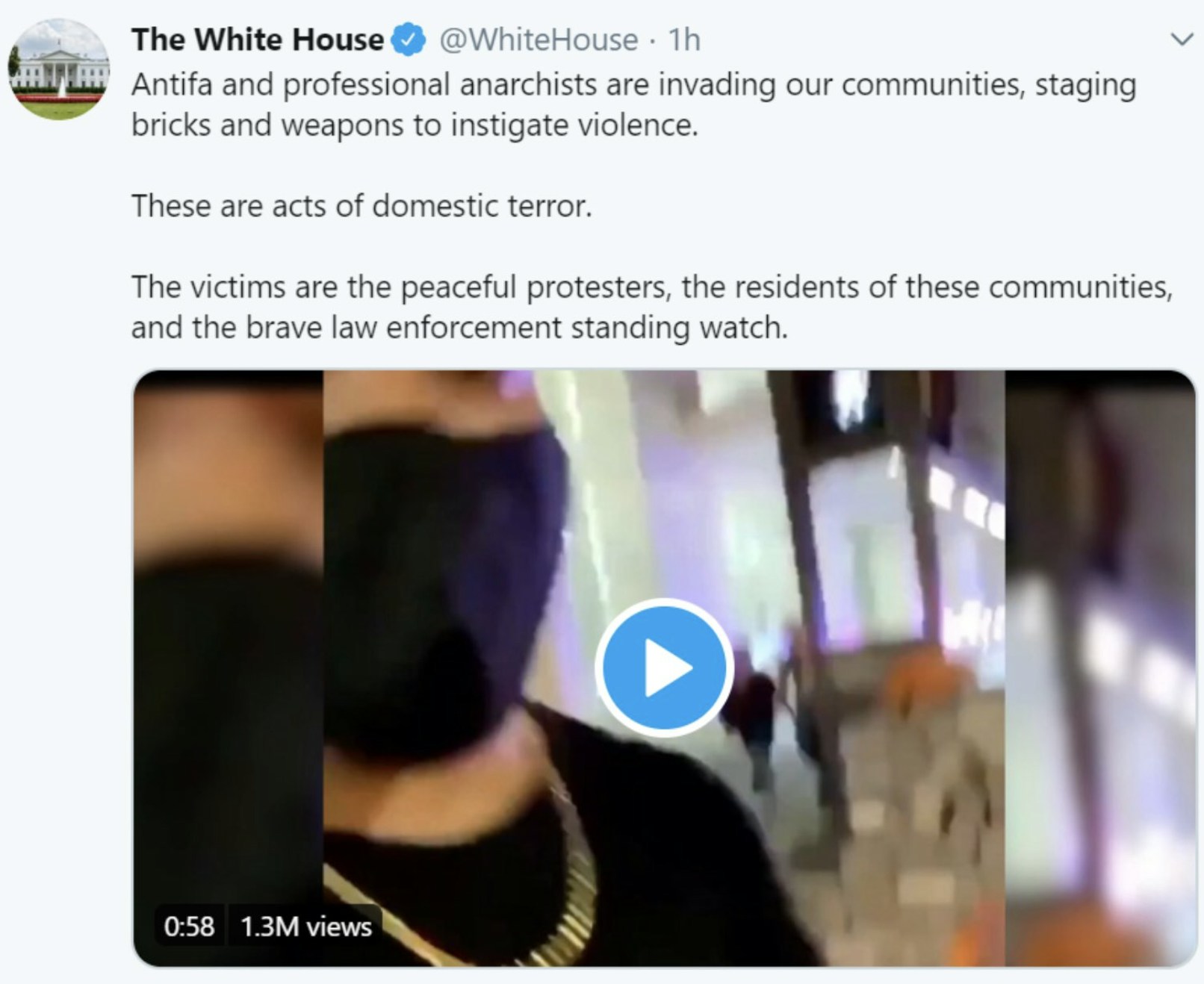
A screenshot of a video and caption posted on the White House Twitter feed on Wednesday.
Within minutes, journalists discovered that most of the clips included in the video posted online by the White House had already been investigated and debunked. A short time later, without explanation or apology, the White House deleted the video from its official Twitter and Facebook feeds — but only after it had been viewed more than a million times on Twitter alone.
A screenshot showing that a video was removed from the White House Facebook feed on Wednesday.
Although the White House tried to hide the video once it became clear just how riddled with errors it was, The Intercept saved a copy before it disappeared.
The video is worth examining in detail, since it shows just how unconcerned with the truth people in the White House are, as they conduct a frantic search for evidence to support the president’s baseless claim that the protests over racial injustice and police impunity have been hijacked by phantom “professional protesters.”
The compilation includes seven clips showing bricks, rocks or paving stones that the people who filmed them found suspicious. Three of the clips were broadcast a day earlier in a report from “Inside Edition,” which told its viewers that “police say small bands of the so-called ‘professional agitators’ are taking advantage of the crisis and hijacking peaceful demonstrations.”
“Piles of bricks have also appeared at the scenes of major demonstrations,” a reporter for the tabloid news show added. “There is speculation they may have been planted there by Antifa, for use as projectiles aimed at cops and storefront windows.”
However, as open-source investigators for BBC News, Buzzfeed and Vice had already reported before the White House compiled the clips, almost all of the video included in it showed ordinary piles of bricks used in construction projects which were underway before the wave of protests began in response to the killing of George Floyd, an unarmed black man, by Minneapolis police officers last week.
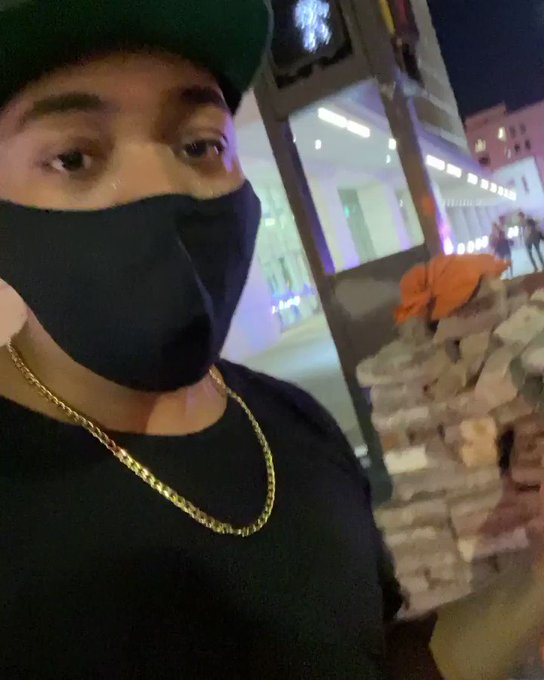
In the first clip, recorded in Dallas on Saturday night, a young black protester addresses the camera, and shares the conspiratorial idea that a pallet of bricks outside a courthouse must have been planted there to provoke a riot.

Reuben Lael@reubengotsoul
The Dallas protest was a lot of things. But I was very disappointed to see this RANDOM stack of bricks in front of the courthouse. #setup #BlackLivesMatters #makeblackcount
6,418
9:56 AM - May 30, 2020
Twitter Ads info and privacy
2,653 people are talking about this
“This is a set-up,” the young man says to the camera in the original video, which was posted on Twitter by a black activist. “You got to do better,” the man adds, wagging his finger in a sarcastic scolding of the slipshod provocateurs he imagines were responsible. In the background, another protester can be heard saying, “there ain’t no damned construction around here.”
That is not quite correct, however. Photographs and video shot on May 5 at the same location, outside the Dallas County Courthouse — during a protest by the far-right Oathkeepers in support of Shelley Luther, a salon owner who was jailed for reopening her business during the coronavirus lockdown — showed that there were extensive roadworks and piles of bricks at that same street corner three weeks before George Floyd was killed.

Oath Keepers@Oathkeepers
Standing outside the Dallas County Courthouse waiting to see if defiant Dallas salon owner Shelley Luther will be arrested today by the local tyrant judge. She is inside court house for a “contempt of court” hearing. Stay tuned.

22
2:33 PM - May 5, 2020
Twitter Ads info and privacy
16 people are talking about this
Even if the roadwork had been largely or entirely completed by last Saturday, it seems far more likely that the bricks had just not been cleared away than that they were removed and then planted again, outside a courthouse, by left-wing agitators.
In an interview, the man who recorded this video and posted it online, Reuben Lael, told me that he took the threat of “interlopers,” meaning “anarchists or any other anti-America groups,” using violence to distort the meaning of the Black Lives Matter protests very seriously. “America is vulnerable and on the radar of people who want to destroy the country,” he said. Lael argued that it was important to him “to protect the young protesters” and “kind of keep the narrative clear” by at least letting the young man who suspected the bricks might have been a set-up make it plain that he was not a rioter and not interested in violence.
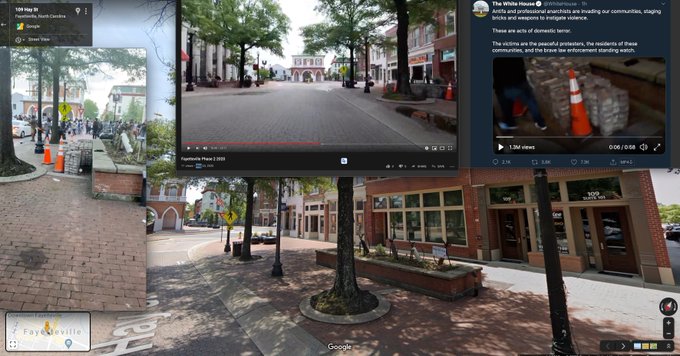
Another clip used by the White House, and “Inside Edition,” shows a pile of bricks in Fayetteville, North Carolina, in video that was posted on Twitter on Saturday. However, as Benjamin Strick of The BBC reported on Tuesday, the bricks were clearly visible at the same spot in video posted on YouTube on May 24, one day before the killing of George Floyd.

Benjamin Strick@BenDoBrown
Hi @WhiteHouse. You are wrong. Some of these "staging bricks" to "instigate violence" videos are false. This one filmed in #Fayetteville (https://www.google.com/maps/@35.0527635,-78.8789179,3a,75y,165.39h,76.74t/data=!3m6!1e1!3m4!1sWhaj_0gr7RbgZ8d5Z4oF9Q!2e0!7i16384!8i8192 …) the bricks were there pre-May 24 in this video here: https://www.youtube.com/watch?v=C5rJCesyF_A …. See more here: https://www.bbc.co.uk/news/52877751 https://twitter.com/WhiteHouse/status/1268248480880963584 …
46
3:37 PM - Jun 3, 2020
Twitter Ads info and privacy
21 people are talking about this
The Fayetteville Public Works Commission also confirmed to Strick’s colleague, Shayan Sardarizadeh, on Tuesday that the paving stones had been placed on that sidewalk last week ahead of planned work to restore the cobblestoned street following work on water and sewer lines beneath the pavement.
In the White House compilation, that video from Fayetteville is the fifth clip, and, as Strick pointed out on Twitter, the pile of paving stones in it appears to be identical to those shown in the second clip in the sequence, which seems to show the same stones (surrounded by the same traffic cones and brick wall) at a different time of day.
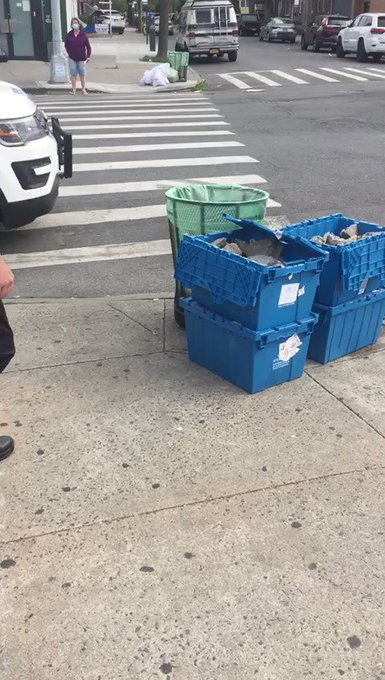
The third clip in the White House video, of a police officer removing blue boxes of stones from a street corner in Gravesend, a part of South Brooklyn where there have been no protests or rioting, was posted on Twitter on Tuesday morning by someone who claimed, without evidence, that they had been placed there by Anifa. “Bricks have been places strategically around Brooklyn in anticipation of protests,” a conservative Brooklyn resident named Yaakov Kaplan wrote in his video caption without evidence. “ANTIFA is way more organized than politicians pretend.”
That video was shared on Twitter on Wednesday morning by Commissioner Dermot Shea of the New York Police Department. However, Mark Treyger, a New York City Council member who represents that area responded to the commissioner’s tweet a short time later, calling his accusation that the stones had been placed there by antifascists false. “This is in my district. I went to the site. This construction debris was left near a construction site on Ave X in Gravesend,” Treyger wrote on Twitter.

Mark Treyger@MarkTreyger718
This is in my district. I went to the site. This construction debris was left near a construction site on Ave X in Gravesend. Could be evidence of a developer breaking law since phase 1 hasn’t begun, but there was no evidence of organized looting on X last night that I’m aware of https://twitter.com/NYPDShea/status/1268187062001455111 …
Commissioner Shea
✔@NYPDShea
This is what our cops are up against: Organized looters, strategically placing caches of bricks & rocks at locations throughout NYC.
2,579
12:28 PM - Jun 3, 2020 · Brooklyn, NY
Twitter Ads info and privacy
1,045 people are talking about this
It is nor clear where the fourth clip in the White House compilation was shot, but it shows what look like ordinary construction materials.
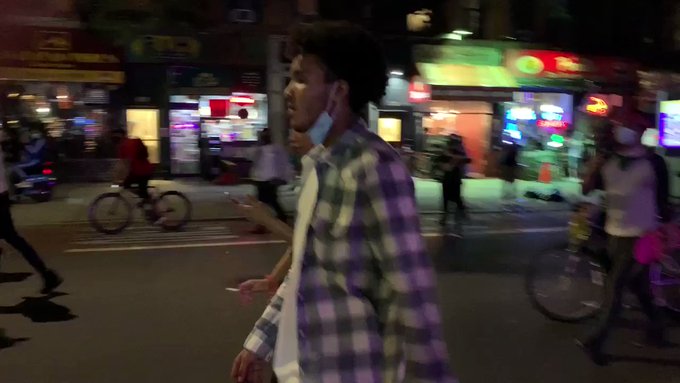
The sixth clip, of young protesters in Manhattan picking up bricks during a march on Saturday night, was edited by the White House to cut out the start of the scene, in which they could be seen first breaking down a barrier around a clearly defined construction site in the East Village. The original clip, posted by a reporter, showed a yellow fence around the building materials and a sign reading “LANE CLOSED CAUTION,” before it was pulled down by the protesters to get at the bricks.

Kevin R Hogan@KRHogan_NTD
"Yo, we got bricks. We got bricks!"—#Rioters in Manhattan chanced upon a cache in the street equipped with bricks and a shovel at 10:01 p.m. on Second Ave between St. Marks Pl. and Seventh St.
3,264
11:41 PM - May 30, 2020 · Manhattan, NY
Twitter Ads info and privacy
2,908 people are talking about this
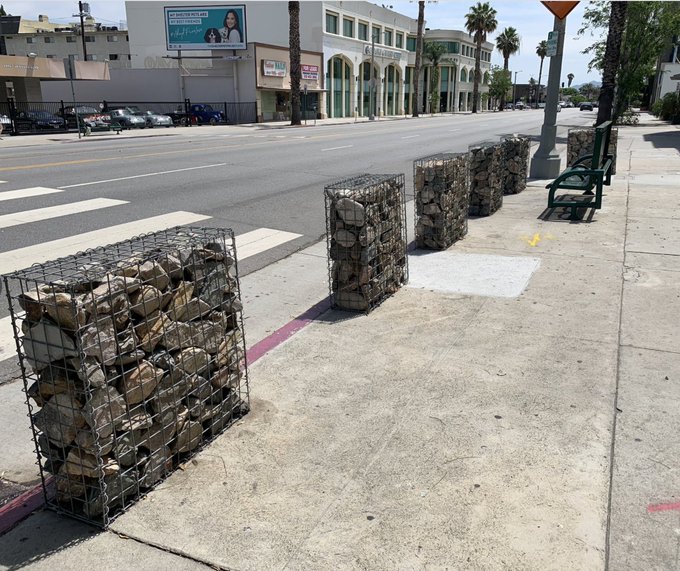
The seventh and final clip offered by the White House as supposed proof of anti-fascists “staging bricks” was perhaps the most embarrassing mistake. That viral clip showed several piles of large rocks inside six metal cages on a sidewalk in Sherman Oaks, California, which people on social platforms speculated were caches of ammunition for future riots.

Talia@talialikeitis
Wow. All over LA ... anyone else seeing these?
Not my video. Just sharing —

2,985
9:49 PM - Jun 1, 2020
Twitter Ads info and privacy
3,605 people are talking about this
In fact, as the Chabad of Sherman Oaks had already explained on its Facebook page on Monday, in response to the viral rumor that these were stones prepared for rioting, the structures were in fact security barriers that had been in place outside the Jewish center for nearly a year.

Jennie (she/her)


 #BlackLivesMatter@JennieRoberson
People keep RTing this like it's prep for looters. That's a hoax. This is in front of Chabad in Sherman Oaks. They're bolted to the cement to keep people from ramming a car into the place of worship & are getting boarded up. Share the shit out of this 2 stop the false narrative.
169
6:55 PM - Jun 1, 2020
Twitter Ads info and privacy
112 people are talking about this
“Nevertheless to alleviate people’s concern that they may be vandalized and used by rioters, they were temporarily removed,” the center said in a message posted on Facebook with a photo of the cages after the rocks had been removed.
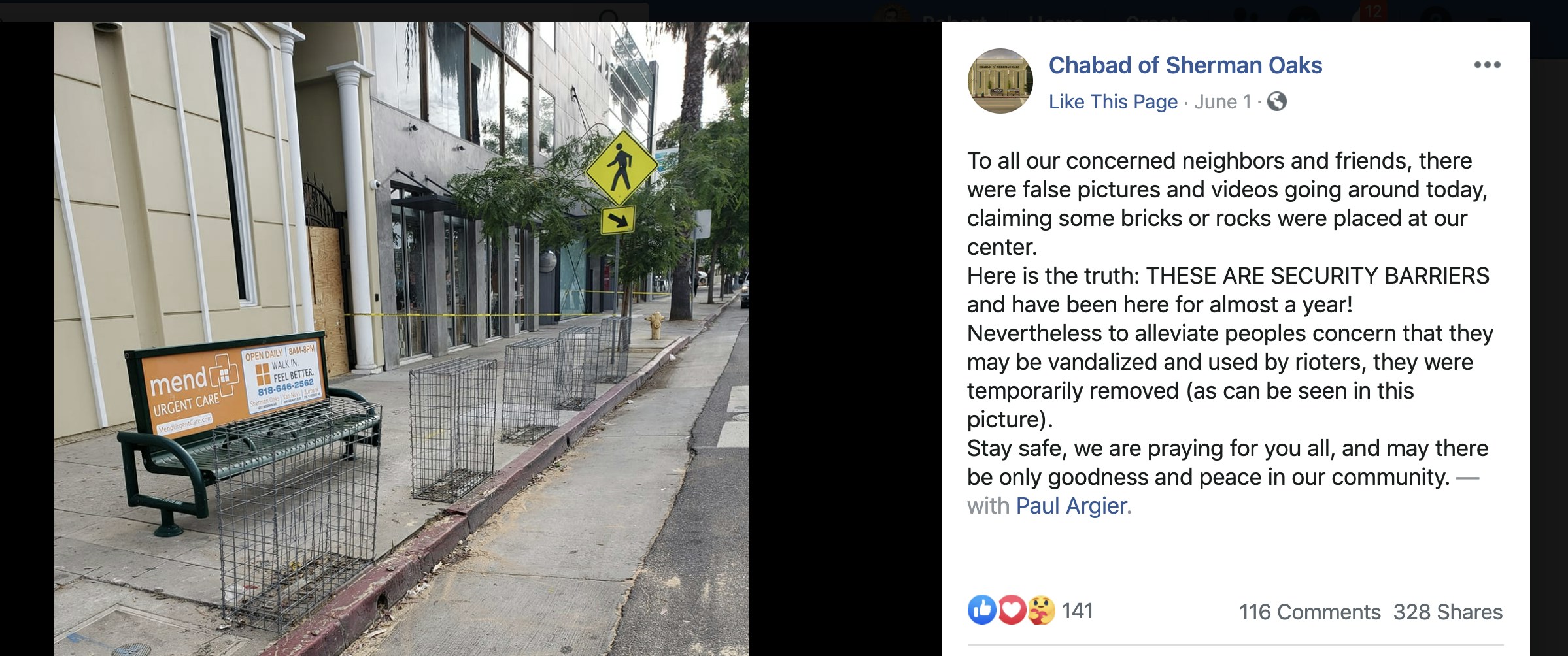
A screenshot of a Facebook message posted on Monday, debunking a viral rumor.
The White House social media director, Dan Scavino, did not reply to a request for comment on why the video was posted after most of its contents had already been debunked, and why it was removed without explanation.
Despite a lack of evidence, belief in the president’s conspiracy theory that “outside agitators” from the ranks of the anti-fascists are infiltrating protests to spark violence has become an article of faith among his supporters, and has been echoed from senior officers in some police departments. On Monday, Terence Monahan, the chief of department and the highest-ranked uniformed police officer in the NYPD, told a local television crew that it was time “to get those groups out of here — from California, from all over this country, who are being paid to take this movement, which is a good movement, and turn it into violence” against police officers.

Robert Mackey
✔@RobertMackey
NYPD is being led by a chief, Terence Monahan, who reveals here that he believes the baseless conspiracy theory that groups from other parts of the country "are being paid" to hijack the protests and inflict violence on the police. He's in charge. https://twitter.com/morenabasteiro/status/1267589169695666176 …
Morena Basteiro
✔@morenabasteiro
An emotional @NYPDChiefofDept tells @JoshEiniger7 that it’s time to get the agitators “out of here” - “from California, from all over this country, who are being paid to take this movement, which is a good movement, and turn it into violence.” @ABC7NY

48
5:57 PM - Jun 2, 2020
Twitter Ads info and privacy
29 people are talking about this
Other departments have found themselves forced to debunk viral rumors of imminent attacks from anti-fascists, who use the term antifa as a nickname, but are not members of an organized group, as Trump and his followers seem to believe.
On Monday, a police department in Idaho wrote on Facebook that a viral rumor spread by a rightwing militia group, that “Antifa has sent a plane load of their people into Boise and three bus loads from Seattle into the rural areas,” was entirely untrue. “The Payette County Sheriff’s Office has been monitoring social media posts that have stated FALSE information,” the department wrote. “The Payette County Sheriff’s Office has not had contact with and has not verified that Antifa is in Payette County. The Payette County Sheriff’s Office has not given any specific warnings to our citizens about Antifa or other organizations.”
Ahead of a protest on Sunday, the Sioux Falls Chamber of Commerce tweeted that it “had received tips from unnamed sources that protesters from outside of Sioux Falls planned to attend the rally and incite violence.”
Sioux Falls Police Chief Matt Burns told The Argus Leader, a local newspaper, on Monday “that authorities were looking for the buses and didn’t find any evidence of them arriving and unloading protesters.”
But unverified claims that “pallets of bricks” have been mysteriously delivered to protest sites have also been embraced by some anti-Trump activists on the left. The podcaster Tonya Tko used many of the same viral clips of bricks in her own video analysis posted on Facebook on Monday, in which she concluded that the government must be trying to undermine peaceful protests in favor of racial justice by inciting people to violence. Tko’s video, “Bricks Planted in Protest Cities Across the U.S.: IT’S A SET-UP!” in which she also suggests that the Covid-19 pandemic might have been part of a wider government plot, has already been viewed 3.4 million times.
MINNEAPOLIS ANTI-POLICE BRUTALITY ORGANIZER ON DEFUNDING THE POLICE
“WE DON’T HAVE TIME TO WAIT”: MINNEAPOLIS ANTI-POLICE BRUTALITY ORGANIZER KANDACE MONTGOMERY ON DEFUNDING THE POLICE
Alleen Brown
https://theintercept.com/2020/06/05/defund-the-police-minneapolis-black-visions-collective/
IN THE WAKE of George Floyd’s murder by Minneapolis police officers, a call to defund police departments has gained traction across the U.S. More people than ever are embracing the idea that the time for police reform has passed.
As an anti-police brutality organizer, Kandace Montgomery has observed the Minneapolis Police Department undergo years of reform efforts. After 24-year-old Jamar Clark was killed by police in 2015, she helped organize a Black Lives Matter chapter in the city. By 2018, it was clear to her and other organizers in the city that only a plan to take money away from police and give it to other community-led safety initiatives would protect black and brown people. The organization she directs, Black Visions Collective, campaigned alongside its counterpart Reclaim the Block to defund the Minneapolis police, yet the mayor still raised the police budget more than $8 million this year.
In the immediate aftermath of Floyd’s murder, the organizers brought their demands back to city council members — that members never increase the police budget again, that they cut the police’s budget by $45 million to help manage Covid-19 shortfalls, expand investment in community-led health and safety strategies, and compel the police to cease violence against community members.
The Intercept spoke to Montgomery about the movement to defund police in Minneapolis. This interview has been edited for clarity.
Paint for me a world without police. Where would all that money go instead?
A world without police would look like safety that is controlled and is led by our community, that focuses on transformation and transformative justice. A world without police means that everybody has what they need to survive and what they need to live healthy lives. It means we have the money that we need for education, health care, housing, workers’ rights. It is a total transformation away from a racist and violent system into one that truly fosters our safety and well-being. When we are talking about police reform, what we’re not talking about is the fact that black communities actually need resources to keep ourselves safe. We make the choice to resource punitive systems instead of stabilizing and nourishing ones that make communities safer.
How did you get involved in this movement?
My experience as a young black queer person just called me to it. Honestly, I think I didn’t really have any other option. Especially the experience of my family, of most of the men and the women experiencing incarceration and police violence directly, called me to want to fight up against that. And over the last few years, after the murder of Trayvon Martin and the acquittal of George Zimmerman, and then the murder of Mike Brown and the nonindictment of Darren Wilson, I have specifically committed my time and my energy and my future to fighting for black liberation for all black lives.
What did the anti-police brutality movement in the city look like at the time Jamar Clark was killed by police in Minneapolis in 2015? What’s different now?
In 2015, I think that we were very righteously angry, and we were clear about the problem. Now, we are clear about the solution. I think that’s the distinction. Now in 2020, we know that justice is not just arresting the officers. Justice goes so much further, because we are interested in not having to be out in the streets anymore, grieving and angry, protesting that another life has been lost. We know that we cannot continue to invest in strategies that call for police reform. The only path forward is transitioning completely away from the Minneapolis Police Department and policing across the country and across the globe really.
What are the biggest wins and the biggest failures you’ve seen since 2015 that laid the groundwork for this moment?
When George Floyd was killed, the Minneapolis Police Department had plenty of reforms in place. They’re ineffective and insufficient. It is putting a police officer in a T-shirt instead of a uniform. It’s still the same thing.
Reclaim the Block began in 2018. Organizing has always been the thing behind transformative change. MLK didn’t march alone. He actually was part of an entire organization that was in it for the long term. Having an organization allows us to collectively raise the resources necessary to fight for our rights and move a long-term agenda, because this work isn’t free.
In 2018, we engaged our community and articulated a story about what’s possible if we divest from the Minneapolis Police Department and invest in community-led safety. That work resulted in $1.1 million moving away from the police department and into opening the Office of Violence Prevention, which does street-level violence intervention that prioritizes not involving police. The money also was rerouted to supporting other organizations that were doing community-level intervention and safety work.
But the year after that, we saw a really huge pushback. What we didn’t fully anticipate was the mayor and the police department working together to create a smear campaign and create a false narrative that crime in our city was increasing. We saw about six months of article after article about this.
The mayor ended up increasing the 2020 police budget by over $8 million. So, what we know is that when you push really hard for transformative change, we will get even harder pushback. And so we have to be really strategic and smart. This moment — we have been building for it.
How has Black Visions Collective responded to George Floyd’s murder? How did your organizing contribute to the actions in the streets?
People took to the streets organically. That was not us. Without any organization, without any nudging, people decided that it was necessary to protest, and it was necessary to ignite an uprising across the country and the globe. As an organization, what we did immediately was called for the defunding of the police. Because we had been calling for that beforehand, we were able to quickly pivot and make it really clear to our city council members that our community was no longer going to be OK with settling with maybe an arrest that doesn’t actually result in a conviction — that we want a total transformation, and we had been waiting too long. The national attention creates an opportunity. George’s spirit as an ancestor has allowed us to have a much larger conversation across the country about what justice actually looks like in these situations.
Most importantly, we are grieving the loss of a black community member. We’re doing that again. Many of us helped found Black Lives Matter and Black Visions Collective for Jamar. It’s incredibly unfair, especially for young black people, that we have to be out here in these streets, putting our lives at risk during the pandemic to fight for justice.
Some of our organizers have been out there nightly, just helping to hold down the space at the different occupations in the city, grilling food, doing things like that. We’ve been offering community trainings around direct action and how to stay safe while protesting. We planned a direct action ourselves in which we left art in memory of George Floyd at each of the city council members’ homes, calling on them to defund the police.
Much of our work has been organizing with other black Minnesotans. We have a call every single day with about 70 different black organizers who are trying to coordinate how to get supplies to our folks, how to get donations to our folks, how to train people to be medics, so that we can provide medical support on the ground at protests, who are thinking about art and how we can tap into artists to create expressions of what we are talking about that are accessible to our community members, as well as organizing healers to provide healing for organizers on the front line and community members who are involved.
How do you think about the property destruction that took place in the city?
I honor and respect the ways in which my community has decided to grieve, even if it’s not how I personally choose to grieve. I want to make sure that all of the small businesses of color are able to redevelop and rebuild and continue to provide necessary services to our community. And I’m calling on our elected officials to ensure that developers do not come in and take away all of those businesses from black and brown people.
What do you think about the reactions of public officials in the city? How have they responded to your demands, and what has gone unanswered?
I’m deeply disappointed in Mayor Jacob Frey. He has not reached out to our group, has not reached out to several groups, actually, to talk about what is the solution forward. It is time for him to get out. He is not the visionary leader that Minneapolis needs and deserves.
For our city council members, they have been much more responsive, and many of them have actually committed to us to really disband the Minneapolis Police Department and transition over the next few years away from having policing in Minneapolis. There’s still work to do with some city council members who just aren’t able to truly imagine what the future could look like.
Minneapolis Public Schools ending its contract with the police is a watershed moment. I know many of the young people who have been calling for school resource officers out of their schools for the last five years or more. Folks who are able to take bold steps are doing it quickly, because they know we don’t have time to wait.
What’s next?
This is going to be a transition — and not a transition that’s going to take 20, 30 years. It needs to happen within five or less. But we do have to be patient with ourselves that we don’t know all of the answers. Right now, we are stepping up and figuring them out as we provide the support to our community.
The mutual aid groups that have been created over the past week are super critical. They’re literally feeding people who would not be able to eat, would not have diapers for their babies. They’re essential, and they’re allowing community members to sustain their needs. They are building in real time models of community safety.
Thinking about a transition plan away from the Minneapolis Police Department is going to be critical. What’s next is continuing to engage our city council, but I think even more so engaging our community to continue to bring this demand to their doorstep. We can’t allow this energy to die down. Minneapolis is going to be watched all across the country.
Amazon “Stands in Solidarity” Against Police Racism While Selling Racist Tech to Police
Sam Biddle
https://theintercept.com/2020/06/03/amazon-police-racism-tech-black-lives-matter/
IT IS A WEEK of renewed social crisis in the United States, which means American companies are quickly lining up to pay lip service to the cause. Just like its tech giant competitors at Facebook, Apple, and Google, Amazon tweeted vaguely in favor of the principles of social justice and equitable policing, a predictable and predictably tinny expression of corporate solidarity with “the fight against systemic racism and injustice.” But Amazon is arguably singular among its mega-tech peers in its determination to provide American law enforcement with tools experts say only enable racist policing.
In their rush to appear sympathetic to the rough contours of social justice — while keeping their legal, public relations, and social media teams in agreement — some companies seem to be forgetting what it is they actually do. When Nextdoor, a social network with a well-documented pattern of stoking the worst kinds of racial panic, tweets an image reading “BLACK LIVES MATTER,” it’s difficult to take seriously. But while Nextdoor is merely content to rationalize and streamline urban and suburban residential paranoia into a tidy algorithmic feed, a growing portion of Amazon’s business, as Wired’s Sidney Fussell noted yesterday, is expanding its public/private video surveillance dragnet across the country with an explicitly “anti-crime” mission.
In 2018, the ACLU published a report showing that Amazon’s “Rekognition” facial recognition software was fundamentally racially biased, disproportionately misidentifying, in ACLU’s test, black members of Congress as people who were arrested and had their mugshot in a police database. “The false matches were disproportionately of people of color, including six members of the Congressional Black Caucus, among them civil rights legend Rep. John Lewis (D-Ga.),” read the report. “Nearly 40 percent of Rekognition’s false matches in our test were of people of color, even though they make up only 20 percent of Congress.” A report published that same year by an MIT team found, similarly, that Rekognition misclassified darker-skinned women as men 31 percent of the time.
The ACLU report added, “People of color are already disproportionately harmed by police practices, and it’s easy to see how Rekognition could exacerbate that.” As the ACLU and other artificial intelligence researchers have made clear, the threat of computerized misidentification isn’t just an academic error, but a potentially ruinous one that could improperly influence police officers prior to an encounter, or even cause them to seek a search warrant, by presenting them with a false criminal history.
It’s difficult to reconcile this reality with a recent tweet from Amazon executive Andy Jassy, chief of Amazon Web Services, the cloud computing division which operates Rekognition:

Andy Jassy
✔@ajassy
*What* will it take for us to refuse to accept these unjust killings of black people? How many people must die, how many generations must endure, how much eyewitness video is required? What else do we need? We need better than what we're getting from courts and political leaders.
1,544
4:41 PM - May 30, 2020
Twitter Ads info and privacy
351 people are talking about this
As Wired’s Fussell astutely pointed out, Jassy has previously defended Rekognition’s use by police on the grounds that the company’s “terms of service” U.S. Constitution would prevent any abuse.
Equally thin Amazon’s companywide statement:
The inequitable and brutal treatment of Black people in our country must stop.
Together we stand in solidarity with the Black community — our employees, customers, and partners — in the fight against systemic racism and injustice.
What exactly does it mean to oppose the discriminatory policing of black Americans while simultaneously selling discriminatory tools to the police — or while operating Ring, a surveillance network predicated on the detection and elimination of racially coded “suspicious activity,” which funnels video directly to local police and which once handed out to employees blue and black Ring-branded novelty police badge stickers emblazoned with “FUCK CRIME” on the front?
In a statement to The Intercept, ACLU technology attorney Jacob Snow said that “If Amazon and Andy Jassy really stand in solidarity with the black community, then they should stop selling facial recognition surveillance technology that supercharges police abuse against the black community. They should also stop firing workers organizing for better conditions in Amazon warehouses. Real solidarity goes beyond empty posts on social media that do nothing to protect black people.”
Liz O’Sullivan, a privacy researcher and advocate who quit her job at AI surveillance firm Clarifai last year over ethical concerns, told The Intercept that the services Amazon provides to police nationwide “may enable these officers to track and suppress those protesting and speaking out against racial injustice” through the use of facial recognition. “Surveillance is a racial justice issue,” O’Sullivan added. “The two cannot be separated.”
I asked Amazon and Jassy repeatedly whether they would permit the use of Rekognition to identify individuals protesting against police violence, and whether the company would more generally reassess or modify the ways in which police use Rekognition, and received no response. Given that Amazon refuses to even disclose which law enforcement agencies use Rekognition to begin with, it’s probably no surprise that they wouldn’t provide clarity on how the software is used or not used. It’s one thing to quietly profit from an unjust system, and quite another to decry its existence while selling the very software it runs on.
Subscribe to:
Comments (Atom)