Saturday, June 6, 2020
BIG PHARMA ATTACKS EFFORTS TO GUARD AGAINST CORONAVIRUS PRICE GOUGING
Sharon Lerner
https://theintercept.com/2020/06/02/big-pharma-coronavirus-treatment-price-gouging/
AFTER HOUSE DEMOCRATS announced a plan to ensure that drugs and vaccines for Covid-19 are affordable and accessible to all, a coalition of conservative groups began quietly working to undermine that effort.
On April 15, Rep. Jan Schakowsky, D-Ill., along with Reps. Peter DeFazio, D-Ore., Rosa DeLauro, D-Conn., and Lloyd Doggett, D-Texas, laid out basic principles for the development and pricing of coronavirus therapies and vaccines. Their demands were simple: Pharmaceutical companies should have to set reasonable prices for their drugs and vaccines used to treat or prevent Covid-19. They should be required to make the costs of research and manufacturing of these products public. During the pandemic, the legislators said, companies should not be able to profit exclusively from these potentially lifesaving drugs.
“Exclusivity determines who has access, who can manufacture, and how we scale up production to meet the need,” the members of Congress noted in a press release at the time. “We cannot leave these decisions up to a single, profit-motivated private company.”
Few have spoken out against the protections that were designed to ensure equitable access to lifesaving medicines — at least publicly. But privately, a coalition of conservative groups attacked the proposed patient protections as “dangerous, disruptive, and unacceptable.” In a May 7 letter, representatives of 31 groups, including Hudson Institute, the Council for Citizens Against Government Waste, and Consumer Action for a Strong Economy, called on Congress to reject the drug pricing guidelines and defended patents and the exclusive right to profit from drugs as “America’s great assets.”
It’s worth noting that at least 15 of the groups arguing for the rights of pharmaceutical companies to exclusively profit from coronavirus-related products have received funding from the pharmaceutical industry. Among the organizations that signed the letter and also received donations from either drug companies or the trade groups that represent them are the American Legislative Exchange Council Action, whose parent organization, ALEC, received at least $530,000 from the trade group Pharmaceutical Research and Manufacturers of America, or PhRMA, since 2015; Americans for a Balanced Budget, which has received more than $375,000 from PhRMA since 2015; and the Institute for Policy Innovation, which received $374,500 from PhRMA during the same period. In all, 15 of the 31 groups received $2.5 million in pharmaceutical industry contributions between 2015 and 2019, according to an analysis of tax filings and other records by Public Citizen.
PhRMA, Hudson Institute, Council for Citizens Against Government Waste, Consumer Action for a Strong Economy, ALEC, Americans for a Balanced Budget, and the Institute for Policy Innovation did not respond to inquiries from The Intercept for this story.
The pharmaceutical industry, which spent $295 million on lobbying in 2019, far more than any other sector in the U.S., has defended the present system of drug development and pricing as an effective way of incentivizing needed investment in pharmaceutical innovation. Currently drug companies can obtain patents, which typically grant them 20 years of property rights. Separately, they can obtain exclusivity for their drugs, which can prohibit the sale of competing products. Either way, according to PhRMA, which represents biotech research companies, intellectual property rights are the key to the creation of needed drugs.
The May 7 letter argued that denying companies exclusive rights to profit from their products or requiring them to disclose proprietary information would benefit China and hurt people with Covid-19 and other diseases.
But according to Doggett, chair of the House Ways and Means Health Subcommittee and one of the authors of the guidelines, it is pharmaceutical greed that poses the real danger. “To know what interests these groups truly represent: Follow the money. Just like their generous campaign contributions, Big Pharma-funded propaganda seeks to protect monopoly power to extract the highest price — whatever the sick and dying will pay,” Doggett wrote in a statement emailed to The Intercept. “This letter only encourages continued inaction to protect the taxpayer investment from a Congress that has remained completely impotent in the face of Big Pharma.”
The April 15 guidelines, which have yet to be codified into proposed legislation, were not the Democrats’ first effort to guard against price gouging during the pandemic. In March, Schakowsky and others attempted to insert language into the coronavirus aid package that would have limited drug makers’ intellectual property rights and allowed the federal government to take action if it had reason to believe that treatments or vaccines developed with public funds were priced too high. But while an early draft of the bill included these provisions, lobbyists for the pharmaceutical industry succeeded in getting them removed from the final legislation.
Perhaps most galling to the Democratic lawmakers is the fact that the vast majority (if not all) of the drugs they seek to protect from exorbitant pricing have been developed at least in part with taxpayer dollars. Between 2010 and 2016, every drug approved by the Food and Drug Administration benefited from science funded with federal research through the National Institutes of Health, according to the advocacy group Patients for Affordable Drugs. During that time, taxpayers spent more than $100 billion on that research.
Although American taxpayers are the “angel investors” of pharmaceuticals, as Doggett put it, many cannot afford the treatments they’ve bankrolled. Some 58 million people in the U.S. reported being unable to afford medicines, according to a November 2019 Gallup poll, which also found that 34 million people reported knowing someone who had died after not getting treatment.
The problem isn’t new. “We have seen it time and again: The government does all the work through Phase III trials, and then licenses it over to a manufacturer to finish the approval. It is like those years of government investment did not exist,” DeLauro wrote in a statement to The Intercept. “As the Chair of the subcommittee that funds the National Institutes of Health and the Biomedical Advanced Research and Development Authority, I am all deeply aware of just how much money the U.S. government invests in the critical, life-saving biomedical research in this country.”
People with HIV and hepatitis C are also painfully familiar with the failings of the U.S. drug pricing system. Although medicines have become available over the past 10 years to treat these viral infections, tens of thousands of people still die because they are unable to afford them. “We have watched as those epidemics continue to spiral out of control and kill people,” said James Krellenstein of the PrEP4All Collaboration, a group that formed in 2018 to advocate for universal access to lifesaving HIV medications and expanded its work to include Covid-19 in February. “In both of these cases, we see we have highly, highly effective drugs in many cases funded by public money and we see drug companies pricing these as exorbitant prices.”
Some of the companies that are receiving government funding to develop coronavirus treatments and vaccines have offered assurances about their pricing. Stéphane Bancel, the CEO of Moderna, which received $486 million of federal funding to speed its work on a coronavirus vaccine, promised to be “very thoughtful” when it comes to pricing. And Johnson & Johnson, which received more than $600 million in federal funding for its coronavirus treatment and vaccine work, said that its vaccine, at least, would be “affordable.”
But Krellenstein said that leaving decisions about coronavirus drug pricing in drug companies’ hands — the approach taken with HIV and hepatitis C — would be a grave mistake. “We know from the past decade that the current approach of doing nothing results in the perpetuation of epidemics and the perpetuation of mass death,” he said.
In the case of remdesivir, an antiviral therapy made by Gilead Sciences that is being tested as a treatment for Covid-19, PrEP4All argues that because U.S. government scientists appear to have contributed in various ways to its creation, the government may actually co-own the patents. If remdesivir proves to be effective in fighting the virus, which is an open question, the group argues that the government could easily expand access to it.
Gilead donated its initial supply of the drug to the federal government and is now preparing to sell it. The company’s CEO Daniel O’Day told CNBC, “We understand our responsibility both to patients and also to shareholders and we’ll be balancing that.”
Regardless of its ownership of remdesivir, the U.S. government has the right to override any patent as long as it provides the company “reasonable compensation” through a legal provision known as Section 1498. The law functions as a sort of eminent domain for patented products, allowing the government to break a company’s monopoly on a product and permit low-cost competition.
An increasing group of people could benefit from this and other steps to make Covid-19 drugs affordable. When Schakowsky and her colleagues first unveiled their proposal in April, there were just over 600,000 confirmed coronavirus infections in the U.S. By the time the pharmaceutical industry-funded groups sent their letter to House members, that number had doubled. Less than a month later, it has tripled to more than 1.8 million, and more than 105,000 people have died from Covid-19.
But U.S. lawmakers have yet to enact protections from price gouging. And while the American pharmaceutical industry is pushing to maintain its ability to exclusively set drug prices and profit from pharmaceutical products, much of the world is moving in the other direction. On Friday, the World Health Organization unveiled a global effort to pool intellectual property, data, and research related to Covid-19. While 36 countries have already announced their support for the project, the U.S. was not among them. Just as WHO was detailing its plan to broadly share the benefits of scientific advancement, President Donald Trump was announcing his plan to withdraw from the global organization.

PENTAGON WAR GAME INCLUDES SCENARIO FOR MILITARY RESPONSE TO DOMESTIC GEN Z REBELLION
Nick Turse
https://theintercept.com/2020/06/05/pentagon-war-game-gen-z/
IN THE FACE of protests composed largely of young people, the presence of America’s military on the streets of major cities has been a controversial development. But this isn’t the first time that Generation Z — those born after 1996 — has popped up on the Pentagon’s radar.
Documents obtained by The Intercept via the Freedom of Information Act reveal that a Pentagon war game, called the 2018 Joint Land, Air and Sea Strategic Special Program, or JLASS, offered a scenario in which members of Generation Z, driven by malaise and discontent, launch a “Zbellion” in America in the mid-2020s.
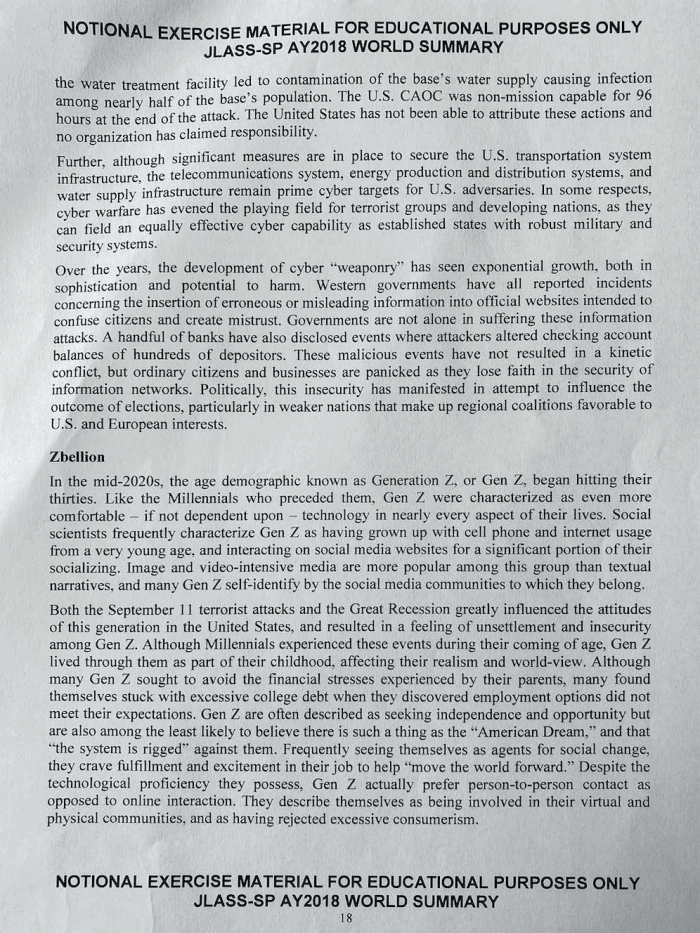
JLASS Document2 pages
The Zbellion plot was a small part of JLASS 2018, which also featured scenarios involving Islamist militants in Africa, anti-capitalist extremists, and ISIS successors. The war game was conducted by students and faculty from the U.S. military’s war colleges, the training grounds for prospective generals and admirals. While it is explicitly not a national intelligence estimate, the war game, which covers the future through early 2028, is “intended to reflect a plausible depiction of major trends and influences in the world regions,” according to the more than 200 pages of documents.
According to the scenario, many members of Gen Z — psychologically scarred in their youth by 9/11 and the Great Recession, crushed by college debt, and disenchanted with their employment options — have given up on their hopes for a good life and believe the system is rigged against them. Here’s how the origins of the uprising are described:
Both the September 11 terrorist attacks and the Great Recession greatly influenced the attitudes of this generation in the United states, and resulted in a feeling of unsettlement and insecurity among Gen Z. Although Millennials experienced these events during their coming of age, Gen Z lived through them as part of their childhood, affecting their realism and world view … many found themselves stuck with excessive college debt when they discovered employment options did not meet their expectations. Gen Z are often described as seeking independence and opportunity but are also among the least likely to believe there is such a thing as the “American Dream,” and that the “system is rigged” against them. Frequently seeing themselves as agents for social change, they crave fulfillment and excitement in their job to help “move the world forward.” Despite the technological proficiency they possess, Gen Z actually prefer person-to-person contact as opposed to online interaction. They describe themselves as being involved in their virtual and physical communities, and as having rejected excessive consumerism.
In early 2025, a cadre of these disaffected Zoomers launch a protest movement. Beginning in “parks, rallies, protests, and coffee shops” — first in Seattle; then New York City; Washington, D.C.; Los Angeles; Las Vegas; and Austin — a group known as Zbellion begins a “global cyber campaign to expose injustice and corruption and to support causes it deem[s] beneficial.”
During face-to-face recruitment, would-be members of Zbellion are given instructions for going to sites on the dark web that allow them to access sophisticated malware to siphon funds from corporations, financial institutions, and nonprofits that support “the establishment.” The gains are then converted to Bitcoin and distributed to “worthy recipients” including fellow Zbellion members who claim financial need. Zbellion leadership, says the scenario, assures its members that their Robin Hood-esque wealth redistribution is not only untraceable by law enforcement but “ultimately justifiable,” as targets are selected based on “secure polling” of “network delegates.” Although its origins are American, by the latter 2020s, Zbellion activities are also occurring across Europe and cities throughout Africa, Asia, and the Middle East, including Nairobi, Kenya; Hanoi, Vietnam; and Amman, Jordan.
In the world of JLASS 2018, Gen Z’s most militant members have essentially taken to privately taxing large corporations and other institutions to combat income inequality or, as the war gamers put it, using the “cyber world to spread a call for anarchy.”
The JLASS war game emerges in the context of the Pentagon playing a controversial and visible role in the unfolding domestic protests against racism and police brutality in the U.S. National Guard units have been deployed in various locations already, and some active-duty military forces were sent by the Trump administration to the Washington D.C. area.
“I think the sooner that you mass and dominate the battlespace, the quicker this dissipates and we can get back to the right normal,” said Secretary of Defense Mark Esper earlier this week during a teleconference call that also saw President Donald Trump deride U.S. governors for their “weak” response to protests over the killing of George Floyd. Trump even declared that he had put Gen. Mark Milley, the chair of the Joint Chiefs of Staff, “in charge.” Later that day, after security forces drove protesters and clergy from Washington, D.C.’s Lafayette Square with tear gas, Milley, dressed in combat fatigues, followed Trump, Attorney General William Barr, Esper, and others to a roundly condemned photo op in front of St. John’s Episcopal Church.
This came amid the backdrop of threats being issued to employ active-duty military to forcefully suppress protests, and the deployment of rapid-reaction units from the 82nd Airborne Division to bases just outside Washington, D.C. With retired admirals and generals, among others, excoriating Trump — and to a lesser extent Esper and Milley — for breeches of long-standing norms in civilian-military relations, it’s worth considering how the Pentagon’s war gamers chose to focus the military’s attention on a generation now demonstrating peacefully in America’s streets.
UNMARKED SECURITY FORCES IN DC SPARK FEAR
By Katie Bo Williams, Defense One.
June 5, 2020
https://popularresistance.org/unmarked-security-forces-in-dc-spark-fear/
Mistaken For Mercenaries, Armed Personnel From Federal Agencies Refuse To Identify Themselves To Street Protestors And Media.
The presence of unmarked federal law enforcement officers, dressed in paramilitary uniforms and wearing no identifying insignia, quickly spread among protesters marching through Washington, D.C.’s streets on Tuesday and Wednesday, causing concerned protesters and officials to ask: Who are they?
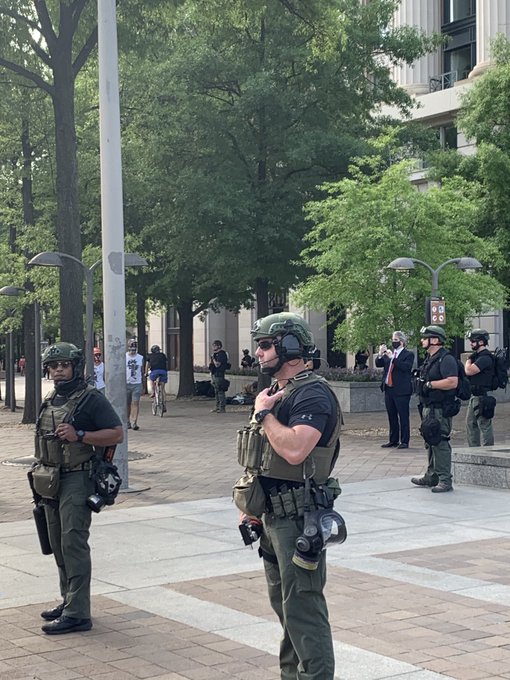
In some locations, security personnel refused to identify themselves to journalists and protesters who asked which agency sent them, answering only that they worked for the federal government. In other places, they identified themselves as working for the Department of Justice. Some carried rifles, or were equipped with body armor, riot shields, and pepper spray canisters.
Two such clad security members in Washington on Tuesday night identified themselves to Defense One as part of a specialized emergency response force run by the Bureau of Prisons — part of the Justice Department — to help maintain security at correctional facilities. They and others are part of what’s known as the bureau’s Special Operations Response Teams, or SORTs. NPR reported on Monday that Attorney General Bill Barr had ordered BOP to send its specialized riot response teams to assist with the local D.C. law enforcement with the civil unrest that has engulfed downtown Washington this week.

Dan Friedman
✔@dfriedman33
Asked who they’re with, these guys say only that they’re with “The Department of Justice.”
56K
4:48 PM - Jun 2, 2020
Twitter Ads info and privacy
28.6K people are talking about this
On Wednesday, protesters, former national security officials, and legal analysts raised alarms about the refusal of these units to identify their specific agency, and the legal authority under which they are operating. Some critics compared the units to “little green men” — a reference to the unmarked Russian soldiers who appeared in Crimea, Ukraine, prior to its 2014 annexation by the Russian Federation and were compared to the classic plastic toy soldiers. A few of the personnel in Washington on Tuesday wore patches identifying them as BOP or SORTs, but many did not.
“There is no generic DOJ police force, obviously. No badges, no identifying info, refusal to say who they represent — it’s like Russia’s little green men have taken over the nation’s capital,” tweeted Matt Miller, a former DOJ spokesman under President Barack Obama.
Asked in a brief phone call why the units had been ordered not to identify themselves in more detail, DOJ spokesman Kerri Kupec said, “I don’t know anything about that.” In a separate conversation, another Justice Department official who spoke on the condition of anonymity dismissed the concerns as the purview of conspiracy theorists, expressing frustration that officials who were “clearly” part of the enforcement efforts would be mistaken for mercenaries. That official argued that the BOP officers were appropriately identifying themselves as being with DOJ, suggesting that no further detail was required.
Legal analysts have raised questions about what statute authorizes BOP’s use in civil law enforcement efforts. Those nitty-gritty rules dictate what kind of authority the units have — like the power to arrest citizens, for example. That, in turn, dictates how civilians can seek redress for any abuses of power.
“BOP, like other federal, state, and local law enforcement officers may be deputized under the authority granted the US Marshals Service to enforce federal criminal statutes and protect federal property and personnel,” DOJ spokesman Wyn Hornbuckle said in an email.
That legal rationale — ”if this is really what happened,” cautioned national security law professor Bobby Chesney — means that the BOP officers have the same broad law enforcement authorities that any deputy U.S. marshal would, including the power to carry fire arms and make an arrest without a warrant for any offense.
But the officers’ refusal to identify themselves is still “bonkers,” Chesney said. Some security analysts and protesters argued that the BOP’s reticence was an intimidation tactic.
“The authority they [are] operating under dictates what they are allowed to lawfully do. If DOJ is being intentionally vague in order to intimidate citizens, that is abusive,” tweeted former NSA counsel Susan Hennessey.
Other analysts expressed concerns that tactical teams trained to deal with prison riots by inmates may not know how to cope with civilian unrest on city streets.
BOP officers “are trained for specific missions in specific conditions quite different from working with U.S. civilians—convicted of no crime—exercising their protected 1st A rights,” tweeted Diana Bolsinger, a senior fellow at the Strauss Center for International Security and Law.
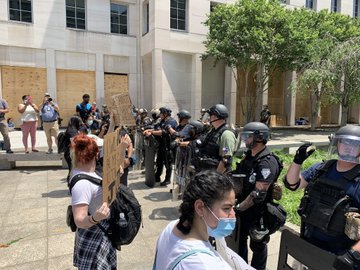
It was far from clear that BOP personnel were the only unmarked paramilitary forces on the streets, not was it clear how many BOP officers have been dispatched to Washington. A hodgepodge of federal agencies have loaned their forces to support local law enforcement efforts as D.C.’s protests entered their sixth day on Wednesday, and the BOP units sometimes appeared to be intermingled with officers from these other agencies. Officers from the DEA, FBI, DHS and other federal agencies could be seen around the city, as well as thousands of National Guardsmen.

Garrett Haake
✔@GarrettHaake
Back outside the White House. Today the perimeter has been pushed back another half block. Federal law enforcement of some kind, but they won’t identify themselves, and all insignias and name plates have been removed.

45.1K
12:31 PM - Jun 3, 2020
Twitter Ads info and privacy
26.9K people are talking about this
The BOP did not respond to requests for information on the units by the time this story was published.
Democratic lawmakers and some former military and security officials also have expressed concern.
“Unacceptable for uniformed federal officers policing constitutionally-protected assemblies to refuse to identify themselves to people who pay their salaries,” tweeted Rep. Don Beyer, D, who represents northern Virginia’s 8th congressional district, directly across the Potomac River from Washington. “Denying accountability to the public they serve ensures abuses.” Arlington County, in Beyer’s district, on Tuesday pulled their police forces out of Washington, saying it did not want to participate in Trump’s escalation and commingling of security forces against the protests.
“DC police are required by law to wear badges that must be visible ‘even if wearing riot gear,’” Beyer noted. “But because Trump called in federal agencies to crack down on peaceful protests, people in the nation’s capital once again are treated as second class citizens.”
Subscribe to:
Comments (Atom)