skip to main |
skip to sidebar
https://www.wsws.org/en/articles/2020/06/05/health-j05.html
By Clara Weiss
5 June 2020
Thousands of health care workers have joined the protests against police violence that have swept the United States and other countries in recent days.
This weekend, videos showed hundreds of nurses cheering protesters in Manhattan in New York City, and on Tuesday, hundreds again joined a protest in Times Square. Protests have also taken place in Boston, Chicago, and Oakland, California.
On Thursday, the protests expanded significantly, with thousands of medical workers staging demonstrations under the banner “White Coats for Black Lives” in cities across the country. The protests have continued to grow despite the violent police crackdown, which has rapidly escalated this week with Trump’s moves to deploy the military and establish a presidential dictatorship.
At Stanford, one of the leading medical schools in the world, hundreds of medical students and workers joined a demonstration in which they knelt down for eight minutes and 46 seconds, the time that Minneapolis police officer Derek Chauvin kneeled on George Floyd’s neck. Nearly 1,000 health care workers joined a protest at Indiana University’s medical school, and hundreds joined protests in Chicago, Illinois, and the surrounding area, as well as in Miami.
Protests also continued to take place at several New York City hospitals, including Jacobi Medical Center, Montefiore Medical Center, Lincoln Medical Center and Bellevue Hospital. All of these hospitals serve overwhelmingly poor and multi-ethnic, working class communities. Left without proper personal protective equipment (PPE), their staff have battled for months against the coronavirus pandemic which hit New York particularly hard, resulting in over 30,000 deaths.
Many more protests are planned for Friday and Saturday, including in Ohio, Colorado and Pennsylvania. Like the protest movement as a whole, the demonstrations by medical workers have been multi-racial and multi-ethnic, encompassing a wide range of generations. They practiced social distancing and wore masks.
Medical workers have also directly joined the ongoing protests and have been targeted by police, in blatantly illegal actions.
On Wednesday night, police in Austin, Texas, deliberately shot medical workers with rubber bulletswho were trying to treat Justin Howell, a 20-year-old. Howell, who was shot in the head with rubber bullets, is still in critical condition and has suffered brain damage. One of the medics who was shot in the hand later reported, “Just so you know, I had been there two full days. With one of my firefighter shirts on that I sewed a huge red and white medical cross on the front and back on. I had red and white crosses taped on my helmet. They knew I was a medic.”
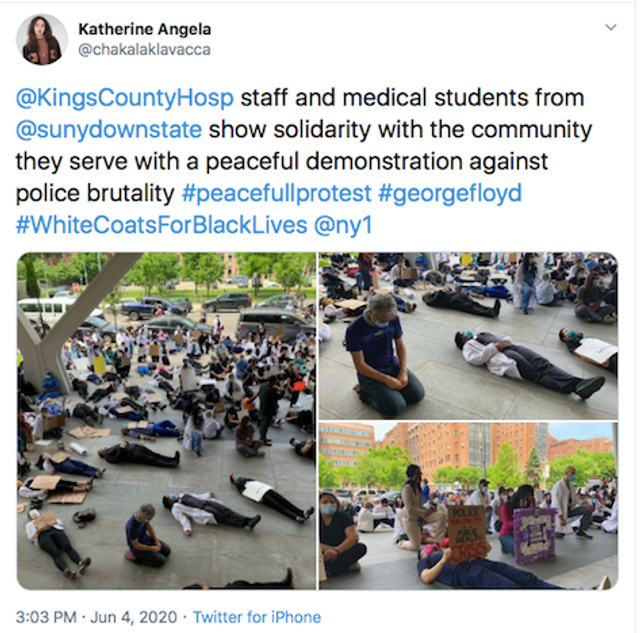
Protest at Kings County, New York
Earlier this week, Rayne Dominic Valentine, a medical worker with Brooklyn Hospital who has stacked bodies of COVID-19 victims, was brutally assaulted by police when walking home. As he was filming an attack by police on protesters, he was himself assaulted by police officers who kicked and beat him so badly that his head cracked and required staples in the hospital. A GoFundMe page for Valentine quickly gathered over $13,000, more than 10 times the requested amount. Many of those who donated were fellow medical workers.
One worker commented on the fund page, “I work at Kings County. We have fought COVID19 together and I will fight alongside you against this terrible injustice. Thank you for all that you have done.”
A scientific worker from Pittsburgh wrote, “I am SO sorry this happened! I am a scientist working on COVID-19 treatments to help those severely ill and prevent them from dying. I had THIS EXACT fear in Pittsburgh. I have to break curfews here because I work the night shifts to process the blood we get from the doctors (who work day shift.) I’m often walking home between midnight and 5am. The bus isn’t an option due to Coronavirus. While I’m Caucasian, I still had this fear that cops would shoot first and ask questions later. I’m so sorry this actually happened to you...it is OUTRAGEOUS that police are allowed to do this.”
It is not a coincidence that the mass protests against police violence and racism now find a strong resonance among health care workers, a section of the working class that has been at the forefront of both the social crisis and the fight against the COVID-19 pandemic.
Anger runs particularly high among doctors and nurses over the tens of thousands of preventable infections and deaths, including at least 291 medical workers who have died because of a lack of PPE. In the US, the richest country in the world, where the government spends hundreds of billions on war and the military every year, over 100,000 people have died from COVID-19, and over 62,000 health care workers have been infected.
After decades of social austerity and devastating cuts to health care, the policy of “malign neglect” has left hospitals—especially in the poorest and hardest areas of the country like the Bronx in New York City—without the medical equipment necessary to adequately treat patients. On top of that, almost 1.5 million health care workers have been laid off, tens of thousands have been furloughed and further hospital closures are being prepared despite the raging pandemic.
In opposition to the attempts by the Democratic Party to promote racial politics to divide the working class, the fight against racism and police violence among medical workers must be consciously fused with a struggle for social equality and the mobilization of resources to seriously combat the pandemic, and against the attempts of the Trump administration to establish a military dictatorship.
The author also recommends:
A call to the working class! Stop Trump’s coup d’état!
[4 June 2020]
Hundreds of thousands stage multiracial demonstrations against police violence in a powerful show of working-class unity
[30 May 2020]
https://www.wsws.org/en/articles/2020/06/05/usun-j05.html
By Shannon Jones
5 June 2020
New unemployment claims in the United States are continuing at historically unprecedented levels as ever-broader layers of the population are feeling the impact of mass joblessness.
In the last week of May, 1.9 million people filed for jobless benefits, a slight drop from the previous week but far outstripping the high of previous recessions by multiple factors. The above number does not include 623,000 new claims for federal aid now available to the self-employed and Gig workers not normally eligible for state unemployment benefits. Nationwide the numbers of workers receiving benefits increased to 21.5 million, indicating more are losing their jobs than are returning to work.
The official unemployment rate is expected to reach 19.5 percent in May, the highest level since the Great Depression. This number is in itself a vast underestimate of the actual rate of unemployment since it does not include undocumented workers, many self-employed workers, discouraged workers and the millions who were unemployed before the pandemic. Some estimate the real unemployment rate is closer to 25 percent.
The official unemployment rate was above 20 percent the week of May 17 to 23 in five states. Nevada, dependent on tourism, has a jobless number of 28.3 percent, the highest unemployment rate of any state, even during the Great Depression. Michigan is second with 22.7 percent.
The unemployment figures give the lie to the claims of an impending “V”-shaped recovery, or that the worst of the economic meltdown is over. To make matters worse, payment of claims for many workers has been delayed due to inefficient and outmoded state unemployment systems. Some laid-off workers have been forced to call their state offices hundreds of times to try to file.
In Michigan 50,000 new claims were filed last week, with only 50 staff workers to process them. Some have reported waits of three to four or even eight weeks to get benefits.
Even though governors in most states are allowing the re-opening of businesses and some companies are recalling workers to take advantage of federal assistance tied to maintaining payrolls, many of these workers are likely to be laid off again when the aid runs out.
Further, the premature re-opening of factories and businesses, while COVID-19 continues to spread, gives workers the impossible choice of returning to work without proper protection or facing the cutoff of their unemployment benefits. Several states are actively encouraging employers to report workers who refuse to return to work over health concerns, who would then face the loss of their benefits.
According to a University of Minnesota survey, through the end of April 10 million people had lost their health care coverage, which in the US is often provided by employers. The loss of health care during a pandemic is a lethal combination, which demonstrates starkly the reactionary character of for-profit medicine.
The continuing high number of new unemployment claims points to the broader economic meltdown that has been triggered by the COVID-19 pandemic. US commercial bankruptcy filings were up 48 percent in May from one year earlier. They were up 28 percent from April, including major bankruptcy filings such as J.C. Penney and Neiman Marcus. This month, fashion retailer J. Crew and Pier 1 Imports joined the list of business failures.
It is becoming increasingly clear that many of the jobs wiped out over the past two months will never come back and that many small businesses will never re-open. In the face of this social catastrophe the response of the ruling class has been to shovel trillions to bail out Wall Street, money that will have to be repaid through the imposition of unprecedented hardship on the backs of millions of workers and young people.
High levels of unemployment are leading to predictions of a mass wave of foreclosures and evictions in coming months as state moratoriums on foreclosures are expiring. While some states have enacted temporary extensions of moratoriums, bans are being allowed to expire in others. In Texas, a moratorium on foreclosures expired May 19. Starting June 8, landlords in non-federally subsidized housing in Louisiana can begin evictions. Kansas has also let its foreclosure ban expire.
A 60-day ban on foreclosures in the state of Wisconsin came to an end on May 27. “I think there is going to be a tsunami of evictions filed, which is going to jam up the courts pretty good for a while,” Nick Toman, an attorney with the Legal Aid Society of Milwaukee, told local media.
The temporary federal expansion of unemployment benefits has helped many to meet mortgage and rent payments. Andrew Jakabovics, with an affordable housing non-profit, told NPR, “When the $600-a-week unemployment insurance runs out at the end of July, most people expect tremendous displacement risk. Evictions are likely to go through the roof.”
Meanwhile, workers are increasingly unable to pay off debt. According to the Wall Street Journal about 15 million credit cards and 3 million auto loans did not get paid in April.
As a consequence of the spreading economic disaster some 54 million people across the US could go hungry, without food aid assistance of some kind, according to an analysis by Feeding America, which oversees a network of food banks. That compares to 37 million last year.
Food pantries distributed 32 percent more food in April than a year earlier, even as thousands had to shut down due to lack of volunteers because of COVID-19. At the same time, staple goods such as canned vegetables are becoming more expensive.
Many of the states with the highest level of food insecurity are in the Deep South, but the problem is truly national in scope. Mississippi is proportionately the worst-affected state both before and since the pandemic. Almost three-quarters of a million people in the state could need food assistance in 2020, including one of every three children. Louisiana, Alabama, Texas, Oklahoma and Arkansas are also severely affected, along with New Mexico and Nevada.
Long lines of cars outside food distribution points are a common sight. Last week in Tucson, Arizona, some 1,400 cars lined up at a mobile distribution point. For three hours, volunteers helped distribute grocery boxes containing canned fruits, pinto beans, pasta, milk, fresh vegetables, frozen meat and bread.
In Las Vegas, Larry Scott, who runs a food bank in the city, said food aid needs to increase by 65 percent to stop people from going hungry . According to Feeding America, workers in the service or leisure and hospitality industry suffer above average rates of food insecurity (16-17 percent). With the shutdown of hotels, restaurants and casinos their situation is particularly dire.
Los Angeles County, California is expected to have 1.68 million food insecure people this year, the highest number in absolute terms in the US. As of May 22, food-related calls to the county’s hotline were up 406 percent since the previous month. The county has a 20.3 percent unemployment rate. While food stamp applications have tripled, food banks say they will be unable to meet the need if high levels of unemployment persist.
The growing economic hardship for millions combined with the rising death toll from COVID-19 due to the homicidal “herd immunity” policy of the ruling class, has raised class tensions to an unprecedented level. It is posing ever more sharply the need for the socialist reorganization of society so that human needs can be met, rather than squandering vast resources on the further enrichment of the financial elite.
https://www.wsws.org/en/articles/2020/06/05/coll-j05.html
By Andy Thompson
5 June 2020
American colleges and universities have begun announcing plans for how they will reopen campuses for the fall 2020 semester amid the ongoing COVID-19 pandemic, with many schools indicating that they will operate on a modified schedule or implement more online learning options for the fall. However, many prominent schools including the University of Louisville, Syracuse University, the University of Texas at Austin and Ohio State University, among others, have unveiled plans to reopen with in-person classes and other school activities for the fall semester.
The schools that are particularly committed to having full or partial reopening of campus activity all have one thing in common: large multimillion-dollar football or basketball programs, with playing seasons that start in the fall. Over the past several decades, college sports has become a multibillion-dollar industry and has made athletics the center of revenue and funding plans in most major US universities.
In early May, the National College Athletics Association (NCAA) released a statement outlining their plan for resuming college sports, titled, “Core Principles of Resocialization of Collegiate Sport.” The principles include a number of conditions that must be met in order for sports to begin: COVID-19 testing for the athletes, adherence to federal guidelines, and a three-phase plan where social distancing measures are gradually lifted over time.
These “principles'' differ little from the phony PR statements of other industries which have already begun sending workers back to factories and workplaces. In these instances, the workers are being forced to return to work with little to no protections that they had been promised. Unsurprisingly, COVID-19 cases have surged in many of these major industrial sectors.
Students returning to campuses, living in crowded residence halls and attending large classrooms, will be confronted with similar circumstances. They will have no guarantee that they will not catch the virus and spread it to others once they return to school.
Eager to restart the multibillion-dollar college sports industry, NCAA has also announced that it will permit student athletes to return to campus for summer workouts and training starting on June 8. Most schools with large sports programs will have their teams on campus in June to prepare for the upcoming season. Some schools like the University of Oklahoma will wait, but only until July 1, before sending their students back to training. Delaying training could set back the athletic performance of those teams. For college sports, winning games is critical for revenue streams.
Canceling the fall 2020 football season alone would result in estimated losses upwards of $4 billion for the top NCAA schools. Athletics programs at 36 colleges reported over $150 million in revenue in the 2018 fiscal year. The University of Texas at Austin and Ohio State University both garnered over $200 million. In total, the revenue generated by college sports programs has surpassed $14 billion per year.
The revenue produced from college sports is mostly from advertising deals and sponsorships from major corporations like Nike, Coca-Cola, and Google. These companies pay handsomely for exclusive access to market their products to the millions of Americans who enjoy college sports. During the televised broadcast of the March Madness basketball tournament, a 30-second commercial costs over $1 million.
Despite the giant sums generated by college athletics departments, only 12 schools actually see a profit return from their sports teams. Most schools go into debt hiring coaching staff and building exclusive, luxurious facilities to entice talented high schoolers to sign on to their teams. In 41 out of 50 states, the highest-paid public employees are college coaches, who are often considered to be the most critical part of a successful sports program. The 25 highest-paid college coaches all have annual salaries of over $4 million. The highest is Dabo Swinney of Clemson university’s football team, who is paid $9.3 million per year.
Only the few schools who make it to the top of their divisions by winning games and tournaments can land the million-dollar corporate sponsorships. The competition for these slots is immense. Oftentimes, the schools that do make profits off their teams put that money back into the program to keep a step ahead of other schools. In other words, the money very rarely, if ever, goes to improving the quality of education for students.
The athletic departments that are not in the exclusive group that makes giant profits are looking to get there and consider it necessary to keep pumping money into the sports programs to develop winning teams and see a return on their investments.
There is no doubt that the fierce competition for the few money-making spots is a major motivating factor driving schools to bring their athletes on campus and get them in shape for the season as quickly as possible. At the University of Georgia, where athletes are returning immediately on June 8, head coach Kirby Smart told ESPN reporters that student athletes will likely be safer than if they stayed home outside of coaching staff supervision. “I know that our facility is one of the safest, and we certainly have the ability to care for that facility better than a lot of places they can go back home,” Smart said.
Schools like the University of Georgia have invested sums into the tens of millions to build professional facilities staffed with trainers whose job it is to keep athletes in good health so they can continue to perform and win games. When the players return for workouts, they will be closely monitored and have their health tested regularly to ensure that a COVID-19 outbreak does not occur within the student teams. Such a development would devastate the performance of a team and potentially take them out of the season entirely, which would cause a financial disaster for teams whose ticket prices and lucrative sponsorship deals depend on winning.
The athletes will be receiving testing and special treatment, but the general student population is another question. The average student will not receive regular testing, access to special facilities, and other precautions that would help prevent the spread of COVID-19. Instead, they will be expected to pay the full cost of tuition, for food in the dining halls, and of course buying tickets to football games.
The NCAA official football schedule is still largely to be determined, and representatives have said they will continue to evaluate the situation as it progresses over the summer before making a final decision for the fall. But statements from coaches and athletic directors make it seem increasingly likely that the games will go on.
Last week, University of Iowa athletic director Gary Barta told ESPN that the school is planning normal operations at their football stadium, where games see upwards of 65,000 fans in attendance. Oregon State athletics director Scott Barnes said, “Anywhere from 75 up to almost 85 percent of all revenues to our departments are derived directly or indirectly from football.”
The head of Texas Christian University athletics, Jeremiah Donati, told reporters, “If there's no football season, or if the football season is interrupted or shortened, there will be a massive fallout. There would have to be massive cutbacks.” Many schools, particularly those who are in the less elite Division II or Division III, have already cut many of their smaller sports programs that do not generate revenue. But even schools with a Division I sports program are cutting their less profitable departments. This includes sports like track and field, lacrosse, soccer, and even baseball.
The pandemic has triggered a crisis in college sports. Years of inflated spending on football programs have driven many schools to rely on the anticipated income of future seasons to cover debts incurred from building stadiums, workout facilities, and high salaries for coaching staff. The potential shutdown of the football season will provoke cuts in funding that will likely target other academic departments to make up for the loss of football revenue. This could include cutting student scholarships and tuition waivers for graduate workers, an increase in costs and fees for undergraduates, and layoffs or wage freezes for teaching staff.
Schools are eager to avoid the looming financial disaster and are making plans to ensure football will open, even if delayed until the spring. The cost of this decision will instead be the health and lives of the student body and the larger university communities.
By Jason Wu, Truthout.
June 4, 2020
https://popularresistance.org/millions-of-tenants-are-ready-for-a-rent-strike-revolution/
Calls to “cancel rent” are catching fire. First came a couple of tweets on Twitter. Then progressive firebrands like Congresswoman Alexandria Ocasio-Cortez endorsed the #CancelRent movement. Now, millions are on a rent strike. Even presumptive Democratic presidential nominee Joe Biden has declared his support for rent and mortgage forgiveness. As millions of tenants mobilize to cancel rent, they are not asking nicely or relying on lip service from politicians. Rather, millions of tenants are taking action by using a powerful time-tested strategy: rent strikes.
As the desperation builds and another month of bills and rent arrears accrues, tenants are no longer politely asking for help. Tenants are rightfully taking matters into their own hands by organizing rent strikes to bring the fight to their landlords and elected officials to cancel rent. “When we fight, we win! We are here to let them know,” said Kim Statuto, who is a tenant leader for tenant organizing group
Community Action for Safe Apartments in the Bronx. “Thousands of people are on strike! Because we can’t pay and because it should not be on us to bail out the landlords!” While rent strikes are not new, I have never seen tenants come together on this scale before.
In New York, multiple unions that represent thousands of housing attorneys and legal services workers, including myself, have joined the cancel rent movement. As an attorney, I have represented tenant associations on countless rent strikes against their landlords in the past decade. In my experience, rent strikes are an incredibly effective strategy for tenants to reclaim their power and win meaningful demands. Rent strikes have been used as early as 1907. In New York City, rent strikes have been closely intertwined with the civil rights struggles of African Americans for many generations — from landlords charging Black Americans higher rents than white Americans, or the city government’s racist housing policies, such as racially discriminatory rental practices and exclusion from public housing. And rent strikes have been incredibly successful in achieving huge victories, such as rent control in the 1940s.
As lawyers, we must caution clients about the legal risks they are undertaking. These are unprecedented times and there are looming questions: What new laws may pass? How will courts process landlords’ claims for nonpayment of rent? How will judges and juries interpret tenants’ legal defenses within a global health pandemic?
The scale of this housing crisis is terrifying for so many who do not see any relief in sight. It also means that individual tenants can, once again, turn to their neighbors for solidarity. When tenants work together on a rent strike, it can: (1) build collective strength and pressure that summons landlords to the negotiating table; and (2) reduce the risk of retaliation for any individual tenant. Perhaps more importantly, tenants transform from passive and helpless witnesses to their own oppression to empowered actors ready to fight and claim their dignity.
Through the mass mobilization that has already taken place, many cities and states have enacted an eviction moratorium to halt any pending evictions for the duration of the pandemic. But it doesn’t go far enough. These moratoriums only delay evictions — New York extended the moratorium by executive order on May 7, but it also opened the door to start evictions again. Landlords will resume eviction lawsuits at a volume that the courts may not be prepared to handle once the pandemic is over.
We can expect large landlords and their army of lawyers to file thousands of new eviction cases in New York City alone — The Legal Aid Society estimates there may be 50,000 new eviction cases in the city after June 20, if not millions across the United States. In places like New York City, where gentrification has created perverse incentives for landlords to evict long-term tenants, landlords attack with a phalanx of eviction mill law firms. During this pandemic, New York landlords filed hundreds of new eviction cases in New York City Housing Court. What happens when the eviction moratorium is over? Will millions of Americans lose their homes?
It is estimated that nationwide, about 31 percent of tenants did not pay their rent in April. This number dipped to 20 percent in May, in part due to unemployment and stimulus checks that provided a temporary buffer. But the number of impacted tenants will continue to grow by necessity, and as tenants become more organized and politicized. It is estimated 38 million workers have filed unemployment claims — some estimates go as high as 43.2 million workers have been impacted, and, in turn, these are millions of tenants who literally do not have the money to pay their rent.
The question for these tenants is whether they will act alone or join their neighbors in negotiating with their landlords and demanding their elected officials enact legislation to provide relief. In large cities, from Los Angeles to New York City, tenant organizers have brought these tenants into a housing movement that brings with it a confrontational style of conflict between the haves and have-nots, perhaps long overdue. Sky-rocketing gentrification and real estate speculation has produced millions of rent-burdened tenants. These tenants have felt the enormous financial pressure for years with barely a safety net to catch them.
Now, landlords must weigh whether they are really prepared to evict up to 100 percent of the tenants in their buildings or if they will forgive this debt. And for elected officials, they must weigh whether they are prepared to stop a looming homelessness crisis for millions of Americans if this rent debt is not canceled — a recent study estimates homelessness may increase by up to 45 percent.
In places like New York, Gov. Andrew Cuomo can solve this problem through the stroke of a pen by state executive order to suspend landlords’ right to collect rent and sue for any rent owed or accumulated during the crisis. Housing Justice for All even organized a protest in front of Governor Cuomo’s mansion with an enormous banner that said “Cancel Rent Cuomo.”
Tenant advocacy groups have made clear that half measures are ineffective and unacceptable — rents must be canceled and they must be universal programs that do not place more burdens on tenants to navigate administrative systems in order to qualify for this relief. Tenants know that they cannot keep waiting for change to miraculously materialize — they know they must fight for rent suspension from their state legislatures to our federal government if there’s any chance of winning.
These are unprecedented challenges that require unprecedented, bold actions to fight for unprecedented solutions — to cancel rents would provide a real path towards recovery. At this breaking point, tenants have lost patience and time has run out — they are no longer willing to beg, persuade and cajole the powers that be to look kindly upon the suffering masses. Decades of growing inequality, coupled with the coronavirus pandemic, has left millions of tenants no choice but to rent strike, and to do so all at once. It would heed landlords and elected officials alike to heed the protest chant: “If we don’t get it, shut it down.”
By Vijay Prashad, Globetrotter, a project of the Independent Media Institute.
June 4, 2020
https://popularresistance.org/the-murder-of-george-floyd-is-normal-in-an-abnormal-society/
The Recent Murder Of George Floyd In The US Is Sadly Unsurprising In A Country That Upholds Capitalist Exploitation Through White Supremacy
There is no need to wonder why George Floyd (age 46) was murdered in broad daylight in Minneapolis, Minnesota, on May 25, 2020. The script of his death is written deep in the ugly drama of US history.
I Can’t Breathe 2020
Officer Derek Chauvin’s knee sat on George Floyd’s neck for eight minutes and 46 seconds. After that time, George Floyd was dead. From the moment Chauvin put his body on an unarmed man, George Floyd said—eleven times—I can’t breathe.
Scientists who study human respiration say that untrained people can hold their breath from between thirty seconds and two minutes; anything more than that results in a process that leads eventually to death.
I Can’t Breathe 2014
Officer Daniel Pantaleo slammed Eric Garner onto the New York City sidewalk just minutes after Garner had helped resolve a dispute on the street. Pantaleo pushed Garner’s face onto the pavement, and Garner said—eleven times—I can’t breathe.
Garner lost consciousness, did not receive medical care in the ambulance, and was pronounced dead soon after arriving at the hospital. He died, effectively, of strangulation.
Dismayed
Both Floyd and Garner were African American; both were men who struggled to make a living in a harsh economic environment.
The UN Human Rights head Michelle Bachelet wrote a powerful statement in response to the death of George Floyd: “This is the latest in a long line of killings of unarmed African Americans by US police officers and members of the public. I am dismayed to have to add George Floyd’s name to that of Breonna Taylor, Eric Garner, Michael Brown and many other unarmed African Americans who have died over the years at the hands of the police—as well as people such as Ahmaud Arbery and Trayvon Martin who were killed by armed members of the public.”
Each year in the United States, more than a thousand people are killed by the police; African Americans are three times more likely to be killed by the police than whites, and African Americans who are killed by police are more likely to be unarmed than whites. Most of these killings are not associated with a serious crime. Astoundingly, 99 percent of the officers who kill a civilian are not charged with a crime.
Permanent Depression
“The Depression,” the poet Langston Hughes wrote of the 1930s, “brought everybody down a peg or two.” It was different for African Americans, for they “had but few pegs to fall.”
Garner was accused of selling loose cigarettes on the street, violating excise tax laws to make a few dollars; Floyd was accused of using a counterfeit $20 bill. Even if these accusations could have been proved, neither were earth-shattering crimes; if they had gone to court, neither would have earned these men death sentences. They were killed after being accused of minor infringements.
When Hughes wrote those words, Lino Rivera, a 16-year-old Afro-Puerto Rican boy, had been arrested for shoplifting a 10-cent penknife. A crowd gathered when the police went to arrest him, a rumor spread that he had been killed, and Harlem rose up in anger. A government report later showed that the protests were “spontaneous” and that the causes of the unrest were “the injustices of discrimination in employment, the aggressions of the police, and racial segregation.” This report could have been written last week. It suggests a permanent Depression.
System Cannot Be Reformed
Historically, police aggression has come before any unrest. In 1967, unrest in Detroit spurred the US government to study the causes, which they assumed would be communist instigators and an inflammatory press. The riots, the National Advisory Commission on Civil Disorders (the Kerner Commission) said, “were not caused by, nor were they the consequences of, any organized plan or ‘conspiracy.’”
Instead, the Kerner Commission said that the cause of the unrest was structural racism. “What white Americans have never fully understood,” the report noted, “is that white society is deeply implicated in the ghetto. White institutions created it, white institutions maintain it, and white society condones it.” By “ghetto” the report’s authors meant the atrocious class inequalities in the United States that had—because of the history of enslavement—been marked by race.
Rather than address the deep inequalities in society, the American government chose to heavily arm police officers and send them to discipline populations in distress with their dangerous weapons. The commission proposed instead “a policy which combines ghetto enrichment with programs designed to encourage integration… into the society outside the ghetto.”
Nothing came of that report, as nothing has come of any of the reports that stretch backward 150 years. Rather than genuinely invest in the well-being of people, the American government—whether governed by Republicans or Democrats—cut back on social programs and cut back on welfare spending; it allowed firms to erode wages and it allowed them to diminish working conditions. What was terrible in 1968 only became worse for the working-class Black population.
The financial crisis of 2008 stole from African American households’ savings that had been accumulated through generations of work. By 2013, Pew Research found that the net worth of white households was 13 times greater than African American households; this was the largest such gap since 1989, and it is a gap that has only widened. Now, with the global pandemic striking the United States particularly hard, data shows that the disease has struck African Americans and other people of color the most. Some of this is because it is African Americans and other people of color who often have the most dangerous frontline jobs.
If Eric Garner and George Floyd earned a minimum wage of $25 for decent work, would they need to be in a position where a belligerent police officer would accuse them of selling loose cigarettes or of passing a counterfeit bill?
They Are Normal
Society in the United States has been broken by the mechanisms of high rates of economic inequality, high rates of poverty, impossible entry into robust educational systems, and remarkable warlike conditions put in place to manage populations no longer seen as the citizenry but as criminals.
Such processes corrode a civilization. The names of Michael Brown, Sandra Bland, Eric Garner, Tamir Rice… and now George Floyd are only the names of the present moment, written in thick ink on cardboard signs across the United States at the many, many protests that continue to take place. The taste of desperation lingers in these protests, along with the anger at the system, and the outrage seems to have no outlet.
Donald Trump is an exaggeration of the normal course of history in the United States. He takes the ugliness to the utmost limit, bringing in the army, sniffing around for the legal possibility of the mass detention of demonstrators. His is a politics of violence. It does not last long. It is hard to beat the urge for justice out of an entire people.
As you read this, somewhere in the United States, another person will be killed—another poor person whom the police deem to be a threat. Tomorrow another will be killed; and then another. These deaths are normal for the system. Outrage against this system is a logical, and moral, response.
By Adam Weinstein, The New Republic.
June 4, 2020
https://popularresistance.org/trump-sends-unambiguous-message-to-police-and-vigilantes/
“Ur-Fascism is still around us, sometimes in plainclothes,” Umberto Eco wrote in 1995. “It would be so much easier, for us, if there appeared on the world scene somebody saying, ‘I want to reopen Auschwitz, I want the Black Shirts to parade again in the Italian squares.’ Life is not that simple.” Eco, the great theorist and novelist, had been an adolescent in northern Italy under Mussolini’s fascist regime, and half a century later, as ultranationalist demagoguery and violence were set aflame by the Cold War’s last European embers, he began to wonder how to recognize, and mobilize against, a nascent fascist regime. “We are here to remember what happened and solemnly say that ‘They’ must not do it again,” he wrote. “But who are They?”
To many Americans—mostly white Americans—Eco’s question has long felt academic. It’s obvious who “They” are, isn’t it? Hitler and the Nazis, of course, and perhaps Islamist terrorists. “They” are totalitarian death cults, but specifically alien ones—to be kept away from our superior shores, and occasionally to be vanquished by our incomparable military.
Eco knew better, and he had America’s number, even in the world wide web’s infancy. “There is in our future a TV or Internet populism, in which the emotional response of a selected group of citizens can be presented and accepted as the Voice of the People,” he wrote. He could be describing the rise of online Trumpism, packaged and Taylorized by the Republican Party apparatus, buttressed by the right-wing media ecosphere and its funders, all in the service of an authoritarian gangster state, which reached an important stage of fascist maturity in the streets of dozens of cities last weekend. The country has entered a moment in which the frog notices it is getting boiled.
In Philadelphia on Sunday morning, the first thing the authorities cleaned up was a statue of former police commissioner and Mayor Frank Rizzo, a race-baiting demagogue who spent his life pitting white residents against everyone else. At a complex in Cincinnati, county sheriff’s deputies replaced the U.S. flag (which they said had been taken by looters) with their own gang colors, a Thin Blue Line banner; the city council chairman blasted that move as insensitive, saying the sheriff “has only made things worse. Again.” Further upstate in Columbus, Ohio, cops pepper-sprayed Congresswoman Joyce Beatty, along with other elected officials. In Cleveland, officials attempted to ban any journalists from traveling downtown to the heart of the protests.
Not that camera crews were much of a deterrent to police brutality. In Atlanta, cops forced open a stopped car—smashing windows, slashing tires, and tasing the two terrified occupants before pulling them out and tying them up. In Los Angeles, a cop in an LAPD SUV ran over a protester’s leg, threw the vehicle into reverse, and fled the scene of the injury. This mirrored the ubiquitous footage of NYPD SUVs used as offensive weapons, plowing forward into crowds of protesters, a chilling law enforcement replay of the tactics deployed in Charlottesville, Virginia, in 2017 by white supremacist James Alex Fields when he used his car to murder street demonstrator Heather Heyer.

Steve Mullis (Semi-Pro Social Distancer)
✔@stevemullis
This compilation just leaves you a bit speechless.

13.5K
1:25 AM - May 31, 2020
Twitter Ads info and privacy
10.1K people are talking about this
Across the country, police donned camouflage uniforms and tactical helmets usually reserved for soldiers; they jumped atop Mine Resistant Ambush Protected vehicles, carried M4 rifles, and wielded surplus gear cast off by the U.S. military as the overseas wars that had necessitated its production waned. Police seized leaf blowers that could disperse their tear gas; they used overwhelming numbers to keep protesters at bay while they destroyed the demonstrators’ makeshift relief stations, which dispensed drinking water and milk to treat gassed protesters. They pepper-sprayed kids with their hands up and shoved women and elderly men and anybody else they could, because they could. And then there were the plastic and rubber bullets, so many of which seemed to be fired directly into the faces of not only demonstrators but bystanders and reporters. (At least 100 journalists have been attacked by police during these protests.)

Joe Lafiosca 
 @joelafiosca
I'm not feeling this latest Ninja Turtles reboot

66
1:42 PM - May 31, 2020
Twitter Ads info and privacy
16 people are talking about this
Where is your federal government? Donald Trump, the bigoted septuagenarian country-club magnate and bullshit artist who wheezed to the presidency with a minority of votes cast on promises that he alone could fix the “American carnage,” began his weekend with a trip to Florida to watch a rocket launch while “Macho Man” blared in the background. Feeling sufficiently phallic, he powered through the weekend with a throaty defense of shooting protesters, retweeted Qanon conspiracy theories about a righteous uprising, claimed without warrant that 80 percent of the protesters were out-of-state agitators, and announced he would seek legal dispensation to treat anti-fascist activists in the United States as terrorists.
“You have to dominate if you don’t dominate you’re wasting your time,” Trump ranted in a phone call with governors on Monday. “They’re going to run over you, you’re going to look like a bunch of jerks. You have to dominate.” He said that “throwing a rock” is “like shooting a gun.” “You have to do retribution, in my opinion,” he said. “You’ve got to arrest people, you have to track people, you have to put them in jail for 10 years, and you’ll never see this stuff again.” He was backed up on the call by none other than Mark Esper, the secretary of defense, who said, “I think the sooner that you mass and dominate the battlespace, the quicker this dissipates and we can get back to the right normal.”
Attorney General Bill Barr, a sufferer of a lifelong tic that makes him mispronounce “supreme dictator” as “unitary executive,” once again hurried to convert Trump’s flatus into a law enforcement crusade. “Groups of outside radicals and agitators are exploiting the situation to pursue their own separate, violent, and extremist agenda,” Barr said in a statement announcing that the FBI would mobilize its 56 nationwide “Joint Terrorism Task Forces” to combat the protest scourge. “The violence instigated and carried out by Antifa and other similar groups in connection with the rioting is domestic terrorism and will be treated accordingly.” Nowhere in the memo was there mention of law enforcement’s nationwide melee.
That’s because, to Trump’s junta, it doesn’t exist. “No, I don’t think there’s systemic racism” in American law enforcement, said national security adviser Robert O’Brien, whose main achievements are that he sprang A$AP Rocky from a Swedish prison and that he isn’t Mike Flynn. “I think 99.9 percent of our law enforcement officers are great Americans … 99.9 percent of these guys are heroes,” O’Brien added in his Sunday interview with Jake Tapper. “But these antifa radical militants who are using military tactics to kill and hurt and maim our police officers, they need to be stopped, and I think that is where the passion from the president is coming [from].”
O’Brien offered no evidence for these claims of outside terrorist agitators—much less enough evidence to compare to the universe of documented anti-press, anti-assembly, anti-minority, anti-peace abuses committed by law enforcement last weekend, the surface of which I’ve barely scratched above.
The message of this federal government is unambiguous. It has been conveyed in part by Customs and Border Protection, the largest law enforcement agency in the U.S.—a force shot through with racism and tyranny, now charged with carrying out Trump’s most knee-jerk nativist impulses—which announced Sunday that it was mobilizing officers to augment police forces “confronting the lawless actions of rioters.” It has been conveyed by local authorities in pro-Trump strongholds, who defend police chokeholds of the sort that killed George Floyd in Minneapolis. “If you say you can’t breathe, you’re breathing,” a Mississippi mayor said in a tweet so thick it had a drawl and carried a rope. “Most likely that man died of overdose or heart attack.”
It was conveyed again on Monday by Arkansas Senator Tom Cotton, a war veteran and folksy violence addict who has evolved into the Republican Party’s preferred delivery vehicle for rolling out the new xenophobic or militaristic products. In recent years, he has single-handedly tried to make war with Iran and China, but this week, he wants to parachute into a hot zone in a city near you. “Anarchy, rioting, and looting needs to end tonight,” he tweeted, grabbing America by its posse comitatus. “If local law enforcement is overwhelmed and needs backup, let’s see how tough these Antifa terrorists are when they’re facing off with the 101st Airborne Division. We need to have zero tolerance for this destruction.”
When challenged on the abject stupidity of his unconstitutional bloodthirst, the senator clarified his statement to make it more violent and threatening. He’d use not just the 101st, but “if necessary, the 10th Mountain, 82nd Airborne, 1st Cav, 3rd Infantry—whatever it takes to restore order. No quarter for insurrectionists, anarchists, rioters, and looters.” Cotton, the former Army officer, could name-check a few of its storied divisions, and his “insurrectionist”-hating must have excited the pulses of more than a few men whose preferred army wore gray, but he seemed to forget that “no quarter” was a violation of his old military code of conduct: This advice to federal law enforcement officers was an overt call to commit war crimes.
Or perhaps that was intentional, just as his use of “insurrectionist” was evidently intentional. Hours after Cotton’s militarist tweeting, four sources told NBC News that Trump was weighing advice from some of his aides to invoke the Insurrection Act, signed into law by Thomas Jefferson in 1807, which provides that “whenever there is an insurrection in any State against its government,” the president may deploy “such of the armed forces, as he considers necessary to suppress the insurrection.”
All of this culminated in Trump’s declaration of war against the populace of the U.S., announced just before sundown on Monday, in a Rose Garden speech. “In recent days, our nation has been gripped by professional anarchists, violent mobs, arsonists, looters, criminals, rioters, antifa, and others,” Trump read dutifully from his teleprompter. “That is why I am taking immediate presidential action to stop the violence and restore security and safety in America.” This he would do, he said, “to stop the rioting and looting” and “to protect the rights of law-abiding Americans, including their Second Amendment rights.”
In addition to Second Amendment men, America would have more troops and boots on the ground. “I have strongly recommended to every governor to deploy the National Guard in sufficient numbers that we dominate the streets,” Trump said:
Mayors and governors must establish an overwhelming law enforcement presence until the violence has been quelled. If a city or state refuses to take the actions that are necessary to defend the life and property of their residents, then I will deploy the United States military and quickly solve the problem for them.
Just before his speech, police teargassed and fired rubber bullets at protesters across the street around Lafayette Square, even though the crowd had been peaceful and there were 20 minutes until a citywide curfew. Once his speech was done, Trump walked through the cleared area to St. Johns Episcopal Church and allowed the assembled media to take pictures of him, alone, standing at the church’s boarded-up entrance, holding a Bible.
This all sent the same message. That message has been received by men around the country, some uniformed, some not, who seem to believe that Trump, Barr, Cotton, and the border patrol speak to them directly. The message is: Join the fascist party. We’re winning.
Trumpism-Republicanism has long possessed most of Umberto Eco’s 14 loose characteristics of Ur-Fascism, which he outlined in his 1995 New York Review of Books essay: the “cult of tradition,” the machismo, the “cult of heroism,” the conviction that “thinking is a form of emasculation” and “disagreement is treason.” For “the obsession with a plot” and “appeal to xenophobia,” Eco actually cited televangelist and Christian Coalition founder Pat Robertson, who is now a Trump supporter. But what was always lacking was a critical step in the advancement of totalitarian fortunes in fascist Italy and Germany: The arch-right U.S. administration hadn’t sufficiently established direct political control over nationwide law enforcement and paramilitary groups to give the Trumpian “Voice of the People” the vigilante justice it demands.
In the years leading up to the George Floyd protests, the Trump administration has been wantonly cruel in its dehumanization, incarceration, and killing of immigrants. It looked the other way as right-wing extremist violence emerged as the chief national security threat in the U.S. It celebrated brutality in law enforcement and in military conduct. It has sought to suppress voters, especially minority and youth voters, everywhere that its party stands for election. There is no doubt that Trump’s fascism has already been bloody and barbaric to many human beings. But, until the past few days, it was not clear whether the White House could mobilize its armed supporters en masse for violence.
This is where the Nazis and fascisti were well ahead of the Trump administration: Before taking power, Sturmabteilungen and Blackshirts were already systematically beating socialists, disrupting assemblies, filling jails, and intimidating voters at polls. Once in power, they claimed that these enemies were only gaining more ground, and they used resistance to violence by police and militiamen as excuses to further erode democratic protections. In Italy, to rig nonexistent support for Mussolini, the Acerbo law was passed; it provided that the party with the most votes in parliamentary elections, even if that was only 25 percent of the ballots, should get two-thirds of the seats. In Germany, Hitler—whose party never earned a majority of the votes in a fair national election—pushed through the Enabling Act to give himself unchecked power after the Reichstag fire. Both edicts replaced their nations’ last vestiges of representative democracy with an unwavering Will of the People, personified in a Man Who Will Stay the Emergency and protected by an iron guard of patriotic, uniformed heroes.
It is time to embrace the parallels, to be unafraid to speak a clear truth: Whether by design or lack of it, Donald Trump and the Republican Party operate an American state that they have increasingly organized on fascist principles. It is also time to consider what else the fascists may yet do, during an unprecedented pandemic, amid unprecedented unemployment, faced with unprecedented resistance ahead of an unprecedented election. The Republican Party wants to make “antifascist” a category of terrorist; whether or not it actually uses active-duty soldiers to round up this new class of undesirables in the “national emergency,” it has at its disposal every police officer who flies a Punisher or Blue Lives Matter flag above the U.S. flag, every armed vigilante and Oathkeeper and Proud Boy who craves the boogaloo.
With federal border patrol and FBI agents involved, there could be neighborhood cordons, warrantless surveillance and raids, mass roundups, tortures, and extrajudicial killings. Of course, the U.S. has already done most of these in recent years, and federal officials have lied about virtually all of it. But these have been explorations and interludes compared to what can follow, in the leadup to the November election and in its aftermath. In Ur-Fascism, Eco says, “pacifism is trafficking with the enemy,” and “since enemies have to be defeated, there must be a final battle, after which the movement will have control of the world.” The nearer we get to a potential ballot-box rejection of Trump, the more intense and final that battle will seem to him and his supporters.
As Trump declares "law and order" clampdown against peaceful demonstrations, author and activist reminds people of most important lesson she's learned studying history of shock doctrine tactics.
by
Jon Queally, staff writer
https://www.commondreams.org/news/2020/06/04/when-they-say-we-dont-have-right-protest-says-naomi-klein-thats-moment-flood-streets
Amid a wave of sustained protest in cities across the U.S. and the globe against police brutality and racial injustice, author and activist Naomi Klein on Thursday reminded those experiencing President Donald Trump's America that it is precisely during times when the government is pushing hardest to discourage dissent that massive displays of public opposition are needed most.
While Trump this week has dispatched with calls for calm and unity in favor of "law and order" machismo and threats of deploying U.S. soldiers, more police, and federal agents to put down demonstrations spurred by last week's killing of George Floyd by police in Minneapolis, Klein in a Twitter post reprised a warning she first issued at the outset of the president's term: "When they say we don't have the right to protest, that is the moment to flood the streets."
"One moment when it is incredibly important to resist, is in that moment when they are trying to scare you," Klein said during the 2017 event in Chicago. "In that moment, when they are telling you to stay home, that is when you go out. When they are saying stay home—go out."
Individuals and communities nationwide have demonstrated their inherent understanding of Klein's guidance. Even after Trump had Lafayette Square outside the White House violently cleared of nonviolent protesters on Monday and threatened to send U.S. soldiers to patrol other U.S. city streets this week, the daily and nightly demonstrations, as Common Dreams previously reported, have only grown in strength and size as the week progressed.
Klein told the audience in 2017 that "we won't know when it will happen," but that when it does people should "flood the streets" en masse. "That matters more than anything," she said to applause. "When they try to take away the right to protest, flood the streets, ok? Get ready."
The event was related to Klein's new book that year, titled "No Is Not Enough," which offered an initial framework for understanding Trump's rise to power as well as a blueprint for how best to resist his obvious racist and fascist tendencies.
Watch the full 2017 event, sponsored by Haymarket Books and featuring prominent scholars Michelle Alexander and Keeanga-Yamahtta Taylor, below:
