Wednesday, June 3, 2020

Former George H.W. Bush Aide Says Protests Could Sink Donald Trump
Tyler Macdonald
https://www.inquisitr.com/6088785/bush-lloyd-green-protests-sink-trump/
Former George H.W. Bush Aide Says Protests Could Sink Donald Trump: ‘We Actually Have Seen This Movie Before’
Lloyd Green, who worked as opposition research counsel to George H.W. Bush’s first campaign, is sounding the alarm on the George Floyd protests and their implications for Donald Trump’s re-election. Green, who later moved to the Department of Justice when William Barr was also attorney general, claims that the recent turn of events echoes the violent protests that were sparked by the acquittals of the Los Angeles police officers who beat Rodney King.
As reported by Raw Story, Bush lost re-election in the 1992 vote following reports of 7.5 percent U.S. unemployment and the King protests — issues that Green claims bear a resemblance to the current state of America.
“Then as now, Bill Barr was attorney general and he failed to reassure. Questioned at the time about the LA riots, Barr intoned that ‘our system is fair and does not treat people differently,’ conceding that ‘our national criminal-justice system is a diverse broad one, and incorporates state systems and county systems.'”
Per the Associated Press, Barr’s hardline approach to crime has put him at odds with modern criminal justice reformers, who the publication claims are pushing for rehabilitation over incarceration. According to Green, the attorney general’s comments in 1992 did not sit well with voters, and the former Bush aide suggested a similar approach would also fail to gain traction amid the protests of Floyd’s death.

Max Blumenthal
✔@MaxBlumenthal
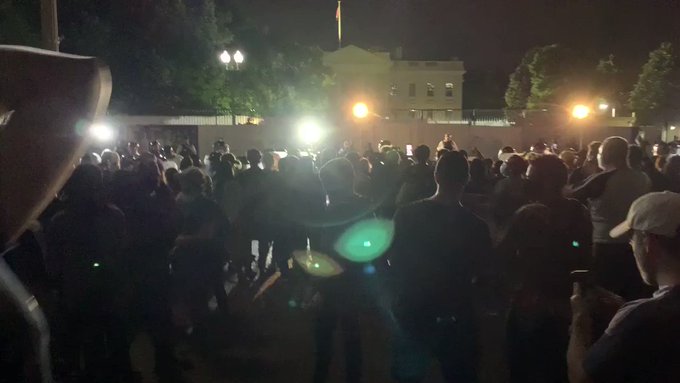
Washington DC. Riot cops are protecting the Trump White House. #dcprotest
2,437
11:54 PM - May 29, 2020
Twitter Ads info and privacy
1,234 people are talking about this
Despite the successes from the Gulf War, Green noted that that the chaos of the riots put both Bush and Bill Clinton behind Ross Perot just two months afterward amid an “endless news loop ” of unrest and violence, which was set against “the backdrop of a recession.”
“Gulf War triumph couldn’t save Bush from an endless news loop of urban unrest, billowing smoke, blaring sirens and broken windows cast against the backdrop of a recession,” Green wrote.
Green noted the 100,000-plus Americans who have died from the coronavirus pandemic and the 40 million-plus who are out of work as a result of the crisis. He also mentioned recent polls that have consistently put Trump behind presumptive Democratic nominee Joe Biden.
“The world makes for a poor scapegoat for a sitting president’s own failures, and the veterans of George H.W. Bush’s re-election campaign can tell you, because we actually have seen this movie before.”
As The Inquisitr reported, a Washington Post/ABC News poll released on Sunday showed Biden surging past Trump with 53 percent support among registered voters nationally — 10 percentage points ahead of the president, who had 43 percent support. The poll also revealed that Biden has improved his standing with key voting blocs, including suburban voters.
America's one term presidents
https://www.thoughtco.com/one-term-us-presidents-3322257
Here's a look at America's one term presidents—those who ran for, but lost, re-election—through history.
Here's a look at America's one term presidents—those who ran for, but lost, re-election—through history.
01
of 11
George H.W. Bush
:max_bytes(150000):strip_icc():format(webp)/georgehwbush-589cf4253df78c47587772ee.jpg)
of 11
George H.W. Bush
Hulton Archive / Getty Images
Republican George H.W. Bush was the 41st president of the United States, serving from 1989 to 1993. He lost a campaign for re-election in 1992 to Democrat William Jefferson Clinton, who went on to serve two full terms.
Bush's official White House biography describes his re-election loss this way: "Despite unprecedented popularity from this military and diplomatic triumph, Bush was unable to withstand discontent at home from a faltering economy, rising violence in inner cities, and continued high deficit spending. In 1992 he lost his bid for reelection to Democrat William Clinton."
02
of 11
Jimmy Carter
:max_bytes(150000):strip_icc():format(webp)/jimmycarter-589cf48c3df78c4758778c9e.jpg)
Republican George H.W. Bush was the 41st president of the United States, serving from 1989 to 1993. He lost a campaign for re-election in 1992 to Democrat William Jefferson Clinton, who went on to serve two full terms.
Bush's official White House biography describes his re-election loss this way: "Despite unprecedented popularity from this military and diplomatic triumph, Bush was unable to withstand discontent at home from a faltering economy, rising violence in inner cities, and continued high deficit spending. In 1992 he lost his bid for reelection to Democrat William Clinton."
02
of 11
Jimmy Carter
Bettmann / Contributor / Getty Images
Democrat Jimmy Carter was the 39th president of the United States, serving from 1977 to 1981. He lost a campaign for re-election in 1980 to Republican Ronald Reagan, who went on to serve two full terms.
Carter's White House biography blames several factors for his defeat, not the least of which was the hostage-taking of U. S. embassy staff in Iran, which dominated the news during the last 14 months of Carter's administration. "The consequences of Iran's holding Americans captive, together with continuing inflation at home, contributed to Carter's defeat in 1980. Even then, he continued the difficult negotiations over the hostages."
Iran released the 52 Americans the same day Carter left office.
03
of 11
Gerald Ford
:max_bytes(150000):strip_icc():format(webp)/geraldford-589cf3da5f9b58819c71c4c0.jpg)
Democrat Jimmy Carter was the 39th president of the United States, serving from 1977 to 1981. He lost a campaign for re-election in 1980 to Republican Ronald Reagan, who went on to serve two full terms.
Carter's White House biography blames several factors for his defeat, not the least of which was the hostage-taking of U. S. embassy staff in Iran, which dominated the news during the last 14 months of Carter's administration. "The consequences of Iran's holding Americans captive, together with continuing inflation at home, contributed to Carter's defeat in 1980. Even then, he continued the difficult negotiations over the hostages."
Iran released the 52 Americans the same day Carter left office.
03
of 11
Gerald Ford
David Hume Kennerly / Hulton Archive
Republican Gerald R. Ford was the 38th president of the United States, serving from 1974 to 1977. He lost a campaign for re-election in 1976 to Democrat Jimmy Carter, who went on to serve one term.
"Ford was confronted with almost insuperable tasks," his White House biography states. "There were the challenges of mastering inflation, reviving a depressed economy, solving chronic energy shortages, and trying to ensure world peace." In the end, he could not overcome those challenges.
In reality, Gerald Ford never even wanted to be president. When President Richard Nixon’s vice president Spiro Agnew resigned in 1973, Ford was appointed vice president by Congress. When President Nixon later resigned rather than face impeachment for his involvement in the Watergate scandal, Ford—who had never run for the office—ended up serving as president for the remainder of Nixon’s term. “I am acutely aware that you have not elected me as your president by your ballots, and so I ask you to confirm me as your president with your prayers,” Ford found himself having to ask the American people.
04
of 11
Herbert Hoover
:max_bytes(150000):strip_icc():format(webp)/herberthoover-589cf5253df78c475877b891.jpg)
Republican Gerald R. Ford was the 38th president of the United States, serving from 1974 to 1977. He lost a campaign for re-election in 1976 to Democrat Jimmy Carter, who went on to serve one term.
"Ford was confronted with almost insuperable tasks," his White House biography states. "There were the challenges of mastering inflation, reviving a depressed economy, solving chronic energy shortages, and trying to ensure world peace." In the end, he could not overcome those challenges.
In reality, Gerald Ford never even wanted to be president. When President Richard Nixon’s vice president Spiro Agnew resigned in 1973, Ford was appointed vice president by Congress. When President Nixon later resigned rather than face impeachment for his involvement in the Watergate scandal, Ford—who had never run for the office—ended up serving as president for the remainder of Nixon’s term. “I am acutely aware that you have not elected me as your president by your ballots, and so I ask you to confirm me as your president with your prayers,” Ford found himself having to ask the American people.
04
of 11
Herbert Hoover
Stock Montage / Getty Images
Republican Herbert Hoover was the 31st president of the United States, serving from 1929 to 1933. He lost a campaign for re-election in 1932 to Democrat Franklin D. Roosevelt, who went on to serve three full terms.
The stock market crashed within months of Hoover's first election in 1928, and the United States plunged into The Great Depression. Hoover became the scapegoat four years later.
"At the same time he reiterated his view that while people must not suffer from hunger and cold, caring for them must be primarily a local and voluntary responsibility," his biography reads. "His opponents in Congress, who he felt were sabotaging his program for their own political gain, unfairly painted him as a callous and cruel President."
05
of 11
William Howard Taft
:max_bytes(150000):strip_icc():format(webp)/WilliamTaft-589cf55a5f9b58819c72326d.jpg)
Republican Herbert Hoover was the 31st president of the United States, serving from 1929 to 1933. He lost a campaign for re-election in 1932 to Democrat Franklin D. Roosevelt, who went on to serve three full terms.
The stock market crashed within months of Hoover's first election in 1928, and the United States plunged into The Great Depression. Hoover became the scapegoat four years later.
"At the same time he reiterated his view that while people must not suffer from hunger and cold, caring for them must be primarily a local and voluntary responsibility," his biography reads. "His opponents in Congress, who he felt were sabotaging his program for their own political gain, unfairly painted him as a callous and cruel President."
05
of 11
William Howard Taft
Stock Montage / Getty Images
Republican William Howard Taft was the 27th president of the United States, serving from 1909 to 1913. He lost a campaign for re-election in 1912 to Democrat Woodrow Wilson, who went on to serve two full terms.
"Taft alienated many liberal Republicans who later formed the Progressive Party, by defending the Payne-Aldrich Act which unexpectedly continued high tariff rates," Taft's White House biography reads. "He further antagonized progressives by upholding his secretary of the interior, accused of failing to carry out [former President Theodore] Roosevelt's conservation policies."
When the Republicans nominated Taft for a second term, Roosevelt left the GOP and lead the Progressives, guaranteeing the election of Woodrow Wilson.
06
of 11
Benjamin Harrison
:max_bytes(150000):strip_icc():format(webp)/BenjaminHarrison-589cf67b5f9b58819c727241.jpg)
Republican William Howard Taft was the 27th president of the United States, serving from 1909 to 1913. He lost a campaign for re-election in 1912 to Democrat Woodrow Wilson, who went on to serve two full terms.
"Taft alienated many liberal Republicans who later formed the Progressive Party, by defending the Payne-Aldrich Act which unexpectedly continued high tariff rates," Taft's White House biography reads. "He further antagonized progressives by upholding his secretary of the interior, accused of failing to carry out [former President Theodore] Roosevelt's conservation policies."
When the Republicans nominated Taft for a second term, Roosevelt left the GOP and lead the Progressives, guaranteeing the election of Woodrow Wilson.
06
of 11
Benjamin Harrison
Stock Montage / Getty Images
Republican Benjamin Harrison was the 23rd president of the United States, serving from 1889 to 1893. He lost a campaign for re-election in 1892 to Democrat Grover Cleveland, who went on to serve two full terms, though not consecutively.
Harrison's administration suffered politically after a substantial Treasury surplus evaporated, and prosperity seemed about to disappear as well. The 1890 congressional elections swept in Democrats, and Republican leaders decided to abandon Harrison even though he had cooperated with Congress on party legislation, according to his White House biography. His party renominated him in 1892, but he was defeated by Cleveland.
07
of 11
Grover Cleveland
:max_bytes(150000):strip_icc():format(webp)/GroverCleveland-589cf6233df78c475877f6b6.jpg)
Republican Benjamin Harrison was the 23rd president of the United States, serving from 1889 to 1893. He lost a campaign for re-election in 1892 to Democrat Grover Cleveland, who went on to serve two full terms, though not consecutively.
Harrison's administration suffered politically after a substantial Treasury surplus evaporated, and prosperity seemed about to disappear as well. The 1890 congressional elections swept in Democrats, and Republican leaders decided to abandon Harrison even though he had cooperated with Congress on party legislation, according to his White House biography. His party renominated him in 1892, but he was defeated by Cleveland.
07
of 11
Grover Cleveland
Stock Montage / Getty Images
*Democrat Grover Cleveland was the 22nd and 24th president of the United States, having served from 1885 to 1889, and 1893 to 1897. So he doesn't technically qualify as a one-term president. But because Cleveland is the only president to serve two non-consecutive four-year terms, he holds an important place in U.S. history, having lost his initial bid for re-election in 1888 to Republican Benjamin Harrison.
"In December 1887 he called on Congress to reduce high protective tariffs," his bio reads. "Told that he had given Republicans an effective issue for the campaign of 1888, he retorted, 'What is the use of being elected or re-elected unless you stand for something?'"
08
of 11
Martin Van Buren
:max_bytes(150000):strip_icc():format(webp)/Martin-Van-Buren-589cf7273df78c4758781c10.jpg)
*Democrat Grover Cleveland was the 22nd and 24th president of the United States, having served from 1885 to 1889, and 1893 to 1897. So he doesn't technically qualify as a one-term president. But because Cleveland is the only president to serve two non-consecutive four-year terms, he holds an important place in U.S. history, having lost his initial bid for re-election in 1888 to Republican Benjamin Harrison.
"In December 1887 he called on Congress to reduce high protective tariffs," his bio reads. "Told that he had given Republicans an effective issue for the campaign of 1888, he retorted, 'What is the use of being elected or re-elected unless you stand for something?'"
08
of 11
Martin Van Buren
Stock Montage / Getty Images
Democrat Martin Van Buren served as the eighth president of the United States, serving from 1837 to 1841. He lost a campaign for re-election in 1840 to Whig William Henry Harrison, who died shortly after taking office.
"Van Buren devoted his inaugural address to a discourse upon the American experiment as an example to the rest of the world. The country was prosperous, but less than three months later the panic of 1837 punctured the prosperity," his White House biography reads.
"Declaring that the panic was due to recklessness in business and overexpansion of credit, Van Buren devoted himself to maintaining the solvency of the national Government." Still, he lost re-election.
09
of 11
John Quincy Adams
:max_bytes(150000):strip_icc():format(webp)/John-Quincy-Adams-589cf74d3df78c4758781e1b.jpg)
Democrat Martin Van Buren served as the eighth president of the United States, serving from 1837 to 1841. He lost a campaign for re-election in 1840 to Whig William Henry Harrison, who died shortly after taking office.
"Van Buren devoted his inaugural address to a discourse upon the American experiment as an example to the rest of the world. The country was prosperous, but less than three months later the panic of 1837 punctured the prosperity," his White House biography reads.
"Declaring that the panic was due to recklessness in business and overexpansion of credit, Van Buren devoted himself to maintaining the solvency of the national Government." Still, he lost re-election.
09
of 11
John Quincy Adams
Stock Montage / Getty Images
John Quincy Adams was the sixth president of the United States, serving from 1825 to 1829. He lost a campaign for re-election in 1828 to Andrew Jackson after his Jacksonian opponents accused him of corruption and public plunder - "an ordeal," according to his White House biography, "Adams did not easily bear."
10
of 11
John Adams
:max_bytes(150000):strip_icc():format(webp)/JohnAdams-589cf8253df78c4758782e7f.jpg)
John Quincy Adams was the sixth president of the United States, serving from 1825 to 1829. He lost a campaign for re-election in 1828 to Andrew Jackson after his Jacksonian opponents accused him of corruption and public plunder - "an ordeal," according to his White House biography, "Adams did not easily bear."
10
of 11
John Adams
Stock Montage / Getty Images
Federalist John Adams, one of America's Founding Fathers, was the second president of the United States, having served from 1797 to 1801. "In the campaign of 1800 the Republicans were united and effective, the Federalists badly divided," Adams' White House biography reads. Adams lost his re-election campaign in 1800 to Democratic-Republican Thomas Jefferson.
Don’t feel too sorry for one-term presidents. They get the same nice presidential retirement package as two-term presidents including a yearly pension, a staffed office, and several other allowances and benefits.
In 2016, Congress passed a bill that would have cut the pensions and allowances given to former presidents. However, President Barak Obama, soon to be a former president himself, vetoed the bill.
11
of 11
And Perhaps Lyndon Johnson?
:max_bytes(150000):strip_icc():format(webp)/lbj-58a9b21b5f9b58a3c90cfdd3.jpg)
Federalist John Adams, one of America's Founding Fathers, was the second president of the United States, having served from 1797 to 1801. "In the campaign of 1800 the Republicans were united and effective, the Federalists badly divided," Adams' White House biography reads. Adams lost his re-election campaign in 1800 to Democratic-Republican Thomas Jefferson.
Don’t feel too sorry for one-term presidents. They get the same nice presidential retirement package as two-term presidents including a yearly pension, a staffed office, and several other allowances and benefits.
In 2016, Congress passed a bill that would have cut the pensions and allowances given to former presidents. However, President Barak Obama, soon to be a former president himself, vetoed the bill.
11
of 11
And Perhaps Lyndon Johnson?
Bettmann / Getty Images
While President Lyndon B. Johnson served for six years, from 1963 to 1969, he could actually be considered a one-term president. Elected as President John F. Kennedy’s vice president in 1960, Johnson became president through succession after Kennedy was assassinated on November 22, 1963.
Elected to his own first term in 1964, Johnson succeeded in convincing Congress to pass many of his Great Society proposals for sweeping social domestic programs. However, under growing criticism for his handling of the Vietnam War, Johnson stunned the nation with two surprise announcements on March 31, 1968: he would cease all U.S. bombing of North Vietnam and seek a negotiated end to the war, and he would not run for reelection to a second term.
While President Lyndon B. Johnson served for six years, from 1963 to 1969, he could actually be considered a one-term president. Elected as President John F. Kennedy’s vice president in 1960, Johnson became president through succession after Kennedy was assassinated on November 22, 1963.
Elected to his own first term in 1964, Johnson succeeded in convincing Congress to pass many of his Great Society proposals for sweeping social domestic programs. However, under growing criticism for his handling of the Vietnam War, Johnson stunned the nation with two surprise announcements on March 31, 1968: he would cease all U.S. bombing of North Vietnam and seek a negotiated end to the war, and he would not run for reelection to a second term.
In Defense of Antifa
https://www.counterpunch.org/2020/06/02/in-defense-of-antifa/
by RON JACOBS
FacebookTwitterRedditEmail

Since Donald Trump and his sycophantic henchman Bill Barr decided to label the movement known as Antifa a terrorist organization, people across the political spectrum are resurrecting their antipathy towards the phenomenon. This cacophony of charges and misconceptions has once again put this amorphous manifestation in the spotlight. The last time most people had even heard of them was after some of its adherents shut down one of the last speeches by an alt-right luminary on a college campus. It was because of Antifa’s success in chasing fascists and their allies from colleges that it faded into the ether where all dead news stories go. Because police in the US don’t seem to be able to stop killing unarmed Black people and the Trumpists decision to go after anti-fascists again, Antifa is back. Along with their return comes aa chorus of criticism.
Antifa is once again being attacked by elements of the right, elements of the Left and the center. Those on the right see an anarchist anti-capitalist bogeyman. The critics on the left see nihilism and a misunderstanding of the definition of fascism. Those in the liberal/conservative center see an undefinable and unquantifiable element in the body politic that prefers violence to debate and vandalism to voting. All of these criticisms are both wrong and right. Precisely because it is not an organized group and has no politics beyond challenging those it considers fascists or very sympathetic to fascism, Antifa opens itself to these and other misunderstandings. There is no single spokesperson or committee to defend and explain it. Because it so loosely defined, it opens itself up to multiple definitions, many of which are lies.
As a person who defends Antifa (and identifies as an anti-fascist, among other things), I have been told by people that Antifa is a government plot, a bunch of rich punks who like to break things, a group of people who substitute punching people for a political program, and the reason Donald Trump will win re-election. Furthermore, people have told me that Antifa go after ordinary people by confusing right wing populists with fascism and that, while Trump is a populist, he is not a fascist. My response to this is that there were certainly many Germans, Italians and Spaniards who were their nation’s version of populist in the 1930s who never thought their support for Hitler, Mussolini or Franco would lead to the debacle it did. In other words, knowing this, why should we wait for fascists to show us what real fascism is if we can shut them down before that?
Right wing populists are much closer to fascism then they are to anything else. My understanding of history is that many fascist sympathizers in Europe and the US in the 1930s considered themselves populist in their politics. Once they realized the nature of those leading them, it was too late to turn back even if they had wanted to. Fascism is the ultimate realization of capitalism. It does not stand in opposition to any manifestation of that system. Neoliberalism is a step closer to the realization of fascism. Even though the meaning of Trumpism in relation to fascism continues to be debated, the fact remains that the US is considerably more authoritarian than it was even four years ago. That isn’t to say that it was not authoritarian prior to Trump’s entrance into the White House—of course it was. Indeed, the rise of the politics Trump represents would not be possible without the history that preceded his presidency. However, Trumpism is unique in the history of authoritarian rule in the USA in that it revolves around a single human—Donald Trump.
For those who have been paying attention, the Trumpistss have been taking plays right out of the classic fascist textbook. A few examples of this are:
1. Gleichshaltung–replacing bureaucrats and other officials with Trumpists (or leaving the positions blank so Trumpists can invoke policies favoring right wing capitalists (mostly)
2. Going after unions and workers in general
3. Naming immigrants as the other and criminalizing their existence
4. Provoking political, ethnic, gender and racial divisions…..you get the picture…
Has Antifa made mistakes? Of course they have. After all, it’s through praxis, not pontificating, that one learns what works best. In virtually every human endeavor, one learns much from their mistakes. Hell, when it comes to leftish movements, the movement behind the Sanders campaign made a few mistakes itself. They were arguably more consequential than any made by Antifa. However, like the Sanders campaign, Antifa has had its share of successes too. Perhaps the greatest one is that invitations to alt-right and fascist speakers to speak on university and college campuses greatly diminished (even prior to covid shutdowns) since the Antifa campaign to shut them down began.
Folks running under the Antifa banners are first and foremost against fascists and white supremacists. This includes people like Charles Murray and David Duke and the tiki torchbearers in Charlottesville. It includes Proud Boys and neo-nazis, Donald Trump and racist cops. The unfortunate (for some) truth is that sometimes, you gotta’ fight fascists if you want to fight fascism. Vigils don’t make them go away. In today’s climate, when fascist sympathizers (if not outright fascists) are sprinkled throughout the national government, various state governments and throughout most every type of law enforcement, disavowing Antifa and labeling it as criminal helps the most reactionary elements of the state consolidate their control. You may not like their tactics, but these folks are allies. The idea that they might be infiltrated is of course true, but who does more harm? An infiltrated bunch of leftists and anarchists or a bunch of liberals spouting the same garbage as the president, the justice department and other rightist politicians attempting to enhance the police state.
Subscribe to:
Comments (Atom)