Wednesday, June 3, 2020
MAJOR PUBLIC DEFENSE NONPROFIT IN NEW YORK IS UNIONIZING
By Hamilton Nolan, In These Times.
June 2, 2020
https://popularresistance.org/major-public-defense-nonprofit-in-new-york-is-unionizing/
One Of The Nation’s Most Respected Public Defender Nonprofits Is Unionizing, The Latest In A Surge Of Union Drives At Prominent Nonprofits Across The Country.
The Bronx Defenders, a large nonprofit that defends low-income people in the Bronx, New York, told management today that they intend to unionize with the Association of Legal Aid Attorneys, an affiliate of the UAW. The proposed union will have about 270 members, covering virtually the entire non-management staff. Of those, about 100 are not attorneys, including everyone from social workers to paralegals to facilities workers.
Employees at the Bronx Defenders cited issues like pay, health care benefits, and equality of professional development and promotions as motivating factors for the union drive. But one factor stood out more than any other: the potential for burnout among public defenders and those who work alongside them.
“I’ve seen people who were hired with me who left already because of burnout,” says Imani Waweru, a staff attorney in the criminal defense practice who has been at the organization for less than two years. “What we do every day is advocate. Why not have a place we can advocate for ourselves?”
Naima Drecker-Waxman, an associate in the immigration practice, agrees that burnout is a real threat—and believes that improvements in working conditions for the Bronx Defenders staff will translate to better outcomes for the clients. “We need to ensure our workforce is treated with respect in order to serve our clients,” she says.
Discussions about unionizing began quietly a year ago, and the effort to collect union cards intensified in the past couple of months. (Union drives at nonprofits usually win voluntary recognition from management, thanks to the inherent pressure for the organization to live up to the ideals it espouses. Employees at the Bronx Defenders expect the same.) The culmination of the union campaign comes against the backdrop of the coronavirus crisis, which has hit both the Bronx and the incarcerated population of New York City with savage force. The employees of the Bronx Defenders see their union drive as part of a larger struggle to improve a justice system that often seems unable to keep up with the demands of the crisis. “We’re all sharing this burden of a court system that’s not responsive to our needs,” says Drecker-Waxman.
Alexi Shalom, the union organizer at the ALAA, says his union has already won protective equipment and hazard pay in other places. “We’re seeing the tangible benefits of an organized workforce,” he says. “Our members are of no use to clients if they’re sick.”

Trump Clears Protests With Tear Gas and Uses Bible as a Prop for Church Photo Op
https://citizentruth.org/dc-bishop-outraged-by-trump-clearing-protests-with-tear-gas-and-using-bible-as-a-prop-for-church-photo-op/
DC Bishop ‘Outraged’ by Trump Clearing Protests With Tear Gas and Using Bible as a Prop for Church Photo Op
Guest Post June 2, 2020
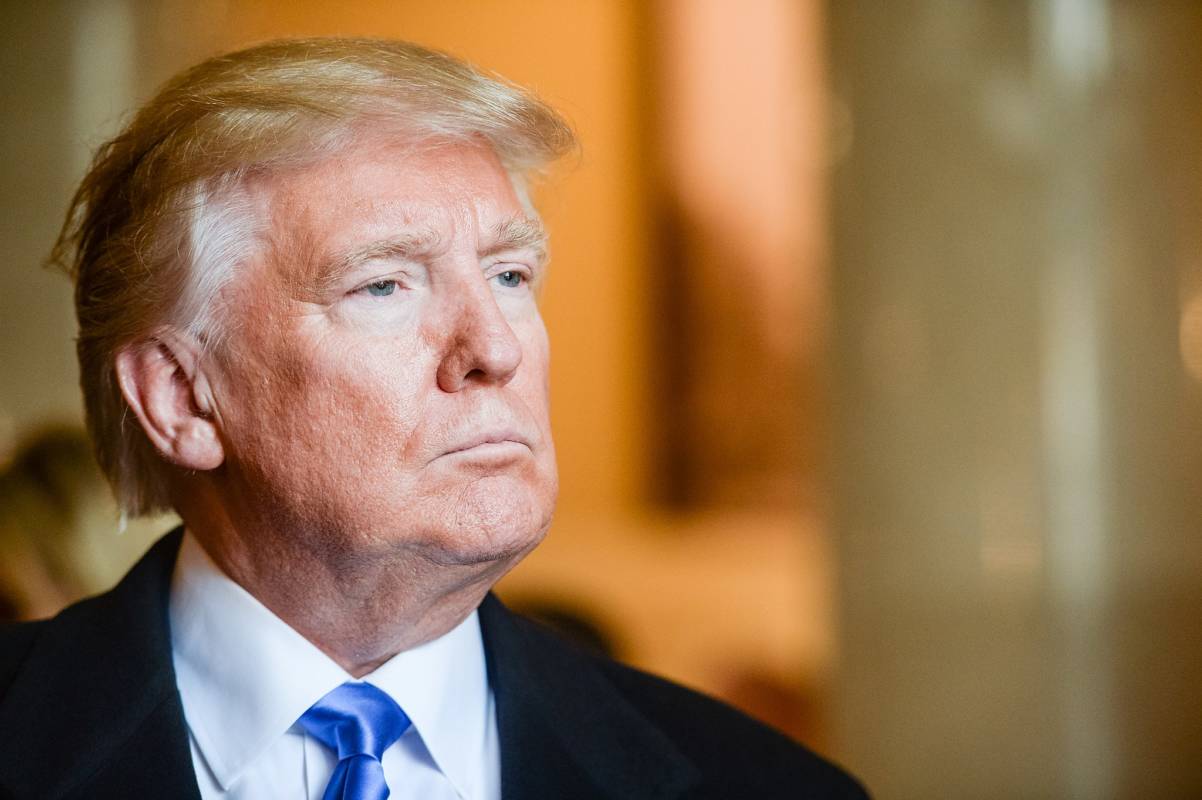
President-elect Donald Trump visit's the Tomb of the Unknown Soldier for their inaugural wreath-laying ceremony in Arlington National Cemetery, Arlington, Va., Jan. 19, 2017. (U.S. Army photo by Sgt. Alicia Brand/released)
“Everything he has said and done is to inflame violence,” the Right Rev. Mariann Edgar Budde said of the president.
(By: Jessica Corbett, Common Dreams) President Donald Trump had police violently disperse peaceful protesters with tear gas and rubber bullets on Monday night so he could threaten to deploy the military to U.S. cities from the Rose Garden then walk to the nearby St. John’s Episcopal Church for a photo op—moves sharply condemned by the bishop who oversees the church.
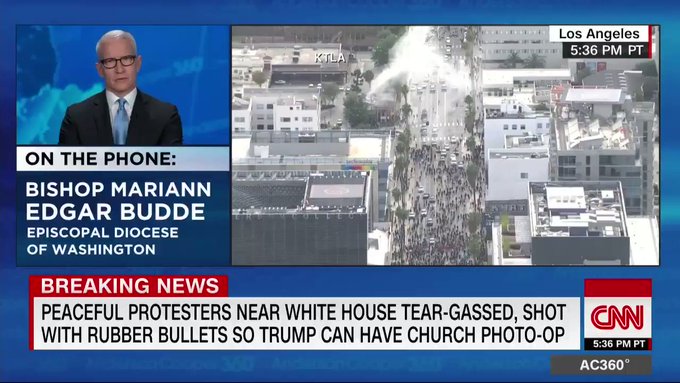
“I am the bishop of the Episcopal Diocese of Washington and was not given even a courtesy call, that they would be clearing [the area] with tear gas so they could use one of our churches as a prop,” the Right Rev. Mariann Edgar Budde told the Washington Post.
“Everything he has said and done is to inflame violence,” Budde said of the president, who threatened to use force to quash ongoing protests against police brutality and systemic racism. “We need moral leadership, and he’s done everything to divide us.”
Trump’s speech and subsequent stunt outside the church—along with the swift backlash it provoked—came as demonstrations erupted around the world over the police killing of George Floyd, an unarmed black man, in Minneapolis and the long history of discrimination and violence by U.S. law enforcement.
Budde denounced Trump’s photo op—in which he held up a Bible and gathered with members of his administration outside the church—in a series of Monday night television appearances.
“Let me be clear: The president just used a Bible, the most sacred text of the Judeo-Christian tradition, and one of the churches of my diocese without permission as a backdrop for a message antithetical to the teachings of Jesus and everything that our churches stand for,” Budde said on CNN.
“And to do so… he sanctioned the use of tear gas by police officers in riot gear to clear the church yard,” she added. “I am outraged.”

Oliver Darcy
✔@oliverdarcy
Bishop Mariann Edgar Budde: "The President just used a Bible ... and one of the churches of my diocese without permission as a backdrop for a message antithetical to the teachings of Jesus and everything our churches stand for....I am outraged."
17.5K
7:44 PM - Jun 1, 2020
Twitter Ads info and privacy
9,188 people are talking about this
In an appearance on MSNBC, Budde said she found it “deeply offensive” that Trump used the chuch as a backdrop and the Bible as a prop, saying that the sacred text “call[s] upon us to love God and love neighbor… proclaims every human being to be a beloved child of God, and exhorts us to live lives of peace and justice.”
In her position, Budde oversees more than 80 Episcopal congregations, including St. John’s. In a written statement to the Post, Presiding Bishop Michael Curry, head of the Episcopal denomination, also denounced Trump’s behavior.
Curry accused the president of using “a church building and the Holy Bible for partisan political purposes.” He added that “this was done in a time of deep hurt and pain in our country, and his action did nothing to help us or to heal us.”
“The prophet Micah taught that the Lord requires us to ‘do justice, love mercy, and walk humbly with our God,'” Curry wrote. “For the sake of George Floyd, for all who have wrongly suffered, and for the sake of us all, we need leaders to help us to be ‘one nation, under God, with liberty and justice for all.'”
Less than 24 hours after the controversial Monday night appearance, the president was scheduled to visit the Saint John Paul II National Shrine in Northeast Washington with First Lady Melania Trump on Tuesday morning before returning to the White House to sign an executive order on religious freedom.

Sr. Simone Campbell
✔@sr_simone
As President Trump goes to the John Paul II Center this morning may he learn what the Pope taught: Racism is a sin that constitutes a serious offense against God.
and NOT USE THIS AS ANOTHER CAMPAIGN PHOTO OP
83
8:07 AM - Jun 2, 2020
Twitter Ads info and privacy
29 people are talking about this
“Everything he has said and done is to inflame violence,” the Right Rev. Mariann Edgar Budde said of the president.
(By: Jessica Corbett, Common Dreams) President Donald Trump had police violently disperse peaceful protesters with tear gas and rubber bullets on Monday night so he could threaten to deploy the military to U.S. cities from the Rose Garden then walk to the nearby St. John’s Episcopal Church for a photo op—moves sharply condemned by the bishop who oversees the church.
“I am the bishop of the Episcopal Diocese of Washington and was not given even a courtesy call, that they would be clearing [the area] with tear gas so they could use one of our churches as a prop,” the Right Rev. Mariann Edgar Budde told the Washington Post.
“Everything he has said and done is to inflame violence,” Budde said of the president, who threatened to use force to quash ongoing protests against police brutality and systemic racism. “We need moral leadership, and he’s done everything to divide us.”
Trump’s speech and subsequent stunt outside the church—along with the swift backlash it provoked—came as demonstrations erupted around the world over the police killing of George Floyd, an unarmed black man, in Minneapolis and the long history of discrimination and violence by U.S. law enforcement.
Budde denounced Trump’s photo op—in which he held up a Bible and gathered with members of his administration outside the church—in a series of Monday night television appearances.
“Let me be clear: The president just used a Bible, the most sacred text of the Judeo-Christian tradition, and one of the churches of my diocese without permission as a backdrop for a message antithetical to the teachings of Jesus and everything that our churches stand for,” Budde said on CNN.
“And to do so… he sanctioned the use of tear gas by police officers in riot gear to clear the church yard,” she added. “I am outraged.”
Oliver Darcy
✔@oliverdarcy
Bishop Mariann Edgar Budde: "The President just used a Bible ... and one of the churches of my diocese without permission as a backdrop for a message antithetical to the teachings of Jesus and everything our churches stand for....I am outraged."
17.5K
7:44 PM - Jun 1, 2020
Twitter Ads info and privacy
9,188 people are talking about this
In an appearance on MSNBC, Budde said she found it “deeply offensive” that Trump used the chuch as a backdrop and the Bible as a prop, saying that the sacred text “call[s] upon us to love God and love neighbor… proclaims every human being to be a beloved child of God, and exhorts us to live lives of peace and justice.”
In her position, Budde oversees more than 80 Episcopal congregations, including St. John’s. In a written statement to the Post, Presiding Bishop Michael Curry, head of the Episcopal denomination, also denounced Trump’s behavior.
Curry accused the president of using “a church building and the Holy Bible for partisan political purposes.” He added that “this was done in a time of deep hurt and pain in our country, and his action did nothing to help us or to heal us.”
“The prophet Micah taught that the Lord requires us to ‘do justice, love mercy, and walk humbly with our God,'” Curry wrote. “For the sake of George Floyd, for all who have wrongly suffered, and for the sake of us all, we need leaders to help us to be ‘one nation, under God, with liberty and justice for all.'”
Less than 24 hours after the controversial Monday night appearance, the president was scheduled to visit the Saint John Paul II National Shrine in Northeast Washington with First Lady Melania Trump on Tuesday morning before returning to the White House to sign an executive order on religious freedom.
Sr. Simone Campbell
✔@sr_simone
As President Trump goes to the John Paul II Center this morning may he learn what the Pope taught: Racism is a sin that constitutes a serious offense against God.
and NOT USE THIS AS ANOTHER CAMPAIGN PHOTO OP
83
8:07 AM - Jun 2, 2020
Twitter Ads info and privacy
29 people are talking about this
Democratic Leadership Idly Stands by as Trump Implements Military Takeover
Alec Pronk June 2, 2020
https://citizentruth.org/democratic-leadership-idly-stands-by-as-trump-implements-military-takeover/
Despite the threats from the President and members of Congress, the number of nationwide protests increased with over 350 cities holding demonstrations.
After another day of police brutality and increasing pressure from Trump and his Republican counterparts, Speaker Nancy Pelosi and Senate Democratic Leader Chuck Schumer issued a short and vapid statement.
Primarily, Pelosi and Schumer took issue with the police actions of teargassing peaceful protesters to allow Trump to score a photo-op in front of St. John’s Church. The statement said, “tear-gassing peaceful protesters without provocation just so that the President could pose for photos outside a church dishonors every value that faith teaches us.
But they ignored most of Trump’s statement on the same day which included a threat to send in the military in states where governors and police failed to take control of the protests.
“I have strongly recommended to every governor to deploy the National Guard in sufficient numbers that we dominate the streets. Mayor and governors must establish an overwhelming law enforcement presence until the violence is quelled. If a city or state refuses… then I will deploy the United States military and quickly solve the problem for them,” Trump said in an address to the nation.
The Democratic leadership failed to call out, and currently, the House of Representatives is only meeting virtually with no plans to hold a hearing on Trump’s clear power grab.
A Call to Arms?
Another portion of Trump’s speech also caused great alarm: “I am mobilizing all federal resources, both civilian and military.”
The combination of Trump’s appearance outside of a boarded-up church with a speech that made overt references to God and mobilizing civilian resources, speculation has grown that Trump is calling for his supporters to join the attacks against protesters. Trump also made a direct call last week for violence by tweeting, “when the looting starts, the shooting starts.”
Professor and author Jared Yates Sexton warned that Trump’s speech was “a message to the Cult of the Shining City and the white supremacist Christianity that has taken over the American Right.” Sexton was raised in the faith and argued Trump’s Bible stunt will result in increased violence.
Pelosi and Schumer objected to the Bible photo-op by saying it “dishonors every value that faith teaches us.” Pelosi and Schumer make no mention of Trump’s call to deploy the military or make much worry about his stoking of tensions. They only called on Trump and law enforcement to “respect the dignity and rights of all Americans” without making specific demands.
Using the Military against Americans
Donald Trump was not the only Republican to announce they would deploy the military if need be to stop protests.
Arkansas Congressman Tom Cotton said, “If local law enforcement is overwhelmed and needs backup, let’s see how tough these Antifa terrorists are when they’re facing off with the 101st Airborne Division.” Cotton later added “the 10th Mountain, 82nd Airborne, 1st Cav, 3rd Infantry—whatever it takes to restore order” to his list of threats.
Protesters in Arkansas faced police violence during their demonstrations including police firing flashbangs at close range while protesters kneeled in front of the State Capitol.
Florida Congressman Matt Gaetz also tweeted out, “now that we clearly see Antifa as terrorists, can we hunt them down like we do those in the Middle East?”
Trump tried to designate Antifa, an anti-fascist political activist movement, as a terrorist organization.
Despite the threats from the President and members of Congress, the number of nationwide protests increased, with Al Jazeera documenting protests in over 350 American cities in all 50 states. Currently, the clashes between protesters and police look to only be increasing, and without clear opposition to Trump’s takeover, the Democratic leadership is shying away from its responsibility to fight back against widespread state-sanctioned violence.
Does Neo-Feudalism Define Our Current Epoch?
by LOUIS PROYECT
https://www.counterpunch.org/2020/05/29/does-neo-feudalism-define-our-current-epoch/
When I learned that we were entering a new period called neo-feudalism, my first reaction was to wonder if that was any worse than what we have now. After all, the serf might have suffered from a lack of freedom but at least had lots of time off as Michael Perelman pointed out in “The Invention of Capitalism“:
Although their standard of living may not have been particularly lavish, the people of precapitalistic northern Europe, like most traditional people, enjoyed a great deal of free time. The common people maintained innumerable religious holidays that punctuated the tempo of work. Joan Thirsk estimated that in the sixteenth and early seventeenth centuries, about one-third of the working days, including Sundays, were spent in leisure. Karl Kautsky offered a much more extravagant estimate that 204 annual holidays were celebrated in medieval Lower Bavaria.
Then again, I wondered if they were using the term feudalism in the same way I do. When I first began to hear about Trump as a “neo-fascist,” I stubbornly insisted on using the term fascism in a strict sense. I didn’t find him that different from past American presidents, including F.D.R. who threw Japanese-Americans into concentration camps in defiance of constitutional guarantees to citizens.
I decided to look more closely at the term after Jodi Dean’s article appeared in the Los Angeles Review of Books on May 12th. Comrade Dean, after all, is an accurate barometer of trends in the left academy. Before his shelf-life had expired, Dean was quite the apostle of Slavoj Zizek. Titled “Neofeudalism: The End of Capitalism?”, her article identified Joel Kotkin as “a conservative geographer” who envisions the U.S. future as mass serfdom. Well, if that means having one-third of your working days off, that might not be so bad. Although Dean’s article doesn’t mention him, Robert Kuttner has also weighed in the March/April 2020 issue of The American Prospect. Since these three constitute the broad political spectrum from Kuttner’s liberalism to Dean’s Marxism, I thought that writing about them might help me clarify my own thinking and that of my readers. With the cataclysmic changes capitalism is now undergoing, one can understand why some would go in search of new theories.
Let me start with Joel Kotkin, an urban studies professor who traffics in futuristic projections. His 2010 “The Next Hundred Million: America in 2050” was just such an exercise. The book called for nurturing the middle class, a goal shared by just about every politician on the planet, at least verbally. He has a new book out titled “The Coming of Neo-Feudalism: A Warning to the Global Middle Class” that seems consistent with the earlier one. You’d think that anybody warning about neo-feudalism would be an arch-enemy of Donald Trump, but it turns out that Kotkin was a fan. In a 2017 Daily Beast article titled “Here’s How Donald Trump Could End America’s New Feudalism,” California liberals, especially in Silicon Valley, are the dragon and Donald Trump is St. George:
Neo-feudalism diminishes the property owning middle-class. In the Bay Area, regional governments are now seeking to limit all new development to a mere fraction of the area’s land mass, all but guaranteeing the future generations will face almost impossibly high housing prices. And a new set of state regulations, including a requirement that new houses have “zero” net energy use all but guarantees that houses, over time, will continue becoming ever more expensive.
The article hails Trump’s nativism, economic nationalism and all the other nostrums associated with the far-right. He writes, “For all the awfulness associated with Trump, his election stemmed from a disinclination among Americans to accept their place in the new technocratic order.” There’s not much else to say about Kotkin except to paraphrase what Jeeves told Bertie Wooster: “You would not enjoy Kotkin, sir. He is fundamentally unsound.”
Let us turn now to Robert Kuttner, a stalwart and long-time Democratic Party supporter. His prolix article titled “The Rise of Neo-Feudalism” does not target Donald Trump per se. Thankfully, Kuttner sees neo-feudalism as a product of both Democratic and Republican administrations. It is a system that promotes deregulation, allows Facebook and other tech firms to enjoy a monopoly, and empowers Monsanto to screw small farmers through its intellectual property control over seeds. Since these abuses grew under both Obama and Trump, we can at least give Kuttner credit for not making Trump the embodiment of neo-feudalism.
Although he does not pinpoint exactly when such practices began, he does identify most of the 20th century as the halcyon days of democratic rather than feudal rule. The first inkling you get that Kuttner is rather hazy on feudalism as a system is when he refers to the Enclosure acts:
In the new tragedy, public regulation is precluded because law has been sundered from the democratic commons, in a manner that evokes the original tragedy of the commons—the English enclosure movement of the 17th and 18th centuries—in which lands that had been cultivated by the peasantry since time immemorial were carved up into commercial properties by local lords, with the blessing and legal protection of the Crown.
If you’ve read Marx, you’d understand that there was nothing feudal about the enclosure movement. Instead, it was the sine qua non for capitalist farming. Those “local lords” were not disposed to giving farmhands the kind of days off they enjoyed in the 12th century. They worked them to the bone, all in pursuit of profit. In the same way that there was nothing pre-capitalist about slavery in the New World, there was nothing feudal about English agriculture once the Enclosure acts began.
Kuttner makes the same error in discussing American industrialists of the 19th century. They retained “quasi-feudal rights” through the entire contract doctrine, which provided that “workers who left an employer mid-contract had no right to be paid for any work they had performed, and the tort of enticement, which enabled employers to prevent their workers from departing their establishment to work for someone else.” Once again, there is nothing feudal about that. It was simply the capitalist class using the law against workers who lacked the political power to defend themselves. During apartheid in South Africa, there were pass laws that robbed the black miner from enjoying the same freedoms as white wage workers. Pass laws were not feudal. Instead, they were part of apartheid’s racial capitalism.
As another example, you can look at how the Spaniards exploited native peoples in Peru in the 17th and 18th centuries. The Incas used the Mit’a to force conquered tribes to build roads. When the Spanish took power, they used the Mita (a different spelling and different meaning) to mine for gold. That gold was a critical link in the birth of capitalism and had nothing to do with the unhurried life under the Incan empire. It was human sacrifice rather than being worked to death in a gold mine that made you worry.
The one thing that Kotkin and Kuttner have in common is the belief that Silicon Valley is the embodiment of neo-feudalism. After reading a section of his article titled “Silicon Valley as a Giant Fiefdom”, you’d conclude that Mark Zuckerberg has something in common with King Louis XIV. He is outraged that companies like companies Google, Apple, and Amazon have invented their own jurisprudence within the terms of service that nobody reads to allow them to make money off our personal data. Is this feudal? I don’t see how. It just strikes me as the unlimited power of monopolies, the same sort of injustice that led Lenin to write “Imperialism, the Highest Stage of Capitalism.” As they say, the more things change, the more they stay the same.
Turning now to Jodi Dean, she at least acknowledges that today’s neo-feudalism does not reproduce all the features of traditional feudalism. To help her readers understand how the earlier feudalism works, she cites Perry Anderson and the late Ellen Meiksins Wood. From them, she draws the central lesson that political authority and economic power overlapped. Feudal lords extracted a surplus from peasants through legal coercion.
Under neo-feudalism political authority reasserts itself:
Political power is exercised with and as economic power, not only taxes but fines, liens, asset seizures, licenses, patents, jurisdictions, and borders. At the same time, economic power shields those who wield it from the reach of state law. Ten percent of global wealth is hoarded in off-shore accounts to avoid taxation. Cities and states relate to Apple, Amazon, Microsoft, Facebook, and Google/Alphabet as if these corporations were themselves sovereign states — negotiating with, trying to attract, and cooperating with them on their terms.
Like Kuttner, she mistakes the power exercised by such monopolies with feudalism. Google operating like a “sovereign state” is hardly feudal. Maybe she needs refresher course in “Imperialism, the Highest Stage of Capitalism.” Before WWI, the lines between the state and monopolies were highly porous. Like Google, General Electric straddled the world and forced sovereign states to bow before it. Lenin wrote:
The famous A.E.G. (General Electric Company), which grew up in this way, controls175 to 200 companies (through the “holding” system), and a total capital of approximately 1,500 million marks. Of direct agencies abroad alone, it has thirty-four, of which twelve are joint-stock companies, in more than ten countries. As early as 1904 the amount of capital invested abroad by the German electrical industry was estimated at 233 million marks. Of this sum, 62 million were invested in Russia. Needless to say, the A.E.G. is a huge “combine”—its manufacturing companies alone number no less than sixteen—producing the most diverse articles, from cables and insulators to motorcars and flying machines.
Perhaps, the ability of high-tech companies to achieve the dominance that Standard Oil and G.E. once enjoyed sends people like Kuttner and Dean in search of new terminology to capture the current period. It would be far better for them to identify the underlying class relations in 1914 and that still exist in 2020. People handling packages for Amazon are wage earners. The wage form disguises the ability of the boss to extract surplus value. Under feudalism, that was more obvious. The serf produced a hundred bushels of wheat and the lord took ten. He needed them to exchange for the armor his soldiers wore to defend the estate against rivals. The main difference? Under capitalism, the wage worker has no ties to the soil. If a factory is unprofitable, he or she loses her job. Under the sluggish feudal system, you are tied to the soil replicating age-old practices like leading an ox across a field.
Toward the end of the article, Dean tries to justify this new way of analyzing class relations. She writes:
For those on the left, neofeudalism lets us understand the primary political conflict as arising out of neoliberalism. The big confrontation today is not between democracy and fascism. Although popular with liberals, this formulation makes little sense given the power of oligarchs — financiers, media and real estate moguls, carbon and tech billionaires.
Once you get past the buzzwords about feudalism, all Jodi Dean seems to be saying is that big corporations are our enemy. Is that such a political or intellectual breakthrough?
With all due respect to the American Zizek, those on the left who have mastered their Marxism do not see the big confrontation as between democracy and fascism. That is how Noam Chomsky, Todd Gitlin, and Eric Alterman might see it. For us, it has always been a battle between those who own the means of production and those who sell their labor power to survive. Today, when the means of production lie prostrate on the ground like a dying ox, it is probably a good idea to stick to the Marxist basics rather than trendy but empty terms. If people want to call the capitalist system “neo-feudal,” I have no objection. For many people making a career out of Marxist punditry, there is always a need to keep your brand fresh and marketable. Once they called Zizek a superstar of Marxism and the Elvis of cultural studies. Now, like some superannuated movie star, it is hard for him to gain attention except through absurd books like “Pandemic! Covid-19 Shakes The World.” Let’s hope Comrade Dean stays on top of her game. The competition is tough out there.
How Immunity for Cops and Facebook Kills Americans
Thom Hartmann June 2, 2020
https://citizentruth.org/how-immunity-for-cops-and-facebook-kills-americans/
When you tell people they won’t be held accountable for their actions, it almost always ends badly. That’s what’s happened with our police and our social media, two institutional pillars of personal and political society in America today. Removing those dual immunities could dramatically change—for the better—the lives of millions of Americans.
For police, the doctrine of “qualified immunity” first took hold in 1967 in the Supreme Court case Pierson v. Ray, when it was used “to shield white police officers from a lawsuit they faced for enforcing segregation,” as the Princetonian editorial board wrote recently.
In Pierson v. Ray, a group of black and white clergymen who supported racial integration sued the police for arresting their members for violating segregation rules and sitting in a “white[s] only” part of a bus station in Jackson, Mississippi, in 1961.
The Supreme Court concluded that the police largely had immunity from being sued because the arrests were made in “good faith.” (The Supreme Court also said in Pierson v. Ray that those officers were not expected to predict that the Supreme Court would decide in the 1965 case of Thomas v. Mississippi that whites-only areas were unconstitutional.)
The Reagan Revolution brought a huge expansion of the doctrine when, in 1982, the Supreme Court in Harlow v. Fitzgerald redefined and expanded the immunity granted to any government employee, in a case involving former members of the Nixon administration.
While the Supreme Court never mentioned police in that decision, as government employees the police gained the same immunity given by the court to members of the executive and legislative branches of government.
The result of these decisions—examples of the Supreme Court essentially making law, as Congress has only occasionally weighed in on any of these issues—is that police in America routinely get away with murder and egregious violence.
The Supreme Court may, in the next week or two, take up a case that will examine this doctrine as it specifically applies to police; they have several such cases before them, and will probably choose at least one of them to base their ruling on.
Meanwhile, immunity is also helping out the internet oligarchs.
At the same time cops are flashing white power signs and killing black people at a rate 3.5 times greater than they are killing white people, Facebook and other social media sites are providing a safe haven for killer cops and white supremacists to hang out and promote violence.
They can do this because Congress, trying to jumpstart the internet, gave immunity to the owners and operators of websites where other people could post their own opinions, comments and rants.
Section 230 of the Communications Decency Act, passed in 1996, essentially says that the owners of services like Facebook and Twitter have very, very little responsibility for what people say—or what they do as the result of what they or others say—on their message boards or systems.
As a result, social media has become a sewer of lies, propaganda and the incitement of violence. (Although they do generally moderate and block copyright violations; protecting property rights is a far higher priority for these companies and the law than protecting personal rights, group safety, or democracy.)
It wasn’t always this way.
Back in the 1980s and early 1990s, I ran a small business that provided “moderating” services to CompuServe, which at first, along with AOL, pretty much was the internet.
We oversaw nearly 30 message boards devoted to a variety of topics from tech support for desktop publishing, Macs and PCs to ADHD, UFOs and the Kennedy assassination. A compilation of one of our message boards, published as the book Think Fast!, even won a national tech award and was put into an exhibition at the Smithsonian celebrating the emerging internet.
We had more than 40 people working from home all around the world, and CompuServe paid our company well for our work. We didn’t get rich from doing this as we were paying most of our employees (there were a few volunteers), but for about a decade we made a very comfortable middle-class living.
The reason CompuServe paid us to do this—and AOL was paying their own group of subcontractors to moderate their boards—was that CompuServe didn’t want to get sued if somebody posted something slanderous, obscene, or inciting violence on their platform.
Additionally, there was no anonymity: everybody who posted had to have verified their identity with a credit card (CompuServe charged a small monthly membership fee), and people who broke those rules were quarantined or outright banned from our boards. (Today this could be done via IP addresses or other means that don’t require money.)
Section 230, however, gave the owners and managers of CompuServe and AOL, and later Facebook, Twitter, 4Chan and pretty much every other site on the web, immunity from lawsuit. It was, for Zuckerberg et al., the equivalent of the Harlow v. Fitzgerald decision’s immunity grant to police.
Thus, today social media companies are spending millions of dollars a week to keep Section 230 in place so they won’t have to hire people like me and my old colleagues to keep their message boards clean and honest.
This is not an issue of censorship, by the way—Facebook and Twitter are already censoring posts on their platforms daily, based not on federal law or what’s best for democracy, but on their own internal rules, referred to as their “terms of service.” Facebook, for example, has given Fox News host Tucker Carlson’s Daily Caller (among others)—a site that publishes people who traffic in climate denial and anti-Semitism and is notoriously pro-Trump—the power to decide which posts are fact and which are fiction, which will be taken down and which will persist.
Instead, it’s an issue of money. If Facebook, Twitter et al. were held responsible for what people post on their sites, it would cost them a fair amount of money to hire thousands of people to keep their boards clean.
Instead of being worth $85 billion, Zuckerberg may end up only being worth $80 billion, no doubt a crushing blow.
The internet has changed a lot since 1996, when CompuServe pretty much quit paying our company to moderate their boards because they no longer had liability for things said there.
Holding companies like Twitter and Facebook to the same liability standards that every newspaper or radio and TV station in America today faces will not end their business model or wipe out their profitability.
Similarly, holding police to the standards of responsibility and decency they faced at law (although often unenforced) prior to 1982 won’t end policing or wipe out their ability to keep our communities safe.
But both will go a long way toward improving Americans’ quality of life and saving our republic.
This article was produced by Economy for All, a project of the Independent Media Institute.
Trump Considering Insurrection Act to Deploy Military to US City Streets as Protests Continue
https://citizentruth.org/this-is-no-game-trump-considering-insurrection-act-to-deploy-military-to-us-city-streets-as-protests-continue/
‘This Is No Game’: Trump Considering Insurrection Act to Deploy Military to US City Streets as Protests Continue
Guest Post June 1, 2020
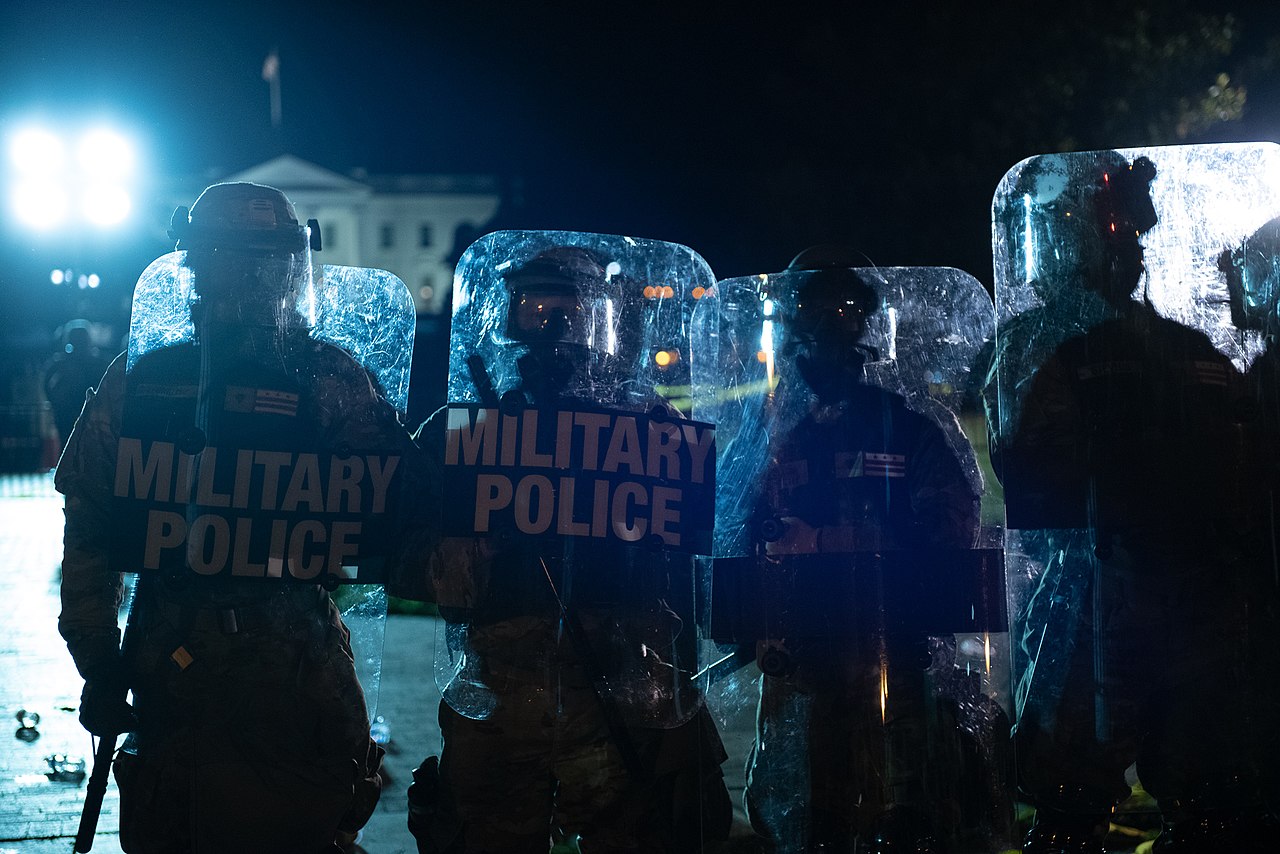
Riot Control at George Floyd protests in Washington DC, Lafayette Square. Date: 30 May 2020, 21:04:30 Source: Own work Author: Rosa Pineda
“Trump is rejecting the rule of law and proposing military action that is antithetical to basic premises of the American experiment.”
(By: Eoin Higgins, Common Dreams) President Donald Trump on Monday evening threatened to use the Insurrection Act of 1807 to deploy the U.S. military to the nation’s city streets if unrest over the killing of George Floyd did not calm.
“Trump is rejecting the rule of law and proposing military action that is antithetical to basic premises of the American experiment,” tweeted The Nation‘s John Nichols. “He thinks he is playing a political game. This is no game.”
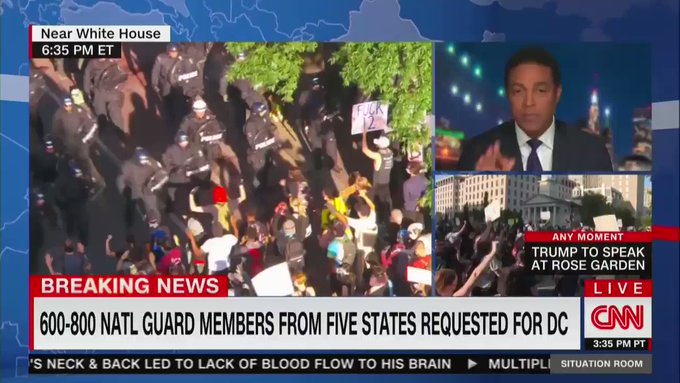
The president, who spent part of the weekend hidden in a bunker at the White House as protests raged outside the building, announced during a speech at the Rose Garden Monday that he was preparing to send military troops to cities around the nation.
“If a city or state refuses to take the actions necessary to defend the life and property of their residents, then I will deploy the United States military and quickly solve the problem for them,” said Trump.
The president also announced he was immediately deploying “thousands and thousands of heavily armed soldiers, military personnel, and law enforcement officers” to Washington—the only place in the country the president can legally deploy the army without restriction.
As NBC News reported:
To activate the military to operate in the U.S., Trump would have to invoke the 213-year-old Insurrection Act, which four people familiar with the decision had told NBC News he planned to do.
[…]
Trump’s decision on whether to invoke the act, adopted in 1807, to deploy troops has come as his frustrations mount over the protests that have followed the death of Floyd, a black man who was killed in police custody last week in Minneapolis. The people familiar with his decision said Trump was angry Sunday night at the destruction some protestors caused in Washington, particularly the vandalization of national monuments.
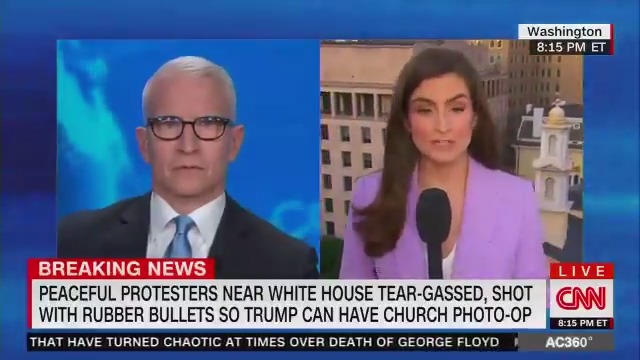
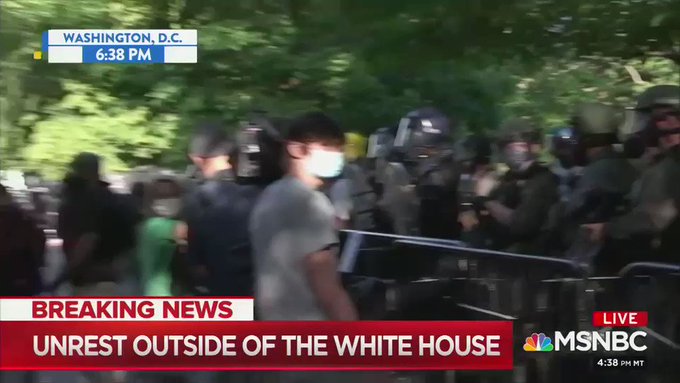
After his speech, Trump walked to St. John’s Church. Police cleared the way for the president to walk to the photo-op with force, using batons, tear gas, and pepper spray against peaceful demonstrators in Lafayette Square on the way to the church.

Aaron Rupar
✔@atrupar
The area outside the White House looks like a warzone right now
9,066
5:37 PM - Jun 1, 2020
Twitter Ads info and privacy
5,433 people are talking about this

John Whitehouse@existentialfish
CNN reports that Trump used tear gas and rubber bullets on peaceful protesters for a photo op, after being upset about media coverage about him being rushed to a bunker.
25K
7:20 PM - Jun 1, 2020
Twitter Ads info and privacy
12.7K people are talking about this
The national protest movement that erupted after Floyd’s killing by Minneapolis police officers on May 25 has spread across the entire country as long simmering rage over police brutality, racism, and civilian killings have combined with the economic and social crises of the coronavirus pandemic to propel tens and hundreds of thousands of people into the nation’s city streets night after night.

nikki mccann ramírez@NikkiMcR
I put the videos of police clearing out Lafayette Square and Trump’s photo op side by side.

56.2K
7:40 PM - Jun 1, 2020
Twitter Ads info and privacy
32.4K people are talking about this
“Abuse of power and systemic racism are a deadly combination, particularly for people of color and Indigenous Peoples, who are disproportionately criminalized and targeted by weaponized policing around the world—destroying lives, families, and communities, denying people their basic humanity and dignity, and violating their rights,” the Center for International Environmental Law (CIEL) said in a statement of solidarity with the protest movement.

Andrew Lawrence@ndrew_lawrence
no words
62.7K
5:45 PM - Jun 1, 2020
Twitter Ads info and privacy
28.3K people are talking about this
As Common Dreams reported, police around the country have constantly attacked protesters, escalating the demonstrations into violence and injuring and arresting hundreds of people. At least two people have died.
“People are angry,” Amnesty International USA End Gun Violence campaign manager Ernest Coverson said in a statement. “People are exhausted.”
“They have a right to take to the streets and peacefully protest—everyone has that right,” Coverson continued. “The rights of the many to take to the streets and demand justice and comprehensive police reform cannot be trampled upon, for any reason.”
The White House has been a regular target of Washington protesters, who have gathered at or near it nightly, at times destroying or damaging property around the building.
The president’s response to the protest movement has focused primarily on supporting the police. While Trump has mentioned George Floyd and expressed rare sympathy for a black victim of police abuse, the main focus of the president’s remarks over the past week have been on supporting law enforcement as officers beat, pepper spray, and launch tear gas at demonstrators.
“Sending in the military to respond to a peaceful revolution has been the only action this administration has taken,” said Coverson.
“Trump is rejecting the rule of law and proposing military action that is antithetical to basic premises of the American experiment.”
(By: Eoin Higgins, Common Dreams) President Donald Trump on Monday evening threatened to use the Insurrection Act of 1807 to deploy the U.S. military to the nation’s city streets if unrest over the killing of George Floyd did not calm.
“Trump is rejecting the rule of law and proposing military action that is antithetical to basic premises of the American experiment,” tweeted The Nation‘s John Nichols. “He thinks he is playing a political game. This is no game.”
The president, who spent part of the weekend hidden in a bunker at the White House as protests raged outside the building, announced during a speech at the Rose Garden Monday that he was preparing to send military troops to cities around the nation.
“If a city or state refuses to take the actions necessary to defend the life and property of their residents, then I will deploy the United States military and quickly solve the problem for them,” said Trump.
The president also announced he was immediately deploying “thousands and thousands of heavily armed soldiers, military personnel, and law enforcement officers” to Washington—the only place in the country the president can legally deploy the army without restriction.
As NBC News reported:
To activate the military to operate in the U.S., Trump would have to invoke the 213-year-old Insurrection Act, which four people familiar with the decision had told NBC News he planned to do.
[…]
Trump’s decision on whether to invoke the act, adopted in 1807, to deploy troops has come as his frustrations mount over the protests that have followed the death of Floyd, a black man who was killed in police custody last week in Minneapolis. The people familiar with his decision said Trump was angry Sunday night at the destruction some protestors caused in Washington, particularly the vandalization of national monuments.
After his speech, Trump walked to St. John’s Church. Police cleared the way for the president to walk to the photo-op with force, using batons, tear gas, and pepper spray against peaceful demonstrators in Lafayette Square on the way to the church.
Aaron Rupar
✔@atrupar
The area outside the White House looks like a warzone right now
9,066
5:37 PM - Jun 1, 2020
Twitter Ads info and privacy
5,433 people are talking about this
John Whitehouse@existentialfish
CNN reports that Trump used tear gas and rubber bullets on peaceful protesters for a photo op, after being upset about media coverage about him being rushed to a bunker.
25K
7:20 PM - Jun 1, 2020
Twitter Ads info and privacy
12.7K people are talking about this
The national protest movement that erupted after Floyd’s killing by Minneapolis police officers on May 25 has spread across the entire country as long simmering rage over police brutality, racism, and civilian killings have combined with the economic and social crises of the coronavirus pandemic to propel tens and hundreds of thousands of people into the nation’s city streets night after night.
nikki mccann ramírez@NikkiMcR
I put the videos of police clearing out Lafayette Square and Trump’s photo op side by side.
56.2K
7:40 PM - Jun 1, 2020
Twitter Ads info and privacy
32.4K people are talking about this
“Abuse of power and systemic racism are a deadly combination, particularly for people of color and Indigenous Peoples, who are disproportionately criminalized and targeted by weaponized policing around the world—destroying lives, families, and communities, denying people their basic humanity and dignity, and violating their rights,” the Center for International Environmental Law (CIEL) said in a statement of solidarity with the protest movement.
Andrew Lawrence@ndrew_lawrence
no words
62.7K
5:45 PM - Jun 1, 2020
Twitter Ads info and privacy
28.3K people are talking about this
As Common Dreams reported, police around the country have constantly attacked protesters, escalating the demonstrations into violence and injuring and arresting hundreds of people. At least two people have died.
“People are angry,” Amnesty International USA End Gun Violence campaign manager Ernest Coverson said in a statement. “People are exhausted.”
“They have a right to take to the streets and peacefully protest—everyone has that right,” Coverson continued. “The rights of the many to take to the streets and demand justice and comprehensive police reform cannot be trampled upon, for any reason.”
The White House has been a regular target of Washington protesters, who have gathered at or near it nightly, at times destroying or damaging property around the building.
The president’s response to the protest movement has focused primarily on supporting the police. While Trump has mentioned George Floyd and expressed rare sympathy for a black victim of police abuse, the main focus of the president’s remarks over the past week have been on supporting law enforcement as officers beat, pepper spray, and launch tear gas at demonstrators.
“Sending in the military to respond to a peaceful revolution has been the only action this administration has taken,” said Coverson.
Subscribe to:
Comments (Atom)