Tuesday, June 2, 2020
Let’s Imagine a Post-Pandemic Era With Less Policing and No New Jails
In this time of heightening crisis, we must be brave enough to use our full imaginations — and listen to those who have been dreaming of and fighting for just cities and communities for years.
June 1, 2020 Amanda Alexander TRUTHOUT
https://portside.org/2020-06-01/lets-imagine-post-pandemic-era-less-policing-and-no-new-jails
Right now, the “impossible” is happening every day.
In Detroit, with COVID-19 bursting the boundaries of our everyday catastrophes, we are seeing astounding — and overdue — changes in police and courtroom practices. Police are arresting fewer people and courts have scaled back to so-called “essential functions.” This comes after thousands of people in the community have long demanded an end to aggressive police stops, driver’s license suspensions and court debt. Now, courts have stopped issuing warrants for failing to appear and fewer people are being jailed. In some U.S. cities, jail populations are the lowest they’ve been since the 1980s — even the 1940s. Macomb County, near Detroit, just shelved plans for a new $300 million jail, citing the pandemic.
After years of unemployment, foreclosed homes, water shutoffs, shuttered schools, health clinic closures and jail expansion, many in Detroit’s Black majority have no illusions that our current system is doing anything but abandoning them to die. This calculated divestment has been relentless; after the outbreak of COVID-19, we learned that Wayne County officials had shifted $4 million in the 2019-2020 budget away from indigent health care and into new jail construction. And yet, in our neighborhoods, Detroit residents continue to prioritize each other. If we can do that here, despite decades of disinvestment, it’s possible everywhere. This moment has shown us that changes can happen quickly, and that the “impossible” is simply a matter of priorities. It’s about choosing — or being forced to choose — transformative solutions that dial into our collective humanity.
We are facing fundamental choices about who we are as a society. We could choose racist fear and fascist, dystopian policing. We could continue to deem entire communities “criminal” and refill the jails just as swiftly as we’ve begun to empty them. Or we could recognize we cannot return to “business as usual” because even before the pandemic, we had a state of emergency.
We’re at a turning point now. It’s time to learn from people who have been imagining new ways of being in community, and who have begun making monumental shifts.
At the Detroit Justice Center, we’ve asked more than a hundred young people what investments the city and county could make that would help them feel safe, valued and empowered. Not one of them has said we need more police on the streets or more jails. Instead, they said we should build mental health spas, restorative justice mediation centers, and invest in public transit. Pay our teachers, fix our schools, build housing that’s affordable and accessible for people with disabilities. These are not partisan political demands; in reality they are the freedom dreams of young people who understand that broad swaths of people have been living in a state of emergency for decades.Many communities have long known: jails produce poverty, job loss, evictions and homelessness, neighborhood instability, violence, trauma, debility and death.
In Detroit and much of the country, people who experience the brunt of systemic and interpersonal violence and the horrors of our jails and prisons have been fighting for renewed visions of safety and community well-being. They reject the idea that some people are only worthy of a jail or prison cell, and they have been leading the way in building more just cities. Their broader solutions encompass worker-owned cooperatives and thriving local farms and food systems, and they also recognize the need to empty jails in order to unlock the resources that we spend on criminalizing and punishing people.
We’ve entered a moment when we could bring the era of building new jails to an end. In the past several years, more research has shown what so many communities have long known: jails produce poverty, job loss, evictions and homelessness, neighborhood instability, violence, trauma, debility and death. Jails make communities less safe and less healthy. Where incarceration rates are high, community social and economic well-being decline. And all of this misery costs us over $1.2 trillion each year (once the impact on other systems like foster care, housing, and the costs to families is taken into account, that’s the total cost of incarceration in this country). Fortunately, organizers have given us ideas for what we could build instead, and models for fighting for budgets that would create more just and equitable communities.
Last year, in a historic vote, the Atlanta City Council moved to shut down the Atlanta City Detention Center and repurpose it as a hub where residents can access health care, housing, quality child care and more. The Center for Equity, Wellness and Freedom is the result of years of organizing and strategizing by formerly incarcerated women and their allies. Women on the Rise and the Racial Justice Action Center, led by Marilynn Winn and Xochitl Bervera, mobilized over 45 organizations to shut the jail under a rallying cry of “Communities Over Cages.” Atlanta officials built the jail in the lead-up to the 1996 Olympics “to hide the homeless from the community,” as Winn puts it, and filled it by ensnaring poor people in a cycle of tickets, warrants and unaffordable cash bail.
Over many years, the Atlanta activists fought to reduce pretrial incarceration, end cash bail, eliminate city ordinances that criminalize poverty, and cut city contracts with Immigrant and Customs Enforcement. And they didn’t stop there. As the jail population shrank from over 1,000 to less than 100, they began to articulate a vision for how the city could reallocate the $32.5 million it was spending each year on the jail to meet communities’ needs. After the city council vote, Atlanta’s Mayor Keisha Lance Bottoms declared, “No longer will Atlanta be in the jail business.” Winn and others did what visionary organizers do so well — they’d made the unimaginable inevitable.Winn and others did what visionary organizers do so well — they’d made the unimaginable inevitable.
Thankfully, it’s been happening in cities all over the country. In New York City, Philadelphia, Milwaukee, Chicago, St. Louis, Seattle, Baton Rouge, Los Angeles, and elsewhere, people are demanding resources for health care and well-being. And they’re winning. In Philadelphia, organizers with the “Close the Creek” campaign won a fight to shutter the city’s House of Corrections after pretrial reforms drove down Philly’s jail population by a third, from 8,082 to 5,394, in two years (2016-2018). Last summer, San Francisco’s Board of Supervisors voted to close the city’s Juvenile Hall and create rehabilitative noninstitutional support options for young people — after the Young Women’s Freedom Center and other organizers made them do it. This time last year, in Los Angeles County, after more than a decade of building power, the JusticeLA campaign blocked the construction of two new jails — projects totaling over $3.5 billion — and went on to win an unprecedented commitment to public health care. In Colorado, formerly incarcerated people and their allies, led by the Colorado Criminal Justice Reform Coalition, have won millions in community reinvestment for housing, jobs, reentry supports and health care in communities hardest hit by violence and incarceration.
In this time of heightening crisis, we must be brave enough to use our full imaginations — and listen to those who have been dreaming of and fighting for just cities and communities for years. While these community builders and organizers do not have all the answers, they have been asking the right questions. Questions that have very high stakes for all of us, like how can we heal, so that we can create healthy communities? And how, through our heartbreak, can we be more open-hearted people, so that we can create cities that are more just?
This is transformative work that can orient us toward a livable future for us all. If we’re lucky, future generations will thank us for it.

THE GEORGE FLOYD KILLING IN MINNEAPOLIS EXPOSES THE FAILURES OF POLICE REFORM
Alice Speri, Alleen Brown, Mara Hvistendahl
https://theintercept.com/2020/05/29/george-floyd-minneapolis-police-reform/
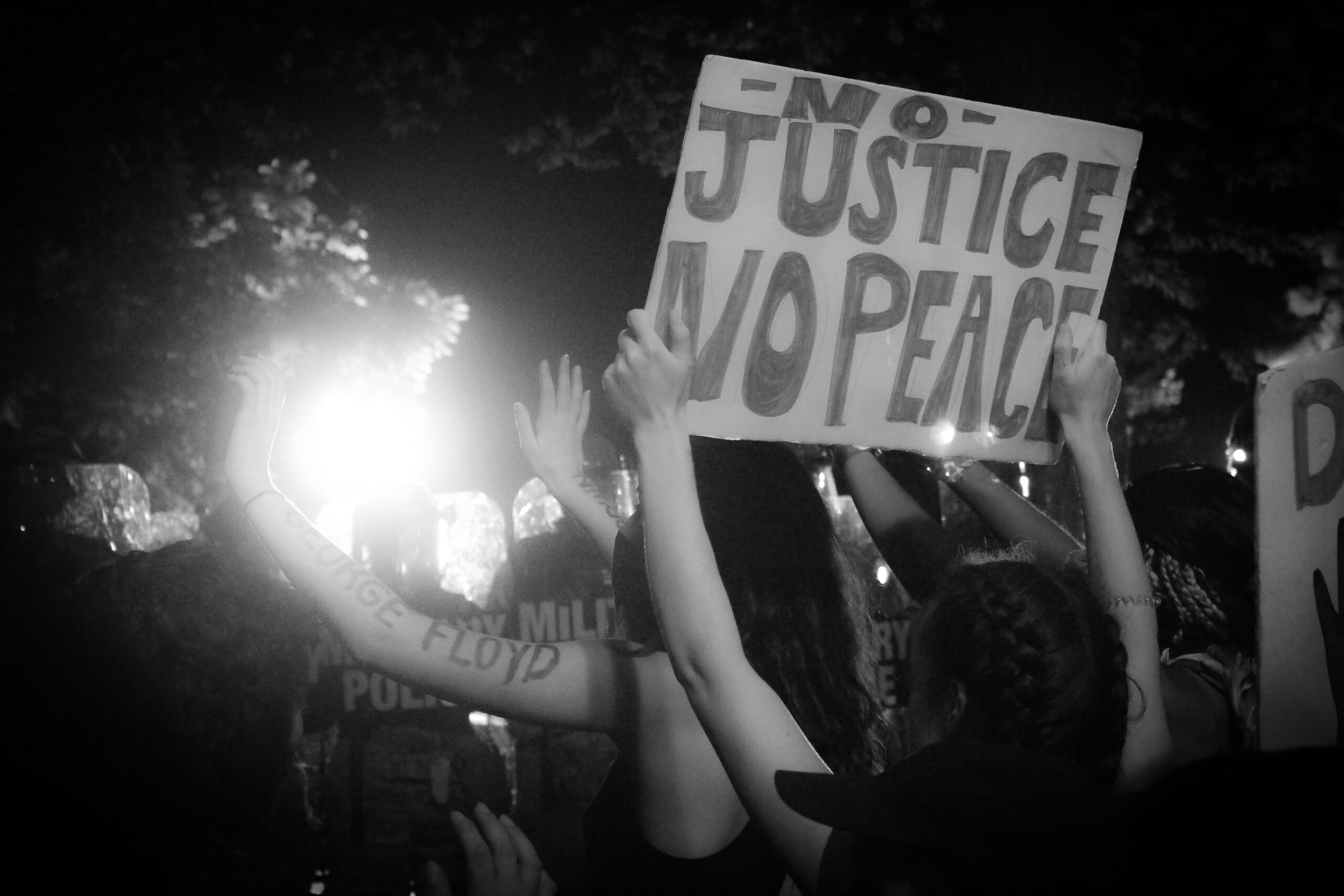
AS PROTESTS OVER the police killing of George Floyd engulfed Minneapolis for a third night on Thursday, and solidarity protests broke out in cities across the country, there was both a sense that the country had been through this before — too many times — and that the stakes had begun to shift.
In the Twin Cities, where Floyd’s killing at the hands of officer Derek Chauvin was just the latest in a series of high-profile police killings in the last five years, those who took to the streets in the middle of a coronavirus pandemic were tired and exasperated. Years of misconduct and brutality by local police had brought many protests and much talk of reform. But Floyd’s death was an urgent reminder that here, as across the country, police reform had failed, and that the time had come for something different.
“They call for training, but are they doing the training, and is the training being internalized?” said Moriah Stephens, a special education teacher, as she stood near a highway overpass in St. Louis Park, the suburb where Floyd had lived, waving as passing cars honked in support. “I can tell you 50 times over that my life matters and I would like you to speak out about the fact that my life matters, and you can hear me say that 50 times, but are you going to do it?”
“I’m tired of being angry, and I’m tired of being tired, and I’m tired of seeing new hashtags,” she added, referring to a recent wave of police killings and other racist incidents across the country. “I’m lucky I’m alive. I can stand here. I can shout. There’s part of me that’s like, I need to use what I have — I have my life and I need to use it, but I’m also tired of doing that.”
Stephens, who had joined protests after the police killings of Philando Castile in a Minneapolis suburb in 2016, said her father was currently undergoing chemotherapy treatment. She was reluctant to go out in the middle of a Covid-19 outbreak that had already taken nearly 1,000 lives in Minnesota, and like many protesters was wearing a mask and standing at a distance from others. “I’m not supposed to be around people. But that’s where I’m at.”
In Floyd’s neighborhood, the signs people carried recalled protests following earlier police killings while also raising new demands. They said “I can’t breathe” — George Floyd’s last words as Chauvin kneeled on his neck for more than seven minutes, but also the last words of Eric Garner, who was killed six years ago by a New York police officer, igniting a movement against police violence of which Floyd’s death is just the latest chapter. After Garner’s death, as after the death of Michael Brown the same year in Ferguson, Missouri, and those of scores of other black men and women killed by police since then, protesters called for the officers to be held accountable. But there were new calls at Thursday’s protests — such as “Fund Community Not Police” — that tapped into a more recent and growing movement demanding not so much police reform and accountability as abolition, through the defunding of police departments.
“In the wake of George Floyd’s murder by MPD officer Derek Chauvin, and the Minneapolis Police Department’s escalated violence against the city’s grieving Black community, Minneapolis is in desperate need of visionary leadership,” the Minneapolis group Reclaim the Block wrote in a statement calling on the city council to defund the police department. “Now is the time to invest in a safe, liberated future for our city. We can’t afford to keep funding MPD’s attacks on Black lives.”
There were signs some local leaders were starting to see it the same way. Under pressure from students, the University of Minnesota announced this week that it would scale back its contract with the Minneapolis Police Department. The University of Minnesota was the first public institution to cut ties with MPD after the killing of George Floyd. On Friday afternoon, Minneapolis public schools board members issued a resolution to terminate the school district’s contract with the Minneapolis Police Department. And protesters called for more action to curtail the role of police altogether.
“The system is not broken. It’s doing exactly what it was designed to do; that’s what people need to wrap their heads around,” said Imani Jackson, who grew up in St. Louis Park. “We need to create an entire new one.”
Reform Is Not the Answer
In the hours immediately after Floyd’s death, it was clear that the national conversation around police violence, set in motion by the killings of Brown and Garner in 2014, had finally begun to change. Chauvin, as well as three officers who had stood by without intervening as he killed Floyd, were promptly fired. Minneapolis Police Chief Medaria Arradondo, who took the helm of the department three years ago following backlash over another police killing, called for an FBI investigation. Mayor Jacob Frey called for the officers to be charged. On Friday, Chauvin was arrested and charged with third-degree murder and manslaughter — a charge that means the officer had no intent to kill and left some protesters disappointed.
“People weren’t having it no more,” said Sam Martinez, an organizer with the Twin Cities Coalition for Justice 4 Jamar. “The system knew that.”
A number of law enforcement and elected officials across the country also quickly denounced the Minneapolis officers’ actions — public criticism that would have been unthinkable just a few years ago.
In New York City, where Floyd’s death carried echoes of Eric Garner’s and where at least 72 protesters were arrested last night in a solidarity demonstration, Police Commissioner Dermot Shea and Mayor Bill de Blasio took to Twitter to condemn Floyd’s killing. “What we saw in Minnesota was deeply disturbing. It was wrong,” tweeted Shea. “This is not acceptable ANYWHERE.” “I am horrified,” tweeted de Blasio. “George Floyd was murdered in broad daylight and the man who killed him was a police officer.”
De Blasio’s and Shea’s comments stood in stark contrast with their defense of Daniel Pantaleo, the officer who killed Garner. Pantaleo was fired last summer, five years after Garner’s death.
“It took him five years to take any action in the Eric Garner case, and now he wants immediate action in Minneapolis,” said Alex Vitale, who runs the Policing and Social Justice Project at Brooklyn College, echoing widespread criticism of de Blasio’s statement.
Even the National Fraternal Order of Police, the largest police union in the country and a staunch defender of officers involved in killings of unarmed people in the past, released a statement criticizing the Minneapolis officers’ actions. “Based on the by-stander’s video from this incident, we witnessed a man in distress pleading for help,” the group wrote in a statement that was soon echoed by many local chapters of the union. “There is no doubt that this incident has diminished the trust and respect our communities have for the men and women of law enforcement.”
But critics warned that the public condemnations, including by law enforcement, were more a matter of political expediency than anything else. “I think that is politically convenient for all of them,” said Kandace Montgomery, director of Black Visions Collective, a Minnesota-based racial justice group, which is affiliated with Reclaim the Block and the Movement for Black Lives. “Until they actually offer real solutions and offer real policies that address the inherent violence of police departments, it’s all talk.”
“That’s all well and good, but it means nothing to me until they actually start making concrete changes in how they do business in their police department,” echoed Neill Franklin, a retired police major and the executive director of the Law Enforcement Action Partnership. Franklin pointed to the long history of complaints of abuse and excessive force filed against the officers responsible for Floyd’s death — and to the fact that reports of police misconduct, nationwide, are kept from public view largely because of union contracts that protect officers no matter their conduct.
“There are police chiefs who are now voicing their disgust about what happened in Minneapolis. Well, how about you now move to make these personnel records public?” said Franklin. “If you really are concerned as a police leader in what’s happening, not just with Mr. Floyd, but case after case, rework the union contracts. … We need to change these laws so that we have the ability to take swift action.”
But while calling for greater transparency — including a national database tracking officers terminated for misconduct so they wouldn’t just move from department to department — Franklin acknowledged efforts to reform police had largely fallen short.
“Reform is not the answer, we’ve been trying it for decades, and as you can see, we’re just not getting anywhere,” he said. “We need a new paradigm of policing in the United States. It needs to be completely dismantled and reconstructed, not changing a policy here or there.”
“We are still working with a model of policing in this country that was born out of slavery in this country, that was born out of a white supremacy in this country,” he added. “That’s why reform won’t work and that’s why we haven’t made any traction whatsoever on this issue of race, as we’ve seen with the death of Mr. Floyd.”
In fact, the swift condemnation of the Minneapolis officers was largely a testament to the deep crisis policing has been facing for years. That crisis was only exacerbated by the current health and economic emergency, which has left communities reeling and feeling that their government, across institutions, has failed them in unprecedented ways.
“Police have realized that their basic legitimacy is being challenged here, and they had better figure out some way to get out from under this,” said Vitale, who wrote a book that has both anticipated and informed the growing national movement to defund police. “So if that means throwing a few individual officers under the bus, they are happy to do that.”
The reluctance of prosecutors to charge the officers responsible for Floyd’s killing was yet another sign of how little has changed. “There is other evidence that doesn’t support a criminal charge,” said County Attorney Mike Freeman, who compared Floyd’s death to that of Freddie Gray, who died in the custody of Baltimore police in 2015 — a rare case in which the officers involved were charged with murder 12 days after the incident. That prosecution was ultimately unsuccessful. “It was a rush to charge, it was a rush to justice,” Freeman said of Gray’s case, despite the fact that Floyd’s death, unlike Gray’s, was clearly caught on camera.
“When it’s the average citizen who gets arrested and charged for something, the arrest is made immediately as soon as you have probable cause for an arrest,” noted Franklin, the retired cop.
In Ferguson, the top prosecutor’s refusal to charge officer Darren Wilson in 2014 led to weeks of protests as a grand jury sifted through evidence in the case before declining to bring charges. In Minneapolis, it took three days of protests for Chauvin to be arrested and charged. Some protesters set several buildings on fire, including the Third Precinct headquarters, where Chauvin worked. And as they did after protests erupted in Ferguson, Missouri, police responded to protests of Floyd’s death with tear gas and rubber bullets, at one point spraying tear gas out of a moving vehicle onto an apparently peaceful crowd. Several protesters, as well as some journalists, were arrested. Minnesota Gov. Tim Walz mobilized the National Guard, and after Chauvin was arrested, Frey set an 8 p.m. curfew for the weekend. President Donald Trump, as Barack Obama did after Freddie Gray’s killing in Baltimore, called protesters who looted stores “thugs” — though unlike Obama, Trump also called for them to be shot.
In fact, Michael Brown’s death in Ferguson ushered in an era of police reform that saw federal and local governments invest heavily in police training, including on racial bias, and in technology like body cameras that officials promised would bring about accountability. Floyd’s death was yet another reminder that those reforms have failed.
“This is happening after five years of being told, ‘Don’t worry, we’re getting the training,’” said Vitale. “The de-escalation training, the anti-bias training, the mindfulness training … why aren’t things getting any better?”
As evidence mounts of the failures of police reform, some departments and unions are beginning to embrace calls for individual accountability for “bad cops” who they continue to insist are not representatives of their institutions as a whole. But while protesters continue to call for individual officers to be arrested and prosecuted, there is a growing recognition that police misconduct will continue, no matter how many reforms politicians enact, as long as policing exists at the present scale.
“They are desperate. They see that they’ve got a major credibility problem and that there are active campaigns to take their money away,” said Vitale. “This whole idea of jailing killer cops as a way to fix policing is completely naive and misguided. Even when they are convicted, as rare as that is, there’s really no evidence that this feeds back into changes in how policing is done.”
Reducing the size of police departments by curbing their resources, he and others argue, will be far more effective at reducing police violence than any costly effort to improve the police. “These ‘defund and fund alternatives’ kinds of movement are much more threatening to police chiefs, which is why I think they are bending over backwards to try to get out ahead of this thing,” said Vitale. “People in the movement are shifting: They are not calling for body cameras and more training. More and more people are like, ‘Fuck that, take their money away.’”
The Conversation Has Changed
The movement against police brutality took off in Minnesota after police killed Jamar Clark in 2015. The 24-year-old black man was shot in the head by a pair of officers who said they had acted in self-defense, a story some witnesses disputed. In the wake of his death, community members shut down Interstate 94 and occupied the 4th Precinct in North Minneapolis for more than two weeks. Despite intensive organizing by groups like the Twin Cities Coalition for Justice 4 Jamar, an internal investigation by the Minneapolis police department found that the two officers who killed Clark did not so much as violate a department policy.
Since then, local movements have pushed for justice for the families of victim after victim of police violence in Minnesota. Among those killed was Philando Castile, a 32-year-old black motorist pulled over by St. Anthony police in the suburb of Falcon Heights in 2016, whose girlfriend began livestreaming after an officer shot him as Castile reached for his wallet. In 2017, Justine Ruszczyk, also known as Justine Damond, a 40-year-old white woman, was approaching a Minneapolis police car to report a potential sexual assault when a startled police officer shot and killed her. And in 2018, body camera footage revealed Minneapolis police chasing Thurman Blevins, a 31-year-old black man who they said was carrying a gun, and shooting him to death. Jeronimo Yanez, the officer who killed Castile, was acquitted, and prosecutors declined to file charges against the officers who killed Blevins. Mohamed Noor, who killed Ruszczyk, was sentenced to 12 years in prison — a sentence that some felt only came because Ruszczyk was white and Noor is black. Her family was awarded a record $20 million settlement.
At least a dozen police reform bills have failed to make meaningful progress in the state legislature since 2015. The most recent effort began last July, with the appointment of a task force that included police as well as anti-police-brutality organizers. After a series of public hearings, the group released a list of 28 proposals for reform in February, including creating a specialized unit in the Bureau of Criminal Apprehension for investigating instances of deadly force. Then Covid-19 hit, and the follow-up actions required by the state legislature stalled.
On the heels of Michael Brown’s death in Ferguson and of a series of other high-profile police killings, in 2014 Minneapolis became one of six cities to pilot the National Initiative for Building Community Trust and Justice — a multimillion-dollar program that was the Obama administration’s response to the national call for police accountability. The initiative, widely replicated in police departments across the country, promoted a “community based” approach to policing in response to criticism of so-called broken windows policing and New York-style stop-and-frisk.
“The whole idea was that if police had implicit bias training, so more money for training police, and were using technology for more accountability, and that if police officers were more respectful when they’re interacting with the community, that that will promote a better idea of policing, and more cooperation with police,” said Nancy Heitzeg, a sociology professor at St. Catherine University in St. Paul, who has studied the initiative.
“That was the theory,” she said. “And what does it say about the limits of reform that the city of Minneapolis and the Minneapolis police department could be part of a multi-year, multimillion-dollar national project to enhance police community relations, and after all of that, here we are?”
After years of investment in improved policing with no results to show for it, “the conversation has changed,” she added. “There’s much more of a public awareness and conversation about abolition, and what that means and what that might look like. … I think people were radicalized by Jamar Clark and Philando Castile. And then they saw the contradictions around Justine Damond.”
Montgomery, the director of Black Visions Collective, said that organizers are tired of just calling for prosecutions. “We’re moving past a conversation around prosecuting the police and individual officers — that doesn’t change anything. It doesn’t prevent another Philando Castile or George Floyd,” said Montgomery. “To me and many of my comrades, police reform is irrelevant.”
Some demands have shifted to community control. Organizer Sam Martinez told The Intercept that the Coalition for Justice 4 Jamar wants a board similar to a city council or school board to run the police: controlling its budget, approving union contracts, and deciding disciplinary actions. Martinez says the board would have to be fundamentally different from previous civilian police review councils that law enforcement has mostly ignored.
For his part, Mayor Jacob Frey, who critiqued police during an election campaign that took place in the aftermath of Ruszczyk’s killing, increased the police budget last year by more than $8 million, part of an effort to put more officers on the street. He has called his brand of police reform “community-oriented” policing, where more officers would build stronger relationships with community members.
Meanwhile, the local police union has maintained powerful sway over the fate of the mayor’s tepid reform efforts. This summer, Frey banned police officers from participating in warrior-style trainings that promote an attitude that lethal threats to police are everywhere. Yanez, the officer who killed Castile, had participated in one such training. In response, Minneapolis police union head Bob Kroll, an avid Trump supporter, stated that the union would offer the training free to any officer who wanted it.
Montgomery argues that defunding police is the only meaningful way forward. “For too long we have invested a massive amount of money in an institution that continues to prove itself to be failing and to be inadequate to address the safety needs of our community,” said Montgomery. “Defunding is about allocating the abundance of resources we do have to things that have been proven to work” — like housing, health, and education.
On Friday morning, organizers with Reclaim the Block delivered a petition to Minneapolis city council members, demanding that they agree to never again increase the police funding, cut the current budget by $45 million to help manage Covid-19 shortfalls, invest in community-led health and safety strategies, and work to compel the police department to stop inflicting violence on community members. The elected officials were given a deadline of 8 a.m. Saturday to respond.
“My greatest hope is that our city council, our mayor, folks across the country take this opportunity to look at solutions that actually keep us safe and away from the police,” said Montgomery. “My fear is that we will settle for something that looks like justice but won’t change our future and won’t guarantee that we won’t have to be doing this in a couple of weeks or months or years.”
Racist History Behind Trump’s Threat to Shoot Minneapolis Protesters Spurs Twitter to Act
Robert Mackey
https://theintercept.com/2020/05/29/twitter-restricts-access-trumps-threat-shoot-minneapolis-protesters/
DONALD TRUMP’S BLOODTHIRSTY threat to have protesters in Minneapolis shot by the military, issued in a tweet early Friday morning, prompted Twitter to restrict access to the president’s message, ruling that it violated the social network’s policy against “glorifying violence.”
In the tweet, posted just before 1 a.m. Eastern Time, Trump first wrote that “THUGS are dishonoring the memory of George Floyd,” the black man whose killing on Monday by a Minneapolis police officer who knelt on his throat as he gasped for air has prompted protests and rage. The president then threatened to have soldiers open fire unless local authorities in Minneapolis regain control, adding, “when the looting starts, the shooting starts.”
The tweet was soon covered by an initial warning message, which said the president’s comments violated the platform’s rules, but had not been removed because “it may be in the public’s interest” to be able to read them.
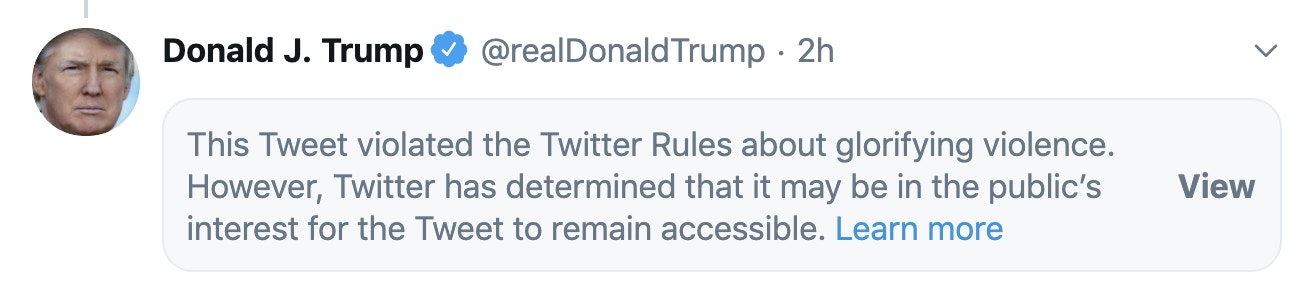
A screenshot of a warning appended to a tweet from Donald Trump on Friday morning.
Readers who clicked past that screen were able to read the inflammatory tweet, but with the warning message above it.
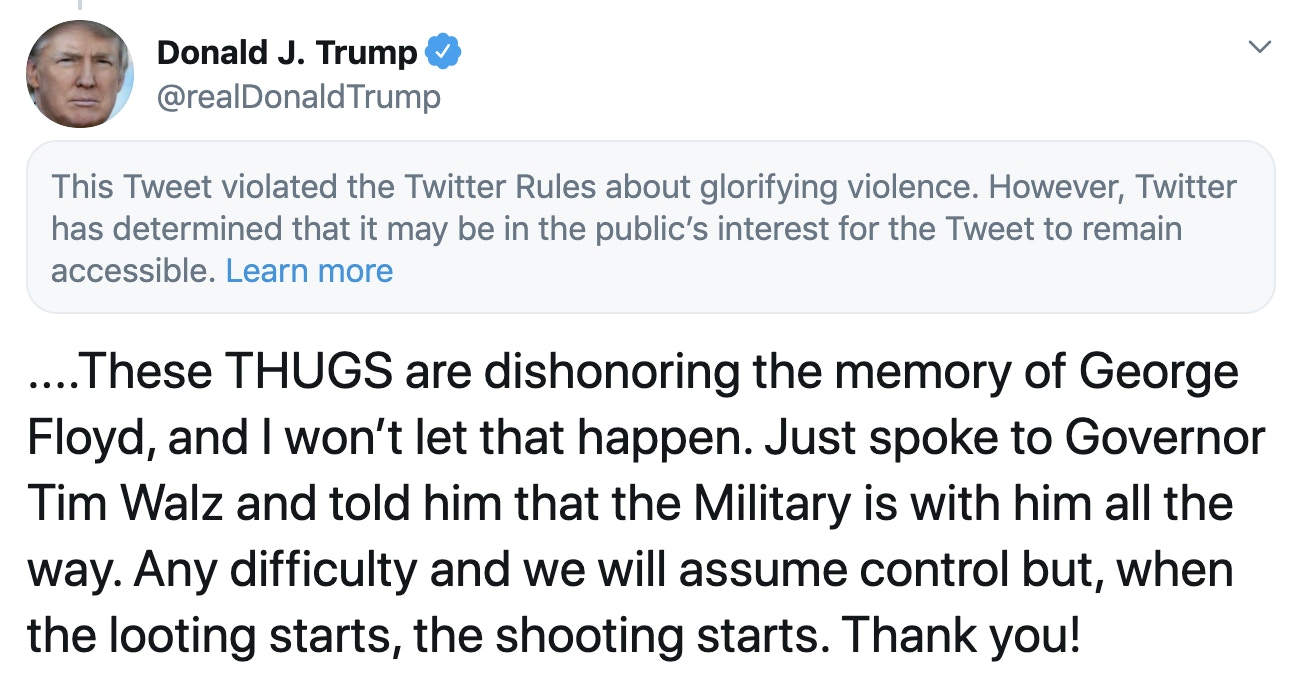
A screenshot of a tweet from Donald Trump, which came with a warning from Twitter about the president’s violent threat.
As Twitter noted in its explanation of why it had added “a public interest notice” to the tweet, that last phrase was even uglier to older Americans who might remember where they first heard it. The words were spoken in 1967 by Walter Headley, a racist Miami police chief, who told reporters that his officers would open fire if looting broke out in the city’s predominantly black neighborhoods.
According to a contemporary news report, from December 28, 1967, when Headley announced that he was declaring war on “young hoodlums, from 15 to 21, who have taken advantage of the civil rights campaign,” he added, “we don’t mind being accused of police brutality.” The goal of his crackdown on Miami’s black community, Headley said, was to unleash “an epidemic of law and order.”
Headley repeated the looting and shooting threat the following year when protests in the Liberty City neighborhood devolved into riots during that summer’s Republican National Convention in Miami, which nominated Richard Nixon for the presidency.
As NPR reports, the pro-segregation presidential candidate George Wallace also used the looting and shooting phrase on the campaign trail in 1968.
The protests in Miami that summer were prompted, in part, by anger over Headley’s “stop and frisk” policy targeting black citizens and his preference for “shotguns and dogs” in the policing of a community demanding civil rights.
As Jonathan Myerson Katz noted, the protests turned violent when a white man drove through a black rally in a car with a “Wallace for President” bumper sticker on the evening of Aug. 7, 1968. The police opened fire with tear gas and bullets. Three people were killed by the police and a black reporter for The Washington Post, Hollie West, was arrested in Liberty City by officers who refused to acknowledge his press credentials.
Trump’s reference to Headley and/or Wallace was unlikely to have been accidental. In 2016, Trump told a New York Times reporter that his own acceptance speech was inspired by Nixon’s in 1968. “I think what Nixon understood is that when the world is falling apart, people want a strong leader whose highest priority is protecting America first,” Trump said. “The 60s were bad, really bad. And it’s really bad now. Americans feel like it’s chaos again.”
“This Tweet violates our policies regarding the glorification of violence based on the historical context of the last line, its connection to violence, and the risk it could inspire similar actions today,” the company said in a thread explaining its decision. “We’ve taken action in the interest of preventing others from being inspired to commit violent acts, but have kept the Tweet on Twitter because it is important that the public still be able to see the Tweet given its relevance to ongoing matters of public importance.”
In line with Twitter’s policy on tweets that it would have removed from the platform but for the public interest exception, the company added that “engagements with the Tweet will be limited. People will be able to Retweet with Comment, but will not be able to Like, Reply or Retweet it.”
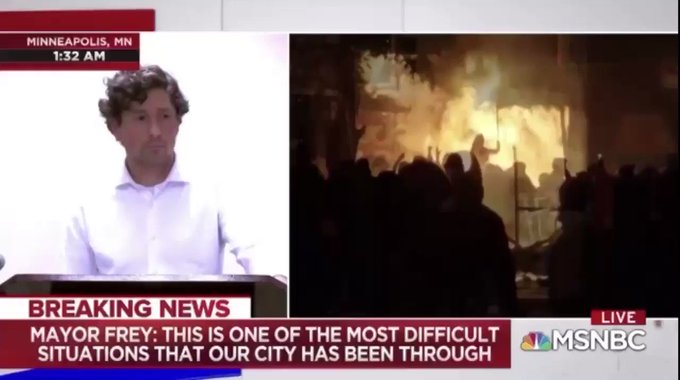
The mayor of Minneapolis, Jacob Frey, was asked to respond to the president’s tweet, and an earlier one calling him “very weak,” at a news conference early on Friday.
Frey shook his head in disbelief as the tweets were read to him.

Acyn Torabi@Acyn
Mayor Frey responds to the President’s tweets: Weakness is refusing to take responsibility for your own actions. Weakness is pointing your finger at somebody else during a time of crisis. Donald Trump knows nothing about the strength of Minneapolis. We are strong as hell..
1,404
1:42 AM - May 29, 2020
Twitter Ads info and privacy
598 people are talking about this
“Well, let me say this,” Frey responded. “Weakness is refusing to take responsibility for your own actions. Weakness is pointing your finger at somebody else during a time of crisis. Donald Trump knows nothing about the strength of Minneapolis. We are strong as hell. Is this a difficult time period? Yes. But you better be damn sure that we’re going to get through this.”
Later on Friday, after the police officer seen on video killing Floyd, Derek Chauvin, was arrested and charged with third-degree murder and manslaughter, the mayor described that “as an essential first step” in a tweet of his own.

Mayor Jacob Frey
✔@MayorFrey
The man who killed George Floyd has been charged with murder. This an essential first step on a much longer road toward justice and healing our city.
2,613
2:30 PM - May 29, 2020
Twitter Ads info and privacy
982 people are talking about this
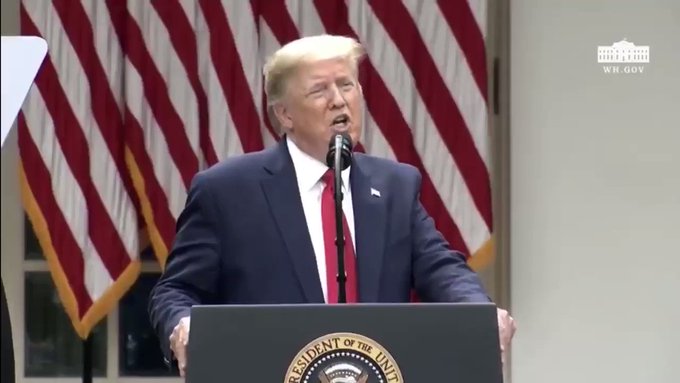
Trump, who had been expected to address the killing of Floyd, and his own provocative taunt, at a White House news conference, instead confined his remarks to inflaming tensions with China, by changing the terms of the U.S. relationship to Hong Kong and declaring a full withdrawal from the World Health Organization, before departing without taking a single question.
Acyn Torabi@Acyn
The President escapes his own press conference to evade questions on Minneapolis
488
2:05 PM - May 29, 2020
Twitter Ads info and privacy
341 people are talking about this
His administration did, however, devote some time to trying to dodge the Twitter restriction, by using the White House Twitter feed to quote the president’s inflammatory rhetoric. That White House tweet was soon restricted too, with the same warning label.
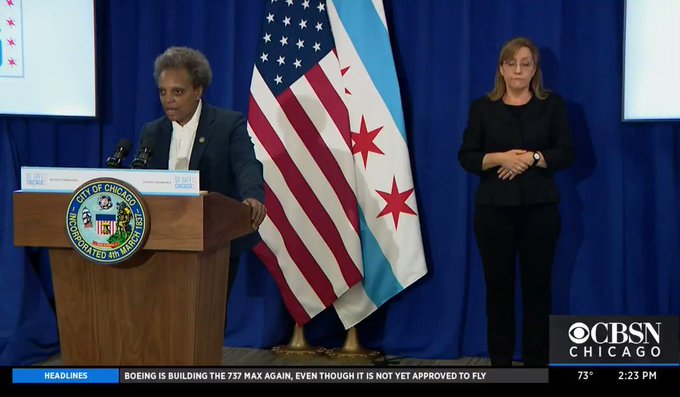
Anger over Trump’s rhetoric spread widely on Friday. Chicago’s Mayor Lori Lightfoot called Trump’s comment “profoundly dangerous.”

 arcusD
  @_MarcusD3_
Lori Lightfoot not holding back on Trump!
450
3:47 PM - May 29, 2020
Twitter Ads info and privacy
193 people are talking about this
“His goal is to polarize, to destabilize local government and inflame racist urges,” she added. “And we cannot, absolutely not, let him prevail. And I will code what I really want to say to Donald Trump. It’s two words, it begins with ‘F’ and it ends with ‘you.’ I will not remain silent while this man cynically tries to turn this incredibly painful moment into one for his own political gain.”
Twitter’s decision to draw a line for Trump came just hours after he issued an executive order threatening to make it easier for users to file lawsuits against the company for perceived political bias. The order was a transparent act of retaliation against the company for having appended a fact-checking note to a tweet in which Trump made a range of false claims about plans for California to make it easier for registered voters to vote by mail during the ongoing pandemic.
Jameel Jaffer, the executive director of the Knight First Amendment Institute at Columbia University, told Adweek that the executive order itself violated the First Amendment because it was an act of government retaliation. “The order was born unconstitutional because it was issued in retaliation for Twitter’s fact-checking of President Trump’s tweets,” Jaffer said.
“The First Amendment protects Twitter’s right to respond to the president’s speech, including by attaching warnings to tweets that glorify violence,” Jaffer said in a statement sent to The Intercept. “Fundamentally this dispute is about whether Twitter has the right to disagree with, criticize, and respond to the president. Obviously, it does. It is remarkable and truly chilling that the president and his advisers seem to believe otherwise.”
Jaffer’s colleague Katie Fallow, a senior attorney at the First Amendment Institute, noted that unusual language that appeared to have been added to the order without much review, “make the retaliatory motive even clearer.”

Katie Fallow@KatieFallow
Exhibit one million in 1st Amendment claim of government retaliation. https://twitter.com/briankarem/status/1266123740640927749 …
Brian J. Karem
✔@BrianKarem
Here, buried in the Executive Order is the reason @realDonaldTrump flipped his wig: He’s upset Twitter fact checked him. It is always about him.
275
5:05 PM - May 28, 2020
Twitter Ads info and privacy
84 people are talking about this
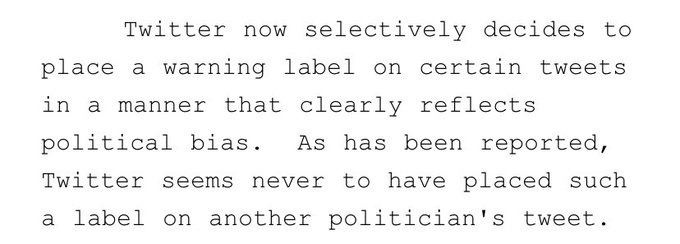
“Twitter now selectively decides to place a warning label on certain tweets in a manner that clearly reflects political bias,” one part of the order reads. “As has been reported, Twitter seems never to have placed such a label on another politician’s tweet.”
What’s odd, as Fallow notes, is that the order references “another politician” without saying that the first politician it is concerned with here is Trump, although that is quite clear from the context. Another less than subtle hint is that the order throws in a gratuitous attack on the company’s failure to label tweets by Rep. Adam Schiff, who led the impeachment of Trump, in which he supposedly “mislead his followers by peddling the long-disproved Russian Collusion Hoax, and Twitter did not flag those tweets.”
LOUISVILLE POLICE LEFT THE BODY OF DAVID MCATEE ON THE STREET FOR 12 HOURS
Aída Chávez
https://theintercept.com/2020/06/01/louisville-police-left-the-body-of-david-mcatee-on-the-street-for-12-hours/
THE BODY OF David McAtee laid in the streets of Louisville, Kentucky, for over 12 hours on Monday. McAtee had been killed by law enforcement just after midnight on Sunday, May 31, amid days of protests over police violence nationwide. Noon the next day, protesters were gathered at the site. McAtee’s body was still there.
McAtee, the owner of a local barbecue business and a beloved community figure, was shot and killed after Louisville police and the National Guard opened fire on a crowd that had gathered at a parking lot on 26th and Broadway. As the owner of YaYa’s BBQ, McAtee was known to give police officers free meals. Bystanders and witnesses have said that the crowd was not protesting when the police arrived. Police claim that they were returning fire after the crowd began shooting.
Kentucky Gov. Andy Beshear attributed the killing to the Louisville Metro Police Department and the National Guard. Police officers, Louisville Mayor Greg Fischer said, had not activated their body cameras in violation of policy. Police Chief Steve Conrad was fired as a result, but retains his pension. Acting Chief Robert Schroeder, at the press conference, seemed to walk back Beshear’s statement pending investigation. “We do not know who shot him,” he said, “we do not know if it was related to a separate incident, if it was due to the shots fired by our officers and the National Guardsmen soldiers who accompanied them.” The press conference did not address why McAtee’s body was left outside, and Louisville police did not respond to a request for comment.
Robert LeVertis Bell, a community activist who’s running for the Louisville Metro Council in the 4th District, was among the hundreds of protesters who had gathered at the scene early Monday afternoon. He said the crowd was made up mostly of members of the community, not experienced activists, who were angry and hurt. “We were already dealing with the death of Breonna Taylor,” he said, referring to the police shooting of a young black woman two months ago.
“Even if they had some sort of legitimate, procedural reason for [keeping the body at the scene] you’d think they would have in mind the trauma that they’re inflicting when they do that, especially having experienced that with the Mike Brown case in Ferguson,” Bell said. “That’s the first thing I thought, that this was terrorism… because it’s terrorizing, even if they don’t intentionally try to do it.”
Protests of police brutality around the country saw escalating violence over the weekend, with police driving vehicles into crowds and firing rubber bullets, tear gas, and flash grenades, in clashes that have gone viral on social media. Police have arrested more than 4,100 people over days of demonstrations, according to a tally from the Associated Press, and several protesters have been killed. On Saturday night in Omaha, Nebraska, Jake Gardner, a white bar owner, shot and killed James Scurlock, a 22-year-old black man, outside his establishment. On Monday, prosecutors said the man acted in self defense and would not be charged. Calvin L. Horton Jr. was shot and killed outside a pawnshop in Minneapolis. Chris Beaty, a former football player, and Dorian Murrell were also shot and killed in separate incidents in Indianapolis over the weekend, though it was not immediately clear who was responsible for either killing. A protester died in St. Louis after reportedly being dragged on the highway by a FedEx truck.
At the mayor’s press conference, Kentucky State Rep. Charles Booker, a Louisville native who is challenging Mitch McConnell for Senate in 2020, spoke for the community. “My voice is strained because I’ve been doing a lot of yelling and crying as well,” he said, and called for police officers involved in Taylor’s death to be relieved of their duties and for the investigations in Taylor’s death to be expedited. “To lose your job when someone has died at your hands is a small price to pay.”
RIGHT-WING GROUP SEEKS TO PURGE UP TO 800,000 VOTERS IN PENNSYLVANIA, A KEY BATTLEGROUND STATE
Akela Lacy
https://theintercept.com/2020/05/28/pennsylvania-voter-rolls-purge-judicial-watch/
SIX STATES ARE facing federal lawsuits and threats of litigation from the ultra-conservative nonprofit Judicial Watch that could jeopardize the integrity of upcoming primary and general elections.
The suits claim that states are not properly maintaining voter rolls as required by federal law, and raise the specter of voter fraud, arguing that improper maintenance could leave the door open to “dirty elections.”
Judicial Watch, which focuses on the courts and is funded primarily by large grants from conservative foundations, is suing Pennsylvania’s chief election official, along with county legislators and election officials in three of the state’s six counties with the most registered voters. Pennsylvania was critical to Donald Trump’s win in 2016. He won by less than 1 percentage point, losing only 11 counties, including the three suburban Philadelphia counties being sued by Judicial Watch. It was the first time Pennsylvania went red since 1988. Democrats almost certainly need to win the state — where former Vice President Joe Biden was born, and where his campaign is headquartered — to take back the White House.
The group has filed similar suits in North Carolina and Maryland. The Pennsylvania lawsuit follows notices Judicial Watch sent to 19 counties in Pennsylvania, California, Virginia, Colorado, and Kentucky last December, threatening lawsuits unless they removed ineligible voters from rolls. One Pennsylvania county buckled under pressure and made changes to its voter rolls, while the three that are currently being sued did not. Counties in California and Kentucky, facing pressure from Judicial Watch, last year started the process to remove close to 2 million voters from their rolls.
“Nobody questions that states should keep voter rolls accurate and up to date,” said Adriel I. Cepeda Derieux, senior staff attorney with the American Civil Liberties Union Voting Rights Project. “The problem is when overly aggressive procedures sweep too widely to catch eligible voters who should remain on the rolls. And those excessive practices have been again and again shown to disproportionately impact racial and language minority communities.”
Voters who are erroneously removed from the rolls would have to re-register ahead of upcoming elections, though it’s not certain they would be notified in time. Voters whose registrations are in question are usually notified by mail, though given the ongoing pandemic, many people are not currently at the addresses listed on their registrations or are not able to access mail due to illness or other extenuating circumstances.
Republicans have peddled the myth of rampant voter fraud in an effort to curtail voting rights and suppress votes to their advantage. They have upped the ante in recent weeks as a number of states battle over how to make voting accessible amid the coronavirus pandemic, which has postponed some elections. On May 21, Judicial Watch sued California following Democratic Gov. Gavin Newsom’s order to completely shift November elections to vote-by-mail; it would be the first state to do so as a result of the ongoing pandemic. The Republican National Committee, the National Republican Congressional Committee, and the California Republican Party filed suit against the order several days later. “Dirty voting rolls can mean dirty elections,” Judicial Watch President Tom Fitton said in an April 28 press release on the Pennsylvania suit.
There is no evidence to bear out that claim. While there have been no recent major incidents of voter fraud, there was a case of electoral fraud committed by Republicans in North Carolina. Senate Majority Leader Mitch McConnell, R-Ky., bizarrely referenced that case when warning against potential voter fraud in other states. In that case, a political strategist working for a Republican congressional candidate was indicted on charges of orchestrating a scheme to collect and submit fraudulent absentee ballots in 2018 and 2016, including forging signatures and filling out incomplete ballots, and paying workers to collect them.
In response to increased legal activity surrounding claims of voter fraud, the Brennan Center for Justice released a report Wednesday debunking 10 myths related to the issue. The public policy group warns against using flawed lists of voter data to justify purges, citing cases in Virginia and Texas.
“This year, not surprisingly, we’ve seen a remarkable uptick in terms of litigation seeking both to remove voters from the rolls, and also to prevent certain groups of registered voters from being able to vote by mail in the primaries,” said John Powers, counsel at the Lawyers’ Committee for Civil Rights Under Law. The group recently filed to intervene in the Judicial Watch suit in Pennsylvania. He noted that these types of lawsuits tend to be frivolous. “Plaintiffs raise concerns that their vote could be diluted due to voter fraud, and then they cite a couple of random examples from out of state, and often times from many years ago — decades ago — which are highly speculative.”
There are adequate protections in place to detect and prevent rare cases of voter fraud, Powers said. “The system works,” he said. In regard to expanded vote-by-mail, fears about the potential for remote voting fraud do not “justify imposing restrictions that are gonna disenfranchise or severely burden thousands of voters in the upcoming election cycle.”
IN PENNSYLVANIA’S MIDDLE District Court, Judicial Watch sued the Department of State, along with election officials in Bucks, Delaware, and Chester counties. The group argued that Pennsylvania has “abnormally low number of removals” under procedure mandated by the National Voter Registration Act, or NRVA, “to identify voters who have changed residence,” and cited low removal numbers as evidence that the state “is not removing inactive registrations as the law requires.” In other words, Judicial Watch is claiming that county officials are not properly maintaining voter rolls and implying without evidence that this leaves open the door to voter fraud.
The suit claims that there are up to 800,000 inactive voters in the three counties, meaning they are ineligible to vote. That would amount to more than 65 percent of all registered voters across the three counties. Judicial Watch claims that its analysis of voter registration data shows that the Pennsylvania counties “removed almost no names under NVRA procedures for identifying and updating the registrations of those who have moved.”
The right-wing group sent letters to Secretary of the Commonwealth Kathy Boockvar, who was appointed last January by Democratic Gov. Tom Wolf, and county legislators and election officials in Bucks, Chester, and Delaware Counties, asking them to provide “all documents concerning any instance(s) of voter fraud.” The complaint asks the court to compel county election offices and officials to “comply with their voter list maintenance obligations,” as well as obligations regarding record production under the NRVA.
Boockvar, a named defendant in the lawsuit, recently said “we 100% dispute” the suit’s claims.
Discussing the Pennsylvania suit on a press call earlier this month, Ezra Rosenberg, co-director of the Lawyers’ Committee for Civil Rights Under Law, said the purge would be “unlawful” and that Judicial Watch had based its litigation on “unverified, self-generated analysis that compares the voter registration data with outdated census data.”
“They cite some EAC statistics where they say the county’s only purged seventeen people, but that information is inaccurate,” said Powers, of the Lawyers Committee for Civil Rights, referencing a 2019 U.S. Election Assistance Commission report on an election administration and voting survey administered in 2018. “Judicial Watch’s own pleadings include correspondence with the county officials where they say, ‘Hey, we’ve purged tens of thousands of people over this period,’” he said. “What additional purges does Judicial Watch want these counties to undertake? They never say clearly.”
The ACLU Voting Rights Project and the group’s Pennsylvania chapter, along with the Lawyers’ Committee for Civil Rights, and Simpson Thacher & Bartlett LLP, filed a motion to intervene in the suit on May 11 on behalf of Common Cause Pennsylvania and the League of Women Voters of Pennsylvania. The groups want to get involved to help manage voter outreach and to ease the burden on state officials, who are trying to respond to the current public health crisis.
“These three counties account for eighteen percent of all reported Covid-19 cases and twenty-five percent of all virus-related deaths in the state of Pennsylvania,” Rosenberg said. Election officials are already facing increased burdens related to the coronavirus, he added, including forced closures of voter registration locations like Department of Motor Vehicles sites. “These competing concerns will obviously consume defendants’ resources and attention in ways that make it very likely that they may need the aid of organizations like ours, which are going to help defend against an unlawful purge of voters.”
Bucks, Chester and Delaware counties, which consistently vote Democratic, cover the Philadelphia suburbs to the north and southwest where Hillary Clinton got the bulk of her support in 2016. They went blue again in 2018. According to state voter registration data, the three counties account for the third, fourth, and fifth most registered voters in the state, and registered Democrats outnumber Republicans in all of them (though there are only roughly 600 more Democrats than Republicans in Chester County).
Earlier this year, under threat of a Judicial Watch lawsuit, Pennsylvania’s Allegheny County removed 69,000 names from its voter rolls. Last year, after the group threatened litigation in California and Kentucky, counties in California and Kentucky began the process of removing more than 1.8 million voters, including up to 1.5 million in Los Angeles County alone. Voters in those counties were sent notices that they would be removed from rolls if they did not vote in future elections or confirm their voting address.
In April, Judicial Watch filed a federal suit against two counties in North Carolina saying they had failed to clean voter roles and alleging that there were close to 1 million inactive voters statewide. The group also claimed that both counties have “had registration rates that were close to, at, or above 100% of its age-eligible citizenry.”
A federal judge in April ruled in Judicial Watch’s favor in a 2017 voter data suit filed in Maryland, ordering the state to produce a list of registered voters in Montgomery County, complete with birthdates. The judge wrote that the state’s defense, citing privacy concerns regarding disclosure of personal voter information, “are valid” but that because state law does not safeguard birth dates within the context of the case, disclosure is required by law. There are currently 674,752 registered voters in the county.
IN THE WAKE of coronavirus, states are largely moving to expand mail voting.“It’s a common sense step to protect the right to vote in the midst of the pandemic,” said Powers, of the Lawyers Committee for Civil Rights.
But in response, there’s been an increase in litigation by right-wing groups seeking to restrict who can vote by absentee ballot. Powers listed ongoing cases in Nevada, Michigan, California, and Virginia dealing with the question of who can and can’t vote absentee, particularly under disability and illness exceptions related to the coronavirus. Plaintiffs in the Virginia case are suing against Virginia lawmakers’ vote-by-mail expansion to allow people with coronavirus-related illness to qualify under provisions for people with disabilities and related illnesses. On Wednesday, the Texas Supreme Court issued a ruling in a case brought by Republican Attorney General Ken Paxton, who sought a court order that lack of immunity to Covid-19 could not be considered a “disability” for purposes of voting by mail. The court held that a lack of immunity was not a disability, but said election officials should take voters’ requests for a mail ballot at face value.
“States — and now, because of this litigation, courts — are being forced to make careful determinations about the right to vote and how to protect the right to vote in the middle of a pandemic,” Powers said. “You have situations where, if you restrict who can vote absentee, voters are gonna be disenfranchised.”
President Donald Trump earlier this month threatened to withhold funding from Michigan and Nevada if they went forward with plans to expand mail-in voting. Trump on Tuesday posted a tweet falsely claiming that voting by mail would ensure widespread voter fraud. It was the first tweet Twitter has ever flagged as untrue.
LEE CAMP: Nineteen Facts About American Policing That Will Blow Your Mind
Just a few facts will change everything you think you know about American police, writes Lee Camp, with pictures by Eleanor Goldfield from the streets of downtown Washington.
https://consortiumnews.com/2020/06/01/lee-camp-19-facts-about-american-policing-that-will-blow-your-mind/
With all the protests and anger and violence across the country, a justified discussion about policing has begun on our corporate media airwaves. (I would say the discussion is overdue, but in fact we’ve had it roughly every three years for the past 40 years.) However, despite all the coverage, a deeper debate sits ignored – A debate about why our American police system exists at all, how it works (or doesn’t), and where it came from.
The following 19 facts about American policing will change everything you think you know. First let’s start with the sheer amount of murder.
Police kill roughly 1,000 Americans per year. In 2016 The Guardian found that American police murdered 1,093. That’s three lives extinguished by police every day.
In the UK the average per year is three murders by police. Not 300. Just three. This means American police generally kill more citizens in a week than the UK will kill in a year. In 2018 Denmark & Switzerland’s police killed no one. Zero. They literally let everyone live. (You would think they would kill at least a few just to stay in practice.)
The vast majority of those Americans killed are not “hardened” criminals (whatever that means). The Treatment Advocacy Center finds that one out of every four people killed by U.S. police was severely mentally ill. If you add in simply mentally unstable or cognitively impaired, the number is much higher. Probably well over 50 percent of the time police murder someone, the victim is not of stable and sound mind.
Last year NBC news found that since 2005, only 35 officers had been convicted of any crime after having taken someone’s life. If we assume the U.S. averaged 900 police killings per year (a very low estimate) and that only one officer was involved in each killing (an even lower estimate), this means cops are convicted .28% of the time after killing someone. Less than one percent. But it gets worse.
NBC reports, “Only three officers have been convicted of murder during this period [2005 to 2019] and seen their convictions stand.” That’s a rate of conviction of .024% – For all intents and purposes police officers can murder with impunity.
What Cops Do All Day
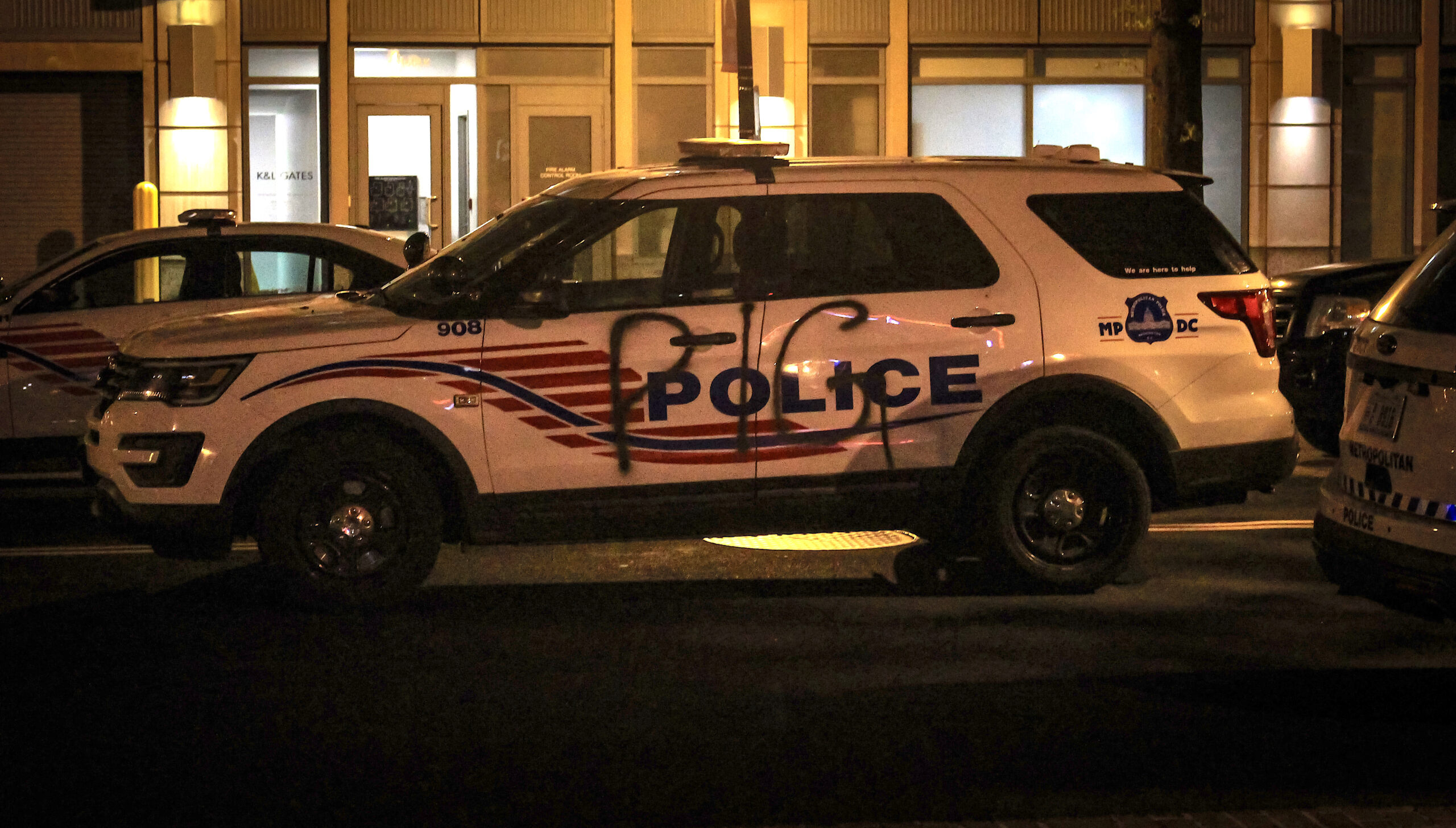
In the nations’ capital. (Eleanor Goldfield)
Now let’s take a moment to disabuse ourselves of the liberal fantasy of policing. The vast majority of what police do in America is not run around catching the evil-doers like an episode of CSI or Law & Order or Die Hard or Starsky & Hutch or all the other TV shows and movies ever made ever.
Professor Alex Vitale notes in “The End of Policing” that most cops average less than one felony arrest per year – meaning almost the entirety of a police officer’s day-to-day consists of standing around and occasionally dealing with small or nothing crimes. These “crimes” such as loitering or “causing a disturbance” are designed to simply “put people in the system.” People of color are far more likely to be arrested for these types of crimes. Once “in the system,” the sentence for a future “crime of loitering” or “atrocity of playing loud music” can be much longer.
Vitale continues, “Even detectives (who make up only about 15% of police forces) spend most of their time taking reports of crimes that they will never solve—and in many cases will never even investigate. …Most crimes that are investigated are not solved.”
Rather than working harder to solve larger crimes, our government officials have created hundreds of smaller “crimes” for police to nail citizens for. In the past few decades there has been a surge of bans on things like sleeping in public, begging, giving away free food, “camping” in public, and sleeping in one’s car. Laws like these only serve to make homelessness (and helping the homeless) illegal and allow police to insert themselves, often upending lives. (Because people begging for change often have it too easy.)
A study in New York City found that over half of those who cycle regularly through the prison system were homeless. Does anyone honestly believe that endlessly grabbing homeless people and charging them for nothing crimes does anything to help our society or the people involved? The fact that most officers spend their days doing this is equivalent to firefighters walking around spraying people’s cigarettes with water while the actual building fires are left to burn. (More on those in a moment.)
When wealthy or even middle class people get caught doing most of these small crimes, they are either ignored by the police or let off with a warning. If a Wall Street trader in a suit and tie takes a nap on a bench, do the police lock him up? If a doctor or a dentist or real estate agent is “caught” sleeping in their car, are they brought down to the station? No. These so-called “crimes” serve to simply enforce the class structure and give police a reason to arrest the poor and the non-white.
Meanwhile, the true crimes don’t even garner a glance. The largest crimes in the nation and the world are often legal, and even when they aren’t, they have nothing to do with police. Corporate executives endlessly decide to dump toxins in our water or keep a baby powder on the shelves when they know it contains asbestos or continue sales of an herbicide when they know it causes cancer or push opioids on troubled Americans even as the bodies pile up. Generally in such cases, no one will go to prison, no one will do a perp walk with handcuffs on. And in the incredibly rare moment that a top exec is locked up, it has nothing to do with your average police officers.
Designed to Create Crime
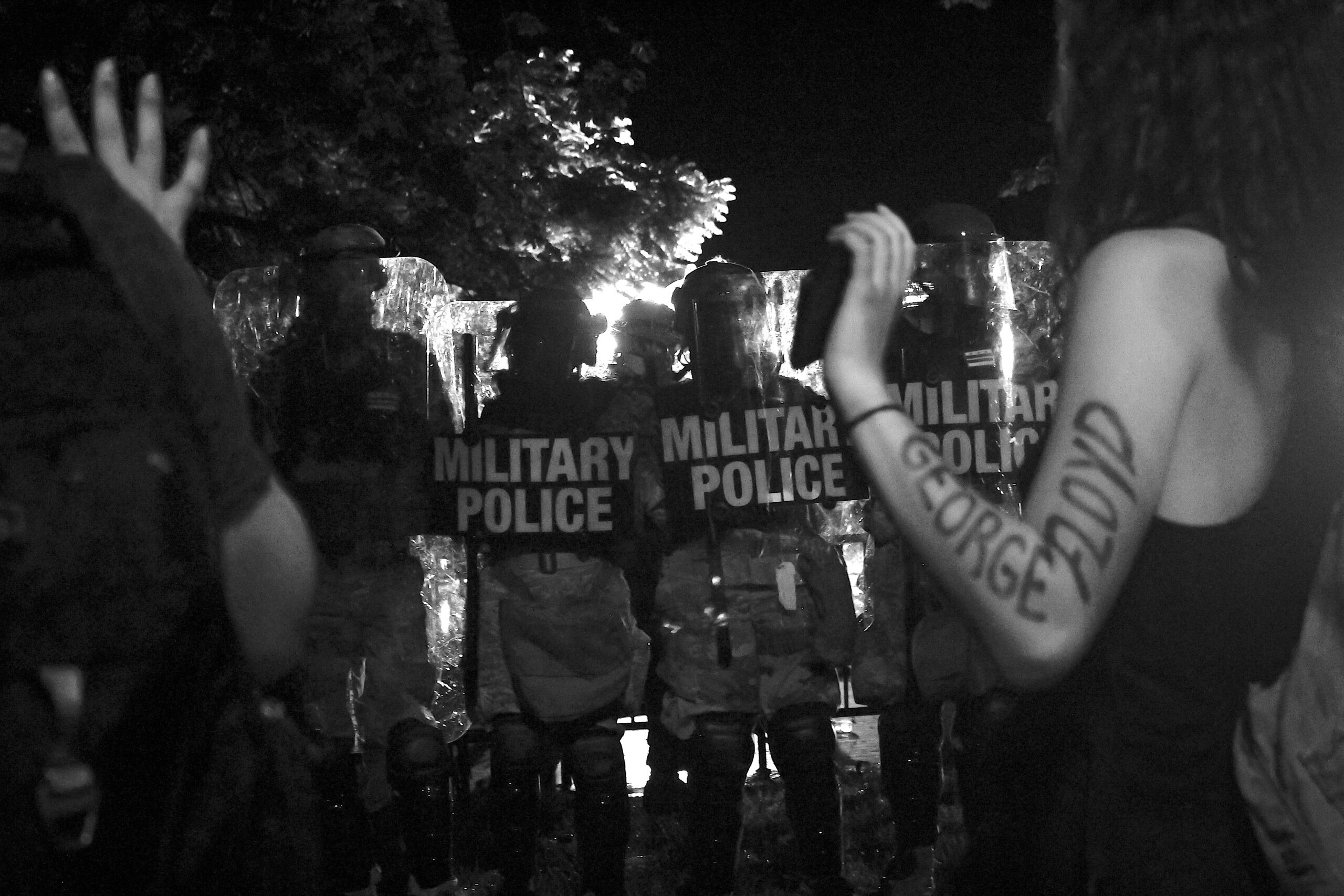
Military police in the streets of Washington. (Eleanor Goldfield)
As Michelle Alexander, author of The New Jim Crow has put it, “We need an effective system of crime prevention and control in our communities, but that is not what the current system is. This system is better designed to create crime, and a perpetual class of people labeled criminals.”
The U.S. has the largest prison population in the world. And if we slightly rephrase that, we get, “America is the largest prison state in the world.” But the mainstream media doesn’t like the sound of that, so they won’t say it.
Police in some regards commit more crime than average citizens. Police now seize more from citizens via civil asset forfeiture than the amount of property stolen by street criminals in burglaries.
Cops often protect inanimate objects against the unarmed citizens they have taken an oath to serve and protect. For example, in Standing Rock the law enforcement were steadfastly guarding a pipeline against the people who actually owned the land through which it stabbed and drank the water it would ultimately contaminate.
So we’ve established police are not doing the job most people think they are and that they kill a lot of innocent people while acting like military patrols on the streets of the “Land of The Free.” Now let’s get into how poorly they’re trained at actually doing the jobs they shouldn’t be doing.
Police academies spend [on average] 110 hours on firearms and self-defense, yet only eight hours on conflict management. This means, generally speaking, police spend 12 times as many hours learning how to shoot and kill people as learning how NOT to shoot and kill people.
In most states hair stylists are required to have far more training than police officers. Even CNN reported, “The minimum training requirement for Michigan police officers is 594 hours. To work with electrical signs, you’ll need 4,000 hours of experience.”
Former Philadelphia police captain Ray Lewis has said police departments don’t want to hire officers who are empathetic. And pro-police website Officer.com has published articles saying empathy could be dangerous for policing.
Some cities also don’t want smart cops. In fact, a court back in 2000 upheld the right of police departments to avoid hiring intelligent officers. …So yes, in some American cities the authorities actively fill the department’s ranks with dumb people who can’t relate to your situation. That certainly sounds like the opposite of what you’d want for a job opening that includes the phrase, “Gun included.”
Dark Roots
Confrontation in DC. (Eleanor Goldfield)
And finally, we must ask, “If our policing system is a draconian, military-style, Orwellian model used to consolidate an entrenched class hierarchy, then where did it come from? How did we get here?”
As detailed in “Our Enemies in Blue,” the American police system originated from slave patrols, which turned the streets of towns into patrol routes for what was a quasi-military force. From its earliest days the American model was a racist tactic to protect the higher class people from the downtrodden and oppressed. The numbers don’t lie. The system has not largely changed since those early days.
Prof. Vitale writes, “The reality is that the police exist primarily as a system for managing and even producing inequality by suppressing social movements and tightly managing the behaviors of poor and nonwhite people: those on the losing end of economic and political arrangements.”
These 19 facts should fully flip the script on how we view police in America. We need a completely new/different/smaller/less-violent model. And we need it starting 400 years ago.
If you feel this column is important, please share it.
THE TREASON OF THE RULING CLASS
By Chris Hedges, Scheer Post.
June 1, 2020
https://popularresistance.org/the-treason-of-the-ruling-class/
Capitalist democracy has devolved into a mafia State.
The ruling elites no longer have legitimacy. They have destroyed our capitalist democracy and replaced it with a mafia state. What the Roman philosopher Cicero called a commonwealth, a res publica, a “public thing” or the “property of a people,” has been transformed into an instrument of naked pillage and repression on behalf of a global corporate oligarchy. We are serfs ruled by obscenely rich, omnipotent masters who loot the U.S. Treasury, pay little or no taxes and have perverted the judiciary, the media and the legislative branches of government to strip us of civil liberties and give them the freedom to commit financial fraud and theft.
The loss of control over our system of rulership, the misuse of all democratic institutions, the electoral process and laws to funnel money upwards into to a handful of oligarchs while stripping us of power, ominously means that the ruling elites can no longer claim the right to have a monopoly on violence. Violence employed by police and security agencies such as the FBI, which have devolved into occupying forces, protect the exclusive interests of a tiny, ruling criminal class and expose the fiction of the rule of law and the treason of the ruling elites.
“In order for nonviolence to work, your opponent must have a conscience,” Stokely Carmichael warned. And if your opponent is bereft of a conscience, then state violence is inevitably met with counter-violence. Tyranny takes the place of reform. The danger of widespread sectarian violence in America is now very real.
There are three options: reform, which, given the decay in the American body politic, is impossible; revolution; or tyranny. The more things deteriorate, the more the elites feel threatened, the more brutal the police, the National Guard and the organs of state security will become. The longer the serfs defy their masters the more the populations in the jails and prisons, which are already the largest in the world, will swell.
If the mafia state is not overthrown, then America will become a naked police state where any opposition, however tepid, will be met with draconian censorship or force. Police in cities around the country have already thwarted the reporting by dozens of journalists covering the protests through physical force, arrests, tear gas, rubber bullets and pepper spray. The huge social divides, largely built around race, will be used by the neo-fascists in power to divert a legitimate rage by a betrayed working class to set neighbor against neighbor. Neo-fascist “patriots” will be unleashed like attack dogs against people of color, Muslims, feminists, intellectuals, artists, the media and liberals. Dissent, even nonviolent dissent, will become treason.
The uprisings in the streets of American cities are not only about the wanton murder by police of yet another person of color, but a frantic fight to wrest back power over our own lives. They go far behind police brutality, a daily reality for those trapped in our internal colonies where 1,100 citizens are murdered by police every year, almost all unarmed. The uprisings are fueled as well by the seizure of the institutional and structural mechanisms that once made some form of equality, always imperfect and always colored by an animus towards the poor and people of color, possible.
Half the country lives in poverty or a category called near poverty. The working class and the working poor are priced out of the health care system. The schools do not educate their children, who live without adequate food and often clean water, are repeatedly evicted from their homes, have their utilities shut off, cannot find jobs, are crippled by punishing debt peonage and with the pandemic are dying at disproportionally higher rates. They get the message the oligarchs are sending. They, and their children, are expendable. They don’t count. Their lives are of no consequence, unless they are locked in a cage where their bodies can generate as much as $60,000 a year for the multitude of corporations, including the for-profit medical services, food services, money transfer services, commissary services, phone services, private prisons and prison contractors, not to mention the large corporations and state governments that exploit the cheap and bonded labor of 1 million of our 2.3 million prisoners.
The prison system is a multi-billion dollar a year industry with lobbyists in state capitals and Washington making sure these bodies remain in cages or are put back into cages soon after they are released. The neo-slavery in our prisons is the corporate model envisioned for all of America.
The two ruling parties are equally complicit in this assault. The Democratic Party, in the midst of the worst economic downturn since the Great Depression, is trying to sell us a presidential nominee, Joe Biden, who was one of the principal architects of de-industrialization and responsible for the loss of hundreds of thousands of good, union jobs. Biden and Bill Clinton also destroyed our welfare program, where 70 percent of the recipients were children, and orchestrated the doubling of our prison population and the tripling and quadrupling of sentences.
Biden, as Naomi Murakawa points out in “The First Civil Right: How Liberals Built Prison America,” was a driving force behind the notoriously harsh penalties in the Anti-Drug Abuse Acts of 1986 and 1988, and the three-strikes legislation in the Violent Crime Control and Law Enforcement Act of 1994, which also provided funding for 100,000 new police officers and the aggressive prosecution of 60 new capital crimes. He sponsored legislation to dramatically curtail the ability of those in prison to appeal and led the passage of the Federal Death Penalty Act of 1994 and The Anti-Terrorism and Effective Death Penalty Act of 1996. He oversaw the militarization of the police and the massive expansion of death-eligible crimes, which he has repeatedly bragged about.
Biden was also at the forefront of the re-segregation of our public school system and has repeatedly called for cuts to Social Security. He was instrumental in the disastrous trade deals such as the North American free Trade Agreement (NAFTA) and austerity programs as well as establishing the most pervasive system of mass government surveillance in human history. Watching Stacey Abrams, who certainly knows better, twist herself into contortions to lavish praise on Biden, even tossing the #MeToo movement overboard, is another sad example of the corrosive disease of careerism. Biden, one of the most important architects behind the wars in the Middle East, where we have squandered upwards of $7 trillion and destroyed or extinguished the lives of millions of people, is personally responsible for far more suffering and death at home and abroad than Donald Trump.
If we had a functioning judicial and legislative system, Biden, along with the other architects of our disastrous imperial wars, plundering of the country and betrayal of the American working class, would be put on trial, not offered up as a solution to our political and economic debacle. The myopia of the ruling elites is that they think they can foist Biden on us because he is not Trump. But the game is up. The façade of democracy no longer works.
It is only the dwindling and largely white middle and professional classes who still believe the fiction that this election offers a choice or that we live in a democracy. The working class and the working poor know better. Their lives were, as Barbara Ehrenreich wrote, one long emergency before the pandemic. Now they face the prospect of bankruptcy this summer when unemployment and stimulus checks run out, the moratorium is lifted on evictions to double or triple the unhoused population of 11 million people and unemployment skyrockets to 25 percent. Forty-eight percent of front line workers remain ineligible for sick pay, and some 43 million Americans have just lost their employee-sponsored health insurance. Food banks are already overrun with tens of thousands of desperate families.
And in the midst of this crisis, what did our kleptocratic rulers do? They looted $4 trillion on a scale unseen since the 2008 bailout overseen by Barack Obama and Biden. They gorged and enriched themselves at our expense, while tossing crumbs out of the windows of their private jets, yachts and palatial homes to the suffering and despised masses.
The CARES Act handed trillions in funds or tax breaks to oil companies, the airline industry, which alone got $50 billion in stimulus money, the cruise ship industry, a $170 billion windfall for the real estate industry, private equity firms, lobbying groups, whose political action committees have given $191 million in campaign contributions to politicians in the last two decades, the meat industry and corporations that have moved offshore to avoid U.S. taxes. The act allowed the largest corporations to gobble up money that was supposed to go to keep small businesses solvent to pay workers. It gave 80 percent of tax breaks under the stimulus package to millionaires and allowed the wealthiest to get stimulus checks that average $1.7 million. The CARES Act also authorized $454 billion for the Treasury Department’s Exchange Stabilization Fund, a massive slush fund doled out by Trump cronies to corporations that, when leveraged 10 to 1, can be used to create a staggering $4.5 trillion in assets. The act authorized the Fed to give $1.5 trillion in loans to Wall Street, which no one expects will ever be paid back. American billionaires have gotten $434 billion richer since the pandemic. Jeff Bezos, the richest man in the world, whose corporation Amazon paid no federal taxes last year, alone added $34.6 billion to his personal wealth since the pandemic started.
How long can you expect people to watch their children go hungry? How long can you expect people to watch their loved ones suffer and die because they can’t get medical care? How long can you expect people to be abused by lawless police and a court system designed to railroad the poor into jails and prisons? How long can you watch the rich profit from your misery?
I would prefer that our revolution eschew the poison of violence, which I know too intimately from my two decades as a war correspondent. But I also know that when everything around you conspires to crush you, the only way left to affirm yourself is to destroy, not only the structures and institutions that have oppressed you, but often yourself. I saw this when I lived in the impoverished neighborhood of Roxbury in Boston and when I worked as a reporter in Gaza. This understanding was something Malcom X, who came out of poverty, always understood and Martin Luther King, a product of the black bourgeoisie, learned later.
It is ultimately the ruling elites who will determine the mechanics of resistance. When they close every escape route, when they speak exclusively in the language of force, then the language of force becomes the only form of communication. Trump’s demand that states use the National Guard to crush the protests and threat to deploy the U.S. military in the streets of American cities only heightens the anger and frustration that led to the uprisings.
The ruling elites are, at the same time, desperately seeking scapegoats. The idea that Antifa, which on the spectrum of terrorist groups would rank alongside the Boy Scouts, is behind these clashes is as ridiculous as the idea that Russia is responsible for the election of Trump. This desperate search for explanations that absolve the ruling elites saw Susan Rice, who was Obama’s national-security adviser, blame the violence on “foreign actors,” adding that “this is right out of the Russian playbook.” This trope is always trotted by despotic rulers to discredit dissidents who are branded as the enemy of the people.
The longer the ruling elites refuse to address the root causes behind these protests, the more they loot the treasury to enrich themselves and their fellow oligarchs, the more they engage in futile and absurd efforts to deflect blame, the more unrest will spread. The last desperate resort by the oligarchs to save themselves will be to stoke the fires of racialized violence between disenfranchised whites and disenfranchised people of color. This, I fear, is the next chapter in this saga. I saw this tactic used to deadly effect in the former Yugoslavia. These are dark times. They are about to get darker.
Chris Hedges writes a regular original column for Scheerpost.
Subscribe to:
Comments (Atom)