skip to main |
skip to sidebar
By Kevin Zeese and Margaret Flowers, Popular Resistance.
May 31, 2020
https://popularresistance.org/nationwide-uprising-against-failed-state-triggered-by-police-killings/
The nationwide uprising sparked by the murder of George Floyd and other recent racially-motivated events is a response to the bi-partisan failed state in which we live. It comes in the midst of the COVID19 pandemic and the largest economic collapse in the US in more than a century. These three crises have disproportionately impacted people of color and added to longterm racial inequality and injustice.
Black Lives Matter erupted six years ago when a police officer shot and killed Mike Brown in Ferguson, MO. Since that time, police have murdered approximately 1,100 people every year. The response of the government at all levels to the crisis of police killings has been virtually nonexistent. While people seek to avenge the death of George Floyd, the problems are much deeper and the changes needed are much broader.
The Root Of The Problem Is A Failed State
During the COVID19 pandemic, millionaires and billionaires have been bailed out by the government with trillions of dollars while working people were given a pittance of $1,200 per person and a short term increase in unemployment benefits for the more than 40 million people who have lost their jobs. Many workers who provide essential services have had to continue to work putting themselves and their communities at risk.
Urgently needed healthcare is out of reach for millions with no or skimpy health insurance resulting in people dying at home or not going to the hospital until their illness became serious. For this and other reasons, COVID19 is disproportionately impacting communities of color.
Glen Ford of Black Agenda Report puts the mass revolt in the context of the long history of white supremacy that has existed since Africans were brought to the United States. Chattel slavery was enforced by the earliest form of policing, with the first formal slave patrol created in the Carolina colonies in 1704. After the Civil War and a brief period of Reconstruction where African people could participate in civic life, Jim Crow followed with white racists, often allied with Southern police, inflicting terrorism against the Black population through lynchings and other means. Black people were arrested for laws like vagrancy and then punished by being forced to work picking cotton or other jobs. This new form of slavery continues as inmates are forced to work for virtually no pay in prisons, are leased out to dangerous jobs like meat processing, or are used as scabs.
George Floyd’s murder enraged people who have seen too many deaths as a result of police violence. The murder in broad daylight with cameras filming and scores of witnesses showed the impunity of police who are used to not being held accountable for their violence. During the uprising, police have used extreme violence and targeted people with cameras and the media even saying they were the problem.
The root of the problem is a failed state that does not represent the people and has a deep history of racism and inequality that are being magnified by the current crises. The failure to respond to these crises is resulting in an ungovernable country as the social contract has been broken.
Lawlessness among the wealth class, corruption of politicians by campaigns financed by the wealthiest with payoffs to their children and relatives has set the stage for no respect for the law. As one protester exclaimed, “Don’t talk to us about looting, you are the looters. You have been looting from black people. You looted from the Native Americans. Don’t talk to us about violence, you taught us violence.”
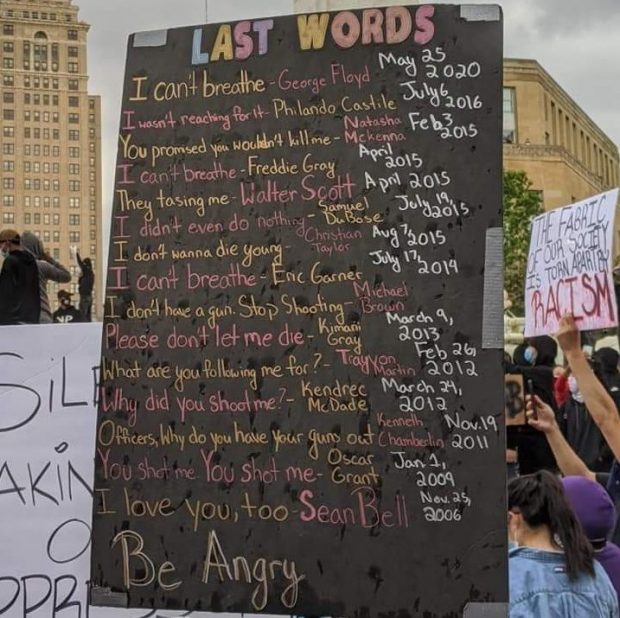
Last Words of people killed by police from Twitter, Washington, DC May 30, 2020
The Failed State Cannot Reform Itself
George Floyd’s final words, “I can’t breathe,” echoed the same words of Eric Garner, who was killed six years ago by a New York police officer. Although there were protests then, not much has changed. The system failed to respond.
Failure starts at the top. There have been years of inaction at all levels of government. The New York Times reports “The administration has largely dismantled police oversight efforts, curbing the use of federal consent decrees to overhaul local police departments. Mr. Barr has said that communities that criticize law enforcement may not deserve police protection, and Mr. Trump has encouraged officers not to be ‘too nice’ in handling suspects.”
Trump poured gasoline on the current fire with incendiary rhetoric promising ‘looting leads to shooting’ echoing racists of the past and promising to send in the US military if Democrats can’t stop the uprising. Trump has put the military on alert to deploy to civilian protests. He maintains power by dividing people praising armed protesters who demanded reopening the economy despite the pandemic and calling unarmed protesters against police violence “thugs”.
On Friday, the White House locked down on security alert because of protests. Trump responded by calling for MAGA protesters to come to the White House. They did not come but protests at the White House have continued to increase.
Both Republicans and Democrats are responsible for the current rebellion. Joe Biden has described himself as a ‘law and order’ Democrat from the beginning of his career. He was the primary architect of the federal mass incarceration of Black people and helped add hundreds of thousands of police with militarized equipment to urban communities. He courts police unions that defend killer cops. And Biden opposed the integration of schools.
The failure of leadership continues at the state and local levels with politicians closely tied to the Fraternal Order of Police, which aggressively defends police who kill civilians. Every city can point to a series of police killings with no prosecutions or acquittals and few convictions. Minneapolis is a city with a long history of race-based police violence. Indeed, violence against Indigenous peoples led to the formation of the American Indian Movement. Tne Intercept summarizes some of the cases:
In 2015, the police killed Jamar Clark a 24-year-old black man. Protests lasted two weeks but led to no prosecution.
In 2016, Philando Castile, a 32-year-old black motorist, was killed in a Minneapolis suburb. More than two weeks of protest followed and two years later the officer was acquitted.
In 2017, Justine Ruszczyk, a 40-year-old white woman, approached a Minneapolis police car to report a sexual assault. The police officer, Mohamed Noor, who shot and killed her was sentenced to 12 years in prison, and her family was awarded a record $20 million settlement.
In 2018, body camera footage showed Minneapolis police chasing Thurman Blevins, a 31-year-old black man, and shooting him to death. Prosecutors refused to file charges against the officers who killed Blevins.
Protests have led to some changes but they haven’t solved the problem. Money has been spent on body cameras, which have rarely had any impact. Similarly, training on de-escalation and racial sensitivity has made little difference.
Over the last six years, cities have increased funding for police departments at the expense of health, education, and other underfunded urban programs. Rather than providing people with necessities, the government has relied on controlling neglected communities with an occupying police force. Some of the police are even trained by the Israeli occupiers.
Even in the midst of a pandemic and economic collapse, the government cannot give people access to healthcare, protect their jobs, suspend their rents or control food prices. As Rosa Miriam Elizalde writes in her comparison of the United States to Cuba, the difference is a matter of values. The United States government spends more than 60 percent of the discretionary budget on weapons and war. It should be no surprise that the government acted more quickly to suppress people with militarized police, thousands of National Guard troops, and curfews than it did to protect their lives when the pandemic and recession started.
Reform Is Not Enough: Defund The Police, Give Communities Control, Build Alternatives To Police
The country must look more deeply at policing. Retired police major, Neill Franklin, the executive director of the Law Enforcement Action Partnership told the Intercept, “We need a new paradigm of policing in the United States. It needs to be completely dismantled and reconstructed, not changing a policy here or there.”
The Minneapolis group, Reclaim the Block, wrote a statement calling on the city council to defund the police department. Last week, they made four demands of their city council:
Never again vote to increase police funding.
Propose and vote for a $45 million cut from MPD’s budget as the city responds to projected COVID19 shortfalls.
Protect and expand current investment in community-led health and safety strategies.
Do everything in their power to compel MPD and all law enforcement agencies to immediately cease enacting violence on community members.
This is an agenda that makes sense for cities across the country. A growing movement demands the defunding of police departments. It is evident that the way to reduce police violence is to fund alternative non-law enforcement approaches to conflict resolution, safety strategies, and mental health as well as investing in neglected communities.
Another growing movement calls for democratic community control of the police where communities elect a Civilian Police Accountability Council (CPAC). The critical difference between this and Civilian Police Boards is that the Accountability Council is democratically elected not appointed by the police chief or politicians who are allied with the police. Neill Franklin urges a national database of officers terminated for misconduct so they will not be hired by other police departments.
The New York Times reports that “in 2012, the civilian board in Minneapolis was replaced by an agency called the Office of Police Conduct Review. Since then, more than 2,600 misconduct complaints have been filed by members of the public, but only 12 have resulted in an officer being disciplined.” The most severe censure was only a 40-hour suspension. Derek Chauvin, who killed George Floyd, has at least 17 misconduct complaints, none of which derailed his career, in nearly two decades with the Minneapolis Police Department.
Chauvin was involved in the fatal shooting in October 2006 when Senator Klobuchar was Minneapolis’ district attorney. Rather than prosecuting Chauvin, she sent the case to a grand jury that declined to indict Chauvin. In 2011, Chauvin was involved in a high-profile shooting of a Native American. He was placed on administrative leave but was reinstated to the force when no charges were brought. If democratic community control of the police were in place, it is highly likely Chauvin would have been removed as a police officer and George Floyd would still be alive.
Support for change is growing. Bus drivers refused to transport arrested protesters for the police in Minneapolis and New York. Payday Report wrote transit union leaders nationwide are instructing members not to cooperate with police in arresting protesters. And Universities are dropping their contracts with the Minneapolis Police Department.
Protests continue nationwide. Thus far escalating police violence and the use of the National Guard has failed to stop them. The government may use the military, although by law there are restrictions on that. There will be efforts to pacify the protests by political leaders and non-profits who will try to take over the leadership. These must be rejected.
To achieve the changes we need, people must stay in the streets and connect the problems we face to the demand for systemic changes. We will need to support each other as many are doing by distributing food and providing medical care, jail support and legal representation. We urge people to meet in assemblies to discuss what their goals are, their vision of how communities could be organized differently and what actions they can take. We need to build confidence in each other that we can work together for the future we want. That is how we will get there.
BY
ROBERT GREENE II
https://jacobinmag.com/2020/05/red-summer-riots-african-americans-pandemic-police
Arash of racist violence against African Americans has hit the United States. Across the land, African Americans and left organizations attempt to organize, or even fight back. Meanwhile, a pandemic ravages the country and the world. International crises further threaten to tear the nation apart.
This was the state of things in the summer of 1919.
The United States reeled from the “Red Summer” riots, where hundreds of African Americans were slain in cities and small towns alike. Many of the “riots” were little more than anti-black pogroms, waged in response to growing demands for civil rights, labor rights, and adequate housing. This all came as the nation struggled to return to a peacetime economy amid international uncertainty, and the influenza pandemic — popularly known as the “Spanish Flu” — pummeled the country. Ultimately, 675,000 Americans would die from influenza, part of over 50 million deaths worldwide.
Historians tend to say that history doesn’t repeat itself. But, in this case, it does feel like it rhymes.
When I began working on this piece last week, people across the nation were outraged at the latest on-camera murder of an African American. Ahmaud Arbery was shot and killed in the South Georgia city of Brunswick earlier this year while out for a run. His killers told the authorities that they feared Arbery fit the description of a local burglar and argued they were simply defending themselves under Georgia law — an argument supported by the local district attorney, who refused to pursue the case. (Police later arrested two men, charging them with murder and aggravated assault.)
Since then, in a radically short amount of time, additional killings of African Americans — men and women — at the hands of police have pushed a long-running debate about racism and policing to a possible breaking point. On Thursday, protesters in Minneapolis torched a police station following the on-camera killing of a forty-six-year-old black man, George Floyd, and seven people were shot in Louisville during protests following the murder of a twenty-six-year-old black woman, Breonna Taylor, by plainclothes police. On Friday and Saturday, demonstrations exploded across the country as the conflagration continued in Minneapolis.
The killings caught on camera offer a disturbing reminder of the numerous photographs of lynchings dispersed throughout the nation in the early twentieth century. Some were catalogued by the NAACP and displayed as examples of American brutality and barbarism. Others, however, were featured on postcards and sent to white Americans throughout the country, small trinkets of white terror.
The bloodiest wave of violence during the Red Summer took place in Elaine, Arkansas, as African-American sharecroppers struggled to organize. In the face of devastating landlord opposition, and constant rumors fueled by the local press of African Americans organizing to kill white people, the black sharecroppers were harassed and eventually murdered by soldiers and vigilantes. At least two hundred people — men, women, and children — were slaughtered; the exact number is still unknown today.
Arbery’s death is both a reflection of this legacy of white supremacist vigilantism and the latest iteration of the racist effort to control black movement and labor. The very idea of where a black person should and shouldn’t be has been deeply political, rooted in racist hierarchies.
The locations of the recent killings are also linked to the struggles of the African-American past. Brunswick sits on the Georgia coastline, close to the Black Belt — a predominately African-American region famous for its rich soil. In the 1920s and ’30s, Communists like Harry Haywood argued that the multistate strip of land was a “nation with a nation” where black people had a right to self-determination comparable to other independence movements. The white supremacist fear of black freedom fueled attempts during the Red Summer and through the decades to suppress African-American movements, which were often tied to the broader left.
Up north, the brutal death of George Floyd occurred in Minneapolis, a city that likes to pride itself for its racial liberalism but, like many otherwise progressive urban areas in America, has a deeply checkered history of police violence. In 1948, Minneapolis mayor Hubert Humphrey declared that it was time for the Democratic Party to “get out of the shadow of states’ rights and walk forthrightly into the bright sunshine of human rights.” Yet from 2009 to 2019, African Americans comprised 60 percent of the victims of police shootings in Minneapolis despite making up less than 20 percent of the city’s population.
Breonna Taylor’s death in Louisville, Kentucky at the hands of the police has drawn less attention than the deaths of Arbery and Floyd, but is equally important. Killed because the police served a warrant at her home following “no-knock” procedures, Taylor’s boyfriend, Kenneth Walker, fired his weapon believing their home was being robbed. Louisville has its own past of racist divisions. The attempt by Anne and Carl Braden in 1954 to help Andrew and Charlotte Wade, an African-American couple, purchase a home in the suburbs triggered accusations of communist sympathies and, in Carl Braden’s case, a conviction for sedition.
Today, as protesters take to the streets in Louisville and elsewhere, freighted with this history, they’re also contending with a COVID-19 pandemic that — due to austerity and economic immiseration — is dealing an especially severe blow to African Americans. The rallying cry “Black Lives Matter” has taken on a new and radically urgent tone.
In 1919, African Americans tried, in various places, to fight back during the Red Summer. In 2020, demonstrators in Minneapolis and around the country are struggling to overturn a brutally racist social order.
We are now living, it seems, in a Red Spring.
AN INTERVIEW WITH
BRIAHNA JOY GRAY
https://jacobinmag.com/2020/05/briahna-joy-gray-bernie-sanders-press-secretary
Briahna Joy Gray knows what it’s like to feel the wrath of establishment Democrats. Serving as national press secretary for a campaign that incensed them like few others, Gray became the object of unending scorn from mainstream pundits and party operatives.
In late April, Gray joined Ana Kasparian and Michael Brooks on their new Jacobin YouTube show (which you can like and subscribe to here) for a post-campaign discussion. The transcript has been edited for length and clarity.
AK
How is life after the Bernie campaign? I see some of the reactions to you on Twitter, which are pretty disheartening, but how are you holding up?
BJG
I’m doing as well as can be expected. Obviously, the campaign ending is a personal difficulty for all of us, who were so committed to the ideologies that were represented, and which unfortunately don’t have a lot of other homes in our mainstream political sphere, but we’re also all dealing with the larger crisis of the coronavirus pandemic.
MB
Bri, just stay on that for a second. Because I think these reactions to you and other people are revelatory of a mindset that exists inside the broader Democratic Party. When people say, “Bri, David Sirota, you’re never going to work in this town again.” And then you look and you say, “Why? Did Bri key one of these people’s cars? No. What are you talking about?” Oh, they’re committed to an agenda of health care for all and other core tenets that the whole [Bernie] Sanders campaign was about.
BJG
I think that what it really exposes is the extent to which there aren’t a lot of substantive arguments among whatever you want to call them — neoliberals, corporate Democrats, etcetera. So when I tweet a simple truism — like, yes, people shouldn’t die because they’re poor and can’t afford coronavirus treatment, but that also extends to people who are dealing with cancer or people who are dealing with diabetes — there’s this kind of meltdown.
It’s particularly marked, I think, when it comes to me, because so much of the mainstream liberal discourse has been completely captured by identifying good actors and bad actors purely based on their identity. And when confronted with a black woman who also happens to believe in Medicare for All, and a living wage, and student debt cancellation, and medical debt cancellation, and some basic progressive principles, they don’t quite know what to say or to do with that. I think that’s why I and Nina Turner have been lightning rods for a certain kind of meltdown or tantrum-throwing, if you will.
AK
I’m really glad that you mentioned that, because this particular primary election really clarified things for me: the very issues that these moderate Democrats claim they care about are just issues that they will exploit for political gain.
BJG
This is something that I used to write about before I joined the campaign, and which I thought was going to be a more central issue. I really anticipated that Kamala Harris would have a longer life in her campaign, and that it was going to be a question of “Why should we vote for an old white man when there is this black woman in the race?”
But what actually became clear — and which has been made even more interesting by a recent poll, which showed that it’s white people who are much more concerned or disappointed by a white candidate being the Democratic nominee than black people or other people of color — is that the interest in these kind of glass-ceiling-breaking campaigns is only relevant insofar as it advances a more moderate political agenda.
The first diverse state to vote in the election was Nevada. We won, and people were silent. You could hear a pin drop when it came to the discussion about what that meant for Bernie Sanders’s coalition. It was complete and total erasure of Latinos without even a second thought. And there was no political blowback.
Bernie Sanders was either number one or number two with black voters for the entire race. I remember an article shortly before I left the Intercept, which pointed out that Bernie Sanders outpolled Kamala Harris two to one with black voters. But that was a non-story. Nobody cared as long as there was someone, anyone, polling better than him with black voters.
Then that became not just a story about how does he bolster outreach, it became a story that was supposed to imply something was intrinsically racist about the campaign as a whole — a kind of subtext which never existed even for candidates like Amy Klobuchar and Pete Buttigieg, who struggled to get out of single digits.
So as a black person, and as a woman now, in the context of these Me Too allegations against Joe Biden, it is deeply disappointing. If you are going to be the party of identity, at least have those values concretized. At least believe in that on some intrinsic level.
What they’re doing right now is giving free rein and fodder to every bad-faith, racist, sexist individual on the Right, who has always claimed that the Democrats never truly believed any of this stuff. It’s difficult to see where we’re going to go next if the Democratic Party doesn’t substantially reform and also adopt economic populist principles.
MB
I want to follow up on a different but related note. You’ve always been somebody who has argued against the idea of “moral means testing” — the corollary of actual means testing, where if you talk too much about universal decency and justice for all, that might include some bad people.
One part of it is a broader, very important left idea that, as much as humanly possible, we don’t want to write anybody off as irredeemable. And secondly, why does somebody have to perform in any type of exceptional way, one way or another, to secure basic decency in life?
BJG
Yeah. It’s funny because I come to this whole world not because I was a red diaper baby and not because I came up through politics. I was genuinely guided by a kind of secular humanist ethical development, which says to me, “I live on the Left, or however you want to describe it, because I believe in the intrinsic value of human life.”
That’s what guided my understanding that we shouldn’t throw away people through our criminal justice system, that rehabilitation should be the goal of any kind of criminal justice, and that we shouldn’t discriminate against people once they are out of prison. It guides my understanding that you are not the worst thing that you ever did in your life. That everyone deserves health care, no matter your economic status.
Everyone seems to get these principles, but when you start to get into other areas, and we start to talk about racism, for instance, or other kinds of personal prejudice, it becomes very black or white. So Democrats will understand that we should have rehabilitation and that a prison sentence isn’t a sentence to get raped or be in solitary confinement. But at the same time, we’ll say, “The person who used an epithet is canceled forever.”
We have Democrats saying things about, “Trump voters deserve to live in squalor. They voted for him, and that’s the world that they deserve, the outcome that they deserve.” Not thinking about worlds of imperfect information, or the extent to which their lives have intrinsic value, or that people change and evolve over time. And that they have children who did not make those voting choices who live in those households.
Much of the writing that I did before I joined the Sanders campaign was about trying to clarify where we actually stand on a number of these issues, from more minor things like cultural appropriation discourse to more substantive things like how identity is weaponized in politics, precisely because I want to shore up our position. Not because I want to attack the Left, but because I believe the underlying principles are really true and that we should have the best arguments, ones that aren’t so easily weaponized against us.
MB
I agree completely. “Attacking the Left” — that’s like saying the coach of a basketball team running drills is opposing his team. It’s ludicrous, of course you need to up your game.
BJG
Yeah, as a former varsity basketball player, I really love that analogy.
AK
Yeah, that’s absolutely right. Just to give a recent example, we had a discussion about the optics of Nancy Pelosi doing this video in front of her $24,000 refrigerators, and showing off her collection of luxury ice cream in the middle of a pandemic where people are literally starving and do not know how they’re going to pay for their rent, for their mortgage.
What Pelosi did in that video was incredibly dumb. I’m just going to call it exactly what it is. It’s dumb. And when we did a segment on it, I said that it’s going to be used against her by the Trump campaign, and guess what? It was used against her by the Trump campaign.
Because while Donald Trump and Republicans are absolute liars when they pretend as though they care about the working class and improving the economy for the majority of Americans, they’re successful in their messaging, their empty hollow messaging. And they do, in a very, very successful way, paint Democrats like Nancy Pelosi as these corporatists who have helped to ship jobs abroad, who live in luxury, who enjoy their wealth, and who really screwed up the manufacturing sector in America. They’re really good at that kind of messaging.
BJG
Yeah, I think about that a lot. There’s an argument that Democrats don’t want to win, that they are equally satisfied by either corporate party being in charge, or their interests are served either way. Sometimes I’m feeling very cynical, and that’s where I am.
Other times I say, “Even if I think that that’s happening, that has a kind of defeatist air about it, and we can’t embrace that. But what else is happening?” Well, sometimes I think psychologically that Democrats are in a kind of losing defensive posture. Donald Trump does present an existential, terrifying threat, especially looking down the barrel of another four years. And maybe it’s a “don’t kick a man while he’s down” kind of attitude, or you feel too vulnerable, or members of the party, voters, feel too vulnerable to be really clear-eyed about the flaws in messaging.
I also think that the Democratic Party has propped up figures, Nancy Pelosi being one of them, that are perceived more for their symbolic value as opposed to any understanding of what role they’ve played in the party, including detrimental roles they’ve played in the party. So if Nancy Pelosi to you is this totem who shamed Trump in a viral GIF, clapping at the State of the Union, then yeah, you’re going to be less willing to perceive her as someone who is flawed in any way.
Why is it that Nancy Pelosi has been able to accumulate such an enormous amount of wealth while being a sitting member of Congress for decades? Why is it that there are so many people who are thrown from food insecurity to full-blown inaccess to food in the context of a crisis?
I think the criticism from the Left has to always be about, why is the distribution of wealth the way it is? What structural factors enabled her to accumulate so much? That is where the argument is the strongest. That’s, I think, where Bernie Sanders got a lot of his power, especially in 2016, talking about the 99 percent and the 1 percent, and the oligarchy, and corporate greed, and all of those kinds of themes.
So there’s lessons there for both the Left, in terms of how we frame our critique, and also for the center left, mainstream Democrats, about how to be more clear-eyed.
MB
Bri, they say you’ll never work in this town again, but you are working in many towns. So what are you up to now?
BJG
I’m back with Current Affairs, writing there as a contributing editor. And I hope to do some other media projects so that hopefully I’ll still be able to talk to folks the way I could through “Hear the Bern.” I really enjoyed that format. I really enjoyed having access to so many intelligent people who were able to have such free-flowing conversations.
And now that I’m outside of the context of the campaign — there were things we couldn’t do or targeted critiques of other candidates that we were discouraged from getting into — I have free rein. I think there’s so much work still to be done, about what to do with this movement, including before this primary officially ends. I’m really hoping to launch some media opportunities in which we can continue that dialogue. So stay tuned.
AN INTERVIEW WITH
ADAM BURCH
https://jacobinmag.com/2020/05/minneapolis-bus-drivers-unions-george-floyd-protest-police
The murder of George Floyd in Minneapolis has set off a wave of protests and uprisings across the country. The rash of police violence, coupled with the COVID-19 pandemic and the unemployment crisis, has clearly pushed many to the breaking point.
Because the vast majority of people protesting are workers, it makes sense that their organizations would get involved in the fight. Many unions have released statements condemning the killing of Floyd, including the Amalgamated Transit Union (ATU), which represents bus drivers in Minneapolis. Going even further than other labor organizations, the ATU defended their members’ right to decline to assist police, saying: “Minneapolis bus drivers — our members — have the right to refuse the dangerous duty of transporting police to protests and arrested demonstrators away from these communities where many of these drivers live. This is a misuse of public transit.”
Yesterday, Jacobin contributor Mindy Isser interviewed Adam Burch, a rank-and-file Minneapolis bus driver who has been organizing his coworkers to oppose the use of city transit to aid police. They spoke about the latest developments in Minneapolis, his Facebook post and subsequent petition aimed at fellow union members, and the vital role that organized labor can play in fighting police brutality.
MI
Can you share what the last few days in Minneapolis have been like?
AB
It’s been a whirlwind. I’ve been around left organizing for a while. I’ve been at many protests, rallies, whatever, and there’s been nothing like this.
Unfortunately, Minneapolis has a lot of past experiences with cops killing black people — the Jamar Clark murder in 2015 in the north side of Minneapolis, then the occupation outside the 4th Precinct there; and then in 2016, the Philando Castile murder, then the occupation of the Governor’s Mansion and the shutdown of I-94. The responses and the movements that developed around those instances pale in comparison to what’s going on here now. I wasn’t in Ferguson or Baltimore, but a lot of people are making those kinds of comparisons, like is this a bigger rebellion beyond police violence?
The murder happened on Monday, and everyone woke to the news of it Tuesday. There was a rally called immediately by a number of left groups locally at 38th and Chicago, the intersection Floyd was murdered at.
That area is a really working-class residential neighborhood on the south side of Minneapolis, and all along that street, people came out to their yards and their porches with handmade signs, saying, “Justice for George Floyd” and “Black Lives Matter.” There was clearly a lot of community support for the protests.
We marched to the 3rd Precinct, where the cops had set up military-style barricades and were quick to use tear gas and proceeded to use marker rounds (essentially a paintball gun). These tactics really contributed to the escalation of the overall mood. It’s escalated since, and it’s very much a revolt.
We’ve all seen the news — during the day, there are peaceful, nonviolent protests, and at night, it escalates. On Wednesday night I think the police had a lot to do with that, based on their tactics. But on Thursday after there was a standoff between protesters and police, it was clear that the police lost control of the situation, and they made the decision to retreat and left the 3rd Precinct wide open. There was no police presence in the area, and that’s when the protesters burned the precinct to the ground.
MI
Can you say more about this being a revolt and a bigger rebellion beyond police violence?
AB
Like I said, there has unfortunately been a long history of police department murders. In none of those cases would anyone agree that justice was served. So there’s this kind of simmering hangover from all of these previous miscarriages of justice.
There is an incredible crisis of poverty and homelessness in Minneapolis. There is a large number of Native Americans here, and in the area of the city where many live, a huge homeless encampment developed along an interstate. It was a huge signifier of how bad the housing situation is here, how unaffordable it is for working-class people, and many have been displaced. The city passed a $15 minimum wage law, but we had to fight tooth and nail for it — the city establishment opposed it, and it was totally on the basis of a movement of working-class people.
The police have had their budget increased year after year, and there are austerity budgets for everything else — same as everywhere. And there’s just very little accountability. All but one city politician in Minneapolis is a Democrat. Our Revolution endorsed candidates and a couple won, and so there was this perception that we would have this very progressive city council. But nothing has really changed.
All this time, there’s this racist police officer who has a long history of being abusive to people he’s arresting or questioning — there’s an instance where he shot someone during an arrest, and he’s had multiple conduct complaints filed against him. And he was never fired until now.
So there’s this systemic failure at every level of the Democratic Party here to address much of anything. And it’s only on the back of movements that things have been won.
There’s this pandemic going on, we’re in the worst recession in anyone’s living memory, and I think there’s just a complete unraveling of the social fabric. It’s a surreal feeling. People that are participating in the protests are like, what’s there to lose? We were dealing with austerity budgets even before the pandemic, now we have the pandemic and a recession, and the promises politicians are making that working-class people will be taken care of aren’t coming to fruition. There are crazy levels of unemployment, people are losing their jobs, and now you have this reminder that your police department will murder you. The whole situation is a tinderbox, and it just needed something to spark it.
MI
On Wednesday night, you wrote a widely shared Facebook post where you declared “an injury to one is an injury to all” and stated that you would “encourage and try to convince all [your] coworkers and fellow union members to also refuse to assist MPD [Minneapolis Police Department] sending protesters to jail.” Can you tell me about what prompted that?
AB
I was involved in the direct action in July 2016 when we took over I-94. They made a bunch of arrests that evening, and I was one of them. The way they took us to jail was on a city bus — the kind of bus I drive now.
So on Wednesday night, I was doing my regular shift. I knew there was this occupation going on at the 3rd Precinct, but other than that it was a normal night. I got a message over our monitor that’s on every bus — which is how transit control communicates with us — and they said, “Hey, we need police buses for 26th and Hiawatha,” which is the intersection of the 3rd Precinct. I remembered my experience of being one of the protesters that was arrested, and so at my next break I wrote that post.
I ignored [transit control’s message] because what they were asking for was if we want to work overtime, essentially. I wasn’t telling my boss no to their face, but thought it might be pretty easy to go back to the garage and talk to my coworkers and fellow union members and see if they didn’t want to drive around a police bus either. And maybe if there were enough of us, and enough of a pushback, then maybe they’d reconsider if this was a proper use of public transit.
MI
And were your coworkers and your union with you, or was this just your own thing?
AB
On Thursday I went back into work, and they announced that they were going to shut down the transit system, and those that wanted to stick around were volunteering. What that entailed was evacuating buses from a garage near the 3rd Precinct, driving around with the police, or driving protesters to jail. Before I even talked to them, a lot of drivers were not comfortable with that. One guy said his wife would kill him if he was near the protests, another driver said, “Well, as soon as you put police in your bus, you’ll be a target for the protesters.” Dispatch asked one of my coworkers if she wanted to drive cops around, and she said no, and to me she said, “I don’t want to support a police department that killed George Floyd.”
I made my post into a petition that basically said, “do you agree, and will you talk to your coworkers about not helping the police department?” I put the petition in a group called Union Members for Justice for George Floyd, and I sent it to my coworkers. It’s been a good organizing tool. We used the Facebook group and the petition to build for a labor contingent at the rally today [Saturday]. Our local president spoke at the rally and so did a shop steward, who is also the president of our local’s black caucus.
MI
What do you think is the role of unions when black people are killed by the police or in other instances of racism?
AB
This is something we’ve been talking about a lot. I think one of the reasons we wanted to create the Facebook group and why we wanted to have local trade union members active is because we want to show that unions are the most progressive force in society. There may be a low union consciousness among people, because density is low and we’ve been on the defensive for decades, but when unions were at their strongest they fought for everyone.
They were involved in the Civil Rights Movement, they took up housing issues, they organized in communities outside the immediate workplace. And of course it’s because they knew that if they were going on strike and they wanted it to be effective, they needed the support of the broader community. You can’t do that if you’re narrowly focused on the workplace.
I think it’s imperative for the broader labor movement to make it clear that unions fight for all workers, the entire working class, whether they are organized or not. I think it’ll show people that unions are the fighting force that they can trust, because they truly represent their interests, and are the best way to protect themselves from the bosses, corporations, and the state and their police forces.
The organized working class getting involved in these fights is what it takes to win and to have a sustained mass movement. There’s a huge amount of desire out here right now to keep fighting, but to do it in a collective, organized way, and unions can provide a lot of that organization that’s needed.
Ultimately, too, workers are in the best position to shut down capitalist profits. And that’s what it’s going to take. Organize workers at the point of production — that’s the best way to strike fear in the bosses and the corporations and the ruling class. That needs to be marshaled into our movements, whether that’s the fight for better hours or whether it’s a complete uprooting of the police system. It’s going to take a real sustained mass movement to do that.
MI
What should other workers do, union or not, right now?
AB
They should go to the protests, they should talk to the people there and get an idea of where people are at, what their level of consciousness is. There needs to be some kind of program put forward and a clear set of demands. There need to be ongoing days of mass action, but there also need to be meetings (which I know people don’t want to do!) to debrief and plan next steps and refine the program.
The movement out there today needs leaders that come out of these occupations. I don’t think people should just go home, but there needs to be a plan, and there needs to be leadership. That’s what’s missing now.
GLENN HOULIHAN
Whenever mass protests of any kind kick off, defenders of the status quo immediately accuse protesters as being duped by “outside agitators.” Don’t fall for it — the lie of the outside agitator is designed to weaken protests and downplay our widespread anger at injustice.
https://www.jacobinmag.com/2020/05/outside-agitator-racial-justice-protests-minneapolis-george-floyd
Over the last few days, we’ve seen a national uprising against racism and police brutality. In response, the first instinct of the defenders of the status quo was to unite behind an old talking point: the uprising was carried out by “outside agitators” from beyond the communities where the protests took place. It’s a trope that should be immediately recognized as both false and designed to downplay and write off the widespread anger that led to these rebellions.
President Donald Trump, Minnesota governor Tim Walz, and Minneapolis mayor Jacob Frey have all blamed out-of-state agitators for the “riots.” Mainstream media soon echoed this narrative. NBC and the Hill were among the outlets reporting St. Paul mayor Melvin Carter saying, “Every single person we arrested last night, I’m told, was from out of state.”
As it turns out, an investigation by KARE 11, an NBC-affiliated television station in Minneapolis, states that “local jail records show the vast majority of those arrested for rioting, unlawful assembly, and burglary are Minnesotans.” The data, taken from the Hennepin County Jail roster, shows that “of thirty-six cases, about 86 percent of those arrested [from May 29 to May 30] listed Minnesota as their address” — four times more than the 20 percent Gov. Walz estimated at a press conference on Saturday morning. Mayor Carter subsequently retracted the incorrect statement, blaming inaccurate information during a police briefing.
Why does this matter? The “outside agitator” trope is today often accompanied by a tirade against “white anarchists” or “Antifa” carrying out the rebellion — while people of color don’t. This is an attempt to isolate and weaken protesters from each other, to make the “good” protesters distrustful and paranoid about “infiltration” by white radicals. (Radicals of color, meanwhile, are nowhere to be found.) Fostering distrust among developing coalitions is a quick and easy way to ensure their swift demise.
These accusations have long popped up in response to civil rights struggles. In 1965, the White Citizens’ Council posted over two hundred billboards throughout the South attempting to discredit Martin Luther King Jr by associating him with communism. One, which shows a photo of King attending a 1957 event at the Highlander Folk School, a key training site for many civil rights activists, is titled “Martin Luther King at Communist Training School.” On the billboard, a giant, cartoonish arrow points directly to King.Red-baiting accompanied King wherever he went in the South. In 1965, just before the brutal police crackdown of civil rights demonstrators in Selma, Alabama, Dallas County sheriff Jim Clark implied King was an outsider agitator and estimated the march was “possibly made up of one-fourth communists and one-half pro-communists.”
For Clark and scores of white racists throughout the South, the paternalistic idea was that “our Negroes” would never engage in such protests, as they were largely content but were being stirred up by outside troublemakers. Acknowledging that enormous numbers of local African Americans were deeply angry at the status quo and ready to revolt would have meant acknowledging that the status quo was rotten.

Ash J@AshAgony
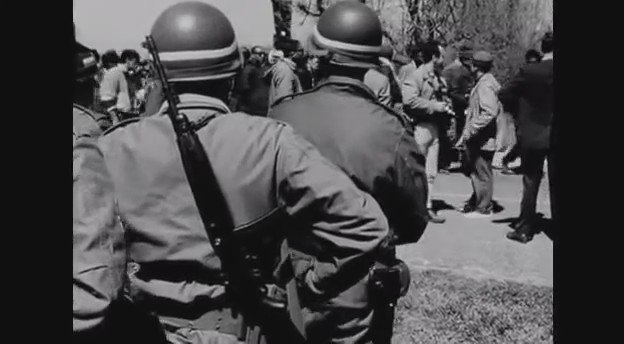
#TBT 1965: Sheriff Jim Clark of Alabama talks about MLK's marches, "outside agitators," & the large communist presence at protests.
809
9:53 PM - Sep 22, 2016
Twitter Ads info and privacy
552 people are talking about this
Richard Seymour wrote in 2014, in response to the term being employed by both liberals and reactionaries during the Ferguson uprising, “The ‘outside agitator’ line reeks of good old boy vigilantism, the commingling of race-baiting and red-baiting that was typical of Southern counterrevolution in the dying days of Jim Crow.”
Segregationists sought to preserve Jim Crow law by branding black radicals as communists, condemning black activists to destructive investigations from the House Un-American Activities Committee (HUAC) and elsewhere. As Paul Heideman states, “The anticommunist purges of the late 1940s and early 1950s dealt a hammer blow to the movement for racial equality.” A reactionary crusade against communists, aided and abetted by liberal Democrats and premised in many ways in the myth of the outside agitator radical being responsible for civil rights unrest, successfully demolished an emerging coalition between left-led workers’ unions and civil rights activists.
In 2020, the phrase, and these tactics, have once again reared their ugly head. The myth of “outside agitators” is being simultaneously weaponized by conservatives and liberals to demean and intimidate protesters. We shouldn’t let them — it’s an accusation designed to downplay the widespread anger so many are feeling and acting on in this country.
King warned us, “We must all learn to live together as brothers or we will all perish together as fools.”
Don’t fall for defenders of the status quo continuing to blame “outside agitators” for the rebellions sweeping the country right now — they want us to perish together as fools.
BY
PETER GOWAN
The uprising in response to George Floyd’s murder by a Minneapolis police officer this week has led to predictable calls to condemn looting. But the real looting in our society comes from the military, the police, the pharmaceutical companies, private equity, the landlords, the real estate speculators, and the billionaires — not protesters against police brutality.
https://jacobinmag.com/2020/05/george-floyd-minneapolis-uprising-police-brutality
In the aftermath of a Minneapolis police officer’s murder of George Floyd, some of our nation’s media have turned to some crucial questions which must be addressed:
Should we condemn looting?
Yes, we should condemn the looting of the Global South by Western militaries and multinational corporations. We should fear the terrifying possibility that the COVID-19 vaccine will be enclosed, privatized, and sold for profit; and the looting of underdeveloped nations and underinsured people that would ensue.
We should fight back against the looting of underdeveloped nations’ coffers by odious debts and structural adjustment programs being drawn up and imposed by international institutions at this very minute.
But should we care about the other kind of looting?
It would take a heartless monster not to care about the looting of homes and buildings by vulture capitalists. We should organize against the impending wave of evictions that will crash into our communities as soon as courts reopen. And we should fight back against the theft of stable homes and schools; the unnecessary destruction of lives due to their prioritizing food over rent.
We care that whole working-class communities will be gentrified, their buildings replaced with housing for wealthier, whiter families, who bring in a bigger haul of loot for the landlord. We should be outraged that police are looting homeless people’s encampments, and we must demand that safe vacant homes and rooms no longer be hoarded away from unhoused people.
Should we care about actual looting?!?
Of course! Private equity stands to make a fortune off the bankruptcy of businesses around the country. By firing workers and raiding their pensions, they’ll make off with the bag. We care about the attempt to loot the United States Postal Service, for example, destroying countless good union jobs and an essential public service in order to dismantle a publicly owned institution and turn it into a private business to generate profit.
We are outraged by the ongoing looting of local and state government welfare programs by a federal Republican Party that wishes to see them destroyed and a House Democratic leadership whose solution to this issue is to give the rich in blue states a gigantic tax break. We are disgusted that representatives who claim to stand for workers and oppressed people will gladly allow their standards of living to collapse while passing tax cuts for the rich.
Without organizing a powerful labor fightback, we will see the actual looting of public coffers while the billionaire class has become $434 billion richer during the pandemic.
But should we care about the looting of stores like Target and Autozone?
This was the destruction of property by people enraged over the murder of an innocent black man by a white police officer. Should we, like Martin Luther King’s “white moderate,” equivocate about an anti-racist uprising?
Should we blame working-class black people for lashing out at a government and economy designed to repress, exploit, and subdue them; during a pandemic in which capitalism has made it near impossible for them to survive? Should we participate in this ritual condemnation even though our media consistently treats identical acts of property destruction by sports fans as simply revelry and exuberance, and corporate looting of working-class communities as business as usual?
No. George Floyd mattered. Black lives matter. And until we can build a movement that can defeat racism and capitalism, until working people of all races unite against capitalists and their repressive apparatus, it is a good thing that bosses, government officials, and the police who protect them are sometimes reminded that black lives matter through a little proletarian fury.
If you care about looting, turn your eyes to the militaries, the police, the pharmaceutical companies, the private equity ghouls, the landlords, the real estate speculators, and the billionaires. And demand that a world once looted from the vast majority be now returned to them.
BY
DAVID SIROTA
We live in an Orwellian era, in which working-class people pilfering convenience store goods is called “looting.” Rich people stealing hundreds of billions of dollars, on the other hand, is just well-functioning “public policy.”
https://jacobinmag.com/2020/05/looting-minneapolis-police-george-floyd
Headlines this morning are all about looting — specifically, looting in Minneapolis, after the police killing of an unarmed African-American man was caught on video. In the modern vernacular, that word “looting” is loaded — it comes with all sorts of race and class connotations. And we have to understand that terms like “looting” are an example of the way our media often imperceptibly trains us to think about economics, crime, and punishment in specific and skewed ways.
Working-class people pilfering convenience-store goods is deemed “looting.” By contrast, rich folk and corporations stealing billions of dollars during their class war is considered good and necessary “public policy” — aided and abetted by arsonist politicians in Washington lighting the crime scene on fire to try to cover everything up.
To really understand the deep programming at work here, consider how the word “looting” is almost never used to describe the plundering that has become the routine policy of our government at a grand scale that is far larger than a vandalized Target store.
Indeed, if looting is defined in the dictionary as “to rob especially on a large scale” using corruption, then these are ten examples of looting that we rarely ever call “looting”:
“The Fed Bailed Out the Investor Class“: “Thanks to this massive government subsidy, large companies like Boeing and Carnival Cruises were able to avoid taking money directly — and sidestep requirements to keep employees on.”
“Millionaires To Reap 80% of Benefit From Tax Change In Coronavirus Stimulus“: “The change — which alters what certain business owners are allowed to deduct from their taxes — will allow some of the nation’s wealthiest to avoid nearly $82 billion of tax liability in 2020.”
“Stealth Bailout’ Shovels Millions of Dollars to Oil Companies“: “A provision of the $2.2 trillion stimulus law gives [companies] more latitude to deduct recent losses. . . . The change wasn’t aimed only at the oil industry. However, its structure uniquely benefits energy companies that were raking in record profits.”
“The Tax-Break Bonanza Inside the Economic Rescue Package“: “As part of the economic rescue package that became law last month, the federal government is giving away $174 billion in temporary tax breaks overwhelmingly to rich individuals and large companies.”
“Wealthiest Hospitals Got Billions in Bailout for Struggling Health Providers“: “Twenty large chains received more than $5 billion in federal grants even while sitting on more than $100 billion in cash.”
“Airlines Got the Sweetest Coronavirus Bailout Around“: “The $50 billion the government is using to prop up the industry is a huge taxpayer gift to shareholders.”
“Large, Troubled Companies Got Bailout Money in Small-Business Loan Program“: “The so-called Paycheck Protection Program was supposed to help prevent small companies from capsizing as the economy sinks into what looks like a severe recession. . . . But dozens of large but lower-profile companies with financial or legal problems have also received large payouts under the program.”
“Public Companies Received $1 Billion Meant For Small Businesses“: “Recipients include 43 companies with more than 500 workers, the maximum typically allowed by the program. Several other recipients were prosperous enough to pay executives $2 million or more.”
“Firms That Left U.S. to Cut Taxes Could Qualify for Fed Aid“: “Companies that engaged in so-called corporate inversion transactions while maintaining meaningful U.S. operations appear to be eligible for two new programs.”
“The K Street Bailout“: “Lobbyists already got bailed out, in effect, when corporations got bailed out. This is kind of the ultimate in double dipping; corporations are nursed back to health by the sheer force of Federal Reserve commitments, this allows them to keep their lobbying expenses up, and then lobbyists lobby for free money for themselves.”
This looting is having a real-world effect: as half a billion people across the globe could be thrown into poverty and as 43 million Americans are projected to lose their health care coverage, CNBC reports that “America’s billionaires saw their fortunes soar by $434 billion during the U.S. lockdown between mid-March and mid-May.”
Apparently, though, all of that pillaging is not enough. The looting is now getting even more brazen: President Trump is floating a new capital gains tax cut for the investor class, while the New York Times notes that House speaker Nancy Pelosi’s new proposal “to retroactively lift a limit on state and local tax deductions would largely funnel money to relatively high earners.”
We don’t call this “looting” because it is being done quietly in nice marbled office buildings in Washington and New York.
We don’t call this “looting” because the looters wear designer suits and are very polite as they eagerly steal everything not nailed down to the floor.
We don’t call this “looting,” but we should — because it is tearing apart our nation’s social fabric, laying waste to our economy, and throwing our entire society into chaos.
