skip to main |
skip to sidebar
By Danielle Schulkin, Just Security.
June 1, 2020
https://popularresistance.org/white-supremacist-infiltration-of-us-police-forces/
Systemic racism in US Police Forces is than “a few bad apples.”
On Sunday morning, CNN’s Jake Tapper asked President Trump’s National Security Advisor, Robert O’Brien, whether he thinks “systemic racism” is a problem in law enforcement agencies in the United States. O’Brien responded: “I don’t think there is systemic racism. I think 99.9 percent of our law enforcement officers are great Americans,” said O’Brien. “But … there’s a few bad apples.”
There are two flaws in O’Brien’s response. First, O’Brien ignores the well-documented support by law enforcement officers of alt-right extremist ideology throughout the country. Second, O’Brien misunderstands the nature of systemic racism—a term that means that institutions we have in place produce racially disparate effects on minority populations—in his discussion of individual officers.
An FBI intelligence assessment—titled “White Supremacist Infiltration of Law Enforcement” and published in 2006 during the administration of President George W. Bush—raised alarm over white supremacist groups’ interest in “infiltrating law enforcement communities or recruiting law enforcement personnel.” The report, based on FBI investigations and open sources, warned, for example, that skinhead groups were actively encouraging their members to become “ghost skins” within law enforcement agencies, a term the report said white supremacists use to describe members who “avoid overt displays of their beliefs to blend into society and covertly advance white supremacist causes.”
In 2015, a classified FBI Counterterrorism Policy Guide, obtained by The Intercept, stated that “domestic terrorism investigations focused on militia extremists, white supremacist extremists, and sovereign citizen extremists often have identified active links to law enforcement officers.”
FBI Assessment 2006 White Supremacist Infiltration Law Enforcement by Just Security on Scribd
In 2009, the Department of Homeland Security issued a report on right-wing extremism and its relationship to “violent radicalization” in the United States. The report’s principle researcher on the subject, Daryl Johnson, later told The Intercept:
“Federal law enforcement agencies in general — the FBI, the Marshals, the ATF — are aware that extremists have infiltrated state and local law enforcement agencies and that there are people in law enforcement agencies that may be sympathetic to these groups.”
This may not be a coincidence.
An investigation published in 2019 by the Center for Investigative Reporting found that hundreds of active-duty and retired law enforcement officers are members of Confederate-sympathizing, anti-Islam, or anti-government militia groups on Facebook. Within these private groups, members often are openly racist. Police officers have also been linked to groups like the Oath Keepers and Three Percenters, who believe in defending white Americans from “enslavement” and are actively hostile to immigrants. The investigation identified active-duty and retired police officers as active members in explicitly racist Facebook groups such as “Veterans Against islamic Filth” (the group deliberately lowercases “Islamic” in its name) and “PURGE WORLDWIDE (The Cure for the Islamic disease in your country).”
The leader of the Oath Keepers movement, Stewart Rhodes, bragged in 2009 that his anti-government group includes “thousands of retired and active law enforcement officers.” On May 30, during protests in New York City, a New York Police Department (NYPD) officer appears to have made a hand gesture that has been linked to white supremacist groups, which the New York Attorney General asked to be reported to her office.

kiki@kikimurphy_
watching a stream of the union square protests to see this police officer throw up what looks to be a white power sign. stay safe out there, these cops are monsters.

29K
10:35 PM - May 30, 2020
Twitter Ads info and privacy
16.6K people are talking about this
The Plain View Project, a database of public Facebook comments made by nearly 2,900 current and former police officers in eight cities, suggested that nearly 1 in 5 of the current officers identified in the study made public posts or comments that appear “to endorse violence, racism and bigotry,” as reported by Buzzfeed News and Injustice Watch in a study of the database. For example, there are 1269 identified problematic posts from active duty Philadelphia police officers on the site. Of the 1073 Philadelphia police officers identified by the Plain View Project, 327 of them posted public content endorsing violence, racism and bigotry. Of those 327, at least 64 hold leadership roles within the force, serving as corporals, sergeants, lieutenants, captains, or inspectors.
The history of racism and white supremacist membership in law enforcement agencies is long and well-documented. In the 1990s, a federal judge found that there was a “neo-Nazi, white supremacist gang” of Los Angeles police deputies – self-styled “the Vikings” – that existed with the knowledge of police department officials. In 2015 and 2016, the San Francisco police department attempted to fire at least 17 officers after investigations revealed they were sending racist text messages. Last year, a police officer in Oregon was linked to the leader of an alt-right white nationalist group.
The Ku Klux Klan historically – and even in recent years – has had ties to local law enforcement. In 2014, a police department in Central Florida fired two officers, one of whom was the deputy police chief, for being members of the Ku Klux Klan (commendably, the information in that case came from the FBI via the Florida Department of Law Enforcement). In 2015, a North Carolina police officer was pictured giving a Nazi salute at a KKK rally.
The failure of police units to discipline police officers over allegations of excessive use of force and/or for racist behavior or actions is part and parcel of the systemic issues protesters have demonstrated over for many years and in recent days.
The officer charged with George Floyd’s murder, Derek Chauvin, was the subject of at least 17 misconduct complaints prior to Floyd’s death, almost all of which resulted in no discipline and the rest of which concluded with only a letter placed in his file. News reports say the nature of the complaints is unclear from the information the Minneapolis Police Department released, and that the department wouldn’t provide details.
In 2018, Buzzfeed News reported that at least 319 NYPD employees committed offenses, including harassment and assault in some cases, that were sufficient cause for termination between 2011 and 2015, but for which they were not fired. “Thirty-eight were found guilty by a police tribunal of excessive force, getting into a fight, or firing their gun unnecessarily,” according to the news outlet. Some officers who declined to be identified told Buzzfeed the internal investigations into the actions were “rife with favoritism, racism, and pressures to just plead guilty.”
Disciplinary systems that struggle to hold officers to account for other offenses will similarly fail to remove racist police officers, undermining public trust in entire departments. In Chicago, according to the Citizens Police Data Project, only 7 percent of all police complaints have resulted in any disciplinary action, including allegations of police officers using racial slurs. In 2018, the chief of police in Elkhart, Indiana not only did not discipline an officer but promoted him to sergeant despite the officer “using police communications equipment to refer to white power,” reports ProPublica.
Minneapolis Lieutenant Bob Kroll, president of the Police Officers Federation of Minneapolis, was previously a named defendant in a discrimination lawsuit brought by four black Minneapolis police officers against the Minneapolis Police Department for discrimination. In their complaint, the plaintiffs allege that the Lieutenant openly wore a “White Power badge” on his a motorcycle jacket. Kroll, who admits that he is sometimes called racist but rejects the characterization, has referred to the Black Lives Matter movement as a “terrorist organization.”
As further indication of the extent of racism within law enforcement, under the Obama administration,15 police departments across the United States entered into consent decrees for police reform, which are binding agreements on police to enact court-enforced reforms, such as “preventing discriminatory policing and excessive force,” among other measures. The Justice Department report of its consent decree in Chicago, for instance, revealed that police department received over 30,000 complaints of officer misconduct in five years and determined that a “systematic pattern of excessive force within the Chicago Police Department has eroded trust among minority communities.”
Notably, on March 31, 2017, Trump’s former attorney general, Jeff Sessions, ordered the Justice Department to review Obama-era consent decrees on police department reform and curbed their use by requiring political appointees to sign off on any future settlements. The Trump administration restriction on the use of the decrees was characterized as a transition away from protecting civil rights to promoting law and order. During his nomination hearings, Attorney General William Barr said he supported the Sessions’ policy. To date, the Trump administration has not issued any new consent decrees against police forces within the United States.
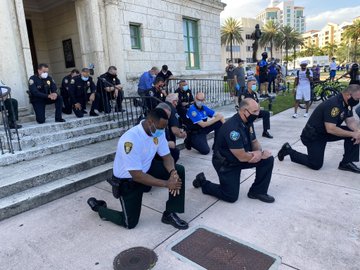
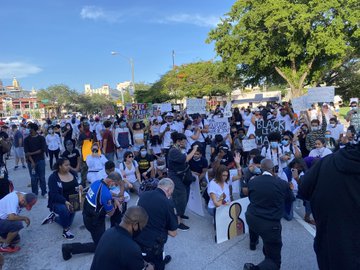
Of course, clearly by no means all police units or all members of police forces in the United States are members of racist or white supremacist groups or support alt-right ideology. Notable examples of strong relations with citizens and community-led policing in response to this past week’s protests include New Jersey police officers marching with Black Lives Matters protestors, the Dallas and Georgia’s police chiefs listening to and walking with protestors, and police in both New York City and South Florida kneeling in solidarity with protestors. In Flint, Michigan, Genesee County Sheriff Christopher Swanson removed his riot gear and

Franklin White@FranklinWSVN
Demonstrators & Police Chiefs from Miami Dade County kneel and say a prayer following the death of #GeorgeFloyd @wsvn #MiamiDade #7News #wsvn @OfficialJoelF
18.8K
5:45 PM - May 30, 2020
Twitter Ads info and privacy
8,032 people are talking about this
But the term “systemic racism” does not mean that individuals who operate within the system are generally racists. Instead, it means the institutions we have in place produce racially disparate effects on minority populations. And, in that regard, there are well-documented empirical studies of systemic racism in law enforcement agencies—including the use of policies like stop and frisk and disparate rates of policing activities including traffic stops, searches of motorists during traffic stops, levels of respect shown during stops, misdemeanor arrests, marijuana arrests, use of SWAT teams, individuals jailed for inability to pay petty fines for moving violations, militarized policing of different neighborhoods, resolution of murders of white versus black victims, sustained complaints against police officers, and unarmed victims of police shootings.
The evidence of links to explicit white supremacist groups is surely only the tip of a racist iceberg. Other forms of racism that affect all our institutions—without sparing law enforcement agencies—include explicit and implicit racial bias. O’Brien’s comments leave no assurance that he has a command of the facts or if he does that he is willing to acknowledge or seriously grapple with them.
https://www.wsws.org/en/articles/2020/06/02/trum-j02.html
By Jacob Crosse
2 June 2020
On Monday evening, President Donald Trump delivered a fascistic speech from the Rose Garden in which he announced the deployment of military forces in the capital and an escalation of police repression to end nationwide protests over the police murder of George Floyd one week ago (see: “Coup d’état in Washington: Trump declares war on the constitution”).
Trump’s remarks followed leaked audio from a conference call earlier on Monday between Trump, Attorney General William Barr, Chairman of the Joint Chiefs of Staff Gen. Mark Milley and state governors. In the call, Trump laid out the administration's plans for a police-military occupation of the country, which received no serious pushback from any on the call.
Vowing not to have a repeat of Sunday evening, when Trump was forced to turn off the White House lights and retreat to a “secure bunker,” he ordered the deployment of active duty military police to occupy the White House grounds. Nine M35 two-and-a-half-ton troop carriers, carrying over 200 soldiers, entered the grounds at approximately 5:00 pm.
Trump’s decree was accompanied by incitement to police violence against the population. As Trump delivered his remarks, 25 minutes before the 7 pm curfew was to take effect, horse-mounted police, armored personnel carriers and hundreds of black-booted military police bearing riot shields fired tear gas and rubber bullets into a crowd of roughly 1,000 peaceful protesters without warning.
Trump’s demand that governors and mayors deploy even greater force to “dominate,” arrest, prosecute and impose long prison sentences on protesters was an attack on democratic rights and assertion of authoritarian rule without precedent in US history.
In the teeth of these threats, nationwide protests continued throughout the US. In over 125 cities, youth and workers of all races have defied vicious police repression, curfews, right-wing thugs, vehicular assaults and mass arrests to continue to demand justice for victims of police murder. As of Monday morning, the Associated Press reported that over 4,400 had been arrested, likely a drastic undercount. In Chicago alone, Cook County Sheriff Tom Dart estimated that 2,000 had been arrested over the weekend. In Atlanta, some 200 people were arrested Monday night.
The National Guard has been activated in 21 states, with over 17,000 out of a possible 350,000 soldiers deployed at this time to assist in putting down “civil unrest.” In a number of states, including Kentucky and California, National Guard troops have been shifted from support roles and mobilized alongside heavily armed riot police to directly attack protesters.
The first reported police killing of a protester took place early Monday morning in Louisville, Kentucky, where thousands have marched for six days to denounce the police murder of 26-year-old emergency medical technician Breonna Taylor in March as well as the May 25 murder of George Floyd in Minneapolis. Official reports claim that David McAtee was shot and killed when forces “returned fire.” The reports do not say whether McAtee was killed by police or National Guard soldiers.
McAtee, a 53-year-old barbecue restaurant owner described by his mother Odessa Riley as a “community pillar,” was unarmed. He was left in the street for 12 hours after he was gunned down. According to family members, McAtee died shielding his niece from a barrage of gunfire.
In Omaha, Nebraska, Douglas County Attorney Don Kleine announced Monday that the state would not be pursuing charges against bar owner Jake Gardner, who shot and killed 22-year-old James Scurlock outside his bar Sunday evening.
Kleine ruled that Gardner, a twice deployed Marine and vehement Trump supporter, had acted in “self-defense” and feared for his life. Video evidence shows that Gardner’s father had shoved one protester, who in turn had pushed back. The tape shows Gardner confronting Scurlock, who was with two friends at the time of the tussle.
On Sunday it was announced by Governor Tim Walz that Minnesota State Attorney General Keith Ellison would be leading the prosecution of Derek Chauvin, the fired Minneapolis police officer caught on video holding his knee on George Floyd for nearly nine minutes and ignoring his victim’s cries that he could not breathe until he was dead. After a delay of several days, Chauvin was charged with third-degree murder and homicide, lower-level charges that carry much lighter sentences than first- or second-degree murder.
None of Chauvin’s three fellow cops, who helped restrain Floyd and keep angry bystanders away as the 46-year-old was being asphyxiated, have even been charged. On Monday, Minneapolis Police Chief Medaria Arradondo suggested that the three might be charged, telling CNN that “Mr. Floyd died in our hands and so I see that as being complicit.”
Democratic operative Al Sharpton hailed the appointment of Ellison to oversee the prosecution as a victory for the protesters and sign that “justice” would be achieved. Sharpton is seeking to reprise his role in the police killings of Michael Brown and Freddie Gray, i.e., spreading illusions in the Democratic Party in order to contain and dissipate protests against police violence. Despite Sharpton’s claims of “victory” in these earlier cases, none of the killer cops were convicted and the Obama administration refused to press federal civil rights charges.
Ellison, a supposed “progressive” Democrat and supporter of Bernie Sanders, appeared on Sunday news interview programs to join in denouncing “outside agitators” and back the deployment of the National Guard and imposition of curfews in Minneapolis and St. Paul. On Monday, he sought to temper hopes of swift justice for Floyd, telling CNN he was in no hurry to “rush to judgment.”
Also on Monday, experts hired by George Floyd's family released an independent autopsy concluding that Floyd died of “asphyxiation from sustained pressure” when his neck and back were compressed by Minneapolis police officers during his arrest. The pressure cut off blood flow to his brain, the autopsy determined.
This conclusion is at variance with the autopsy report released Monday by the Hennepin County Medical Examiner, which, while agreeing that Floyd’s death was a homicide, said the cause of death was “cardiopulmonary arrest [heart failure] complicating law enforcement subdual, restraint, and neck compression.” The medical examiner made no mention of asphyxiation and said heart disease was a factor in Floyd’s death.
Protests have continued in Minneapolis despite the brutal police crackdown and extension of the nightly curfew, which began at 10 pm Monday night. According to Governor Tim Walz, a Democrat, 476 protesters have been arrested since Friday.
Walz was effusive during the conference call with Trump Monday morning, thanking him for his “strategic guidance” in urging the full deployment of the National Guard to suppress peaceful protests.
In New York City, mass protests against police brutality continued despite the ongoing threat of COVID-19 that has killed nearly 16,500 in the city. Protesters were set to defy a newly imposed 11:00 pm curfew as thousands of multiracial youth remained in the streets as of this writing. New York police have arrested over 1,000 people.
Despite mostly peaceful marches throughout Southern California Monday, National Guard troops have been deployed to Los Angeles. As of this writing, police have arrested at least 50 people in Los Angeles for allegedly “looting.”
Despite the widespread nature and participation of broad sections of the population in the protests, which have taken place in every US state and capital, governors and mayors of both parties continue to propagate the myth that “outside agitators,” Antifa and “anarchists” have “hijacked” the protests. These baseless claims are being amplified in an attempt to break up the protests against state violence, justify more police violence on a massive scale, and carry out unconstitutional measures to criminalize political opposition to the government’s policies.
"He's describing fascism."
by
Jake Johnson, staff writer
https://www.commondreams.org/news/2020/06/01/unhinged-call-trump-urges-governors-use-military-and-throw-demonstrators-jail-10
Shortly after several media outlets reported on President Donald Trump's remarks during a call with U.S. governors Monday morning, The Daily Beast obtained and published the full audio of the call:
The Daily Beast Politics · Trump Audio
Earlier:
President Donald Trump reportedly ripped U.S. governors in a conference call Monday morning for failing to do enough to "dominate" the tens of thousands of people who have taken to the streets across the U.S. to protest the police killing of George Floyd.
The president urged state leaders to crack down even more harshly on demonstrators—who have already been treated brutally by law enforcement—with mass arrests and lengthy prison sentences.
"You have to dominate, if you don't dominate you're wasting your time," Trump said, according to audio of the call obtained by CBS News. "They're going to run over you, you're going to look like a bunch of jerks. You have to dominate."
Trump called on state officials to track demonstrators and hit them with a decade in prison as a deterrent against future protests. "You've got to arrest people, you have to track people, you have to put them in jail for 10 years and you'll never see this stuff again," Trump said.
"This is fascism," tweeted Evan Greer, deputy director of internet privacy group Fight for the Future. "He's describing fascism."
One anonymous person listening in on the call told Ed O'Keefe of CBS that the president's tone and words during the call were "unhinged."
The Washington Post, citing three anonymous officials who were on the call, reported that Trump pressed governors to "take back the streets and use force to confront protesters and said if they did not, they would look like 'fools,' alarming several governors on the call as they communicated privately."
"You have to use the military," Trump said, according to the Post.
Trump's comments came hours after thousands of people poured into the streets of Washington, D.C. and other major cities around the U.S. over the weekend to protest Floyd's killing at the hands of Minneapolis police officers. On Friday night, according to the New York Times, Trump was rushed into a secure and underground bunker by Secret Service agents as protests erupted outside the White House.
While Trump has yet to deliver a formal address to the nation on Floyd's killing and the uprising it sparked, the president has tweeted out incendiary threats against demonstrators and criticized local officials for not being sufficiently brutal in their handling of the mass protests.
On Saturday, the president said the U.S. military "can have troops on the ground" in Minneapolis "very quickly."
"We have our military ready, willing, and able, if they ever want to call our military," Trump said.
Illinois Gov. J. B. Pritzker, a Democrat, reportedly raised alarm about Trump's response to the nationwide demonstrations during the conference call Monday morning.
"I have been extraordinarily concerned with the rhetoric coming out of the White House making it worse," said Pritzker. "People are feeling real pain out there. We have to have national leadership in calling for calm."
In Los Angeles, City Councilman Marqueece Harris-Dawson said, "Our fear is real that additional law enforcement will only further violence against people of color."
by
Jessica Corbett, staff writer
https://www.commondreams.org/news/2020/06/01/protests-over-george-floyds-killing-met-curfews-police-crackdowns-and-national-guard
Local police and National Guard troops cracked down on demonstrations in cities across the country throughout the weekend as protests provoked by the killing of George Floyd continued against police brutality, systemic racism, and the militarization of local law enforcement.
There have been peaceful demonstrations as well as instances of violence and destruction. Police nationwide responded to the mass mobilization with force, though some officers in Michigan joined one protest and publicly condemned the conduct of Floyd's killer, Minneapolis police officer Derek Chauvin.
While protesters welcomed the news Friday that Chauvin was arrested and charged in the May 25 killing of Floyd, an unarmed black man, they are calling for legal action against the other three officers involved in Floyd's death—who were merely fired—as well as broader reforms to policing in the United States.
Demonstrations Sunday demanding justice for Floyd and other people of color killed by the police in recent years culminated as the White House went dark and fires burned in D.C., local governments across the country imposed curfews, and the National Guard was deployed in over two dozen states.
Here is a look at some protests and related developments from Sunday and Monday...
Minneapolis:
A truck driver identified by authorities as Bogdan Vechirko was arrested after driving a tractor-trailer into a crowd of peaceful protesters on a closed Minneapolis bridge. Though no protesters appear to have been struck by the vehicle, Vechirko was reportedly pulled from the truck by protesters before police arrived and was later taken to a hospital with non-life threatening injuries.
During an appearance on CNN, host Don Lemon asked Philonise Floyd if he had a question for Minneapolis Police Chief Medaria Arradondo.
"I want to know if he's going to get me justice for my brother," said Philonise Floyd, by ensuring that all officers involved in George Floyd's killing are arrested and convicted.
A CNN journalist passed on the question to the chief. "Being silent, or not intervening, to me you're complicit," Arradondo said to the Floyd family about the officers he fired, while noting that he does not have the authority to bring charges against them. "Mr. Floyd died in our hands, and so I see that as being complicit."
Minnesota Attorney General Keith Ellison has taken the lead on all charges brought foward in connection with Floyd's death. The Minneapolis Police Department—which Arradondo has run since 2017—has faced national scrutiny the past week for its handling of the recent protests and its broader conduct.
Birmingham, Alabama:
In Linn Park, protesters defaced an obelisk Confederate monument. As Al.com columnist Kyle Whitmire noted, "For the last three years, the city and state have been in a legal battle over the monument in court, with state Attorney General Steve Marshall fighting to preserve it."
Whitmire wrote that after failing to topple the obelisk, demonstrators turned to a statue of the park's namesake. According to the local news station WBRC, "Protesters pulled down the top part of the statue of Charles Linn by tying a rope and using manpower and a truck to pull it down."
Boston:
"After a large and peaceful protest in Boston, a turning point around 9 pm," tweeted New York Times journalist Ellen Barry. "Then pockets of remaining protesters began breaking windows, and set a police SUV on fire. It is burning near the State House, belching a column of black smoke. That image will last."
Chicago:
Actor John Cusack, who documented the Chicago protests on Twitter, said early Sunday morning that he stopped riding his bike to take a video: "Cops didn't like me filming the burning car so they came at me with batons. Hitting my bike." He tweeted a blurry video with audio of an officer repeatedly yelling at him to leave the area, followed by another video of the burning car and a group of officers.
Chicago Mayor Lori Lightfoot announced Sunday that a National Guard contingent would support the Chicago Police Department after 240 arrests overnight. Illinois Gov. JB Pritzker said that at the city's request, he activated 375 soldiers who "will carry out a limited mission to help manage street closures and will not interfere with peaceful protestors exercising their First Amendment rights."
Late Sunday, Chicago Public Schools announced that "based on the evolving nature of activity across the city, we are suspending grab-and-go meal sites and all other school and administrative office activities tomorrow," leaving thousands of families to figure out how to feed children in the midst of the coronavirus pandemic. The Chicago Teachers Union and others criticized the decision on Twitter.
Cleveland:
Cleveland police were sharply criticized by civil liberties advocates and journalists after reportedly saying Sunday that as part of the downtown curfew that is in effect until Tuesday night, "No media is allowed downtown unless they are inside their place of business. Period."
"This is unconstitutional," tweeted the ACLU of Ohio. "The City of Cleveland has no authority to restrict the rights and access of the press. The power of the people is rooted in the ability of the #FreePress to investigate and report news, especially in times of upheaval. We are reviewing this situation."
Although Cleveland Mayor Frank Jackson later said in a press conference Sunday that credentialed members of the media would still be allowed downtown, the ACLU of Ohio on Monday morning highlighted NPR producer Rachel Rood's account of the difficulty she experienced getting to her office.
Washington:
As Common Dreams previously reported, while protests raged across the nation, "the external floodlights that typically keep the White House illuminated at night were shut off as President Donald Trump remained out of sight and silent—with the exception of occasional incendiary outbursts on Twitter."
Critics regarded the move as a symbol of Trump's lack of leadership during this time of national turmoil. According to The Guardian, when the 11 pm curfew took effect, "the police line in front of the White House advanced with tear gas rounds across Lafayette Park clearing out the protesters, with intermittent sprints."
Jounalists and others circulated images on social media of fires that burned near the darkened White House:
Los Angeles:
The City of Los Angeles and Mayor Eric Garcetti continued to endure intense criticism for announcing a city-wide closure of Covid-19 testing sites Saturday. Critics regarded the decision as a punitive response to the protests, noting that Garcetti said in a press conference that "we're not going to stand for the burning of police cars" or "people who destroy shop windows."
Garcetti then requested 1,000 National Guard troops from California Gov. Gavin Newsom. The Los Angeles Times reported that "by Sunday morning, scores of Guardsmen toting M-4 rifles could be seen patrolling streets between skid row and Bunker Hill. In combat gear, they stood guard outside shattered storefronts and graffiti-tagged buildings, where windows had been shattered and the street strewn with trash."
"On Sunday afternoon, scores of troops had formed a partial perimeter around City Hall, which faces the Los Angeles Police Department building and was itself guarded by many police officers," according to the newspaper. In response to Garcetti's decision to bring in the Guardsmen, City Councilman Marqueece Harris-Dawson said, "Our fear is real that additional law enforcement will only further violence against people of color."
Louisville, Kentucky:
Louisville Mayor Greg Fischer confirmed in a statement Monday that David McAtee was killed in an incident at Dino's Food Mart involving a crowd, Louisville Metro Police Department, and the National Guard shortly after midnight. A local ABC affiliate reported that LMPD Chief Steve Conrad said someone in the crowd fired as law enforcement began to clear the parking lot and both local police and the National Guard returned fire.
Kentucky Gov. Andy Beshear released a statement Monday that aligned with Conrad's description of the incident. However, the governor added that "given the seriousness of the situation, I have authorized the Kentucky State Police to independently investigate the event." Local residents, meanwhile, gathered near the site of the shooting on Monday:
Floyd's death has reignited outrage in Louisville over the police killing of Breonna Taylor, a 26-year-old black emergency room technician, in her home on March 13. After months of outrage and calls for accountability, the FBI opened an investigation into Taylor's killing on May 21.
New York City:
Largely peaceful demonstrations in New York City included marches across the Brooklyn and Williamsburg Bridges. However, the New York Times noted that "Mayor Bill de Blasio said on Monday that he was considering implementing a curfew after parts of New York City descended into chaos for a fourth night."
"As the night wore on, violent confrontations between protesters and police officers erupted throughout Manhattan and Brooklyn," the Times reported. "Protesters threw glass bottles and trash at the police, while large groups of officers charged down streets, pushing crowds of demonstrators aside and using batons as they made arrests."
The New York Police Department was widely criticized over the weekend after officers drove their vehicles into demonstrators in Brooklyn. Denouncing de Blasio's response to the incident, Rep. Alexandria Ocasio-Cortez (D-N.Y.) tweeted that "running SUVs in crowds of people should never, ever be normalized. No matter who does it, no matter why."
Philadelphia:
Members of the National Guard headed to Philly after a weekend that saw at least 429 arrests and police deploying pepper spray from an armored vehicle to disperse crowds. While the city garnered national attention for looting and destruction, peaceful protesters—including former Philadelphia Eagles player Malcolm Jenkins—gathered Sunday for a demonstration at Center City.
"These are all of our children," city Register of Wills Tracey Gordon said of black Americans mistreated by police while speaking to a crowd that peacefully assembled at City Hall on Sunday, according to The Philadelphia Inquirer. "They deserve to have dignity. Everyone deserves to have dignity in this city and in this country."
"Police brutality has created a flashpoint for unrest that was already simmering," read an editorial published Monday in The Times of London.
by
Julia Conley, staff writer
https://www.commondreams.org/news/2020/06/01/global-protests-erupt-solidarity-racial-justice-defenders-us
People in a number of international cities violated bans on large gatherings over the weekend to show solidarity with protests against police brutality that have exploded in at least 140 cities across the United States.
Political leaders overseas condemned the killing of Floyd, who died after now-former Minneapolis officer Derek Chauvin pressed his knee onto Floyd's neck for over eight minutes while the man was unarmed and handcuffed and as onlookers pleaded with Chauvin to stop.
An estimated 1,500 people in Berlin marched on Sunday to the ethnically and racially diverse neighborhood of Hermannplatz, a day after more than 2,000 people gathered outside the U.S. embassy where they chanted "Black Lives Matter" and held pictures of Floyd.
Other spontaneous gatherings were held in Copenhagen, London, Madrid, and Tokyo.
Political leaders overseas condemned the killing of Floyd, who died after now-former Minneapolis officer Derek Chauvin pressed his knee onto Floyd's neck for eight minutes while the man was unarmed and handcuffed and as onlookers pleaded with Chauvin to stop.
"Systematic racism caused his death, not just one bad apple in an institution," said Emma Sheerin, a lawmaker with the Irish Sinn Féin party in Northern Ireland. "In the north where our own freedom fighters and civil rights organizations were inspired by the demonstrations of the American civil rights movement of the 1960s, we stand in solidarity with those who struggle for equality."
In England, officials on Friday denounced the arrest of CNN correspondent Omar Jimenez and his camera crew as they reported on the protests in Minneapolis.
"Journalists all around the world must be free to do their job and hold authorities to account without fear of retribution," Britain's Foreign Office said in a statement.
Michelle Bachelet, the high commissioner for human rights at the United Nations, called on the U.S. to take "serious action" to end police killings of civilians, which happened nearly 1,100 times in 2019.
News agencies around the world registered shocked reactions to the protests which grew last week and over the weekend, spreading to U.S. cities both large and small and marked by law enforcement officers running vehicles into crowds of protesters, pepper spraying Rep. Joyce Beatty (D-Ohio) in Columbus, Ohio; and reportedly severely injuring Linda Tirado, a photojournalist in Minneapolis—among other acts of violence.
The German newspaper Bild wrote that the protests were "scenes like out of a civil war."
The Times of London, meanwhile, expressed no confidence in President Donald Trump's ability to—or interest in—taking steps to quell the anger brought on by Floyd's killing and those of other black civilians. The newspaper criticized Trump's threats of violence toward protesters and predicted he would continue to stoke outrage among his political opponents.
"Politically, identifying enemies puts Mr. Trump into his comfort zone," the Times' leading article read on Monday. "Rather than pouring oil on troubled waters, he has opted for petrol."
"Police brutality has created a flashpoint for unrest that was already simmering," the Times added. "President Trump must change his tone to avoid a violent summer."
"Militarizing local police forces doesn't make our communities safer."
by
Jake Johnson, staff writer
https://www.commondreams.org/news/2020/06/01/militarization-cops-full-display-senator-plans-amendment-end-transfer-military
With the militarization of local police forces on full display as heavily armed cops and armored vehicles patrol the streets and crack down on protests over the killing of George Floyd, Sen. Brian Schatz on Sunday said he plans to introduce an amendment to end the federal program that permits the transfer of excess military equipment to police departments across the nation.
Julián Castro, the former Housing Secretary, applauded Schatz's proposal, warning that "as long as our police arm up like a combat force, they'll act like it.""I will be introducing an amendment to the National Defense Authorization Act to discontinue the program that transfers military weaponry to local police departments," the Hawaii Democrat tweeted late Sunday.
President Donald Trump in 2017 rolled back Obama-era limits on the 1033 Program, which authorizes the Defense Department to send military equipment and weapons to local police departments. As NBC reported at the time, "Congress created the program in 1990 during the height of the war on drugs for federal and state law enforcement agencies, and it was expanded seven years later to include all law enforcement departments."
"Since the program's inception," NBC noted, "more than $5.4 billion in equipment has flowed to police."
The response by local law enforcement to the nationwide uprising that followed Floyd's killing has heightened scrutiny of the 1033 Program, with lawmakers and activists warning that access to military hardware has made police behavior toward protesters even more brutal and violent.
"Militarizing local police forces doesn't make our communities safer," tweeted Rep. Pramila Jayapal (D-Wash.), co-chair of the Congressional Progressive Caucus.
Philip McHarris, a PhD candidate in sociology and African American studies at Yale University, wrote in an op-ed for the Washington Post last week that "police departments have come to resemble military units, contributing to deadly violence disproportionately against black Americans."
"The cycle of police brutality sparking unrest, and that unrest being met by the militarized police is increasingly familiar in modern American society," wrote McHarris. "Tough-on-crime policies and militarized police departments have paved the way for increased police contact and tragic violence. Reducing the capacity for police to engage in routine and militaristic violence is the only way to break recurring cycles of police killings and the militarized response that protests of them are often met with."
