Tuesday, June 2, 2020
US Senate Quietly Approves $38 Billion for Israel Amid Historic Economic Downturn
Alison Weir May 30, 2020
https://citizentruth.org/us-senate-quietly-approves-38-billion-for-israel-amid-historic-economic-downturn/
S.3176 was passed without being named, debated, or even discussed, even though it would set into law the largest such aid package in US history.
This article was originally published at IAK and Mintpress News on May 22nd
The Senate Foreign Relations Committee quietly passed a bill yesterday to give Israel a minimum of $38 billion over the next ten years despite the ongoing devastation to the U.S. economy caused by the coronavirus.
The bill – S.3176 – will now go before the full Senate. Since the legislation has already been passed by the House of Representatives, if the Senate passes the bill, it will then go to the president to be signed into law.
The bill was passed by the committee under two unusual circumstances and with almost no public awareness.
First, Senate Committee Chairman Jim Risch (R-Idaho) refused to allow a live stream of the meeting, despite the fact that the Senate Rules panel had recommended that extra efforts be taken to ensure public transparency while the Capitol is closed to the public and the presence of reporters is severely limited. The Senate’s Press Gallery Standing Committee of Correspondents had objected strongly to Risch’s decision.
Second, the bill was passed without being named, debated, or even discussed, even though it would set into law the largest such aid package in U.S. history. There has been no mention of the bill by most media in the United States.
The massive package is particularly noteworthy in light of the current devastation to the American taxpayers who will be footing the bill – over $10 million per day. In recent months approximately 30 million Americans have lost jobs, 100,000 small businesses have already closed forever, and over seven million are at risk of doing so.
The bill was voted on as part of a package of 15 bills that were voted on “en bloc” (all together).
After Senator Kaine said he didn’t know what the list contained, Risch responded: “I’m not trying to pull anything here… this was circulated among the staff.”
Risch then rapidly listed the numbers but did not give the titles. There was then a voice vote and the motion passed unanimously.
Democratic members of the committee had voiced strong objections to blocking a live stream of the meeting because of a different agenda item. After the meeting, Committee Ranking Member Robert Menendez (D-NJ) released a video of the meeting.
None, however, voiced any concern for giving a massive aid package to a country widely documented as a major violator of human rights.
Neither did any Democrats on the committee object to requiring American taxpayers to give Israel what amounts to over $7,000 per minute when many Americans are suffering catastrophic financial difficulties.
Democratic committee members Menendez, Ben Cardin, Cory Booker, and Chris Coons, like many of the Republican members, are particularly known for being under the influence of AIPAC and the Israel lobby and receiving pro-Israel campaign donations. Many of the members are co-sponsors of the bill.
The bill, entitled “United States-Israel Security Assistance Authorization Act of 2020,” expands and sets into law a memorandum of understanding agreement signed by the Obama administration with Israel in 2016. This agreement is nonbinding and not required by law. It also set the $38 billion as a ceiling.
The legislation just passed by the committee would make this disbursal legally required, and, in addition, it would make the $38 billion a floor rather than a ceiling. In other words, the amount of money could legally go even higher.
Given the power of the pro-Israel lobby, combined with the fact that U.S. media are not informing Americans of this use of their tax money, the likelihood is that U.S. money to Israel will go up in the future – possibly even this year.)
Most Americans say they feel the U.S. is giving Israel too much money. Israel has received more U.S. tax money than any other country – on average, about 7,000 times more per capita than others around the world.
The Council for the National Interest has posted a petition against this year’s installment, $3.8 billion. So far, it has been signed by close to 2,000 people.

Media Elite Denounce Looting Even as Billionaires Reap Record Profits from Taxpayer-Funded Bailouts
https://citizentruth.org/media-elite-denounce-looting-even-as-billionaires-reap-record-profits-from-taxpayer-funded-bailouts/
A mountain of studies on wealth inequality have shown its corrosive effect on social cohesion, with the more unequal a society gets, the less likely people are to see themselves as participants in a community and view others as a threat.
(By: Alan Macleod, Mintpress News) The extrajudicial killing of African-American man George Floyd by Police Officer Derek Chauvin sparked a storm of protests both in Minneapolis and across the country. These have included large peaceful demonstrations, but also arson, destruction of property and looting. Police have abandoned multiple precincts in the face of overwhelming popular rage.
The Reverend Martin Luther King Jr. consistently argued that looting is the language of the unheard and oppressed, a physical manifestation of their marginalization. However, many in the establishment, particularly on the right, have not interpreted the events as such, and appear scandalized by them.
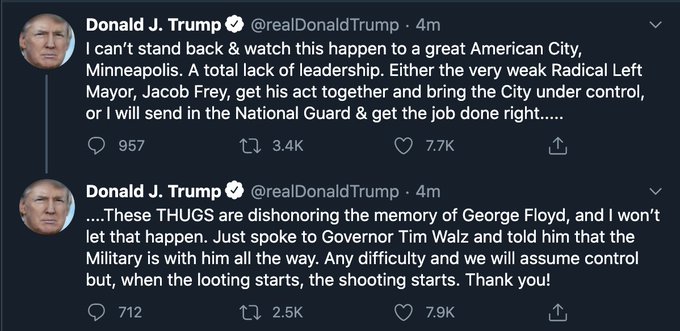
Fox News host Tucker Carlson condemned the uprising as “a form of tyranny” and “oppression.” Referring to the suffocation of George Floyd, Carlson said police brutality was “bad;” “But none of it was nearly as bad as what you just saw. The indiscriminate use of violence by mobs is a threat to every American,” he said, calling for something to be done. President Trump was even more forthright, suggesting that the National Guard be sent in to open fire on “thugs” and “looters.” “When the looting starts, the shooting starts,” he tweeted from both his personal and White House accounts.

molly conger@socialistdogmom
the president has just tweeted his support for using live fire on protesters in minneapolis
7,061
11:58 PM - May 28, 2020
Twitter Ads info and privacy
2,504 people are talking about this
Yet a new and updated report from the Institute for Policy Studies (IPS) reveals that the looting in Minneapolis pales into insignificance compared with the enormous wealth American’s billionaire class has managed to accrue during the pandemic. In the ten weeks since the nationwide lockdown first began, the group calculates that billionaires have increased their wealth by $485 billion – equal to 16.5 percent. This half-trillion-dollar rise, for Chuck Collins, Director of the IPS’ Program on Inequality and the Common Good, is something close to looting the whole economy.
“The wealthy are economically distancing from the rest of society. Worse, some are pandemic profiteering, looting government stimulus programs and taking advantage of market monopolies,” he told MintPress News.
The enormous explosion in wealth, even amidst a pandemic that has caused the economy to collapse, businesses to close, and demand to dwindle, is down in no small part to the passing of the Coronavirus Aid, Relief and Economic Security (CARES) Act, one of the greatest upwards transfers in wealth in history. While the bill, passed in late March, includes a check of up to $1,200 for most Americans, the vast majority of the benefits go to the ultra wealthy.
A report from the Joint Committee on Taxation (JCT), a nonpartisan congressional body, found that almost 82 percent of the tax breaks and other financial benefits go to those already earning over $1 million per year. In contrast, less than three percent will go to the great majority who earn under $100,000 annually. The loopholes around capital gains tax will especially benefit the richest few hundred Americans. The JCT also projects that the tax cut will add almost $170 billion to the deficit over the next ten years.
Some of the biggest winners in the last few weeks, according to the IPS, include Amazon CEO Jeff Bezos (up over $34 billion in two months), Facebook co-founder Mark Zuckerberg (up over $25 billion) and Microsoft’s Bill Gates, who increased his already enormous fortune by $8 billion. Meanwhile, Elon Musk, whose California Tesla car plant was closed for months, has seen his net worth increase by almost 50 percent, to over $36 billion. Even in the last week, America’s billionaires’ fortunes have increased by $50 billion.
At the same time, unemployment has surged to over 40 million, and food banks across the country are inundated with customers desperate for anything they can get. Around one third of renters in the United States failed to pay their rent in April and May.
“When the wealth of billionaires surges at the same time that tens of millions lose their lives and livelihoods, it undermines the solidarity required for us to pull together and help one another during a pandemic,” Collins added.

Peter Daou
✔@peterdaou
NO MORE LOOTING
I heard there was looting and I'm furious. Republicans and Democrats stealing from the poor to bail out the rich in a #pandemic. That kind of theft is unacceptable.
16.2K
6:00 AM - May 28, 2020
Twitter Ads info and privacy
3,557 people are talking about this
While many among the elite may be aghast at the scenes of low level looting in Minneapolis, the enormous siphoning off of public funds to further enrich billionaires has gone largely unnoticed. A mountain of sociological studies on wealth inequality have shown that it has a corrosive effect on social cohesion, with the more unequal a society gets, the less likely people are to see themselves as participants in a community, viewing others as threats. More unequal societies also commonly favor more repressive policing tactics like the ones seen in Minneapolis this week. Although many might not realize it, the enormous looting by billionaires and the petty looting by protestors in Minneapolis might have more in common than first meets the eye.
The US, “a Failed Social Experiment”
By Ángel Guerra Cabrera on May 31, 2020
https://www.resumen-english.org/2020/05/the-us-a-failed-social-experiment/
“What we are witnessing in the United States is a failed social experiment,” the philosopher Cornel West said in an interview with CNN about the murder by the police of African-American George Floyd.
A disciple and follower of Martin Luther King, Harvard University professor and veteran social fighter, West, author of 20 books and actor in the Matrix film trilogy, explains: “What I mean is that the history of blacks for over 200 years in the United States has been one of seeing this country fail. Its capitalist economy could not generate and provide in such a way that people could live decent lives. The nation-state, its criminal… legal justice system, could not generate protection of rights and freedoms. And now our culture, of course, is so market-oriented – everything for sale, everybody for sale – that it can’t deliver the kind of nourishment for the soul, for meaning, for purpose”.
“But the point is that we must fight,” he concluded. “Even when we have a failed social experiment, we must fight. We must have an anti-fascist coalition against what is happening in the White House and in the Republican Party. And we have to tell the truth about the weak, cowardly activity that we see so often in the neoliberal wing of the Democratic Party… “When I saw those images in Atlanta, I could see Brother Martin (Luther King), right there in Atlanta, saying: ‘I warned you about militarism, about poverty. I warned them about materialism, about racism in all its forms. I warned you about xenophobia… You are reaping what you have sown. And at that moment you have Brother George (Floyd) – it is so clear – it was a lynching at the highest level. No one can deny it.”
According to West, the United States now faces a choice between a “nonviolent” revolution or continuing with the failures of the status quo. “And what I mean by revolution is the democratic sharing of power, resources, wealth, and respect. If we don’t have that, we’re going to have more violent explosions.”
America’s Moment of Reckoning
“America’s Moment of Reckoning”: Cornel West Says Nationwide Uprising Is Sign of “Empire Imploding”
https://www.democracynow.org/2020/6/1/cornel_west_us_moment_of_reckoning
Transcript
This is a rush transcript. Copy may not be in its final form.
NERMEEN SHAIKH: Dr. Cornel West, could you respond to what professor Yamahtta Taylor said? You agree that, of course, the murder of George Floyd was a lynching. You’ve also said that his murder and the demonstrations that have followed show that America is a failed social experiment. So could you respond to that and also the way that the state and police forces have responded to the protests, following George Floyd’s killing, with the National Guard called out in so many cities and states across the country?
CORNEL WEST: Well, there’s no doubt that this is America’s moment of reckoning. But we want to make the connection between the local and the global, because, you see, when you sow the seeds of greed — domestically, inequality; globally, imperial tentacles, 800 military units abroad, violence and AFRICOM in Africa, supporting various regimes, dictatorial ones in Asia and so forth — there is a connection between the seeds that you sow of violence externally and internally. Same is true in terms of the seed of hatred, of white supremacy, hating Black people, anti-Blackness hatred having its own dynamic within the context of a predatory capitalist civilization obsessed with money, money, money, domination of workers, marginalization of those who don’t fit — gay brothers, lesbian sisters, trans and so forth. So, it’s precisely this convergence that my dear sister Professor Taylor is talking about of the ways in which the American Empire, imploding, its foundations being shaken, with uprisings from below.
The catalyst was certainly Brother George Floyd’s public lynching, but the failures of the predatory capitalist economy to provide the satisfaction of the basic needs of food and healthcare and quality education, jobs with a decent wage, at the same time the collapse of your political class, the collapse of your professional class. Their legitimacy has been radically called into question, and that’s multiracial. It’s the neofascist dimension in Trump. It’s the neoliberal dimension in Biden and Obama and the Clintons and so forth. And it includes much of the media. It includes many of the professors in universities. The young people are saying, “You all have been hypocritical. You haven’t been concerned about our suffering, our misery. And we no longer believe in your legitimacy.” And it spills over into violent explosion.
And it’s here. I won’t go on, but, I mean, it’s here, where I think Ella Baker and Fannie Lou Hamer and Rabbi Heschel and Edward Said, and especially Brother Martin and Malcolm, their legacies, I think, become more central, because they provide the kind of truth telling. They provide the connection between justice and compassion in their example, in their organizing. And that’s what is needed right now. Rebellion is not the same thing in any way as revolution. And what we need is a nonviolent revolutionary project of full-scale democratic sharing — power, wealth, resources, respect, organizing — and a fundamental transformation of this American Empire.
AMY GOODMAN: And your thoughts, Professor West, on the governor of Minnesota saying they’re looking into white supremacist connections to the looting and the burning of the city, and then President Trump tweeting that he’s going to try to put antifa, the anti-fascist activists, on the terror list — which he cannot do — and William Barr emphasizing this, saying he’s going after the far left to investigate?
CORNEL WEST: No, I mean, that’s ridiculous. You know, you remember, Sister Amy — and I love and respect you so — that antifa saved my life in Charlottesville. There’s no doubt about it, that they provided the security, you see. So the very notion that they become candidates for a terrorist organization, but the people who were trying to kill us — the Nazis, the Klan — they’re not candidates for terrorist organization status — but that’s what you’re going to get. You’re going to get a Trump-led neofascist backlash and clampdown on what is going on. We ought to be very clear about that. The neofascism has that kind of obsession with militaristic imposition in the face of any kind of disorder. And so we’ve got to be fortified for that.
But most importantly, I think we’ve got to make sure that we preserve our own moral, spiritual, quality, fundamental focus on truth and justice, and keep track of legalized looting, Wall Street greed; legalized murder, police; legalized murder abroad in Yemen, in Pakistan, in Africa with AFRICOM, and so forth. That’s where our focus has to be, because with all of this rebellious energy, it’s got to be channeled through organizations rooted in a quest for truth and justice.
A Class Rebellion: Keeanga-Yamahtta Taylor on How Racism & Racial Terrorism Fueled Nationwide Anger
https://www.democracynow.org/2020/6/1/keeanga_yamahtta_taylor_protests_class_rebellion
Transcript
This is a rush transcript. Copy may not be in its final form.
AMY GOODMAN: This is Democracy Now!, democracynow.org, The Quarantine Report. I’m Amy Goodman in New York City, joined by my co-host Nermeen Shaikh from her home also here in New York City. Hi, Nermeen.
NERMEEN SHAIKH: Good morning, Amy. And welcome to our listeners and viewers around the country and around the world.
AMY GOODMAN: Well, in the largest nationwide uprising since the 1960s, protesters shut down cities across the United States over the weekend following the police killing of George Floyd, the 46-year-old African American man in Minneapolis.
PROTESTERS: George Floyd! Say his name! George Floyd! Say his name! George Floyd! Say his name! George Floyd!
What do we want? Justice! When do we want it? Now! What do we want? Justice! When do we want it? Now! If we don’t get it? Shut it down! If we don’t get it? Shut it down! If we don’t get it? Shut it down! What do we want? Justice!
AMY GOODMAN: George Floyd died one week ago, on Memorial Day, when Minneapolis police officer Derek Chauvin arrested him and pressed his knee into Floyd’s neck for nearly nine minutes as Floyd repeatedly gasped, “I can’t breathe,” and then stopped moving. On Friday, Chauvin was charged with third-degree murder and second-degree manslaughter. The three other officers involved have been fired along with Chauvin but not arrested. Minnesota Governor Tim Walz has announced Attorney General Keith Ellison will take the lead in the investigation and any prosecutions related to George Floyd’s killing. At the Minneapolis intersection where Floyd was killed, people created a memorial and declared it a sacred space.
Meanwhile, protests continued throughout the weekend from coast to coast. The police erupted in violence in response to the widespread protests, arresting more than 4,000 people and attacking demonstrators with tear gas and rubber bullets in cities across the country. Police cars and buildings went up in flames as thousands braved the coronavirus and increasing police violence to demonstrate. In New York City alone, authorities said 47 police vehicles have been damaged. At least 40 cities have imposed curfews. The National Guard has been deployed in Minnesota, California, Illinois, Florida and other states. Police departments are facing increasing criticism for using excessive force on protesters and, in at least 50 separate incidents, attacking journalists.
The protests come as the nation’s dealing with its largest public health crisis in generations and the highest unemployment rate since the Great Depression. During protests Friday, President Trump was moved to the White House’s underground bunker. On Saturday, he took to Twitter to threaten protesters with “vicious dogs” and “ominous weapons.” He also tweeted he would designate antifa as a terrorist organization, even though legal experts say he lacks the authority to designate a domestic group as a terrorist organization, and warn such a move would violate the First Amendment.
Outrage over Floyd’s death comes after protests led to the arrest of two white men last month for the February shooting death of Black jogger Ahmaud Arbery in Georgia, and then a third man arrested, and after the Louisville police shooting death of Breonna Taylor in her home in March, which the FBI is now investigating.
The demonstrations have been mostly outside, with many people wearing masks, so it’s unclear if they’ll trigger spread of the coronavirus. But many protesters who were arrested were taken to jails that are COVID hot spots.
For more, we’re hosting a roundtable discussion with Dr. Cornel West, professor of the practice of public philosophy at Harvard University, author of many books, including Race Matters and Black Prophetic Fire. And we’re joined by Keeanga-Yamahtta Taylor, assistant professor of African American studies at Princeton University. Her recent piece for The New York Times is headlined “Of Course There Are Protests. The State Is Failing Black People.” She’s also author of Race for Profit: How Banks and the Real Estate Industry Undermined Black Homeownership and From #BlackLivesMatter to Black Liberation. And with us from Charlotte, North Carolina, Bakari Sellers is with us, an attorney and author of his new memoir, My Vanishing Country. He became the youngest African American elected official in the country when he was elected to the South Carolina state Legislature in 2006.
We welcome you all to Democracy Now! We’re going to begin with professor Keeanga-Yamahtta Taylor. If you can respond to the mass uprising that has happened around the country and the police response to it, as well as the original horror on Memorial Day, the killing of George Floyd?
KEEANGA-YAMAHTTA TAYLOR: Well, thank you, Amy, for letting me come on this morning to talk.
You know, I think part of what we are seeing is years and years of pent-up rage. Many people have referenced the 1960s, have referenced Ferguson in 2014, but I think it’s important to say that these are not just repeats of past events. These are the consequences of the failures of this government and the political establishment, the economic establishment of this country to resolve those crises, and so they build and accumulate over time. And we are watching the boiling over of that.
Imagine how angry, desperate, rage-filled you would have to be to come out and protest in the conditions of a historical pandemic that has already killed over 103,000 Americans, that has had a disproportionately horrendous impact in Black communities. I believe 23,000 or 24,000 Black people have died. To put it more bluntly, one in every 2,000 African Americans in the United States has died as the result of COVID. So imagine how difficult things have to be for people to come out in those conditions. So, I think that the buildup around police brutality, the continuation of police brutality, police abuse and violence and murder has compelled people to have to endure those conditions, because it is obvious that there is either nothing that our government can do about this or that the government is complicit and chooses not to do anything about this.
And I think that we have to add to that the crisis that is unfolding beyond police brutality in the country, as well, because we all know that the videotapes of police beatings, abuse, murder have never stopped. So, the movement that grew out of the Ferguson uprising, that became Black Lives Matter, the conditions that led to that never actually ended. And I think that what has reignited that is obviously the public lynching of George Floyd one week ago in Minneapolis, but also the conditions, the wider context within which that is spilling over. And because of that wider condition of mass unemployment, of the death that has been caused by the pandemic, that this is not just — I don’t believe these are just protests around or against police brutality.
But we see a lot of — hundreds, if not thousands, of young white people in these uprisings, making these multiracial rebellions, really. And I think that that is important. Some people have sort of described the participation of white people as outside agitators, or I know that there are reports of white supremacists infiltrating some of the demonstrations. And I think that those are things that we have to pay attention to, keep track of and try to understand. But I think we cannot dismiss in a widespread way the participation of young white people, because we have to see that what has happened over the last decade has gutted their lives, too. And there has been some discussion about this with perhaps their parents’ generation, with the description of deaths by despair.
So, we know that the life expectancy of ordinary white men and women has gone into reverse — something, by the way, that does not typically happen in the developed world. And it is driven by opioid addiction, alcoholism and suicide. And so, this generation, whose lives really — you know, if you’ve graduated from college, your life has been bracketed by war at the turn of the 21st century, by recession and now by a deadly pandemic. And so, I think we’re seeing the convergence of a class rebellion with racism and racial terrorism at the center of it. And in many ways, we are in uncharted territory in the United States.
NATIONWIDE UPRISING AGAINST FAILED STATE TRIGGERED BY POLICE KILLINGS
By Kevin Zeese and Margaret Flowers, Popular Resistance.
May 31, 2020
https://popularresistance.org/nationwide-uprising-against-failed-state-triggered-by-police-killings/
The nationwide uprising sparked by the murder of George Floyd and other recent racially-motivated events is a response to the bi-partisan failed state in which we live. It comes in the midst of the COVID19 pandemic and the largest economic collapse in the US in more than a century. These three crises have disproportionately impacted people of color and added to longterm racial inequality and injustice.
Black Lives Matter erupted six years ago when a police officer shot and killed Mike Brown in Ferguson, MO. Since that time, police have murdered approximately 1,100 people every year. The response of the government at all levels to the crisis of police killings has been virtually nonexistent. While people seek to avenge the death of George Floyd, the problems are much deeper and the changes needed are much broader.
The Root Of The Problem Is A Failed State
During the COVID19 pandemic, millionaires and billionaires have been bailed out by the government with trillions of dollars while working people were given a pittance of $1,200 per person and a short term increase in unemployment benefits for the more than 40 million people who have lost their jobs. Many workers who provide essential services have had to continue to work putting themselves and their communities at risk.
Urgently needed healthcare is out of reach for millions with no or skimpy health insurance resulting in people dying at home or not going to the hospital until their illness became serious. For this and other reasons, COVID19 is disproportionately impacting communities of color.
Glen Ford of Black Agenda Report puts the mass revolt in the context of the long history of white supremacy that has existed since Africans were brought to the United States. Chattel slavery was enforced by the earliest form of policing, with the first formal slave patrol created in the Carolina colonies in 1704. After the Civil War and a brief period of Reconstruction where African people could participate in civic life, Jim Crow followed with white racists, often allied with Southern police, inflicting terrorism against the Black population through lynchings and other means. Black people were arrested for laws like vagrancy and then punished by being forced to work picking cotton or other jobs. This new form of slavery continues as inmates are forced to work for virtually no pay in prisons, are leased out to dangerous jobs like meat processing, or are used as scabs.
George Floyd’s murder enraged people who have seen too many deaths as a result of police violence. The murder in broad daylight with cameras filming and scores of witnesses showed the impunity of police who are used to not being held accountable for their violence. During the uprising, police have used extreme violence and targeted people with cameras and the media even saying they were the problem.
The root of the problem is a failed state that does not represent the people and has a deep history of racism and inequality that are being magnified by the current crises. The failure to respond to these crises is resulting in an ungovernable country as the social contract has been broken.
Lawlessness among the wealth class, corruption of politicians by campaigns financed by the wealthiest with payoffs to their children and relatives has set the stage for no respect for the law. As one protester exclaimed, “Don’t talk to us about looting, you are the looters. You have been looting from black people. You looted from the Native Americans. Don’t talk to us about violence, you taught us violence.”
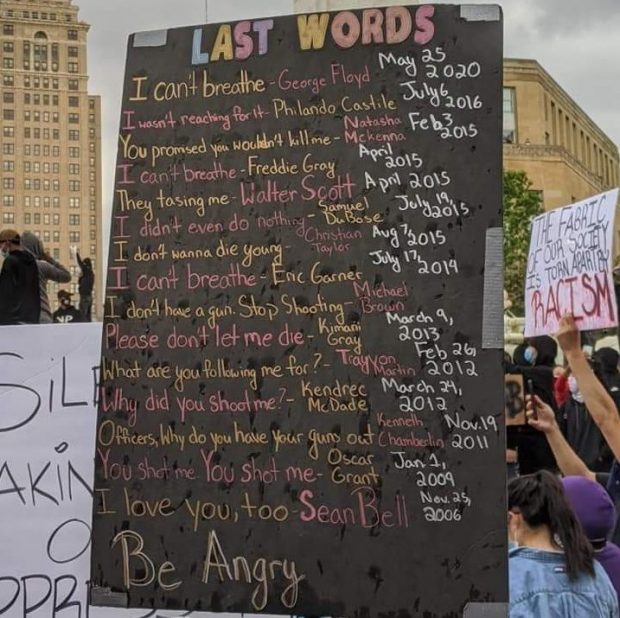
Last Words of people killed by police from Twitter, Washington, DC May 30, 2020
The Failed State Cannot Reform Itself
George Floyd’s final words, “I can’t breathe,” echoed the same words of Eric Garner, who was killed six years ago by a New York police officer. Although there were protests then, not much has changed. The system failed to respond.
Failure starts at the top. There have been years of inaction at all levels of government. The New York Times reports “The administration has largely dismantled police oversight efforts, curbing the use of federal consent decrees to overhaul local police departments. Mr. Barr has said that communities that criticize law enforcement may not deserve police protection, and Mr. Trump has encouraged officers not to be ‘too nice’ in handling suspects.”
Trump poured gasoline on the current fire with incendiary rhetoric promising ‘looting leads to shooting’ echoing racists of the past and promising to send in the US military if Democrats can’t stop the uprising. Trump has put the military on alert to deploy to civilian protests. He maintains power by dividing people praising armed protesters who demanded reopening the economy despite the pandemic and calling unarmed protesters against police violence “thugs”.
On Friday, the White House locked down on security alert because of protests. Trump responded by calling for MAGA protesters to come to the White House. They did not come but protests at the White House have continued to increase.
Both Republicans and Democrats are responsible for the current rebellion. Joe Biden has described himself as a ‘law and order’ Democrat from the beginning of his career. He was the primary architect of the federal mass incarceration of Black people and helped add hundreds of thousands of police with militarized equipment to urban communities. He courts police unions that defend killer cops. And Biden opposed the integration of schools.
The failure of leadership continues at the state and local levels with politicians closely tied to the Fraternal Order of Police, which aggressively defends police who kill civilians. Every city can point to a series of police killings with no prosecutions or acquittals and few convictions. Minneapolis is a city with a long history of race-based police violence. Indeed, violence against Indigenous peoples led to the formation of the American Indian Movement. Tne Intercept summarizes some of the cases:
In 2015, the police killed Jamar Clark a 24-year-old black man. Protests lasted two weeks but led to no prosecution.
In 2016, Philando Castile, a 32-year-old black motorist, was killed in a Minneapolis suburb. More than two weeks of protest followed and two years later the officer was acquitted.
In 2017, Justine Ruszczyk, a 40-year-old white woman, approached a Minneapolis police car to report a sexual assault. The police officer, Mohamed Noor, who shot and killed her was sentenced to 12 years in prison, and her family was awarded a record $20 million settlement.
In 2018, body camera footage showed Minneapolis police chasing Thurman Blevins, a 31-year-old black man, and shooting him to death. Prosecutors refused to file charges against the officers who killed Blevins.
Protests have led to some changes but they haven’t solved the problem. Money has been spent on body cameras, which have rarely had any impact. Similarly, training on de-escalation and racial sensitivity has made little difference.
Over the last six years, cities have increased funding for police departments at the expense of health, education, and other underfunded urban programs. Rather than providing people with necessities, the government has relied on controlling neglected communities with an occupying police force. Some of the police are even trained by the Israeli occupiers.
Even in the midst of a pandemic and economic collapse, the government cannot give people access to healthcare, protect their jobs, suspend their rents or control food prices. As Rosa Miriam Elizalde writes in her comparison of the United States to Cuba, the difference is a matter of values. The United States government spends more than 60 percent of the discretionary budget on weapons and war. It should be no surprise that the government acted more quickly to suppress people with militarized police, thousands of National Guard troops, and curfews than it did to protect their lives when the pandemic and recession started.
Reform Is Not Enough: Defund The Police, Give Communities Control, Build Alternatives To Police
The country must look more deeply at policing. Retired police major, Neill Franklin, the executive director of the Law Enforcement Action Partnership told the Intercept, “We need a new paradigm of policing in the United States. It needs to be completely dismantled and reconstructed, not changing a policy here or there.”
The Minneapolis group, Reclaim the Block, wrote a statement calling on the city council to defund the police department. Last week, they made four demands of their city council:
Never again vote to increase police funding.
Propose and vote for a $45 million cut from MPD’s budget as the city responds to projected COVID19 shortfalls.
Protect and expand current investment in community-led health and safety strategies.
Do everything in their power to compel MPD and all law enforcement agencies to immediately cease enacting violence on community members.
This is an agenda that makes sense for cities across the country. A growing movement demands the defunding of police departments. It is evident that the way to reduce police violence is to fund alternative non-law enforcement approaches to conflict resolution, safety strategies, and mental health as well as investing in neglected communities.
Another growing movement calls for democratic community control of the police where communities elect a Civilian Police Accountability Council (CPAC). The critical difference between this and Civilian Police Boards is that the Accountability Council is democratically elected not appointed by the police chief or politicians who are allied with the police. Neill Franklin urges a national database of officers terminated for misconduct so they will not be hired by other police departments.
The New York Times reports that “in 2012, the civilian board in Minneapolis was replaced by an agency called the Office of Police Conduct Review. Since then, more than 2,600 misconduct complaints have been filed by members of the public, but only 12 have resulted in an officer being disciplined.” The most severe censure was only a 40-hour suspension. Derek Chauvin, who killed George Floyd, has at least 17 misconduct complaints, none of which derailed his career, in nearly two decades with the Minneapolis Police Department.
Chauvin was involved in the fatal shooting in October 2006 when Senator Klobuchar was Minneapolis’ district attorney. Rather than prosecuting Chauvin, she sent the case to a grand jury that declined to indict Chauvin. In 2011, Chauvin was involved in a high-profile shooting of a Native American. He was placed on administrative leave but was reinstated to the force when no charges were brought. If democratic community control of the police were in place, it is highly likely Chauvin would have been removed as a police officer and George Floyd would still be alive.
Support for change is growing. Bus drivers refused to transport arrested protesters for the police in Minneapolis and New York. Payday Report wrote transit union leaders nationwide are instructing members not to cooperate with police in arresting protesters. And Universities are dropping their contracts with the Minneapolis Police Department.
Protests continue nationwide. Thus far escalating police violence and the use of the National Guard has failed to stop them. The government may use the military, although by law there are restrictions on that. There will be efforts to pacify the protests by political leaders and non-profits who will try to take over the leadership. These must be rejected.
To achieve the changes we need, people must stay in the streets and connect the problems we face to the demand for systemic changes. We will need to support each other as many are doing by distributing food and providing medical care, jail support and legal representation. We urge people to meet in assemblies to discuss what their goals are, their vision of how communities could be organized differently and what actions they can take. We need to build confidence in each other that we can work together for the future we want. That is how we will get there.
We Are Living in a Red Spring
BY
ROBERT GREENE II
https://jacobinmag.com/2020/05/red-summer-riots-african-americans-pandemic-police
Arash of racist violence against African Americans has hit the United States. Across the land, African Americans and left organizations attempt to organize, or even fight back. Meanwhile, a pandemic ravages the country and the world. International crises further threaten to tear the nation apart.
This was the state of things in the summer of 1919.
The United States reeled from the “Red Summer” riots, where hundreds of African Americans were slain in cities and small towns alike. Many of the “riots” were little more than anti-black pogroms, waged in response to growing demands for civil rights, labor rights, and adequate housing. This all came as the nation struggled to return to a peacetime economy amid international uncertainty, and the influenza pandemic — popularly known as the “Spanish Flu” — pummeled the country. Ultimately, 675,000 Americans would die from influenza, part of over 50 million deaths worldwide.
Historians tend to say that history doesn’t repeat itself. But, in this case, it does feel like it rhymes.
When I began working on this piece last week, people across the nation were outraged at the latest on-camera murder of an African American. Ahmaud Arbery was shot and killed in the South Georgia city of Brunswick earlier this year while out for a run. His killers told the authorities that they feared Arbery fit the description of a local burglar and argued they were simply defending themselves under Georgia law — an argument supported by the local district attorney, who refused to pursue the case. (Police later arrested two men, charging them with murder and aggravated assault.)
Since then, in a radically short amount of time, additional killings of African Americans — men and women — at the hands of police have pushed a long-running debate about racism and policing to a possible breaking point. On Thursday, protesters in Minneapolis torched a police station following the on-camera killing of a forty-six-year-old black man, George Floyd, and seven people were shot in Louisville during protests following the murder of a twenty-six-year-old black woman, Breonna Taylor, by plainclothes police. On Friday and Saturday, demonstrations exploded across the country as the conflagration continued in Minneapolis.
The killings caught on camera offer a disturbing reminder of the numerous photographs of lynchings dispersed throughout the nation in the early twentieth century. Some were catalogued by the NAACP and displayed as examples of American brutality and barbarism. Others, however, were featured on postcards and sent to white Americans throughout the country, small trinkets of white terror.
The bloodiest wave of violence during the Red Summer took place in Elaine, Arkansas, as African-American sharecroppers struggled to organize. In the face of devastating landlord opposition, and constant rumors fueled by the local press of African Americans organizing to kill white people, the black sharecroppers were harassed and eventually murdered by soldiers and vigilantes. At least two hundred people — men, women, and children — were slaughtered; the exact number is still unknown today.
Arbery’s death is both a reflection of this legacy of white supremacist vigilantism and the latest iteration of the racist effort to control black movement and labor. The very idea of where a black person should and shouldn’t be has been deeply political, rooted in racist hierarchies.
The locations of the recent killings are also linked to the struggles of the African-American past. Brunswick sits on the Georgia coastline, close to the Black Belt — a predominately African-American region famous for its rich soil. In the 1920s and ’30s, Communists like Harry Haywood argued that the multistate strip of land was a “nation with a nation” where black people had a right to self-determination comparable to other independence movements. The white supremacist fear of black freedom fueled attempts during the Red Summer and through the decades to suppress African-American movements, which were often tied to the broader left.
Up north, the brutal death of George Floyd occurred in Minneapolis, a city that likes to pride itself for its racial liberalism but, like many otherwise progressive urban areas in America, has a deeply checkered history of police violence. In 1948, Minneapolis mayor Hubert Humphrey declared that it was time for the Democratic Party to “get out of the shadow of states’ rights and walk forthrightly into the bright sunshine of human rights.” Yet from 2009 to 2019, African Americans comprised 60 percent of the victims of police shootings in Minneapolis despite making up less than 20 percent of the city’s population.
Breonna Taylor’s death in Louisville, Kentucky at the hands of the police has drawn less attention than the deaths of Arbery and Floyd, but is equally important. Killed because the police served a warrant at her home following “no-knock” procedures, Taylor’s boyfriend, Kenneth Walker, fired his weapon believing their home was being robbed. Louisville has its own past of racist divisions. The attempt by Anne and Carl Braden in 1954 to help Andrew and Charlotte Wade, an African-American couple, purchase a home in the suburbs triggered accusations of communist sympathies and, in Carl Braden’s case, a conviction for sedition.
Today, as protesters take to the streets in Louisville and elsewhere, freighted with this history, they’re also contending with a COVID-19 pandemic that — due to austerity and economic immiseration — is dealing an especially severe blow to African Americans. The rallying cry “Black Lives Matter” has taken on a new and radically urgent tone.
In 1919, African Americans tried, in various places, to fight back during the Red Summer. In 2020, demonstrators in Minneapolis and around the country are struggling to overturn a brutally racist social order.
We are now living, it seems, in a Red Spring.
https://jacobinmag.com/2020/05/red-summer-riots-african-americans-pandemic-police
Arash of racist violence against African Americans has hit the United States. Across the land, African Americans and left organizations attempt to organize, or even fight back. Meanwhile, a pandemic ravages the country and the world. International crises further threaten to tear the nation apart.
This was the state of things in the summer of 1919.
The United States reeled from the “Red Summer” riots, where hundreds of African Americans were slain in cities and small towns alike. Many of the “riots” were little more than anti-black pogroms, waged in response to growing demands for civil rights, labor rights, and adequate housing. This all came as the nation struggled to return to a peacetime economy amid international uncertainty, and the influenza pandemic — popularly known as the “Spanish Flu” — pummeled the country. Ultimately, 675,000 Americans would die from influenza, part of over 50 million deaths worldwide.
Historians tend to say that history doesn’t repeat itself. But, in this case, it does feel like it rhymes.
When I began working on this piece last week, people across the nation were outraged at the latest on-camera murder of an African American. Ahmaud Arbery was shot and killed in the South Georgia city of Brunswick earlier this year while out for a run. His killers told the authorities that they feared Arbery fit the description of a local burglar and argued they were simply defending themselves under Georgia law — an argument supported by the local district attorney, who refused to pursue the case. (Police later arrested two men, charging them with murder and aggravated assault.)
Since then, in a radically short amount of time, additional killings of African Americans — men and women — at the hands of police have pushed a long-running debate about racism and policing to a possible breaking point. On Thursday, protesters in Minneapolis torched a police station following the on-camera killing of a forty-six-year-old black man, George Floyd, and seven people were shot in Louisville during protests following the murder of a twenty-six-year-old black woman, Breonna Taylor, by plainclothes police. On Friday and Saturday, demonstrations exploded across the country as the conflagration continued in Minneapolis.
The killings caught on camera offer a disturbing reminder of the numerous photographs of lynchings dispersed throughout the nation in the early twentieth century. Some were catalogued by the NAACP and displayed as examples of American brutality and barbarism. Others, however, were featured on postcards and sent to white Americans throughout the country, small trinkets of white terror.
The bloodiest wave of violence during the Red Summer took place in Elaine, Arkansas, as African-American sharecroppers struggled to organize. In the face of devastating landlord opposition, and constant rumors fueled by the local press of African Americans organizing to kill white people, the black sharecroppers were harassed and eventually murdered by soldiers and vigilantes. At least two hundred people — men, women, and children — were slaughtered; the exact number is still unknown today.
Arbery’s death is both a reflection of this legacy of white supremacist vigilantism and the latest iteration of the racist effort to control black movement and labor. The very idea of where a black person should and shouldn’t be has been deeply political, rooted in racist hierarchies.
The locations of the recent killings are also linked to the struggles of the African-American past. Brunswick sits on the Georgia coastline, close to the Black Belt — a predominately African-American region famous for its rich soil. In the 1920s and ’30s, Communists like Harry Haywood argued that the multistate strip of land was a “nation with a nation” where black people had a right to self-determination comparable to other independence movements. The white supremacist fear of black freedom fueled attempts during the Red Summer and through the decades to suppress African-American movements, which were often tied to the broader left.
Up north, the brutal death of George Floyd occurred in Minneapolis, a city that likes to pride itself for its racial liberalism but, like many otherwise progressive urban areas in America, has a deeply checkered history of police violence. In 1948, Minneapolis mayor Hubert Humphrey declared that it was time for the Democratic Party to “get out of the shadow of states’ rights and walk forthrightly into the bright sunshine of human rights.” Yet from 2009 to 2019, African Americans comprised 60 percent of the victims of police shootings in Minneapolis despite making up less than 20 percent of the city’s population.
Breonna Taylor’s death in Louisville, Kentucky at the hands of the police has drawn less attention than the deaths of Arbery and Floyd, but is equally important. Killed because the police served a warrant at her home following “no-knock” procedures, Taylor’s boyfriend, Kenneth Walker, fired his weapon believing their home was being robbed. Louisville has its own past of racist divisions. The attempt by Anne and Carl Braden in 1954 to help Andrew and Charlotte Wade, an African-American couple, purchase a home in the suburbs triggered accusations of communist sympathies and, in Carl Braden’s case, a conviction for sedition.
Today, as protesters take to the streets in Louisville and elsewhere, freighted with this history, they’re also contending with a COVID-19 pandemic that — due to austerity and economic immiseration — is dealing an especially severe blow to African Americans. The rallying cry “Black Lives Matter” has taken on a new and radically urgent tone.
In 1919, African Americans tried, in various places, to fight back during the Red Summer. In 2020, demonstrators in Minneapolis and around the country are struggling to overturn a brutally racist social order.
We are now living, it seems, in a Red Spring.
Subscribe to:
Comments (Atom)