Wednesday, May 13, 2020

Bernie Sanders, Ilhan Omar, Yanis Varoufakis & 300 lawmakers call for cancellation of developing world’s’ debt
https://www.yanisvaroufakis.eu/2020/05/13/bernie-sanders-ilhan-omar-carlos-menem-yanis-varoufakis-richard-durbin-and-300-other-lawmakers-call-for-a-cancellation-of-developing-worlds-debt-washington-post/
Sen. Bernie Sanders (I-Vt.) and Rep. Ilhan Omar (D-Minn.) in a Wednesday letter addressed to Georgieva and David Malpass, president of the World Bank, called on international financial organizations to consider “extensive debt forgiveness” for more than 70 of the world’s poorest countries. The letter, which also called for significant fiscal stimulus to help stabilize the global economy, was signed by more than 300 lawmakers from over two dozen countries, including former Argentine president Carlos Menem, former Greek finance minister Yanis Varoufakis and Sen. Richard J. Durbin (D-Ill.), one of the most senior members in the U.S. chamber.
“The vulnerable communities that lack the resources and privileges to adopt adequate public health measures will ultimately face the disproportionate burden of coronavirus,” read the letter, a draft of which was shared with Today’s WorldView. “Such harm means that global supply chains, financial markets, and other interconnected exchanges will continue to be disrupted and destabilized.”
The two U.S. lawmakers called for a technocratic instrument in the IMF’s tool kit known as special drawing rights, or SDRs, that could bring hundreds of billions, even trillions, of dollars of new liquidity into the global economy. The last time the IMF allowed for a major infusion of additional SDRs was in 2009 as part of a $1 trillion injection into the global economy that followed the financial crisis.
The IMF’s gold reserves have soared $19bn since #coronavirus pandemic. This is more than the entire debt the poorest countries owe. The IMF should use these windfall profits to #CancelTheDebt to avert catastrophic loss of life in developing countries
Sanders and Omar, widely seen as occupying the left flank of Democratic Party politics, are pushing ideas about debt relief and crisis spending that are becoming increasingly mainstream. Economists and policymakers to their right have already made similar calls for a new round of SDRs, which would not make much of a difference for taxpayers in wealthy nations. Boosters of the idea say that rich countries could voluntarily transfer some of the funds generated by the SDRs — which are allocated on the basis of IMF quotas that give richer nations much larger shares — to poorer ones.
“Taking commonsense measures to cancel debts and provide financial stability — steps which do not cost U.S. taxpayers a penny — is the very least we can do to prevent an unimaginable amount of poverty, hunger, and disease that could harm hundreds and hundreds of millions of people,” Sanders said in an email to Today’s WorldView.
So far, the Trump administration, whose Treasury Department carries enormous influence over the IMF, has balked at the idea. One reason for its opposition is an unwillingness to create a mechanism that boosts the foreign reserves of adversarial countries such as China, Iran or Venezuela without forcing them to make any concessions…
For the letter’s signatories, debt forgiveness is an essential plank of a broader global recovery. “What this crisis shows us is that we are all in this together, as a global community,” said Sanders. “We have got to show unprecedented compassion, solidarity, and cooperation right now, because this pandemic has revealed for everybody that we are only as safe and healthy as the most vulnerable among us.”
BOTCHED INFILTRATION OF VENEZUELA LEAVES GUAIDÓ TAINTED BEYOND REPAIR
By Leonardo Flores, Popular Resistance.
May 12, 2020
https://popularresistance.org/botched-infiltration-of-venezuela-leaves-guaido-tainted-beyond-repair/
The latest chapter in the ongoing effort to overthrow the Venezuelan government reads like a bad spy thriller: a group of mercenaries piloted speedboats from Colombia to Venezuela; half of them were killed or captured by Venezuelan security forces immediately upon landing, while the other half – apparently delayed by mechanical issues with their boat – surrendered to local police and militia the next day. Thirty-nine attackers have been captured so far, including two Americans, both former special forces soldiers. Their plan was to capture or kill high-value targets, including Venezuelan President Nicolás Maduro. Instead, it failed miserably and raised more concerns about the leadership of opposition figure Juan Guaidó.
Guaidó’s Insidious Contract
Information about the attack continues to trickle out, yet there is overwhelming evidence of Guaidó’s involvement. According to multiple sources, Guaidó signed a $212 million contract with Jordan Goudreau, an ex-Green Beret, for Goudreau’s private security firm to overthrow President Maduro, although payments were never made. This corroborates an accusation made in late March by Clíver Alcalá, an opposition-aligned, retired Venezuelan general who surrendered to U.S. Drug Enforcement Agency custody after being indicted for drug trafficking. Copies of a general services agreement with the signatures of Guaidó and Goudreau have been leaked online, and the Washington Post reported news of a video call in which Guaidó says he is “about to sign” the contract. Furthermore, several of the Venezuelans who took part in the raid have links to Guaidó, including at least two who participated in the April 30, 2019 coup attempt.
The paramilitary force that would have resulted from the contract has been described as similar to the death squads that operated in El Salvador, Nicaragua and Guatemala in the 80’s. This is no exaggeration. The contract explicitly identifies colectivos as a military target, without ever defining the term. The nebulousness of this term suggests that anyone who runs afoul of the paramilitaries could be categorized as part of a colectivo.
Leopoldo López, the founder and leader of Guaidó’s party Voluntad Popular, recently wrote an opinion piece in El País, Spain’s most important newspaper, in which he implied that chavismo is a virus like Covid-19. It is not difficult to see how this sort of rhetoric influenced the contract. Page 11 of the contract’s attachment B authorizes the “on scene commander” of an operation to lethally target certain civil servants of institutions – including the Foreign Ministry, Planning Ministry and Youth Ministry – even in cases that could result in high collateral damage. The message is clear; anyone close to a chavista can be considered expendable.
The United States’ Role
The Venezuelan government, which was apparently able to stop the raid after being tipped off by sources in Colombia, accused the United States of being involved. The Trump administration has denied any involvement, but there is good reason to suspect otherwise. Secretary of State Pompeo left open the possibility that the U.S. knew “who bankrolled” the operation, while refusing to “share any more information about what we know took place.” Moreover, the Associated Press reported that the DEA had informed Homeland Security of Goudreau’s plans to smuggle weapons into Colombia. Goudreau met twice with Keith Schiller, a longtime bodyguard and advisor to President Trump, and worked security at a Trump campaign rally in 2018. In addition, the Wall Street Journal reported the CIA was aware of the plan.
The plan involved kidnapping President Maduro, taking control of an airport and flying him to the United States, ostensibly to collect on the $15 million bounty offered by the Department of Justice. Had the mercenaries been successful, it is hard to believe that the Trump administration, with the US Navy floating right outside Venezuela’s maritime border, would not have seized the opportunity to grab President Maduro.
Yet whether the United States government was involved in this particular raid, the Trump administration has been openly and directly supporting violent regime change in Venezuela since April 30, 2019. That is the date Guaidó launched his failed military uprising, in which he tried to take over a Caracas airbase. Had a few things gone differently that day, Venezuela would be in a civil war. Guaidó was responsible then and he is responsible now. Additionally, he was educated in Washington, he declared himself “president” because of Washington, he has bipartisan political support and he receives U.S. taxpayer money. Given Guaidó’s involvement, it is impossible for Washington to wash its hands of the plot. The Trump administration is responsible for giving him what little power he has, and therefore it is responsible for his actions
A Growing Liability
Guaidó has denied knowledge of the affair, but he is proving to be a liability for the Trump administration. He has been photographed with members of a drug cartel who subsequently claimed Guaidó traded favors with them. His team embezzled funds raised from a “humanitarian aid” concert held in Colombia. He led a failed uprising in April 2019 that was ridiculed around the world, as it consisted of just a few dozen soldiers. He is using Venezuelan funds previously frozen in a Citibank account to pay his associates $5,000 a month, while failing to deliver on promises to send Venezuelan doctors and nurses $100 for their efforts in fighting Covid-19. Now he faces credible accusations and evidence that he is involved in arms trafficking, financing a terror plot and planning a potential genocide in Venezuela.
The capture of two Americans may change the political landscape, as they are poised to become a point of contention between the Trump and Maduro administrations. Secretary Pompeo said the United States will “use every tool” to secure the release of the two Americans, but to date, there is one tool the Trump administration has never used with regards to Venezuela: dialogue. The best-case scenario is the handover of the pair to the United States as part of a deal to begin direct talks between the two governments. The worst-case scenario is that the Trump administration will perceive them as hostages and retaliate with military action.
Sensible politicians could use this event as a catalyst to spur talks within Venezuela and between Venezuela and the United States. The Puebla Group, a bloc of progressive Latin American politicians that includes ten former heads of state, has done just that, issuing a statement which warns that military action would lead to “geopolitical instability throughout Latin America” and calls for “democratic dialogue and a peaceful solution” to the conflict.
In the U.S., Democrats have been almost entirely silent on the matter, with the exception of a letter by Senators Chris Murphy, Tom Udall and Tim Kaine that questions the Trump administration’s tactics, but not its strategy or objectives. Unless Democrats begin to take advantage of the liability Guaidó represents and push back against Trump’s regime change efforts, there seems to be little hope of improving U.S. – Venezuela relations, regardless of who wins the presidency in November.
COVID-19 CAN TRIGGER REVOLUTION—HERE’S HOW!
By Isa Benros, Phil Wilmot and Søren Warburg,
International Center for Nonviolent Conflict.
May 12, 2020
https://popularresistance.org/covid-19-can-trigger-revolution-heres-how/
Historically, pandemics have forced humans to break with the past and imagine their world anew. This one is no different. It is a portal, a gateway between one world and the next. — Arundhati Roy
COVID-19 is an example of what movement analysts call a “trigger event.” When shocking events of immense scale occur suddenly—such as natural disasters, military coups, economic collapse, or virus pandemics—they drastically alter life as we know it, and radically shift public sentiment. The previously unimaginable quickly becomes reality.
Trigger events create confusion and unease, but they also present tremendous opportunities for those who have a plan and know how to use the moment to push their agendas. Those in power and private interest groups are already doing this to ensure that they will come out of the crisis with their wealth and position still intact. Activists must push an agenda that represents the public interest—the imperative of a just society and the rights of ordinary people—with effective strategies for advancing relevant new policies. Right now, there is a need for a platform and vision for mass participation, a well-articulated analysis of why we’re suffering, and a vision for how to achieve a better future. This can provide a sense of agency, a shared story, and a strategy that enables people to work collectively towards common goals.
How Do We Leverage This Trigger Event?
To leverage this trigger event, it helps to understand a broader perspective on social movements, and in particular different stages of movement development.
Inspired by the activist Bill Moyer’s stages of progression for social movements, Movement Net Lab designed “The Movement Cycle” to illustrate six phases of a movement’s life:
Enduring Crisis, characterized by growing public anger.
Uprising, characterized by a massive response of action.
Peak, when members briefly enjoy a “honeymoon” sensation—the temporal thrill of victory.
Contraction, when members are disillusioned that their great work has not fully ushered in the lofty change they expected. (Membership is likely to wane at this point, especially if core organizers had not prepared for it.)
Evolution, guided by the learning and reflection of members.
New Normal, characterized by consistent and modest regrowth (whether in the direction of movement goals or not) until another trigger event is seized.
As illustrated below, trigger events like the one we’re seeing now often occur between the first two phases:
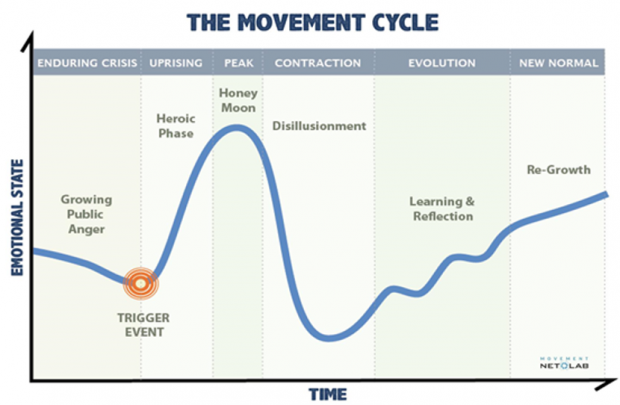
As people are increasingly aggrieved by their circumstances, they become more willing to act. When a particular scenario unfolds that feels completely overbearing (a “trigger event”), organizers can seize it as a trigger event to spark a mass uprising. Source: Authors.
As we see it, the top priorities for organizers, activists, and civil society in the current COVID-19 moment are:
Understanding the Uprising (“Heroic”) phase and acting strategically during it.
Preparing to enjoy the Peak (“Honeymoon”) phase in a way that limits the negative impact of the “Disillusionment” phase that follows, and that provides a basis for longer term growth towards success.
To advance these two priorities, here are capacities that movements, networked NGOs, allied financiers, and self-organized groups can build in this phase of social movement development.
Develop Plans And Processes To Absorb New Membership
In light of government failures to respond adequately to COVID-19, and the suffering and long-standing inequalities in our societies that this pandemic has exposed, many people are now newly awakened and will be motivated to take action. How can these people be recruited into movements, and then sustain their participation once they’ve joined? Answers to these questions will look different across different contexts, but they inevitably involve creating infrastructures that strengthen relationships between existing activists and new volunteers—for example by establishing affinity groups, events, social network groups, etc.
Because it can be challenging to do this in a time of social distancing, setting up virtual communities of practice that offer authentic human interaction through webinars and virtual workshops can help in this regard. One example is Nonviolence International and Beautiful Trouble’s ongoing “We are All Part of One Another” webinar series.
However, we also need to go beyond simply migrating to digital organizing spaces. Delegating leadership and encouraging self-organizing are crucial movement capacities right now. To cultivate more sincere human interaction, movements should ensure that newcomers don’t leave their first (likely virtual) meeting without being plugged into working groups or affinity groups. A follow-up plan for subsequent meetings or actions to take place should always be clear for attendees.
Convene Communities To Promote Healing
We have all heard the mantras of individual self-care during this time (“Distance yourself! Wash your hands! Spend time in nature!”), but many people also have a need for broader shared healing. We need movements that have the capacity to convene communities and encourage collective healing, and empowerment, as part of their activities. Consolidating local caregiver information and forming volunteer groups are a few examples of ways we can mobilize solidarity for mental health support and serve the most hurting members of our communities.
Engage In Mutual Aid And Expand Coalitions
Mutual aid and community support networks are blossoming throughout the world to help those affected by COVID-19. Movement organizers must deepen relationships with those who are engaged in this community-based service work (and of course, in some cases, movement organizers are the ones who are already doing this work).
Mutual aid and humanitarianism do not automatically raise political consciousness in and of themselves, but they can create the space for it. But when those engaged in mutual aid also help their communities understand how they can mobilize together to create political change, the results can be potent. Those serving local community needs can also deepen public understanding of existing system flaws such as economic disparities; inequalities in health care access and outcomes; public policies and budgets that favor armed defense over human security; and leadership incompetence (e.g. bailing out large companies operating in non-essential industries). This exposure can be channeled to challenge and transform the faulty system. Activists can also engage in charitable acts in ways that pressure the system to behave as it should.
Pool Resources
Now is also the time to critically look at how you can collect resources and make them available to others. Pool funds for projects (one ongoing example is the Middle East Children’s Alliance’s Emergency Aid for Palestine and Lebanon During COVID-19 Pandemic). If you’re a nonprofit organization, you can publicly offer yourself as a fiscal sponsor. Develop a crowdfunding campaign with your comrades to support those suffering financially during COVIC-19. ActionAid has established a COVID19 youth-led action fund to do exactly that.
Draw On The Leadership And Skills Of Artists
Human resources are the most important resources a community has. Keep trainers, designers, artists, and people who are skilled in organizing and strategy at hand. In particular, artists (of all disciplines) are irreplaceable in their ability to elevate society’s capacity to imagine. NGOs, donors, and self-organized groups should turn to artists for their understanding and visualization of this crisis through a word, song, or image. Artists can also offer insight on the appropriate structures they need to carry out their work in support of social and political transformation. Inattentiveness to the visionary leadership of artists during COVID-19 will result in tone-deaf responses to a disaster felt by most as a deeply human hardship.
Beyond the value of artists’ visionary work, they are valuable local partners in more concrete actions, such as volunteering their currently unused workspace for hospital overflow (like this recent example from New York), or turning their attention to mask fabrication.
Develop And Advance Alternative Policies
Capitalist economies of many countries worldwide are presently being bailed out by socialism! In some cases right-wing despots are being forced to use state funds for the wellbeing of their people. Yet even in cases where socialized policies are supporting populations, those that continue to pillage our planet are getting a fatter slice of the cake.
Beyond exposing system faults and reframing the pandemic to shift public opinion, we can also research and analyze specific policies and structures to advocate as alternatives to the status quo. As policymaking bodies currently under quarantine reconvene, the opportunity arises to pressure them to pass new economic, health-related, and other legislation and make changes within government. Being late to this game is not an option—the opportunity to push them to focus on the public interest and the needs of ordinary people is real, and we must be prepared to win that fight by building power and advancing policy alternatives.
It’s Up To Us: Another World Is Possible!
People worldwide are alert to the ramifications of COVID-19, and many are already organized and taking action to seize this crisis for the better. What remains to be seen is whether these fragmented efforts coalesce into collective power. Our ability to harness this power will determine whether we are able to leverage this pandemic in a way that transforms oppressive social, economic, and political systems. Our insights above provide a starting point for networked NGOs, allied financiers, and self-organized groups to consider how to use our present situation as strategically as possible. There is no need to feel powerless. The time is now to emerge from our paralysis and cultivate the new world together!
May 12, 2020
https://popularresistance.org/covid-19-can-trigger-revolution-heres-how/
Historically, pandemics have forced humans to break with the past and imagine their world anew. This one is no different. It is a portal, a gateway between one world and the next. — Arundhati Roy
COVID-19 is an example of what movement analysts call a “trigger event.” When shocking events of immense scale occur suddenly—such as natural disasters, military coups, economic collapse, or virus pandemics—they drastically alter life as we know it, and radically shift public sentiment. The previously unimaginable quickly becomes reality.
Trigger events create confusion and unease, but they also present tremendous opportunities for those who have a plan and know how to use the moment to push their agendas. Those in power and private interest groups are already doing this to ensure that they will come out of the crisis with their wealth and position still intact. Activists must push an agenda that represents the public interest—the imperative of a just society and the rights of ordinary people—with effective strategies for advancing relevant new policies. Right now, there is a need for a platform and vision for mass participation, a well-articulated analysis of why we’re suffering, and a vision for how to achieve a better future. This can provide a sense of agency, a shared story, and a strategy that enables people to work collectively towards common goals.
How Do We Leverage This Trigger Event?
To leverage this trigger event, it helps to understand a broader perspective on social movements, and in particular different stages of movement development.
Inspired by the activist Bill Moyer’s stages of progression for social movements, Movement Net Lab designed “The Movement Cycle” to illustrate six phases of a movement’s life:
Enduring Crisis, characterized by growing public anger.
Uprising, characterized by a massive response of action.
Peak, when members briefly enjoy a “honeymoon” sensation—the temporal thrill of victory.
Contraction, when members are disillusioned that their great work has not fully ushered in the lofty change they expected. (Membership is likely to wane at this point, especially if core organizers had not prepared for it.)
Evolution, guided by the learning and reflection of members.
New Normal, characterized by consistent and modest regrowth (whether in the direction of movement goals or not) until another trigger event is seized.
As illustrated below, trigger events like the one we’re seeing now often occur between the first two phases:
As people are increasingly aggrieved by their circumstances, they become more willing to act. When a particular scenario unfolds that feels completely overbearing (a “trigger event”), organizers can seize it as a trigger event to spark a mass uprising. Source: Authors.
As we see it, the top priorities for organizers, activists, and civil society in the current COVID-19 moment are:
Understanding the Uprising (“Heroic”) phase and acting strategically during it.
Preparing to enjoy the Peak (“Honeymoon”) phase in a way that limits the negative impact of the “Disillusionment” phase that follows, and that provides a basis for longer term growth towards success.
To advance these two priorities, here are capacities that movements, networked NGOs, allied financiers, and self-organized groups can build in this phase of social movement development.
Develop Plans And Processes To Absorb New Membership
In light of government failures to respond adequately to COVID-19, and the suffering and long-standing inequalities in our societies that this pandemic has exposed, many people are now newly awakened and will be motivated to take action. How can these people be recruited into movements, and then sustain their participation once they’ve joined? Answers to these questions will look different across different contexts, but they inevitably involve creating infrastructures that strengthen relationships between existing activists and new volunteers—for example by establishing affinity groups, events, social network groups, etc.
Because it can be challenging to do this in a time of social distancing, setting up virtual communities of practice that offer authentic human interaction through webinars and virtual workshops can help in this regard. One example is Nonviolence International and Beautiful Trouble’s ongoing “We are All Part of One Another” webinar series.
However, we also need to go beyond simply migrating to digital organizing spaces. Delegating leadership and encouraging self-organizing are crucial movement capacities right now. To cultivate more sincere human interaction, movements should ensure that newcomers don’t leave their first (likely virtual) meeting without being plugged into working groups or affinity groups. A follow-up plan for subsequent meetings or actions to take place should always be clear for attendees.
Convene Communities To Promote Healing
We have all heard the mantras of individual self-care during this time (“Distance yourself! Wash your hands! Spend time in nature!”), but many people also have a need for broader shared healing. We need movements that have the capacity to convene communities and encourage collective healing, and empowerment, as part of their activities. Consolidating local caregiver information and forming volunteer groups are a few examples of ways we can mobilize solidarity for mental health support and serve the most hurting members of our communities.
Engage In Mutual Aid And Expand Coalitions
Mutual aid and community support networks are blossoming throughout the world to help those affected by COVID-19. Movement organizers must deepen relationships with those who are engaged in this community-based service work (and of course, in some cases, movement organizers are the ones who are already doing this work).
Mutual aid and humanitarianism do not automatically raise political consciousness in and of themselves, but they can create the space for it. But when those engaged in mutual aid also help their communities understand how they can mobilize together to create political change, the results can be potent. Those serving local community needs can also deepen public understanding of existing system flaws such as economic disparities; inequalities in health care access and outcomes; public policies and budgets that favor armed defense over human security; and leadership incompetence (e.g. bailing out large companies operating in non-essential industries). This exposure can be channeled to challenge and transform the faulty system. Activists can also engage in charitable acts in ways that pressure the system to behave as it should.
Pool Resources
Now is also the time to critically look at how you can collect resources and make them available to others. Pool funds for projects (one ongoing example is the Middle East Children’s Alliance’s Emergency Aid for Palestine and Lebanon During COVID-19 Pandemic). If you’re a nonprofit organization, you can publicly offer yourself as a fiscal sponsor. Develop a crowdfunding campaign with your comrades to support those suffering financially during COVIC-19. ActionAid has established a COVID19 youth-led action fund to do exactly that.
Draw On The Leadership And Skills Of Artists
Human resources are the most important resources a community has. Keep trainers, designers, artists, and people who are skilled in organizing and strategy at hand. In particular, artists (of all disciplines) are irreplaceable in their ability to elevate society’s capacity to imagine. NGOs, donors, and self-organized groups should turn to artists for their understanding and visualization of this crisis through a word, song, or image. Artists can also offer insight on the appropriate structures they need to carry out their work in support of social and political transformation. Inattentiveness to the visionary leadership of artists during COVID-19 will result in tone-deaf responses to a disaster felt by most as a deeply human hardship.
Beyond the value of artists’ visionary work, they are valuable local partners in more concrete actions, such as volunteering their currently unused workspace for hospital overflow (like this recent example from New York), or turning their attention to mask fabrication.
Develop And Advance Alternative Policies
Capitalist economies of many countries worldwide are presently being bailed out by socialism! In some cases right-wing despots are being forced to use state funds for the wellbeing of their people. Yet even in cases where socialized policies are supporting populations, those that continue to pillage our planet are getting a fatter slice of the cake.
Beyond exposing system faults and reframing the pandemic to shift public opinion, we can also research and analyze specific policies and structures to advocate as alternatives to the status quo. As policymaking bodies currently under quarantine reconvene, the opportunity arises to pressure them to pass new economic, health-related, and other legislation and make changes within government. Being late to this game is not an option—the opportunity to push them to focus on the public interest and the needs of ordinary people is real, and we must be prepared to win that fight by building power and advancing policy alternatives.
It’s Up To Us: Another World Is Possible!
People worldwide are alert to the ramifications of COVID-19, and many are already organized and taking action to seize this crisis for the better. What remains to be seen is whether these fragmented efforts coalesce into collective power. Our ability to harness this power will determine whether we are able to leverage this pandemic in a way that transforms oppressive social, economic, and political systems. Our insights above provide a starting point for networked NGOs, allied financiers, and self-organized groups to consider how to use our present situation as strategically as possible. There is no need to feel powerless. The time is now to emerge from our paralysis and cultivate the new world together!
CHILDREN PROTEST FOR THEIR PARENTS AT THE SMITHFIELD FOODS MEAT FACTORY
By Taylor Trujillo, KLKN TV.
May 12, 2020
https://popularresistance.org/children-protest-at-smithfield-foods-meat-factory/
Protesters Rallied Another Saturday For Better Working Conditions At Smithfield Foods.
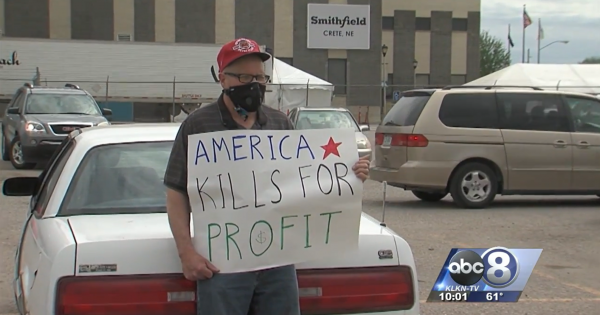
Saturday in Crete was the second round of drive–by protests against the lack of COVID–19 safety conditions at Smithfield Foods.
Protestors were seen donning signs down main street with sayings like “essential not disposable.”
The workers, experiencing a quick turnaround on Tuesday that didn’t give them the initial 2 week closure they were hoping to get.
“When are we going to stop? When 300 people are sick? Is that where the COVID is going to stop,” said Sheila Balbuena, whose parents are working at the plant.
“We would rather not eat meat for weeks or even months as long as everyone’s safe and the prices decrease,” said Yesenia Regalado, whose parents are working at the plant.
“I haven’t been able to hug my mom in the past two weeks because she’s worried she’s going to affect any of us if she has it, you know,” said Emmanuel Sanchez-Mora, whose parents are working at the plant.
Emmanuel Sanchez-Mora, a graduate from UNL, says it was the income his parents made from working at the plant that got him his degree.
“My parents personally are proud to be working at Smithfield. They’re thankful. I’ve heard my mother thank God a million times for that job…. We don’t want them to be affected, but we don’t want to be affected ourselves, and we don’t want our town to be affected. This town was built from Smithfield,” said Sanchez-Mora.
But, he, and others want to know when enough is enough.
“I think a fair outcome would be for them to quarantine our parents for at least two weeks, pay them for those two weeks, and let the curve flatten a little bit,” said Sanchez-Mora.
The fight still going strong while nearly 50 confirmed cases, all linked to the meat processing plant.
Subscribe to:
Comments (Atom)