Wednesday, May 13, 2020
Elon Musk and the economics of class war
https://www.wsws.org/en/articles/2020/05/13/pers-m13.html
13 May 2020
Tesla CEO Elon Musk announced Monday that the Palo Alto, California-based automaker would restart production at its Fremont, California assembly facility in defiance of orders from local health authorities for the plant to remain closed to protect workers from COVID-19.
“Tesla is restarting production today against Alameda County rules,” Musk said on Twitter. The San Francisco Chronicle reported that Tesla production lines had been operating over the weekend. At full capacity, the plant employs 10,000 workers.
Musk is well aware that he will face no serious consequences for endangering the lives of thousands of people. On Tuesday, local officials merely sent a letter to Tesla telling the company to cease production until they come to terms on a plan to reopen. The greatest penalty Musk potentially faces is a fine of up to $1,000 a day or up to 90 days in jail, the latter being highly unlikely.
The global auto industry is restarting production across North America and Europe, sanctioned by state governments and the Trump administration. Democratic Michigan Governor Gretchen Whitmer has allowed automakers in Michigan to restart production this week.
The bipartisan campaign to force workers back on the job risks a major upsurge of the pandemic. Testifying before the US Senate’s health committee yesterday, Dr. Anthony Fauci cautioned against a premature reopening of the economy, saying that without adequate preparations “we run the risk of having a resurgence.”
California, as across the US, is nowhere near prepared to conduct mass testing or implement the contact tracing and quarantining necessary to contain any outbreaks of the virus. The state has conducted roughly 992,000 tests out of a total population of 40 million.
The dire situation facing meatpacking workers underscores the inherent dangers of spreading the virus in workplaces such as Tesla that involve assembly lines, which move products through the hands of dozens of workers before reaching their final state. At the Tyson meat plant in Logansport, Indiana, nearly 900 employees tested positive last month, of whom three have died.
With his decree reopening Tesla, Musk is compelling workers to return to work or face economic destitution. In an email, the company threatened workers: “Choosing not to report to work may eliminate or reduce your eligibility for unemployment.”
Over 4.5 million Californians, or 23.5 percent of the state’s workforce, have officially filed for unemployment. Only one in eight of those who filed in March has had his or her claim processed, placing immense pressure on workers to return to work.
Musk’s hypocritical claims to speak for the economic interests of Tesla employees are belied not only by his endangering of their lives. He has threatened to permanently shut down the Fremont facility, destroying the livelihoods of its 10,000 employees, unless his demands are met.
“Tesla will now move its HQ and future programs to Texas/Nevada immediately,” Musk warned last week. “If we even retain Fremont manufacturing activity at all, it will be dependen [sic] on how Tesla is treated in the future. Tesla is the last carmaker left in CA.”
Throughout his career, Musk has built up a personality cult around himself as a brilliant engineer and self-made billionaire. In reality, his father owned an emerald mine in Zambia.
His ascent to stratospheric levels of wealth, rapidly becoming one of the richest people in the world, is inseparable from the massive run-up in asset values after the 2008 financial crisis.
Musk is the very personification of the type of venture capitalist spawned by a capitalist economy ever more dependent on increasing levels of debt.
Tesla has lost money nine of the past 10 years, during which it has maintained a negative price-to-earnings ratio. Yet its share value has soared. Just one year ago, Tesla’s share price was under $200, but its valuation has since then increased five-fold, hitting $917 earlier this year. It is currently priced at $809, with a market capitalization of $150 billion.
This has made Musk unfathomably rich. Since the start of this year, he has amassed an additional $12.6 billion, making him the world’s 22nd richest person, with a total of $40.1 billion. His executive pay package, the largest in history, is entirely contingent on the rise of Tesla’s stock value.
This fortune rests upon a mountain of debt, which can be serviced only through the extraction of surplus value from the working class.
It is entirely fitting that Musk’s demand for workers to get back to work has been hailed by US President Trump, who embodies the predatory interests of the American financial oligarchy. “California should let Tesla & @elonmusk open the plant, NOW,” Trump tweeted on Tuesday. Musk’s actions have underscored that Trump is not an aberration, but rather personifies a ruling class whose wealth is based on the vast expansion of fictitious capital, debt and social plunder.
Musk, and executives like him, are continuously compelled to demonstrate their utter ruthlessness to the investors who have bought into the massive Ponzi scheme of the American stock market. The only thing real about any of it is the labor of workers, whose ever greater exploitation forms the basis of the fantastic enrichment of Musk and his fellow oligarchs. It is this social dynamic that leads Musk to demand that his workers’ lives be sacrificed for profit.
An appropriate response to Musk’s actions would be to indict him for criminal endangerment of his workers and the regional population, impound Tesla facilities worldwide, and expropriate the vast bulk of his wealth to pay for the inevitable health and social consequences caused by his negligence and willful indifference. His individual actions affirm the need for the broader demand of the Socialist Equality Party, which calls for “the expropriation of all large financial and corporate institutions and their conversion into democratically controlled public utilities.”
Evan Blake

More than 20 Million People Losing Job-Based Coverage Will Become Eligible for ACA Coverage
As Unemployment Skyrockets, More than 20 Million People Losing Job-Based Health Coverage Will Become Eligible for ACA Coverage through Medicaid or Marketplace Tax Credits
Nearly Six Million Are Not Eligible and Will Have to Pay the Full Cost of Coverage, and Many Could End Up Uninsured
Coverage Losses Will Affect At Least a Million Residents in Each of Eight States: California, Texas, Pennsylvania, New York, Georgia, Florida, Michigan and Ohio
With more than 31 million workers filing unemployment claims between March 1 and May 2 as the coronavirus crisis hit the nation’s economy, a new KFF analysis estimates 26.8 million people across the country would become uninsured due to loss of job-based health coverage if they don't sign up for other coverage.
While most are eligible for coverage under the Affordable Care Act (ACA), not all will take it up. In addition, 5.7 million are not eligible for help under the ACA and would have to pay the full cost of their coverage, and many of them will likely remain uninsured.
The analysis estimates that, based on their incomes and other factors, most (79%) who lost employer coverage and became uninsured are likely eligible for subsidized coverage, either through Medicaid (12.7 million) or through the ACA’s marketplaces (8.4 million).
Overall, nearly 78 million people live in a family experiencing job loss since March 1. Some already have coverage from a source besides the previous employer, which they would retain, or could switch to coverage offered by their spouse’s employer or, for young adults, through parents.
At first, a small number (150,000) who live in states that have not expanded their Medicaid programs to cover low-income childless adults would fall into a “coverage gap,” ineligible for Medicaid but with incomes too low to qualify for tax credits to help with marketplace premiums. The analysis projects that this group would grow to 1.9 million by January 2021 when workers’ unemployment benefits expire, dropping their incomes below the threshold to qualify for tax credits.
“Unlike in past recessions, most of those who lose their job-based coverage will be eligible for health coverage because of the Affordable Care Act, though some may find coverage unaffordable even with subsidies,” Executive Vice President for Health Policy Larry Levitt said. “As unemployment benefits expire, however, about two million more people in states that did not expand their Medicaid programs under the ACA will move into the Medicaid coverage gap and have no affordable option.”

Eight states have at least a million affected residents and account for nearly half of all people losing employer coverage and becoming uninsured: California (3.4 million), Texas (1.6 million), Pennsylvania (1.5 million), New York (1.5 million), Georgia (1.4 million), Florida (1.4 million), Michigan (1.2 million) and Ohio (1 million). These are all large states with many workers in hard-hit industries that often provide health benefits.
The analysis reflects workers’ incomes while working and while employed, family status, and state of residence. It takes into account workers’ expected unemployment benefits, including the $600 per week additional federal supplement available through the end of July.
Other findings include:
The analysis estimates 6.1 million children are losing employer coverage, though the vast majority (5.5 million) are eligible for Medicaid or the Children’s Health Insurance Program in their states. These programs generally cover children at higher-income levels than adults.
As Congress continues to debate aid to states, the analysis estimates about 16.8 million people who lost employer coverage will be eligible for Medicaid by January 2021, placing a potential strain on state budgets and provider capacity.

Japan could carry the day in a US-China conflict
By BERTIL LINTNER
MAY 13, 2020
https://asiatimes.com/2020/05/japan-could-carry-the-day-in-a-us-china-conflict/?mc_cid=4b971fcf34&mc_eid=7864488218
When Japanese Prime Minister Shinzo Abe said last month that the Covid-19 pandemic was the biggest national crisis since World War II, it was widely overlooked that just weeks earlier his government passed by far the nation’s biggest defense budget since the end of that conflict.
The Japanese Diet, or parliament, approved a whopping US$46.3 billion defense budget on March 27, replete with earmarks for new hypersonic anti-ship missiles and helicopter carrier upgrades that will allow for the carrying of Lockheed Martin F-35B stealth fighters.
Defense-related spending in Japan has traditionally aimed chiefly to shield against neighboring North Korea’s nuclear threat. But the new ramped up spending is more clearly pointed towards an expansionist and increasingly assertive China, according to Japanese military insiders.
“It is China, not North Korea, that is the main concern,” said a Japanese official who requested anonymity.
As the US ramps up Covid-19 inspired threats against China and fears of a possible armed conflict mount, many strategic analysts have speculated that the Asia-Pacific’s strategic balance may have shifted in favor of China in sight of its fast rising military might and capabilities.
But that calculus often overlooks Japan’s stealthier military progress and the support it could provide the US in any potential conflict scenario, including through new weapons’ systems designed specifically to counter China’s new-age military assets including aircraft carriers.
Exhibit A is Japan’s new hypersonic anti-ship missile, which is specifically designed to pose a threat to Chinese aircraft carriers in the East and South China Seas. The missile, qualified as a “game changer” by the Japanese defense establishment, can glide at high speed and follow complex patterns, making it difficult to intercept with existing anti-missile shields.When finally put into service, Japan will be the fourth country in the world after the United States, Russia and China to be armed with hypersonic gliding technology.
New spending will also go towards deploying Japan’s first real aircraft carriers since World War II as well as enhancing its space security, including through research into using electronic waves to disrupt what the budget terms “enemy communication systems”, likely meaning China’s.
Japan’s bolstered naval capacities will allow it to monitor or, from its main and outlying islands, even interdict Chinese naval forces from breaking out of the Yellow Sea into the Pacific in a potential conflict scenario.
In April 2018, moreover, Japan inaugurated its first marine unit since World War II. Serving under the military’s Amphibious Rapid Deployment Brigade, it is ready for action anywhere in the immediate maritime region.
Some observers believe that the Japanese Navy is now as capable, and possibly superior, to any force in the Pacific including China.
Meanwhile, more China-oriented defense spending is on the way. Ministry of Defense forecasts show that the defense budget will increase to $48.4 billion in fiscal 2021 and rise to $56.7 billion by 2024.
That would appear to be conflict with Japan’s pacifist 1947 constitution, imposed on it by the US after its defeat in World War II to prevent a repeat of its invasions across the region.Japan’s defense budget is still maintained at 1% of gross domestic product (GDP), a rule imposed in the late 1950s to prevent Japan from becoming a military superpower, an era when memories of the country’s wartime atrocities were still fresh.
But with China’s recent strong emergence as a military power, that budgetary limit looks increasingly anachronistic and could soon be lifted if defense hawks in Tokyo have their way.
By law, the former expansionist power’s Self-Defense Forces (SDF) are still not permitted to maintain armed forces with war potential. But since its formation in 1954, SDF has quietly grown into one of the world’s most powerful, if not understated, militaries.
Indeed, Japan now has the world’s eighth-largest military budget, trailing only the US, China, India, Russia, Saudi-Arabia, France, Germany and the United Kingdom, according to the Stockholm International Peace Research Institute, a think tank.
The SDF now has nearly 250,000 active personnel and is equipped with the latest weaponry and technology procured mainly from the US. That includes a wide range of missiles, fighter planes and helicopters, as well as some of the world’s most technologically advanced diesel-electric submarines and indigenously built battle tanks.
Japan also maintains a permanent naval base in Djibouti on the Horn of Africa, where the US and China also maintain military bases.
Tokyo has come under pressure from US President Donald Trump to boost its budget and shoulder more financial responsibility for US-provided defense protection at Japan-situated bases, a rising point of contention between the allies.
In April last year, then defense minister Takeshi Iwaya declared that Japan is already spending 1.3% of GDP on defense when peacekeeping operations, coastguards and other security costs are tallied.Tokyo has increased defense spending every year under Abe. Moreover, the constitution’s Article 9, which outlaws war as a means to settle international disputes, was re-interpreted in 2014 to allow the SDF to defend its allies, including the US, if war is declared upon them.
That provision has enabled Japan to participate in future more actively in military operations outside its own boundaries, a trend that actually began in the early 1990s through the SDF’s participation in a UN intervention to establish peace in war-torn Cambodia.
Although the SDF’s mission was termed “non-combatant”, it was the first time since World War II that Japanese troops were seen outside the country. That deployment was followed by participation in a range of other UN peace-keeping operations in Africa and East Timor. In 2004, Japan sent troops to Iraq to assist the US-led reconstruction of that country.
That deployment was controversial even at home in Japan as it was the first time since World War II that Japan sent troops abroad except for participation in UN peace-keeping missions.
But Tokyo has since increasingly coordinated its defense policies with the US as well as India, two countries which are equally worried about China’s growing clout in the Indo-Pacific region.
Japan’s participation in Exercise Malabar, an annual tripartite naval exercise that involves partnership with the US and India since 2015, has demonstrated its naval prowess far from home and sent a muscular message to China, significantly at a time when Beijing extends its naval reach deeper into the Indian Ocean.
It is unclear whether Exercise Malabar will be conducted this year due to the Covid-19 crisis, but Japan’s defense relations with India have grown apace since Narendra Modi became prime minister in 2014.Japanese ambassador to India Kenji Hiramatsu, speaking to media after a visit to Japan by Indian Defense Minister Rajnath Singh in September last year, was clearly upbeat about the partnership, stating that the visit “is very significant to compare notes on various aspects of Japan-India defense cooperation, including some joint exercises [and] defense equipment cooperation…we are very excited to have a good discussion on opening the Pacific also. We are on the same page on various aspects of international affairs.”
That cooperation involves not only Exercise Malabar but also land-based maneuevers. In October and November last year, a joint exercise called “Dharma Guardian-2019” between India and Japan was conducted at the military’s Insurgency and Jungle Warfare School at Vairangte in the northeastern Indian state of Mizoram.
According to an official Indian statement at the time, the aim of the exercise was to carry out “joint training of troops in counter-insurgency and counter-terrorism operations in mountainous terrains.”
Why Japan would be interested in counterinsurgency operations in India was not made clear, but “the statement also said that, “Exercise Dharma Guardian-2019 will further cement the long-standing strategic ties between India and Japan.” Northeastern India is a volatile region where the border with China is still in dispute.
China has been quick to respond to what it perceives as an emerging US-led, Japan-supported anti-China axis in the region. China has two combat-ready aircraft carriers, the Liaoning and the Shandong, and a third is under construction. According to the US-based International Institute for Strategic Studies, China plans to have five or six aircraft carriers by 2030.
Hu Xijin, editor-in-chief of the Global Times, an English language newspaper under the communist party organ People’s Daily, wrote in an editorial on May 8 that China needs to expand its stockpile of nuclear warheads from 260 currently to 1,000. “Some people may call me a war monger”, Hu wrote, but “they should instead give this label to US politicians who are openly hostile to China…this is particularly true as we are facing an increasingly irrational US.”Irrational or not, the US has stepped up its verbal attacks in China during the Covid-19 crisis with Trump even saying that the virus, which originated in China and as of May 10 had claimed 279,345 lives globally and 78,794 in the United States, is the “worst attack” ever on his country, more severe than the Japanese bombing of Pearl Harbor during World War II and the 9/11 terrorist attacks of 2001.
Abe, on the other hand, has refrained from openly blaming China for the virus crisis. The Japanese government even donated medical supplies to China when it ran short of masks, gloves and other protective gear, and when the cruise ship Diamond Princess was quarantined in Yokohama, China sent testing kits to Japan while Chinese billionaire Jack Ma donated a million masks.
But such gestures of goodwill cannot hide the fact that new battle-lines are fast being drawn in the Indo-Pacific and that Japan will play an increasingly important role in the region’s post Covid-19 geo-strategic contests, regardless if the US becomes more or less committed to the region’s security.
https://asiatimes.com/2020/05/japan-could-carry-the-day-in-a-us-china-conflict/?mc_cid=4b971fcf34&mc_eid=7864488218
When Japanese Prime Minister Shinzo Abe said last month that the Covid-19 pandemic was the biggest national crisis since World War II, it was widely overlooked that just weeks earlier his government passed by far the nation’s biggest defense budget since the end of that conflict.
The Japanese Diet, or parliament, approved a whopping US$46.3 billion defense budget on March 27, replete with earmarks for new hypersonic anti-ship missiles and helicopter carrier upgrades that will allow for the carrying of Lockheed Martin F-35B stealth fighters.
Defense-related spending in Japan has traditionally aimed chiefly to shield against neighboring North Korea’s nuclear threat. But the new ramped up spending is more clearly pointed towards an expansionist and increasingly assertive China, according to Japanese military insiders.
“It is China, not North Korea, that is the main concern,” said a Japanese official who requested anonymity.
As the US ramps up Covid-19 inspired threats against China and fears of a possible armed conflict mount, many strategic analysts have speculated that the Asia-Pacific’s strategic balance may have shifted in favor of China in sight of its fast rising military might and capabilities.
But that calculus often overlooks Japan’s stealthier military progress and the support it could provide the US in any potential conflict scenario, including through new weapons’ systems designed specifically to counter China’s new-age military assets including aircraft carriers.
Exhibit A is Japan’s new hypersonic anti-ship missile, which is specifically designed to pose a threat to Chinese aircraft carriers in the East and South China Seas. The missile, qualified as a “game changer” by the Japanese defense establishment, can glide at high speed and follow complex patterns, making it difficult to intercept with existing anti-missile shields.When finally put into service, Japan will be the fourth country in the world after the United States, Russia and China to be armed with hypersonic gliding technology.
New spending will also go towards deploying Japan’s first real aircraft carriers since World War II as well as enhancing its space security, including through research into using electronic waves to disrupt what the budget terms “enemy communication systems”, likely meaning China’s.
Japan’s bolstered naval capacities will allow it to monitor or, from its main and outlying islands, even interdict Chinese naval forces from breaking out of the Yellow Sea into the Pacific in a potential conflict scenario.
In April 2018, moreover, Japan inaugurated its first marine unit since World War II. Serving under the military’s Amphibious Rapid Deployment Brigade, it is ready for action anywhere in the immediate maritime region.
Some observers believe that the Japanese Navy is now as capable, and possibly superior, to any force in the Pacific including China.
Meanwhile, more China-oriented defense spending is on the way. Ministry of Defense forecasts show that the defense budget will increase to $48.4 billion in fiscal 2021 and rise to $56.7 billion by 2024.
That would appear to be conflict with Japan’s pacifist 1947 constitution, imposed on it by the US after its defeat in World War II to prevent a repeat of its invasions across the region.Japan’s defense budget is still maintained at 1% of gross domestic product (GDP), a rule imposed in the late 1950s to prevent Japan from becoming a military superpower, an era when memories of the country’s wartime atrocities were still fresh.
But with China’s recent strong emergence as a military power, that budgetary limit looks increasingly anachronistic and could soon be lifted if defense hawks in Tokyo have their way.
By law, the former expansionist power’s Self-Defense Forces (SDF) are still not permitted to maintain armed forces with war potential. But since its formation in 1954, SDF has quietly grown into one of the world’s most powerful, if not understated, militaries.
Indeed, Japan now has the world’s eighth-largest military budget, trailing only the US, China, India, Russia, Saudi-Arabia, France, Germany and the United Kingdom, according to the Stockholm International Peace Research Institute, a think tank.
The SDF now has nearly 250,000 active personnel and is equipped with the latest weaponry and technology procured mainly from the US. That includes a wide range of missiles, fighter planes and helicopters, as well as some of the world’s most technologically advanced diesel-electric submarines and indigenously built battle tanks.
Japan also maintains a permanent naval base in Djibouti on the Horn of Africa, where the US and China also maintain military bases.
Tokyo has come under pressure from US President Donald Trump to boost its budget and shoulder more financial responsibility for US-provided defense protection at Japan-situated bases, a rising point of contention between the allies.
In April last year, then defense minister Takeshi Iwaya declared that Japan is already spending 1.3% of GDP on defense when peacekeeping operations, coastguards and other security costs are tallied.Tokyo has increased defense spending every year under Abe. Moreover, the constitution’s Article 9, which outlaws war as a means to settle international disputes, was re-interpreted in 2014 to allow the SDF to defend its allies, including the US, if war is declared upon them.
That provision has enabled Japan to participate in future more actively in military operations outside its own boundaries, a trend that actually began in the early 1990s through the SDF’s participation in a UN intervention to establish peace in war-torn Cambodia.
Although the SDF’s mission was termed “non-combatant”, it was the first time since World War II that Japanese troops were seen outside the country. That deployment was followed by participation in a range of other UN peace-keeping operations in Africa and East Timor. In 2004, Japan sent troops to Iraq to assist the US-led reconstruction of that country.
That deployment was controversial even at home in Japan as it was the first time since World War II that Japan sent troops abroad except for participation in UN peace-keeping missions.
But Tokyo has since increasingly coordinated its defense policies with the US as well as India, two countries which are equally worried about China’s growing clout in the Indo-Pacific region.
Japan’s participation in Exercise Malabar, an annual tripartite naval exercise that involves partnership with the US and India since 2015, has demonstrated its naval prowess far from home and sent a muscular message to China, significantly at a time when Beijing extends its naval reach deeper into the Indian Ocean.
It is unclear whether Exercise Malabar will be conducted this year due to the Covid-19 crisis, but Japan’s defense relations with India have grown apace since Narendra Modi became prime minister in 2014.Japanese ambassador to India Kenji Hiramatsu, speaking to media after a visit to Japan by Indian Defense Minister Rajnath Singh in September last year, was clearly upbeat about the partnership, stating that the visit “is very significant to compare notes on various aspects of Japan-India defense cooperation, including some joint exercises [and] defense equipment cooperation…we are very excited to have a good discussion on opening the Pacific also. We are on the same page on various aspects of international affairs.”
That cooperation involves not only Exercise Malabar but also land-based maneuevers. In October and November last year, a joint exercise called “Dharma Guardian-2019” between India and Japan was conducted at the military’s Insurgency and Jungle Warfare School at Vairangte in the northeastern Indian state of Mizoram.
According to an official Indian statement at the time, the aim of the exercise was to carry out “joint training of troops in counter-insurgency and counter-terrorism operations in mountainous terrains.”
Why Japan would be interested in counterinsurgency operations in India was not made clear, but “the statement also said that, “Exercise Dharma Guardian-2019 will further cement the long-standing strategic ties between India and Japan.” Northeastern India is a volatile region where the border with China is still in dispute.
China has been quick to respond to what it perceives as an emerging US-led, Japan-supported anti-China axis in the region. China has two combat-ready aircraft carriers, the Liaoning and the Shandong, and a third is under construction. According to the US-based International Institute for Strategic Studies, China plans to have five or six aircraft carriers by 2030.
Hu Xijin, editor-in-chief of the Global Times, an English language newspaper under the communist party organ People’s Daily, wrote in an editorial on May 8 that China needs to expand its stockpile of nuclear warheads from 260 currently to 1,000. “Some people may call me a war monger”, Hu wrote, but “they should instead give this label to US politicians who are openly hostile to China…this is particularly true as we are facing an increasingly irrational US.”Irrational or not, the US has stepped up its verbal attacks in China during the Covid-19 crisis with Trump even saying that the virus, which originated in China and as of May 10 had claimed 279,345 lives globally and 78,794 in the United States, is the “worst attack” ever on his country, more severe than the Japanese bombing of Pearl Harbor during World War II and the 9/11 terrorist attacks of 2001.
Abe, on the other hand, has refrained from openly blaming China for the virus crisis. The Japanese government even donated medical supplies to China when it ran short of masks, gloves and other protective gear, and when the cruise ship Diamond Princess was quarantined in Yokohama, China sent testing kits to Japan while Chinese billionaire Jack Ma donated a million masks.
But such gestures of goodwill cannot hide the fact that new battle-lines are fast being drawn in the Indo-Pacific and that Japan will play an increasingly important role in the region’s post Covid-19 geo-strategic contests, regardless if the US becomes more or less committed to the region’s security.
From almshouses to nursing homes—pandemic edition
from David Ruccio
https://rwer.wordpress.com/2020/05/13/from-almshouses-to-nursing-homes-pandemic-edition/
I’ve often read that people who wash their hands in innocence do so in blood-stained basins. And their hands bear the traces.
— Bertolt Brecht, Mother Courage
The first time care for elderly and chronically ill Americans was radically transformed was during the first Great Depression, as almshouses were overwhelmed and public support grew to replace old-style charitable “indoor relief” with new-style government-funded “outdoor relief,” based on cash payments to people to support themselves in the community. According to Sidney D. Watson (pdf), “The Social Security Act of 1935 embodied this new approach to American social welfare, creating cash benefit programs to provide the elderly and needy with the money to support themselves at home rather than in institutions.”*
Later, the Social Security Amendments of 1950, 1956, 1960, and 1965 (which created Medicaid), a combination of federal and state payments fueled the growth of nursing homes by expanding eligibility and authorizing states to make vendor payments directly to for-profit care institutions. The existing nursing home industry fought to get Medicaid funding and, through its lobbying efforts, to keep and expand based on Medicaid funding.** It then used those funds to warehouse the elderly and infirm, in the care of workers who earn low wages, most of whom are women of color, a large portion of whom are immigrant workers.
Now, those same nursing homes, like the almshouses of the 1930s, have been overwhelmed by a “tidal wave of human need”—but for a very different reason: they have become one of the key sites of the novel coronavirus pandemic.
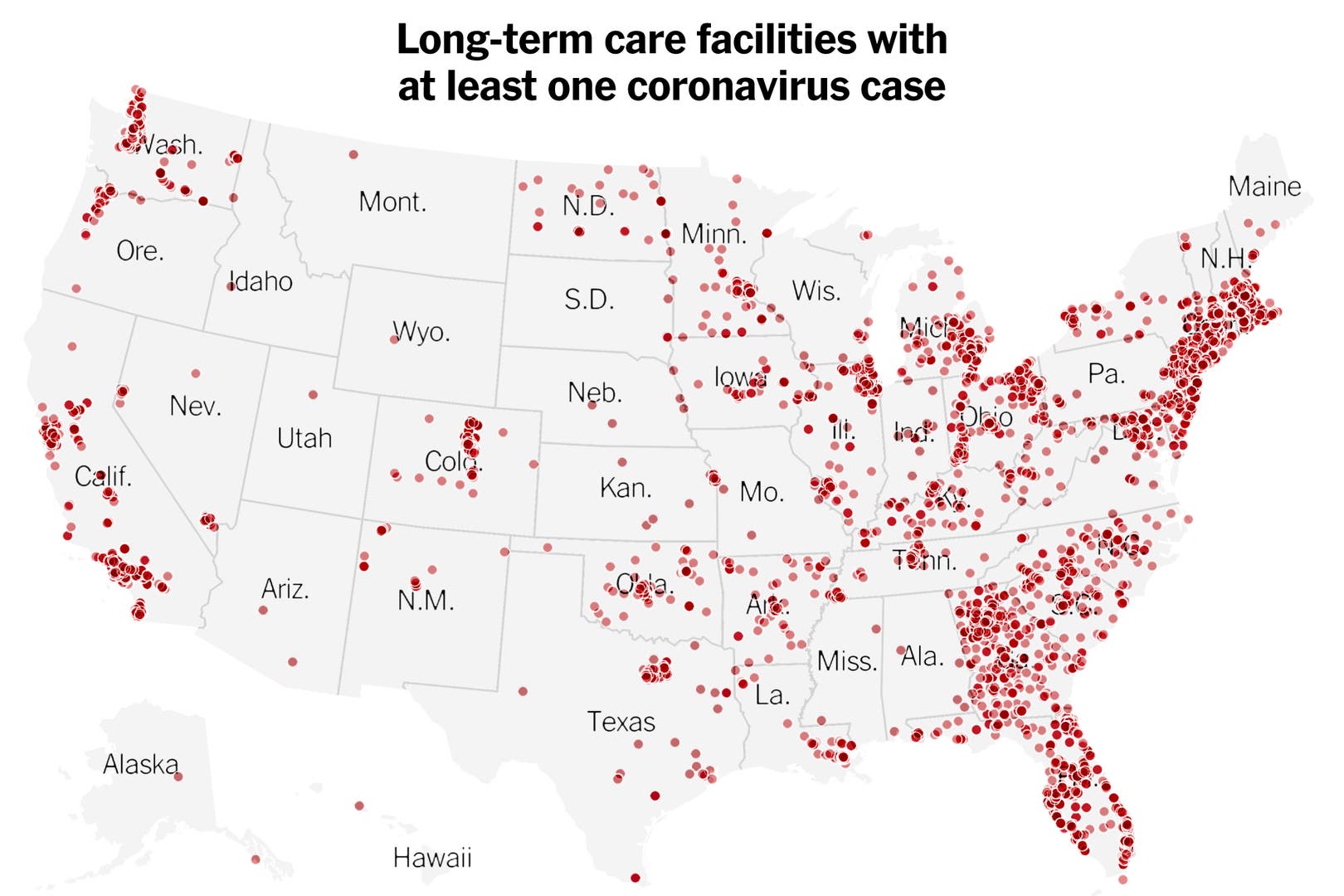
According to a recent investigation by the New York Times, about one-third of all U.S. coronavirus deaths are nursing-home residents or workers. At least 25,600 residents and workers have died from the coronavirus at nursing homes and other long-term care facilities for older adults in the United States, which has infected more than 143,000 people at some 7,500 facilities. Moreover, in about a dozen states, the number of residents and workers who have died accounts for more than half of all deaths from the virus.***
For example, in Massachusetts, more than half the state’s deaths, 2,922, come from long-term care facilities that have become major sources of infection. As of this past Saturday, 336 long-term care centers in the state had reported at least one COVID-19 case and some 15,965 residents and health care workers have been sickened.
Unfortunately, the existing data can’t for the most part distinguish between patients and workers. What we do know is that most nursing-home patients (60 percent) are supported by Medicaid, and therefore are (or are made) poor or near-poor. Across the country, they are being infected by and dying from COVID-19 at rates that are much higher than for the general population.

As for the more than 3 million nursing-home workers in the United States, they earn a median wage of $12.15 an hour, for a median annual wage of only $25,280.**** The chart above demonstrates that, while the typical nursing-home worker earns more than retail cashiers, their wages and annual pay put them substantially below the national average as well as many other occupations, from bus drivers to chief executives.
We also know that, thanks to a recent study (pdf) by PHI (formerly the Paraprofessional Healthcare Institute), a great deal about the demographic makeup of the nursing-home workforce (which, for their purposes, include, in addition to home health and personal care aides, nursing assistants). It is predominantly (86 percent) female, a majority (59 percent) people of color (including 30 percent who are Black and 18 percent Latinx), and about one in four (26 percent) born outside the United States. Because of their low wages, about 1 in 7 nursing-home workers live in poverty, almost half (44 percent) are low-income (defined as below twice the poverty line), and 2 in 5 (42 percent) require some form of public assistance.
Taken together, these data reveal a workforce that is collectively marginalized in the labor market.
Unfortunately, it should come as no surprise, given the obscene levels of inequality in the United States and the nature of long-term care for the elderly and infirm, that both residents and workers in nursing homes occupy a marginalized position in American society. As a result, both groups are living and working—and, increasingly, dying—in one of the veritable hellholes of the current pandemic.
For a century now, the United States has not had to rely on charity and poorhouses to care for the elderly and infirm. But if we didn’t know before, then surely the effects of the novel coronavirus pandemic have demonstrated how much their replacement—the nursing-home industry—like many other capitalist institutions, has failed to protect both those who have been placed in its care and those who have worked so diligently, under impossible conditions, to provide that care. Today, the nursing-home industry requires a transformation that is as at least radical as the one that was started during the first Great Depression.
In the meantime, the industry needs to be pushed by individual states and the federal government, by any means necessary, to rescue its residents and workers from their pandemic-induced nightmare.
*Watson argues that
The Social Security Act was an epochal event in American social welfare. It reflected a belief that public assistance recipients should, and could, be trusted to spend their benefits as they saw fit and that use of “in-kind” benefits was unnecessary, demeaning, and stigmatizing. The disabled would continue to be cared for through “indoor relief” in a variety of institutions including mental asylums, tuberculosis sanitariums, public hospitals, and schools for the deaf.
**As Watson explains,
By making nursing home care free for all senior citizens without assets, nearly half of the elderly in 1975, Medicaid provided a powerful incentive to families to institutionalize parents, who might previously have moved in with grown children or sought the part-time care of a home health aide. By offering states a federally funded alternative to state psychiatric hospitals, nursing homes also became the place to institutionalize those with developmental disabilities and long-term mental illness.
***The BBC recently reported that one-third of all coronavirus deaths in England and Wales are now happening in “care homes”—an ominous feature of the Anglo-American response to the pandemic.
****Bureau of Labor Statistics earnings data are for 3,161,500 Home Health and Personal Care Aides (2018 SOC occupations 31-1121 Home Health Aides and 31-1122 Personal Care Aides and the 2010 SOC occupations 31-1011 Home Health Aides and 39-9021 Personal Care Aides) for May 2019.
Subscribe to:
Comments (Atom)