skip to main |
skip to sidebar
Jon Schwarz
https://theintercept.com/2020/05/05/capital-21st-century-documentary-thomas-piketty/
“THE WAY the elite stays in power, and passes on their privilege to the next generation, is by shaping the way that we think.”
You may have heard this from a million rose emoji Twitter accounts. But it sounds different coming from Gillian Tett at the beginning of a new documentary, “Capital in the 21st Century,” just released online. Tett is the chair of the U.S. editorial board of the Financial Times, the salmon-colored international business newspaper read by Deutsche Bank vice presidents from London to Dubai to Singapore. (Every month FT publishes a magazine called “How to Spend It.”)
“Capital in the 21st Century” is based on the bestselling 2013 book by Thomas Piketty, a French economist. The film, directed by Justin Pemberton, undermines that core power of the world’s elites — shaping how we think — in a particularly wise, sneaky way.
There are many other documentaries about the same subject as “Capital in the 21st Century” — i.e., the rise of the 0.1 percent and the fall of everyone else. They’re mostly a barrage of graphs and numbers that make you feel like you drank three Heinekens at lunch and want to take a nap. “Capital” doesn’t do this. Instead it just tells a story, the centurieslong story of capitalism.
That makes it unique in popular culture, particularly since it does so not in a dry monotone but often via clips from movies. The story of capitalism is the central reality of everyone’s life. But it isn’t taught in high school. It’s not on TV. That’s truly bizarre if you think about it, yet, as Tett has explained elsewhere, it’s unlikely that you will. All societies maintain what anthropologists call “social silence” about the society’s most significant subjects. As Tett puts it, what matters most “is not discussed because those topics are considered boring, irrelevant, taboo, or just unthinkable.”
“Capital in the 21st Century” understands that the daily facts about capitalism seem boring, irrelevant, etc., to most people because they’re not part of a story. They’re like baseball scores when you don’t know anything about baseball’s rules or teams or history. But understanding the story of capitalism is like understanding all of that about baseball, plus having a team to root for, and realizing that, if your team loses, you’re going to die. This makes the business section much more exciting.
The movie starts by going back to the period 250 years ago when capitalism first gained momentum via the Industrial Revolution. Until then Europe was feudal, with a swarm of kings, dukes, earls, and marquessates holding most of the wealth in the form of land.
But factories generated new, insurgent wealth. Both the American and French revolutions were in part fights between old feudal elites and a new business elite struggling to be born. And while the old and new elites disagreed on who should be in charge, they both agreed that regular people shouldn’t be.
While no one remembers this, even the Communist Manifesto in 1848 acknowledged the accomplishments of the business class. “The bourgeoisie,” Karl Marx and Friedrich Engels wrote, “has been the first to show what man’s activity can bring about. It has accomplished wonders far surpassing Egyptian pyramids, Roman aqueducts, and Gothic cathedrals.”
The problem was that in the pursuit of profit, capitalism also generated spectacular new forms of exploitation. “Capital in the 21st Century” spends time on examples such as the massive expansion of slavery, the murderous rampages of European colonialism, and “master and servant” laws in the United Kingdom that made it illegal for workers to quit. The movie’s key point about this time is that unbound capitalism made countries richer overall, but there was nothing inherent in it that improved life for regular people. In fact, it was in many ways worse for them than when they were governed by lords and ladies.
Piketty explains that by 1914 in Paris, the top 1 percent owned 70 percent of all wealth, and two-thirds of the population died with nothing. In the face of this raw brutality, all kinds of alternatives, from communism to socialism to Georgism, gained adherents across Europe. Capitalists were petrified. What could they do that wouldn’t require them to share any wealth or power?
“You have this rise in nationalism and competition between European countries,” Piketty says. “Nationalism is often used by elites to make people forget class conflict and instead focus on national identity.”
It can be debated the degree to which berserk nationalism was consciously stoked by Europe’s rulers to distract from their failures. If present-day politics are anything to go by, they likely knew exactly what they were doing. A recent GOP memo for Republican officeholders on how to deal with their coronavirus faceplant told them “don’t defend Trump” — since he’s indefensible — but “attack China.”
In any case, when World War I came, Europe’s leaders thought it was exactly what they needed. A British politician declared England was “at war quite irrespective of party or class.” Germany’s Kaiser was just as happy, proclaiming, “I see no parties anymore, I see only Germans.”
The war was such a catastrophe that it generated exactly what Europe’s elites feared most: a communist revolution. Germany’s cunning plan to send Vladimir Lenin back to Russia in 1917 was history’s greatest own goal, leading directly to the Soviet army occupying Berlin 28 years later.
As “Capital” explains, it was only with the worldwide slaughter of the Second World War that capitalism was willing to make some changes. First of all, the upper class had literally blown up much of its capital, and its power was at a low ebb. Moreover, as Stanford political science professor Francis Fukuyama points out, they were genuinely concerned about losing everything: “The existence of the communist alternative scared the capitalist world into thinking if it didn’t at least address some of the basic inequality issues that they would lose the battle of ideas. … Unless the state tried to do something about jobs, and do enough redistribution to keep people from starving, you wouldn’t have basic social stability.”
This worked. For about 30 years, the film says, societies realized that “capitalism must be harnessed like some wild horse.” This period saw huge increases in wealth for regular workers, and the first widespread middle class in history.
This lasted long enough that many people began to believe this was capitalism’s natural state, and earlier times had been an aberration. But as World War II receded into the distance, capitalism mounted a counterattack with the elections of Ronald Reagan in the U.S. and Margaret Thatcher in the U.K. Their message was that the problem of the 20th century hadn’t been the refusal of capitalism to compromise with human beings, but instead the problem was the few compromises capitalism did make.
The wholesale collapse of communism emboldened capitalism further. With hindsight, it now appears that the decades of middle-class capitalism after World War II was the aberration, and since at least the 1990s we’ve been returning to capitalism’s norm.
This is what frightens Piketty: that we’re poised to rerun the 20th century in some hideously mutated form. “There are always politicians tempted to exploit the rising inequality,” he says. “You could see this very clearly in the world before 1914. And I’m very afraid at the beginning of the 21st century, that because we feel we cannot regulate international capitalism, we cannot properly tax billionaires and multinationals, instead we vent our anger” at other targets. The danger of misdirected rage is now even clearer than when the movie was filmed, as Congress and the Trump administration use the novel coronavirus as an excuse for “just shoveling money to rich people” via complicated but extremely lucrative tax breaks.
That’s where the story of “Capital in the 21st Century” ends. “People on the streets are starting to say, enough. Enough of the inequality, and enough of not having a story about how this ever gets better,” says journalist Paul Mason. The movie and Piketty have real but limited suggestions for this kind of story about the future. But they’ve done a huge service to everyone by helping us see how we got to where we are today, which is the first step to figuring out where we want to go next.
Sharon Lerner
https://theintercept.com/2020/05/07/coronavirus-whistleblower-hhs-n95-ppe/
A WHISTLEBLOWER COMPLAINT filed earlier this week partially solves the mystery of how the country with the most expensive health care system on earth wound up unable to provide enough face masks to protect its workers. The report from Rick Bright, who was ousted from his job as director of the Biomedical Advanced Research and Development Authority, a division of Health and Human Services, in April, also provides a new villain in the tragic saga of the Trump administration’s mismanagement of the coronavirus crisis: Robert Kadlec.
Though officially tasked with quickly mobilizing a national response to public health crises, Kadlec, the assistant secretary for preparedness and response and formerly Bright’s boss, is described in the report as a petty tyrant who ignored, mocked, and thwarted Bright’s repeated efforts to address the imminent shortage of masks and other personal protective equipment in January and February, as the virus began spreading across the country.
In a lengthy, detailed account that reads like a script from a horror movie and will likely earn Kadlec the lasting enmity of everyone who has lost a front-line worker to the virus, Bright lays out a series of unsuccessful and increasingly desperate attempts to push Kadlec and HHS Secretary Alex Azar to recognize and address the looming shortage of personal protective equipment. The attempts to call attention to the crisis began in mid-January, when Bright, a virologist who has spent decades in government preparing for public health emergencies, called for a senior-level meeting to coordinate the response to the coming pandemic.
But Bright’s bosses were unconvinced of the need for the meeting of the “disaster leadership group.” In a January 18 email, Kadlec responded to Bright’s suggestion that he was “not sure if that is a time sensitive urgency.”
Among the concerns Bright repeatedly raised to Kadlec was the need for N95 face masks, which are used to protect health care workers from infectious diseases. Bright, who had served as head of BARDA since 2016, realized that the masks and other equipment would be in short supply. On January 21, Mike Bowen, co-owner of Prestige Ameritech, the largest surgical mask producing company in the U.S., contacted Bright to express concern about the shortage of the masks.
In an email sent the following day, Bowen offered a solution. “He explained that Prestige Ameritech had four N95 manufacturing lines that were currently not operational, but could be reactivated ‘in a dire situation and with government help,’” according to the whistleblower report. But Bright couldn’t get sign-off from his boss, Kadlec, to get the emergency production started.
The problem partly stemmed from long-simmering tensions between Bright and Kadlec. According to the complaint, since he was appointed by President Donald Trump in 2017, Kadlec had repeatedly pushed Bright to award government contracts to politically connected companies, including one tied to Trump’s son-in-law Jared Kushner. Prior to that, Kadlec had served on the staff of Sen. Richard Burr, R-N.C., who is now best known for dumping his stocks while assuring the public about the coronavirus.
In any case, Kadlec did not take kindly to Bright’s urgent pleas about the pandemic. On January 23, the disaster leadership group finally met. Bright spoke about the fact that BARDA didn’t have funds available to address the emerging epidemic, as well as his concern that he would be forced to redirect funds from existing projects until new funding was made available.
But at that meeting and another held that day, both Kadlec and Azar seemed surprised by Bright’s level of alarm, according to the report. While Bright described the dire need for action and supplies, Kadlec and Azar “asserted that the United States would be able to contain the virus and keep it out of the United States. Secretary Azar further indicated that the [Centers for Disease Control and Prevention] would look at the issue of travel bans to keep the virus contained.”
Rather than getting a response from his superiors, Bright’s urgency got him excluded from the next meeting about the coronavirus. According to the complaint, Bryan Shuy, Kadlec’s chief of staff, told Bright after the meeting that his request for urgent funding set off “quite a shit storm” and had offended HHS leadership.
Meanwhile, Bowen, the co-owner of the mask company, continued to email Bright about the mask shortage, explaining that his company was getting requests from China and that nearly half of the masks in the U.S. are imported from Chinese manufacturers. “If the supply stops, US hospital will run out of masks. No way to prevent it,” Bowen warned in a January 25 email.
That night, Bright emailed Kadlec about the problem. “Hearing face mask supply is also getting very low as China and HK trying to procure,” he wrote to his boss. “I’ve alerted [Critical Infrastructure Protection, a division of HHS over which Kadlec has authority] on this throughout week. May need to consider options here also before things are gone.”
On January 27, after several emails to Bright, Bowen, who had yet to receive authorization to proceed with mask production, sent another email, saying, “Rick, I think we’re in deep shit. The world.” That same day, although the agency hadn’t addressed the severe mask shortage, an HHS spokesperson told Axios that the Strategic National Stockpile, a collection of lifesaving supplies for public health emergencies, which is overseen by BARDA, “holds millions of face masks as well as N95 respirators that could be used if needed in responding to a public health emergency when local supplies are exhausted and aren’t available from commercial suppliers.”
Two days later, still without a contract, Bowen sent yet another desperate email. “This week, we sent 1,000,000 masks to China and Hong Kong,” he wrote to Bright. “I think China will cut off masks to the USA. If so, US hospitals are going to have a very rough time, as up to half of the supply is made in China. A horrible situation will become unbearable.”
On February 7, Bright made the case for ramping up federal production of N95 masks at a meeting of the disaster leadership group but was shot down. While Bright again warned of imminent shortages, two members of Kadlec’s staff, Laura Wolf and Jessica Falcon, told him that there was no need for immediate action.
“Dr. Wolf and Dr. Falcon responded that the plan was to monitor for any supply chain issues and, if needed, ask the CDC to update its guidelines to tell people who ‘don’t need’ masks to not buy them,” as Bright’s complaint explains.
After weeks of being foiled by his superiors, Bright met on Saturday and Sunday, February 8 and 9, with Trump adviser Peter Navarro, who seemed to share his urgency about the need for masks. The two drafted a memo sent to the White House coronavirus task force that called for the U.S. to immediately halt the export of N95 masks and ramp up production.
But Kadlec did not seem to appreciate being subject to a directive that had clearly come from Bright, who was both a longtime adversary and beneath him in the pecking order. Rather than acknowledge that thousands of lives were at stake and immediately swing into action, the assistant secretary of disaster preparedness complained to his colleagues about Bright going above his head, referring in emails to Bright’s “weekend at Peter’s” and calling Navarro “Rick’s friend” in the White House.
On February 25, more than a month after Bowen’s first email, Azar testified to the Senate Appropriations Committee that the Strategic National Stockpile had only 30 million masks. That number is less than one one-hundredth of the 3.5 billion that a specialized group within HHS that focuses on the risk from viral outbreaks has estimated are necessary.
On March 4, as increasing numbers of health care workers were becoming sick and dying from the coronavirus, HHS finally put in a request for 500 million N95 face masks. Meanwhile, Kushner was assembling a team of handpicked corporate volunteers to procure protective equipment. The group, which included recent college graduates who had no experience with disaster response or supply procurement, had little success, according to the Washington Post, which first reported on the team.
That same month, as Bright predicted, BARDA was forced to stop its work addressing other potential public health emergencies in order to have enough money to fund its coronavirus efforts. As The Intercept reported at the time, BARDA suspended projects aimed at preventing anthrax, Sudan Ebola virus, Marburg virus, smallpox, viral hemorrhagic fevers, and antimicrobial resistant threats so that it could redirect its funds to buy supplies to fight the current emergency.
Later that month, BARDA received its first direct funding: $3.5 billion specifically for addressing Covid-19. In the past, its budget had fallen within that of the assistant secretary for disaster preparedness. This time, Bright would be able to use the new money without having to go through Kadlec.
But the freedom was shortlived. On April 17, Kadlec informed Bright that he was being transferred to a position within the National Institutes of Health. Asked on his whistleblower complaint form why he thinks he was retaliated against, Bright wrote that “I pushed for a more aggressive agency response to COVID-19. My supervisor became furious when Congress appropriated billions of dollars directly to my office.”
The Department of Health and Human Services did not immediately respond to a request for comment.
Naomi Klein
Under Cover of Mass Death, Andrew Cuomo Calls in the Billionaires to Build a High-Tech Dystopia
https://theintercept.com/2020/05/08/andrew-cuomo-eric-schmidt-coronavirus-tech-shock-doctrine/
FOR A FEW fleeting moments during New York Gov. Andrew Cuomo’s daily coronavirus briefing on Wednesday, the somber grimace that has filled our screens for weeks was briefly replaced by something resembling a smile.
“We are ready, we’re all-in,” the governor gushed. “We are New Yorkers, so we’re aggressive about it, we’re ambitious about it. … We realize that change is not only imminent, but it can actually be a friend if done the right way.”
The inspiration for these uncharacteristically good vibes was a video visit from former Google CEO Eric Schmidt, who joined the governor’s briefing to announce that he will be heading up a blue-ribbon commission to reimagine New York state’s post-Covid reality, with an emphasis on permanently integrating technology into every aspect of civic life.
“The first priorities of what we’re trying to do,” Schmidt said, “are focused on telehealth, remote learning, and broadband. … We need to look for solutions that can be presented now, and accelerated, and use technology to make things better.” Lest there be any doubt that the former Google chair’s goals were purely benevolent, his video background featured a framed pair of golden angel wings.
Just one day earlier, Cuomo had announced a similar partnership with the Bill and Melinda Gates Foundation to develop “a smarter education system.” Calling Gates a “visionary,” Cuomo said the pandemic has created “a moment in history when we can actually incorporate and advance [Gates’s] ideas … all these buildings, all these physical classrooms — why with all the technology you have?” he asked, apparently rhetorically.
It has taken some time to gel, but something resembling a coherent Pandemic Shock Doctrine is beginning to emerge. Call it the “Screen New Deal.” Far more high-tech than anything we have seen during previous disasters, the future that is being rushed into being as the bodies still pile up treats our past weeks of physical isolation not as a painful necessity to save lives, but as a living laboratory for a permanent — and highly profitable — no-touch future.
Anuja Sonalker, CEO of Steer Tech, a Maryland-based company selling self-parking technology, recently summed up the new virus-personalized pitch. “There has been a distinct warming up to human-less, contactless technology,” she said. “Humans are biohazards, machines are not.”
It’s a future in which our homes are never again exclusively personal spaces but are also, via high-speed digital connectivity, our schools, our doctor’s offices, our gyms, and, if determined by the state, our jails. Of course, for many of us, those same homes were already turning into our never-off workplaces and our primary entertainment venues before the pandemic, and surveillance incarceration “in the community” was already booming. But in the future under hasty construction, all of these trends are poised for a warp-speed acceleration.
This is a future in which, for the privileged, almost everything is home delivered, either virtually via streaming and cloud technology, or physically via driverless vehicle or drone, then screen “shared” on a mediated platform. It’s a future that employs far fewer teachers, doctors, and drivers. It accepts no cash or credit cards (under guise of virus control) and has skeletal mass transit and far less live art. It’s a future that claims to be run on “artificial intelligence” but is actually held together by tens of millions of anonymous workers tucked away in warehouses, data centers, content moderation mills, electronic sweatshops, lithium mines, industrial farms, meat-processing plants, and prisons, where they are left unprotected from disease and hyperexploition. It’s a future in which our every move, our every word, our every relationship is trackable, traceable, and data-mineable by unprecedented collaborations between government and tech giants.
If all of this sounds familiar it’s because, pre-Covid, this precise app-driven, gig-fueled future was being sold to us in the name of convenience, frictionlessness, and personalization. But many of us had concerns. About the security, quality, and inequity of telehealth and online classrooms. About driverless cars mowing down pedestrians and drones smashing packages (and people). About location tracking and cash-free commerce obliterating our privacy and entrenching racial and gender discrimination. About unscrupulous social media platforms poisoning our information ecology and our kids’ mental health. About “smart cities” filled with sensors supplanting local government. About the good jobs these technologies wiped out. About the bad jobs they mass produced.
And most of all, we had concerns about the democracy-threatening wealth and power accumulated by a handful of tech companies that are masters of abdication — eschewing all responsibility for the wreckage left behind in the fields they now dominate, whether media, retail, or transportation.
That was the ancient past known as February. Today, a great many of those well-founded concerns are being swept away by a tidal wave of panic, and this warmed-over dystopia is going through a rush-job rebranding. Now, against a harrowing backdrop of mass death, it is being sold to us on the dubious promise that these technologies are the only possible way to pandemic-proof our lives, the indispensable keys to keeping ourselves and our loved ones safe.
Thanks to Cuomo and his various billionaire partnerships (including one with Michael Bloomberg for testing and tracing), New York state is being positioned as the gleaming showroom for this grim future — but the ambitions reach far beyond the borders of any one state or country.
And at the dead center of it all is Eric Schmidt. Well before Americans understood the threat of Covid-19, Schmidt had been on an aggressive lobbying and public relations campaign pushing precisely the “Black Mirror” vision of society that Cuomo has just empowered him to build. At the heart of this vision is seamless integration of government with a handful of Silicon Valley giants — with public schools, hospitals, doctor’s offices, police, and military all outsourcing (at a high cost) many of their core functions to private tech companies.
It’s a vision Schmidt has been advancing in his roles as chair of the Defense Innovation Board, which advises the Department of Defense on increased use of artificial intelligence in the military, and as chair of the powerful National Security Commission on Artificial Intelligence, or NSCAI, which advises Congress on “advances in artificial intelligence, related machine learning developments, and associated technologies,” with the goal of addressing “the national and economic security needs of the United States, including economic risk.” Both boards are crowded with powerful Silicon Valley CEOS and top executives from companies including Oracle, Amazon, Microsoft, Facebook, and of course, Schmidt’s colleagues at Google.
A
S CHAIR, SCHMIDT, who still holds more than $5.3 billion in shares of Alphabet (Google’s parent company), as well as large investments in other tech firms, has essentially been running a Washington-based shakedown on behalf of Silicon Valley. The main purpose of the two boards is to call for exponential increases in government spending on research into artificial intelligence and on tech-enabling infrastructure like 5G — investments that would directly benefit the companies in which Schmidt and other members of these boards have extensive holdings.
First in closed-door presentations to lawmakers and later in public-facing op-eds and interviews, the thrust of Schmidt’s argument has been that since the Chinese government is willing to spend limitless public money building the infrastructure of high-tech surveillance, while allowing Chinese tech companies like Alibaba, Baidu, and Huawei to pocket the profits from commercial applications, the U.S.’s dominant position in the global economy is on the precipice of collapsing.
The Electronic Privacy Information Center recently got access through a Freedom of Information Act request to a presentation made by Schmidt’s NSCAI one year ago, in May 2019. Its slides make a series of alarmist claims about how China’s relatively lax regulatory infrastructure and its bottomless appetite for surveillance are causing it to pull ahead of the U.S. in a number of fields, including “AI for medical diagnosis,” autonomous vehicles, digital infrastructure, “smart cities,” ride-sharing, and cashless commerce.
The reasons given for China’s competitive edge are myriad, ranging from the sheer volume of consumers who shop online; “the lack of legacy banking systems in China,” which has allowed it to leapfrog over cash and credit cards and unleash “a huge e-commerce and digital services market” using “digital payments”; and a severe doctor shortage, which has led the government to work closely with tech companies like Tencent to use AI for “predictive” medicine. The slides note that in China, tech companies “have the authority to quickly clear regulatory barriers while American initiatives are mired in HIPPA compliance and FDA approval.”
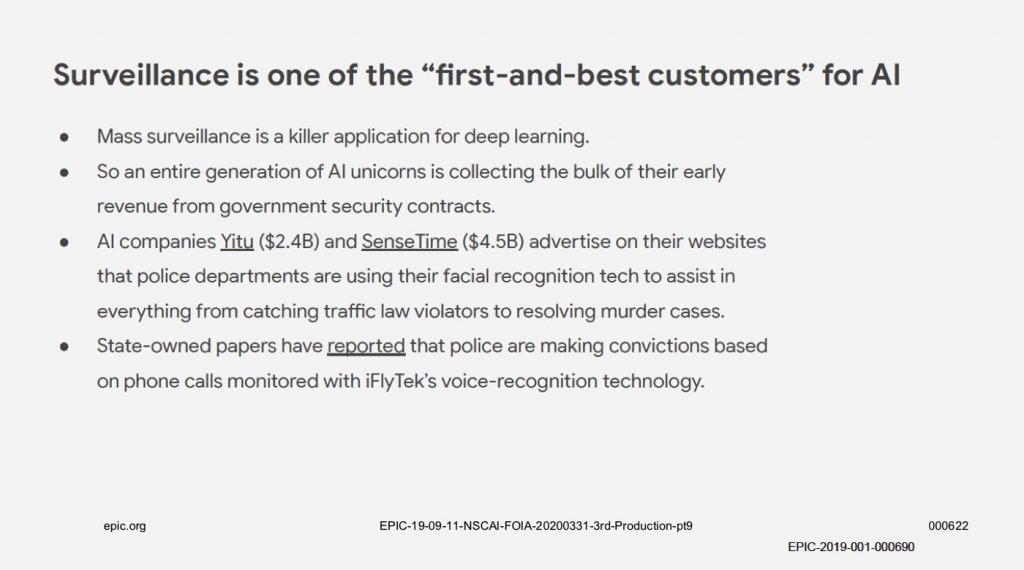
Image: NSCAI
More than any other factor, however, the NSCAI points to China’s willingness to embrace public-private partnerships in mass surveillance and data collection as a reason for its competitive edge. The presentation touts China’s “Explicit government support and involvement e.g. facial recognition deployment.” It argues that “surveillance is one of the ‘first-and-best customers’ for Al” and further, that “mass surveillance is a killer application for deep learning.”
A slide titled “State Datasets: Surveillance = Smart Cities” notes that China, along with Google’s main Chinese competitor, Alibaba, are racing ahead.
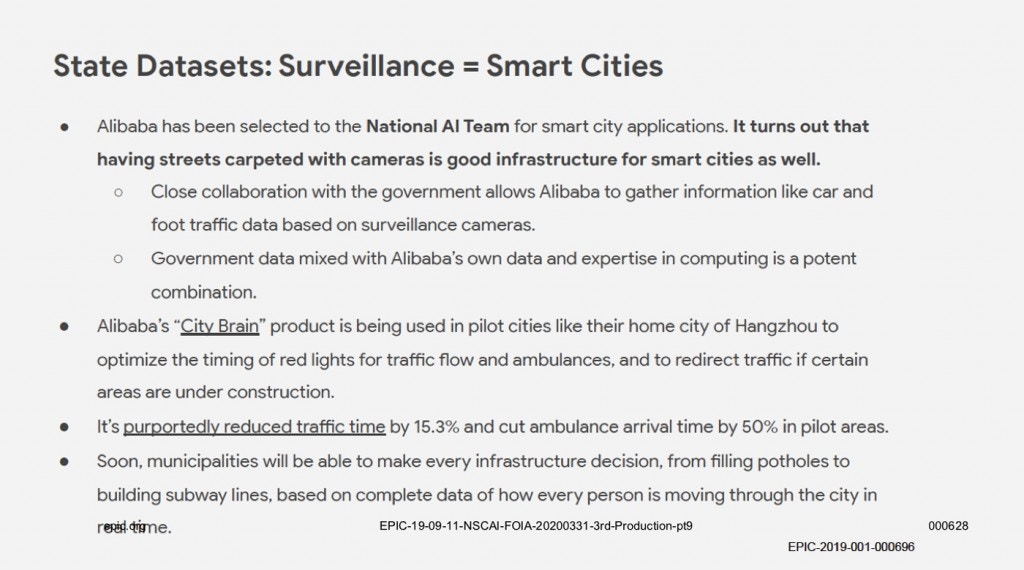
Image: NSCAI
This is notable because Google’s parent company Alphabet has been pushing this precise vision through its Sidewalk Labs division, choosing a large portion of Toronto’s waterfront as its “smart city” prototype. But the Toronto project was just shut down after two years of ceaseless controversy relating to the enormous amounts of personal data that Alphabet would collect, a lack of privacy protections, and questionable benefits for the city as a whole.
Five months after this presentation, in November, NSCAI issued an interim report to Congress further raising the alarm about the need for the U.S. to match China’s adaptation of these controversial technologies. “We are in a strategic competition,” states the report, obtained via FOIA by the Electronic Privacy Information Center. “AI will be at the center. The future of our national security and economy are at stake.”
By late February, Schmidt was taking his campaign to the public, perhaps understanding that the budget increases his board was calling for could not be approved without a great deal more buy-in. In a New York Times op-ed headlined “I used to Run Google. Silicon Valley Could Lose to China,” Schmidt called for “unprecedented partnerships between government and industry” and, once again, sounding the yellow peril alarm:
A.I. will open new frontiers in everything from biotechnology to banking, and it is also a Defense Department priority. … If current trends continue, China’s overall investments in research and development are expected to surpass those of the United States within 10 years, around the same time its economy is projected to become larger than ours.
Unless these trends change, in the 2030s we will be competing with a country that has a bigger economy, more research and development investments, better research, wider deployment of new technologies and stronger computing infrastructure. … Ultimately, the Chinese are competing to become the world’s leading innovators, and the United States is not playing to win.
The only solution, for Schmidt, was a gusher of public money. Praising the White House for requesting a doubling of research funding in AI and quantum information science, he wrote: “We should plan to double funding in those fields again as we build institutional capacity in labs and research centers. … At the same time, Congress should meet the president’s request for the highest level of defense R & D funding in over 70 years, and the Defense Department should capitalize on that resource surge to build breakthrough capabilities in A.I., quantum, hypersonics and other priority technology areas.”
That was exactly two weeks before the coronavirus outbreak was declared a pandemic, and there was no mention that a goal of this vast, high-tech expansion was to protect American health. Only that it was necessary to avoid being outcompeted by China. But, of course, that would soon change.
In the two months since, Schmidt has put these preexisting demands — for massive public expenditures on high-tech research and infrastructure, for a slew of “public-private partnerships” in AI, and for the loosening of myriad privacy and safety protections — through an aggressive rebranding exercise. Now all of these measures (and more) are being sold to the public as our only possible hope of protecting ourselves from a novel virus that will be with us for years to come.
And the tech companies to which Schmidt has deep ties, and which populate the influential advisory boards he chairs, have all repositioned themselves as benevolent protectors of public health and munificent champions of “everyday hero” essential workers (many of whom, like delivery drivers, would lose their jobs if these companies get their way). Less than two weeks into New York state’s lockdown, Schmidt wrote an op-ed for the Wall Street Journal that both set the new tone and made clear that Silicon Valley had every intention of leveraging the crisis for a permanent transformation.
Like other Americans, technologists are trying to do their part to support the front-line pandemic response. …
But every American should be asking where we want the nation to be when the Covid-19 pandemic is over. How could the emerging technologies being deployed in the current crisis propel us into a better future? … Companies like Amazon know how to supply and distribute efficiently. They will need to provide services and advice to government officials who lack the computing systems and expertise.
We should also accelerate the trend toward remote learning, which is being tested today as never before. Online, there is no requirement of proximity, which allows students to get instruction from the best teachers, no matter what school district they reside in. …
The need for fast, large-scale experimentation will also accelerate the biotech revolution. … Finally, the country is long overdue for a real digital infrastructure…. If we are to build a future economy and education system based on tele-everything, we need a fully connected population and ultrafast infrastructure. The government must make a massive investment—perhaps as part of a stimulus package—to convert the nation’s digital infrastructure to cloud-based platforms and link them with a 5G network.
Indeed Schmidt has been relentless in pursuing this vision. Two weeks after that op-ed appeared, he described the ad-hoc homeschooling programing that teachers and families across the country had been forced to cobble together during this public health emergency as “a massive experiment in remote learning.” The goal of this experiment, he said, was “trying to find out: How do kids learn remotely? And with that data we should be able to build better remote and distance learning tools which, when combined with the teacher … will help kids learn better.” During this same video call, hosted by the Economic Club of New York, Schmidt also called for more telehealth, more 5G, more digital commerce, and the rest of the preexisting wish list. All in the name of fighting the virus.
His most telling comment, however, was this: “The benefit of these corporations, which we love to malign, in terms of the ability to communicate, the ability to deal with health, the ability to get information, is profound. Think about what your life would be like in America without Amazon.” He added that people should “be a little bit grateful that these companies got the capital, did the investment, built the tools that we’re using now, and have really helped us out.”
I
T’S A REMINDER that, until very recently, public pushback against these companies was surging. Presidential candidates were openly discussing breaking up big tech. Amazon was forced to pull its plans for a New York headquarters because of fierce local opposition. Google’s Sidewalk Labs project was in perennial crisis, and Google’s own workers were refusing to build surveillance tech with military applications.
In short, democracy — inconvenient public engagement in the designing of critical institutions and public spaces — was turning out to be the single greatest obstacle to the vision Schmidt was advancing, first from his perch at the top of Google and Alphabet and then as chair of two powerful boards advising Congress and Department of Defense. As the NSCAI documents reveal, this inconvenient exercise of power by members of the public and by tech workers inside these mega-firms, has, from the perspective of men like Schmidt and Amazon CEO Jeff Bezos, maddeningly slowed down the AI arms race, keeping fleets of potentially deadly driverless cars and trucks off the roads, protecting private health records from becoming a weapon used by employers against workers, preventing urban spaces from being blanketing with facial recognition software, and much more.
Now, in the midst of the carnage of this ongoing pandemic, and the fear and uncertainty about the future it has brought, these companies clearly see their moment to sweep out all that democratic engagement. To have the same kind of power as their Chinese competitors, who have the luxury of functioning without being hampered by intrusions of either labor or civil rights.
All of this is moving very fast. The Australian government has contracted with Amazon to store the data for its controversial coronavirus tracking app. The Canadian government has contracted with Amazon to deliver medical equipment, raising questions about why it bypassed the public postal service. And in just a few short days in early May, Alphabet has spun up a new Sidewalk Labs initiative to remake urban infrastructure with $400 million in seed capital. Josh Marcuse, executive director of the Defense Innovation Board that Schmidt chairs, announced that he was leaving that job to work full-time at Google as head of strategy and innovation for global public sector, meaning that he will be helping Google to cash in on some of the many opportunities he and Schmidt have been busily creating with their lobbying.
To be clear, technology is most certainly a key part of how we must protect public health in the coming months and years. The question is: Will that technology be subject to the disciplines of democracy and public oversight, or will it be rolled out in state-of-exception frenzy, without asking critical questions that will shape our lives for decades to come? Questions like, for instance: If we are indeed seeing how critical digital connectivity is in times of crisis, should these networks, and our data, really be in the hands of private players like Google, Amazon, and Apple? If public funds are paying for so much of it, should the public also own and control it? If the internet is essential for so much in our lives, as it clearly is, should it be treated as a nonprofit public utility?
And while there is no doubt that the ability to teleconference has been a lifeline in this period of lockdown, there are serious debates to be had about whether our more lasting protections are distinctly more human. Take education. Schmidt is right that overcrowded classrooms present a health risk, at least until we have a vaccine. So how about hiring double the number of teachers and cutting class size in half? How about making sure that every school has a nurse?
That would create much-needed jobs in a depression-level unemployment crisis and give everyone in the learning environment more elbow room. If buildings are too crowded, how about dividing the day into shifts, and having more outdoor education, drawing on the plentiful research that shows that time in nature enhances children’s capacity to learn?
Introducing those kinds of changes would be hard, to be sure. But they are not nearly as risky as giving up on the tried-and-true technology of trained humans teaching younger humans face-to-face, in groups where they learn to socialize with one another to boot.
Upon learning of New York state’s new partnership with the Gates Foundation, Andy Pallotta, president of New York State United Teachers, was quick to react: “If we want to reimagine education, let’s start with addressing the need for social workers, mental health counselors, school nurses, enriching arts courses, advanced courses and smaller class sizes in school districts across the state,” he said. A coalition of parents’ groups also pointed out that if they had indeed been living an “experiment in remote learning” (as Schmidt put it), then the results were deeply worrying: “Since the schools were shut down in mid-March, our understanding of the profound deficiencies of screen-based instruction has only grown.”
I
N ADDITION TO the obvious class and race biases against children who lack internet access and home computers (problems that tech companies are eager to be paid to solve with massive tech buys), there are big questions about whether remote teaching can serve many kids with disabilities, as required by law. And there is no technological solution to the problem of learning in a home environment that is overcrowded and/or abusive.
The issue is not whether schools must change in the face of a highly contagious virus for which we have neither cure nor inoculation. Like every institution where humans gather in groups, they will change. The trouble, as always in these moments of collective shock, is the absence of public debate about what those changes should look like and whom they should benefit. Private tech companies or students?
The same questions need to be asked about health. Avoiding doctor’s offices and hospitals during a pandemic makes good sense. But telehealth misses a huge amount. So we need to have an evidence-based debate about the pros and cons of spending scarce public resources on telehealth — versus on more trained nurses, equipped with all the necessary protective equipment, who are able to make house calls to diagnose and treat patients in their homes. And perhaps most urgently, we need to get the balance right between virus tracking apps, which with the proper privacy protections have a role to play, and the calls for a Community Health Corps that would put millions of Americans to work not only doing contact tracing but making sure that everyone has the material resources and support they need to quarantine safely.
In each case, we face real and hard choices between investing in humans and investing in technology. Because the brutal truth is that, as it stands, we are very unlikely to do both. The refusal to transfer anything like the needed resources to states and cities in successive federal bailouts means that the coronavirus health crisis is now slamming headlong into a manufactured austerity crisis. Public schools, universities, hospitals, and transit are facing existential questions about their futures. If tech companies win their ferocious lobbying campaign for remote learning, telehealth, 5G, and driverless vehicles — their Screen New Deal — there simply won’t be any money left over for urgent public priorities, never mind the Green New Deal that our planet urgently needs.
On the contrary: The price tag for all the shiny gadgets will be mass teacher layoffs and hospital closures.
Tech provides us with powerful tools, but not every solution is technological. And the trouble with outsourcing key decisions about how to “reimagine” our states and cities to men like Bill Gates and Eric Schmidt is that they have spent their lives demonstrating the belief that there is no problem that technology cannot fix.
For them, and many others in Silicon Valley, the pandemic is a golden opportunity to receive not just the gratitude, but the deference and power that they feel has been unjustly denied. And Andrew Cuomo, by putting the former Google chair in charge of the body that will shape the state’s reopening, appears to have just given him something close to free reign.
Four Die-Hard Loyalists Are Enabling Trump’s Apocalyptic Coronavirus Response
James Risen
https://theintercept.com/2020/05/08/coronavirus-trump-kushner-miller-pompeo-barr/?utm_medium=email&utm_source=The%20Intercept%20Newsletter
THE FOUR HORSEMEN OF THE PANDEMIC are rampaging through Washington. Their names are Kushner, Miller, Pompeo, and Barr.
They are fulfilling Donald Trump’s darkest desires to twist the Covid-19 pandemic into a culture war, while also looking for ways to exploit the nation’s greatest public health crisis in a century to foment hoaxes and conspiracy theories and punish Trump’s enemies.
Meanwhile, they are ignoring the actual pandemic. Trump and his lackeys have decided to let America burn.
They have wasted the time the American people gave them to come to grips with Covid-19. It was precious time granted by people who, in overwhelming numbers, complied with state-level stay-at-home orders for two months so the government could come up with a serious national strategy to address the health crisis and its economic fallout.
But Trump has betrayed that sacrifice by failing to develop any coherent plan at all. He has surrendered to the virus, even as the American death toll heads rapidly toward 100,000.
He has instead spent his time sitting in the White House watching cable news, braying at his critics on Twitter, and summarily firing anyone in the federal government who tries to actually take action to prevent the pandemic from becoming even worse. The latest victim is Dr. Rick Bright, who filed a whistleblower complaint on Tuesday after he was ousted from his position as director of the government’s Biomedical Advanced Research and Development Authority. Bright’s sin? He refused to get on board with the Trump administration’s incoherent response to the virus, notably its dangerous and ill-informed efforts to push hydroxychloroquine, an antimalarial drug, as a Covid-19 treatment just because Trump had called it a miracle cure.
While professionals like Bright are pushed aside, Trump has turned to the usual suspects to do his bidding.
Jared Kushner, his pale, thin-lipped son-in-law, has gone from creating havoc in the Middle East, where he was supposedly in charge of developing Trump’s “policy” for the region, to creating havoc in the federal response to Covid-19, thanks to his role running a backdoor coronavirus task force rife with incompetence and political favoritism. (The Trump White House has a front-door ad-hoc task force, run by Vice President Mike Pence, but Trump shut down the professional pandemic team at the National Security Council in 2018.)
Kushner’s most consequential and deadliest contribution to the government’s response came early in the crisis, when he convinced Trump that the press was overhyping the threat. That appealed to Trump’s natural inclination to call Covid-19 a media-invented hoax, especially as he started facing criticism for failing to address shortages of tests and other urgently needed medical equipment, including protective gear for nurses and doctors. Trump’s failure to take any action during the pandemic’s critical early days allowed the virus to become embedded in the United States.
Naturally, Kushner has now declared victory, even as Covid-19 expands its fatal reach across the nation. “We’re on the other side of the medical aspect of this,” Kushner told Fox News last week. “We’ve achieved all the different milestones that are needed. The federal government rose to the challenge, and this is a great success story.”
Stephen Miller, a young man with an endless forehead who serves as Trump’s master of the dark arts of xenophobia and nationalism, has inserted himself into the Covid-19 crisis as well, convincing the president to sign an executive order severely restricting immigration during the pandemic. Of course, Miller wants the temporary order to lead to the permanent, draconian crackdown on immigration he has long wished for. Miller has pushed through dozens of smaller changes in immigration policies and procedures during the pandemic, which may also lead to permanent changes.
Miller’s long-term anti-immigrant obsession has already had a devastating impact on the nation’s ability to deal with the pandemic. Trump has gutted the budget of the Federal Emergency Management Agency, which is supposed to coordinate America’s disaster response, while a growing share of funding for its parent organization, the Department of Homeland Security, has been shifted to immigration and border control.
Mike Pompeo, the secretary of state with a body like a neighborhood bowling league champion, is helping Trump foment conspiracy theories about the origins of Covid-19. Pompeo has been pushing the notion that the virus was manufactured in a Chinese laboratory. By contrast, the consensus among most scientists, public health officials, and intelligence analysts throughout the world is that the virus reached humans naturally through contact in a Chinese wet market.
While the exact origins of the virus don’t matter to most Americans now struggling to deal with Covid-19, Pompeo’s goal in pushing this so-called Wuhan lab theory is to make Trump feel better about his own failed handling of the crisis. It also can be weaponized to convince Trump’s die-hard base that the government’s botched handling of the pandemic is not Trump’s fault.
Over the last few days, Pompeo has offered a series of confused statements about the issue, probably because Dr. Anthony Fauci, the nation’s top infectious disease professional, has repeatedly and publicly pushed back, saying that the scientific evidence shows that the virus is not man-made.
Over the weekend, Pompeo claimed there was strong evidence that the virus originated in a Chinese lab. On Wednesday, he said he wasn’t certain, but added that there is “significant evidence” that the virus came from a Chinese laboratory.
His jumbled statements show that Pompeo is trying to walk a tightrope between the experts and Trump, who has a long-standing addiction to conspiracy theories.
In the process, Pompeo has managed to pointlessly anger China — just one aspect of a broader Trump-Pompeo renunciation of international cooperation on Covid-19. Earlier this week, the Trump administration refused to join a virtual summit of world leaders who pledged to join forces to develop vaccines and treatments.
Attorney General William Barr, Trump’s Tom Hagen, has also joined the president’s Covid-19 show. Barr is now threatening to turn the Justice Department against the state governors who, in the absence of national leadership, have done the most to grapple with the pandemic. In the process, Barr is aligning himself with the ugliest strain of an emerging American culture war. Trump has repeatedly tweeted his opposition to state stay-at-home orders, while showing support for protests by armed right-wingers at several state capitols, who have demanded that the stay-at-home orders be lifted. In another demonstration of Barr’s political fealty to Trump, the attorney general is now threatening lawsuits against states with strict stay-at-home orders, complaining that they infringe of people’s civil liberties.
But Barr’s claim to be a champion of civil liberties was undermined by his actions just weeks earlier, when the administration tried to empower the attorney general to ask federal judges to freeze court proceedings during a national emergency. While the Democratic-controlled House will almost certainly not vote for the administration proposal, if it did become law it could mean that anyone arrested could be held without charge until the crisis ends.
For Trump and his flunkies, Covid-19 has been everything but a public health crisis. As if to underline that point, Trump said earlier this week that Pence’s coronavirus task force would soon be winding down. He quickly changed course on that, saying that the task force will remain active but will focus on reopening the economy. In other words, it will be an adjunct to Trump’s reelection campaign.
While the pandemic ravages American workers, the federal government has orchestrated a monumental transfer of wealth from the bottom of the economic ladder to the top.
BY MILES KAMPF-LASSIN
http://inthesetimes.com/article/22514/covid-19-coronavirus-wealthy-corporate-welfare
The novel coronavirus has already claimed over 70,000 lives in the United States since the pandemic began to spread throughout the country earlier this year—a figure topping total U.S. casualties during the course of the Vietnam War.
The Trump administration is predicting the death toll will soon skyrocket, with 3,000 deaths a day becoming the norm by early June—even as the president and his fellow Republicans urge a “reopening” of the economy. Due to the structural inequities baked into our economic and healthcare systems, the fatalities caused by the virus have disproportionately been borne by African Americans.
Alongside this devastating loss of life, over 30 million Americans are newly out of work due to the shutdown and lack of a robust response from the federal government. Nearly a third of all renters can’t afford to pay their monthly rent. Half of all Americans now say they or someone in their home has lost hours or a job due to the pandemic. The unemployment rate is widely predicted to surpass 30% in the coming months, which a Columbia University study estimates will plunge over 21 million more Americans into poverty.
And it’s not just individuals. Over 40% of all small businesses are on the verge of permanent closure. And states and local governments are also facing financial ruin as their costs balloon while revenues dry up. As a solution, Senate Majority Leader Mitch McConnell (R-Ky.) recommends that states facing budget shortfalls simply declare bankruptcy—a prospect that experts say risks causing a prolonged depression in America.
Yet, as this pandemic wreaks havoc upon working people the country over, it has also had another stark impact: making the rich ever richer.
The pandemic payout
According to a recent report from the Institute for Policy Studies, America’s billionaires saw their wealth shoot up by $282 billion in just 23 days as the country was sheltering in lockdown. Overall, U.S. billionaire wealth grew by nearly 10% at the same time over 20 million people filed for unemployment, and by April 10 had passed $3.2 trillion—topping last year’s level.
To take just one example, Jeff Bezos, Amazon CEO and already the richest person in the world, saw his fortune inflate by $24 billion in the first three months of the year, a surge the report’s authors say is “unprecedented in the history of modern markets.” Meanwhile, his workers have staged a series of walkouts and other labor actions to protest a lack of basic workplace protections as warehouse employees have fallen ill with the virus, and some have died.
As mass death overtook the country in April and the economy went into free fall, the U.S. stock market saw its best month in over three decades, a boon that has overwhelmingly benefited the richest people in the country. Private healthcare companies have seen major gains, boosting the fortunes of healthcare billionaires, just as an estimated 9 million Americans were booted off of their employer-sponsored insurance plans—a figure that could soon climb to 43 million.
A deficient response
But what of the widely touted stimulus measures passed by Congress? While some relief was included in the form of direct cash payments of $1,200, expanded unemployment insurance and loans to small businesses, each of these programs was tainted with acute flaws.
The direct payment plan excludes millions, including undocumented immigrants, U.S. citizens married to noncitizens, many college students and other dependents. And even among those who are eligible, millions have not yet received their checks and some may have to wait up to five months. At the same time, thanks to a change to the tax code tucked into the relief package, 43,000 Americans who make more than $1 million will be saved an average of $1.7 million annually, costing U.S. taxpayers $90 billion in 2020 alone.
Expanded unemployment insurance, while helping provide support for those newly out of work, also incentivized companies to lay off their workforces rather than retaining them while the government continues to provide them paychecks, as countries like the UK and Denmark are doing. The process of applying for the program has been deemed a “nightmare” for millions attempting to navigate an overwhelmed system. What’s more, workers at businesses newly deemed “essential” such as meatpacking, are now being forced back to work, often in unsafe conditions—and those who refuse over concerns about their safety will lose this unemployment aid.
The Small Business Paycheck Protection Program, meanwhile, turned out to be a bust for actual small businesses. Of the original $350 billion allocated for these businesses in the CARES Act, over $243 million ended up going to large corporations. This includes the subsidizing of massive chains, luxury hotels and even Trump “megadonors” like Monty Bennett, chairman of Ashford Hospitality Trust, who Forbes says “is believed to have received at least $59 million.” As a result, only 5% of all small businesses were able to access those funds, and over 30 million are still struggling to receive relief.
Meanwhile, the banks handling these loan applications made off with $10 billion in fees—including many of the same banks that were bailed out by taxpayers during the last recession in 2008. For their wealthiest clients, the New York Times reports, these banks—including JPMorgan Chase and Citibank—offered “concierge treatment” to put their applications at the front of the line.
The profiteers
Such galling inequities written into the stimulus are just the tip of the iceberg. The true callousness of the approach can be seen most clearly in the corporate welfare at the heart of the relief effort. While often posed as a $500 billion fund for large companies, in fact, the CARES Act allocated over $4 trillion to corporate America, since the federal reserve can leverage the initial funding by a ratio of ten to one.
That fund is being overseen by Treasury Secretary Steven Mnuchin, himself no stranger to corporate abuse and profiteering. Soon after signing the bill, Trump moved to undo independent oversight in the program. And the corporations receiving this funding will not be required to keep their workers employed, or even to limit executive compensation.
This aid will flow to some of the largest and most powerful companies in the country, which are also the ones with the most liquidity and therefore ability to withstand the economic impacts of the shutdown. And as we saw in the wake of the 2008 financial crisis, bailing out large corporations with taxpayer money only increases their stranglehold over our economy.
Another path
Taken together, the U.S. federal government’s response to the Covid-19 crisis has led to a monumental transfer of wealth from the bottom of the economic ladder to the top. At a time when the poorest and most vulnerable Americans are facing the direst consequences of the deadly pandemic, they’re simultaneously seeing their tax dollars earmarked to further profit the richest and most protected.
This asymmetrical response forecasts an American future further defined by oligarchy and deep-seated social stratification. As the concentration of wealth and power accelerates, the ability of working people to eke out a living will be more and more constrained.
Still, this moment of crisis also offers another path: the opportunity to fundamentally restructure our national priorities to bolster those most in need—by finally making the wealthy pay.
According to the Institute for Policy Studies report, taxes paid by billionaires fell by 79% between 1980 and 2018. Over this period, corporate taxes have similarly been drastically cut, including by President Trump in his 2017 Tax Cuts and Jobs Act. As a result of this shift, government coffers have dried, social safety net programs have been slashed, the working poor have been squeezed and the 1% have accumulated more money than they could spend in multiple lifetimes.
When it comes to the U.S. response to the Covid-19 crisis, billionaire tech investor Chamath Palihapitiya estimates that “only five to 10 cents of every dollar that’s being spent or guaranteed by the federal government is going to the average American.”
Instead of pursuing such a market fundamentalist approach, Congress could, for example, institute a wealth tax; significantly raise both the corporate and top marginal tax rates; guarantee free healthcare to all; cover 100% of unemployed workers’ paychecks and provide $2,000 monthly cash payments to all Americans during the pandemic; cancel rent, mortgage payments, and all student and medical debt; and enact a federal jobs guarantee to carry out testing and contract tracing so that we can all safely emerge from this crisis. Politicians from Reps. Alexandria Ocasio-Cortez (D-N.Y.) and Ilhan Omar (D-Minn.) to Sens. Bernie Sanders (I-Vt.) and Richard Blumenthal (D-Conn.) have already put forward these types of bold policies to respond to the economic toll of the pandemic.
Such proposals may seem far-fetched. But then, think of the strategy currently being carried out by the federal government: sacrificing American lives in the service of accumulating capital. It’s the status quo that’s radical. If there was ever a time to upend it, it’s now.

