Friday, May 8, 2020
Is Capitalism Too Close to See?
(David Swanson) I’m not quite as big a fan of the new film “Capital in the Twenty-First Century” as Jon Schwarz is but think he makes some great points about it, as he usually does. The film doesn’t tell a story with characters and drama. It’s a documentary that tries to recount the economic history of the past few centuries from a European/American perspective in a little over an hour, which means it’s rushed, much of it is familiar already, and the facts and statistics it throws out lack clarity and documentation, as is usually the case in films. (In its defense, the film is based on a book that is widely available.)
But the film does present people with topics that are rarely if ever talked about, things not normally noticed because they are taken to be inevitable or because they are taboo. For example:
The United States tells itself it was created by Europeans who fled religious persecution for a land of liberty. But the biggest flood of immigrants from Europe to the United States, Canada, and Australia was made up of people fleeing the capitalism of the industrial revolution. And those who succeeded best economically were typically those who became the owners of enslaved human beings on stolen land. Land of the Enslaved — Home of Capitalism’s Refugees — doesn’t have the same ring to it.
Western history books tell us that European nations colonized the world because they were more advanced. Advanced toward what? Well, toward slavery, colonialism, and militarism, among other things. (A couple of those other things are environmental and technological apocalypse, neither of which is ever mentioned in the film, but more on those later.)
Big economic growth areas for capitalism in the nineteenth century were fashion and Christmas, or — in other words — creating the need to buy crap you didn’t want because the crap you have is out of style, and creating the need to buy crap you don’t even like because it’s December or some month prior thereto.
The U.S. military, according to this film, during some (frustratingly unspecified) period of time, primarily served the purpose of strike breaking. Whether this is strictly true, and how the use of the U.S. military abroad and domestically are quantified, I do not know. But few enough people have any idea that the United States has waged wars against and even bombed its own people for nonviolently demanding basic human rights, that the point is worth making.
Of course, there are a great many things we aren’t supposed to question, so that even a film about economic taboos itself operates within other common limits. For example, I spend a lot of time trying to get people to question the acceptance of organized mass murder, also known as war.
As the film rushes through history with a few minutes devoted to each war, much like a traditional text book, it inevitably tells us that World War II ended the Great Depression, but never hints at how much better a nonviolent project could have done the same. In fact, it seems to claim that only something as devastating to humanity, the earth, and society as total war could have worked, because the war destroyed capital through bombing, as well as through inflation, and new regulations — regulations that came out of the sense of solidarity, equality, and humanity that only the mass slaughter of innocents can bring.
But does a better economy follow from mass-murder as a general rule? Is that the only thing it can follow from? These are questions that should have been addressed. A bit later in the film, Francis Fukuyama, a guy who declared history to be over about 30 years ago but whose invitations to appear in films somehow failed to end, credits World War II with creating a good harmonious world, and blames the Civil Rights movement and other activist riffraff for wrecking it. One reason that such toxic nonsense shouldn’t be presented without commentary is that if we don’t learn the superiority of nonviolence to violence in changing the world, we’ll all die.
This brings me back to the missing apocalypses. One can’t fault a film for failing to mention that humanity is moving ever closer to nuclear catastrophe, since nobody else mentions it either, or for failing to mention disease pandemics since the current one no doubt arose after the film was made, or for failing to mention the wars of the past 75 years since the film’s focus is on nations that wage their wars far away. But it’s almost strange to see a film discuss the raw deal young people have gotten economically without ever touching on the raw deal they’ve gotten environmentally, especially since a very different notion of economy and well-being and consumption may be required for survival, and even more so because so many young people are aware of climate collapse — perhaps more than are aware of the evils of capitalism.
On the other hand, “Capital in the Twenty-First Century” offers a broad perspective that is badly needed in many ways. In the United States, many are used to comparisons of today’s inequality of wealth with that of the 19th century, but the European perspective of this movie draws comparisons with the 18th and 17th centuries — starker and more frightening comparisons to times and places in which most people lacked most everything, and in which inheritance and the ownership of property controlled wealth.
It often seems that similarities between one unequal and unfair time period can be found in just about any other. So, when were things more equal? According to the story told here, after World War I and after World War II (plus right up through the 1970s despite the absence of WWIII). Of course, after World War I there was more prosperity in only some parts of the world. The film shows us Adolf Hitler saying (in German) and later Ronald Reagan (in English) that they want to make their countries “great again.”
This movie lays the blame for the turn toward inequality in the 1970s on the price of oil and inflation, plus attacks on unions, but what about the choice to depend on oil? What about the choice to militarize the Middle East, overthrow governments, build up a giant cold (but hot) war, and wage an enormous oil-fueled mass-murder operation in Vietnam, Laos, and Cambodia? What about the opposite of warm-fuzzy feelings of solidarity that grew out of that operation?
Part of “Capital in the Twenty-First Century” is a review of sociological experiments that seem to find that virtually anyone given wealth advantages will both assume they deserved them (even if possessing indisputable evidence that nothing but luck was involved) and develop bigotry toward those less well-off. But, of course, virtually anyone means virtually anyone within a particular culture — a culture that created, for example, the Monopoly game that’s involved in some of the experiments but which everyone already knows how to play, or at least the pro-monopoly version of the game which originally had an anti-monopoly, pro-cooperation version as well.
To its great credit, “Capital in the Twenty-First Century” proposes several concrete steps. These include progressively taxing wealth, and taxing multi-national corporations’ profits based on the percentage of their sales in each country, rather than based on what islands they hide their shell companies and secret bank accounts in. Recommended steps also include opposing the anti-immigrant xenophobia and fascism rising around us.

Trump’s “Bay of Pigs” in Venezuela
https://www.wsws.org/en/articles/2020/05/07/pers-m07.html
7 May 2020
A pair of abortive armed landings by US-led mercenaries on Venezuela’s coast earlier this week has made it clear that the global coronavirus pandemic and the death and devastation it has wrought upon the American people have done nothing to curb US imperialism’s predatory and criminal pursuit of geostrategic interests in South America and across the globe.
The first of the two landings took place early Sunday morning in Maputo in the state of La Guaira, barely a half hour’s drive from the Venezuelan capital of Caracas. Eight of the armed men who came ashore, including the leader of the group, an ex-Venezuelan army captain known as “Pantera” (the panther), were killed, and the rest captured.
A second landing took place on Monday on the peninsula of Chuao in Aragua state, also on Venezuela’s Caribbean coast, west of Caracas. Here, the armed invaders were detected by local fishermen, who turned them over to Venezuelan security forces.
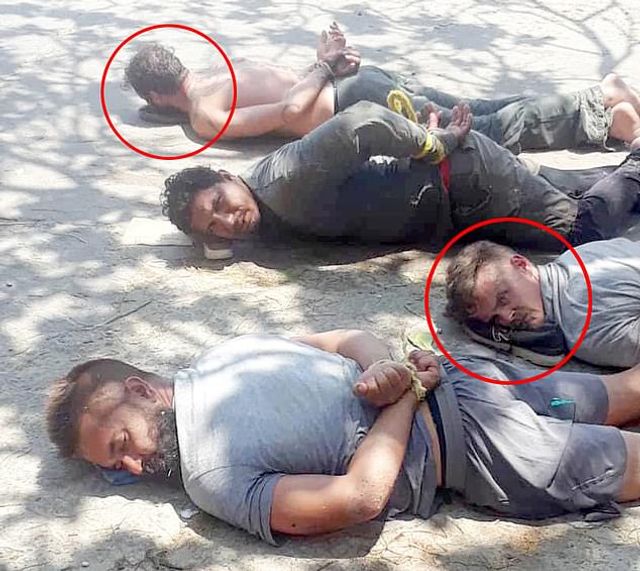
US mercenaries Luke Denman (circled at top) and Airan Berry (bottom) after being captured in Venezuela.
Among those captured was Josnars Adolfo Baduel, the son of a former Venezuelan defense minister sent to prison on corruption charges, who has been at the center of a series of coup plots. Also taken prisoner were two US citizens, Luke Denman, 34, and Airan Berry, 41, both of whom have been identified as former US special operations troops. Baduel told Venezuelan authorities that the two Americans had told him that they worked for the security force of US President Donald Trump.
Venezuelan officials have shown the media passports and military ID cards of the two captured Americans, along with photographs of armaments captured along with the mercenaries. They also released a video of an interrogation of Denman, who said that his mission had been to seize control of a Caracas airport in order to receive planes that would carry out the rendition of Venezuela’s President Maduro to the US. Asked who was directing the operation, he replied, “President Donald Trump.”
At the center of the operation was one Jordan Goudreau, an ex-Green Beret veteran of Iraq and Afghanistan, who runs a Florida-based private security contracting firm, SilverCorp USA. By his own account, Goudreau was hooked up with the Venezuelan right and its US-backed coup plots by Keith Schiller, Trump’s longtime bodyguard, who served as director of Oval Office operations. Videos have since surfaced showing Goudreau working security at Trump rallies.
The military contractor’s ties with US intelligence and the Venezuelan right became apparent when he was hired in February 2019 to provide security for a concert paid for by British billionaire Richard Branson on the Venezuelan-Colombian border as part of a failed CIA Trojan Horse operation to force phony aid convoys into Venezuela.
Goudreau has publicly taken responsibility for the latest operation, claiming that it is still ongoing and its objective is “to overthrow the government of Maduro.” He said that despite the abject failure of the maritime invasion, other elements remain active inside Venezuela and were “going to start attacking tactical targets,” in other words, launch a wave of terrorism.
In addition, Goudreau confirmed the validity of a contract posted online that was signed between himself and Juan Guaidó, the right-wing political nonentity who proclaimed himself “interim president" of Venezuela in January of last year and was instantly anointed by Washington and its allies as the “legitimate government" of Venezuela.
A taped conversation in English between Guaidó and Goudreau has also been released in which the US puppet agreed to pay $213 million to the American security contractor to carry out the armed intervention, with the fee guaranteed by oil resources stolen from Venezuela by the US government.
Goudreau claimed that Guaidó failed to make the promised payments. Whatever the exact arrangement, however, it is clear that someone paid for the organization of a mercenary army and its deployment to the shores of Venezuela. Whether it was the puppet or the puppet master makes little difference.
If Guaidó, who attempted to spark a military coup little more than a year ago, is not behind bars, it is because Maduro’s “Bolivarian Socialist" bourgeois government still sees him as a possible interlocutor with US imperialism and the traditional oligarchy in pursuit of a deal to salvage Venezuelan capitalism and prevent a revolutionary explosion from below.
Asked about the attempted seaborne invasion of Venezuela, Trump claimed that he knew nothing about it and that it had “nothing to do with our government.”
US Secretary of State Mike Pompeo gave a somewhat more conditional answer at a State Department press conference Wednesday, declaring, “There was no US government direct involvement in this operation.” He said he was “not prepared to share any more information about what we know took place.”
As for the two captured US mercenaries, Pompeo stated that Washington would “use every tool that we have available to try and get them back.”
On what grounds the US can demand that they be sent back, the secretary of state did not say. Is there the slightest doubt that a pair of foreign nationals caught invading the US with the objective of kidnapping or killing Donald Trump would be sentenced on terrorism charges to life in prison or worse?
The armed incursions have unfolded in the context of a “maximum pressure” campaign of crippling sanctions against Venezuela that is tantamount to a state of war. An effective embargo against the country has cut off its oil exports and prevented it from importing vitally needed medicine and medical supplies, leading to tens of thousands of deaths, even before the onset of the coronavirus pandemic. Since its outbreak, US imperialism has only tightened the sanctions seeking to employ disease and death as a weapon in forcing the Venezuelan population into submission and completing its drive for regime change.
Even as the death toll mounted in the US and the economy plummeted, Trump ordered the deployment of a naval task force to waters off Venezuela’s Caribbean coast on the pretext of combatting narcotics trafficking, even though the vast majority of drugs flowing into the US are sent via Colombia and the Pacific Ocean through Central America, protected by Washington’s right-wing allies in Bogota, Tegucigalpa and Guatemala City. The destroyers and littoral combat ships sent into this operation are ill-designed for catching drug smugglers.
The sordid events on Venezuela’s coast recall the darkest chapters of US imperialism’s prolonged history of military aggression, semicolonial exploitation and police state repression in Latin America. In earlier US imperialist interventions gone bad, including the ill-fated Bay of Pigs invasion of Cuba in 1961, Washington officials initially also issued categorical denials of US involvement. Similarly, in the illegal operation to fund the “contra" terrorist war against Nicaragua in the 1980s, Washington maintained deniability until CIA contractor Eugene Hasenfus was shot down flying weapons to the contra mercenaries.
Both the Bay of Pigs and the so-called Iran-contra affair triggered major political crises in Washington and close scrutiny by the American media. The reports of an abortive US-orchestrated invasion of Venezuela, however, have been passed over in near silence by the corporate media and have elicited not a word of criticism from Trump’s ostensible political opposition within the Democratic Party. From Biden to Sanders, they have all lined up behind the regime change operation in Venezuela.
This operation, serving the interests of America’s ruling oligarchy, is aimed at establishing unfettered control by US energy conglomerates over the country’s oil reserves, the largest on the planet, and rolling back the growing influence of China and Russia in Venezuela and Latin America as a whole, which US imperialism has long regarded as its “own backyard.”
In the midst of the worldwide coronavirus pandemic that threatens the lives of millions, US imperialism is pursuing its predatory interests by means of military aggression, threatening to ignite another world war that would kill billions.
Only the working class, uniting across national boundaries in a common struggle to put an end to capitalism and imperialism, can provide an alternative to the grave threats posed to the survival of humanity.
Bill Van Auken
The author also recommends:
The defense of Venezuela and the struggle for socialism in Latin America
[10 May 2019]
Report reveals that armed troops were mobilized to force through US aid provocation on Venezuelan border
[7 March 2019]
Among those captured was Josnars Adolfo Baduel, the son of a former Venezuelan defense minister sent to prison on corruption charges, who has been at the center of a series of coup plots. Also taken prisoner were two US citizens, Luke Denman, 34, and Airan Berry, 41, both of whom have been identified as former US special operations troops. Baduel told Venezuelan authorities that the two Americans had told him that they worked for the security force of US President Donald Trump.
Venezuelan officials have shown the media passports and military ID cards of the two captured Americans, along with photographs of armaments captured along with the mercenaries. They also released a video of an interrogation of Denman, who said that his mission had been to seize control of a Caracas airport in order to receive planes that would carry out the rendition of Venezuela’s President Maduro to the US. Asked who was directing the operation, he replied, “President Donald Trump.”
At the center of the operation was one Jordan Goudreau, an ex-Green Beret veteran of Iraq and Afghanistan, who runs a Florida-based private security contracting firm, SilverCorp USA. By his own account, Goudreau was hooked up with the Venezuelan right and its US-backed coup plots by Keith Schiller, Trump’s longtime bodyguard, who served as director of Oval Office operations. Videos have since surfaced showing Goudreau working security at Trump rallies.
The military contractor’s ties with US intelligence and the Venezuelan right became apparent when he was hired in February 2019 to provide security for a concert paid for by British billionaire Richard Branson on the Venezuelan-Colombian border as part of a failed CIA Trojan Horse operation to force phony aid convoys into Venezuela.
Goudreau has publicly taken responsibility for the latest operation, claiming that it is still ongoing and its objective is “to overthrow the government of Maduro.” He said that despite the abject failure of the maritime invasion, other elements remain active inside Venezuela and were “going to start attacking tactical targets,” in other words, launch a wave of terrorism.
In addition, Goudreau confirmed the validity of a contract posted online that was signed between himself and Juan Guaidó, the right-wing political nonentity who proclaimed himself “interim president" of Venezuela in January of last year and was instantly anointed by Washington and its allies as the “legitimate government" of Venezuela.
A taped conversation in English between Guaidó and Goudreau has also been released in which the US puppet agreed to pay $213 million to the American security contractor to carry out the armed intervention, with the fee guaranteed by oil resources stolen from Venezuela by the US government.
Goudreau claimed that Guaidó failed to make the promised payments. Whatever the exact arrangement, however, it is clear that someone paid for the organization of a mercenary army and its deployment to the shores of Venezuela. Whether it was the puppet or the puppet master makes little difference.
If Guaidó, who attempted to spark a military coup little more than a year ago, is not behind bars, it is because Maduro’s “Bolivarian Socialist" bourgeois government still sees him as a possible interlocutor with US imperialism and the traditional oligarchy in pursuit of a deal to salvage Venezuelan capitalism and prevent a revolutionary explosion from below.
Asked about the attempted seaborne invasion of Venezuela, Trump claimed that he knew nothing about it and that it had “nothing to do with our government.”
US Secretary of State Mike Pompeo gave a somewhat more conditional answer at a State Department press conference Wednesday, declaring, “There was no US government direct involvement in this operation.” He said he was “not prepared to share any more information about what we know took place.”
As for the two captured US mercenaries, Pompeo stated that Washington would “use every tool that we have available to try and get them back.”
On what grounds the US can demand that they be sent back, the secretary of state did not say. Is there the slightest doubt that a pair of foreign nationals caught invading the US with the objective of kidnapping or killing Donald Trump would be sentenced on terrorism charges to life in prison or worse?
The armed incursions have unfolded in the context of a “maximum pressure” campaign of crippling sanctions against Venezuela that is tantamount to a state of war. An effective embargo against the country has cut off its oil exports and prevented it from importing vitally needed medicine and medical supplies, leading to tens of thousands of deaths, even before the onset of the coronavirus pandemic. Since its outbreak, US imperialism has only tightened the sanctions seeking to employ disease and death as a weapon in forcing the Venezuelan population into submission and completing its drive for regime change.
Even as the death toll mounted in the US and the economy plummeted, Trump ordered the deployment of a naval task force to waters off Venezuela’s Caribbean coast on the pretext of combatting narcotics trafficking, even though the vast majority of drugs flowing into the US are sent via Colombia and the Pacific Ocean through Central America, protected by Washington’s right-wing allies in Bogota, Tegucigalpa and Guatemala City. The destroyers and littoral combat ships sent into this operation are ill-designed for catching drug smugglers.
The sordid events on Venezuela’s coast recall the darkest chapters of US imperialism’s prolonged history of military aggression, semicolonial exploitation and police state repression in Latin America. In earlier US imperialist interventions gone bad, including the ill-fated Bay of Pigs invasion of Cuba in 1961, Washington officials initially also issued categorical denials of US involvement. Similarly, in the illegal operation to fund the “contra" terrorist war against Nicaragua in the 1980s, Washington maintained deniability until CIA contractor Eugene Hasenfus was shot down flying weapons to the contra mercenaries.
Both the Bay of Pigs and the so-called Iran-contra affair triggered major political crises in Washington and close scrutiny by the American media. The reports of an abortive US-orchestrated invasion of Venezuela, however, have been passed over in near silence by the corporate media and have elicited not a word of criticism from Trump’s ostensible political opposition within the Democratic Party. From Biden to Sanders, they have all lined up behind the regime change operation in Venezuela.
This operation, serving the interests of America’s ruling oligarchy, is aimed at establishing unfettered control by US energy conglomerates over the country’s oil reserves, the largest on the planet, and rolling back the growing influence of China and Russia in Venezuela and Latin America as a whole, which US imperialism has long regarded as its “own backyard.”
In the midst of the worldwide coronavirus pandemic that threatens the lives of millions, US imperialism is pursuing its predatory interests by means of military aggression, threatening to ignite another world war that would kill billions.
Only the working class, uniting across national boundaries in a common struggle to put an end to capitalism and imperialism, can provide an alternative to the grave threats posed to the survival of humanity.
Bill Van Auken
The author also recommends:
The defense of Venezuela and the struggle for socialism in Latin America
[10 May 2019]
Report reveals that armed troops were mobilized to force through US aid provocation on Venezuelan border
[7 March 2019]
Labour MP sacked from care home for raising PPE concerns
Nadia Whittome revealed on Wednesday night that she had been "asked not to return" to work by charitable trust ExtraCare
https://morningstaronline.co.uk/article/b/labour-mp-nadia-whittome-sacked-care-home-raising-ppe-concerns
LABOUR MP Nadia Whittome has claimed she was sacked from her temporary role as a carer during the coronavirus pandemic after speaking out about personal protective equipment (PPE) shortages.
The Nottingham East MP, who at 24 is the youngest in Parliament, revealed on Wednesday night that she had been "asked not to return" to work by charitable trust ExtraCare.
She had returned to her former role at Lark Hill retirement village, which is run by the trust, to help relieve strain on the care service.
However she was accused of "spreading misinformation" about PPE shortages in the media.
Ms Whittome said the reason behind ExtraCare's decision to terminate her role was based on an interview she gave to Newsnight on April 24 about inadequate supply of PPE.
She had previously complained that staff were given only one face mask each per day, meaning the same mask was used for multiple residents.
"I am appalled that ExtraCare have chosen this course of action, without following any due process and without me ever having portrayed them negatively in the media," she said.
"I will continue to speak the truth about my frontline experiences and I condemn care companies which try to gag staff for speaking out and raising concerns."
ExtraCare said Ms Whittome had returned on a casual basis and worked eight shifts between March and April.
"Our in-house care team are now fulfilling our needs at this time and Nadia's help is no longer needed," it said in a statement.
Ms Whittome is inviting care staff across Britain to contact her office in confidence if they have faced intimidation or disciplinary action at work for speaking out about PPE shortages.
Seventy-five years since the end of World War II in Europe
https://www.wsws.org/en/articles/2020/05/08/pers-m08.html
8 May 2020
Seventy-five years ago today, the Second World War came to an end in Europe. In the early hours of 7 May, Colonel General Albert Jodl signed the unconditional capitulation of the Wehrmacht in Rhimes, France. In the face of the advancing Red Army, Adolf Hitler had committed suicide one week earlier in the Führer bunker in Berlin. All combat came to an end at midnight on 8 May 1945.
The Second World War was the most brutal and bloody conflict in human history. The crimes and cruelties that were perpetrated surpassed anything that humanity could have imagined in its worst nightmares.
Around 70 million people were killed, two thirds of whom were civilians: unarmed men, women and children. This was not collateral damage. The extermination of large sections of the population was the explicit goal declared by the Nazis’ war of annihilation, which reached its bloody culmination in the murder of 6 million Jews.
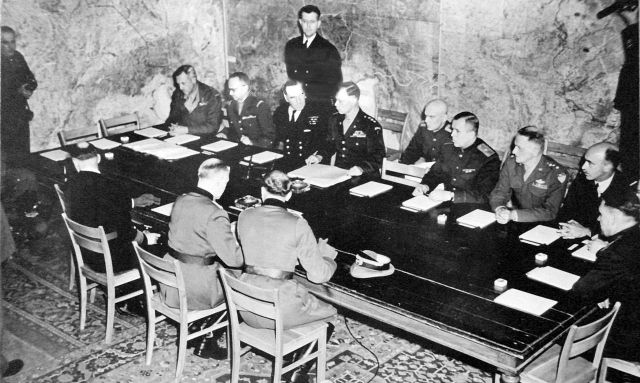
Signing of the unconditional surrender on May 7, 1945 in Reims; General Jodl front left (Image: Musée de la reddition de Reims)
The Soviet Union alone lost 27 million citizens, of whom one half were civilians. Of the 13 million in uniform, 3.3 million froze or starved to death in German prisoner of war camps, which alone amounted to a monstrous war crime. Members of the Communist Party, Jews or partisans captured by the Germans were shot immediately. Whole districts were starved, burned to the ground and destroyed.
This murderous terror was not confined to the front lines. Alongside the Jews, who were carted off to Auschwitz from across Europe, hundreds of thousands of Sinti and Roma, members of other minorities, forced labourers and political prisoners lost their lives at the hands of the Nazis. Around 200,000 people with disabilities were killed as part of the euthanasia programme. German military courts convicted 1.5 million Wehrmacht soldiers for disrupting the war effort, including 30,000 who were sentenced to death. The victims of the civilian judicial system were never fully recorded. The People’s Court of Justice alone issued 5,200 death sentences.
The Allies increasingly adapted their methods to those of their enemy. For the first time in modern warfare, both sides deliberately exterminated the civilian populations of large cities. The two-year-long siege of Leningrad by the Wehrmacht claimed more than 1 million lives. The Allies’ firebombing of Dresden, Hamburg and other cities killed tens of thousands of civilians far from the front lines. In April 1945, US President Harry Truman signed the order to drop the atomic bomb on Japan in Potsdam, less than 30 kilometres from Hitler’s Führer bunker.
The trauma, outrage and disgust provoked by the unspeakable crimes and cruelties committed during the Second World War deeply anchored the conviction among wide sections of the German and world population: “No more fascism! No more war!” But three quarters of a century after the end of the war, fascism and war are imminent global dangers once again.
These dangers existed long before the global COVID-19 pandemic, but the virus has rapidly accelerated them.
Concepts like “herd immunity” and “triage” have infiltrated daily language. They are part of the discussion of how many human lives should be sacrificed for “the economy,” i.e., speculators on the share markets and the super-rich. In spite of urgent warnings from medical experts, millions of workers are being forced back to work. US President Donald Trump has described Americans as “warriors” ready to give their lives for the greater good.
Wolfgang Schäuble, president of the federal parliament, stated that “it is not correct to say that the protection of life and health has unconditional priority over everything else.”
The threat of a third world war, which would mean the end of human civilisation, has never been so great as it is today.
The US president openly sympathises with fascist militias in the United States and right-wing dictators around the world, and is threatening Venezuela, Iran and even nuclear-armed China with war. He is supported in this by the opposition Democrats. The military spending of the Third Reich pales in comparison to the US defence budget, which this year amounts to $738 billion. In 1938, the last year prior to the war, Hitler invested 17.5 billion marks in the army. In today's money, this equates to $78 billion.
Germany, of all places, has become a hotbed for the rehabilitation of war and fascism. No other European country has increased its defence budget so rapidly. In 2019 alone it rose by 10 percent to almost $50 billion. Germany overtook Britain in the process and now has the seventh largest defence budget in the world behind France.
The ruling elite’s perspective was summed up by the Green Party’s Joschka Fischer, who appealed to the Germans to use 8 May to “overcome their pacifism.” The country needs to “escape from its pacifist instincts,” he wrote in the Tagesspiegel. The approaching end of the “soft patronage” of the protective power of the United States is forcing “Europe to increasingly defend its own security.” That can “not work without Germany.” The weakening of American protection is posing “questions for Germany that others have answered for us since the spring of 1945.” In other words: back to the era prior to 1945!
The leader of the opposition in Germany’s federal parliament and honorary chairman of the far-right Alternative for Germany (AfD), Alexander Gauland, described 8 May as a “day of absolute defeat,” when Germany lost its “agenda-setting ability.” He made these remarks in rejecting a petition initiated by Auschwitz survivor Esther Bejarano calling for 8 May to be made a national holiday. It comes in the wake of Schäuble’s description of the year 1945 as a “catastrophe.”
Right-wing extremist professor Jörg Baberowski began the rehabilitation of the Nazis six years ago with his comment that Hitler was “not vicious.” He was defended by the university administration, the media and politicians, while the Sozialistische Gleichheitspartei (SGP—Socialist Equality Party), which criticised him, was placed on the Secret Service’s list of anticonstitutional organisations. Baberowski was due to have given a keynote speech at the main commemoration of the end of the Second World War at the memorial in Torgau, Saxony. His appearance was prevented only by the coronavirus, which forced the cancellation of the event.
The overwhelming majority of the population in Germany and internationally opposes the return to militarism and fascism. But opposition is insufficient to prevent another catastrophe. It is necessary to have a clear understanding of their causes and a political perspective to fight them. The lessons drawn from the Second World War show that the struggle against fascism and war is inseparable from the struggle against capitalism. It requires the mobilisation of the international working class to fight for a socialist programme.
There are countless historical, sociological and literary works on the Nazis and the Second World War. But the extraction of the lessons from the plunge of human civilisation into barbarism collided immediately with powerful political and social interests.
The German elites continued their careers in big business, the government, intelligence services, judiciary, police, universities and the army after 1945 and had no interest in looking back. Hitler, whom they had served and embraced, suddenly was declared to have seduced and abused them. The Führer was to blame for everything, and they were all merely following orders, or were even secret resistance fighters. It took 18 years before the first trial was held of SS guards at Auschwitz, where over a million people were exterminated between 1940 and 1945.
The US government, which exposed the Nazis’ crimes to the world in the Nuremberg Trials, rapidly changed course when it required Nazi experts in the Cold War. The trials were suspended after two dozen of the worst criminals were sentenced to death and about five times as many were handed prison sentences.
Although the Stalinist rulers in the Soviet Union and Eastern Europe pursued war criminals somewhat more actively, they had no interest in clarifying the historical questions. This would have inevitably revealed their own criminal role on the eve of the Second World War, when the Stalinist bureaucracy paralysed and suppressed the struggles of the mass Communist parties against fascism and war.
In Germany, the KPD (Communist Party of Germany) refused to call for a united front with the SPD (Social Democratic Party) against the Nazis, even though until 1932 both workers’ parties were much stronger than the Nazis. In France and Spain, the Stalinists subordinated the working class to popular fronts with the liberal bourgeoisie, persecuted and murdered revolutionary workers, and thus paved the wave for the victory of reaction.
The writings of Leon Trotsky, who defended the heritage of Marxism and the Russian Revolution against the Stalinist degeneration of the Soviet Union, still serve today as the most important source if one wishes to understand the Second World War and the Nazi dictatorship.
Trotsky insisted that the Second World War was triggered by the same causes as the First: the struggle between the major capitalist nation-states for global hegemony in an increasingly integrated world; the contradiction between the world economy and the nation-state system upon which capitalism is based; and the fundamental incompatibility of socialised productive forces with private ownership of the means of production.
Already in the summer of 1934, five years prior to the Second World War, Trotsky warned:
The same causes, inseparable from modern capitalism, that brought about the last imperialist war have now reached infinitely greater tension than in the middle of 1914. The fear of the consequences of a new war is the only factor that fetters the will of imperialism. But the efficacy of this brake is limited. The stress of inner contradictions pushes one country after another on the road to fascism, which, in its turn, cannot maintain power except by preparing international explosions. All governments fear war, but none of the governments has any freedom of choice. Without a proletarian revolution, a new world war is inevitable.
Hitler’s personality influenced the course of events, but it was not the cause for the war. The real question to be asked was how it was that an anti-Semitic psychopath from the gutter of Vienna’s backstreets rose to become leader of Germany. The answer is clear: the ruling elite needed Hitler and his fascist movement as a battering ram against the socialist strivings of the working class and to prepare a second imperialist war.
“This German epileptic with a calculating machine in his skull and unlimited power in his hands did not fall from the sky or come up out of hell: he is nothing but the personification of all the destructive forces of imperialism,” wrote Trotsky of Hitler in 1940.
Britain and the United States did not wage a war to defend democracy against fascism, as they claimed, but rather for the imperialist redivision of the world.
The war resolved none of the problems that had provoked it. Based on the economic power of the United States and the politics of Stalinism, which suppressed the revolutionary movement of the working class and disarmed powerful resistance movements in France and Italy, a fragile truce emerged between the imperialist powers. In Eastern Europe, no socialist revolutions took place. The Stalinists in the so-called buffer states moved to impose widespread nationalisations only when the bourgeois elements developed an ever stronger orientation to the West. At the same time, they suppressed worker uprisings, including in East Germany in 1953 and in Hungary in 1956.
The mass strikes and student revolts that shook France, large parts of Europe and the United States between 1968 and 1975 prompted the ruling elite to launch a counteroffensive and deregulate the financial markets. The results were an unprecedented integration of global production and an intensification of the struggle for world hegemony.
The dissolution of the Soviet Union in 1991 did not represent the end of socialism, but rather the collapse of the nationalist programme of the Stalinist bureaucracy. It heralded, as the International Committee of the Fourth International was the only political party to note at the time, a new stage in imperialist conflicts and a new era of wars and revolutions.
Thirty years later, the correctness of this analysis is beyond question. Global capitalism is steering towards another catastrophe, while the working class, which is much larger and more internationally connected than ever before, is being radicalised rapidly. The decisive question now posed is the building of the International Committee of the Fourth International and its sections, the Socialist Equality parties, to give the struggles of the working class a socialist political orientation. Only the overthrow of capitalism can prevent a further catastrophe on the scale of the Second World War.
Peter Schwarz
The Soviet Union alone lost 27 million citizens, of whom one half were civilians. Of the 13 million in uniform, 3.3 million froze or starved to death in German prisoner of war camps, which alone amounted to a monstrous war crime. Members of the Communist Party, Jews or partisans captured by the Germans were shot immediately. Whole districts were starved, burned to the ground and destroyed.
This murderous terror was not confined to the front lines. Alongside the Jews, who were carted off to Auschwitz from across Europe, hundreds of thousands of Sinti and Roma, members of other minorities, forced labourers and political prisoners lost their lives at the hands of the Nazis. Around 200,000 people with disabilities were killed as part of the euthanasia programme. German military courts convicted 1.5 million Wehrmacht soldiers for disrupting the war effort, including 30,000 who were sentenced to death. The victims of the civilian judicial system were never fully recorded. The People’s Court of Justice alone issued 5,200 death sentences.
The Allies increasingly adapted their methods to those of their enemy. For the first time in modern warfare, both sides deliberately exterminated the civilian populations of large cities. The two-year-long siege of Leningrad by the Wehrmacht claimed more than 1 million lives. The Allies’ firebombing of Dresden, Hamburg and other cities killed tens of thousands of civilians far from the front lines. In April 1945, US President Harry Truman signed the order to drop the atomic bomb on Japan in Potsdam, less than 30 kilometres from Hitler’s Führer bunker.
The trauma, outrage and disgust provoked by the unspeakable crimes and cruelties committed during the Second World War deeply anchored the conviction among wide sections of the German and world population: “No more fascism! No more war!” But three quarters of a century after the end of the war, fascism and war are imminent global dangers once again.
These dangers existed long before the global COVID-19 pandemic, but the virus has rapidly accelerated them.
Concepts like “herd immunity” and “triage” have infiltrated daily language. They are part of the discussion of how many human lives should be sacrificed for “the economy,” i.e., speculators on the share markets and the super-rich. In spite of urgent warnings from medical experts, millions of workers are being forced back to work. US President Donald Trump has described Americans as “warriors” ready to give their lives for the greater good.
Wolfgang Schäuble, president of the federal parliament, stated that “it is not correct to say that the protection of life and health has unconditional priority over everything else.”
The threat of a third world war, which would mean the end of human civilisation, has never been so great as it is today.
The US president openly sympathises with fascist militias in the United States and right-wing dictators around the world, and is threatening Venezuela, Iran and even nuclear-armed China with war. He is supported in this by the opposition Democrats. The military spending of the Third Reich pales in comparison to the US defence budget, which this year amounts to $738 billion. In 1938, the last year prior to the war, Hitler invested 17.5 billion marks in the army. In today's money, this equates to $78 billion.
Germany, of all places, has become a hotbed for the rehabilitation of war and fascism. No other European country has increased its defence budget so rapidly. In 2019 alone it rose by 10 percent to almost $50 billion. Germany overtook Britain in the process and now has the seventh largest defence budget in the world behind France.
The ruling elite’s perspective was summed up by the Green Party’s Joschka Fischer, who appealed to the Germans to use 8 May to “overcome their pacifism.” The country needs to “escape from its pacifist instincts,” he wrote in the Tagesspiegel. The approaching end of the “soft patronage” of the protective power of the United States is forcing “Europe to increasingly defend its own security.” That can “not work without Germany.” The weakening of American protection is posing “questions for Germany that others have answered for us since the spring of 1945.” In other words: back to the era prior to 1945!
The leader of the opposition in Germany’s federal parliament and honorary chairman of the far-right Alternative for Germany (AfD), Alexander Gauland, described 8 May as a “day of absolute defeat,” when Germany lost its “agenda-setting ability.” He made these remarks in rejecting a petition initiated by Auschwitz survivor Esther Bejarano calling for 8 May to be made a national holiday. It comes in the wake of Schäuble’s description of the year 1945 as a “catastrophe.”
Right-wing extremist professor Jörg Baberowski began the rehabilitation of the Nazis six years ago with his comment that Hitler was “not vicious.” He was defended by the university administration, the media and politicians, while the Sozialistische Gleichheitspartei (SGP—Socialist Equality Party), which criticised him, was placed on the Secret Service’s list of anticonstitutional organisations. Baberowski was due to have given a keynote speech at the main commemoration of the end of the Second World War at the memorial in Torgau, Saxony. His appearance was prevented only by the coronavirus, which forced the cancellation of the event.
The overwhelming majority of the population in Germany and internationally opposes the return to militarism and fascism. But opposition is insufficient to prevent another catastrophe. It is necessary to have a clear understanding of their causes and a political perspective to fight them. The lessons drawn from the Second World War show that the struggle against fascism and war is inseparable from the struggle against capitalism. It requires the mobilisation of the international working class to fight for a socialist programme.
There are countless historical, sociological and literary works on the Nazis and the Second World War. But the extraction of the lessons from the plunge of human civilisation into barbarism collided immediately with powerful political and social interests.
The German elites continued their careers in big business, the government, intelligence services, judiciary, police, universities and the army after 1945 and had no interest in looking back. Hitler, whom they had served and embraced, suddenly was declared to have seduced and abused them. The Führer was to blame for everything, and they were all merely following orders, or were even secret resistance fighters. It took 18 years before the first trial was held of SS guards at Auschwitz, where over a million people were exterminated between 1940 and 1945.
The US government, which exposed the Nazis’ crimes to the world in the Nuremberg Trials, rapidly changed course when it required Nazi experts in the Cold War. The trials were suspended after two dozen of the worst criminals were sentenced to death and about five times as many were handed prison sentences.
Although the Stalinist rulers in the Soviet Union and Eastern Europe pursued war criminals somewhat more actively, they had no interest in clarifying the historical questions. This would have inevitably revealed their own criminal role on the eve of the Second World War, when the Stalinist bureaucracy paralysed and suppressed the struggles of the mass Communist parties against fascism and war.
In Germany, the KPD (Communist Party of Germany) refused to call for a united front with the SPD (Social Democratic Party) against the Nazis, even though until 1932 both workers’ parties were much stronger than the Nazis. In France and Spain, the Stalinists subordinated the working class to popular fronts with the liberal bourgeoisie, persecuted and murdered revolutionary workers, and thus paved the wave for the victory of reaction.
The writings of Leon Trotsky, who defended the heritage of Marxism and the Russian Revolution against the Stalinist degeneration of the Soviet Union, still serve today as the most important source if one wishes to understand the Second World War and the Nazi dictatorship.
Trotsky insisted that the Second World War was triggered by the same causes as the First: the struggle between the major capitalist nation-states for global hegemony in an increasingly integrated world; the contradiction between the world economy and the nation-state system upon which capitalism is based; and the fundamental incompatibility of socialised productive forces with private ownership of the means of production.
Already in the summer of 1934, five years prior to the Second World War, Trotsky warned:
The same causes, inseparable from modern capitalism, that brought about the last imperialist war have now reached infinitely greater tension than in the middle of 1914. The fear of the consequences of a new war is the only factor that fetters the will of imperialism. But the efficacy of this brake is limited. The stress of inner contradictions pushes one country after another on the road to fascism, which, in its turn, cannot maintain power except by preparing international explosions. All governments fear war, but none of the governments has any freedom of choice. Without a proletarian revolution, a new world war is inevitable.
Hitler’s personality influenced the course of events, but it was not the cause for the war. The real question to be asked was how it was that an anti-Semitic psychopath from the gutter of Vienna’s backstreets rose to become leader of Germany. The answer is clear: the ruling elite needed Hitler and his fascist movement as a battering ram against the socialist strivings of the working class and to prepare a second imperialist war.
“This German epileptic with a calculating machine in his skull and unlimited power in his hands did not fall from the sky or come up out of hell: he is nothing but the personification of all the destructive forces of imperialism,” wrote Trotsky of Hitler in 1940.
Britain and the United States did not wage a war to defend democracy against fascism, as they claimed, but rather for the imperialist redivision of the world.
The war resolved none of the problems that had provoked it. Based on the economic power of the United States and the politics of Stalinism, which suppressed the revolutionary movement of the working class and disarmed powerful resistance movements in France and Italy, a fragile truce emerged between the imperialist powers. In Eastern Europe, no socialist revolutions took place. The Stalinists in the so-called buffer states moved to impose widespread nationalisations only when the bourgeois elements developed an ever stronger orientation to the West. At the same time, they suppressed worker uprisings, including in East Germany in 1953 and in Hungary in 1956.
The mass strikes and student revolts that shook France, large parts of Europe and the United States between 1968 and 1975 prompted the ruling elite to launch a counteroffensive and deregulate the financial markets. The results were an unprecedented integration of global production and an intensification of the struggle for world hegemony.
The dissolution of the Soviet Union in 1991 did not represent the end of socialism, but rather the collapse of the nationalist programme of the Stalinist bureaucracy. It heralded, as the International Committee of the Fourth International was the only political party to note at the time, a new stage in imperialist conflicts and a new era of wars and revolutions.
Thirty years later, the correctness of this analysis is beyond question. Global capitalism is steering towards another catastrophe, while the working class, which is much larger and more internationally connected than ever before, is being radicalised rapidly. The decisive question now posed is the building of the International Committee of the Fourth International and its sections, the Socialist Equality parties, to give the struggles of the working class a socialist political orientation. Only the overthrow of capitalism can prevent a further catastrophe on the scale of the Second World War.
Peter Schwarz
Yanis Varoufakis In conversation with David McWilliams on the future after Covid-19
David McWilliams and I have had many conversations, often in front of large audiences in Ireland, on the economics and politics of Europe, Brexit, Ireland, Greece, the world. In this latest conversation we are discussing the impact of Covid-19 on capitalism. The extract below, published by The Guardian, comes from the last chapter of an edited volume entitled A Vision for Europe 2020: Nothing But an Alternative
David McWilliams: I think it is fair to say that capitalism – in the course of this unprecedented crisis – has been suspended. We are not going back to where we were, to business as usual. The state has come back, and this episode will not be forgotten by the electorate. I don’t know where we are going, but one thing seems clear: we are not going back.
Yanis Varoufakis: I like this phrase: capitalism has been suspended. The last time capitalism was suspended in the west was during the second world war, with the advent of the war economy: a command economy that fixed prices. The war economy marked the transcendence of the standard capitalist model.
But what we see now is not so much the suspension of capitalism. The rules of capitalism may have been suspended – all those sacrosanct policies are gone, the neat separation of fiscal and monetary policy is gone, the idea that public debt is a bad thing is gone.
But the institutions that are necessary to build “the war economy without war” so to speak – to suspend and transcend capitalism – those have not been put in place. There is a profound difference between saying: “It’s all going to shit, so we don’t expect you to stick to the rules,” and saying: “The rules themselves have changed, and we must make new ones to prevent an economic collapse.” All this talk of quantitative easing by the European Central Bank suggests that we remain very far from a war economy mindset.
DM: This is a familiar category error in Europe. If you are basing your economic policy on the willingness of people who are too traumatised and sick to borrow – which is the core logic of quantitative easing – then you have a very serious problem. A common image of quantitative easing is the hose: a huge monetary hose, with water gushing out to stop the fire of crisis. But the hose of monetary policy is limited by this little valve called the banks, a little valve called the credit committee, a little valve called the “willingness of business to borrow money”. And ultimately, that hose of money becomes a trickle – and even that trickle stands to benefit the wealthy much more than the poor.
So I take your point that despite the suspension of the rules, the infrastructure remains in place. But people across Europe are now saying: “Hey, there is an alternative.” This second phase will be about how we move ahead in rethinking capitalism, in rethinking finance, rethinking how economies work and for whom – potentially toward a new Bretton Woods-style settlement for the entire global economy.
So that’s where we are: in the first year of the third decade of the 21st century. Looking out at the next decade, armed with history as well as economics, what do you think the global and European economy will look like?
YV: We are sitting on a saddle point, prepared to tip in either direction. It is utterly indeterminate which of the two directions we travel.
Let us start with the positive scenario. It builds from your point about the prospects for a new Bretton Woods – with its particular manifestation in the European Union.
The fact that Germany is now in the same pile of shit as the rest of us offers a glimmer of hope
If we are going to have continental consolidation, what should it look like? It would not be a federation, because – even though that is more necessary than ever – it is less likely than ever, because the centrifugal forces of the coronavirus crisis, the migration crisis, and the euro crisis are pulling us apart. But the alternative is to deploy the existing [EU] institutions in a way that can simulate a federated Europe, and we can do this tomorrow, if we so choose: to provide immediate cash to all those who are struggling in poverty, to invest in the green transition.
There is a glimmer of hope here, because there is a profound difference between 2020 and 2010. Back then, when Ireland and Greece went belly up, there were remarkable dissimilarities between what our countries were experiencing and what Germany was experiencing, what Holland was experiencing. Today, Germany’s industrial machine is broken – and was broken long before coronavirus hit. Two main industries – automobiles and machine tooling – were already in serious trouble. So the fact that Germany is now in the same pile of shit as the rest of us offers a glimmer of hope that they might say: what should we do? It’s no longer: “Your problem: here’s the Troika.”
DM: And we will send you the bill as well! So that’s the positive scenario. The interruption of “business as usual” gives way to new policies and new possibilities for Europe and beyond. What’s the other option?
YV: Well, we humans – and we Europeans, in particular – love to miss fantastic opportunities and end up with dystopian outcomes instead. It’s very likely that we will encounter the same recalcitrance by the same set of European ordoliberals, who will keep putting roadblocks in the way of moves toward a genuine, democratic federalism.
DM: Obviously, such a roadblock will have a disproportionate impact on the southern member states of the European Union. What do you think the impact of this particular trauma will have on, say, Italy – a founding member of the European Union, and a crucial part of Europe’s emotional hinterland?
YV: Every time there is a crisis in Europe, Italian growth rates fall. Every time there is a problem, Italy sinks deeper into stagnation – with Salvini waiting in the wings. If Frankfurt, Berlin, and Brussels fail again to move toward the positive scenario, Italy – not just Italy, but all of Europe’s most devastated regions – will move again toward the neo-fascist right. In that case, all bets are off.
This is the endpoint of the negative scenario: a giant domino effect, leading to the disintegration of the European Union. Not that the EU will cease to exist. Only that it will become irrelevant, like the Commonwealth of Independent States.
DM: Oh, I remember the Commonwealth of Independent States very well …
YV: It still exists! It still has an office in Moscow. So the negative scenario is that the European Union will become like the CIS. And that will be music to the ears of the Trumps, Bolsonaros, and Modis of this world. We would move into a transactional, Hobbesian global economy: nasty, brutish, and poor for the majority of people.
My sense is that the period when you could travel, engage, move, we might have reached the end of that open period.
DM: When I was born in Ireland, the country was very poor. And then it became quite wealthy, on the back of the European project, on the back of Europe’s position in the global supply chain, and with a tax policy that attracted lots and lots of capital. My sense is this model might be gone, and this style of globalisation along with it. I fear that the period when you could travel, engage, move – we might have reached the end of that open period. People will say: “This virus came from the cosmopolitan world, from the world of international movement.” Whether it’s right or not, we might begin to blame people. We know that the Black Death resulted in ferocious antisemitism in Europe. People asked: “Who can we blame for this?” And so they blamed the one community that was already in isolation in the ghetto.
This is what terrifies me most, sitting here in the first year of the third decade of the 21st century. What we saw before may come again, and we turn back to Yeats: “Turning and turning in the widening gyre / The falcon cannot hear the falconer; / Things fall apart; the centre cannot hold; / Mere anarchy is loosed upon the world.” I fear now, unless we move quickly and in a new direction, the world that my kids will inherit is going to turn very nasty, indeed. So it’s a clarion call.
YV: The loudest call in a generation. I share all of your concern for the future, although I must challenge the analysis on which it is based. The openness that you describe has always gone hand in hand with severe restriction: Nafta and the US-Mexico border; freedom of movement in Europe and Frontex along the Mediterranean. This is not a contradiction; it is the logic of a system that prizes the movement of capital over the freedom of human beings.
If we fail now to stand together – to rally around a new Bretton Woods, to deliver the investments that humanity and the planet so desperately need – my fear is that this system will only deepen its cruel logic. Surfing on the hose of liquidity unleashed by the policies like quantitative easing, the financial sector will increase its grip on the global economy; bankers are very good at getting rich from such volatility. So now is the time for us, here in Europe as around the world, to mobilise behind this shared vision of a global new deal. Because without it, the walls between us will only get taller and thicker: porous only to the money that flows through them.
Subscribe to:
Comments (Atom)