IN A WEEK where the number of Americans killed by Covid-19 passed 66,000, Donald Trump assured us that this death toll, looked at from the right angle, is really proof of how great he is at his job.
Asked on Thursday to account for his son-in-law and adviser Jared Kushner’s description of the federal government’s chaotic response to the coronavirus pandemic as “a great success story” that “needs to be told,” the president said that he agreed. “We’ve solved every problem,” he claimed. “We solved it quickly.”
“I don’t think anybody has done a better job — with testing, with ventilators, with all of the things that we’ve done,” Trump added. “And our death totals, our numbers per million people, are really very, very strong. We’re very proud of the job we’ve done.”
Trump’s strange boast about the “very, very strong” death toll puzzled many viewers, but it helps to know that, for weeks, the president and his senior medical adviser, Dr. Deborah Birx, have been urging Americans to consider that, on a per capita basis, the U.S. mortality rate is lower than that of several of the worst-hit countries in Western Europe.
On April 10, for instance, Trump asserted that “we’ve kept our fatality rate very, very low compared to other countries.” Later in the same briefing, Birx said that he was right. “As the President noted, our mortality in the United States is significantly less than many of the other countries when you correct them for our population.”
“The United States has achieved a significant lower mortality rate than almost all other countries,” Trump said at another briefing six days later.
“While we mourn the tragic loss of life — and you can’t mourn it any stronger than we’re mourning it,” Trump said at the start of a briefing on April 18, “the United States has produced dramatically better health outcomes than any other country, with the possible exception of Germany — and I think we’re as good or better.”
Birx then presented a bar chart comparing the death toll in the U.S., expressed as a share of population, to the far higher rates of death in six European nations: Belgium, Spain, Italy, France, the United Kingdom and the Netherlands. After she did so, Trump interrupted her presentation to point to the far lower reported mortality rate of another country on the chart, China, and suggested that the authorities there must have lied about their death toll to produce that statistic.
But that chart also included evidence that it is profoundly misleading to cast the U.S. response as a success by comparing it to just those six countries. That’s because the data also showed that Germany, whose success Trump had downplayed, had a far lower mortality rate than the U.S.
A screenshot of a chart presented by Dr. Deborah Birx at a White House coronavirus task force briefing on April 18.
Photo: CSPAN, via YouTube
As the data presented by Birx showed, as of mid-April, Americans were more than twice as likely as Germans to have died from Covid-19. While the U.S. had recorded 11.24 deaths per 100,000 people then, Germany, which had a high rate of infection, had kept deaths down to 5.25 per 100,000.
Today, Americans are faring even worse in comparison to Germans. According to updated mortality rates compiled on May 2 by Johns Hopkins researchers for the 10 countries with the most confirmed cases of Covid-19, the U.S. now has 20.29 deaths per 100,000, compared to 8.21 in Germany.
A chart posted online by researchers at Johns Hopkins showed mortality rates as of May 2 for the 10 countries most affected by Covid-19.
Photo: Johns Hopkins Corona Resource Center
Expressed in Trump’s preferred metric of deaths per million, for every 203 Americans lost to Covid-19 so far, just 82 Germans have perished. What this means is that if the federal government in Washington had been as successful at keeping its citizens alive as the one in Berlin, the death toll in the U.S. would not be, as it is today, more than 66,000, but less than 27,000.
In other words, Trump and Birx have been engaged in a kind of statistical sleight-of-hand, one that seems designed to distract attention from the fact that tens of thousands of Americans would still be alive today had their government managed the crisis as well as the German one.
At no point in the April 18 briefing did either Trump or Birx explain why Americans should be satisfied with being less likely to die of Covid-19 than citizens of Britain or France, but in so much more danger than Germans.
There are also other ways in which it is misleading to compare deaths in the U.S. so far to those of the six European nations with the worst mortality rates. To start with, by focusing just on other hard-hit countries, Trump distracts attention from the fact that there are dozens of other countries, in Europe and other parts of the world, that have far lower mortality rates than the U.S. — like Greece, Austria, Denmark, Portugal, Canada and Japan.
Most notably, South Korea, which was so successful at suppressing the outbreak through early action and widespread testing that it has recorded just 250 deaths — a mortality rate of 0.48 per 100,000 — was also not included in the ranking presented by Birx. If the U.S. had matched South Korea, just over 1,500 Americans would have died to date.
Despite this, Trump has continued to incorrectly refer to that chart from the April 18 briefing as proof that the United States is “right at the top” of world rankings. Speaking to the press on Thursday during an Oval Office meeting with New Jersey’s governor, Phil Murphy, Trump asked Birx to get out the chart, falsely claiming that it showed “we’re the leader of the world, we’re really the leader, in this case, the leader of the world. And we’ve done better, if you look at our deaths, if you look at mortality rates…. I’m going to get a chart, because it’s maybe the most impressive thing — right? — how we’ve done.”
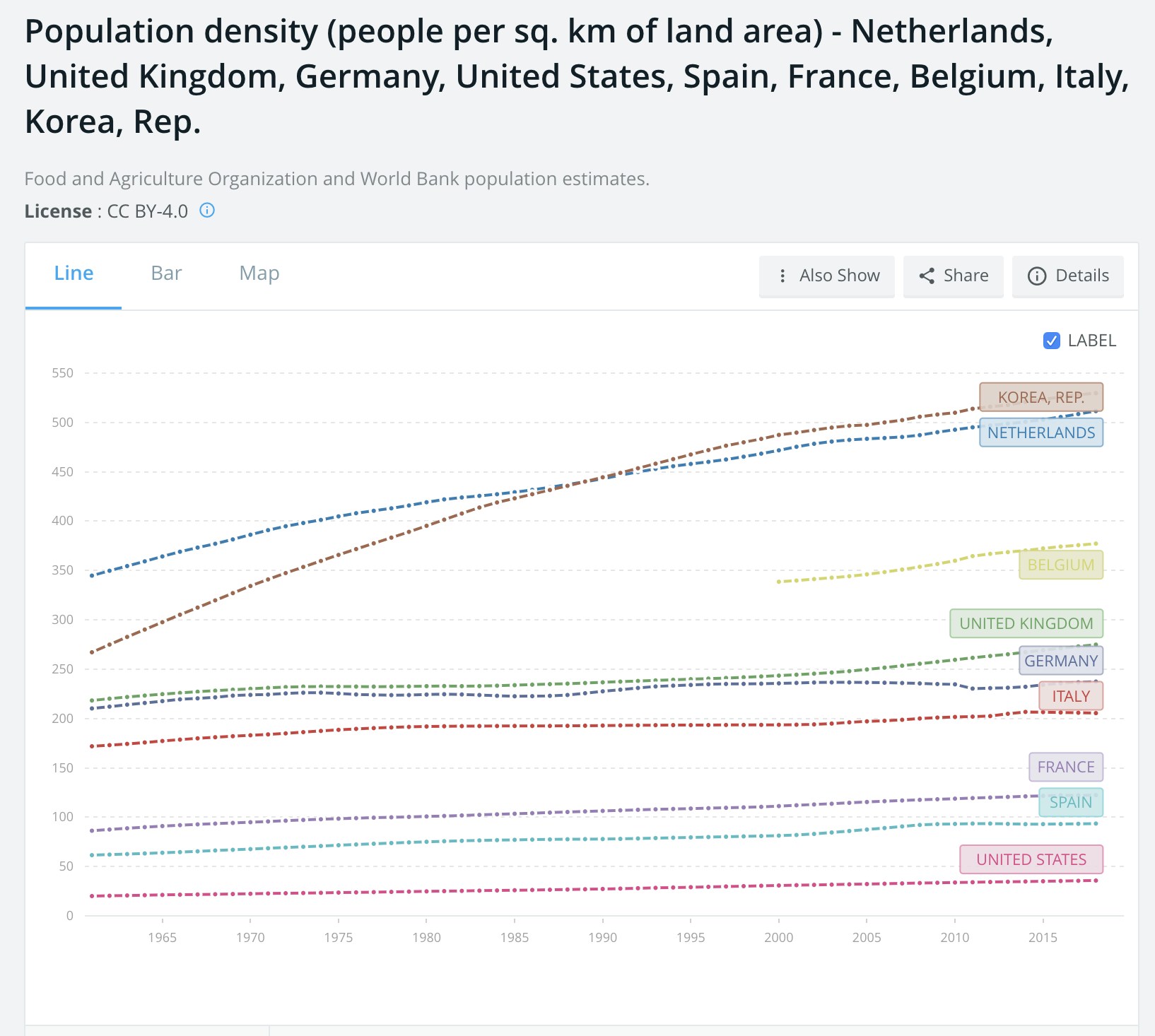
Then there is the fact that all six of the most affected European countries are much more densely populated than the U.S., and population density appears to make it harder to stop the spread of the virus.
A screenshot of a chart from the World Bank, showing the relative population density of several countries.
Photo: World Bank
That Germany and South Korea are also densely populated indicates that there are other factors at play, but the first wave of outbreaks in Europe and the U.S. have been most intense in major cities and their surrounding metropolitan areas.
Even the least densely populated of the six European nations that have been hit the hardest by the outbreak, Spain, is more densely settled than it might seem. Alasdair Rae, a professor of urban studies and planning at the University of Sheffield, noted in 2018 that Spain’s population density of 93 people per square kilometer is misleading, since only about 13 percent of the country’s territory is actually lived in. Barcelona, along with Madrid, has been one of the two Spanish cities most affected by the pandemic. As Rae pointed out, “more than 53,000 people inhabit a single square kilometer area in Barcelona,” making it the most densely populated square kilometer in Europe.
As a series of visualization of population density created this week by Rae shows, the worst affected areas of Europe — northern Italy, Belgium, the Netherlands, northern France and southern England — are among the continent’s most tightly packed regions.
The U.S. by contrast, has a much higher rural population than Western Europe. For that reason, it might be more appropriate to compare the mortality rates of those European nations to that of the seven badly hit northeastern American states that have formed an interstate compact to collaborate on the phased reopening of their economies.
Those states — New York, New Jersey, Connecticut, Massachusetts, Rhode Island, Pennsylvania and Delaware — have recorded 35,718 deaths out of a combined population of about 53.6 million. That mortality rate of 66.6 per 100,000 for the region exceeds the current figure for every European country except Belgium, which, unlike the U.S., includes in its count a large number of deaths in nursing homes that are suspected of being virus-related, but have not been confirmed by testing.
While Belgium’s coronavirus emergency task force has come under some political pressure for including so many suspected cases — nearly half the nation’s total deaths — health officials have refused to change their method, describing surveillance of the disease as more important than negative publicity.
One Belgian government minister, Denis Ducarme, noticed and was not happy about the chart of national mortality rates displayed by Birx and Trump last month to bolster their argument that the U.S. was doing relatively well in handling the pandemic. “Our method of counting is the most exhaustive possible,” Ducarme wrote on Twitter. “When @realDonaldTrump makes a macabre ranking, by pointing the finger at Belgium to give the impression that all is well in the U.S.A. I find it disgraceful, the basest of politics.”
K STREET MAY soon have its own taxpayer-funded bailout.
Industries as varied as oil refining, construction, fast food restaurants, and chemical manufacturing are seeking federal cash to support their lobbyists in Washington, D.C.
Many of the largest lobbying forces are organized under the 501(c)(6) section of the tax code as trade groups. Corporations with similar concerns pool their money together to fund trade groups, which in turn employ thousands of lobbyists to shape elections and legislation on a daily basis. But the Paycheck Protection Program, the centerpiece of the small business rescue program, excluded such trade groups. That could change in the next round of stimulus legislation, which Congress is scheduled to debate later this month.
Lobbyists have stepped up a campaign to make sure professional influence peddlers are eligible for the PPP, or P3, funds. The push also includes a demand for an additional $25 billion for canceled events and other lost revenue from the coronavirus pandemic. Senior Democratic lawmakers, including House Speaker Nancy Pelosi, plan to accommodate the demand and change the eligibility standard so that small business bailout money can flow to business advocacy groups.
The American Society of Association Executives, which represents trade group leadership, explained in a letter to lawmakers that trade group lobbyists need federal funding to better advocate for their clients.
“These organizations are already relied upon to help coordinate federal resources to combat the coronavirus pandemic, and they require staff to fulfill this duty,” ASAE wrote. Trade groups, the ASAE letter notes, have faced declining revenue as corporations wind down dues payments and sponsorship fees in response to the economic downturn.
The letter was signed by many of the most influential Beltway lobby groups. The American Fuel & Petrochemical Manufacturers Association, one of the trade groups requesting the 501(c)(6) bailout, pays its top lobbyist, Chet Thompson, $1.8 million a year. The group represents the largest oil refiners in the country, including Exxon Mobil, Koch Industries, and Motiva Enterprises, the U.S. arm of Saudi Arabian oil company Aramco.
Other trade groups that joined the letter include the National Retail Federation, which represents firms such as Walmart and Macy’s; the National Restaurant Association, which represents McDonald’s and Darden Restaurants; and ACA International, the lobby group for debt collectors.
A similar joint letter on the 501(c)(6) issue to Wisconsin lawmakers, from the Wisconsin Manufacturers and Commerce, a branch of the U.S. Chamber of Commerce, pitched lobby groups as vital conduits of information. “During this difficult time, business trade associations are performing an essential role for our state’s businesses,” the Wisconsin lobbyists wrote.
The Wisconsin lobbyists argued that they should be eligible for the P3 funds because business trade groups “transmit information, answer questions, and ensure that our members have the tools they need to comply with the deluge of laws, orders and regulatory changes that are being introduced.”
The Wisconsin letter was signed by local organizations, such as the Wisconsin Dairy Alliance and the Wisconsin Restaurant Association. It was also signed by the American Chemistry Council, the national chemical industry behemoth that employs 64 registered lobbyists and spends lavishly on campaign-style television advertisements for favored lawmakers.
The P3 program, though touted as a small business program, has attracted headlines in recent weeks as large multinational firms, churches, and politically connected interests have won access to the loans, which may be converted to grants if recipients maintain payroll.
“There are some odd inconsistencies in who is eligible for loans under the Paycheck Protection Program,” said Craig Holman, a lobbying expert with the watchdog group Public Citizen.
“The program should be exclusively targeting small enterprises of fewer than 500 employees. As such, it is perfectly reasonable to exclude trade associations from eligibility. Small businesses that are members of these trade associations are already eligible for the loans, even though their lobbying associations 501(c)(6)s are not,” Holman noted.
But the campaign to provide 501(c)(6) lobby groups with bailout money has been sold as a way to save struggling business interests — an argument that appears to be winning over key lawmakers.
Rep. Stephanie Murphy, D-Fla., and Rep. Ami Bera, D-Calif., two leading moderate Democrats, have expressed support for the campaign. The two lawmakers participated in a conference call last month with industry executives and lobbyists, pledging to try to change the eligibility requirements.
“Right now, the way it is being implemented, it’s not necessarily helping everybody it was intended to,” said Murphy during the call, which was sponsored by ASAE.
“The 501(c)(6) issue is clearly an example of that,” added Murphy. “I just got off a call with my local Chamber, and they are doing everything they can to keep their doors open.”
Rep. Dina Titus, D-Nev., in a letter in support of the 501(c)(6) rule change, also argued that P3 money would help local Nevada Chambers of Commerce.
Lobby groups have poured resources into the campaign in recent weeks.
The Associated Builders and Contractors, which represents largely nonunion construction companies, has called on member companies to press lawmakers to support the change. Association of Chamber of Commerce Executives, a federation of state business lobbyists backed by Google, Facebook, Comcast, and other large business interests, has highlighted the push for federal aid.
The National Association of Concessionaires, which represents snack food companies such as Coca-Cola and Hersey, is another example. The group has waged war in recent years to defeat taxes on sugary foods, nutrition labeling requirements, and other rules viewed as onerous to business.
Now the group faces an existential threat not to sugary sweets, but from declining revenue that could risk the employment of its team of corporate advocates. The group recently held a call with Rep. Raja Krishnamoorthi, D-Ill., who expressed support for a change to the bailout program to allow money for 501(c)(6) groups such as the NAC.
Krishnamoorthi, according to an update published by NAC, urged the group to write to Congress as fast as possible. “There is no time to wait,” said Krishnamoorthi, as “time is of the essence.”
Pelosi, speaking during a webinar on Tuesday evening, discussed Democrats plans to push for a variety of reforms to the P3 program in the next round of emergency coronavirus legislation. Among the changes, Pelosi said, would be a shift to include 501(c)(6) trade groups. The shift, if adopted, represents a dramatic flow of government money to business lobbying groups.
Pelosi also signaled support for P3 money to 501(c)(4) issue advocacy organizations, which include groups such as the Sierra Club and the National Rifle Association. In her remarks, she did not include expanding the program for 501(c)(5) organizations, which represent labor unions, to be eligible for P3 rescue funds, a demand made by some Democratic lawmakers.
EVER SINCE Donald Trump declared his presidential candidacy and rank racism in 2015, those of us who’d witnessed the nationalist undoing in the Balkans at the end of the last millennium have found the subsequent rise of Trumpism frighteningly familiar. We quickly recognized a host of nationalist pathologies: the tactical importance of bigotry, since enemies must be ceaselessly identified and hated; relentless misogyny as a means of controlling women and their bodies, because the nation is a masculinist project where women serve as wombs for national reproduction; a profusion of lies, conspiracy theories, and plain nonsense, since reality is controlled by the enemies (fake news, deep state, the Jews, etc.) and must be perpetually undone and redone; the coalescing of a diverse political field around a leader and a stupidly conceptual goal (Greatness! Capitalism! Freedom!); loyalist cabals who are vetted, validated, and eliminated by the leader’s whims; and rampant venality combined with a criminal reconfiguration of the economy.
But the most important and troubling symptom is the open and ceaseless commitment to conflict meant to culminate in transformative, cathartic violence; this marks the beginning of collective self-actualization. As we bear witness to armed white American militias storming or protesting outside government institutions, it is clear that the chaos and tragedy of Covid-19 are being used by Trump and the GOP to enhance the conflict and accelerate the birth of a new, greater America. At the heart of every nationalist mythology is some kind of a rebirth, usually bloody and requiring sacrifices, preferably of the weak and the doubtful.
Because those who experienced the bloody undoing of Yugoslavia have already seen the havoc nationalism wreaked in their own lives and countries, it is hard not to worry about its symptoms again — or, as a Bosnian saying goes: If you were bitten by a snake, you’re scared of lizards. It would be wrong, of course, to ignore the differences between the histories, including the respective political conditions, in pre-dissolution Yugoslavia and in the United States in the last few years (or decades). Still, insisting there are no points of comparison means accepting the proposition at the root of every emanation of nationalism: that “our” nation is unlike any other, historically unique and incomparable. If one is not blinded by that kind of essentialist entitlement, the common practices of nationalism become recognizable across cultures and histories.
Take the nationalist conviction that the nation is oppressed by state structures controlled by (the) others and is therefore unable to fulfill its unique potential, which is why state structures need to be smashed, along with those who control them. Such a conviction is repeatedly fueled by Trump and widely shared by his supporters, not least by those brandishing assault rifles around the state legislatures of Michigan, Virginia, and Ohio, soon to arrive in your neighborhood.
Slobodan Milosevic, the Serb leader who in died in 2006 in the Hague while on trial for genocide and crimes against humanity committed in the 1990s in Croatia, Bosnia, and Kosovo, similarly framed his nationalist narrative. He insisted that the Serbian people made sacrifices for Yugoslavia but were instead cheated out of their victorious gains by those who controlled the federal state. He wanted to reshape Yugoslavia so that his people could rightfully dominate it and thus make Serbia great again, or greater. Similarly, for the Croat nationalists, led by Franjo Tudjman, once a general in the Yugoslav People’s Army, only an ethnically pure nation state could provide freedom and actualization. Milosevic and Tudjman were on opposing sides, but their projects were akin. Both strived to destroy the Yugoslav state by any means necessary. Pursuing a conflict that would irreversibly undo civic and governmental structures was essential to their nationalist projects.
The destructive urge was placed, however, onto the shoulders and arms of “the people” who needed to exhibit their anger and show that the current state could not respond to their unquenchable thirst for justice and liberty. A crucial role in the rise of millennial Serbian nationalism was played by rallies where masses of aggrieved Serbs protested against myriad injustices. The rallies were presented as spontaneous happenings of the people (dešavanje naroda, in Serbian), but were orchestrated by Milosevic’s proxies and underlings. These extra-systemic performances of mass infuriation were bludgeons with which the nationalists attacked weak state structures, as well as the doubters in their own ranks. The rallies also constituted loyalist spaces from which warriors and collaborators could be recruited for the future wars. What was invariably promised at the rallies, implicitly or explicitly, were revenge and punishment for those who “the people” believed wronged them. Milosevic’s nationalist project would carry out those promises, which eventually landed him at the International Criminal Tribunal for the Former Yugoslavia. Once he set out to follow the trajectory of destructive confrontation, there was no way or reason for him to stop until he reached its logical extreme: genocide.
The conflictual essence of Trumpism was made fully evident very early, in the course of the Republican primaries in 2016. While all the other GOP candidates tried to validate their garden-variety bigotry by importing fancy reactionary ideas and referring gratuitously to the Bible, the Framers, or some historical figure or another, the only thing Trump consistently offered was his pathological narcissism (exactly matching the popular belief in American exceptionalism) and his penchant for conflict and aggression. He promised, implicitly and explicitly, revenge and punishment for those who wronged white America. As we now know all too well, white America’s response to Trumpian revenge fantasies was quick and enthusiastic, and thus the GOP graduated from a routinely racist conservative party to one unquestionably committed to white nationalism, up to and including outright white supremacy.
In the meantime, Trump, the chosen tool of undoing, has been carrying out his promises, with the full and passionate support of the GOP and many of its rich donors. The claims of false and foolish pundits notwithstanding, at no point was Trump going to relent, change, or metamorphose into being “presidential,” for the simple reason that Trumpism is nothing without the constant perpetuation of conflict.
For many of my fellow ex-Yugoslavs, it was instantly clear that once the GOP and Trump committed to conflict and destruction, they could never afford to quit, for that would constitute a tactical error leading to an irreversible defeat. They now have no choice but to follow their trajectory to its logical extreme, which must be victory and rebirth at all cost. They will kill if they have to, or at least let Covid-19 do it.
When armed Trumpists pretend to be a happening of good people who demand the end of the lockdown, anti-fascist ex-Yugoslavs don’t necessarily see an American version of murderous Serbian paramilitaries. What we see with heart-clenching clarity is that the familiar nationalist strategy of perpetually inciting conflict is advancing along a predictable trajectory.
What is even more frightening is the hankering across the political range for a magical national correction, the indulging of a persistent fantasy that some essential American quality (decency, reasonability, checks and balances, etc.) will finally kick in and halt the Trumpist madness, thus allowing the country to snap out of its nightmare and revert to its good old national essence. That was never going to happen: The ongoing conflict is not a glitch but a process that cannot be stopped or resolved politically. With the GOP in death-cult mode, a steady destruction of checks and balances previously imagined to be fail-safe, the jelly-spined leadership of the Democratic Party, and the Soviet-grade purging of any disloyalty or disobedience in the federal systems, Trump has effectively destroyed American politics.
What the actual resolution might look like, I fear to envision, but I know it will not resemble anything Americans can remember or dare to imagine.
The pandemic crisis created a rare economic opportunity. In effect, the whole economy was thrown up for grabs, with the winners and losers determined by who had the political power to get a nice bailout. Needless to say, those who were already rich got the big handouts, those at the bottom got crumbs, if anything at all.
Suppose we had let the market work its magic on the airlines, on the hotel chains, the restaurant chains, the aircraft industry (i.e. Boeing), and on the oil industry. With few exceptions, the big actors in these sectors would all have been bankrupt. The companies would have been reorganized, with the ones that were otherwise viable being restructured. Debtors would take large haircuts only collecting a fraction of what they had been owed. Shareholders would be wiped it, losing trillions of dollars of equity. Many top executives would likely been sent packing, and would no longer be able to count on paychecks in the millions or tens of millions.
Of course, things didn’t turn out this way because almost no one in policy circles actually believes in the market. That’s just something they tell children and liberal policy wonks. The people in power believe in using the government to give themselves as much money as possible. Usually they can do this through structuring the market so that money flows upward.
This is perhaps most clear in the case of government-granted patent and copyright monopolies. These government-granted monopolies in areas like prescription drugs, medical equipment, software, pesticides, fertilizers and other items likely transfer more than $1 trillion a year from the pockets of ordinary people to those who own these monopolies. Over the last four decades these monopolies have been made longer and stronger, with almost no one paying attention, in spite of the huge amount of money at stake.
It is easy to point to market structuring in other areas, most notably finance and corporate governance, which have allowed for the accumulation of great fortunes at the expense of the rest of us. Again, the rule changes that allow for massive upward redistribution were mostly done with little public attention, even though large amounts of money were at stake.
I go through these issues in more detail in Rigged [it’s free], but the point is simple: the rich have structured the market in ways that hugely increase their share of income. They pretend that this was just a natural market outcome. Many liberals accommodate this fiction, complaining that conservatives are “market fundamentalists” who dislike government.
Anyhow, the bailout from the pandemic required surrendering the illusion. The industries that were hardest hit rushed to Congress and the White House and demanded, and got, handouts. The sums involved were enormous. The airline industry got $17.5 billion (more than 10 million food stamp person years) in grants and another $7.5 billion in government subsidized loans. The cargo airline industry got $4 billion in grants and subsidized loans. The oil industry is getting a large bailout that is still be mapped out. Boeing was designated to get $17 billion in grants and subsidized loans.
This is all in full public view. While many workers will be left unemployed, with meager unemployment benefits (once the initial $600 a week bonus period ends), billionaire shareholders will have the value of their portfolios propped by the government. CEOs and other high level executives, who pocket millions or even tens of millions in pay annually, will remain secure in their high-paying jobs and will be able to maintain their lavish lifestyles as though nothing had happened.
Congress could have prevented this massive handout, either by requiring bankruptcies and supporting companies through the process, as happened with the auto bailout in the Great Recession, or by restricting executive pay and dividend payouts at companies that receive bailouts. As it turned out there were no effective restrictions imposed on these companies.
In fact, Congress decided to throw in a little something extra to help wealthy contributors get through the crisis. It put in a tax break for real estate investors, which will give $170 billion over the next decade to people in the top 1 percent of the income distribution. The beneficiaries of this gift include people like Jared Kushner and the Trump family.
While serious people should do their best to monitor the bailouts and limit the corruption, we have to recognize that the rich have largely won this battle. They have managed to ensure that most of them will not only be kept whole through this crisis, many will come out ahead. In a period where millions are losing jobs, with many struggling to be able to pay the rent and get enough to eat, the rich have managed to feast off the public purse.
If we can’t pull the rich away from the trough while Donald Trump is still in the White House, we can propose remedies that a Biden administration should pursue. There are two simple and easier ones: a special one-time tax for high income households and a corporate profit tax tied to stock returns.
For the one-time tax, we can add ten percentage points to the income tax for the top bracket of households for 2020 and 2021. (This would apply to income above roughly $300k for an individual and $500k for a couple.) This tax would be in addition to whatever longer-term changes to the tax code that a Biden administration might want to make. This tax should apply to all income, including capital gains, both realized and unrealized.
The latter would be a new innovation that many tax analysts have advocated for some time. There is no obvious reason to allow someone to defer their taxes on capital gains just because they choose not to sell their stock or real estate. The I.R.S. can gain valuable experience in assessing unrealized capital gains. One obvious mechanism would be to assign a value based on the gains in comparable assets (e.g. a stock index or changes in real estate prices in the area of the property held). The difference between the tax liability for the actual capital gain and the imputed gain can be corrected at the time the asset is sold.
This one-time tax should raise more than $350 billion a year which is a bit more than 1.5 percent of GDP or more than 200 million food stamp person years. In other words, it is real money, although a bit less than we would save if we had no patent monopolies on prescription drugs.
The other gift to the rich would be a 10 percentage point excess profits tax which would take the form of a tax tied to the returns on their stock. Since companies have gotten very good at hiding their profits from the I.R.S. this tax makes it easy for them. We simply tax away ten percent of returns to shareholders, either in the form of dividends or higher share prices, using the halfway point between the start of the year share price and crisis trough as a reference point.
This means that the companies can hide their profits wherever they want and it doesn’t affect their tax liability, unless they also manage to hide them from their shareholders. In that case, the I.R.S. would have a powerful ally in collecting the taxes it is owed. With a market capitalization of U.S. corporations near $40 trillion, if the stock gains under this formula average 8 percent annually over 2020 and 2021, it should net the government another $320 billion for each of these two years.
These two fun fixes should go a long way towards taking back the money that we gave to the rich in the bailout. I usually don’t look to taxes as the primary mechanism for addressing inequality, but rather restructuring the market so that it doesn’t generate so much inequality, but when we are creating massive inequality through direct government transfers to the very rich, it is entirely appropriate to look to taxes to take this money back.
We also don’t have to worry about the long-term impact of creating a massive tax evasion/avoidance industry since this is only a two-year story. We can still count on the rich to lie, cheat, and steal to get out of their taxes for these two years, but it doesn’t make sense for them to make long-term plans to avoid a one-time hit to their income.
I would not count on a Biden administration to be anxious to take back the bailout loot secured by the rich and powerful, but it is possible it can be pressured in this direction. The first step is to put the menu on the table.
We cannot allow this crisis to open the door for more suppression of privacy rights. Mass surveillance is already out of control — this week on Redacted Tonight
Some governments responded to this pandemic effectively, others such as the USA, took a far worse path — in my interview with Vijay Prashad on VIP
I take a look back to remind you all that Wall Street actively pushes investors to avoid financing cures because there’s more money in long-term treatments — in this installation of Moment Of Clarity
This crisis gives the surveillance state a cause to celebrate. It’s an opportunity for them to further encroach on our privacy — in my latest article on Consortium News
The sexual assault allegations against Joe Biden forced the Liberal establishment to expose themselves as cynical opportunists — get this story & more this week on my news podcast with Eleanor Goldfield, Common Censored
The rich are scared that China will produce a free coronavirus vaccine before a Western corporation can patent it for profit — on MintPress News
Julian Assange’s extradition hearing will continue in September once they’ve secured a safe courtroom — on Consortium News
A new study finds that in 50 years 1/3 of humanity could be living in an area with an unbearably hot climate — on Common Dreams