Thursday, May 7, 2020
CDC Offered Detailed Guidance on Safely Reopening Businesses. White House Said Report Would 'Never See the Light of Day'
"One more instance of this administration undercutting experts for its own political benefit."
by
Julia Conley, staff writer
30 Comments
https://www.commondreams.org/news/2020/05/07/cdc-offered-detailed-guidance-safely-reopening-businesses-white-house-said-report
Scientists at the Centers for Disease Control and Prevention were told by the White House that the agency's detailed guidance on reopening local economies would "never see the light of day," according to an Associated Press report published Thursday.
The guidance was set to be released last Friday and provided specific advice for local officials and business owners as many states begin to reopen. It covered safety protocols that should be in place before restaurants, childcare facilities, and other venues can begin operating as normal again.
Evidently preferring that the public rely on the White House's more vague guidelines, the Trump administration shelved the 17-page report, which was then provided to the AP by CDC scientists on the condition of anonymity.
The White House's actions represent "one more instance of this administration undercutting experts for its own political benefit," wrote Noah Bookbinder, executive director of Citizens for Responsibility and Ethics in Washington (CREW).
Public health workers expressed anger over the sidelining of the nation's top experts on epidemiology by an administration which has been pushing for more than a month to reopen the economy as quickly as possible, against CDC advice.
The CDC's "Guidance for Implementing the Opening Up America Again Framework" is divided into sections, providing protocols for restaurants, workplaces with medically vulnerable employees, places of worship, and other establishments and public venues.
The guidelines recommend that any business or public building which reopens must be prepared to shut down again in the event of new Covid-19 cases in the area—a recommendation not included in the White House's "Opening Up America Again" guidance published last month.
According to the New York Times, White House Chief of Staff Mark Meadows last week called the CDC document "overly prescriptive."The CDC also included advice for restaurants and other businesses regarding maintaining distances of six feet between customers, while the White House wrote only that large venues including movie theaters and restaurants should "operate under moderate physical distancing protocols."
The Trump administration likely shelved the document, wrote former Obama administration official Richard Stengel, because the "White House does not want to be accountable, and [the] guidelines would make them so."
The White House guidance says states and localities should only reopen if they have seen a 14-day decrease in the number of documented Covid-19 cases, but as David Wallace-Wells wrote in New York magazine Thursday: "That is not the case for the U.S. as a whole: On May 6, there were 23,841 new cases reported; on April 28, there were 22,541 new cases reported; on April 23, the number of new cases reported was just 7,588."
More than half of U.S. states have begun or will soon begin a phased-in reopening of their economies even as new cases increase in a majority of states.

'Outrageous': Major US Companies Hand Shareholders Hundreds of Millions in Dividends While Slashing Thousands of Jobs
"Instead of spending hundreds of millions of dollars on dividends to enrich wealthy shareholders," said Sen. Bernie Sanders, these "corporations should be using this money to compensate the thousands of workers they laid off."
by
Jake Johnson, staff writer
17 Comments
https://www.commondreams.org/news/2020/05/06/outrageous-major-us-companies-hand-shareholders-hundreds-millions-dividends-while
Five major U.S. corporations that have laid off thousands of workers in recent weeks have simultaneously dished out hundreds of millions of dollars in cash dividends to wealthy shareholders, drawing outrage from Sen. Bernie Sanders and others who say the companies should be using the money to keep people employed.
The Washington Post reported Tuesday that manufacturing giant Caterpillar, toolmaker Stanley Black & Decker, clothing company Levi Strauss, office furniture company Steelcase, and World Wrestling Entertainment have paid out a combined $700 million in cash dividends to shareholders while they shutter operations and lay off employees as the Covid-19 pandemic continues to ravage the U.S. economy.
"They are not alone," the Post reported. "As the pandemic squeezes big companies, executives are making decisions about who will bear the brunt of the sacrifices, and in at least some cases, workers have been the first to lose, even as shareholders continue to collect... Caterpillar, for example, announced a $500 million distribution to shareholders April 8, about two weeks after indicating that operations at some plants would stop."
"We are in a strong position as we face today's challenges and are taking the necessary actions now to protect our employees and the business while positioning the company to thrive into the future," CEO James Loree said at the time.Stanley Black & Decker, a fortune 500 company, announced at the beginning of April that it planned to lay off workers due to the coronavirus pandemic.
Stanley Black & Decker issued a $106 million dividend to shareholders just two weeks after announcing job cuts, according to the Post. Levi Strauss rewarded shareholders with $32 million in dividends on April 7, the same day the company said it would furlough all of its U.S. retail store employees.
In a tweet Wednesday morning, Sen. Bernie Sanders (I-Vt.) called the companies' behavior "outrageous."
"Instead of spending hundreds of millions of dollars on dividends to enrich wealthy shareholders, Caterpillar, Black & Decker, Levi Strauss, and other corporations should be using this money to compensate the thousands of workers they laid off."
Bharat Ramamurti, a member of the congressional panel overseeing the Trump administration's use of corporate bailout money, pointed out that "there's nothing stopping" large companies from receiving taxpayer bailout money and continuing to lay off workers.
It is unclear whether any of the companies examined in the Post report have received bailout funds from the Treasury Department.
William Lazonick, emeritus economics professor at the University of Massachusetts at Lowell, told the Post that "in a downturn like this, the first thing a company should do is give up any distributions to shareholders."
"But in a crisis, companies will differ," said Lazonick. "Some will care... and some will rob the workers."
TRUMP FIRES INSPECTOR GENERAL AHEAD OF DAMNING WHISTLEBLOWER COMPLAINT ABOUT BOGUS CORONAVIRUS CURES
Sharon Lerner
https://theintercept.com/2020/05/04/rick-bright-hhs-whistleblower-coronavirus/?utm_medium=email&utm_source=The%20Intercept%20Newsletter
ON FRIDAY, WHILE Rick Bright was in the process of filing what promises to be a damning whistleblower complaint to the Inspector General of the Department of Health and Human Services, President Donald Trump announced that he was firing the inspector general, Christi Grimm, and nominating a handpicked replacement.
Two weeks ago, Bright, who, as deputy assistant secretary for preparedness and response for HHS, oversaw the government’s purchase and funding of vaccines, treatments, and tests for the coronavirus, said he had been forced out of his job because he refused to cave to pressure to adopt scientifically unproven treatments for Covid-19.
“I believe this transfer was in response to my insistence that the government invest the billions of dollars allocated by Congress to address the COVID-19 pandemic into safe and scientifically vetted solutions, and not in drugs, vaccines and other technologies that lack scientific merit,” wrote in a statement released by his lawyers, as The Intercept reported at the time.
Grimm became inspector general in January and came under attack from Trump after her office published a report pointing out severe shortages of testing supplies and personal protective equipment. In a tweet, Trump called the report, which was based on interviews with hospital administrators from 323 hospitals in 46 states, the District of Columbia, and Puerto Rico, “another Fake Dossier” because Grimm had worked for the Obama administration. In fact, while she did serve under Barack Obama, Grimm, who been in the IG’s office since 1999, has also worked for the administrations of Bill Clinton and George W. Bush. Trump’s nominee to replace Grimm is attorney Jason Weida.
The highly anticipated whistleblower report from Bright is expected to focus on hydroxychloroquine, a drug that Trump hyped as a “game changer” but that was found in a Veterans Affairs study to be of no clinical benefit to coronavirus patients, and actually increased their chances of death. While Trump’s enthusiasm, which sent online demand for the drug surging 1,000 percent, has since fizzled, he has now put his faith in another drug: Gilead Sciences’ remdesivir. On Friday, Trump met with Gilead CEO Dan O’Day to announce that the Food and Drug Administration would be giving the drug emergency use authorization as a treatment for Covid-19.
“We’re going to be having some really incredible results,” Trump predicted.
While incredible results usually precede FDA authorization, with remdesivir, that has changed. The decision was made based on a single study, the results of which have yet to be made public in their entirety but are said to show that Covid-19 patients who received the drug tended to recover more quickly. While the study showed a benefit, it was modest and only about the amount of time it took patients to recover; those who took the drug recovered in 11 days as opposed to 15 for those who didn’t take the drug. There was no significant improvement in survival rates, as some virologists have pointed out: Eight percent of patients on the drug died, compared to 11.6 percent of patients who didn’t take it. And while several other trials of the drug have yet to be made public, a recent Chinese study found that there was no benefit either in terms of mortality or the length of time it took for patient to recover. In the Chinese study, 12 percent of patients who were taking remdesivir had to stop because of adverse reactions to the drug, some of which were life-threatening.
The approval comes as Gilead, which paid out $874 million in cash dividends to shareholders and made $1.3 billion in stock buybacks in the first quarter of this year, has sharply increased its lobbying. The company, whose former top lobbyist, Joe Grogan, is a member of the White House coronavirus task force, spent $2.45 million on lobbying in the first quarter of 2020, up from $1.86 million in the first quarter of last year.
In March, Gilead sought and was granted orphan drug status for remdesivir, a designation reserved for treatments of rare diseases that would have given several benefits, including the ability to profit exclusively from the product for seven years. The company later reversed course. On Friday, Gilead announced that it would be donating 1.5 million doses of the drug to the government. According to tax law, tax deductions for such charitable donations are generally capped at 10 percent of a corporation’s income. Gilead did not respond to an inquiry about whether it would seek a deduction for its contribution.
Now that remdesivir has emergency approval, questions have turned to its pricing. While the cost of producing a 10-day course of the drug is estimated at $9.32, according to the Institute for Clinical and Economic Review, it could be priced at $4,500 or more.
OCASIO-CORTEZ CHALLENGER LEFT HER JOB AS CNBC ANCHOR TO SERVE ON BOARD OF COMPANY THAT PROFITS FROM DEATH
Aída Chávez
https://theintercept.com/2020/05/04/michelle-caruso-cabrera-gwg-holdings-aoc/
BEFORE MICHELLE CARUSO-CABRERA launched a conservative primary challenge against Democratic Rep. Alexandria Ocasio-Cortez in New York, she was on the board of directors of GWG Holdings, a life settlement company that makes money off life insurance policies purchased primarily from seniors, the terminally ill, and those unable to afford it for less than face value, turning a profit when the beneficiary dies.
In September 2018, Caruso-Cabrera left her full-time position as an anchor at CNBC to join the board of directors at Beneficient Group, a Dallas-based company that lends money to ultrawealthy Americans who need it fast by turning nonliquid assets into cash. Beneficient is funded by GWG Holdings, a Minneapolis-based life insurance investor that poured nearly $1 billion into the company in a 2018 transaction.
Last April, GWG Holdings announced that it was expanding its partnership with Beneficent, replacing most of its board with Beneficient’s current board of directors. An SEC filing shows that Caruso-Cabrera joined GWG’s board that same day. A couple months later, she was awarded 8,169 restricted stock units of GWG Holdings, according to filings.
Caruso-Cabrera explained her decision to join GWG’s board in a farewell segment on CNBC. “We talk so much about corporate governance on CNBC; we criticize it a lot, right?” she said. “And I have thought, you know, the next step should maybe be corporate governance because boards need help.”
On February 21, Caruso-Cabrera resigned from her board positions to run for Congress, according to SEC filings. She has positioned herself as a moderate, pro-business Democrat in the race, accusing Ocasio-Cortez of being “out of touch” with her constituents and not actually being working class. Caruso-Cabrera, who lived in a high-priced apartment in Trump International Hotel and Tower in Manhattan for years, told Business Insider that Ocasio-Cortez “doesn’t know what it takes to put food on the table and to put a roof over the head of a family.” Ocasio-Cortez, in fact, took on multiple jobs after graduating college to help her family make ends meet, working 18-hour days to supplement her mother’s income as a housecleaner and bus driver, as the freshman lawmaker has described.
Caruso-Cabrera’s campaign quickly picked up support among corporate interests, receiving early donations from dozens of prominent private-equity executives and investment bankers, as The Intercept previously reported. Notably, her bid is being backed by the U.S. Chamber of Commerce, a powerful conservative lobbying group that has poured millions into electing Republicans. (Caruso-Cabrera was herself a Republican until a few years ago.)
Caruso-Cabrera was making public appearances on behalf of Beneficient as recently as this year. In January, she appeared on CNBC, where she remained a contributor after quitting her staff job, as a Beneficient board member, discussing Goldman Sachs Group Inc.’s pledge to increase diversity on corporate boards on “Squawk Box.”
LIFE SETTLEMENTS, ALSO known as “viatical settlements,” grew in the 1980s during the height of the AIDS epidemic. The New York Times described the niche industry in a 2017 article as such:
If a life-settlement company likes its odds of turning a profit, it will buy the policy, paying out more than the policy’s cash value — the amount received if the policy were canceled — but less than the face value, or death benefit. The firm acquires the policy and continues paying the premiums. Then the company (or a big investor who buys bundles of policies) collects when the seller dies. It’s something like a reverse mortgage, but on your life instead of your house.
GWG Holdings, which has a portfolio of more than $2 billion, entered the life settlement business in 2006. The firm reported in a 2019 SEC filing that it continues to hold a portfolio of life insurance policies, but would no longer be purchasing additional policies. Its subsidiary, GWG Life told the New York Times that it “works with nursing homes and assisted living chains to reach people contemplating the daunting costs of long-term care.” Life settlement companies offer larger payments to people they expect will die soon — the sooner they die, the quicker the payout. (GWG has referred to profits from policy holder deaths as “policy realizations” and portfolio “seasoning.”)
To boost its profits, GWG Holdings has used biological specimens to reach more accurate life expectancy estimates. “GWG has been sending out cheek-swabbing kits, to capture saliva, to prospective policy sellers since February,” a 2017 Forbes article said. Life Epigenetics, which is owned by GWG Holdings, is “working to commercialize epigenetic technology for the life insurance and related industries,” according to the company’s website. In 2018, GWG collected DNA from Minneapolis residents, paying $100 for blood, urine, and saliva samples to expand its research into life expectancy. The Star Tribune reported at the time that Scientific Testing Partners, which is owned by Life Epigenetics, sought 1,000 participants for its collection of genetic information. A company spokesperson told The Intercept that the subsidiary of GWG that was involved in epigenetic research was spun out last year and is operating as a separate company.
The firm also endorsed a 2018 bill that would have allowed seniors, regardless of health status, to sell their life insurance policies and set aside the proceeds in a tax-free account to pay for some health care costs, including long-term care. In a press release, GWG, which stood to benefit from incentivizing seniors to sell their life insurance policies, suggested that by keeping seniors off Medicaid for their long-term care, the bill would potentially “save taxpayers as much as $2 billion over the next nine years.” The bill floundered in the House with only two sponsors.
Asked about Caruso-Cabrera’s involvement with GWG, and whether she supports that bill, campaign spokesperson Katy Delgado said, “Michelle was proud to be one of the first Latinas to serve on the board of a financial services company. When elected to Congress, Michelle will work with all of her congressional colleagues to write and pass bills to ensure seniors are not forgotten.”
Through Creative Accounting, Trump Tries to Cast America’s Death Toll as an Achievement
Robert Mackey
https://theintercept.com/2020/05/02/creative-accounting-trump-tries-cast-americas-death-toll-achievement/
IN A WEEK where the number of Americans killed by Covid-19 passed 66,000, Donald Trump assured us that this death toll, looked at from the right angle, is really proof of how great he is at his job.
Asked on Thursday to account for his son-in-law and adviser Jared Kushner’s description of the federal government’s chaotic response to the coronavirus pandemic as “a great success story” that “needs to be told,” the president said that he agreed. “We’ve solved every problem,” he claimed. “We solved it quickly.”
“I don’t think anybody has done a better job — with testing, with ventilators, with all of the things that we’ve done,” Trump added. “And our death totals, our numbers per million people, are really very, very strong. We’re very proud of the job we’ve done.”

Kyle Griffin
✔@kylegriffin1
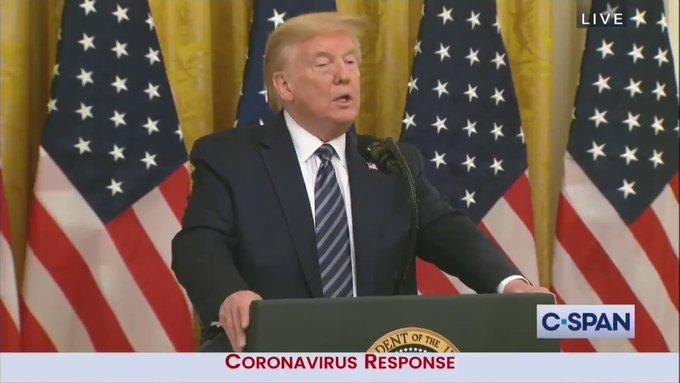
Trump today: "Our death totals, our numbers, per million people, are really very, very strong. We're very proud of the job we've done." Via CSPAN
4,499
5:10 PM - Apr 30, 2020
Twitter Ads info and privacy
6,276 people are talking about this
Trump’s strange boast about the “very, very strong” death toll puzzled many viewers, but it helps to know that, for weeks, the president and his senior medical adviser, Dr. Deborah Birx, have been urging Americans to consider that, on a per capita basis, the U.S. mortality rate is lower than that of several of the worst-hit countries in Western Europe.
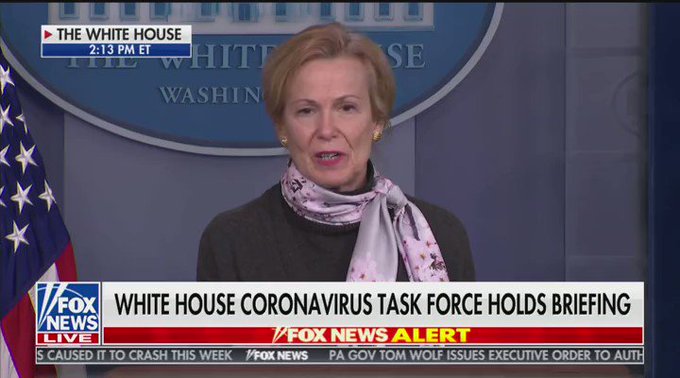
On April 10, for instance, Trump asserted that “we’ve kept our fatality rate very, very low compared to other countries.” Later in the same briefing, Birx said that he was right. “As the President noted, our mortality in the United States is significantly less than many of the other countries when you correct them for our population.”

Daily Caller
✔@DailyCaller
Dr. Birx says that the covid19 mortality rate in the United States is "significantly less" than that of other countries when adjusted for population
747
1:20 PM - Apr 10, 2020
Twitter Ads info and privacy
379 people are talking about this
“The United States has achieved a significant lower mortality rate than almost all other countries,” Trump said at another briefing six days later.
“While we mourn the tragic loss of life — and you can’t mourn it any stronger than we’re mourning it,” Trump said at the start of a briefing on April 18, “the United States has produced dramatically better health outcomes than any other country, with the possible exception of Germany — and I think we’re as good or better.”
Birx then presented a bar chart comparing the death toll in the U.S., expressed as a share of population, to the far higher rates of death in six European nations: Belgium, Spain, Italy, France, the United Kingdom and the Netherlands. After she did so, Trump interrupted her presentation to point to the far lower reported mortality rate of another country on the chart, China, and suggested that the authorities there must have lied about their death toll to produce that statistic.
But that chart also included evidence that it is profoundly misleading to cast the U.S. response as a success by comparing it to just those six countries. That’s because the data also showed that Germany, whose success Trump had downplayed, had a far lower mortality rate than the U.S.

A screenshot of a chart presented by Dr. Deborah Birx at a White House coronavirus task force briefing on April 18.
Photo: CSPAN, via YouTube
As the data presented by Birx showed, as of mid-April, Americans were more than twice as likely as Germans to have died from Covid-19. While the U.S. had recorded 11.24 deaths per 100,000 people then, Germany, which had a high rate of infection, had kept deaths down to 5.25 per 100,000.
Today, Americans are faring even worse in comparison to Germans. According to updated mortality rates compiled on May 2 by Johns Hopkins researchers for the 10 countries with the most confirmed cases of Covid-19, the U.S. now has 20.29 deaths per 100,000, compared to 8.21 in Germany.

A chart posted online by researchers at Johns Hopkins showed mortality rates as of May 2 for the 10 countries most affected by Covid-19.
Photo: Johns Hopkins Corona Resource Center
Expressed in Trump’s preferred metric of deaths per million, for every 203 Americans lost to Covid-19 so far, just 82 Germans have perished. What this means is that if the federal government in Washington had been as successful at keeping its citizens alive as the one in Berlin, the death toll in the U.S. would not be, as it is today, more than 66,000, but less than 27,000.
In other words, Trump and Birx have been engaged in a kind of statistical sleight-of-hand, one that seems designed to distract attention from the fact that tens of thousands of Americans would still be alive today had their government managed the crisis as well as the German one.
At no point in the April 18 briefing did either Trump or Birx explain why Americans should be satisfied with being less likely to die of Covid-19 than citizens of Britain or France, but in so much more danger than Germans.
There are also other ways in which it is misleading to compare deaths in the U.S. so far to those of the six European nations with the worst mortality rates. To start with, by focusing just on other hard-hit countries, Trump distracts attention from the fact that there are dozens of other countries, in Europe and other parts of the world, that have far lower mortality rates than the U.S. — like Greece, Austria, Denmark, Portugal, Canada and Japan.
Most notably, South Korea, which was so successful at suppressing the outbreak through early action and widespread testing that it has recorded just 250 deaths — a mortality rate of 0.48 per 100,000 — was also not included in the ranking presented by Birx. If the U.S. had matched South Korea, just over 1,500 Americans would have died to date.
Despite this, Trump has continued to incorrectly refer to that chart from the April 18 briefing as proof that the United States is “right at the top” of world rankings. Speaking to the press on Thursday during an Oval Office meeting with New Jersey’s governor, Phil Murphy, Trump asked Birx to get out the chart, falsely claiming that it showed “we’re the leader of the world, we’re really the leader, in this case, the leader of the world. And we’ve done better, if you look at our deaths, if you look at mortality rates…. I’m going to get a chart, because it’s maybe the most impressive thing — right? — how we’ve done.”
Then there is the fact that all six of the most affected European countries are much more densely populated than the U.S., and population density appears to make it harder to stop the spread of the virus.
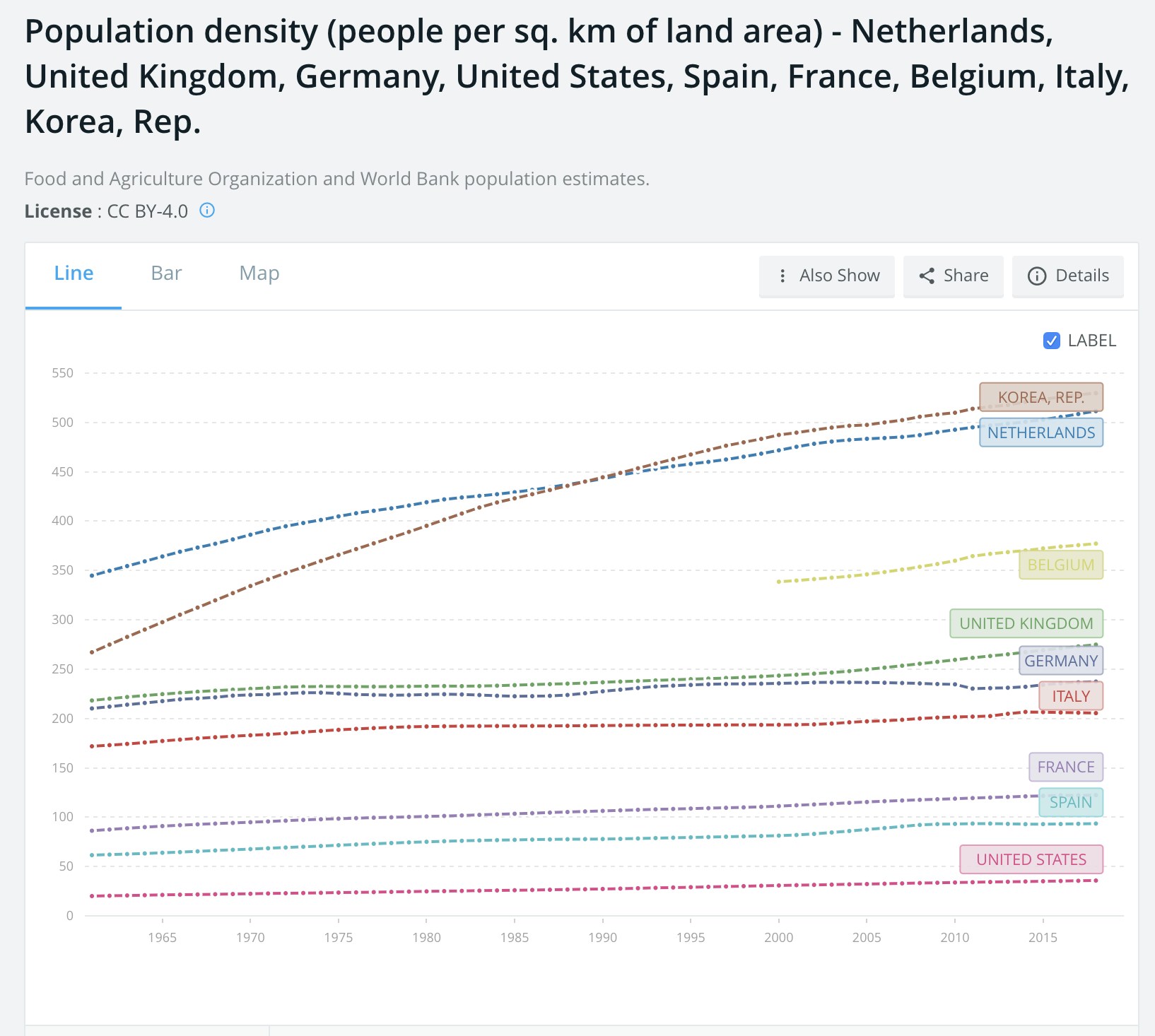
A screenshot of a chart from the World Bank, showing the relative population density of several countries.
Photo: World Bank
That Germany and South Korea are also densely populated indicates that there are other factors at play, but the first wave of outbreaks in Europe and the U.S. have been most intense in major cities and their surrounding metropolitan areas.
Even the least densely populated of the six European nations that have been hit the hardest by the outbreak, Spain, is more densely settled than it might seem. Alasdair Rae, a professor of urban studies and planning at the University of Sheffield, noted in 2018 that Spain’s population density of 93 people per square kilometer is misleading, since only about 13 percent of the country’s territory is actually lived in. Barcelona, along with Madrid, has been one of the two Spanish cities most affected by the pandemic. As Rae pointed out, “more than 53,000 people inhabit a single square kilometer area in Barcelona,” making it the most densely populated square kilometer in Europe.
As a series of visualization of population density created this week by Rae shows, the worst affected areas of Europe — northern Italy, Belgium, the Netherlands, northern France and southern England — are among the continent’s most tightly packed regions.
The U.S. by contrast, has a much higher rural population than Western Europe. For that reason, it might be more appropriate to compare the mortality rates of those European nations to that of the seven badly hit northeastern American states that have formed an interstate compact to collaborate on the phased reopening of their economies.
Those states — New York, New Jersey, Connecticut, Massachusetts, Rhode Island, Pennsylvania and Delaware — have recorded 35,718 deaths out of a combined population of about 53.6 million. That mortality rate of 66.6 per 100,000 for the region exceeds the current figure for every European country except Belgium, which, unlike the U.S., includes in its count a large number of deaths in nursing homes that are suspected of being virus-related, but have not been confirmed by testing.
While Belgium’s coronavirus emergency task force has come under some political pressure for including so many suspected cases — nearly half the nation’s total deaths — health officials have refused to change their method, describing surveillance of the disease as more important than negative publicity.
One Belgian government minister, Denis Ducarme, noticed and was not happy about the chart of national mortality rates displayed by Birx and Trump last month to bolster their argument that the U.S. was doing relatively well in handling the pandemic. “Our method of counting is the most exhaustive possible,” Ducarme wrote on Twitter. “When @realDonaldTrump makes a macabre ranking, by pointing the finger at Belgium to give the impression that all is well in the U.S.A. I find it disgraceful, the basest of politics.”
SPEAKER PELOSI SUPPORTS PUSH FOR TAXPAYER BAILOUT OF CORPORATE LOBBYISTS
Lee Fang
https://theintercept.com/2020/05/05/lobbyists-trade-groups-bailout/
K STREET MAY soon have its own taxpayer-funded bailout.
Industries as varied as oil refining, construction, fast food restaurants, and chemical manufacturing are seeking federal cash to support their lobbyists in Washington, D.C.
Many of the largest lobbying forces are organized under the 501(c)(6) section of the tax code as trade groups. Corporations with similar concerns pool their money together to fund trade groups, which in turn employ thousands of lobbyists to shape elections and legislation on a daily basis. But the Paycheck Protection Program, the centerpiece of the small business rescue program, excluded such trade groups. That could change in the next round of stimulus legislation, which Congress is scheduled to debate later this month.
Lobbyists have stepped up a campaign to make sure professional influence peddlers are eligible for the PPP, or P3, funds. The push also includes a demand for an additional $25 billion for canceled events and other lost revenue from the coronavirus pandemic. Senior Democratic lawmakers, including House Speaker Nancy Pelosi, plan to accommodate the demand and change the eligibility standard so that small business bailout money can flow to business advocacy groups.
The American Society of Association Executives, which represents trade group leadership, explained in a letter to lawmakers that trade group lobbyists need federal funding to better advocate for their clients.
“These organizations are already relied upon to help coordinate federal resources to combat the coronavirus pandemic, and they require staff to fulfill this duty,” ASAE wrote. Trade groups, the ASAE letter notes, have faced declining revenue as corporations wind down dues payments and sponsorship fees in response to the economic downturn.
The letter was signed by many of the most influential Beltway lobby groups. The American Fuel & Petrochemical Manufacturers Association, one of the trade groups requesting the 501(c)(6) bailout, pays its top lobbyist, Chet Thompson, $1.8 million a year. The group represents the largest oil refiners in the country, including Exxon Mobil, Koch Industries, and Motiva Enterprises, the U.S. arm of Saudi Arabian oil company Aramco.
Other trade groups that joined the letter include the National Retail Federation, which represents firms such as Walmart and Macy’s; the National Restaurant Association, which represents McDonald’s and Darden Restaurants; and ACA International, the lobby group for debt collectors.
A similar joint letter on the 501(c)(6) issue to Wisconsin lawmakers, from the Wisconsin Manufacturers and Commerce, a branch of the U.S. Chamber of Commerce, pitched lobby groups as vital conduits of information. “During this difficult time, business trade associations are performing an essential role for our state’s businesses,” the Wisconsin lobbyists wrote.
The Wisconsin lobbyists argued that they should be eligible for the P3 funds because business trade groups “transmit information, answer questions, and ensure that our members have the tools they need to comply with the deluge of laws, orders and regulatory changes that are being introduced.”
The Wisconsin letter was signed by local organizations, such as the Wisconsin Dairy Alliance and the Wisconsin Restaurant Association. It was also signed by the American Chemistry Council, the national chemical industry behemoth that employs 64 registered lobbyists and spends lavishly on campaign-style television advertisements for favored lawmakers.
The P3 program, though touted as a small business program, has attracted headlines in recent weeks as large multinational firms, churches, and politically connected interests have won access to the loans, which may be converted to grants if recipients maintain payroll.
“There are some odd inconsistencies in who is eligible for loans under the Paycheck Protection Program,” said Craig Holman, a lobbying expert with the watchdog group Public Citizen.
“The program should be exclusively targeting small enterprises of fewer than 500 employees. As such, it is perfectly reasonable to exclude trade associations from eligibility. Small businesses that are members of these trade associations are already eligible for the loans, even though their lobbying associations 501(c)(6)s are not,” Holman noted.
But the campaign to provide 501(c)(6) lobby groups with bailout money has been sold as a way to save struggling business interests — an argument that appears to be winning over key lawmakers.
Rep. Stephanie Murphy, D-Fla., and Rep. Ami Bera, D-Calif., two leading moderate Democrats, have expressed support for the campaign. The two lawmakers participated in a conference call last month with industry executives and lobbyists, pledging to try to change the eligibility requirements.
“Right now, the way it is being implemented, it’s not necessarily helping everybody it was intended to,” said Murphy during the call, which was sponsored by ASAE.
“The 501(c)(6) issue is clearly an example of that,” added Murphy. “I just got off a call with my local Chamber, and they are doing everything they can to keep their doors open.”
Rep. Dina Titus, D-Nev., in a letter in support of the 501(c)(6) rule change, also argued that P3 money would help local Nevada Chambers of Commerce.
Lobby groups have poured resources into the campaign in recent weeks.
The Associated Builders and Contractors, which represents largely nonunion construction companies, has called on member companies to press lawmakers to support the change. Association of Chamber of Commerce Executives, a federation of state business lobbyists backed by Google, Facebook, Comcast, and other large business interests, has highlighted the push for federal aid.
The National Association of Concessionaires, which represents snack food companies such as Coca-Cola and Hersey, is another example. The group has waged war in recent years to defeat taxes on sugary foods, nutrition labeling requirements, and other rules viewed as onerous to business.
Now the group faces an existential threat not to sugary sweets, but from declining revenue that could risk the employment of its team of corporate advocates. The group recently held a call with Rep. Raja Krishnamoorthi, D-Ill., who expressed support for a change to the bailout program to allow money for 501(c)(6) groups such as the NAC.
Krishnamoorthi, according to an update published by NAC, urged the group to write to Congress as fast as possible. “There is no time to wait,” said Krishnamoorthi, as “time is of the essence.”
Pelosi, speaking during a webinar on Tuesday evening, discussed Democrats plans to push for a variety of reforms to the P3 program in the next round of emergency coronavirus legislation. Among the changes, Pelosi said, would be a shift to include 501(c)(6) trade groups. The shift, if adopted, represents a dramatic flow of government money to business lobbying groups.
Pelosi also signaled support for P3 money to 501(c)(4) issue advocacy organizations, which include groups such as the Sierra Club and the National Rifle Association. In her remarks, she did not include expanding the program for 501(c)(5) organizations, which represent labor unions, to be eligible for P3 rescue funds, a demand made by some Democratic lawmakers.
Pelosi Offers To SELL You Healthcare During Crisis. WTF?!?
How long do we have to put up with this dried up old mummy?
https://www.youtube.com/watch?v=De0Opy6PRNA&feature
Subscribe to:
Comments (Atom)