Wednesday, May 6, 2020

Layoffs and corporate bankruptcies spread as US workers face mounting hardship
https://www.wsws.org/en/articles/2020/05/05/jobs-m05.html
By Shannon Jones
5 May 2020
US clothing retailer J. Crew filed for bankruptcy and US Steel and GE Aviation announced major job cuts as the economic catastrophe engulfing US workers continued to grow amidst the coronavirus pandemic. Along with a general meltdown of brick and mortar retail, manufacturing, health care and public services face deep cuts.
Despite the push by the Trump administration to abandon social distancing standards and reopen wide sections of the US economy, the official US COVID-19 death toll is holding steady at about 2,000 daily. By the latest count, cumulative US deaths are near 70,000, with over 1.2 million confirmed infections.
A report by the Centers for Disease Control published in the New York Times Monday contradicted the rosy official reports by the White House suggesting that the virus is in decline. It predicted that the US daily death rate would reach 3,000 by June 1, with 200,000 new cases daily as the virus spreads into less urbanized areas that previously had been only lightly impacted. While the Trump administration has distanced itself from the report, the numbers were based on modeling solicited by the US Federal Emergency Management Agency.
The health crisis is being compounded by a continuing meltdown of the US economy, with 30 million having filed for unemployment benefits and unknown millions more either not eligible for jobless pay or unable to file due to overloaded state offices. This does not take into account the millions of small businesses facing ruin due to the drying up of customers.
On top of the millions impacted by temporary business closures, major corporations are announcing permanent job cuts in anticipation of a protracted recession.
US fashion retail chain J. Crew filed chapter 11 bankruptcy on May 4, the first national retail casualty of the pandemic. It has agreed to turn over effective control of the company to its creditors in exchange for the cancellation of $1.7 billion in debt. It said it had no plans at present to close stores, but its future, like that of many retail businesses, remains highly uncertain.
Other major retailers could follow. Neiman Marcus and J.C. Penney are reportedly struggling to raise cash and are likely considering following the examples of J. Crew.
Meanwhile, US Steel said in a filing Friday that it is preparing for the layoff of as many as 6,500 employees, although it expects the actual number affected to be about 2,700 of the 27,500 it currently employs. Even before the coronavirus pandemic hit, the company faced slowing demand as auto sales stagnated.
The company has now idled seven out of its 10 blast furnaces in the United States. These include three at the Gary Works site in Indiana, one at Granite City in Illinois, two at Great Lakes Steel in Michigan and one at the Mon Valley Works south of Pittsburgh.
On Monday, General Electric said it planned to cut the global workforce in its aviation division by 25 percent, impacting up to 13,000 jobs. The cuts come amidst a collapse in air travel and a likely sharp fall in orders for new planes from struggling airlines. The cuts will involve both voluntary and involuntary layoffs.
GE said the cuts were permanent, as it expected a prolonged depression in air travel. In a letter to employees, GE Aviation CEO David Joyce said, “To protect our business, we have responded with difficult cost-cutting actions over the last two months. Unfortunately, more is required as we scale the business to the realities of our commercial market.”
The spiraling economic crisis is forcing state and local governments to prepare for massive cuts as tax revenue dries up. According to an estimate by the National League of Cities, between 300,000 and one million public-sector workers could be furloughed or laid off, impacting areas such as education, sanitation, public safety and health. The city of Detroit has already reduced hours or furloughed 3,000 workers. The City of Los Angeles has presented a 2020-2021 budget calling for the temporary furlough of 15,000 employees.
Underscoring the irrationality of for-profit medicine, health care providers across the US have carried out massive layoffs, furloughs or pay cuts. Hospitals have seen revenue dry with the cancellation of nonessential procedures, while facing high costs for treating COVID-19 patients, including the inflated cost of supplies such as masks. Some hospitals are concerned that vendors are buying up available supplies to sell them at higher prices.
The onset of the pandemic has seen a wave of bankruptcies, as already struggling firms are pushed over the edge. Among the recent casualties are:
Art Van Furniture, a Warren, Michigan-based retail chain, filed for bankruptcy March 8 and closed all 176 of its retail locations, with the loss of about 3,700 jobs.
Miami, Florida-based CMX Cinemas, a movie theater chain that also runs dine-in restaurants and bars, filed for bankruptcy April 25. All 41 of its theaters located in 12 states had been closed during the pandemic.
The slump in oil prices and demand forced Diamond Offshore Drilling to file for bankruptcy April 27. The Houston, Texas-based company employs 2,500 people and had revenue of $981 million last year.
Another petroleum company impacted by the oil glut, Denver-based shale oil producer Whiting Petroleum, filed for bankruptcy on April 1, though it said it would continue to operate its business. One analyst predicted that it was only “the first domino to fall” in the US energy sector amidst the collapse in oil prices. The US shale oil sector has the highest production costs in the world and needs a $50-$55-a-barrel world price to operate in the black.
Frontier Communications FTR, one of America’s largest telecom companies, filed on April 14. FTR is facing $10 billion in outstanding debt. Private equity firm BlackRock is the company’s largest stockholder, with a 9 percent investment. Vanguard Group and Charles Schwab each hold about 6 percent. Frontier is the fourth largest telecommunications provider, but was loaded up with debt following the acquisition of Verizon wireline services in several states, including Texas, California and Florida.
Modell’s Sporting Goods, based in New York, filed for Chapter 11 on March 11 and said it would close all 153 stores in the northeast. It had been in business since 1889.
Auto parts maker Spectra Premium filed for bankruptcy in Canada on March 10, with a simultaneous filing in the US. The company said that its operations had been hurt by US tariffs against China.
SpeedCast International, a satellite internet company that provides internet service to the cruise industry when ships are out at sea, filed for bankruptcy on April 23. The company serves 80 percent of cruise brands globally.
National fitness chain Golds Gym filed for bankruptcy Monday. It will close 30 gyms, but continue operations at its 700 other locations, including about 63 that are company-owned and operated.
An analysis by Gusto, a support platform for small business, found that young people and low-wage workers are being hardest hit by the economic meltdown. Those earning less than $20 per hour were 115 percent more likely to be laid off than those making $30 an hour or more. In addition, those under age 25 experienced a 93 percent higher rate of job loss than those age 35 and above.
According to their data, “the vast majority of workers in food and beverage, accommodations and salon and spa are paid hourly,” and more than 75 percent earn less than $15 an hour. These industries being hardest hit by state lockdowns.
The so-called stimulus measures by the US government, far from addressing the crisis, have been targeted to line the pockets of the super-rich, not to alleviate social distress. Tens of millions have not received even the meager $1,200 one-time “stimulus” check, and millions more are still waiting for unemployment benefits, assuming they can get through to overwhelmed state offices.
This is not merely the result of bureaucratic incompetence, but part of a policy. The ruling class is using the growing economic distress as a weapon to force workers back in the factories to crank out profit for the corporations, even as the pandemic continues and the death toll mounts.
Workers must oppose the antisocial, homicidal policy of the corporate elite with its own strategy, based on the unification of workers globally in the fight for socialism. The resources to fight the pandemic must be mobilized by seizing the vast fortunes of the billionaires to provide economic relief to workers and small businesses and the implementation of mass testing and other measures needed to stem the pandemic.
The author also recommends:
Trump White House steps up return to work drive
[4 May 2020]
Millions of US workers blocked from applying for jobless benefits
[29 April 2020]
As US unemployment reaches Great Depression levels, millions still unable to obtain assistance
[1 May 2020]
Global automakers press ahead with reopening in midst of coronavirus pandemic
https://www.wsws.org/en/articles/2020/05/05/auto-m05.html
By Marcus Day
5 May 2020
The global automakers are moving ahead this week with either restarting production or finalizing plans to reopen operations, even as the coronavirus pandemic continues to spread. At the same time, the blatant disregard for workers’ health and safety by capitalist governments, the corporations and their accomplices in the trade unions is generating widespread resistance to the back-to-work drive.
The auto giants have already begun to bring production in Europe back up. Last week, Fiat Chrysler (FCA) restarted its van plant in Atessa in Italy, the country hardest-hit by COVID-19 in Europe, even before the official lockdown was lifted. The company is starting up other Italian plants this week.
In addition, luxury automakers Ferrari in Italy and Rolls-Royce and Aston Martin in the UK are all resuming operations this week.
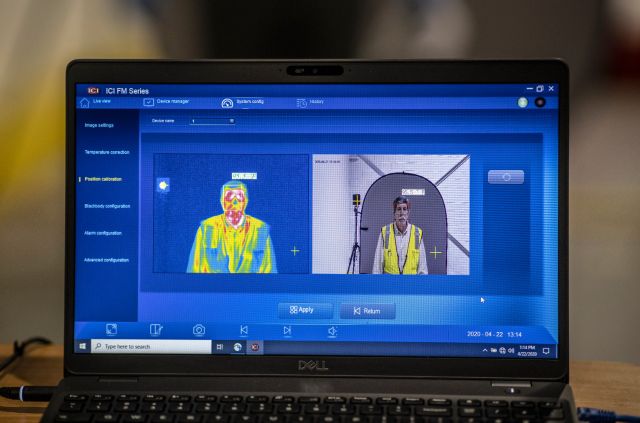 Ford Motor Company demonstrates a temperature scan to be used to screen workers. Credit: Ford
In North America, the Detroit Three auto companies are now targeting a restart date of May 18, less than two weeks away, despite the center of the auto industry, Michigan, continuing to be hammered by the pandemic. FCA has already begun erecting medical tents outside its Windsor and Brampton assembly plants in Ontario, Canada, along with some plants in the Detroit area. FCA, Ford and General Motors in recent weeks have solicited workers to return and beginning prepping factories to reopen in the US.
However, other automakers such as Hyundai, Kia, BMW, and Daimler have already restarted their factories in the US South, reopening plants in Montgomery, Alabama; West Point, Georgia; Spartanburg, South Carolina; and Vance, Alabama, respectively. Honda, Toyota, and Subaru are reported to be planning US production restarts next Monday, May 11.
The automakers confront virtually unprecedented challenges in restarting and coordinating vast supply chains across North America. Much of US assembly relies on parts produced in Mexico, where COVID-19 cases continue to rapidly climb. Like their brothers and sisters in the US, workers in Mexico confronting a lack of protective equipment and safety measures have rebelled in a series of walkouts at maquiladora sweatshops just across the border in recent weeks.
However, the government of Mexican President Andrés Manuel López Obrador (AMLO) is collaborating closely with the US manufacturing industry and the Trump administration in order to ensure that there is no disruption of supplies and parts to US corporations, regardless of the death toll. The president of Katcon, a global auto supplier, told the Detroit Free Press, “The feeling in Mexico, based on the statements from the government and the president of Mexico himself, have been very clear and sensible, balancing health and economic concerns as best as possible.” AMLO, the company executive added, “has said if the US and Canada are going to reopen, we will allow the automotive industry to reopen. Dialogue in Mexico is very positive and encouraging.”
On the part of the Detroit Three, press releases and public statements by company executives and union officials have ritualistically repeated talking points on the careful preparation of “safety protocols,” and concern for workers’ health being the “highest priority.” The facts, though, speak otherwise. It was not until workers launched a wave of wildcat strikes in March across Ontario, Michigan, Indiana and Ohio that the companies were forced to idle production. Even so, the belated shutdown of plants still allowed the virus to spread unhampered for weeks, resulting in at least two dozen workers succumbing to COVID-19 at the Detroit Three companies to date, and many more seriously sickened by it.
The Detroit News reported Monday that four workers from FCA’s Warren Truck plant had died, including 65-year-old Catherine Bright Pace, who worked in the paint shop where workers conducted a job action over the spread of the virus on March 16.
Both the companies and the United Auto Workers union are touting measures such as temperature checks as supposedly ensuring the conditions will be safe for workers to return. However, scientific reviews of the pandemic continue to provide evidence that large percentages of those who are contagious show no signs of fever or other symptoms, with a study in Iceland finding 50 percent of cases were asymptomatic.
Asked whether workers at GM Wentzville’s Assembly plant near St. Louis felt it was safe to return to work, a veteran worker told the WSWS, “No! Everyone I speak to are not with it at all. A lot of folks are saying if they start back up so soon, they are immediately going on sick leave.”
“My plant thinks that a mask and cleaning will keep us safe,” an auto parts worker at Metalsa in Kentucky said. “I have preexisting conditions myself, which are linked to a higher level of death, so I am completely terrified. The UAW will not help, the local union president has never done anything but help himself.”
Workers also continue to take to social media to voice their opposition. Posts on the UAW’s official Facebook page typically attract dozens to hundreds of angry comments, with workers denouncing the indifference of the union to their health and safety.
In response to UAW President Rory Gamble’s letter on April 30 lauding talks with Ford on restart plans, one worker wrote, “Wanna know how we can avoid any infections? Stay shut down. Not even a question, we see the money influencing these decisions.” Another commented, “You can’t even keep the bathrooms clean.”
While it continues to slavishly repeat company PR about safety protocols, the UAW has at the same time begun ominously warning workers about the necessity of “self-reporting” symptoms, seeking to shift responsibility for any future outbreaks from the companies onto workers. Last week, UAW-Ford Vice President Gerald Kariem said, “We also recognize that we all have a role in self-reporting any exposure without repercussions and in following through on implementing these protections.”
The auto companies and broader sections of corporate America are angling to secure the same liability protections granted by the Trump administration to the meatpacking industry, in the hopes of dodging lawsuits for knowingly subjecting workers to hazardous working conditions.
Industry lobbying groups such as the Alliance for Automotive Innovation, the Motor & Equipment Manufacturers Association and the National Association of Manufacturers published a letter to Congress Sunday, writing, “Companies doing their best to control the spread of this disease with the limited guidance available deserve legal protection.”
Attempting to cloak their clutch for their pocketbook with the cover of preventing shortages in goods and services, the letter continued, “Temporarily suspending suits that threaten to shut down vital industries … is a sensible step to ensure every American has access to basic life essentials without creating new shortages and exacerbating the crisis.”
Even as the auto giants are rushing to reopen production and renew the flow of profits, company executives and industry analysts have increasingly signaled their intentions to respond to the collapse in sales with ruthless cost-cutting measures.
On a recent conference call with investors, Ford CEO Jim Hackett said, “One truth, right? Don’t waste a crisis.” Hackett’s remarks reprise the comment made by Obama administration Chief of Staff Rahm Emanuel in 2008: “You never want a serious crisis to go to waste.” What Emanuel had in mind was to be made clear within a few months, as the Obama administration forced General Motors and Chrysler into bankruptcy, working with the auto companies and the UAW to close down a swath of plants, lay off thousands, and slash pay and benefits for new hires.
And in a recent Automotive News Daily Drive podcast, Morgan Stanley analyst Adam Jonas outlined the drastic extent of layoffs and other cost cuts expected by Wall Street if there is not a rapid return to business as usual. He noted that if auto sales remain at the recent level of 11 million a month, the automakers “run the risk of being a zombie industry.” In such a scenario, “most companies to remain viable would have to permanently reduce their headcount and/or fixed cost bases by 30 percent or more [emphasis added].” This would entail tens of thousands of job cuts, in the midst of the worst economic crisis since the Great Depression of the 1930s.
The drive to restructure the auto industry at workers’ expense is already generating opposition.
On Monday, workers at Nissan’s Barcelona plant in Spain began an indefinite strike, the same day the company sought to restart production at the facility. Nissan has thus far refused to release longer-term plans for the future of the plant, raising concerns that it may eventually seek to shutter it.
Autoworkers must reject the false dilemma presented to them of either joblessness and destitution or sickness and death. In every country, workers confront the need to form new organizations, rank-and-file factory and safety committees, in order to protect themselves from the pandemic and ensure that their rights are secured.
In opposition to the demands of the companies and their union partners for profits over workers’ lives, rank-and-file committees must demand the extension of the shutdown of all nonessential production, full compensation and income protection for the unemployed and furloughed, and a massive expansion of testing and medical care. To achieve these demands, the multitrillion-dollar government bailout of Wall Street and the major corporations must be reversed, and the auto industry placed under workers’ democratic control.
Under US pressure, Mexican government vows to impose return to work and “herd immunity” policy
https://www.wsws.org/en/articles/2020/05/05/mexi-m05.html
By Andrea Lobo
5 May 2020
Hundreds of maquiladora sweatshop plants across Mexico have remained opened as the spread of the COVID-19 pandemic continues to accelerate. This includes 68 percent of those factories in Tijuana, across the border from the US state of California, according to the local government.
The manufacturing plants concentrated along the US-Mexico border have become COVID-19 outbreak epicenters, with dozens of workers dying in overwhelmed hospitals. The closings that did occur were largely due to the wave of wildcat strikes that swept across the border cities Matamoros, Reynosa, Ciudad Juarez, Tijuana and Mexicali last month. However, these plants—which are critical for the reopening of the North American auto industry, along with US defense production—have been gradually reopening over the past two weeks or have sent notices to workers to prepare to return to work soon.
As in Mexicali last Friday, where the right-wing Workers’ Congress (CT) organized a protest outside the municipality building against the premature return to work, workers must be wary of maneuvers by the establishment and so-called “independent” trade unions and associated activists. Their aim is not to defend workers’ lives but to regain their confidence in order to soften the resistance and corral them back to the plants at the first available opportunity, regardless of the risks.
As of this writing, there are 23,471 cases in Mexico and 2,154 deaths, according to the World Health Organization’s tally. While refusing to close non-essential workplaces, provide protection to medical workers or implement mass testing and other emergency measures, President Andrés Manuel López Obrador (AMLO) spent February and March kissing supporters at rallies, claiming that Mexicans should go out, trust their stronger genes, and carry religious icons and a one-dollar bill in the wallet—a lucky amulet across Latin America—as “guardians.”
With the deadly virus spreading and a wave of strikes hitting the maquiladora plants, AMLO finally declared a “health emergency” on March 30, ordering the shutdown of nonessential production and the payment of full salaries.
Even though it did not have the slightest intention of enforcing these measures, the government sought to deflect popular anger by issuing statements about protecting workers’ lives. On April 16, Finance Minister Arturo Herrera wrote in a letter to the IMF, “Notwithstanding the current uncertainty, it is of utmost importance to send a strong message that there is no trade-off between health and the economy. The global economic crisis cannot be solved until the health emergency is effectively addressed.”
That same evening, however, the Trump administration published its plan “Opening Up America Again,” and the US president called AMLO shortly afterwards to pressure him to reopen plants in Mexico.
On April 23, AMLO declared in his daily press briefing: “We’ve committed, above all to our national business owners, to analyze the opening [in the US] to little-by-little start going back to normal productivity at the border. But this has not been decided yet because the coronavirus is unfortunately affecting them very much…” He later announced that the reopening would begin on May 17.
On April 27, Herrera switched his rhetoric about prioritizing health, and said to El Pais that the government would “find the mechanism” to open suppliers to US corporations even sooner. He explained, “What epidemiologists expect is that once we move to the next phase, we’ll start getting a herd immunity with such a high percentage of the population who got it, even though many don’t. What kills the pandemic is not avoiding infections but having had enough infections at such a high amount that there is no way to transmit it since others already got it.”
This is a homicidal policy that will result, if it is carried out, in hundreds of thousands of deaths.
On Monday, the Detroit Free Press published an article titled, “US auto industry preps for restart—and it all depends on Mexico.” It noted, “With about 40% of imported auto parts coming from south of the border, and parts made in the United States that are exported to Mexico for vehicle production there, the interdependency between the two countries cannot be overstated.”
The AMLO government and US- and other foreign-based corporations hope to use economic desperation to force workers back to work.
The UK anti-hunger organization Oxfam estimated that, without government aid, 3 million businesses could be affected, leaving 28 million workers—or nearly half of Mexico’s labor force—without a job or enough income to survive. Oxfam reports that providing informal workers a minimum income for a year would cost about $24 billion, less than a quarter of the $108 billion controlled by the six richest Mexican billionaires.
AMLO has refused to provide any aid to those losing their jobs and income in the informal sector. At the same time, he has claimed he would not give handouts to banks and corporations. However, while AMLO proclaims that his priority is not raising debt, Herrera has announced “the largest issuance of bonds in Mexico’s history,” approximately $6 billion, and the government is pledging to the international markets that it will pay back the debt and interest in full.
At the same time, pressure is mounting to shut down the opposition of Mexican workers. Francisco Santini Ramos, the president of the Business Coordinating Council, the main employer organization, said corporations were being “stigmatized nationally and internationally by the protests of workers at nonessential plants and the deaths of co-workers, which could undermine the attraction of foreign investment.” Specifically referring to two Lear auto parts plants in Ciudad Juárez where at least 16 workers died of COVID-19, he said the company was not at fault and pointed to the health care system.
The daughter of a worker at the plant who recently succumbed to COVID-19 after a long fight against the disease, explained to the WSWS that the Michigan-based corporation forced workers with COVID-19 symptoms to continue working throughout the second half of March. Her father, and many workers on social media noted that the plant would have kept operating if didn’t run out of space in its warehouses due to the shutdown of Lear factories in the US. “They didn’t close the plants even when Lear closed in the US. It’s irresponsible that they kept it open and exposed their employees,” Mónica Rosales told the WSWS.
Regarding the underfunded health care system, the Mexican government has prioritized tax and property incentives for foreign capital, as well as a military buildup to prepare to defend their property and crack down on social opposition.
One of AMLO’s first policy initiatives was to create the largest free economic zone along the US-Mexico border by slashing taxes for corporations. This led to an estimated budget shortfall for the first year of US $4.23 billion. AMLO also cut federal health care personnel by 30 percent and the budget of the Epidemiology Department by nearly 10 percent in his 2020 budget.
The supposed opposition by AMLO and his Morena party to the pro-business policies of the previous governments, especially after the 2012 Pact for Mexico that centered on the privatization of oil and social cuts, increased their popularity.
The Mexican ruling class and US imperialism prevented AMLO from coming to power through electoral fraud in 2006 and 2012 in order to smother rising social expectations. In 2018, however, he was allowed to win the presidency in order to contain simmering social opposition fueled by the killing of 43 teacher students in 2014 and the murderous repression of Gasolinazo protesters in 2017.
The Stockholm International Peace Research Institute (SIPRI) reported yesterday that AMLO raised the military budget 7.9 percent in his first year to $6.5 billion. During the last decade, military spending has increased 47 percent, ostensibly to combat violent drug cartels, but homicides continue to reach higher levels. The US government has also continued to provide billions in military aid and training through the Mérida Initiative.
The main official drug enforcement official who coordinated with US agencies between 2001 and 2012 was Genaro García Luna, who has been indicted in New York for receiving millions of dollars from the Sinaloa Cartel starting as early as 2005.
On Saturday, the US ambassador at the time Roberta Jacobson, who worked closely with García Luna in the development of the Mérida Initiative, said that the former Mexican President Felipe Calderón and US governments knew of García Luna’s ties. Several of García Luna’s closest collaborators remain in top posts under the Morena federal and Mexico City governments.
The Morena government created a new National Guard, which is run by the same corrupt military command, and enshrined the military’s domestic deployment in the Constitution. After its first assignments to crack down on Central American immigrants at the behest of the fascistic Trump administration, the National Guard has been sent to harass striking auto parts workers in Matamoros and to dismantle the blockade of a railway by teachers in Puebla. A National Guard internal memorandum on the COVID-19 crisis notes that it is preparing to move against “social unrest.”
With the pandemic crisis further eroding AMLO’s popularity, the ruling class is preparing for a new stage in the class struggle involving widespread state repression. AMLO’s approval rating, according to the polling firm Mitofsky, fell to the lowest point of his administration at 48.8 percent, compared to 67.1 percent in February 2019. The return-to-work campaign, as is the case internationally, is a particularly explosive issue—with the Ipsos MORI Global Advisor finding in a poll that 65 percent of Mexicans oppose a reopening until the pandemic is totally contained.
Despite the efforts by the trade unions and pseudo-left organizations in Mexico and internationally to boost illusions in AMLO, millions of workers, small-business owners and unemployed have seen past his phony “left” populism. Like the ruling class in the US and countries across the world, the entire political establishment in Mexico is demanding that workers risk their lives for the profits of the transnational corporations and Wall Street.
The only way to protect both the lives and livelihoods of workers is through a mass political mobilization of the working class, leading all oppressed layers behind it and independently of every pro-capitalist party and trade union. The private fortunes of the ruling elite need to be expropriated to end poverty and deprivation and the domestic and foreign-owned factories transformed into public utilities under the control of the working class, as part of the socialist transformation of the economy.
In opposition to the corrupt CTM unions, workers must build rank-and-file factory and workplace committees to unite with US and Canadian workers to demand the closure of all non-essential production and full income to all laid off workers. No production should be resumed until the pandemic is contained, universal testing and contact tracing put in place, and rank-and-file safety committees, working in conjunction with public health experts committed to the interests of workers, not the corporations, can guarantee safe working environments.
With lifting of restrictions, world must brace for a second wave of the COVID-19 pandemic
https://www.wsws.org/en/articles/2020/05/05/viru-m05.html
By Benjamin Mateus
5 May 2020
The rate of COVID-19 infections in the United States continues to remain relatively flat, with approximately 25,000 to 30,000 cases per day. The number of daily fatalities has also remained steady at around 2,000 per day. These coronavirus cases continue to take a considerable toll on the health infrastructure.
As the Eastern Seaboard is seeing declining cases from the lockdown and restrictions placed into effect more than six weeks ago, the pandemic is moving westward into states like Indiana, Illinois, Wisconsin and Minnesota, where the number of daily cases continues to climb just as these states are moving to lift some restrictions. Canada, with over 60,000 cases and over 1,000 deaths, has seen the number of new cases triple over the last three weeks.
Additionally, rural communities in the US, which were initially spared, are facing the ravages of the pandemic. According to the New York Times, “As food processing facilities and prisons have emerged as some of the country’s largest case clusters, the counties that include Logansport, Indiana, South Sioux City, Nebraska, and Marion, Ohio, have surpassed New York City in cases per capita.”
Spain and Italy have made substantial efforts to decrease their daily cases, which are down by 60 percent from their peak, which occurred nearly six weeks ago. The daily cases of fatalities for these two countries have also seen a similar reduction. The United Kingdom has only managed to halt the acceleration of infections, with a current rate of about 5,000 cases per day. Daily fatalities in the UK are slowly turning downward. France and Germany have suppressed new cases and deaths by 80 percent. Portugal, Greece and Turkey have seen similar declines.
Just as in the US, there are indications that the virus is moving out of the European continent into Russia, where there are over 145,000 cases including 10,581 new cases in the last 24 hours. India, too, is seeing an acceleration of cases after a brutal five-week lockdown that caused tremendous hardship for the poorest. Despite this rise, on Monday India moved to relax restrictions, a tentative return to normal with the caveats of “social distancing and stringent hygiene standards” that will be impossible to implement.
Mexico City hospitals are expecting to see the surge peak in mid-May with an estimate of 1,800 patients in intensive care units (ICUs). In Lima, Peru, a city of 10 million people, where more than two million lack access to water and sewage services, the city is the epicenter for COVID-19, with nearly 30,000 of the 47,372 cases in the country. The metropolitan city of Chile, Santiago, has seen over 10,000 cases, accounting for 60 percent of the country’s cases.
Brazil, now with over 100,000 total cases, has seen a spike in daily cases of more than 6,000 per day. Daily reported deaths have surpassed 400 per day, a gross underestimation of the real figure. The number of fatalities in Manaus, a city near the country’s rainforest, has forced cemeteries to bury five coffins at a time in collective graves. The city has run out of ICUs for patients. The cities of Rio de Janeiro and Sao Paulo are facing similar catastrophes despite the fascistic President Jair Bolsonaro’s proclamation that the virus is just a “little cold.”
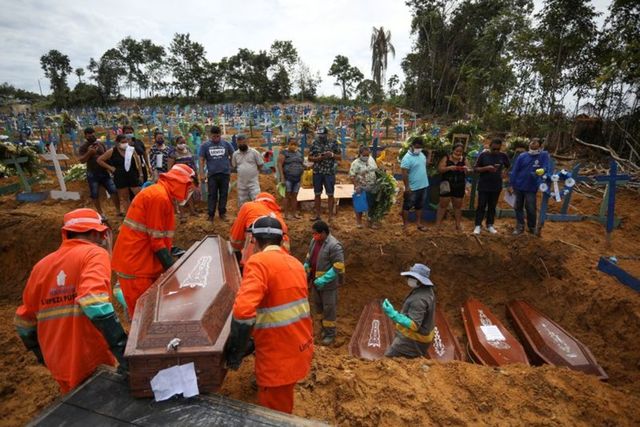 A mass grave in Manaus, Brazil
According to every epidemiologist, too little is known about the nature of this virus to predict its behavior. But the mitigation efforts have made a difference. The African continent, with few resources and underfunded health infrastructure, but years of experience with malaria, HIV, Tuberculosis and Ebola, was much quicker to implement containment measures employing the basic ABC’s of public health measures. With 47,554 total cases and 1,838 total deaths, it is the least impacted continent, though it remains still too early in the course of the pandemic.
Meanwhile, the New York Times reported that an internal White House memo projected that the daily death toll would climb back up to 3,000 by June 1 as states move to relax social distancing efforts and restrictions on businesses. Even the highly criticized University of Washington’s low estimates, often quoted by the White House Coronavirus Task Force, have been revised again to nearly 135,000 deaths in the US by the beginning of August.
On CBS News on Sunday, Dr. Scott Gottlieb, President Trump’s former Food and Drug Administration commissioner, said, “While mitigation didn’t fail, I think it’s fair to say that it didn’t work as well as we expected. We expected that we would start seeing more significant declines in new cases and deaths around the nation at this point. And we’re just not seeing that.” Such disingenuous statements are aimed at downplaying the effects of mitigation and boosting efforts to lift restrictions.
The tremendous discipline, effort and sacrifice made by the working class of many countries to stem and turn the course of the pandemic matter little to the financial markets and their political stooges, who are eager to see restrictions lifted sooner and workers sent back to work regardless of the destructive potential of a second wave. Yet, it is the working class that should be genuinely credited for any measure of success that brought the pandemic under a modicum of control.
At every turn—from failure to provide protective gear and testing kits, delays in imposing restrictions, lack of workplace safety, the collapse of essential public health infrastructure, fraudulent claims of therapeutics for COVID-19—the ruling class has thwarted any real effort to stem and curtail the pandemic. Now the markets are clamoring, “It’s been long enough!”
On Monday, Reuters announced that world leaders had pledged nearly $8 billion to research, manufacturing and equitable distribution of any possible vaccine and therapeutics for COVID-19. The joint venture between the World Health Organization and the European Investment Bank is a new initiative and a suspect one.
According to WHO Director-General Dr. Tedros Adhanom Ghebreyesus, “Combining the public health experience of the World Health Organization and the financial expertise of the European Investment Bank will contribute to a more effective response to COVID-19 and other pressing health challenges.”
This initiative is supposedly aimed at developing more effective malarial treatments and addressing the pressing concerns over growing antimicrobial resistance. Much is being made of the Trump administration abstaining from pledging any help to these efforts as the US aims to direct blame against the WHO and China to cover for their malignant negligence in face of the pandemic.
During a meeting at the end of April, European Union leaders agreed to build a trillion-euro emergency fund, a bailout, while also committing the EU to fast-tracking return-to-work policies. According to Commission President Ursula von der Leyen, the EU had so far already provided state aid worth €1.8 trillion to blunt the economic hit of the coronavirus. These measures are the European counterpart of the US government’s multitrillion-dollar bailout of the markets and big business.
Subscribe to:
Comments (Atom)